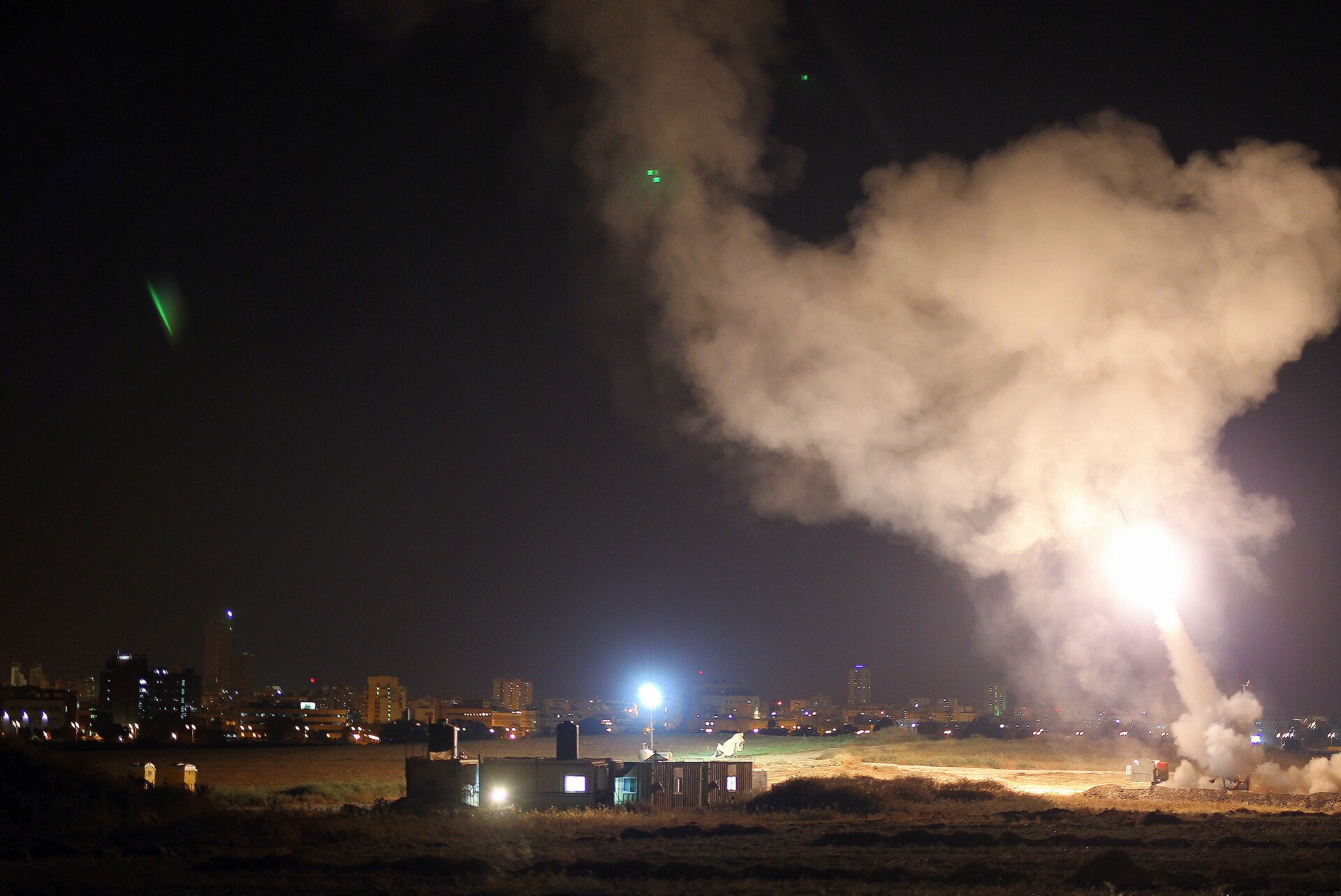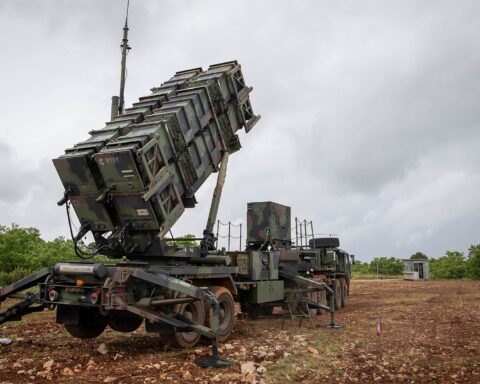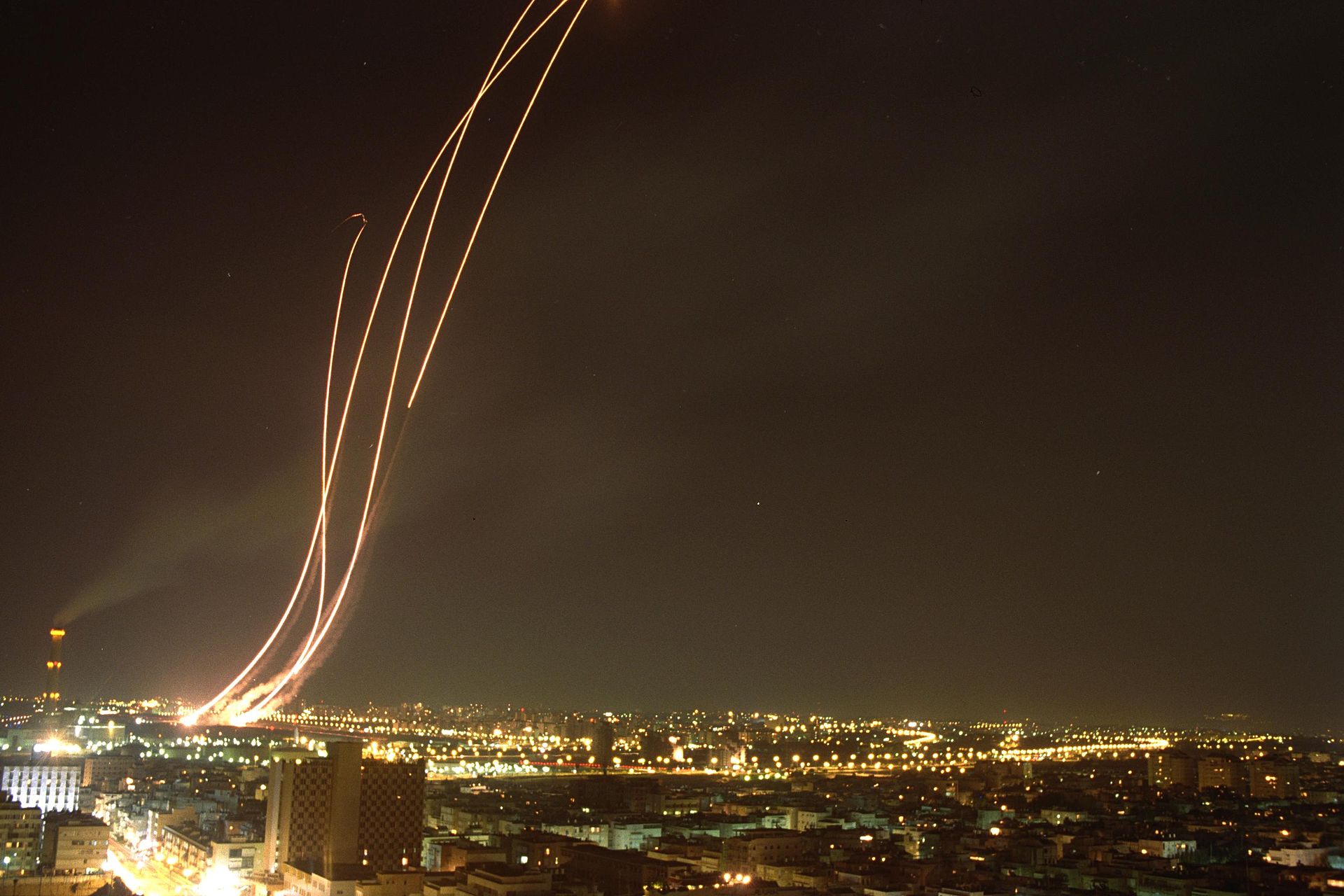

RIYADH — Saudi Arabia has spent more than $80 billion on air defense systems over the past decade, assembling one of the most expensive missile shields on earth. It has Patriot batteries, THAAD interceptors, and a layered radar network that stretches from the Empty Quarter to the Iraqi border. On March 12, those systems intercepted 18 drones in the Eastern Province, shot down missiles aimed at Prince Sultan Air Base, and destroyed a drone heading for Riyadh’s Diplomatic Quarter. But when the warheads that slip through the net reach the ground — as two did in Al-Kharj on March 8, killing an Indian national and a Bangladeshi worker — they land on a population of 35 million people who have no bomb shelters, no reinforced safe rooms, and no civil defense infrastructure remotely comparable to what exists in Israel, Switzerland, or South Korea.
The gap between Saudi Arabia’s military air defense and its civilian protection is the most dangerous asymmetry in the Kingdom’s war posture. Every dollar invested in Patriot interceptors protects oil refineries, military bases, and diplomatic compounds. Almost nothing protects the apartment blocks of Riyadh, the labour camps of the Eastern Province, or the densely packed residential neighborhoods of Jeddah. The Iran war has exposed a vulnerability that $80 billion in defense spending never addressed — and with 71 percent of Saudi Arabia’s population under the age of 35, most of the people living under Iranian missile fire have never experienced anything like this before.
Table of Contents
- What Is Saudi Arabia’s Civil Defense System?
- How Prepared Is Saudi Arabia for Civilian Mass Casualties?
- Why Did Saudi Arabia Never Build Bomb Shelters?
- Thirty-Five Million Under Fire With Three Siren Tones
- Where Do You Go When the Sirens Sound?
- How Does Saudi Arabia’s Civilian Protection Compare to Israel?
- The Civil Defense Readiness Matrix
- The Universal Shelter Standard Saudi Arabia Should Have Built
- The Drone Problem Civil Defense Was Never Designed to Solve
- The Contrarian Case for Saudi Arabia’s Air-Defense-First Strategy
- Can Saudi Arabia Build a Civil Defense System During a War?
- What Must Change Before the Next Barrage?
- Frequently Asked Questions
What Is Saudi Arabia’s Civil Defense System?
Saudi Arabia’s General Directorate of Civil Defense is a government agency operating under the Ministry of Interior that has existed for more than six decades. Reachable at the emergency number 998, it is responsible for the safety and protection of lives and property during peacetime, disasters, and wars. The directorate has acquired vehicles, equipment, and trained personnel for emergency response, and it operates a search-and-rescue team that holds international classification for disaster response.
On paper, the system sounds adequate. In practice, it was built for fires, floods, and industrial accidents — not for sustained missile and drone bombardment from a regional military power. The General Directorate’s mandate covers a population of 35.2 million people spread across 2.15 million square kilometres of territory, according to 2026 estimates from the General Authority for Statistics. Its resources were never scaled for the scenario now unfolding: daily waves of Iranian drones and ballistic missiles targeting population centres, oil infrastructure, and military installations simultaneously.
The directorate operates a National Early Warning Platform that uses Cell Broadcast Technology to deliver alerts directly to mobile phones connected to Saudi mobile networks. Three distinct siren tones exist in the system: an early warning tone — a fixed intermittent sound lasting one minute — signals that a threat has been detected but has not yet arrived; a wavy tone of one minute duration indicates that the danger is imminent or actively occurring; and a fixed continuous tone of one minute signals all-clear. The Civil Defense published guidelines instructing residents to “immediately enter the nearest building or take shelter behind a solid barrier” when they hear the warning siren.
The instruction to shelter behind “a solid barrier” reveals the core problem. In Israel, that means a purpose-built reinforced concrete room in every apartment. In Saudi Arabia, it means whatever wall happens to be closest.
The Middle East briefing 3,000+ readers start their day with.
One email. Every weekday morning. Free.
How Prepared Is Saudi Arabia for Civilian Mass Casualties?
Saudi Arabia’s hospitals have limited preparedness for the mass casualty events that a sustained missile campaign can produce. A study published in the journal Sustainability examining disaster preparedness across Eastern Province hospitals found that only 53.7 percent of hospitals — predominantly those governed by the Ministry of Health — had implemented comprehensive disaster recovery plans. Awareness of mass casualty protocols among hospital staff stood at just 56.1 percent, and only 49.9 percent were aware of their hospital’s incident command system, according to research published in the Saudi Medical Journal.
Riyadh, the primary target of Iranian ballistic missiles, has approximately 11 governmental hospitals and 13 major private hospitals with more than 100 beds each. The private hospitals surveyed reported having disaster preparedness committees, and 92.3 percent had plans covering both internal and external disasters. But only 69.2 percent had agreements with other hospitals to accept overflow patients during emergencies — meaning nearly a third of major private hospitals in the capital have no arrangement for patient transfers during a mass casualty event.
The Al-Kharj attack on March 8 was a small-scale test of this system. Two people died and 12 were injured when a projectile struck a residential compound housing maintenance workers in the central governorate. All casualties were foreign nationals — an Indian citizen and a Bangladeshi citizen were killed, and the 12 injured were Bangladeshi nationals. The Saudi Press Agency reported that the compound belonged to a maintenance and cleaning company. Emergency services responded, but the event was contained enough to avoid straining hospital capacity.
A ballistic missile warhead striking a populated residential district of Riyadh during evening hours would present an entirely different challenge. Iran’s Emad and Khorramshahr missiles carry warheads weighing 500 to 750 kilograms. The 1991 Scud attack on the Dhahran barracks — which killed 28 American soldiers and hospitalized 110 — used a warhead roughly half that size. Iran’s 2026 arsenal is dramatically more lethal than anything Saddam Hussein possessed, and the degradation of Saudi Arabia’s THAAD radar systems under sustained fire increases the probability that heavier warheads will reach their targets.
Why Did Saudi Arabia Never Build Bomb Shelters?
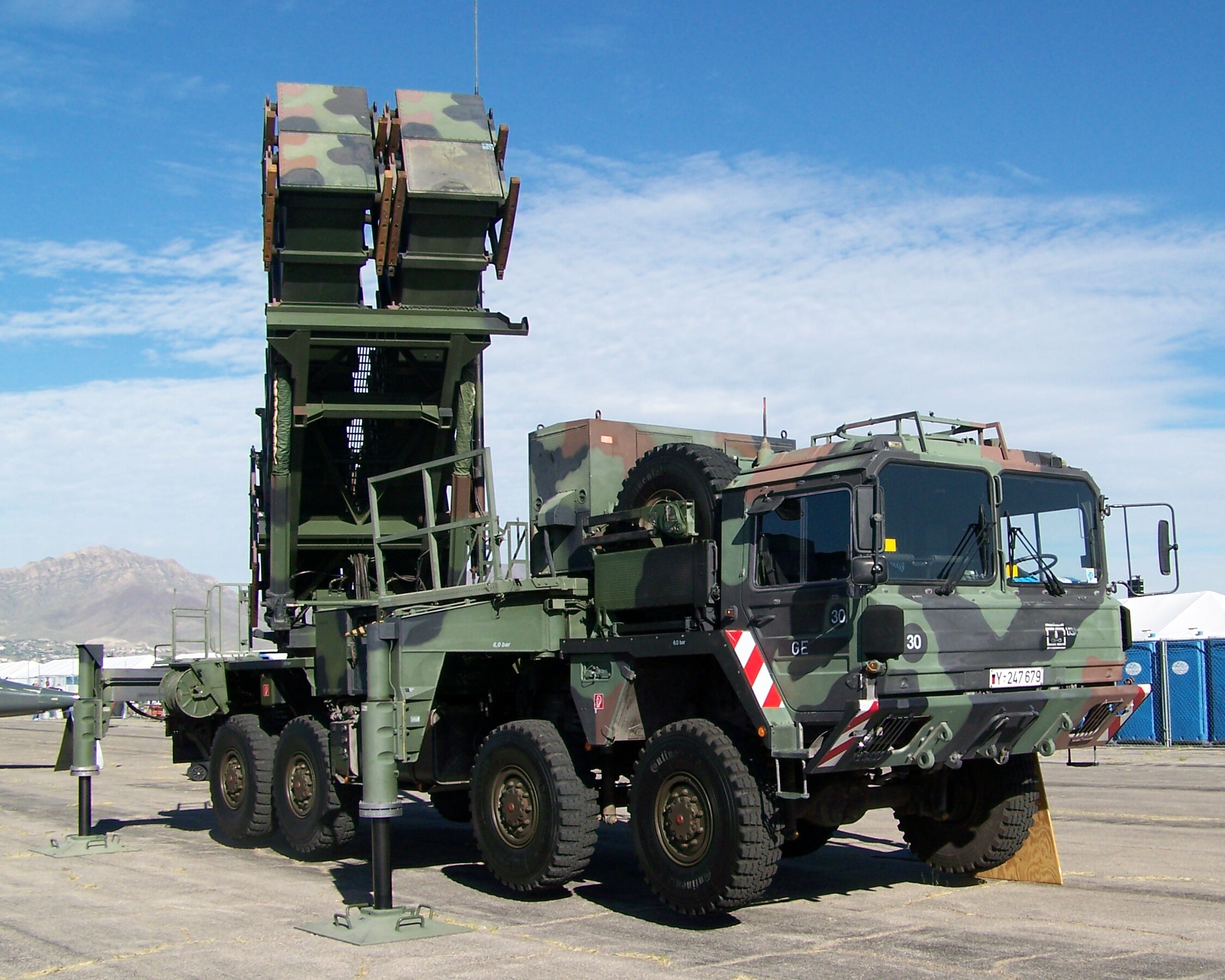
The answer lies in the 1991 Gulf War and the comfortable conclusions the Kingdom drew from it. During Operation Desert Storm, Iraq launched 46 al-Husayn Scud missiles at Saudi territory between January 18 and February 26, 1991. The civilian toll was remarkably low: one Saudi citizen killed in Riyadh on January 25, and 77 people injured, most of them lightly, according to Human Rights Watch documentation of the conflict. The deadliest single strike — the barracks hit in Dhahran that killed 28 American soldiers — targeted a military facility, not a civilian area.
Those numbers created a false sense of security that persisted for 35 years. The Scud missiles were inaccurate, their warheads were small by modern standards, and the Patriot batteries deployed by the United States — despite questions about their actual interception rate — were credited with reducing the threat. Saudi civilian life was barely disrupted. There were no air raid drills, no shelter construction programmes, and no sustained public discussion about what would happen if the next war brought more accurate missiles, larger warheads, and an adversary with a far deeper arsenal.
The decades between 1991 and 2026 reinforced this complacency. Saudi Arabia’s security threats shifted to terrorism — the Khobar Towers bombing in 1996, the Riyadh compound bombings in 2003, the sporadic Houthi missile and drone attacks from Yemen starting in 2015. Each of these threats was either contained by security services or intercepted by air defenses at a rate that seemed to validate the military-first approach. The Aramco Abqaiq attack in September 2019, which temporarily halved the Kingdom’s oil production, was an infrastructure strike with no civilian casualties. It prompted a massive expansion of air defense procurement but no parallel investment in civilian shelters.
The Saudi Building Code 2024 — made mandatory from June 30, 2025 — includes requirements for structural stability, fire safety, energy conservation, and water efficiency. It does not include any requirement for blast-resistant rooms, reinforced safe spaces, or underground shelters in residential construction. Three new codes added in the 2024 update covered seismic design for steel structures, rehabilitation of concrete structures, and fiberglass-reinforced polymer bars. None addressed the scenario of a ballistic missile warhead detonating in a residential district.
Thirty-Five Million Under Fire With Three Siren Tones
When a Euronews report on March 7 examined how air raid sirens and alerts were reshaping daily life across the Middle East, it documented a new reality for Gulf residents who had never before lived under sustained aerial bombardment. Saudi Arabia’s Cell Broadcast system — the National Early Warning Platform — represents the most modern component of the Kingdom’s civil defense apparatus. Unlike traditional sirens that require physical infrastructure and may not be heard indoors, cell broadcast pushes alerts directly to every mobile phone within range of a cell tower, regardless of whether the user has downloaded a specific application.
In a country where smartphone penetration exceeds 98 percent and mobile network coverage blankets virtually all populated areas, cell broadcast is a genuine asset. Saudi Arabia has among the highest social media penetration rates in the world, and its population is digitally literate. The technology works. But a warning is only useful if the person receiving it knows where to go and has somewhere safe to reach within the available time window.
The time problem is acute. Iranian Emad ballistic missiles travel at speeds exceeding Mach 10 — roughly 12,000 kilometres per hour. From launch sites in western Iran to Riyadh is approximately 1,200 kilometres, giving a flight time of roughly six to eight minutes depending on trajectory. Even with early detection by Saudi and American radar systems, the warning window for civilians is measured in minutes, not the 15 to 90 minutes that Cold War civil defense planning assumed for nuclear strikes. A cell broadcast alert that reaches a Riyadh resident’s phone four minutes before impact gives them time to move to an interior room. It does not give them time to reach a shelter that does not exist.
Drones present a different timing challenge. Iran’s Shahed-136 one-way attack drones fly at approximately 185 kilometres per hour, giving much longer warning windows — potentially an hour or more — but their flight paths are harder to predict, and they arrive in swarms rather than individually. Saudi Arabia’s Ministry of Defense reported intercepting 18 drones in the Eastern Province on March 12 alone, plus additional drones in the Empty Quarter targeting the Shaybah oil field. That same day, Saudi forces faced their most intense engagement over the capital when they intercepted 31 drones and three ballistic missiles targeting Riyadh’s Diplomatic Quarter — a barrage that demonstrated exactly the kind of saturation attack that no civil defense system in the Kingdom is equipped to handle. The sheer volume means that even high interception rates leave some drones getting through, and a single drone carrying a 40-kilogram warhead can kill everyone in an unprotected room.
Where Do You Go When the Sirens Sound?
The honest answer, for most Saudi residents, is nowhere with any meaningful protection. Saudi Arabia’s residential construction is overwhelmingly concrete-frame buildings with concrete block infill walls — a construction method that provides reasonable protection against blast overpressure at distance but disintegrates into lethal fragmentation at close range. There are no purpose-built reinforced rooms in Saudi apartments. There are no public shelters in Saudi cities. There are no subway systems that could serve as emergency shelters — Riyadh’s Metro, the largest urban rail project in the world at $23.5 billion, is an elevated and cut-and-cover system that does not provide the deep underground refuge that Kyiv’s Soviet-era metro offered Ukrainian civilians.
The General Directorate of Civil Defense’s published advice — to enter the nearest building and take shelter behind a solid barrier — is the only guidance available. For the 13 million foreign workers who make up more than a third of Saudi Arabia’s population, many of whom live in crowded labour camps with thin-walled prefabricated structures, even this limited protection may not exist. The Al-Kharj casualties were all foreign workers in exactly this type of housing.
Compare this to what happens in Israel when sirens sound. Every Israeli building constructed after 1992 has a Mamad — a reinforced concrete room with walls and ceilings 20 to 30 centimetres thick, designed to withstand blast and shrapnel from conventional weapons and provide protection against chemical and biological agents. Older buildings have communal shelters. The Home Front Command’s alert system, refined over decades of rocket attacks, uses shrinking geographic polygons to target warnings precisely — so only the specific neighborhoods in the projectile’s path receive the alert, reducing panic and allowing emergency services to pre-position.
In Ukraine, when Russia began sustained missile and drone attacks in 2022, Kyiv’s deep metro stations became the primary civilian shelter. In 2023 alone, 338,000 people used Kyiv metro stations as nighttime shelters during air raids, according to municipal statistics. Ukrainian civilians also adapted on their own: refurbishing basements as safe rooms, stocking them with tools and supplies, and developing neighbourhood-level warning systems. A law signed in August 2022 mandated the construction of a comprehensive network of civil protection structures.
Saudi Arabia has none of these options. No deep metro. No mandated safe rooms. No basement culture — most Saudi residential buildings sit on concrete slab foundations without below-grade space. The Kingdom’s civil defense doctrine was written for a world where the threat was localised terrorism, not area bombardment by a state adversary with hundreds of missiles and thousands of drones.
How Does Saudi Arabia’s Civilian Protection Compare to Israel?
Israel’s Home Front Command was created in February 1992 — a direct response to the lessons of the 1991 Gulf War that Saudi Arabia chose not to learn. The command is a military district within the Israel Defense Forces responsible for preparing the civilian population for conflict, supporting it during hostilities, conducting search and rescue, and restoring civilian infrastructure afterward. Its creation represented an institutional acknowledgment that military air defense alone could not protect a civilian population from missile attack.
The contrast between the two systems is stark. Israel’s building code mandates reinforced safe rooms in all new construction. Saudi Arabia’s building code mandates energy efficiency and structural stability against earthquakes but not against weapons. Israel maintains thousands of public shelters across its cities, marked with distinctive signage and regularly inspected. Saudi Arabia has no public shelter network. Israel conducts annual national emergency drills — including the “Turning Point” exercise series — that simulate missile attacks and test civilian response. Saudi Arabia’s Civil Defense conducts fire drills and awareness campaigns but has never run a national missile-attack drill.
Israel’s alert system has been refined through decades of actual combat. The Home Front Command divides the country into digital polygons and can trigger sirens in specific neighborhoods within seconds of detecting a launch. It continuously shrinks these polygons as tracking technology improves, reducing false alarms and unnecessary evacuations. Saudi Arabia’s cell broadcast system is technically modern but has been activated in a real combat scenario for the first time in its existence during the current war. Its effectiveness under sustained bombardment conditions remains untested at scale.
The personnel gap is equally significant. Israel’s Home Front Command employs thousands of active-duty soldiers and reservists dedicated to civilian protection. Saudi Arabia’s General Directorate of Civil Defense is a civilian emergency services agency with approximately 35,000 personnel — but these are primarily firefighters, paramedics, and emergency response coordinators, not specialist civil defense planners trained for wartime civilian protection.
| Metric | Saudi Arabia | Israel |
|---|---|---|
| Air defense investment (decade) | $80+ billion | $15-20 billion |
| Mandated residential shelters | None | Mamad in all post-1992 buildings |
| Public shelter network | None documented | Thousands nationwide |
| National emergency drills | Fire/disaster drills only | Annual “Turning Point” exercises |
| Dedicated civil defense command | GDCD (civilian, under MOI) | Home Front Command (military, under IDF) |
| Civil defense personnel | ~35,000 (emergency services) | ~15,000 active + reserves (specialist) |
| Warning system | Cell broadcast + limited sirens | Polygon-targeted sirens + cell alerts + app |
| Building code shelter requirement | None | Mandatory since 1992 |
| Population covered | 35.2 million | 9.8 million |
| Years under missile threat | ~2 (Houthi + Iran) | 40+ (continuous) |
The Civil Defense Readiness Matrix
Five nations currently face or have recently faced sustained aerial bombardment of civilian areas: Saudi Arabia, Israel, Ukraine, South Korea (potential), and Taiwan (potential). Assessing their civilian protection infrastructure across seven critical dimensions reveals where the Kingdom stands relative to the states it should be benchmarking against — and which gaps are most dangerous.
| Dimension | Saudi Arabia | Israel | Ukraine | South Korea | Switzerland |
|---|---|---|---|---|---|
| Shelter coverage (% of population with access) | <5% | ~85% | ~40% | ~50% | 114% |
| Warning system maturity | Cell broadcast (new) | Multi-layer (decades) | App + siren (adapted) | Siren + broadcast | Siren + app + broadcast |
| Shelter mandate in building code | No | Yes (since 1992) | Yes (since 2022) | Yes (since 1970s) | Yes (since 1962) |
| Annual civil defense drills | No | Yes | Ongoing (wartime) | Yes (biannual) | Yes |
| Hospital mass casualty readiness | 54% | ~90% | ~70% | ~80% | ~95% |
| Dedicated military civil defense command | No (civilian agency) | Yes (HFC) | Yes (adapted) | Yes | Yes (civil protection) |
| Underground infrastructure usable as shelter | Minimal (no deep metro) | Extensive | Deep metro system | Deep metro + tunnels | Purpose-built bunkers |
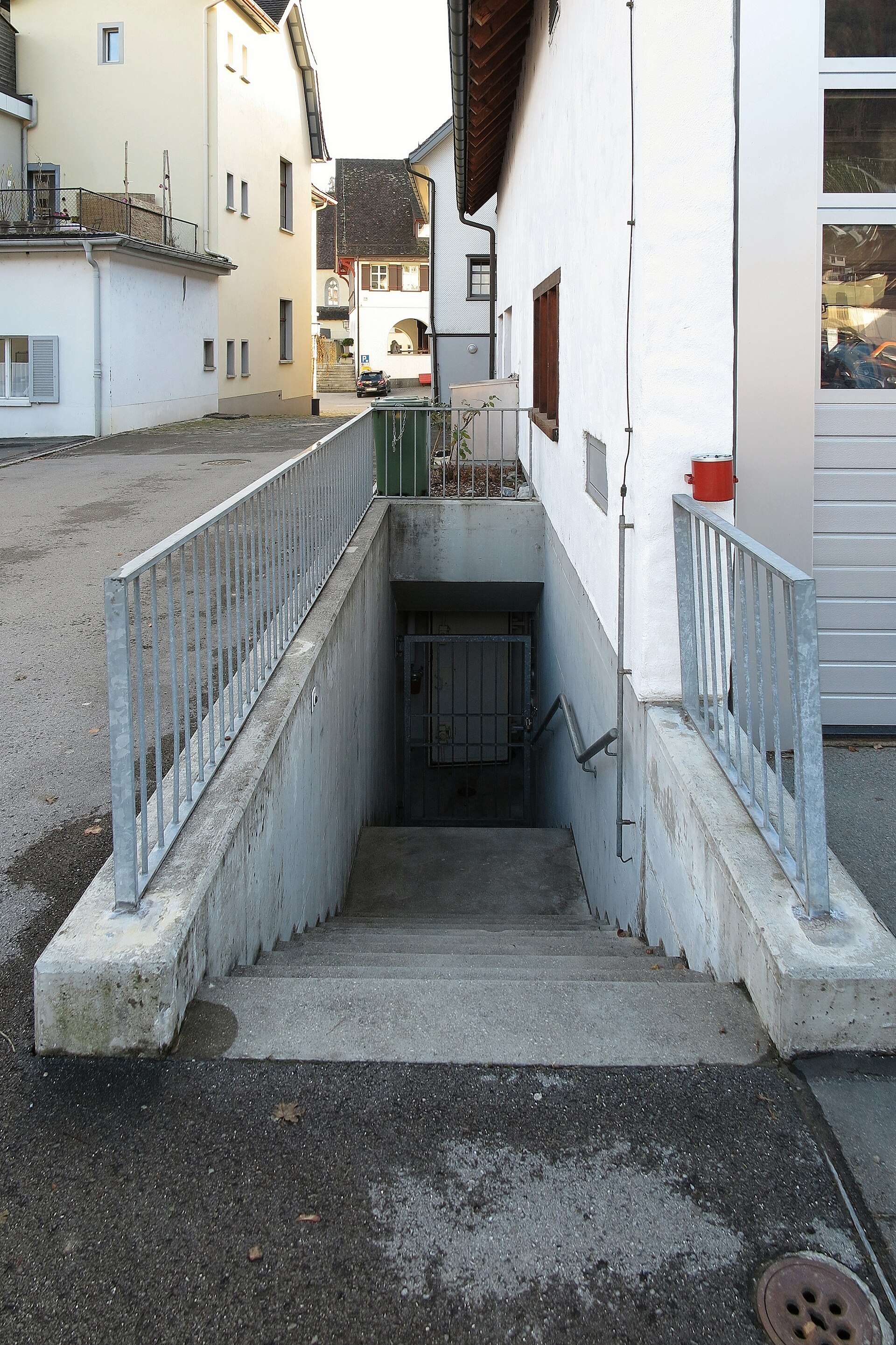
The matrix exposes Saudi Arabia’s position as an outlier among nations facing equivalent threats. Switzerland — a neutral country that has not fought a war since 1847 — has shelter capacity for 114 percent of its population, meaning every person in the country has a guaranteed underground space. Swiss federal law since 1962 requires property owners to build and equip shelters in all new residential buildings, with each person entitled to one square metre of protected space. Shelters must be constructed from reinforced concrete with blast-resistant covers on all openings, equipped with ventilation systems including gas filters, and maintained in a state allowing them to be made operational within five days.
Saudi Arabia, a country that has been attacked by missiles from two different adversaries in the past decade, has no equivalent requirement. The gap between threat level and preparedness is wider in the Kingdom than in any other nation on the matrix.
The Universal Shelter Standard Saudi Arabia Should Have Built
Switzerland’s civil defense system is the global benchmark not because of its cost — estimated at roughly $7 billion over six decades — but because of its universality. The principle is simple: every person in the country, citizen or resident, is entitled to protection. Property owners who cannot build shelters must pay a substitute tax that funds communal shelter construction. The system achieves coverage rates exceeding 100 percent of the total population.
Each shelter’s floor, walls, and ceiling must be constructed from reinforced concrete. All openings must be sealed with blast-resistant covers. Every shelter includes a ventilation system with an air intake, explosion protection valve, ventilation unit, gas filter, and overpressure valve. Emergency exits or escape tunnels are mandatory. The specifications are precise, publicly available, and enforced through building inspections.
The Swiss model proves that universal civilian protection is neither technically complex nor financially ruinous. Switzerland’s gross domestic product is roughly $900 billion — less than a quarter of Saudi Arabia’s total economic output when oil revenues are included. If Switzerland can shelter its entire population for $7 billion spread over 60 years, Saudi Arabia — which spent $80 billion on air defense hardware in a single decade — could have built a comparable system for a fraction of its military procurement budget.
The economics are revealing. A PAC-3 MSE Patriot interceptor costs approximately $4 million per round. Saudi Arabia consumed more than 620 interceptors — Lockheed Martin’s entire 2025 annual production output — in under a week of fighting, according to defense analysts tracking the war. That represents roughly $2.4 billion in expendable munitions in five days. For the same amount, Saudi Arabia could have built reinforced shelter rooms in approximately 240,000 residential buildings at $10,000 per unit — enough to protect more than a million people.
The comparison is not entirely fair. Interceptors destroy incoming threats; shelters merely protect against those that get through. Both are necessary. But the total absence of one half of the equation — the half that directly protects human lives rather than military assets — reveals a strategic priority that valued infrastructure over citizens.
The Drone Problem Civil Defense Was Never Designed to Solve
Traditional civil defense planning assumed a specific threat model: ballistic missiles or aircraft delivering large warheads to known target areas. Warning times were measured in minutes to hours. Shelters were designed to withstand blast overpressure and fragmentation. Evacuation routes led away from likely target zones — military bases, industrial areas, government buildings.
Iran’s drone campaign against Saudi Arabia has shattered every one of these assumptions. Shahed-136 drones cost between $20,000 and $50,000 each, enabling Iran to launch them in waves of dozens at a time. They fly low, making radar detection difficult. Their flight paths can be programmed to avoid known air defense positions. And unlike ballistic missiles that follow predictable trajectories, drones can approach from any direction, turn, and strike targets of opportunity.
The volume problem is the most dangerous. Saudi Arabia’s Ministry of Defense reported intercepting 18 drones in the Eastern Province on a single day — March 12, 2026 — plus additional intercepts over the Empty Quarter and near Riyadh’s Diplomatic Quarter. Iran has fired an estimated 160 to 200 missiles and drones at Saudi targets between February 28 and March 7 alone. Even a 90 percent interception rate — which would be historically exceptional — means 16 to 20 warheads reaching their targets. Against a population with no shelter infrastructure, each warhead that lands in a populated area will produce casualties. By late March, interceptor debris had struck civilian homes in the Eastern Province, vindicating precisely this concern.
The cost asymmetry compounds the problem. Each Patriot interceptor used against a Shahed drone costs 80 to 200 times more than the drone itself — a disparity that threatens Saudi Arabia’s wartime fiscal position and creates an incentive for Iran to simply exhaust the interceptor supply through attrition. Civil defense infrastructure, once built, costs nothing per engagement. A reinforced room protects its occupants whether one drone or a hundred get through the air defense net.
The Contrarian Case for Saudi Arabia’s Air-Defense-First Strategy
The conventional critique — that Saudi Arabia neglected civil defense — contains an assumption that deserves challenge. The Kingdom’s decision to invest overwhelmingly in active military defense rather than passive civilian protection may not be the strategic failure it appears. Three factors argue against the shelter-first model for Saudi Arabia’s specific circumstances.
First, Saudi Arabia’s population density is extremely low outside of a handful of urban centres. The Kingdom’s 35.2 million people are concentrated in Riyadh (approximately 7.5 million), Jeddah (4.6 million), and the Eastern Province cities, with vast empty territory between them. Unlike Israel — where 9.8 million people occupy a country smaller than New Jersey — Saudi Arabia’s dispersed population means that any given missile strike is statistically unlikely to hit a populated area. The strategy of intercepting threats before they reach urban zones exploits this geographic advantage in a way that shelter construction does not.
Second, the climate and construction patterns of Saudi Arabia make traditional below-grade shelters more difficult and expensive to build than in temperate European countries. High water tables in coastal areas, extreme heat that makes underground spaces costly to ventilate, and a construction culture built around above-grade concrete-frame buildings all increase the per-unit cost of shelter construction. The Swiss model, designed for a mountainous country with natural rock formations and temperate underground temperatures, does not translate directly to the Arabian Peninsula.
Third, and most critically, Israel’s experience demonstrates that no shelter system eliminates the need for active defense. The October 7, 2023, Hamas attack killed 1,139 people in a country with the most sophisticated civil defense system on earth. Israel’s Mamad rooms and shelter network saved thousands of additional lives during subsequent rocket attacks, but the system’s existence did not prevent mass casualties when the threat overwhelmed active defenses. Saudi Arabia’s strategic calculus — that preventing warheads from reaching populated areas is more effective than protecting people after they arrive — has a rational foundation.
The problem is that this calculus assumed a threat environment in which interception rates would remain high enough to keep civilian exposure minimal. the degradation of Saudi Arabia’s THAAD radar systems and the sheer volume of Iranian drone attacks have eroded that assumption. The air-defense-first strategy was not wrong in principle. It was wrong in its assumption that active defense alone would always be sufficient — and wrong in its failure to build any fallback for the scenarios where it was not.
Can Saudi Arabia Build a Civil Defense System During a War?
Ukraine’s experience offers a partial answer. When Russia invaded in February 2022, Ukraine’s civil defense infrastructure was largely a Soviet legacy — old bunkers, deep metro stations, and basements of varying quality. Within months, the government adapted. The Kyiv metro was formally designated as a shelter system. Basement inventories were conducted citywide. A law mandating new civil protection structures was signed in August 2022. By 2023, the system was functional enough that 338,000 people used metro shelters during nighttime air raids in Kyiv alone.
Saudi Arabia cannot replicate the Ukrainian model. It has no deep metro system. Its basements are rare. But several immediate measures are achievable even during active hostilities.
The Saudi Building Code 2024, which became mandatory on June 30, 2025, could be amended by emergency decree to require reinforced safe rooms in all new residential construction. Given that Mohammed bin Salman has demonstrated the ability to implement sweeping policy changes rapidly — from the entertainment sector reforms of 2019 to the sovereign wealth fund restructuring of 2024 — a building code amendment mandating blast-resistant rooms would face no legislative obstacles. The question is whether the political will exists to acknowledge the gap publicly.
Existing buildings present the harder problem. Retrofitting reinforced rooms into Saudi Arabia’s existing housing stock — an estimated 3.5 million residential units — would take years and cost billions. An interim measure would be to designate and harden existing structures as community shelters: parking garages, basement-level commercial spaces, and the lower levels of reinforced-concrete government buildings. Saudi Arabia’s extensive network of shopping malls — many with below-grade parking structures — could serve as improvised shelters with relatively minor modifications.
The Kingdom’s construction industry is one of the largest in the world, with an estimated $1.3 trillion in active or planned projects under Vision 2030. Redirecting even a small fraction of this capacity toward shelter construction is feasible. The challenge is not capability but priority.
What Must Change Before the Next Barrage?
Seven specific reforms would close the most dangerous gaps in Saudi Arabia’s civilian protection system. None requires technology that does not already exist. All require political decisions that the war has made urgent.
- Amend the Saudi Building Code to require reinforced safe rooms in all new residential, commercial, and institutional construction, modelled on Israel’s post-1992 Mamad standard. Cost estimate: less than $5,000 per unit for new construction, adding roughly 2-3 percent to building costs.
- Conduct a national audit of existing below-grade structures — parking garages, basements, tunnels — that could serve as community shelters. Designate and sign the most suitable ones within 30 days.
- Upgrade the General Directorate of Civil Defense from a civilian emergency services agency to a military-civilian hybrid command with wartime authority over civilian protection, modelled on Israel’s Home Front Command.
- Deploy a nationwide network of outdoor warning sirens to supplement the cell broadcast system. Cell broadcast fails when networks are congested or damaged; fixed sirens provide redundancy.
- Mandate and conduct quarterly national civil defense drills, beginning immediately, covering shelter-in-place procedures, evacuation routes, and hospital triage protocols.
- Establish bilateral cooperation with Israel’s Home Front Command and Ukraine’s State Emergency Service to import operational lessons from the two countries with the most current experience of sustained aerial bombardment.
- Create a dedicated civil defense fund — separate from the military procurement budget — of at least $5 billion over five years to finance shelter construction, hospital hardening, and emergency supply stockpiling.
The current war may end before most of these measures can be implemented. The next one will not wait for Saudi Arabia to be ready. Every nation that has faced sustained aerial attack in the 21st century — Israel, Ukraine, and now the Gulf states — has learned the same lesson: interceptors buy time, but shelters save lives. The Kingdom that will need decades to recover from this conflict cannot afford to learn that lesson twice.
| Reform | Timeline | Estimated Cost | Impact |
|---|---|---|---|
| Building code amendment (new construction) | 30-60 days to enact | ~2-3% of construction costs | All future buildings protected |
| Below-grade structure audit and designation | 30 days | $10-50 million | Immediate interim shelter access |
| GDCD upgrade to military-civilian command | 90-180 days | $200-500 million annually | Professional wartime civilian protection |
| Outdoor siren network | 6-12 months | $100-300 million | Redundant warning for all urban areas |
| Quarterly national drills | Immediate | $20-50 million per drill | Population knows what to do |
| International cooperation (Israel, Ukraine) | 30-60 days | Minimal | Import proven operational doctrine |
| Dedicated civil defense fund ($5B/5 years) | Budget cycle | $1 billion per year | Systematic shelter construction |
Frequently Asked Questions
Does Saudi Arabia have bomb shelters for civilians?
Saudi Arabia has no nationwide civilian bomb shelter system. There are no mandated reinforced safe rooms in residential buildings, no public shelter network in Saudi cities, and no building code requirement for blast-resistant construction. The General Directorate of Civil Defense advises residents to enter the nearest building and shelter behind a solid barrier, but there are no purpose-built protected spaces comparable to Israel’s Mamad rooms or Switzerland’s universal bunker system.
How does Saudi Arabia warn civilians about incoming missiles and drones?
Saudi Arabia uses a National Early Warning Platform based on Cell Broadcast Technology that sends alerts directly to mobile phones connected to Saudi mobile networks. The system employs three siren tones: a fixed intermittent tone for early warning, a wavy tone indicating active danger, and a continuous tone for all-clear. With smartphone penetration exceeding 98 percent, the warning system reaches most residents, but the absence of shelter infrastructure means people have limited options once warned.
How many civilians has the Iran war killed in Saudi Arabia?
As of mid-March 2026, Saudi Arabia has reported two civilian deaths from the Iran war — an Indian national and a Bangladeshi national killed when a projectile struck a residential compound in Al-Kharj on March 8. Twelve additional people were injured in the same incident, all Bangladeshi nationals. The relatively low civilian toll reflects the high interception rate of Saudi air defense systems, but defense analysts warn that sustained bombardment increases the probability of warheads reaching populated areas.
Why did Saudi Arabia invest in air defense instead of civilian shelters?
Saudi Arabia’s defense strategy prioritised active interception — destroying incoming threats before they reach their targets — over passive protection for civilians on the ground. This approach was reinforced by the 1991 Gulf War, when Iraqi Scud missile attacks produced only one Saudi civilian fatality, creating a perception that military air defense alone was sufficient. The $80 billion invested in Patriot, THAAD, and other systems was designed to create an impenetrable shield. The Iran war has shown that no shield is truly impenetrable.
What would it cost Saudi Arabia to build a civil defense shelter system?
A comprehensive civilian shelter programme modelled on Switzerland’s system would cost an estimated $5 to $10 billion over a decade — roughly 6 to 12 percent of what the Kingdom has spent on military air defense hardware. Immediate interim measures, including auditing and designating existing below-grade structures as community shelters and amending the building code for new construction, could be implemented for under $500 million. The annual cost of maintaining such a system would be approximately $200 to $500 million, less than the price of 125 Patriot interceptor missiles.
On March 18, the absence of shelter infrastructure became acutely visible when Saudi Civil Defense activated Riyadh’s first-ever air raid phone alert, instructing 8.4 million residents to shelter in place during an eight-missile Iranian barrage — without any designated public shelters to direct them to.