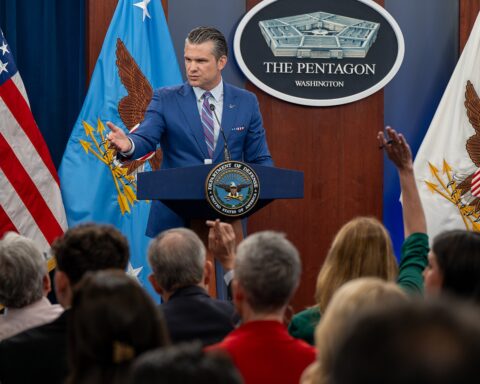

WASHINGTON — Defense Secretary Pete Hegseth said Friday that Iran’s new supreme leader Mojtaba Khamenei was “wounded and likely disfigured” in the Israeli strikes that killed his father on 28 February, the first official confirmation from the Pentagon that the man directing Iran’s war against Saudi Arabia and its Gulf allies may be physically incapacitated. The claim, made during a Pentagon briefing on Day 14 of the conflict, raises urgent questions about who is actually commanding Iran’s military operations and whether a ceasefire can be negotiated with a leader who refuses to appear on camera.
Hegseth cited Khamenei’s decision to deliver his first public statement as a written text read aloud on Iranian state television — rather than appearing on video or releasing an audio recording — as evidence of his condition. “There was no voice and there was no video. It was a written statement,” Hegseth told reporters, adding that the absence suggested the supreme leader was “scared, injured, and on the run.” The Pentagon chief did not provide evidence for the specific claim of disfigurement, and Iran has denied any debilitating injuries.
Table of Contents
- What Did Hegseth Actually Say About Khamenei’s Condition?
- Conflicting Reports on the Extent of Injuries
- Why Has Mojtaba Khamenei Not Appeared in Public?
- Iran’s ‘Janbaz’ Label and What It Reveals
- Who Is Actually Controlling Iran’s War Effort?
- What Does Khamenei’s Condition Mean for a Ceasefire?
- Saudi Arabia’s Strategic Calculus Changes
- Frequently Asked Questions
What Did Hegseth Actually Say About Khamenei’s Condition?
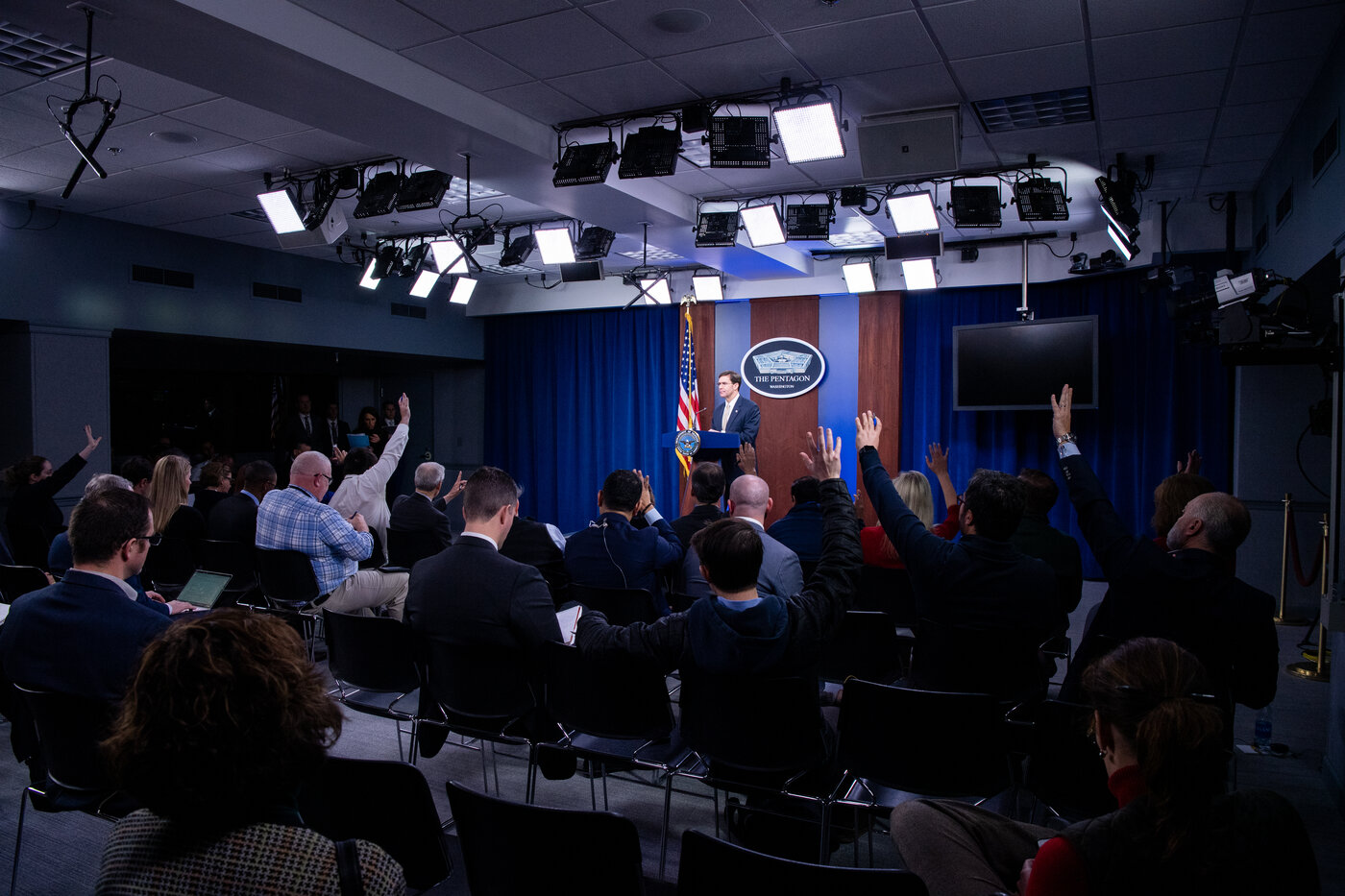
Hegseth’s remarks came during a wide-ranging briefing at the Pentagon on 13 March, where he described Iran’s military capabilities as substantially degraded after two weeks of sustained US and Israeli strikes. The defense secretary said Iran’s missile launch capability had been reduced by 90 percent and its ability to deploy drones was down 95 percent as of Thursday, according to Military Times reporting.
On the subject of Mojtaba Khamenei, Hegseth was pointed. He described the supreme leader’s first public communication — a written statement broadcast on Iranian state television on 12 March — as “a weak one.” The defense secretary questioned why Iran’s highest authority would issue a written message rather than appearing before his people in a moment of national crisis, calling it an indicator of physical weakness rather than strategic caution.
“He’s wounded and likely disfigured,” Hegseth said, according to Axios, adding that the absence of any video, audio, or photographic evidence of Mojtaba Khamenei since his father’s assassination raised serious doubts about his capacity to govern.
The claim represents the most direct public statement from a senior US official about the condition of Iran’s new supreme leader since the war began on 28 February. Previous US officials had avoided commenting directly on Khamenei’s health, limiting their statements to operational assessments of Iran’s military degradation.
The Middle East briefing 3,000+ readers start their day with.
One email. Every weekday morning. Free.
Hegseth also characterised Iran’s continued attacks on Gulf shipping and Saudi infrastructure through the Strait of Hormuz as acts of “sheer desperation” by a regime whose conventional military had been effectively destroyed, according to Time magazine.
Conflicting Reports on the Extent of Injuries
Hegseth’s claim of disfigurement sits at the extreme end of a wide spectrum of reports about Mojtaba Khamenei’s physical condition — a spectrum that ranges from minor scrapes to potential amputation, with almost no verifiable evidence supporting any specific assessment.
CNN reported, citing a source with knowledge of his condition, that Khamenei suffered a fractured foot and minor facial injuries — including bruising around his left eye and superficial cuts — during the 28 February strikes that killed his father, his wife, and several other family members at a compound in Tehran.
An unnamed Iranian official told Reuters on Wednesday that Khamenei’s injuries were “light,” a characterisation echoed by Iran’s ambassador to Japan, who said the supreme leader had not been “impaired” in a way that would prevent him from functioning, according to Reuters.
Iran’s ambassador to Cyprus, however, offered a different account, telling The Guardian that Mojtaba Khamenei had suffered injuries to his legs, arms, and hands — a description more consistent with shrapnel wounds from the airstrike.
At the furthest end of the spectrum, unverified reports from opposition sources — particularly the Mujahedin-e Khalq’s media wing — have claimed Khamenei is in a coma and may have lost at least one leg, according to The Mirror. A fact-checking analysis by Factually.co concluded that there was “no reliable, independently verifiable evidence” that Khamenei is in a coma.
| Source | Date | Claimed Condition | Evidence Provided |
|---|---|---|---|
| Reuters (Iranian official) | 12 March | “Light” injuries | Anonymous official |
| CNN (informed source) | 11 March | Fractured foot, facial bruising, superficial cuts | Single source with access |
| Iran ambassador to Cyprus | 12 March | Injuries to legs, arms, and hands | Diplomatic statement |
| Iran ambassador to Japan | 13 March | Not “impaired” | Diplomatic statement |
| Hegseth (Pentagon) | 13 March | “Wounded and likely disfigured” | No evidence provided |
| Opposition media (MEK) | 12 March | Coma, possible amputation | Unverified opposition claims |
The absence of independent medical verification makes it impossible to adjudicate between these competing accounts. No hospital records, medical photographs, or independent journalist access to Khamenei have been reported. The only certainty is that he survived the same strike that killed Ayatollah Ali Khamenei and has not appeared publicly since.
Why Has Mojtaba Khamenei Not Appeared in Public?
Mojtaba Khamenei has not been seen in any verifiable photograph, video, or public appearance since his father’s assassination on 28 February. For a leader who was formally elected supreme leader by the Assembly of Experts on 9 March — and who issued his first statement on 12 March vowing to keep the Strait of Hormuz closed — this absence is without precedent in the Islamic Republic’s history.
The late Ayatollah Khamenei, even during periods of illness and following cancer surgery, maintained public appearances and delivered addresses in person or via live broadcast. His son’s decision to communicate exclusively through written text has fuelled speculation ranging from calculated political strategy to severe physical incapacity.
Euronews reported that at Mojtaba Khamenei’s inauguration ceremony, a cardboard cutout bearing his image was presented to attendees rather than the supreme leader himself — a detail that, if confirmed, would represent an extraordinary departure from the formal rituals of Iran’s theocratic governance structure.
Three competing explanations account for the public absence. The first, favoured by US officials including Hegseth, holds that Khamenei’s injuries are severe enough to make a public appearance politically damaging — that a visibly wounded supreme leader would project weakness to both domestic rivals and external adversaries at the most critical moment in the Islamic Republic’s history.
The second explanation, offered by Iranian officials, suggests that Khamenei is avoiding public appearances for security reasons. With Israeli intelligence having demonstrated the capability to locate and kill his father — the most protected individual in Iran — appearing in a known location would present an obvious targeting opportunity.
The third, raised by analysts at the RAND Corporation, questions whether Khamenei’s absence reflects not physical incapacity but a power arrangement in which the IRGC, rather than the supreme leader, holds actual operational authority over the war effort.
Iran’s ‘Janbaz’ Label and What It Reveals
Perhaps the most telling signal about Khamenei’s condition has come from Iran’s own state media. Both Iranian state television and the state news agency IRNA referred to Mojtaba Khamenei as a “janbaz” — a Persian term meaning wounded war veteran, historically reserved for soldiers injured during the 1980-1988 Iran-Iraq War, according to Iran International.
The use of “janbaz” is significant for several reasons. It is not a casual descriptor in Iranian political culture — it carries deep emotional resonance and is associated with sacrifice, legitimacy, and moral authority. By applying it to Khamenei, state media appears to be pursuing two objectives simultaneously: acknowledging that the supreme leader was indeed injured, while framing those injuries as a badge of honour that reinforces rather than undermines his authority.
Iranian state television described him specifically as “a janbaz of the Ramadan War,” using the Islamic Republic’s preferred name for the 2026 conflict, which began during the Muslim holy month. The framing positions Khamenei not as a fragile leader hiding from his people, but as a battle-scarred warrior who has earned his position through personal sacrifice — a narrative that resonates powerfully with Iran’s culture of martyrdom.
RFE/RL reported that Iranian officials have simultaneously sought to quell the most extreme health rumours while tacitly acknowledging that Khamenei was wounded. This dual messaging — denying incapacity while celebrating injury — represents a delicate balancing act that some analysts view as unsustainable without an eventual public appearance.
The label also implicitly confirms what Hegseth asserted: that Mojtaba Khamenei was physically harmed in the strikes. The disagreement, then, is not over whether he was injured, but over the severity. Iran presents the injuries as honourable and manageable. The Pentagon presents them as debilitating and disfiguring. Neither has provided independent evidence.
Who Is Actually Controlling Iran’s War Effort?
The question of Khamenei’s physical condition feeds directly into a larger strategic uncertainty: who holds operational command of Iran’s war effort? Under the Islamic Republic’s constitutional structure, the supreme leader serves as commander-in-chief with direct authority over the armed forces. If Khamenei is unable to fulfil that role — whether temporarily or indefinitely — the implications for command authority are profound.
The IRGC publicly declared its “complete obedience” to Mojtaba Khamenei on 8 March, one day before his formal election by the Assembly of Experts, according to The Times of Israel. That timing — pledging loyalty before the democratic process had concluded — reinforced assessments that the IRGC played the decisive role in engineering Khamenei’s succession, using what the Assembly of Experts itself described as “repeated contacts and psychological and political pressure” to secure votes for the late supreme leader’s son.
In practice, the IRGC’s operational autonomy appears to have expanded significantly since the war began. The Revolutionary Guards’ Navy has unilaterally imposed transit restrictions on the Strait of Hormuz, demanding that foreign vessels seek permission before passage. IRGC-aligned forces have launched drone and missile attacks against targets across seven Gulf states — Saudi Arabia, the UAE, Bahrain, Kuwait, Qatar, Oman, and Iraq — in a campaign that appears coordinated at the IRGC command level rather than directed by the supreme leader’s office.
NPR reported that Khamenei’s written statement, in which he vowed to keep the Strait of Hormuz closed, may have been composed and approved by IRGC commanders rather than by Khamenei himself — a claim impossible to verify but consistent with the pattern of IRGC operational dominance that has characterised the conflict since its first days.
Fox News reported that a lethal “black-clad” security unit now guards Mojtaba Khamenei — an elite protection force that answers to the IRGC rather than to the regular military. The existence of this unit underscores the IRGC’s role as both protector and, potentially, handler of the supreme leader.
What Does Khamenei’s Condition Mean for a Ceasefire?
The uncertainty surrounding Khamenei’s health has complicated already fragile ceasefire diplomacy. Any negotiated end to the conflict would require authorisation from Iran’s supreme leader — a requirement embedded in the Islamic Republic’s constitutional structure that cannot be circumvented by the president, foreign ministry, or military.
If Khamenei is as incapacitated as Hegseth suggests, the question becomes whether anyone in Tehran has both the authority and the will to negotiate. Iran’s President Masoud Pezeshkian has signalled interest in de-escalation — Pakistan’s Prime Minister Shehbaz Sharif spoke with Pezeshkian by phone before flying to Riyadh to meet Crown Prince Mohammed bin Salman on 12 March — but the president lacks constitutional authority over war and peace.
Iran has demanded reparations and security guarantees as preconditions for any ceasefire, according to reports from the first two weeks of the conflict. Those demands — which include compensation for the assassination of Ayatollah Khamenei, an end to all sanctions, and international recognition of Iran’s territorial integrity — are widely viewed as non-starters by both Washington and Riyadh.
CNBC reported that Iran ruled out an immediate ceasefire while attacks continued. Mojtaba Khamenei’s first written statement reinforced this position, declaring that the Strait of Hormuz would remain closed until Iran’s demands were met — a stance that has trapped more than 3,000 vessels and 20,000 sailors in the Persian Gulf.
The RAND Corporation’s analysis of the conflict noted that Mojtaba Khamenei’s selection as supreme leader can itself be read as a rejection of diplomatic off-ramps — a signal that Iran has chosen escalation over negotiation. A wounded, angry son avenging his father’s assassination is not the profile of a leader inclined toward compromise.
Saudi Arabia’s Strategic Calculus Changes
For Riyadh, Hegseth’s claim adds another variable to an already complex strategic equation. Saudi Arabia has absorbed more than 100 drone and missile attacks since the war began on 28 February, intercepting the vast majority through its layered air defense network but suffering damage to civilian infrastructure and two fatalities in the residential area of Al-Kharj.
Saudi Arabia’s approach to the conflict — characterised by analysts as strategic restraint — has involved absorbing Iranian attacks without retaliating directly, instead relying on the US and Israeli militaries to degrade Iran’s offensive capabilities. Hegseth’s revelation that the supreme leader directing those attacks may be physically incapacitated introduces a question Riyadh has not had to answer before: does Saudi Arabia negotiate with a regime that may not have a functioning head of state?
Saudi Arabia’s diplomatic channels to Tehran, which Bloomberg reported had been intensified in the days before the war, now face the additional obstacle of identifying a legitimate interlocutor. If Mojtaba Khamenei cannot negotiate in person — or if the IRGC is making operational decisions independently of the supreme leader — then traditional diplomatic frameworks may prove inadequate.
The Saudi response to Hegseth’s claim has been notably restrained. Neither the Saudi foreign ministry nor the Royal Court has publicly commented on Khamenei’s health — a silence consistent with Riyadh’s broader strategy of avoiding actions or statements that could be perceived as provocative while maintaining back-channel communication with Tehran.
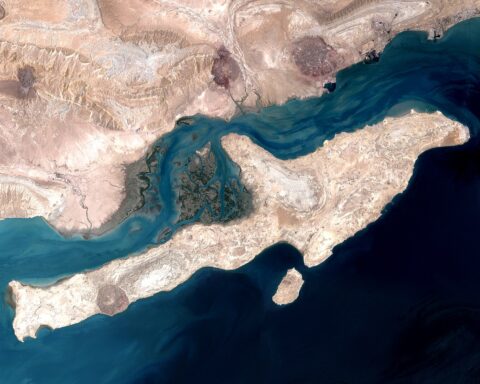
The US strike on Kharg Island — which Trump said “totally obliterated every military target” while deliberately sparing oil infrastructure — adds another dimension. The strike demonstrated that the US can destroy Iran’s most valuable asset at any time. For Saudi Arabia, which depends on stable oil markets, this controlled escalation reinforces the value of maintaining its alliance with Washington while avoiding direct military engagement.
Crown Prince Mohammed bin Salman’s position has been to support the US-Israeli campaign diplomatically while preparing Saudi Arabia for the post-war regional order — a strategy that assumes someone in Tehran will eventually negotiate. If Hegseth’s assessment is correct and no one can, that assumption collapses, and the conflict enters territory for which there is no historical precedent: a theocracy at war with no functioning theocrat.
The Saudi royal family has watched Iran’s succession crisis with particular interest, given the Kingdom’s own recent experience consolidating power under a single leader. Saudi Arabia’s intelligence services have likely formed their own assessment of Khamenei’s condition — one that may or may not align with Hegseth’s public characterisation. Riyadh’s silence on the matter suggests either a lack of independent confirmation or a deliberate decision to avoid undermining back-channel diplomacy with provocative public commentary.
Hegseth’s broader assertion that Iran’s military capacity has been reduced to single-digit percentages of its pre-war levels carries direct implications for Saudi security planning. If accurate, the Kingdom faces a dramatically reduced conventional threat from Iran — but a potentially elevated unconventional one, as desperate regimes with degraded militaries have historically turned to asymmetric methods including terrorism, proxy activation, and sabotage of critical infrastructure. Washington has since escalated its pressure campaign beyond the battlefield: the State Department issued a $10 million Rewards for Justice bounty on Mojtaba Khamenei and nine senior IRGC commanders, a move that signals the United States views the Iranian leadership as a legitimate target for removal, not merely degradation.
Frequently Asked Questions
Is Mojtaba Khamenei confirmed to be injured?
Multiple sources, including Iranian state media and diplomatic officials, have acknowledged that Mojtaba Khamenei sustained injuries during the 28 February strikes that killed his father. Iranian state media referred to him as a “janbaz” (wounded veteran), and Iran’s ambassador to Cyprus confirmed injuries to his legs, arms, and hands. The dispute centres on severity — Iran describes the injuries as light, while Hegseth claims disfigurement.
Has Mojtaba Khamenei appeared in public since becoming supreme leader?
No. As of 14 March, Mojtaba Khamenei has not appeared in any verifiable photograph, video, or live broadcast since his father’s assassination on 28 February. His only public communication has been a written statement read aloud on Iranian state television on 12 March, in which he vowed to keep the Strait of Hormuz closed until Iran’s conditions are met.
By March 17, the situation had escalated further, with Trump questioning whether Mojtaba Khamenei is alive at all, after nine days without any public appearance from Iran’s new leader.
Did Hegseth provide evidence for the disfigurement claim?
No. Defense Secretary Hegseth did not provide photographic, medical, or intelligence evidence to support his specific claim that Mojtaba Khamenei is “likely disfigured.” He cited the absence of video or audio appearances as circumstantial evidence, but acknowledged that Iran has not confirmed the extent of injuries beyond acknowledging they occurred.
Who is commanding Iran’s military operations?
The IRGC appears to hold primary operational control of Iran’s war effort. The Revolutionary Guards publicly pledged “complete obedience” to Mojtaba Khamenei on 8 March, but analysts and intelligence assessments suggest the IRGC may be making operational decisions independently. The IRGC Navy has imposed transit restrictions on the Strait of Hormuz and directed attacks across seven Gulf states without clear evidence of supreme leader involvement.
What does this mean for ceasefire negotiations?
Khamenei’s condition complicates diplomacy significantly. Under Iran’s constitution, only the supreme leader can authorise an end to hostilities. If Khamenei is physically unable to engage in negotiations — or if the IRGC is operating with de facto autonomy — there may be no single interlocutor with both the authority and the willingness to agree to a ceasefire. Pakistan’s shuttle diplomacy between Tehran and Riyadh continues, but the absence of a visible Iranian decision-maker remains a fundamental obstacle.