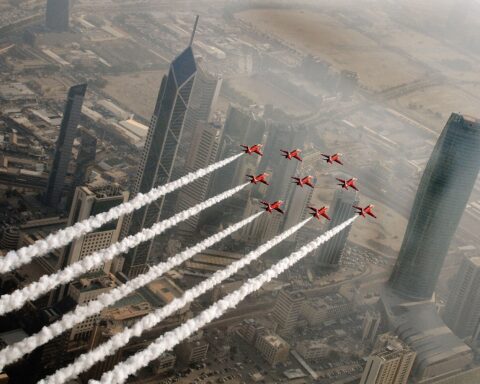
MIAMI — On the evening of March 27, 2026, Donald Trump took the stage at the Faena Hotel in Miami Beach to deliver a closing keynote at the Future Investment Initiative Priority summit. He told the audience of Saudi officials, Wall Street executives, and sovereign wealth fund managers that Iran was “on the run,” that the Middle East’s future had “never looked brighter,” and that the economy would “take off like a rocket” once the conflict ends. He urged Saudi Arabia to join the Abraham Accords. “It’s time now,” he said. Outside, the Atlantic breeze carried none of the concerns that had, over the preceding month, dismantled the most ambitious events calendar the Gulf had ever assembled. That was the point. FII Priority Miami existed because Riyadh, Dubai, Doha, and Bahrain no longer could.
Since US-Israeli strikes on Iran began on February 28, more than 100 conferences, sporting events, music festivals, and trade shows across four Gulf states have been cancelled, postponed, or relocated, according to consultancy Northbourne Advisory. The World Travel and Tourism Council estimates the conflict is costing the Middle East $600 million per day in lost international visitor spending. Dubai hotel occupancy has collapsed from a seasonal average of roughly 90% to 16%. Insurance companies are refusing event cancellation coverage for anything in the region. And the Gulf’s signature claim — that it had become the indispensable global meeting point — lies in ruins, at least for now.
Table of Contents
- The Cancelled Calendar
- What Did the F1 Cancellations Cost?
- Why Can’t Gulf Events Simply Reschedule?
- The CERAWeek No-Shows
- FII Priority Miami and the Geography of Safety
- The Opacity Shift
- How Does 2026 Compare to the 2018 Khashoggi Boycott?
- What Is at Stake for Saudi Arabia’s Events Economy?
- The Recovery Question
- Frequently Asked Questions
The Cancelled Calendar
The scale of disruption has no precedent in Gulf history. Within days of the conflict beginning, airspace closures grounded over 37,000 flights between February 28 and March 8. In Doha, 288 of 308 scheduled departures were cancelled in a single period. In Bahrain, 92 of 93 flights were scrubbed. The physical infrastructure of international travel — the airlines, the routes, the insurance policies that underwrite them — stopped functioning across the region almost overnight.
The events followed. Formula 1 cancelled both the Bahrain Grand Prix (April 10-12) and the Saudi Arabian Grand Prix in Jeddah (April 17-19), with no rescheduled dates. The Qatar MotoGP Grand Prix was pushed from April to November 8. UEFA cancelled the Finalissima between Spain and Argentina in Doha after relocation attempts failed. The Fanatics Flag Football Classic, originally planned for Riyadh, moved to Los Angeles.
The business conference circuit fared no better. The World Economic Forum postponed its Global Collaboration and Growth Meeting in Jeddah indefinitely. LEAP, Riyadh’s flagship technology conference that drew over 200,000 attendees, was pushed to August 31. TOKEN2049, Dubai’s marquee crypto event with 15,000 expected delegates, deferred an entire year to April 2027. The Arabian Travel Market, a cornerstone of Dubai’s hospitality calendar, shifted from May to August 17-20. The UITP Summit, a global transport conference, abandoned Dubai altogether and relocated to Hamburg for 2027.
In entertainment, Abu Dhabi’s Offlimits Music Festival — headlined by Shakira and the Jonas Brothers — was postponed to November 21. Christina Aguilera’s Abu Dhabi concert moved to September. Art Dubai adapted to a reduced format at Madinat Jumeirah. The IAAPA Expo Middle East deferred a full year to April 2027.
The Middle East briefing 3,000+ readers start their day with.
One email. Every weekday morning. Free.
| Event | Type | Location | Original Date | Status | Est. Attendees |
|---|---|---|---|---|---|
| Bahrain Grand Prix | Motorsport | Bahrain | Apr 10-12 | Cancelled | 100,000+ |
| Saudi Arabian Grand Prix | Motorsport | Jeddah | Apr 17-19 | Cancelled | 80,000+ |
| Qatar MotoGP | Motorsport | Lusail | Apr 10-12 | Postponed to Nov 8 | — |
| Finalissima | Football | Doha | Mar 27 | Cancelled | 80,000+ |
| WEF Jeddah Summit | Policy | Jeddah | April | Postponed (no date) | 1,000+ |
| LEAP Tech | Technology | Riyadh | Spring | Postponed to Aug 31 | 200,000+ |
| TOKEN2049 Dubai | Crypto | Dubai | Late April | Deferred to Apr 2027 | 15,000+ |
| ATM Dubai | Tourism trade | Dubai | May 4-7 | Postponed to Aug 17-20 | 30,000+ |
| UITP Summit | Transport | Dubai | Apr 21-23 | Relocated to Hamburg 2027 | 10,000+ |
| IAAPA Expo ME | Entertainment | Abu Dhabi | Late March | Deferred to Apr 2027 | — |
The 15 large events cancelled or postponed in Saudi Arabia alone, per Northbourne Advisory, represent only a fraction of a broader regional paralysis. Across the UAE, Qatar, and Bahrain, the total exceeds 100. Some — like the F1 races and the Finalissima — are gone entirely. Others have been rescheduled to summer months when temperatures exceed 40°C, historically the low season, raising questions about whether rescheduled events will attract the same international attendance that justified them in the first place.
What Did the F1 Cancellations Cost?
Formula 1’s Gulf losses are among the most precisely quantifiable casualties of the conflict. A Guggenheim Partners analysis estimated the cancellation of the Bahrain and Saudi Arabian Grands Prix would cost F1 approximately $190-200 million in revenue and $80 million in EBITDA. The hosting fees alone are substantial: Bahrain pays approximately $45 million per year under a contract running through 2036, while Saudi Arabia pays roughly $55 million annually under a deal extending to 2030. Combined, those fees total about $115 million per year in guaranteed revenue for the sport.
For the host economies, the losses are steeper. Bahrain estimates its Grand Prix contributes approximately $100 million to the local economy annually through tourism, hospitality, and ancillary spending. Saudi Arabia’s race, centred on the Jeddah Corniche Circuit, was positioned as a flagship of the Kingdom’s Vision 2030 sports strategy — an effort that has absorbed $51 billion in sports properties since 2016, according to SPORTFIVE.
Both contracts remain in force. The races will return. But the immediate financial hole — roughly $200 million to F1 and an estimated $200 million in combined local economic impact — cannot be recovered from a single cancellation cycle. The cancellation of both races marked the first time since the COVID-19 pandemic that F1 lost multiple Gulf rounds in a single season.
Why Can’t Gulf Events Simply Reschedule?
The most underreported dimension of the events collapse is not the cancellations themselves but the structural barrier preventing swift recovery: insurance markets have shut the door.
Panteha Peters, an insurance broker at Marsh, told AGBI in March 2026 that event insurers are refusing coverage for anything in the Gulf within the coming months. “Anything happening within the next couple of months, they’re not willing to cover,” she said, citing the perceived claim risk. Natasha Hatherall-Shawe, CEO of event agency TishTash, confirmed the practical consequence: “We have not hosted any events since the conflict began.” War-related disruptions, she noted, are “often excluded or very difficult to cover” under standard event cancellation policies.
Anything happening within the next couple of months, they’re not willing to cover.
Panteha Peters, Marsh Insurance Broker, March 2026
The insurance problem extends well beyond events. Standard travel insurance treats war as “pretty much a blanket exclusion across all travel insurance policies,” according to Australian consumer advocacy group Choice, as reported by Bloomberg. Marine hull insurance rates in the Gulf could rise 25-50% or higher, according to Marsh estimates, with Marcus Baker, Marsh’s global head of marine, telling The Guardian that rates could increase 50-100% or more.
Without event cancellation insurance, organisers face unlimited liability. A conference that sells 15,000 tickets, books a venue, contracts speakers, and arranges catering cannot proceed if a last-minute cancellation — triggered by a missile strike, an airspace closure, or a government advisory — leaves it financially exposed. The insurance gap is not a sentiment problem. It is a balance-sheet constraint that operates independently of whether the security situation improves.
This distinction matters because it separates 2026 from every previous Gulf disruption. COVID-19 was an insurable risk with pandemic clauses and government support packages. The 2018 Khashoggi crisis was a reputational event that did not affect insurance pricing. The Iran war has introduced a class of risk — active military conflict in the physical region — that the insurance industry prices differently from everything that came before.
The CERAWeek No-Shows
The cancellation wave extended beyond the Gulf’s own borders. In Houston, the energy industry’s most important annual gathering — CERAWeek by S&P Global — lost its two most anticipated Gulf speakers.
Aramco CEO Amin Nasser cancelled his planned appearance to remain in Saudi Arabia because of the conflict, according to Reuters. He did not provide a recorded video message. CERAWeek organisers were notified of his withdrawal in advance. During a March 10 Aramco earnings call, Nasser had warned of “catastrophic consequences” for world oil markets if the war continued to disrupt the Strait of Hormuz, noting that Aramco had already cut oil output by approximately 2 million barrels per day from two fields.
Sultan Al Jaber, CEO of the Abu Dhabi National Oil Company, also did not travel to Houston but participated virtually. His comments were striking for their directness: “Weaponising the Strait of Hormuz is not an act of aggression against one nation — it’s economic terrorism against every nation.” Al Jaber subsequently travelled to Washington for meetings on “the Hormuz situation, global energy supply continuity, and the UAE-US strategic partnership,” according to Reuters.
Nasser and Al Jaber are the two most senior energy executives in the Gulf. Their simultaneous absence from CERAWeek — where Nasser is typically a headline speaker — was unprecedented. It signalled that the conflict’s gravity extended to the boardroom level, not merely the conference circuit.
FII Priority Miami and the Geography of Safety
Against this backdrop of regional paralysis, one major Saudi-backed event not only proceeded but thrived. FII Priority Miami ran March 25-27 at the Faena Hotel in Miami Beach, drawing 1,500-2,000 delegates and a roster of speakers that included multiple Saudi cabinet ministers, US administration officials, and Fortune 500 executives.
The reason it survived is geographic. Miami is more than 7,000 miles from the conflict zone. There were no airspace closures to navigate, no missile risk to insure against, no travel advisories to discourage attendance. The event existed on American soil, under American security, with American insurance markets that do not price in Gulf war risk.
The Saudi delegation was senior. PIF Governor Yasir Al-Rumayyan, who also chairs Saudi Aramco and the FII Institute, set the tone: “We are a long-term patient investor. We measure our returns not in quarters, in decades.” Finance Minister Mohammed Al-Jadaan acknowledged the severity of the disruption while framing Saudi infrastructure investment as vindicated: “Imagine you invested significant amounts for 50 years. And the first time you used that investment was a few weeks back,” he said, referencing the East-West pipeline that bypasses the Strait of Hormuz. But he also offered a warning: “What we saw in the last few weeks is an impact beyond what we have seen even post-Covid in terms of supply chain disruption.”
Tourism Minister Ahmed Al-Khateeb and Princess Reema Bandar Al Saud, Saudi Ambassador to the United States, also attended. On the American side, Jared Kushner appeared alongside Steve Witkoff, the US Middle East Envoy. Dina Powell McCormick, President and Vice Chairman of Meta, was present, as were Nelson Griggs of Nasdaq, Mary Callahan Erdoes of JPMorganChase Asset and Wealth Management, and William E. Ford of General Atlantic. FIFA President Gianni Infantino predicted the 2026 World Cup would deliver approximately $80 billion in economic impact. Brazilian football legend Ronaldo appeared on stage alongside him.
Deals were announced. HUMAIN, the PIF-backed AI company, partnered with Turing for a global AI agent marketplace — its first US customer. Patel Family Office and AHQ announced a $1 billion hospitality platform to develop 50 hotels across Saudi Arabia. Saudi Eksab and BTG Pactual signed a framework agreement for a Latin America alternative investment platform. FII claimed that across all previous gatherings, the institute has generated over $250 billion in opportunities.
The summit’s significance extended beyond deal flow. Just forty-eight hours after Trump used the FII stage to announce the F-35 sale and demand normalization, Saudi Arabia co-signed an eight-nation statement defending Al-Aqsa and condemning the longest mosque closure since 1967 — turning the same weekend into a demonstration of the custodianship contradiction the Miami event was designed to paper over.
Richard Attias, Chairman of the Executive Committee and Acting CEO of the FII Institute, captured the institutional messaging: “This is a moment to move from fragmentation to alignment, from hesitation to action.” The event’s theme — “Capital in Motion” — and its headline press release — “Capital Keeps Moving, Even in Uncertain Times” — were calibrated to project continuity. If the Gulf’s events calendar had collapsed, the FII Institute wanted the world to know that Saudi capital had not.
The Opacity Shift
There was, however, something different about this FII. In 2018, the last time the institute faced a crisis — the Khashoggi boycott — the full speaker list was public. Each withdrawal was a visible act: Jamie Dimon pulled out, then Larry Fink, then Stephen Schwarzman, and media outlets published running tallies of who was in and who was out. CNN, CNBC, Bloomberg, the Financial Times, and the New York Times all withdrew as sponsors. The boycott became a story in itself, with the transparency of the speaker list amplifying the reputational damage.
In 2026, the FII Institute adopted a different model. The full programme for FII Priority Miami was available only through the FII Institute Mobile App, which was, according to the institute’s own website, “exclusively available to registered attendees whose participation has been confirmed.” No public attendee list was published. The institute issued six press releases across the three-day event, naming some speakers but not all.
Several speakers announced in advance — including Dr. Fei-Fei Li of Stanford and World Labs, and Ricardo B. Salinas of Grupo Salinas — do not appear in any of the six post-event press releases. Whether they attended and were simply not quoted, or whether they did not attend at all, cannot be verified from public sources. The private app model means that absences, unlike in 2018, are invisible.
This is not necessarily an accident. The shift from transparency to opacity protects the event from the very dynamic that made 2018 so damaging. If no one can confirm who did not show up, there can be no public narrative of abandonment. The strategic logic is sound. But it also means that the full picture of FII Miami — who came, who stayed away, and what that pattern reveals about international confidence in the Saudi investment story — exists only behind a login screen.
How Does 2026 Compare to the 2018 Khashoggi Boycott?
The temptation to draw a straight line between the 2018 FII boycott and the 2026 events collapse is understandable but misleading. The two crises share a superficial similarity — prominent figures withdrawing from Saudi-affiliated events — but differ in every structural dimension.
In October 2018, following the murder of journalist Jamal Khashoggi inside the Saudi consulate in Istanbul, the FII conference in Riyadh became the focal point of a global corporate boycott. Jamie Dimon of JPMorgan Chase, Larry Fink of BlackRock, Stephen Schwarzman of Blackstone, Dara Khosrowshahi of Uber, Diane Greene of Google Cloud, Ajay Banga of Mastercard, and Richard Branson of Virgin Group all withdrew. According to CNBC reporting at the time, Dimon, Fink, and Schwarzman spent the weekend before the event attempting to get the conference cancelled or postponed, reaching out to US Treasury Secretary Steven Mnuchin and the PIF for cover.
The boycott was performative in the truest sense — it was designed to be seen. It was a public act of moral distancing, driven by ESG pressure, media scrutiny, and corporate reputation management. It targeted the Saudi government specifically, over a specific act.
And it achieved nothing lasting. By 2019, Fink and Schwarzman were back at FII, participating in panels. JPMorgan sent its head of global banking, Carlos Hernandez, in place of Dimon. HSBC, Standard Chartered, BNP Paribas, Credit Suisse, and Societe Generale all sent representatives. By 2022, Wall Street CEOs were attending despite a separate dispute between Biden and Saudi Arabia over oil production. By 2023, Fink, Schwarzman, and Dimon all attended during the Israel-Hamas war. Dimon himself later acknowledged that the 2018 boycott “achieved nothing,” while JPMorgan expanded its Saudi team.
| Dimension | 2018 (Khashoggi) | 2026 (Iran War) |
|---|---|---|
| Trigger | Murder of Jamal Khashoggi | Iran war / airspace closures |
| Nature of withdrawal | Public, performative | Silent, pragmatic |
| Events affected | 1 (FII only) | 100+ across 4 Gulf states |
| Speaker transparency | Public lists; public cancellations | Private app; invisible absences |
| Insurance factor | None | Blanket war exclusions |
| Recovery time | 1-2 years (most boycotters returned by 2019) | Unknown |
| Structural damage | Minimal (reputational only) | Potentially significant (geographic risk repricing) |
The critical difference is this: the 2018 boycott was a choice. Executives chose to withdraw, and they chose to return when the reputational calculus shifted. The 2026 collapse is not a choice. Airlines are not flying. Insurance companies are not covering. Airspace is closed. Event organisers face unlimited liability. The people who want to attend Gulf events cannot get there, cannot be insured when they arrive, and cannot guarantee their safety during the event. This is not a moral judgment. It is an actuarial one.
What Is at Stake for Saudi Arabia’s Events Economy?
The events collapse threatens one of the most capital-intensive pillars of Vision 2030. Saudi Arabia has spent $51 billion on sports properties since 2016, according to SPORTFIVE. Between 2020 and Q1 2025, the Kingdom invested nearly $7 billion in sports alone, hosting more than 30 international events, per Saudi Sport Consulting. The sports sector market value is projected to reach $22.4 billion by 2030, up from $8 billion.
The investment pipeline extends far beyond sports. Expo 2030 in Riyadh, secured by the Public Investment Fund, is projected to contribute $64 billion to Saudi GDP and generate 171,000 direct and indirect jobs. The 2034 FIFA World Cup has $2.7 billion earmarked for 15 smart stadiums and 11 venues, with completion targeted for 2028. Savvy Games Group, a PIF subsidiary, has committed $37.8 billion to building an esports hub, according to the Gulf International Forum.
These are not speculative commitments. They are contracted obligations backed by sovereign capital. The long-term contracts — F1 Saudi Arabia through 2030, F1 Bahrain through 2036, the WWE’s approximately $1 billion ten-year agreement, the Esports World Cup targeting 39,000 new jobs by 2030 — guarantee that the events will return in some form. The infrastructure exists, the funding is committed, and the strategic rationale within Vision 2030 has not changed.
But the WTTC’s estimate of $600 million per day in lost international visitor spending across the Middle East — derived from a pre-conflict 2026 forecast of $207 billion in annual international visitor spending — illustrates the scale of immediate damage. Gloria Guevara, President and CEO of the WTTC, noted that “the impact of international visitor spending across the Middle East is significant,” but added that “history shows that the sector can recover quickly.” Whether history is the right guide depends on how long the conflict lasts and whether the structural conditions that enabled the Gulf’s events boom — open airspace, affordable insurance, confident international travellers — can be restored.
The Recovery Question
Industry voices are divided not on whether events will return to the Gulf, but on the terms of their return.
Rana Maristani, CEO of R Consultancy, offered the optimistic case to AGBI: “The events will return. The infrastructure is there. The contracts are live. The region was on its strongest growth cycle in years before February and that underlying momentum has substance behind it.” This is true. The physical infrastructure — the circuits, the convention centres, the hotels — is intact. The contracts are binding. The money is committed.
Adam Parry, founder of AMP Events, articulated the risk: “The UAE has spent years building a safe, neutral brand for business events. That narrative is taking a hit.” The UAE, which positioned itself as a geopolitically neutral meeting ground — a Switzerland of the Gulf — has seen that brand eroded by proximity to a conflict it did not cause and cannot control.
Three factors will determine the speed and completeness of recovery. The first is replaceability: events that can relocate will relocate, and some may not come back. TOKEN2049 deferred to 2027 — but its natural home is Singapore, where it originated. The UITP Summit moved to Hamburg. The Fanatics Flag Football Classic went to Los Angeles. Each relocation is a test case. If those events perform well in their new venues, the case for returning to the Gulf weakens.
The second factor is insurance dependency. Large commercial events — conferences, trade shows, music festivals — require event cancellation insurance to proceed. Government-funded events backed by sovereign wealth are less dependent on commercial insurance and may return faster. The distinction matters: Riyadh Season, a domestically oriented entertainment programme backed by the Saudi state, faces different constraints from TOKEN2049, a privately run international crypto conference that must insure against war risk.
The third factor is audience mobility. Saudi hotels have shown more resilience than UAE hotels because of higher domestic demand and a lower hotel-room-to-population ratio, according to Skift reporting from March 30, 2026. Events with primarily domestic audiences — Saudi sports leagues, local entertainment — will recover faster than internationally dependent conferences and sporting spectacles. The Gulf’s events empire was built on the premise that the world would come to the Gulf. If the world is hesitant, the events most vulnerable are those that most depend on international attendance. The same logic now haunts Saudi Arabia’s alcohol liberalization program: a policy built entirely around foreign guests is proceeding into hotels with 30 percent of their normal occupancy, the political bargain with conservatives exposed by the very absence it was designed to avoid.
Most Saudi events that rescheduled have been pushed to June through September, when temperatures routinely exceed 40°C. This is historically the low season for a reason. Whether rescheduled events can attract meaningful international attendance during the Gulf summer — even if the conflict ends — remains an open question.
The FII Institute’s own behaviour may be the most telling indicator. By holding its marquee event in Miami rather than Riyadh, it demonstrated that the most sophisticated Saudi institutional actors have already concluded that international capital requires neutral geography. Attias acknowledged that FII members have “some concerns” and that “some investment will need to be reallocated,” but maintained that people are “extremely positive and confident” the impact would be corrected. The FII Institute announced a forthcoming “Capital in Motion Index” to track capital flows across geographies and sectors, to be launched at FII 10 in October 2026 — presumably in Riyadh, if the security environment permits.
The consensus is that the Gulf’s events industry will bounce back, as it did after the Khashoggi boycott. The contrarian case is that this disruption is structurally different. The Khashoggi boycott was a reputational crisis that could be waited out. The Iran war has exposed a geographic vulnerability that no amount of investment can eliminate. Insurance companies are not making moral judgments — they are making actuarial calculations. If the conflict drags on or recurs, the Gulf faces a structural repricing of risk that could permanently shift high-value international events to venues like Miami, Singapore, or European capitals. The PIF’s decision to hold FII in Miami is not a one-off pivot. It may be a preview.
Frequently Asked Questions
How many Gulf events have been cancelled because of the Iran war?
Northbourne Advisory estimates more than 100 events have been cancelled, suspended, or postponed across the UAE, Saudi Arabia, Qatar, and Bahrain since February 28, 2026. In Saudi Arabia alone, at least 15 large events have been affected. The disruptions span Formula 1 races, WEF summits, crypto conferences, music festivals, football matches, and trade shows, making this the most comprehensive events shutdown in the region’s modern history.
Will the Formula 1 races return to the Gulf?
Both contracts remain active — Saudi Arabia’s runs through 2030 and Bahrain’s through 2036 — so the races are contractually guaranteed to return once conditions permit. However, the immediate financial impact is significant: the combined hosting fees total approximately $115 million annually, and F1 faces an estimated $190-200 million revenue shortfall from the 2026 cancellations. No replacement races have been scheduled for the current season.
Why did FII Priority Miami succeed while Gulf events failed?
Geography was decisive. Miami is over 7,000 miles from the conflict zone, with no exposure to airspace closures, missile risk, or Gulf-specific insurance exclusions. The event operated under US insurance markets and security conditions. It also benefited from political cover — Trump’s closing keynote and the presence of senior US administration officials gave institutional investors a reason to attend that transcended the usual commercial calculus.
What is the daily economic cost of the events collapse?
The WTTC estimates the conflict is costing the Middle East approximately $600 million per day in lost international visitor spending, based on a pre-conflict 2026 forecast of $207 billion in annual international visitor spending. This figure encompasses all tourism — not events exclusively — but events are a major driver of Gulf international arrivals, particularly in the UAE and Qatar during the spring conference season.
Could the events collapse permanently shift major conferences away from the Gulf?
Events that have successfully relocated — TOKEN2049 to Singapore, the UITP Summit to Hamburg, the Flag Football Classic to Los Angeles — will serve as test cases. If they perform well in alternative venues, organisers may conclude that the Gulf’s geographic risk premium is not worth paying. The insurance industry’s response will be the decisive factor: if war-risk exclusions become a permanent feature of Gulf event policies rather than a temporary measure, the structural economics of hosting major international events in the region change fundamentally.