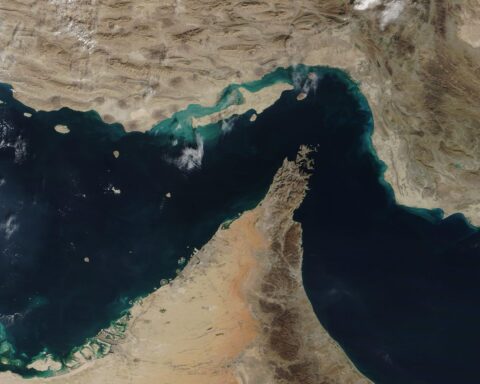
DHAHRAN — When UAE Energy Minister Suhail Al Mazrouei told CNBC on April 28 that “our exit at this time is the right time for it, because it will have a minimum impact on the price,” he was almost certainly right about the barrels and entirely wrong about what those barrels represented. The UAE was not simply OPEC’s third-largest producer; it was the only member whose willingness to cut alongside Saudi Arabia gave Riyadh’s proposals the institutional weight of a Gulf consensus rather than a unilateral demand. Its departure after 58 years of membership leaves the kingdom facing Russia, Iraq, and Kazakhstan — the three largest quota cheaters in OPEC+ history — without a reliable second voice to carry any motion it brings to the table.
The timing strips away any pretense that this is manageable. Saudi Arabia enters this structural isolation with Brent trading well below every published breakeven estimate, a first-quarter deficit that has already consumed three-quarters of the full-year target, and a sovereign wealth fund whose cash reserves have fallen to their lowest level in six years. The kingdom now bears the full cost of production discipline and the full burden of enforcement credibility, simultaneously, alone.
Table of Contents
- The Second Voice
- Why Did the UAE’s Buy-In Matter More Than Its Barrels?
- The Compliance Ledger
- Can Saudi Arabia Enforce Quotas It Cannot Afford to Break?
- The Weapon That Backfires
- What Happens to OPEC+ Spare Capacity Without the UAE?
- The Five-Year Crack
- Where Does Saudi Arabia Find a New Coalition Partner?
- Frequently Asked Questions
The Second Voice
Inside OPEC+ ministerial sessions, production cuts are not decided by formal vote; they are decided by whether the largest producers visibly agree to absorb proportional pain, and the order in which they signal that agreement matters as much as the volume they pledge. When Saudi Arabia proposed the 9.7 million b/d reduction in April 2020 — the largest coordinated cut in oil-market history — the UAE’s parallel commitment to cut, announced alongside Riyadh’s, transformed the proposal from a Saudi demand into a Gulf position that Russia’s Alexander Novak was then pressured to match. The same sequencing operated in November 2022, when OPEC+ cut 2 million b/d over objections from the Biden administration, and again in June 2023, when Saudi Arabia added a voluntary 1 million b/d reduction with Abu Dhabi’s visible backing.
Each of those decisions moved oil prices because the market understood that the Gulf’s two largest capacity holders were acting in concert — and because Russia, Iraq, and Kazakhstan understood that rejecting a joint Saudi-UAE proposal meant opposing not one country but the core of a coalition that controlled the majority of OPEC’s spare production capacity. That second-voice function is gone, and its absence eliminates the framework through which Saudi Energy Minister Prince Abdul Aziz bin Salman converted bilateral pressure into multilateral compliance.
The compliance data quantifies what was lost. At the coalition’s 2021 peak — when the UAE was an active, invested participant — OPEC+ compliance hit 82%, a figure tracked across the group’s production monitoring reports, and the organization’s production targets were credible enough to support a Brent recovery from pandemic lows to above $80. By Q1 2025, with the UAE already disengaged and heading for the door, compliance had fallen to 67%, overproduction had reached 1.2 million b/d, and Iraq, Kazakhstan, and Russia alone accounted for 890,000 barrels per day of the excess. The correlation between the UAE’s institutional commitment and the coalition’s enforcement capacity is not coincidental; it is the mechanism through which OPEC+ functioned when it functioned at all.
Why Did the UAE’s Buy-In Matter More Than Its Barrels?
The UAE’s buy-in transformed Saudi Arabia’s production-cut proposals from unilateral demands into Gulf coalition positions that Russia, Iraq, and Kazakhstan could not dismiss as one country’s preference. Without a second major capacity holder visibly backing Riyadh’s cuts, OPEC+ enforcement lost the institutional credibility that separated a binding agreement from a press release.
The Middle East briefing 3,000+ readers start their day with.
One email. Every weekday morning. Free.
The market fixated on the wrong number when Abu Dhabi walked out. Every analyst note published in the 48 hours after the April 28 announcement led with ADNOC’s 4.85 million b/d production capacity and the roughly 1.45 million b/d gap between that capacity and the UAE’s OPEC+ quota — barrels Abu Dhabi will now bring to market without restraint, targeting 5 million b/d by 2027. Those barrels matter in a supply model, but the institutional mechanics matter more in a price model, because they determined whether Saudi Arabia’s production cuts ever translated into actual supply reductions from the countries that routinely cheated their quotas.
“The Emirati conclusion is that there is no longer utility in belonging to an organization — OPEC — that they feel is dominated by the interests of Saudi Arabia.”
— Council on Foreign Relations, May 2026
Consider the enforcement structure that the UAE’s departure has exposed. OPEC has never had a formal penalty mechanism — no fines, no expulsion trigger, no binding arbitration for quota violations. The only tools available to Saudi Arabia have been bilateral pressure, infrastructure investment deals conditioned on compliance, and the implicit threat of a production-flooding price war — and the UAE’s presence inside the room made the first of those tools effective, because when Prince Abdul Aziz told Iraq’s oil minister that Baghdad needed to honor its commitment, the message carried additional force when Abu Dhabi’s ADNOC — whose capacity dwarfed any cheater’s marginal overproduction — was visibly backing the same demand.
The Arab Center DC put the consequence plainly: the UAE departure “is a blow to the Saudi-led regional order,” and Saudi Arabia will be “forced to cut its production and exports to compensate for UAE increases” without any institutional mechanism to demand reciprocity from the members whose cheating made cuts necessary. Chatham House went further, describing the Saudi-UAE split as “the institutional manifestation of deeper geopolitical repositioning” — Abu Dhabi’s departure transforming the relationship from “structured coordination into embedded and enduring rivalry.” The credibility Abu Dhabi removed from the coalition has already been quantified, in four years of deteriorating compliance data that shows exactly how far the enforcement capacity had eroded before the departure made the erosion permanent.
The Compliance Ledger
The scale of OPEC+ noncompliance is difficult to grasp from the monthly snapshots that dominate energy-desk headlines — a country 50,000 b/d over quota here, 80,000 there — because the individual variances obscure a structural pattern that only becomes visible in cumulative figures. Between January 2024 and July 2025, six OPEC+ members overproduced by a cumulative 4.779 million b/d against their assigned quotas, a total large enough to have absorbed two full rounds of OPEC+ production cuts and rendered them invisible in the supply data. The group adopted a compensation schedule requiring the worst offenders to make up 4.57 million b/d of that excess by mid-2026; as of the last available audit, only 41% of the pledged compensatory cuts had been fully executed, and 30% — nearly a third of all compensation commitments — were completely ignored.
| Country | Quota Compliance (Apr 2025) | Compensation Pledge | Actual Delivery | Delivery Rate |
|---|---|---|---|---|
| Saudi Arabia | ~100% | N/A (fully compliant) | — | — |
| UAE (at exit) | ~100% | N/A (fully compliant) | — | — |
| Russia | 65% | 200,000 b/d (May 2024) | ~85,000 b/d | 42.5% |
| Kazakhstan | 61% | Multiple revised plans | Partial | ~41% (group avg) |
| Iraq | 54% | 150,000 b/d (Sep 2024) | Negligible | ~0% |
| Sources: Argus Media, Interfax, Discovery Alert, OPEC+ Secretariat monitoring reports, January 2024–April 2025. | ||||
The country-level detail is worse than the aggregate. Russia committed to cut 200,000 b/d in May 2024; the actual reduction materialized as roughly 85,000 b/d, a 42.5% delivery rate that Moscow treated as adequate compliance and that no OPEC+ mechanism had the authority to challenge. Iraq pledged 150,000 b/d that September and delivered a negligible actual reduction — consistent with a country whose 54% compliance rate reflects not political unwillingness but institutional incapacity, with Kurdish production operating outside central government control and provincial governors functioning as autonomous commodity exporters answerable to Baghdad in name only.
Kazakhstan, where the Tengizchevroil expansion keeps driving output above any ceiling Astana agrees to in Vienna, showed 61% compliance and has produced four successive updated compensation plans, each largely unexecuted. While that compensation debt mounted, the coalition approved yet another production increase of 188,000 b/d for June 2026 — slightly below May’s 206,000 b/d — continuing to unwind previous cuts even as members failed to honor the terms of those same cuts. These numbers describe a functioning quota system in the same way a bounced check describes a functioning bank account, and they explain why the UAE’s departure — which removes the only other compliant major producer from the table — converts a compliance problem into an enforcement collapse.
Can Saudi Arabia Enforce Quotas It Cannot Afford to Break?
Saudi Arabia cannot enforce quotas it cannot afford to break. Its only demonstrated enforcement tool — production flooding to crash oil prices until cheaters capitulate — requires Riyadh to absorb revenue destruction proportional to its own market share, and the kingdom’s current fiscal position makes it the party least able to survive the weapon’s collateral damage.
The numbers frame the bind with precision. With Brent at $94.58 on June 2, Saudi Arabia is running $14–17 per barrel below the Goldman Sachs consolidated breakeven of $108–111 — a gap that translates to roughly $400 million per day in foregone revenue and an annualized shortfall of approximately $140–150 billion. The Q1 2026 deficit of SAR 125.7 billion ($33.5 billion) consumed 76% of the full-year deficit target of SAR 165 billion in just 90 days, a rate that prompted Goldman to project the full-year deficit at $80–90 billion, or 6–6.6% of GDP. Aramco’s quarterly dividend of $21.89 billion — payable June 9 — now exceeds its quarterly free cash flow of $18.6 billion, which means the state’s primary revenue source is distributing more cash than it earned in the quarter.
A kingdom that has already borrowed to the edge of its debt ceiling, with the national debt management center at roughly 90% of capacity, PIF cash at $15 billion (its lowest level in six years), and Vision 2030 projects being quietly quarantined as financial write-downs, cannot absorb the additional revenue destruction that a 2020-style price war would inflict. A production surge to punish Russia or Iraq for cheating would push Brent toward levels that would blow through every remaining fiscal buffer — Wood Mackenzie projects $80 by December and $65 in 2027, both well below every published Saudi breakeven — and force the kingdom into external borrowing markets at the moment its sovereign credit story depends on demonstrating fiscal discipline.
Columbia University’s Center on Global Energy Policy captured the structural trap: Saudi Arabia faces “competing Trump and OPEC+ priorities,” with Washington pressuring for lower oil prices at exactly the moment Riyadh’s fiscal survival demands higher ones. The enforcement tool exists in theory; deploying it at $94 Brent would push Saudi Arabia below the fiscal floor before any cheater felt the pain — which raises the question of what happened the last two times Riyadh tried.
The Weapon That Backfires
The 1986 precedent is instructive precisely because it proves that production flooding achieves its narrow objective and extracts a cost from the enforcer that takes years to recover. When Saudi Arabia abandoned quota discipline in 1986 to punish members producing above their allocations, oil prices collapsed from roughly $30 to below $10 per barrel, and the kingdom’s revenue fell so severely that it spent the better part of a decade rebuilding fiscal reserves. The cheaters were disciplined, OPEC cohesion was temporarily restored, and Saudi Arabia paid for the restoration with a lost decade of development spending.
The 2020 version was compressed in duration but equally violent in execution. After Russia’s deputy prime minister Alexander Novak rejected an OPEC production cut in March 2020, Saudi Arabia announced plans to bring all spare capacity online targeting 12.3 million b/d and offered deep discounts to key Asian buyers; Brent fell below $20 within weeks, and WTI briefly traded negative for the first time in history. The resolution came through external forces that do not exist in 2026: President Trump called MBS directly, threatening in some accounts to withdraw military support unless Saudi Arabia relented, and the pandemic demand shock absorbed enough global supply disruption to mask the pain of coordinated cuts.
Neither safety valve is available today — there is no demand collapse to cushion oversupply, and Trump’s 2026 posture is to push oil prices down, not broker an OPEC truce to push them up. In 1986, Saudi Arabia had minimal sovereign debt and decades of accumulated reserves to absorb the blow; in 2020, Brent’s pre-crisis level was above breakeven, and the pandemic provided an exit ramp that no one had planned for but everyone used. In 2026, the starting position is already below breakeven, the reserves are already drawn down, and the borrowing capacity is already consumed — which means the question is not whether Saudi Arabia can punish cheaters but what it lost when the UAE took a quarter of OPEC’s spare capacity out the door.
What Happens to OPEC+ Spare Capacity Without the UAE?
OPEC+ loses roughly one quarter of its total spare production capacity with the UAE’s departure. The UAE held 1.54 million b/d of the group’s approximately 5.98 million b/d spare buffer — the second-largest single-country share after Saudi Arabia — and that capacity will now be deployed at Abu Dhabi’s discretion, without reference to any collective output target.
With Abu Dhabi now targeting its stated 5 million b/d production goal by 2027, a quarter of what was previously OPEC+’s strategic reserve has become supply that enters the market on an independent timeline. Rystad Energy described the departure as “spare capacity lost at the worst possible time,” and the timing connects directly to the war: the UAE’s exposure to Iran’s expanding Hormuz transit-toll system — which extended its enforcement map into UAE waters at Fujairah and Umm al Qaiwain on May 22 — means Abu Dhabi needs revenue independence from OPEC constraints at the moment Saudi Arabia needs coalition solidarity most.
Saudi Arabia and Kuwait are now the only OPEC members retaining meaningful uncommitted spare capacity, and Kuwait’s share is a fraction of what the UAE contributed. Saudi Arabia alone now functions as swing producer, quota enforcer, compliance monitor, and spare-capacity holder — four roles that the UAE’s presence inside the coalition had partially distributed across two countries. When a supply disruption occurs — and with Iran asserting unilateral control over Hormuz transit and Saudi Arabia relying on France to deliver its maritime-security message because it cannot send one directly, disruptions are a question of timing, not probability — Riyadh will face the decision alone, bearing a burden the coalition was designed to share.
The dilemma is new in its severity but not in its origins. The fracture between Riyadh and Abu Dhabi has been widening for five years, and the OPEC table was merely the last place where it became impossible to paper over.
The Five-Year Crack
The roots of this rupture trace not to April 2026 but to July 2021, when the same Al Mazrouei who announced the exit refused to extend OPEC+ production cuts unless Abu Dhabi’s baseline was raised from 3.2 million to 3.8 million b/d — a demand that paralyzed the organization for weeks and nearly collapsed the OPEC+ framework two years before the framework actually collapsed. The eventual compromise, a baseline of 3.65 million b/d effective May 2022, satisfied neither party: Saudi Arabia resented the precedent of a member publicly holding the coalition hostage, and the UAE resented a compromise that still left ADNOC producing well over a million b/d below its rapidly expanding capacity.
The Atlantic Council called the 2026 departure “a long time coming,” but the institutional timeline is more precise than that framing suggests. The tension traces to November 2016 and the formation of OPEC+ itself: from the moment the expanded coalition assigned quotas, Abu Dhabi’s allotment failed to reflect its capacity ambitions, and every subsequent year widened the gap between what the UAE could produce and what it was permitted to produce. By the time of the 2021 confrontation, the gap was roughly 800,000 b/d; by the time of departure, it had reached 1.45 million b/d — representing, at $94 Brent, approximately $50 billion in annual revenue that Abu Dhabi was forgoing to preserve a coalition whose largest non-Gulf members were not even honoring their own quotas.
“The UAE’s OPEC exit is not about oil; it is the end of Gulf solidarity.”
— Al Jazeera, April 29, 2026
That assessment reaches well beyond the energy market. The same institutional fracture that removed Abu Dhabi from the OPEC table — a divergence of strategic interests masked for years by a shared label — is playing out across every dimension of the Saudi-UAE relationship, from divergent postures on the Iran war to competing approaches to Washington’s security architecture to the quiet economic competition over foreign direct investment, logistics hubs, and tourism that predated the war and will outlast it. The OPEC departure is the most visible manifestation of a split that now leaves Saudi Arabia searching for a coalition partner in a room where none remains.
Where Does Saudi Arabia Find a New Coalition Partner?
No viable replacement exists inside or adjacent to OPEC+. As the compliance record detailed above makes plain, Russia, Iraq, and Kazakhstan are structural cheaters whose delivery failures are not accidental but systemic. The UAE was the only member with both the production capacity to make its compliance meaningful and the institutional discipline to deliver what it promised.
Russia has never accepted a formal enforcement mechanism and treats compensation pledges as diplomatic gestures rather than production commitments — its delivery rate on the May 2024 pledge is not a failure of execution but a feature of how Moscow approaches multilateral energy agreements, where overproduction serves both revenue needs and the strategic objective of keeping European energy customers dependent on Russian supply infrastructure. Iraq’s noncompliance is structural, not political: the Kurdish production problem documented above has no ministerial fix, because no Iraqi oil minister has ever possessed the legal authority to enforce a Vienna commitment across the full territory of Iraqi output.
Kazakhstan’s Tengizchevroil expansion will continue driving output above any OPEC+ ceiling because the contractual obligations to Chevron and its international partners supersede voluntary OPEC+ commitments in every legal and financial dimension — Astana’s repeated compensation revisions are evidence not of bad faith but of a structural conflict between international oil-company contract law and OPEC+ voluntary frameworks that Astana lacks the authority to resolve. The remaining Gulf producers — Kuwait, which is broadly compliant, and the smaller states whose volumes are too modest to serve as a counterweight — cannot fill the role the UAE occupied, because the role required not just barrels but the perception of an independent Gulf power making an independent strategic choice to align with Riyadh.
That perception is gone. Saudi Arabia’s position inside the coalition that remains is that of a country that cannot afford to cut unilaterally because the fiscal math is already catastrophic, cannot afford to flood because the weapon would destroy its own remaining buffers before it disciplined any cheater, and cannot afford to wait because every month of inaction at current production levels deepens a deficit that is consuming the kingdom’s borrowing capacity at a pace that converts a fiscal problem into a sovereign-credit event. OPEC+ will continue to hold meetings, issue communiqués, and announce production targets — but the UAE’s departure makes one question inescapable: whether the only country still honoring its quota in full is also the only country that can no longer afford to be the only one doing so.
Frequently Asked Questions
When did the UAE join OPEC and what triggered the departure?
Abu Dhabi joined OPEC in 1967, switching to the UAE designation in 1974 after the formation of the federation, making its 58-year membership one of the longest continuous tenures in the organization’s history. The departure was triggered by a decade-long capacity dispute: ADNOC’s production capacity grew from approximately 2.5 million b/d when quotas were last substantively rebased to 4.85 million b/d at the time of exit, meaning the quota system constrained Abu Dhabi more severely with each passing year and each billion dollars invested in upstream expansion. The unannounced nature of the withdrawal — with no advance consultation with other members — signals that Abu Dhabi had concluded the relationship was no longer worth the diplomatic cost of a negotiated departure.
Has any other major OPEC member left the organization?
Qatar departed in January 2019, but Qatar’s production at the time (approximately 600,000 b/d) was a fraction of the UAE’s, and the exit was widely understood as a political statement during the Saudi-led diplomatic blockade rather than a structural capacity dispute. Ecuador left in 2020 and Indonesia suspended its membership in 2016, but neither was a price-setting producer with meaningful spare capacity. The UAE is the first top-five OPEC producer to leave in the organization’s 65-year history, which is why the institutional consequences are categorically different from any prior departure.
Could the UAE rejoin OPEC or coordinate informally?
OPEC’s statute permits readmission by unanimous member vote, but the practical barriers are substantial — the UAE would need to accept a new quota, and having invested billions expanding ADNOC capacity to 5 million b/d specifically because it rejected its former 3.4 million b/d ceiling, rejoining on any terms that constrain production would contradict the strategic logic of leaving. A more plausible arrangement would be an informal coordination mechanism closer to Russia’s original OPEC+ relationship, but this would give Abu Dhabi influence without obligation — an outcome worse for Saudi Arabia than the current clean break, because it would allow the UAE to free-ride on any cuts Riyadh makes while bearing none of the production cost.
What is the June 9 Aramco dividend and why does it matter for OPEC enforcement?
Aramco’s $21.89 billion quarterly dividend — eligibility June 1, payment June 9 — now exceeds Q1 free cash flow by more than $3 billion. The dividend is not discretionary: approximately 98% of Aramco’s shares are held by the Saudi government and PIF, and the dividend is the primary mechanism through which Vision 2030 capital expenditures are funded. Cutting it would signal fiscal distress directly to sovereign-debt markets. That structural lock-in is why oil-price enforcement through production flooding is operationally unavailable: every dollar Brent drops tightens a cash-outflow cycle the kingdom cannot interrupt without triggering the credit event it is trying to avoid. The June 7 OPEC+ supply increase lands squarely inside this bind: 188,000 b/d that Saudi Arabia cannot produce and that the market will price against a breakeven already $13–16 out of reach.
How does the UAE’s departure connect to the Hormuz crisis?
Iran expanded its Persian Gulf Security Architecture (PGSA) enforcement map into UAE waters at Fujairah and Umm al Qaiwain on May 22, directly threatening Abu Dhabi’s maritime export infrastructure. Outside OPEC, the UAE is free to negotiate bilateral transit arrangements with any party — including potential accommodation within the PGSA framework — without reference to Saudi preferences or coalition solidarity obligations. The departure gives Abu Dhabi strategic flexibility on the Hormuz question that membership in a Saudi-dominated organization would have constrained, which is one reason the timing correlates with the escalation of Iran’s maritime-control architecture rather than with any specific OPEC production decision.
The June 7 OPEC+ ministerial meeting that follows the UAE exit adds a further layer to this structural problem: as detailed in the June 7 OPEC+ ministerial that cannot close the gap, the 41st meeting will deliver a production communiqué that cannot move Brent toward the $108–$111 Saudi fiscal breakeven, and the UAE’s departure removes the enforcement architecture that might have made the quotas credible in the first place.