WASHINGTON — The Arms Control Association has given Iran’s negotiators something no amount of PressTV editorializing could produce on its own: an institutional verdict, published in the June 2026 issue of Arms Control Today, declaring the US-Saudi 123 Agreement a “gilded sweetheart deal” that abandons every nonproliferation standard Washington spent seventeen years building. The phrase belongs to Sharon Squassoni, a former government nonproliferation official now at George Washington University’s Elliott School. The argument behind it — that the United States has exempted its closest Gulf partner from the verification requirements it demands of Iran — is not new. What is new is that America’s most established arms control institution has now formalized that argument in language precise enough to cite in a diplomatic communiqué.
Iran has not yet deployed it. No Iranian negotiator has cited the Saudi 123 Agreement in the MOU talks, and no Iranian state media outlet has assembled the comparison into a single explicit brief. That absence is itself informative. Tehran holds a latent asset — a citable, Western-sourced institutional indictment of American nonproliferation credibility — and has not yet spent it. The question is not whether the ACA’s verdict damages Washington’s negotiating position. It already has, by existing. The question is when, and in what forum, Tehran decides to use it.
Table of Contents
- What the ACA Actually Said
- What Did the Gold Standard Require and Why Did Washington Abandon It?
- The Bilateral Safeguards Agreement — What It Covers and What It Misses
- Iran’s Latent Argument
- Does the IAEA Blackout Make the Double Standard Worse?
- The Congressional Resistance and Its Limits
- Who Benefits from the Saudi Precedent?
- Saudi Enrichment Ambitions Are Structural, Not Responsive
- FAQ
What the ACA Actually Said
Squassoni’s June 2026 feature in Arms Control Today lands after four months of incremental ACA coverage — an issue brief in February, a news analysis in March, and now a definitive assessment that reads less like commentary than like a sentencing document. The 123 Agreement between the United States and Saudi Arabia, formalized on May 13, 2026, alongside a $142 billion defense package during Trump’s Riyadh visit, omits three requirements that defined American nuclear cooperation policy since 2009: the prohibition on uranium enrichment, the prohibition on plutonium reprocessing, and the requirement that the recipient state ratify the IAEA Additional Protocol before any US nuclear export licenses are issued.
The ACA’s framing is deliberate. “Gilded” implies something dressed up to disguise inferior material. “Sweetheart” implies terms no arms-length negotiation would produce. Squassoni’s predecessor piece, published in December 2023 under the title “Nuclear Mirage: U.S. Nuclear Cooperation With Saudi Arabia,” diagnosed the same structural problems, but the 2023 analysis was prospective — warning about a deal that had not yet been signed. The June 2026 feature is retrospective. The deal exists. The omissions are no longer hypothetical.
Kelsey Davenport, the ACA’s director for nonproliferation policy, told PBS NewsHour in February that “nuclear cooperation can be a positive mechanism for upholding nonproliferation norms” but that “the devil is in the details” — and that she had “concerns that the Trump administration has not carefully considered the proliferation risks.” By June, the ACA’s institutional position had moved past concern into verdict.
What Did the Gold Standard Require and Why Did Washington Abandon It?
The Gold Standard, established by the 2009 US-UAE 123 Agreement, required three commitments: a permanent ban on uranium enrichment, a permanent ban on plutonium reprocessing, and IAEA Additional Protocol ratification before any US nuclear exports. The Trump administration dropped all three for Saudi Arabia, framing the concession as a competitive necessity against Chinese, Russian, and South Korean bids.
The Middle East briefing 3,000+ readers start their day with.
One email. Every weekday morning. Free.
The UAE agreement, negotiated under the Obama administration, required the UAE to accept comprehensive IAEA access across its entire nuclear program — not only at facilities involving US cooperation. The UAE is now operating the Barakah nuclear plant, four reactors built under those terms.
Saudi Arabia refused those terms. Multiple rounds of 123 negotiations between 2018 and 2024 collapsed specifically because Washington insisted on the Gold Standard and Riyadh would not accept it. The Trump administration broke the impasse by dropping the demand. The administration’s report to Congress, submitted in late November 2025, framed the concession as countering “failed policies” and competing against Chinese, French, Russian, and South Korean bids for Saudi nuclear business.
The competitive-pressure argument has a factual basis — Russia and China have both offered Saudi Arabia nuclear cooperation without enrichment restrictions — but it inverts the purpose of Section 123 of the Atomic Energy Act. The statute requires a bilateral agreement meeting nine nonproliferation criteria before the US can engage in civilian nuclear cooperation with a foreign country. Twenty-three such agreements are currently in force. The law does not mandate an enrichment prohibition; the Gold Standard was a policy choice, not a statutory requirement. But it was a policy choice the United States defended for seventeen years, including against allies, and the decision to abandon it for the largest arms customer in the Gulf carries a specific diplomatic cost that the ACA’s June feature now quantifies.
| Requirement | US-UAE 123 (2009) | US-Saudi 123 (2026) |
|---|---|---|
| Enrichment prohibition | Yes — permanent, written into agreement | No — omitted entirely |
| Reprocessing prohibition | Yes — permanent, written into agreement | No — omitted entirely |
| IAEA Additional Protocol | Required before any US export licenses | Not required — substituted by bilateral arrangement |
| Scope of IAEA access | Entire nuclear program | Joint US-Saudi cooperation facilities only |
| Congressional review | Standard Section 123 process | Standard Section 123 process |
The Bilateral Safeguards Agreement — What It Covers and What It Misses
The replacement mechanism deserves close reading. Instead of requiring Saudi Arabia to ratify the IAEA Additional Protocol — a voluntary enhancement to standard safeguards that over 140 countries have adopted, granting the IAEA authority to inspect both declared and undeclared nuclear sites on short notice — the 123 Agreement substitutes a Bilateral Safeguards Agreement. Under this arrangement, IAEA-“involved” verification applies only to “the most proliferation sensitive areas of potential nuclear cooperation between the Kingdom of Saudi Arabia and the United States” — specifically enrichment, conversion, fuel fabrication, and reprocessing facilities that are part of the bilateral cooperation framework.
The distinction is not cosmetic. The Additional Protocol (INFCIRC/540) gives the IAEA access to a state’s entire nuclear program, including the authority to investigate activities and locations the state has not declared. The bilateral arrangement covers only facilities where US-Saudi cooperation occurs. Any Saudi nuclear activity outside that cooperation framework — facilities built with Chinese, Russian, or South Korean technology, or indigenously developed programs — falls outside the verification scope.
Robert Einhorn, a senior fellow at the Brookings Institution who has written extensively on the proliferation implications of Gulf nuclear programs, proposed in April 2024 that if enrichment were authorized for Saudi Arabia, IAEA verification should go “beyond the Additional Protocol” and be modeled on Iran’s JCPOA-era inspection terms. The Trump administration’s actual agreement falls below the Additional Protocol, let alone JCPOA-level verification — a gap Einhorn’s analysis anticipated and the ACA feature now documents.
Iran’s Latent Argument
Iran has not formally assembled this comparison into a diplomatic brief — but the raw materials are in Iranian hands. PressTV reported the Saudi 123 Agreement on February 21, 2026, as “a major departure from the longstanding US non-proliferation policy in the West Asia region,” noting that the deal “does not expressly forbid uranium enrichment.” The same outlet reported Saudi Energy Minister Prince Abdulaziz bin Salman’s public statement that the kingdom would “enrich uranium and produce ‘yellowcake,’” citing Saudi uranium reserves and asserting the right to a complete nuclear fuel cycle.
Separately, on May 17, 2026, PressTV ran analysis framing US demands on Iran’s enrichment program as “illegal” and “humiliating,” citing NPT Article IV and the argument — attributed to Dr. Peter Kuznick of American University’s Nuclear Studies Institute — that Washington’s demands amounted to an attack on Iran’s “inalienable right” under the treaty. Iranian Foreign Minister Abbas Araghchi declared at the UN disarmament conference in Geneva in February 2026 that Iran’s right to enrich uranium was “inherent and non-negotiable” and that “zero enrichment can never be accepted by us.”
These are parallel tracks. The Iranian domestic narrative (we have a right to enrich) and the Saudi precedent (America just conceded that right to our rival) have not been joined in an official Iranian statement. The ACA’s June feature — authored by a Western institutional voice, not by Tehran — now provides the connective tissue. If and when Iran chooses to make the argument in a negotiating forum, it will not need to cite PressTV. It can cite Arms Control Today.
Russia has moved closer to making the connection explicit. In May 2026, Moscow “slammed the UN and IAEA” — per PressTV’s characterization — for applying “double standards” on Iran, noting that US and Israeli strikes on Iranian nuclear sites went unpunished. The double-standards frame is already in active diplomatic circulation. The Saudi 123 Agreement gives it a second, more specific instantiation.
Does the IAEA Blackout Make the Double Standard Worse?
Yes. Washington is simultaneously demanding Iran accept verification terms the IAEA cannot currently enforce — inspectors have been denied access since February 28, 2026 — while exempting Saudi Arabia from the Additional Protocol that would give the IAEA its broadest inspection authority. The demand and the exemption coexist in the same diplomatic season.
The ACA feature arrives during a specific verification vacuum. The IAEA’s ability to monitor Iran’s nuclear program has been suspended since February 28, 2026, when inspectors were denied access following military strikes on Iranian nuclear infrastructure. The last verified data point — 440.9 kilograms of uranium enriched to 60% U-235 — comes from IAEA Board of Governors report GOV/2026/8, dated February 27, 2026. As of June 2, that figure is ninety-five days old and functionally meaningless as a baseline for negotiations. On June 5, the IAEA’s first wartime report on Iran’s nuclear programme confirmed it still cannot verify the current size, composition, or whereabouts of that stockpile — 97 days into the blackout.
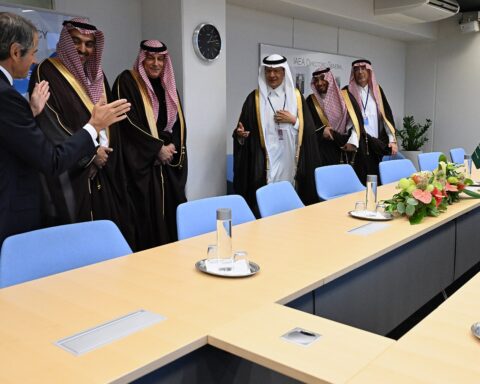
IAEA Director General Grossi addressed the verification vacuum directly when he convened an emergency Board of Governors session in Vienna on June 5, following a four-country Gulf tour that ended in Riyadh — where he met separately with Saudi Foreign Minister Prince Faisal bin Farhan and Energy Minister Prince Abdulaziz bin Salman. Grossi’s Gulf tour placed Saudi Arabia’s civilian nuclear programme on the IAEA’s active regional security agenda for the first time during the conflict.
Iranian lawmakers told the UN nuclear watchdog in May 2026 that enrichment “to 93% is Iran’s right under the NPT” — the most aggressive articulation of the Article IV argument to date. That claim is extreme and contested. But it arrives in a context where the United States has just conceded that its closest Gulf ally need not accept the standard verification instrument 140 countries have adopted. The 93% claim and the Saudi exemption are not equivalent, but they exploit the same crack in the nonproliferation architecture — and the ACA has now handed Iran a Western citation for the width of that crack.
Carnegie Endowment analysis from May 4, 2026 adds a further layer: Iran’s enrichment infrastructure is “largely inoperable” following June 2025 strikes, but large stockpiles of enriched uranium remain, and Iran has denied access to damaged sites, leaving inspectors unable to enforce any verification terms even if agreed. The MOU’s demand for a uranium timeline runs into the same verification gap the ACA feature describes from the Saudi side — Washington cannot verify what Iran has, and it has not required verification of what Saudi Arabia will do.
The Congressional Resistance and Its Limits
The ACA’s verdict does not exist in a vacuum. Congressional opposition to the Saudi 123 Agreement has been bipartisan and specific — and entirely ineffective so far.
Senator Edward Markey of Massachusetts, who has led the legislative resistance, accused the Trump administration on February 20, 2026, of “caving to Saudi demands” and “writing a recipe for nuclear disaster.” His language escalated by March, when a joint Congressional letter to Secretary of State Rubio — signed by twelve members — charged the administration with “waging a reckless and illegal war with Iran over its uranium enrichment program while simultaneously enabling Saudi nuclear development.” Markey called the resulting framework a “Nuclear Wild West.”
The “No Nuclear Weapons for Saudi Arabia Act of 2026,” S. 4243, was reintroduced by Markey and Senator Jeff Merkley on March 25, 2026. It would require any 123 agreement with Saudi Arabia to receive affirmative Congressional approval before taking effect. The bill was referred to the Senate Foreign Relations Committee. No floor vote has been scheduled.
The bipartisan dimension is real but narrow. Senator Jim Risch, the Republican chair of the Foreign Relations Committee, stated that the Gold Standard “has to be included” in a Saudi 123 agreement. Senator Jeanne Shaheen, the ranking Democrat, warned that “Saudi Arabia’s stated intention to acquire nuclear weapons if Iran does demands extreme caution” and that “any potential civilian nuclear cooperation agreement with Saudi Arabia must include enhanced inspections through an Additional Protocol.” Andrea Stricker of the Foundation for Defense of Democracies — a hawkish institution not typically aligned with the ACA — warned that allowing Saudi enrichment or reprocessing “would erode global nonproliferation norms and set a dangerous precedent in an already volatile region.”
The convergence of progressive Democrats, centrist Democrats, a Republican committee chair, and a neoconservative think tank on the same critique is unusual. It has produced letters, hearings, and a bill number. It has not produced a vote, a hold, or a veto. The 123 Agreement, as signed, is moving through the statutory review process with the administration’s backing and a $142 billion commercial relationship behind it.
Who Benefits from the Saudi Precedent?
South Korea, Turkey, Egypt, and the UAE all have standing to cite the Saudi deal when seeking better terms under their own agreements. The UAE accepted enrichment and reprocessing prohibitions in 2009 — its Barakah plant runs under those terms. Its neighbor’s program, approved seventeen years later, carries neither restriction.
Einhorn’s question — posed in his Brookings analysis — extends the problem beyond the bilateral: “After saying ‘yes’ to Saudi Arabia, how could the United States say ‘no’ to a treaty ally like South Korea?” The precedent is not limited to the Middle East.
South Korea has sought enrichment rights under its own 123 Agreement for years, citing its advanced nuclear industry and the need for fuel cycle independence. The United States has resisted. Japan’s 123 Agreement, renewed in 2018, permits reprocessing — but Japan ratified the Additional Protocol and operates under comprehensive IAEA safeguards, a distinction the Saudi agreement explicitly avoids.
The 2026 NPT Review Conference — which the ACA’s June issue reports was “stymied by disputes” — provides the multilateral backdrop. The nonproliferation treaty’s bargain rests on a three-part deal: nuclear-weapon states commit to disarmament, non-weapon states forswear weapons, and in exchange all parties retain the right to peaceful nuclear energy under IAEA safeguards. When the United States exempts a partner from the standard verification framework while demanding a rival accept more than the standard framework, the treaty’s internal logic is strained in a way that every signatory can see.
| Country | Enrichment Permitted | IAEA Additional Protocol | Safeguards Scope |
|---|---|---|---|
| UAE (2009) | No | Required | Entire program |
| Japan (2018) | Yes (reprocessing also) | Ratified | Entire program |
| South Korea (2015) | No (enrichment restricted) | Ratified | Entire program |
| Saudi Arabia (2026) | Not prohibited | Not required | Joint cooperation facilities only |
Saudi Enrichment Ambitions Are Structural, Not Responsive
The Stimson Center’s 2026 analysis concluded that Saudi Arabia’s nuclear path “will not depend on Iran or the war’s outcome.” The enrichment ambition is not a reaction to the current crisis. It predates it.
MBS publicly stated in 2018 that if Iran developed a nuclear weapon, Saudi Arabia would “follow suit as soon as possible.” That conditional framing — linking Saudi nuclear development to Iranian achievement — has since been abandoned in practice. Prince Abdulaziz bin Salman’s February 2026 statement claiming the right to enrich uranium and produce yellowcake invoked Saudi uranium reserves, not Iranian capabilities. The 123 Agreement itself was negotiated alongside a defense package whose scale — $142 billion — reflects a commercial and strategic relationship that operates independently of the Iran file.
This distinction matters for the ACA’s argument. If Saudi enrichment ambitions were purely responsive — a hedge against an Iranian bomb — then the nonproliferation case could be framed as managing a security dilemma. The Stimson finding that the ambition is structural removes that defense. Saudi Arabia is pursuing enrichment capability as a sovereign industrial goal, and the United States has agreed to facilitate that pursuit without the verification architecture it applies to every other enrichment-capable partner.
The fiscal pressures on Riyadh — a Q1 2026 deficit that reached 76% of the full-year target in ninety days, with Brent crude sitting at $91 against a Bloomberg-consolidated breakeven of $108-111 — do not diminish the nuclear ambition. They may accelerate it. A nuclear fuel cycle is a long-term infrastructure play. The $142 billion defense package that accompanied the 123 Agreement included, per The Hill’s pro-deal framing, provisions that supporters argue will keep Saudi Arabia inside the American technology ecosystem rather than pushing it toward Russian or Chinese alternatives. The commercial logic of the deal and the nonproliferation logic of the deal pull in opposite directions, and the ACA’s feature is a formal statement that the commercial logic won.

The pro-deal argument — advanced in a Hill op-ed titled “A good nuclear deal won’t put Saudi Arabia on a path for the bomb” — rests on the claim that engagement is better than exclusion, and that the bilateral safeguards arrangement, while narrower than the Additional Protocol, still involves the IAEA in the most sensitive facilities. Responsible Statecraft described the same deal as a “sweet nuclear deal” given “amid turmoil.” Middle East Eye reported in February that it would face a “rough ride in Congress.” Just Security published a legal-procedural analysis of how Congress should evaluate it. The competing coverage spans the full ideological range, and by June the ACA’s verdict sits at the nonproliferation-maximalist end — but with company from the Foundation for Defense of Democracies on the right and twelve members of Congress across both parties.
The weight of the ACA assessment comes from institutional positioning. Arms Control Today is not a blog or an advocacy newsletter. It is the publication of record for the American arms control community, read by the State Department’s nonproliferation bureau, by IAEA officials in Vienna, and — when they choose to read it — by the diplomats who staff Iran’s mission to the United Nations. Squassoni’s “gilded sweetheart deal” is now part of the nonproliferation literature. It will be cited in academic papers, in Congressional Research Service reports, and in the talking points of any government that wants to argue that American nonproliferation policy is selectively enforced.
Iran does not need to make that argument today. The MOU negotiations are in a different phase — dominated by the Hormuz crisis, the counterparty void in Tehran, and the military facts on the ground. But diplomatic arguments are not perishable. They accumulate. And the ACA has just added a document to Iran’s file that Washington’s own nonproliferation establishment authored, on Washington’s own credibility, in Washington’s own journal of record.
Frequently Asked Questions
Has Iran officially cited the Saudi nuclear deal in MOU negotiations?
No. As of June 2, 2026, no confirmed instance exists of Iranian negotiators or state media formally citing the US-Saudi 123 Agreement as an argument in the MOU talks. PressTV has covered the deal and the enrichment double standard in separate reports — the February 21 coverage called it “a major departure” from US nonproliferation policy, and the May 17 coverage framed US demands on Iranian enrichment as attacks on NPT Article IV rights — but these have not been synthesized into a single diplomatic brief. Russia has come closer to making the explicit connection, accusing the IAEA and UN of “double standards” on Iran in May 2026. The latency of the argument — available but not yet deployed — may itself be a strategic choice by Tehran, holding the comparison in reserve for a moment of maximum diplomatic utility rather than spending it in the current phase of military escalation.
What is Section 123 of the Atomic Energy Act and how many agreements exist?
Section 123 is the provision of the US Atomic Energy Act (42 USC 2153) that governs civilian nuclear cooperation between the United States and foreign countries. Any agreement for the transfer of nuclear material, equipment, or technology must meet nine nonproliferation criteria specified in the statute, undergo Congressional review, and receive Presidential certification. Twenty-three such agreements are currently in force globally, covering countries from Australia to Vietnam. The law does not itself mandate an enrichment or reprocessing prohibition — that policy innovation came with the 2009 UAE agreement and became known as the Gold Standard through subsequent diplomatic practice rather than statutory command. The Congressional review period under Section 123 is ninety legislative days, during which either chamber can pass a joint resolution of disapproval — a mechanism that requires a veto-proof majority to override the President and has never been successfully invoked against a 123 agreement.
How does the Brookings “beyond Additional Protocol” proposal compare to what was actually signed?
Robert Einhorn’s April 2024 Brookings analysis proposed that if the United States were to permit Saudi enrichment, verification requirements should exceed even the Additional Protocol and be modeled on the inspection terms Iran accepted under the JCPOA — which included managed access to military sites, continuous monitoring of centrifuge production, and a 25-year procurement channel arrangement. The actual 123 Agreement falls below the Additional Protocol (facility-specific rather than program-wide verification) and far below JCPOA-level terms. Einhorn also proposed that enrichment, if authorized, be limited to low-enriched uranium below 5% and conducted only at multinational facilities with international equity participation — neither condition appears in the agreement as signed. The gap between the Brookings recommendation and the final deal is wider than the gap between the Gold Standard and the Brookings recommendation.
Could Saudi Arabia still ratify the Additional Protocol voluntarily?
Technically, yes. The Additional Protocol is a voluntary instrument — any NPT signatory can negotiate and ratify one with the IAEA at any time, and 140-plus countries have done so. Saudi Arabia has a Comprehensive Safeguards Agreement (CSA) with the IAEA but has not ratified an Additional Protocol. The 123 Agreement does not prohibit Saudi Arabia from doing so; it simply does not require it as a precondition for US nuclear exports. Senator Shaheen’s call for “enhanced inspections through an Additional Protocol” and Senator Risch’s statement that the Gold Standard “has to be included” both point toward Congressional pressure for voluntary adoption, but no enforcement mechanism exists outside the legislative process. The Bilateral Safeguards Agreement substituted in the 123 text is a separate, narrower instrument that coexists with the CSA — it does not replace or expand the CSA’s scope, and it does not provide the undeclared-site inspection authority that is the Additional Protocol’s central contribution to nonproliferation verification.
What is the status of the “No Nuclear Weapons for Saudi Arabia Act”?
S. 4243, the “No Nuclear Weapons for Saudi Arabia Act of 2026,” was introduced by Senators Edward Markey and Jeff Merkley on March 25, 2026. The bill would require any 123 agreement with Saudi Arabia to receive affirmative Congressional approval — as opposed to the current passive-review process where the agreement takes effect unless Congress passes a joint resolution of disapproval. It was referred to the Senate Foreign Relations Committee, where Chairman Risch has expressed Gold Standard preferences but has not scheduled a markup or hearing specifically on S. 4243. The twelve-signatory March 18 letter to Secretary Rubio demanding Gold Standard compliance represents the outer boundary of active Congressional resistance. No companion bill has been introduced in the House. The practical effect is that the legislative track remains available but dormant, while the 123 Agreement proceeds through its statutory review period under existing law. That double-standard argument gained a direct institutional test when Washington circulated a draft IAEA Board censure condemning Iran on June 5 — the same day Grossi called nuclear talks “pretty close.” Saudi Arabia’s Board seat turned the contradiction into a vote trap that the 123 Agreement’s verification gap made harder to escape.