
Every year on 22 February, Saudi Arabia marks Founding Day — a national holiday commemorating the establishment of the First Saudi State in 1727 by Imam Muhammad bin Saud. For travellers planning a wider Saudi Arabia itinerary, Founding Day offers a rare window into the Kingdom’s pre-oil identity: heritage parades through mud-brick fortresses, traditional sword dances under floodlights, and an entire nation dressed in centuries-old regional costumes. It is one of the most visually spectacular days of the Saudi calendar — and one of the best times to visit.
Date: 22 February (annual public holiday)
Best Time to Arrive: 20–21 February (events start a day before in major cities)
Getting There: Fly into Riyadh for the main events at Diriyah; Jeddah and Dammam host parallel celebrations
Visa Required: Yes — tourist e-visa available online
Budget: USD 80–200/day (most public events are free)
Must-See: Ardha sword dance at At-Turaif, Diriyah Founding March, city-wide drone and fireworks shows
Avoid: Driving near event venues on the evening of 22 February — expect heavy traffic and road closures in central Riyadh
What Is Saudi Founding Day?
Founding Day marks the moment in 1727 when Imam Muhammad bin Saud became the ruler of Diriyah, a mud-brick settlement in the Najd region northwest of present-day Riyadh. His ascension launched the First Saudi State — a political entity that unified the towns and tribes of central Arabia, secured pilgrimage routes, and expanded trade across the peninsula.
King Salman bin Abdulaziz Al Saud formally established Founding Day as a national holiday on 27 January 2022 via Royal Decree No. A/371. The date — 22 February — was chosen to mark the year 1727, when Imam Muhammad bin Saud took power, rather than the later 1744 alliance with the religious scholar Muhammad ibn Abd al-Wahhab. The distinction is deliberate: Founding Day celebrates statehood and governance, not religious partnership.
Saudi Arabia already celebrates Saudi National Day on 23 September, which marks King Abdulaziz’s 1932 unification of the Kingdom. Founding Day, by contrast, reaches three centuries further back — honouring the original founding of the Saudi political project in Diriyah.
Why Founding Day Matters for Travellers
Founding Day is not a sombre state occasion. It is a nationwide cultural festival — think military air displays, heritage villages reconstructed in public parks, traditional cuisine served from open-air stalls, and tens of thousands of Saudis parading through city centres in regional dress. For international visitors, it offers several practical advantages:
- Free public events. The vast majority of Founding Day events — parades, fireworks, drone shows, heritage exhibitions — are free and open to the public.
- Cultural immersion. Saudis actively welcome visitors on Founding Day. Wearing traditional dress (even partially) is encouraged, and many locals will invite foreigners to join family celebrations.
- Extended weekend. Founding Day is an official public holiday, and when it falls near a weekend it creates a three- or four-day break — perfect for combining the celebrations with a Riyadh city break or a trip to AlUla.
- Winter weather. Late February brings some of Saudi Arabia’s most pleasant temperatures — highs of 24–27°C in Riyadh, cooler in the highlands — ideal for outdoor events. See our Saudi Arabia weather guide for regional breakdowns.
- The date palm — sustenance and generosity
- The Arabian horse — chivalry and strength
- The falcon — heritage and nobility
- The market (souq) — trade and prosperity
- Interactive craft workshops (pottery, weaving, leatherwork)
- Traditional food stalls serving dishes like jareesh, kabsa, and margoog
- Falconry displays and Arabian horse shows
- Storytelling sessions on the history of Diriyah and the First Saudi State
- Children’s workshops and educational activities
- Qasr Al-Hukm (Justice Square) — the historic centre of Riyadh, decorated in green and white with a full programme of cultural activities, heritage exhibitions, and traditional performances.
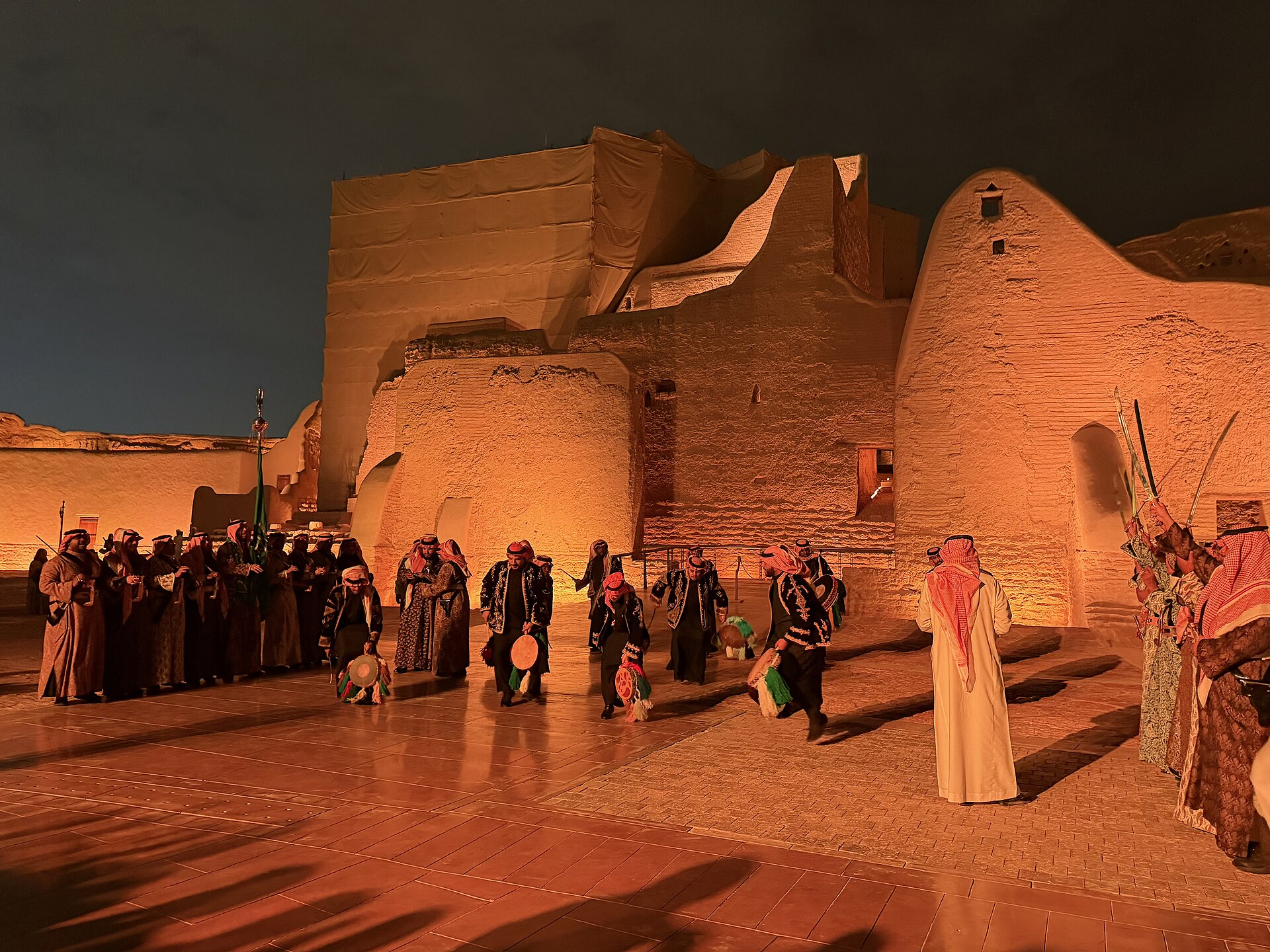
- At-Turaif District, Diriyah — the UNESCO World Heritage Site and birthplace of the First Saudi State. The Diriyah Gate Development Authority organises interactive historical experiences, the Founding March procession, heritage storytelling, and the signature Ardha performance against the backdrop of the illuminated mud-brick Salwa Palace.
- Al-Liwan — a large-scale heritage show featuring theatrical reenactments of life in 18th-century Diriyah.
- Fireworks over the Jeddah Corniche on the evening of 22 February
- Folkloric shows and live traditional music by popular troupes in Al-Balad
- Prince Majed Park field activities including falconry, horse displays, traditional crafts, children’s activities, and henna art
- Streets decorated with flags, lights, and the Founding Day visual identity
- Jareesh — crushed wheat cooked with yoghurt and meat
- Margoog — thin dough squares in a tomato-based vegetable and meat stew
- Kabsa — spiced rice with lamb or chicken, the Saudi national dish
- Arabic coffee and dates — served freely at almost every public event
- AlUla (1.5-hour flight from Riyadh) — explore the Nabataean tombs of Hegra, Elephant Rock, and the Maraya concert hall. See our AlUla travel guide.
- Jeddah (1-hour flight) — combine with the historic Al-Balad district, the Corniche, and Red Sea diving. See our Jeddah travel guide.
- Edge of the World (90-minute drive from Riyadh) — a dramatic escarpment with views over the desert. One of the best sunrise spots in the Kingdom.
- Abha and the Asir Mountains (1.5-hour flight) — cool highlands, terraced villages, and the Abha cable car.
- Saudi Arabia Travel Guide 2026 — The complete guide to visiting the Kingdom
- Riyadh Travel Guide — Explore the capital city where the main Founding Day events take place
- Saudi Arabia in February — Weather, events and what to do during Founding Day month
- Saudi Arabia in September — When Saudi National Day takes centre stage
- AlUla Travel Guide — Ancient tombs and desert festivals near Founding Day
- Saudi Arabia Visa Guide — Every visa type explained
The History Behind the Holiday
Diriyah and the First Saudi State (1727–1818)
The story begins in Diriyah, a settlement founded around 1446 by Mani’ ibn Rabi’a al-Muraydi in the Wadi Hanifa valley. For nearly three centuries, Diriyah grew under the Al Saud family’s leadership. When Imam Muhammad bin Saud assumed power in 1727, he transformed Diriyah from a regional town into the capital of a state that would eventually control most of the Arabian Peninsula.
Imam Muhammad secured stability within Diriyah, fortified its walls, regulated trade, and protected the pilgrimage routes connecting the Hejaz to Najd. The First Saudi State lasted until 1818, when an Ottoman-Egyptian expedition destroyed Diriyah. But the Saudi political project survived — through the Second Saudi State (1824–1891) and finally into the modern Kingdom founded by King Abdulaziz in 1932.
The Founding Day Logo and Visual Identity
The official Founding Day visual identity, launched in 2022 under the slogan “Our Story”, features a circular emblem with a figure carrying the Saudi flag, wearing the traditional shemagh and agal. Surrounding the flag bearer are four symbols representing pillars of the state since 1727:
The colour palette uses heritage-inspired earthy tones alongside the national green — you will see these colours on street banners, building projections, and in the traditional dress worn across the Kingdom.
How Saudi Arabia Celebrates Founding Day
Traditional Dress
The most visible element of Founding Day is the nationwide wearing of traditional dress. On 22 February, millions of Saudis swap modern clothing for regional costumes that vary dramatically by area. Men wear the thobe with a heritage bisht (cloak), shemagh or ghutra, and agal. Women wear colourful embroidered dresses — styles from Najd differ from those of Hejaz, Asir, or the Eastern Province — completed with traditional jewellery and henna.
Green abayas and jalabiyas with gold embroidery are especially popular. The official Founding Day fashion guide lists 22 styles of costumes, each reflecting a distinct region of the Kingdom. Visitors are not expected to dress traditionally, but those who do — even just adding a shemagh — are warmly received. For guidance on general dress in Saudi Arabia, see our customs and etiquette guide.
The Ardha Sword Dance
The Ardha (العرضة) is the iconic Saudi sword dance — a rhythmic, chanted performance where rows of men move in unison, brandishing swords to the beat of drums. It originates from Najd and has been performed before battle and at celebrations for centuries. On Founding Day, large-scale Ardha performances take place at heritage sites across the Kingdom, with the most spectacular staged at At-Turaif in Diriyah.
Fireworks and Drone Shows
After sunset on 22 February, major cities stage fireworks and drone light shows. Riyadh’s skyline is typically lit with formations depicting the Founding Day emblem and national symbols. Jeddah’s Corniche and waterfront host parallel displays. In 2026, drone choreography has become increasingly sophisticated — expect formations of the Arabian horse, the palm tree, and the Saudi flag painted across the night sky.
Heritage Exhibitions and Cultural Events
Cities across the Kingdom set up heritage villages — open-air reconstructions of 18th-century Saudi life. These typically include:
Where to Celebrate Founding Day
Riyadh — The Heart of the Celebrations
As the capital and the city closest to Diriyah, Riyadh hosts the largest and most elaborate Founding Day programme. Key venues include:
Riyadh Municipality decorates streets and main roads with more than 5,000 lighting installations across key intersections, squares, and public spaces. Getting around is easiest via the Riyadh Metro or ride-hailing apps — check our essential apps guide for Careem and other options.
Jeddah
Jeddah’s programme centres on the waterfront and the historic Al-Balad district. Expect:
If you are combining Founding Day with a longer Jeddah stay, see our Jeddah travel guide and parks and waterfront guide.
Dammam and the Eastern Province
The Dammam–Al Khobar corridor hosts folklore performances, open-air cinema screenings of heritage films, and street decorations along the Corniche. Events are smaller than in Riyadh or Jeddah but offer a more local, community-driven atmosphere.
AlUla
AlUla’s Founding Day programme has grown significantly in recent years. The Al-Srraya Festival (typically 21–23 February) offers an immersive cultural experience through the Kingdom’s founding journey with interactive exhibits and activities. The Kokub Event on the Maraya rooftop blends electronic music with traditional heritage under the desert stars. AlUla’s dramatic landscape — sandstone canyons and the ancient Nabataean tombs of Hegra — make it one of the most visually striking places to experience the holiday.
Abha and the Highlands
The Asir highlands bring their own distinct flavour to Founding Day. Abha and the surrounding villages celebrate with traditional Asiri dance, flower garlands, and regional costumes that are among the most colourful in the Kingdom. If you are visiting in late February, the highland weather — highs of 18–22°C — is perfect for outdoor events.
Other Cities
Founding Day celebrations now reach 15+ cities nationwide, including Tabuk, Hail, Buraydah, and Najran. Every region adds its own local traditions — from the wheat dances of Qassim to the maritime heritage displays of the Gulf coast. Streets in virtually every Saudi city are decorated with the Founding Day visual identity by mid-February.
Visiting Diriyah — The Birthplace of Saudi Arabia
No Founding Day visit is complete without seeing Diriyah itself. Located just 20 minutes northwest of central Riyadh, Diriyah is where the entire Saudi story began.
At-Turaif District (UNESCO World Heritage Site)
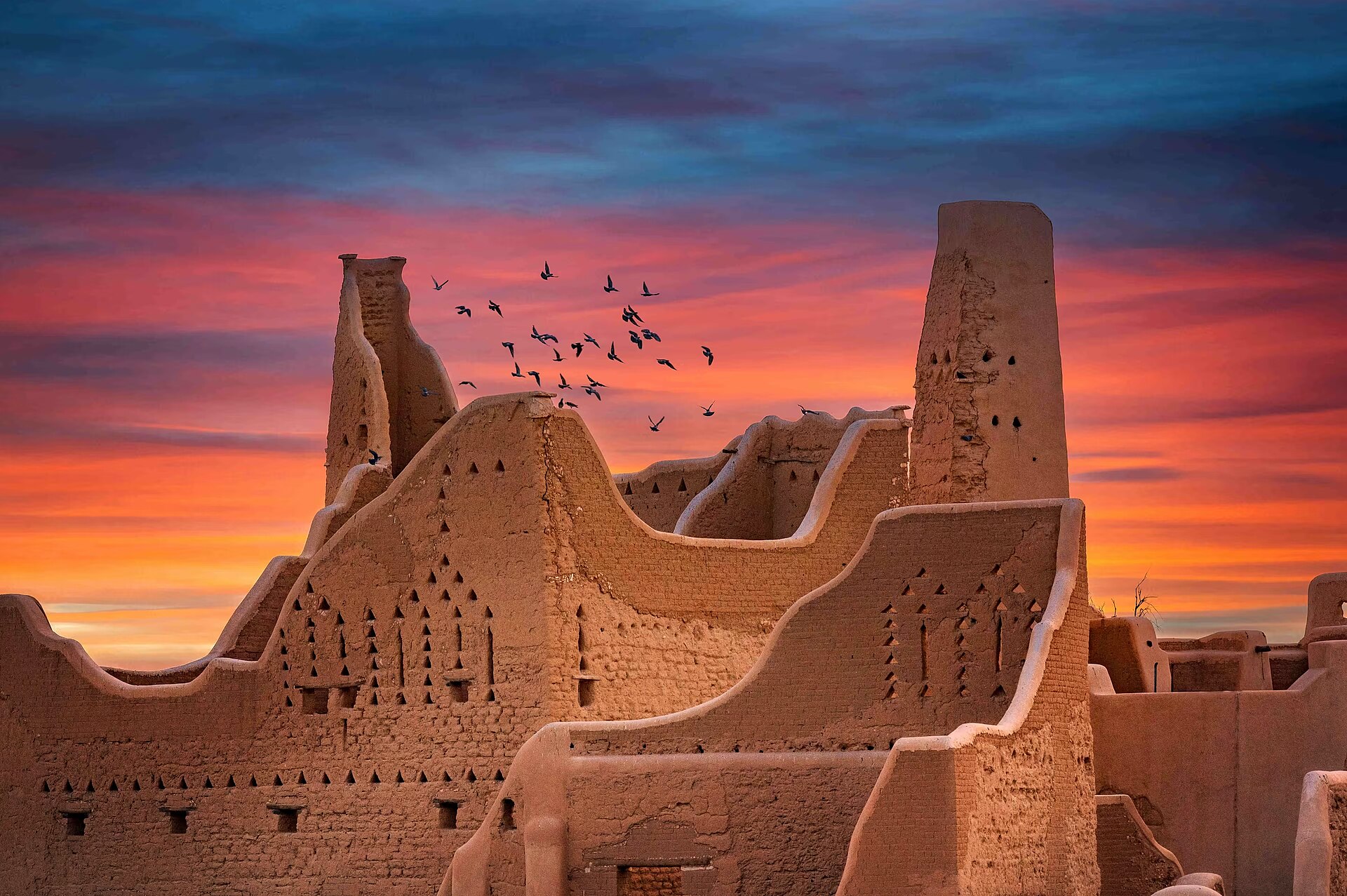
The At-Turaif District was inscribed as a UNESCO World Heritage Site in 2010. It is a stunning example of Najdi architecture — mud-brick walls with geometric decorations, narrow passageways, and the remains of the Salwa Palace where Imam Muhammad bin Saud once ruled. The site has been extensively restored and is open to visitors year-round, but during Founding Day it becomes the centrepiece of the national celebrations.
Tip: At-Turaif can get extremely crowded on 22 February. Arrive early in the morning for quieter exploration, then return for the evening Ardha performance and light shows. Guided tours are available through the Diriyah Gate Development Authority.
The Diriyah Gate Development
The massive Diriyah Gate mega-project is transforming the area around At-Turaif into a world-class cultural and tourism destination with heritage museums, boutique hotels, restaurants, and retail — all designed to complement the ancient structures. Construction is ongoing, but many elements are now open to visitors.
Practical Tips for Founding Day Visitors
When to Book
Founding Day falls in peak winter season, and hotel prices in Riyadh rise significantly for the 20–23 February period. Book accommodation at least 4–6 weeks in advance. For hotel recommendations, see our Saudi Arabia hotels guide.
Getting Around
Major roads near event venues in Riyadh — especially around Justice Square and Diriyah — are closed to traffic on the evening of 22 February. The Riyadh Metro (Lines 1–6) is the most efficient way to move around the city. Ride-hailing via Careem or Uber is available but expect surge pricing and longer wait times. For more on transport options, see our domestic flights guide and Haramain train guide for intercity travel.
Photography
Founding Day is one of the most photogenic days in Saudi Arabia. The combination of heritage architecture, traditional dress, and evening light shows creates outstanding opportunities. However, always ask before photographing individuals, especially women. Check our photography rules guide for full details.
Food and Drink
Heritage food stalls at Founding Day events serve traditional Saudi dishes that are difficult to find the rest of the year. Look for:
Ramadan Overlap
In some years, Founding Day falls during Ramadan (as it did in 2026). When this happens, daytime events are adjusted — public celebrations shift to evening hours after iftar, creating a unique fusion of Ramadan atmosphere and national festivity. Restaurants and food stalls open after sunset, and the cultural programme extends late into the night.
Visa and Entry
International visitors need a valid visa. Citizens of 63 countries can obtain a tourist e-visa online within minutes — see our comprehensive Saudi Arabia visa guide for eligibility, costs, and the application process.
Founding Day vs Saudi National Day
Visitors sometimes confuse the two holidays. Here is how they differ:
| Founding Day | Saudi National Day | |
|---|---|---|
| Date | 22 February | 23 September |
| Established | 2022 (Royal Decree A/371) | Observed since 2005 as public holiday |
| Commemorates | First Saudi State, 1727 — Imam Muhammad bin Saud’s rule in Diriyah | Unification of the Kingdom, 1932 — King Abdulaziz’s declaration |
| Focus | Heritage, traditional dress, 18th-century history | National unity, modern Kingdom, military parades |
| Key Location | Diriyah (At-Turaif) | Riyadh citywide |
| Weather | Winter — pleasant (24–27°C in Riyadh) | Late summer — hot (35–40°C in Riyadh) |
Both holidays are official public days off. For September travel, see our Saudi Arabia in September guide. For February conditions, see Saudi Arabia in February.
Combining Founding Day with Other Saudi Destinations
A Founding Day trip to Riyadh pairs well with side trips to other parts of the Kingdom. February weather makes almost every region accessible: