Contents
- What Does Qatar Mean by “Frozen Conflict”?
- The Decisiveness Summit That Decided Nothing
- Why Can Qatar Survive a Frozen Hormuz and Saudi Arabia Cannot?
- The Saudi Treasury Under Volume Constraint
- Qatar’s $580 Billion Shock Absorber
- The Gas That Stays in the Ground
- How Does Al Udeid Give Qatar Leverage No Other GCC State Has?
- Iran’s Frozen Conflict Dividend
- Does the GCC Have a Mechanism to Resolve This?
- FAQ
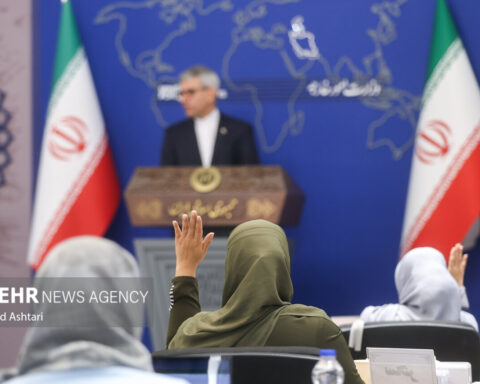
DOHA — Qatar’s Foreign Ministry spokesman Majed al-Ansari stood at a podium in Doha on April 28 and said what no GCC official had been willing to say on the record: the Hormuz crisis is heading toward a frozen conflict, and a frozen conflict will destroy everyone it touches unevenly. “We do not want to see a frozen conflict that ends up being thawed every time there is a political reason,” al-Ansari told reporters, adding that Qatar wants “an end to this war that is sustainable, that takes into account all of our concerns in the region and beyond.” Twenty-four hours earlier, MBS had convened a summit in Jeddah to project collective Gulf defense. Al-Ansari’s word choice made clear that Doha was already planning for collective defense to fail.
The phrase “frozen conflict” was not casual. It is a term of art in international relations — Transnistria, Abkhazia, Nagorno-Karabakh — describing a state where active fighting stops but no political settlement resolves the underlying dispute. Al-Ansari’s use of “thawed” mapped directly onto that academic framework. A Qatari diplomat does not invoke the vocabulary of post-Soviet territorial disputes at a press conference unless the talking point has been drafted, reviewed, and approved. This was not a slip. It was a signal, directed simultaneously at Riyadh, Washington, and Tehran.
What Does Qatar Mean by “Frozen Conflict”?
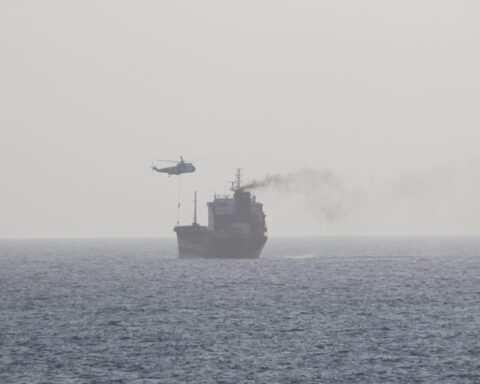
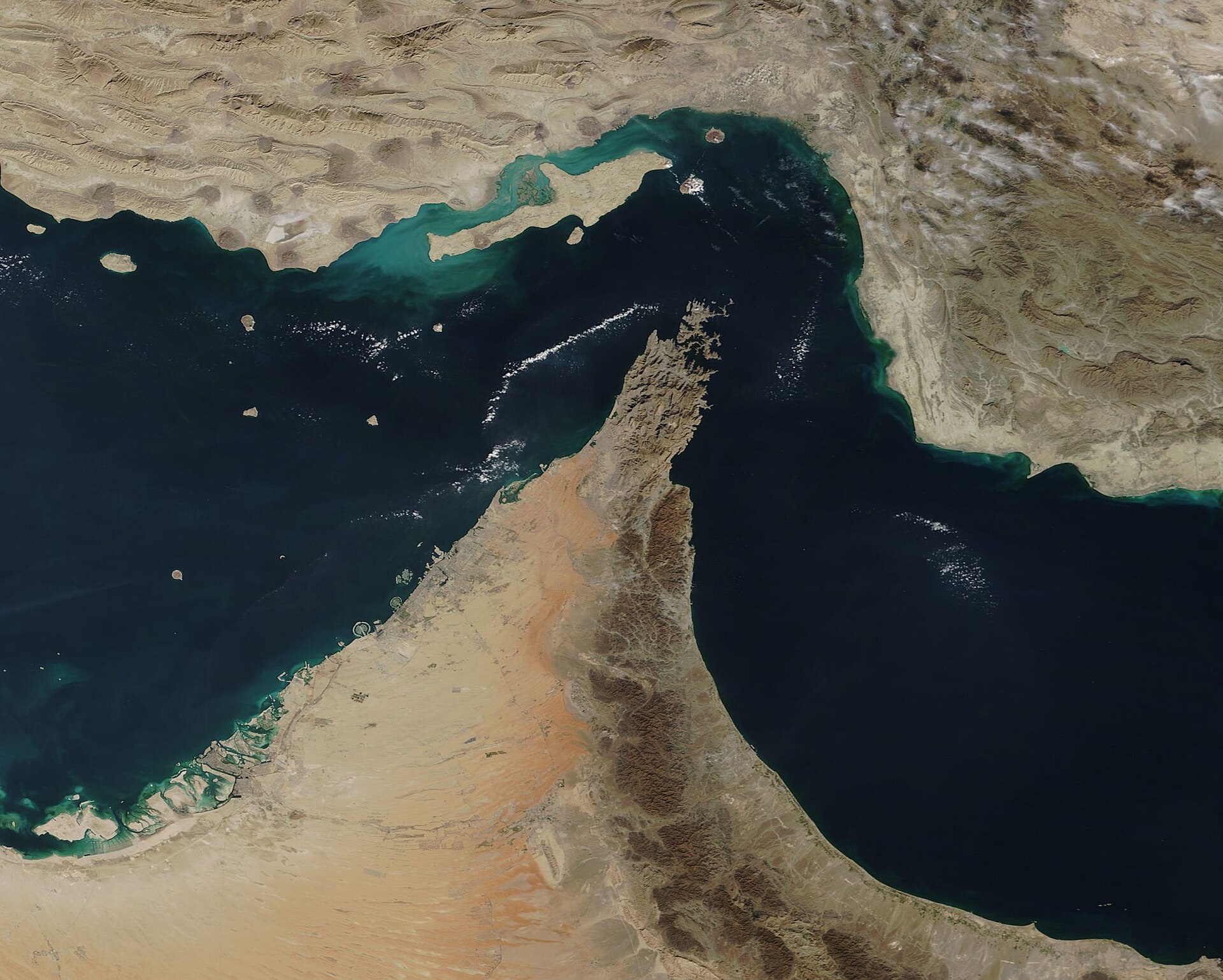
Al-Ansari named a specific failure mode: a ceasefire that stops the shooting but leaves Hormuz under dual blockade, Iran’s nuclear program unresolved, and GCC members locked into a permanent state of mobilization without resolution. As of April 28, only 45 vessels have transited the Strait since the April 8 ceasefire — 3.6% of the pre-war baseline. The US controls the Arabian Sea entry, the IRGC controls the Gulf of Oman exit, and both sides have published conditions the other will not accept. Iran’s April 27 proposal to reopen Hormuz in exchange for postponing nuclear talks was rejected by Trump within hours, with Rubio calling it “extortion.”
The Foreign Policy Research Institute’s framework for frozen conflicts is instructive: they are “boiling-point” situations where the absence of war is not the presence of peace. Nagorno-Karabakh was frozen for 30 years before Azerbaijan thawed it with a nine-hour military operation in September 2023. Al-Ansari was telling the region — and Washington — that a ceasefire without a political settlement on Hormuz would create exactly that kind of instability, except layered on top of the world’s most critical energy chokepoint rather than an Armenian enclave. The implicit question was whether the GCC could survive three decades of that. His implicit answer, judging by everything else Qatar did that week, was that the GCC as currently constituted could not.
The Decisiveness Summit That Decided Nothing
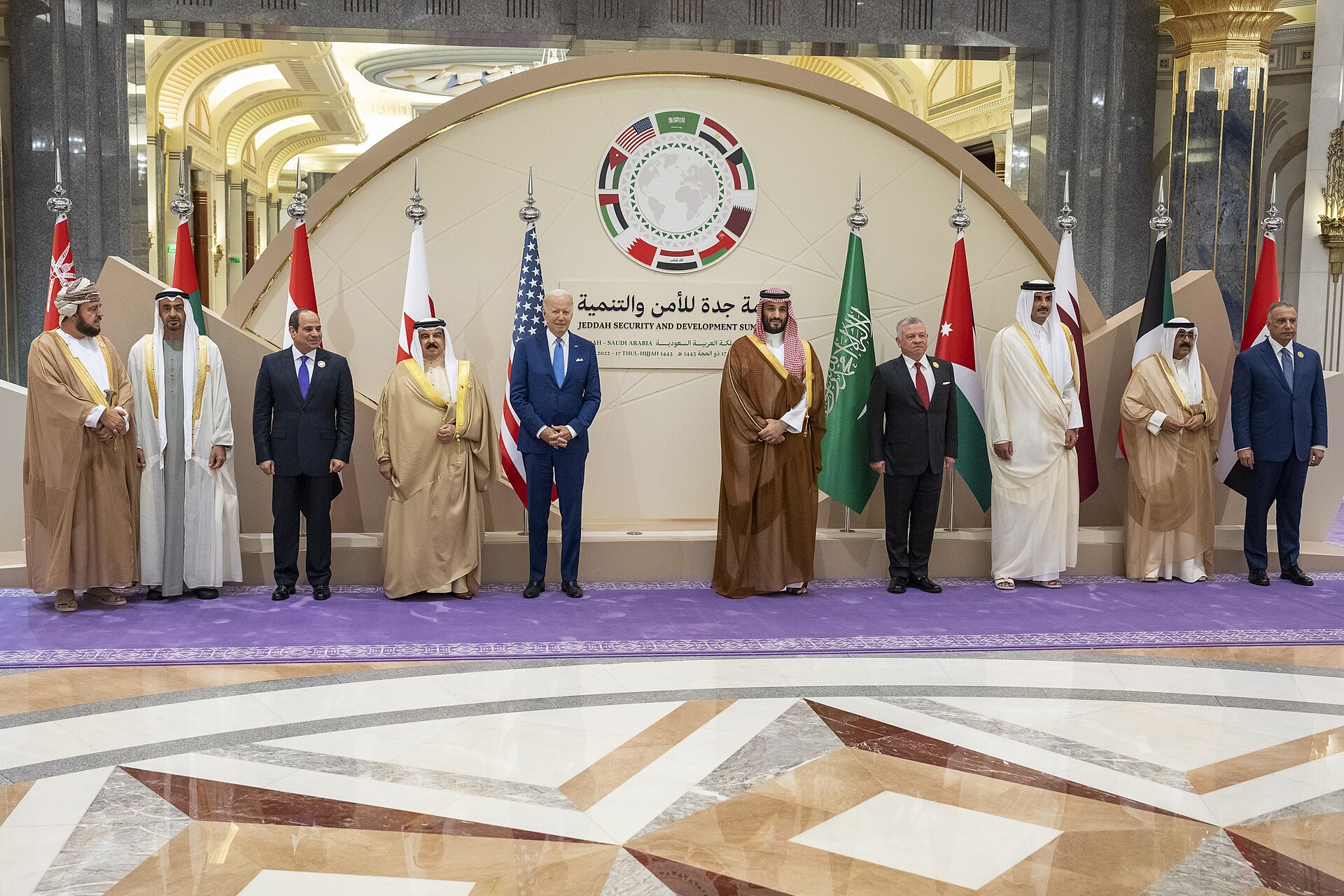
The April 28 Jeddah summit was supposed to be MBS’s show of unity. Saudi Arabia convened it under the banner of collective defense, a deliberate echo of the 2015 Saudi-led coalition in Yemen — Operation Decisive Storm — that gave the summit its name. Qatar’s Emir Sheikh Tamim attended. Kuwait’s Crown Prince Sheikh Sabah Al-Khaled attended. Bahrain’s King Hamad attended. UAE President Mohammed bin Zayed did not. He sent Foreign Minister Abdullah bin Zayed in his place, a protocol signal that diplomatic observers noted immediately. When the host convenes an emergency summit and your head of state sends a deputy, the message is legible without translation.
The Middle East briefing 3,000+ readers start their day with.
One email. Every weekday morning. Free.
What made April 28 extraordinary was not any single defection but the velocity of three simultaneous ones. MBZ’s absence was the first. The second came from Abu Dhabi’s energy ministry: UAE Energy Minister Suhail al-Mazrouei announced the same day that the UAE would exit OPEC and OPEC+ effective May 1, ending 59 years of membership. When reporters asked whether Saudi Arabia had been consulted, al-Mazrouei was blunt: “It was a sovereign national decision.” He confirmed the UAE did not raise the issue with any other country beforehand. Steven A. Cook of the Council on Foreign Relations assessed that the UAE “clearly concluded that the deterioration of their bilateral relationship with Saudi Arabia presented an opportunity.” The third defection was al-Ansari’s frozen conflict statement — Doha naming a future that Riyadh’s summit was designed to prevent.
Three GCC capitals, three different messages, in the same 24-hour window. The Decisiveness Summit declared collective defense. Its members did not collectively show up.
The UAE’s OPEC departure deserves its own weight. Abu Dhabi had been fighting with Riyadh over production quotas since at least 2021, when the UAE briefly blocked an OPEC+ deal because it wanted a higher baseline. The war accelerated a rupture that was already forming: the UAE’s production capacity of roughly 4.2 million barrels per day was being artificially constrained by OPEC+ agreements that primarily served Saudi Arabia’s pricing strategy. With Saudi production involuntarily crashed to 7.25 million bpd and Hormuz partially closed, the UAE calculated that OPEC’s coordination mechanism no longer served Abu Dhabi’s interests — and that Saudi Arabia was too weakened to retaliate. Al-Mazrouei’s “sovereign national decision” phrasing was not merely diplomatic. It was a declaration that the UAE no longer considers Saudi preferences a variable in its energy policy.
Why Can Qatar Survive a Frozen Hormuz and Saudi Arabia Cannot?
The core asymmetry is fiscal, and it is brutal. Qatar’s sovereign wealth fund, the Qatar Investment Authority, holds approximately $580 billion in assets under management — more than 200% of Qatar’s GDP, according to Bloomberg’s January 2026 estimate. Qatar’s central bank holds an additional $70 billion in international reserves, enough to cover roughly 12 months of imports at current rates, per IMF data. The QIA’s global portfolio — real estate in London, stakes in Volkswagen and Barclays, infrastructure across Asia — generates returns that are entirely independent of whether a single LNG tanker exits the Persian Gulf.
Saudi Arabia’s Public Investment Fund holds approximately $930 billion in total assets, but cash reserves have fallen to roughly $15 billion — the lowest level since 2020, according to Middle East Briefing. The distinction between total assets and available liquidity matters enormously in a frozen conflict: you cannot fund a government payroll with an equity stake in Lucid Motors or a golf tournament’s sponsorship rights. Qatar’s $580 billion is overwhelmingly liquid and offshore. Saudi Arabia’s $930 billion is overwhelmingly illiquid and domestic, tied up in megaprojects that are themselves casualties of the war.
The Saudi Treasury Under Volume Constraint
Saudi Arabia’s fiscal position under a frozen Hormuz conflict is not a question of price. Brent closed at $111.16 on April 28 — technically above the PIF-inclusive fiscal break-even of $108–111 per barrel that Bloomberg Economics has calculated. The problem is volume. Saudi production has crashed from 10.4 million barrels per day in February to 7.25 million in March, according to IEA data, a 30% collapse in a single month. The East-West Pipeline’s bypass through Yanbu has a practical ceiling of 4–5.9 million barrels per day against a pre-war Hormuz throughput of 7–7.5 million. That structural gap of 1.1–1.6 million barrels per day is volume that cannot reach market at any price.
Goldman Sachs has calculated a war-adjusted deficit of 6.6% of GDP — double the Saudi government’s official 3.3% projection. Goldman has separately estimated the nominal dollar deficit at $80–90 billion, drawing on a wider revenue-loss model than the official figure assumes. The official deficit figure of $44 billion assumed pre-war production levels and did not account for the Khurais field being offline with no recovery timeline announced. Revenue lost to volume constraint is not deferred; it is destroyed. Every barrel that cannot reach a loading terminal at Yanbu because pipeline capacity is insufficient is revenue that evaporates — unlike Qatar’s gas, which simply remains in the reservoir until extraction resumes.
Vision 2030, the framework meant to reduce Saudi dependence on oil revenue, is itself a casualty of the oil revenue shortfall. NEOM’s flagship project The Line has been suspended since September 16, 2025. PIF construction contracts have fallen from $71 billion to $30 billion — a 60% reduction. Saudi FDI inflows are projected down 60–70% in the first quarter of 2026 compared to the prior year, according to The Middle East Insider. On April 16, Saudi Arabia scrapped tourism funding in what was described as a Vision 2030 shake-up. The diversification engine needs oil revenue to run; oil revenue needs Hormuz volume to flow; and Hormuz volume needs a political settlement that al-Ansari just publicly named as unlikely.
Qatar’s $580 Billion Shock Absorber
Qatar is not unscathed. Iran struck Ras Laffan Industrial City on March 18, reducing annual LNG export capacity by 17%. QatarEnergy declared force majeure on all exports after the Hormuz closure on March 4. Revenue losses are projected at approximately $20 billion over three to five years, and the World Bank projects Qatar’s GDP will contract by more than 5% in 2026. These are serious numbers. The difference is that they are recoverable numbers.
Qatar’s non-hydrocarbon GDP has grown from roughly 46% of total GDP in 2010 to approximately 58% by 2026, according to IMF data — a structural transformation accelerated by the 2017 Saudi-led blockade. When Riyadh, Abu Dhabi, Manama, and Cairo closed their borders and airspace to Qatar for three and a half years, Doha was forced to build self-sufficient supply chains, develop domestic food production, and cultivate trade relationships that bypassed its neighbors entirely. The blockade was meant to bring Qatar to heel. Instead it built an economy that could absorb exactly the kind of external shock now hitting the entire GCC. None of the thirteen demands issued by the blockade quartet were met. Qatar rerouted supply chains through Oman and Turkey, emerged from the Al-Ula Declaration in January 2021 with a more diversified economy, and demonstrated a capacity to absorb isolation that Saudi Arabia — which imposed the blockade rather than enduring it — has never been forced to develop. QatarEnergy’s North Field expansion — from 77 million tonnes per annum to 142 MTPA — is still proceeding, positioning Doha to capture expanded market share once Hormuz reopens.
Saudi Arabia’s non-oil revenue has grown under Vision 2030, but the model requires continuous capital deployment — foreign direct investment, sovereign wealth fund disbursements, construction contracts — that a frozen conflict makes impossible. The Middle East Insider estimates $840 billion in investments are at risk: not just delayed projects, but a delayed national transformation that has no equivalent asset sitting underground waiting to be collected.
The Gas That Stays in the Ground
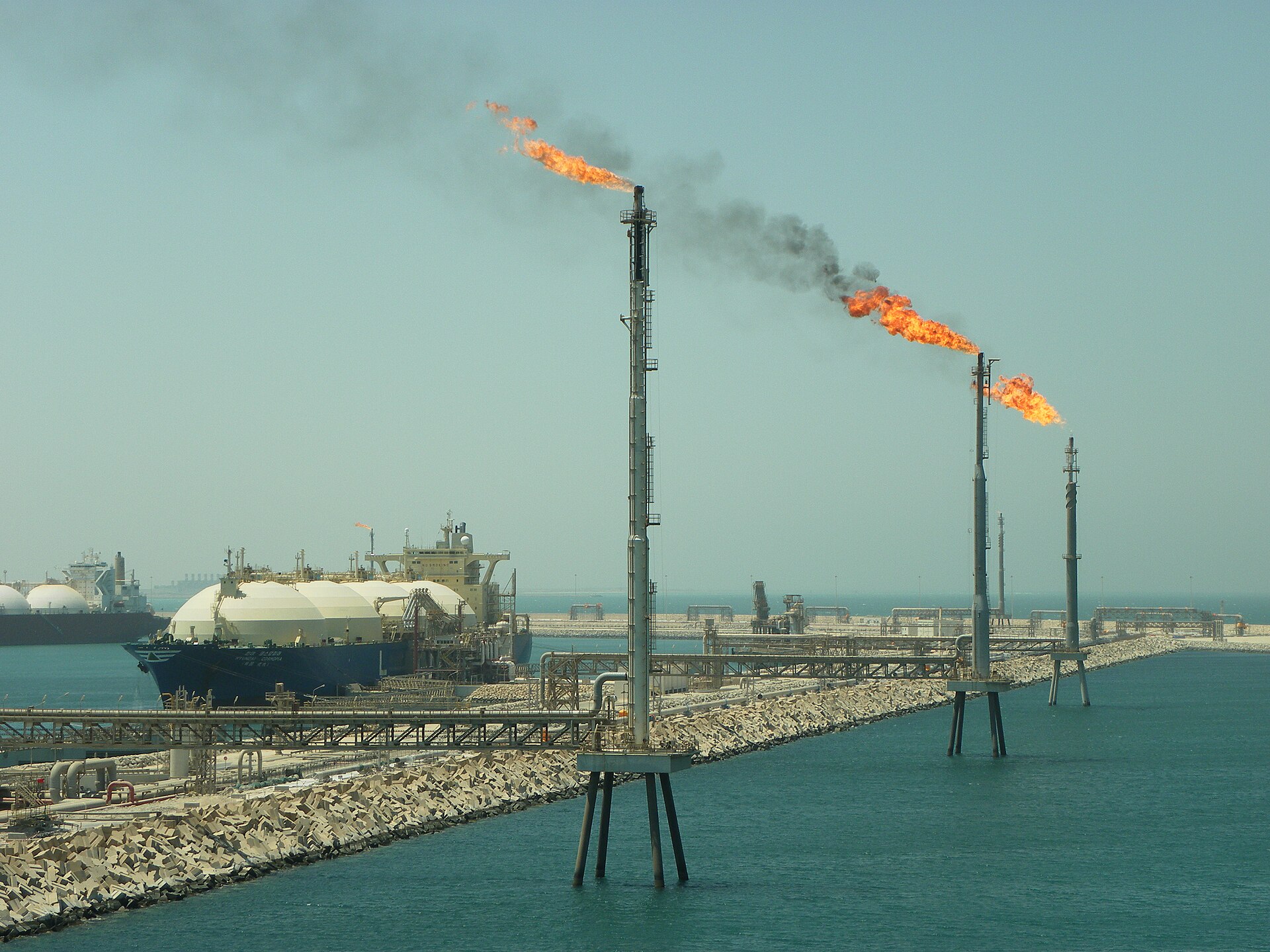
The North Field/South Pars reservoir contains one of the most counterintuitive strategic dynamics of the entire war. The field — the world’s largest natural gas deposit at 9,700 square kilometers — is split between Qatar’s North Dome (6,000 km²) and Iran’s South Pars (3,700 km²). Qatar extracts approximately 18.5 billion cubic feet per day; Iran manages roughly 2 bcf/day. Under normal conditions, extraction on one side draws down the shared pressure reservoir, creating an incentive to pump as fast as possible to capture your share before the other side does.
A frozen conflict inverts this logic. When both sides’ extraction is disrupted — Qatar by Hormuz closure and Ras Laffan damage, Iran by war and sanctions — the shared pressure declines more slowly than it would under normal production. For Qatar, which accounts for roughly 80% of its government revenue from North Field LNG, the gas does not disappear. It waits. Unlike Saudi crude that cannot reach Yanbu because the pipeline capacity is maxed, Qatar’s gas remains in the reservoir at stable pressure, available for extraction at full capacity once a durable settlement reopens Hormuz. Every month of frozen conflict is a month where Qatar’s long-term resource base is preserved at Iran’s extraction expense — because Iran, at 2 bcf/day, was always drawing far less from the shared reservoir than Qatar was.
This is not an abstraction. QatarEnergy’s expansion to 142 MTPA was designed to capture market share before Iran could scale South Pars exports. A frozen conflict that pauses both sides’ extraction and then ends with Qatar’s infrastructure intact and expanded gives Doha a larger share of the same reservoir it would have had anyway — just on a delayed timeline. For Saudi Arabia, there is no equivalent asset sitting underground waiting to be collected.
How Does Al Udeid Give Qatar Leverage No Other GCC State Has?
Al Udeid Air Base hosts approximately 10,000 US service members and serves as CENTCOM’s forward headquarters. Iran struck it on March 3–4, with one missile penetrating base defenses and damaging a radar installation. Qatar shot down two Iranian bombers on March 4 in what became the first direct Qatari engagement of the war. In the same week, Doha refused to allow the United States to launch offensive strikes against Iran from Al Udeid’s runways — a restriction that no other US basing agreement in the Gulf imposes so explicitly.
Qatar simultaneously expelled Iranian military and security attachés within 24 hours of the Ras Laffan strike on March 18, demonstrating that Tehran’s attacks would have consequences. But it retained ministerial communication channels: as recently as April 26, Iran’s Foreign Minister Araghchi called Qatar’s Prime Minister and Foreign Minister directly. Doha evicted the spies and kept the phone line open — a calibration that gives Qatar a structural position no other GCC member can replicate. Saudi Arabia severed diplomatic relations with Iran years ago and has no direct channel. The UAE has its own Iran relationship but subordinated it to the Abraham Accords framework. Kuwait’s Emir characterized the Iranian attacks as aggression by “a neighboring Muslim country, which we consider a friend” — honest but not operationally useful.
In a frozen conflict, Qatar’s dual position — American base host and Iranian interlocutor — becomes more valuable, not less. Both Washington and Tehran need a channel, and Doha controls it. Abram Paley, former acting US special envoy for Iran and now a nonresident senior fellow at the Atlantic Council, warned that Iran will “seek to exploit the differences in interests and perspectives between Gulf countries.” Qatar’s channel is both the mechanism through which that exploitation runs and the tool that gives Doha leverage to shape the outcome. Mehran Haghirian of the Bourse and Bazaar Foundation framed Qatar’s position through the words of Qatar’s Deputy Foreign Minister: “total annihilation of Iran is not an option.” For Qatar, coexistence is not an aspiration — it is a business model.
Iran’s Frozen Conflict Dividend
Tehran has its own reasons to prefer a frozen Hormuz over a resolved one. The IRGC’s toll system — charging $0.50–1.00 per barrel on crude transits and $2 million per VLCC — is generating revenue in yuan and cryptocurrency that bypasses the US sanctions architecture entirely. Iran’s deputy parliament speaker Hajibabai confirmed that the first toll revenues have been transferred to the Central Bank. Analysts estimate these flows are sustainable until approximately August 2026, giving Iran four months of income from a chokepoint it controls without needing to sell a barrel of its own oil.
Iran’s April 27 proposal — reopen Hormuz in exchange for postponing nuclear talks until after the war ends — was structured to fail. It offered Trump a short-term concession (shipping resumes) while preserving Iran’s nuclear program and its claim to permanent Hormuz management rights. Trump rejected it; Rubio called it extortion. But the rejection served Iran’s purposes as well: it allowed Tehran to claim it offered peace while the Americans chose war, a narrative that plays in Islamabad, Ankara, and Beijing — the three capitals where Iran’s ceasefire support structure lives. The Iranian parliament is advancing a 12-article Hormuz sovereignty law, sponsored by lawmakers Ahmadi and Rezayi Kouchi, that would codify IRGC authority over the Strait in domestic legislation. A frozen conflict gives that law time to pass.
The China-brokered transit system — demonstrated when the LNG carrier Al Daayen completed an 8.8-knot transit toward China in early April — has created an alternative operating framework where Beijing, not Washington, determines who moves through the Strait. CNPC and Sinopec hold 8 MTPA in contracted North Field East offtake plus a 5% equity stake, giving China a structural financial interest in keeping the channel open on its own terms. In a frozen conflict, that framework calcifies. Every month it operates is a month where Chinese-intermediated Gulf transit becomes harder to reverse — and every month it grows more obvious that the US Navy’s freedom of navigation doctrine has been replaced by a toll booth operated by the IRGC and a concierge service run from Beijing.
Does the GCC Have a Mechanism to Resolve This?
No. Andrew Leber of the Carnegie Middle East Program and Sam Worby, an independent analyst published an assessment in April 2026 identifying three post-war scenarios for the GCC. The most likely, which they labeled “Status Quo Gulf,” describes ad hoc arrangements without structural integration — essentially the current state plus damage. Their third scenario, “A New Gulf Rift,” describes competitive fragmentation along the Saudi-UAE economic fault line that the OPEC exit has now made visible. The GCC’s founding charter contains no expulsion mechanism and no binding dispute resolution framework. It was designed for consensus among six monarchies that shared a common threat perception. That common threat perception died on April 28.
Haghirian’s analytical frame is the most precise: the GCC operates as “six distinct actors” whose divergence stems from “geography, demography, economic exposure, military alignments, domestic politics, regional ambitions, public opinion, and historical memory.” A frozen Hormuz conflict does not test whether these six actors can agree on a communiqué — they managed that at the Decisiveness Summit. It tests whether they can absorb asymmetric economic damage for an indefinite period without their interests permanently diverging. The UAE’s answer was to exit OPEC. Qatar’s answer was to name the failure mode. Saudi Arabia’s answer was to chair a summit that its most important partner did not attend.
The Carnegie team’s most damaging observation was structural: the GCC “has no seat at the table” in the US-Iran negotiations that will determine whether Hormuz reopens, under what conditions, and on whose timeline. The six wealthiest per-capita states in the Middle East are spectators to a negotiation about a waterway that carries their economic survival. Al-Ansari’s “frozen conflict” warning was not a prediction about US-Iran talks. It was a statement about GCC powerlessness — delivered from Doha, by an official whose country has more tools to survive the outcome than any of its neighbors, on a day when the summit meant to prove otherwise was already falling apart.
Saudi Arabia now inherits an OPEC it cannot operate at capacity, a defense pact whose signatories are already hedging, and a timeline over which its $15 billion in PIF cash reserves must cover an $80–90 billion deficit. Qatar’s QIA has $580 billion and a phone line to Tehran. The Hormuz toll architecture that Trump once floated as a joint venture has become Iran’s revenue stream and Beijing’s operating concession.
Paley warned that the war “might persist for some time, since even a lull in attacks or a deal might not sustainably address the fundamental issues.” Map that against the balance sheets. Qatar has reserves equivalent to 200% of GDP, a reservoir that appreciates during the pause, a communication channel both belligerents need, and a military base that makes it indispensable to Washington regardless of what happens at Hormuz. Saudi Arabia has a pipeline that maxes out at 5.9 million barrels per day, a sovereign wealth fund spending faster than it earns, a deficit approaching $90 billion under war conditions, and a megaproject portfolio that requires exactly the kind of foreign capital that a frozen conflict repels. Al-Ansari named the outcome. The fiscal math names the winner.
FAQ
Has Qatar formally broken with the GCC’s collective position on Iran?
Not formally. Qatar signed the Decisiveness Summit communiqué and al-Ansari simultaneously stated that Hormuz’s closure is “unacceptable in any way.” But Doha’s actions tell a different story: it refused offensive US strikes from Al Udeid, maintained ministerial contact with Araghchi as recently as April 26, and is the only GCC state whose deputy foreign minister has publicly said “total annihilation of Iran is not an option.” The International Crisis Group noted in April 2026 that even after the 2021 Al-Ula reconciliation, the UAE “continued to distrust Qatar for its links to the Muslim Brotherhood” — the deeper ideological fissures never healed, and the war has reactivated them along different lines.
What happens to Qatar’s LNG contracts during a frozen conflict?
QatarEnergy declared force majeure on all LNG exports after the March 4 Hormuz closure, which legally suspends delivery obligations without breaching contracts. Industry estimates suggest Qatar could restore 10–25% of export capacity within weeks of a durable ceasefire, and 50% within two to three months. Critically, Qatar has pre-sold much of the expanded North Field capacity under long-term contracts with Asian buyers — meaning Doha’s post-conflict revenue recovery is contractually guaranteed in a way that Saudi Arabia’s spot-market-dependent crude exports are not.
Could Saudi Arabia use OPEC to pressure Qatar or the UAE?
The UAE has already left. Qatar exited OPEC voluntarily in January 2019, before the war, citing a desire to focus on gas rather than oil — a decision that now looks prescient. OPEC’s April quota for Saudi Arabia stands at 10.2 million barrels per day, roughly 3 million above actual March output. Saudi Arabia cannot use OPEC to compel members to cut when its own involuntary cuts already exceed its quota reduction. The cartel’s enforcement mechanism — the threat of Saudi Arabia flooding the market — requires surplus capacity that currently sits behind a Yanbu pipeline ceiling of 5.9 million barrels per day. The UAE exit that removed Abu Dhabi from that enforcement architecture — and what it means for Saudi Arabia’s ability to defend any price floor — is documented in UAE Exits OPEC After 59 Years, Stripping Saudi Arabia of Its Last Enforcement Lever.
What is Iran’s timeline for sustaining the current Hormuz posture?
Analysts estimate Iran can sustain its toll-revenue and blockade posture until approximately August 2026 based on existing yuan and cryptocurrency flows to the Central Bank. Beyond that, the economics depend on whether China continues to intermediate transits and whether the 12-article Hormuz sovereignty law passes the Iranian parliament in time to give the IRGC domestic legal authority to formalize the toll system. The IRGC’s position is further complicated by the command vacuum left after Admiral Tangsiri was killed on March 30: as of April 29, no successor to the IRGC Navy command has been named — 30 days and counting.