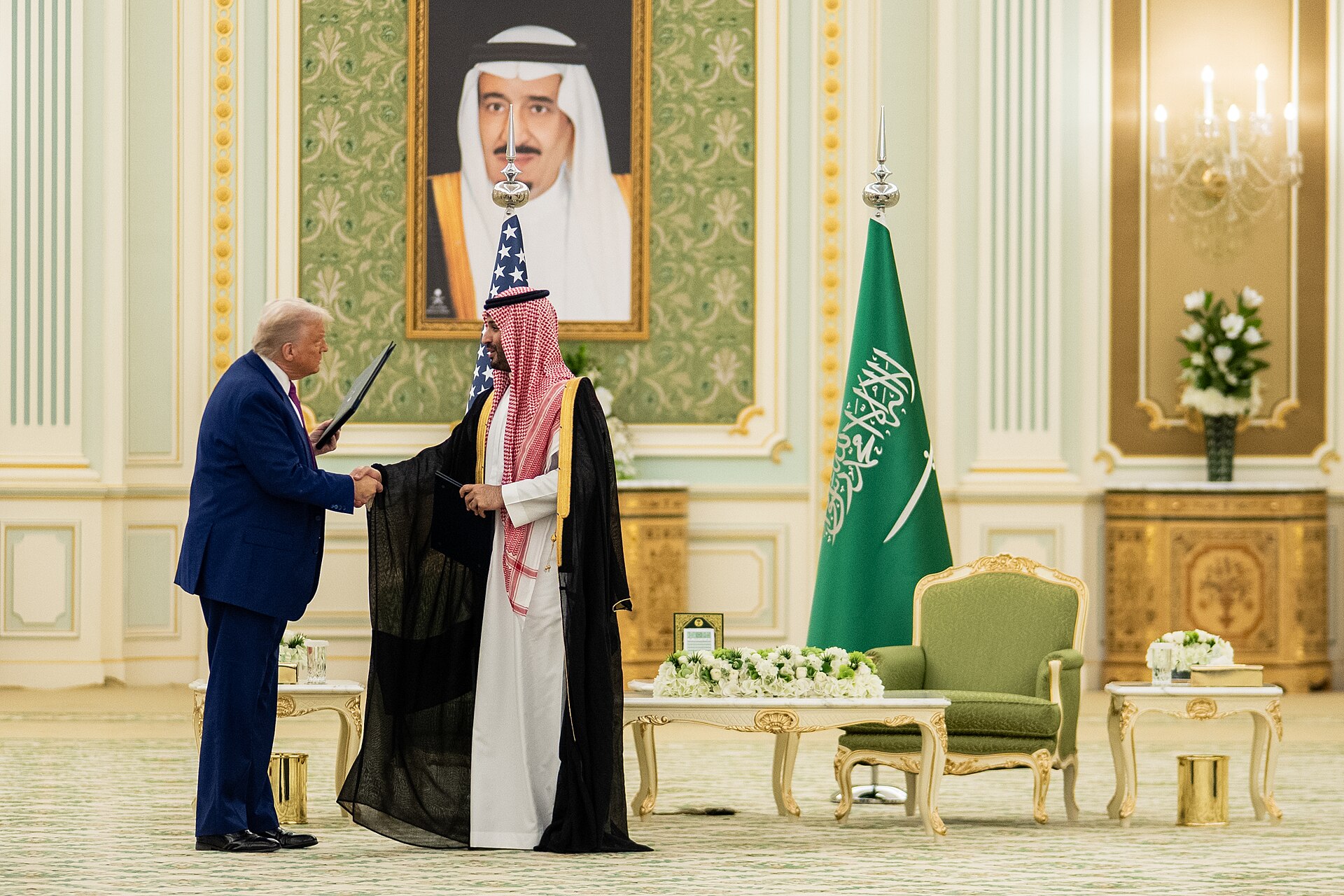
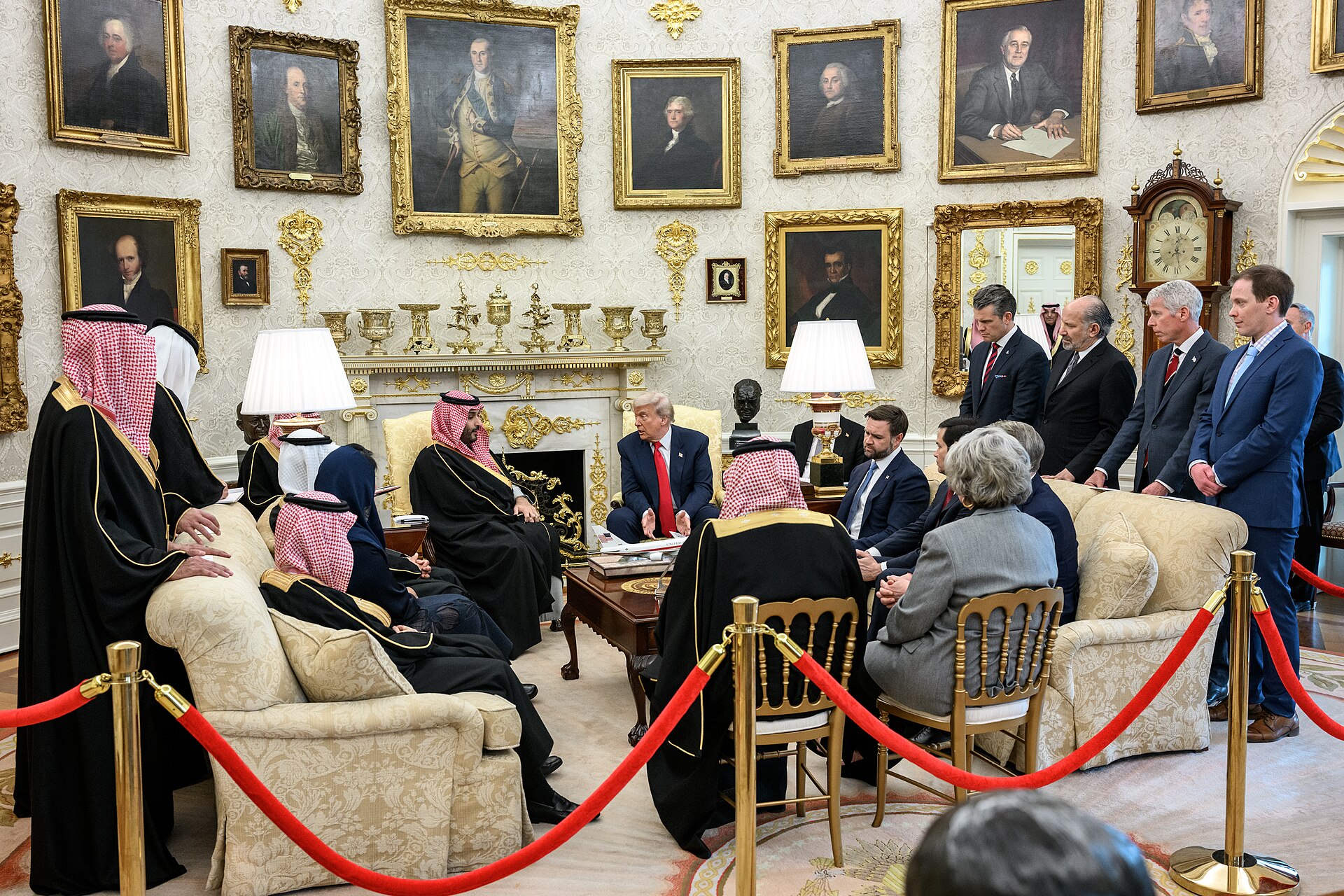
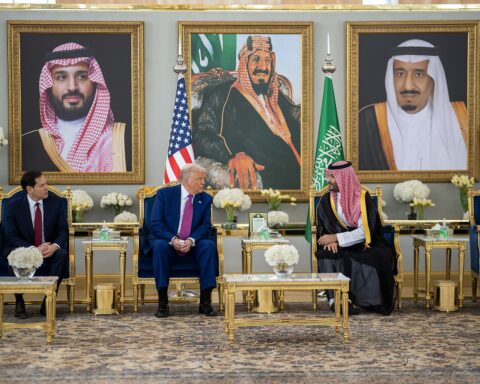
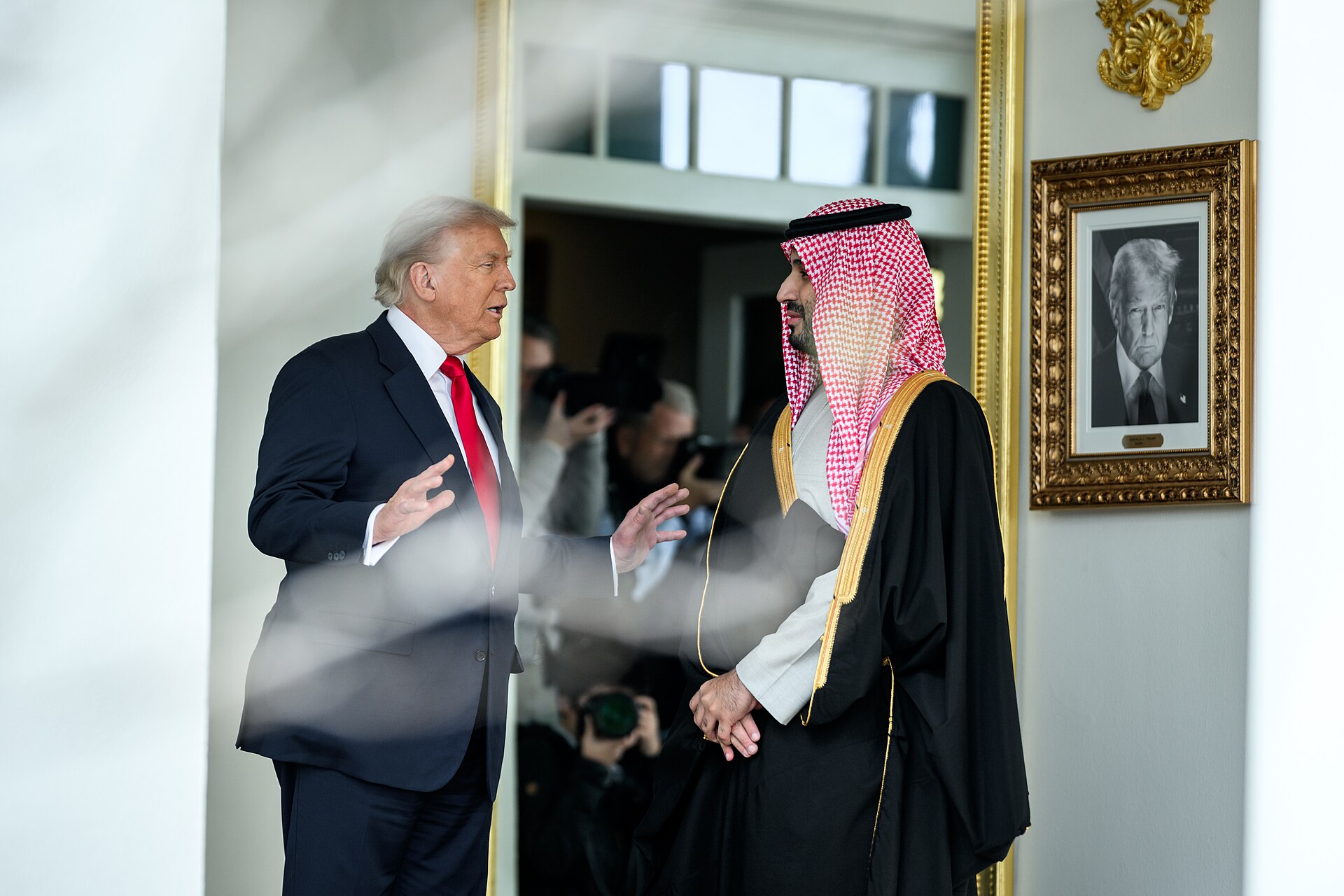
RIYADH — The last time an American president sat across from a Syrian head of state was March 26, 2000, when Bill Clinton flew to Geneva to meet Hafez al-Assad — a meeting that produced nothing, left no minutes, and ended three months before Assad died. Twenty-six years later, on May 14, 2026, Donald Trump met Ahmed al-Sharaa in Riyadh, on Saudi soil, after publicly crediting Mohammed bin Salman with persuading him to lift Syria sanctions the day before. The analytical question is not what Trump gave Syria — it is what MBS extracted from giving Trump the room.
This was not a Syria story dressed up as diplomacy. It was a Saudi strategy story with Syria as the prop. MBS brokered the meeting, hosted it, bankrolled al-Sharaa’s reconstruction pitch with $6 billion in pre-committed Saudi investment, and orchestrated a sanctions lift that Turkey’s Erdogan — who joined by phone, not in person — could only co-claim. Netanyahu was not consulted, and al-Sharaa refused the Abraham Accords on Saudi territory.
MBS walked away with what he has been accumulating since February: broker capital for the deal that actually matters to him, which is the Iran endgame. The Syria meeting was an instrument, not an objective.
Table of Contents
Twenty-Five Years in Ninety Minutes
The Clinton-Assad meeting in Geneva on March 26, 2000, was the product of years of shuttle diplomacy by Warren Christopher and Dennis Ross over the Golan Heights. It collapsed in the room. Assad rejected the terms, flew home, and was dead by June. His son Bashar inherited the presidency, inherited the standoff with Washington, and held it for twenty-four years until December 2024, when Ahmed al-Sharaa’s Hayat Tahrir al-Sham coalition took Damascus. The US had no presidential channel to Syria for the entirety of Bashar al-Assad’s rule — through the Lebanon withdrawal crisis, the 2011 uprising, the civil war, the chemical weapons strikes, the Russian intervention, and the ISIS campaign.
The meeting that broke the silence did not happen in Washington, Geneva, or at the UN General Assembly. It happened in Riyadh, inside the conference infrastructure of a Saudi state visit that was already the most commercially dense bilateral event of the year — $600 billion in announced investment commitments, a $142 billion arms deal that the Pentagon described as “the largest defense sales agreement in history,” and a joint communiqué on Iran that deliberately stopped short of anything enforceable. The Syria meeting was slotted into the morning of May 14, hours before Trump departed for Doha, as if the first US-Syria presidential-level contact in a quarter-century were an addendum.
Trump’s own description of al-Sharaa, offered to reporters aboard Air Force One, was characteristically personal: “A young, attractive guy. Tough guy. Strong past. Very strong past. Fighter… He’s got a real shot at holding it together.” The “very strong past” is an unusual way to describe a man whose organisation was on the State Department’s Foreign Terrorist Organization list until July 7, 2025, and whose personal terrorist designation was not lifted until November of that year.
The Middle East briefing 3,000+ readers start their day with.
One email. Every weekday morning. Free.
The UN Security Council removed HTS from its sanctions list only in February 2026 — three months before al-Sharaa was shaking Trump’s hand on Saudi soil. The speed of the rebranding, from designated terrorist to presidential interlocutor in under a year, is itself a measure of how badly Washington needed someone to fill the vacuum Assad left.
Who Was in the Room — and Who Was Not
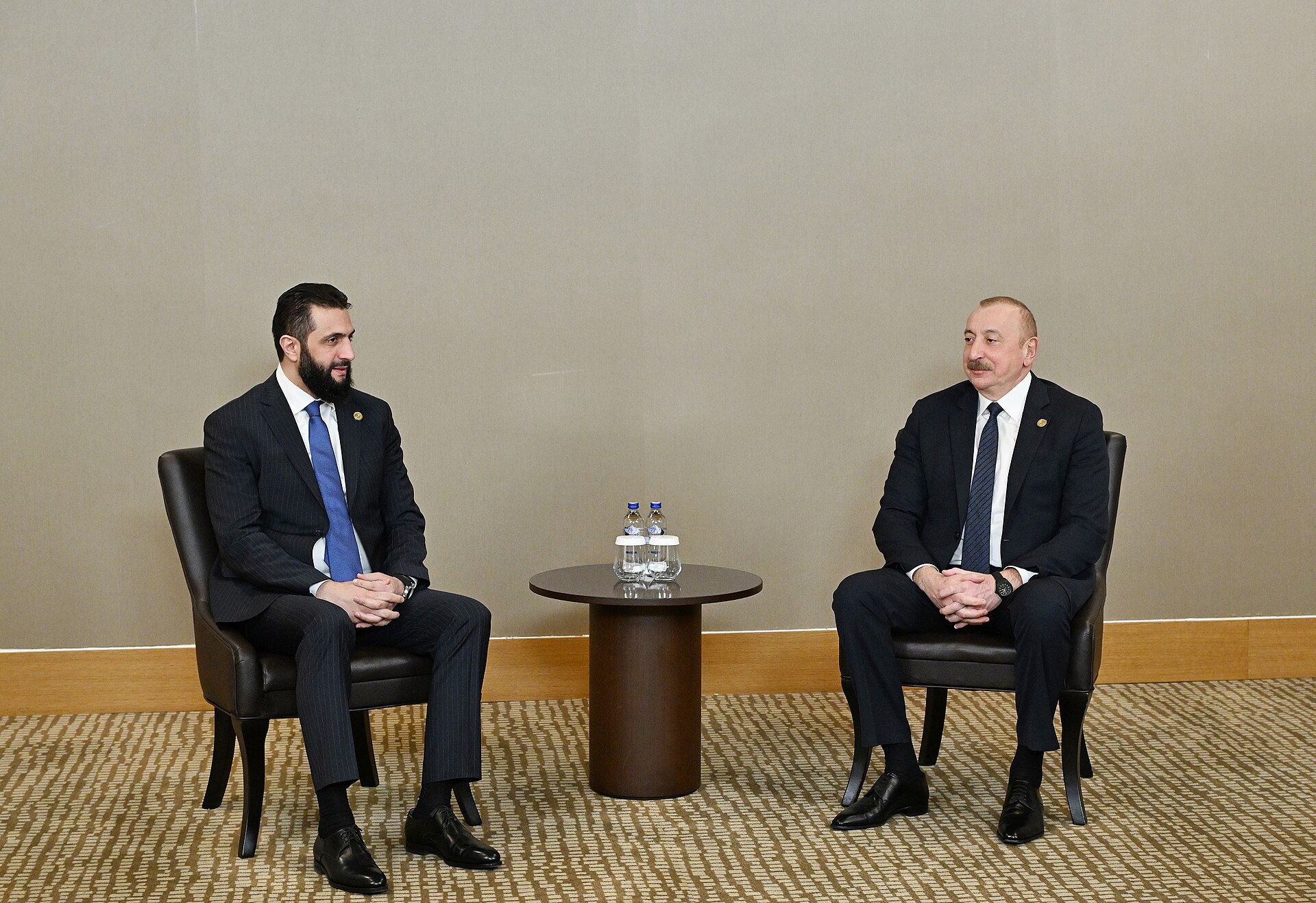
The meeting architecture tells you more than the communiqué. MBS was in the room. Erdogan was on the phone — Turkish media made much of his influence, and Trump acknowledged it, but there is a categorical difference between placing a call and hosting the venue. Erdogan shaped the preconditions; MBS shaped the setting, the sequence, and the audience. Al-Sharaa had already appeared at the Future Investment Initiative in Riyadh in October 2025, where he delivered the line that will define his reconstruction strategy: “We chose the path of reconstruction through investment; we did not choose the path of rebuilding Syria through aid and assistance.” He called Saudi Arabia “the key” to Syria’s future, with MBS sitting in the front row.
Netanyahu was absent from every stage of this process. Trump did not consult Israel before announcing the sanctions lift on May 13, did not seek Israeli input on the meeting with al-Sharaa, and had already issued a public warning — reported by the Times of Israel and Newsweek — telling Israel not to “interfere in Syria’s evolution into a prosperous State.” That warning was a direct rebuke, given that the Israeli military had been conducting near-daily strikes inside Syrian territory.
Netanyahu’s response to the Riyadh meeting was conspicuously restrained — he said a deal with Syria was possible if negotiated “in a good spirit,” the language of a man who has been told he does not have a veto. The muted tone confirmed what the meeting architecture already made clear: this was a Saudi-brokered event on a Saudi timeline, and Israel’s input was not solicited.
The Israeli exclusion matters because of what al-Sharaa said on Saudi soil. Asked about joining the Abraham Accords — the normalisation framework that brought the UAE, Bahrain, Morocco, and Sudan into diplomatic relations with Israel — al-Sharaa refused. His formulation was precise: Syria would “not enter talks directly right now” with Israel, and the Accords framework did not apply because “Syria has borders with Israel and Israel has occupied the Golan since 1967.” He did not close the door to US-brokered engagement, but he drew a line that no Abraham Accords signatory had drawn, and he drew it in Riyadh, with MBS watching.
Why Did Trump Credit MBS for the Syria Decision?
Trump announced the Syria sanctions lift on May 13, one day before the meeting itself, in terms that left no ambiguity about attribution. The decision came “at the urging of Crown Prince Mohammed bin Salman” and Erdogan, and Trump framed it as giving Syria “a chance at greatness.” The executive order he signed terminated the Syrian sanctions programme outright. Treasury simultaneously issued General License 25, authorising transactions with Syria’s interim government, its central bank, and state-owned enterprises. The State Department issued a 180-day Caesar Act waiver in parallel — a provisional workaround for a statute that Congress would need to formally address.
CSIS’s analysis of the Riyadh visit was blunt about the causal chain. “It was MBS who influenced President Trump’s decision to not only announce the lifting of sanctions — which is, as we both know, a little more complicated — but to meet Sharaa in person,” one analyst wrote. The phrase “a little more complicated” is doing heavy lifting: the Caesar Act is legislation, not an executive order, and its sanctions provisions require either congressional repeal or continuous presidential waivers.
What Trump did in Riyadh was maximally dramatic — an executive order, a general licence, a waiver, and a presidential meeting, all compressed into thirty-six hours. What he did not do was produce a durable legal framework. MBS got the spectacle; whether Syria gets the substance depends on whether Congress ratifies it.
The answer to why Trump credited MBS is transactional. The $600 billion in investment commitments, the $142 billion arms deal, and the political theatre of a Riyadh summit were the setting in which Trump could present a foreign policy win — normalising relations with Syria — without appearing to have capitulated to a former terrorist organisation’s demands. MBS provided the venue and the framing. Trump provided the executive authority, and the exchange rate was explicit.
What Did al-Sharaa Actually Say About the Abraham Accords?
Most coverage led with the refusal, but the formulation matters. Al-Sharaa did not say Syria would never normalise relations with Israel. He said Syria would “not enter talks directly right now” and drew a categorical distinction between Syria and the existing Abraham Accords signatories: the UAE has no territorial dispute with Israel; Syria has the Golan Heights, occupied since 1967 and unilaterally annexed by Israel in 1981, a move recognised only by the United States under Trump’s first term in 2019. Al-Sharaa’s position is that the Golan makes Syria a different case, not that normalisation is permanently impossible.
The refusal landed differently because of where it was delivered. MBS himself told Trump at the summit that Saudi Arabia “wants to be part of the Abraham Accords” — but explicitly conditioned normalisation on “a credible path to statehood for the Palestinians.” CSIS assessed that Israeli-Saudi normalisation “will most likely have to wait for the post-Netanyahu era.” So on Saudi soil, in the same diplomatic sequence, MBS offered conditional willingness and al-Sharaa offered conditional refusal, and both conditions pointed at the same obstacle: Israeli policy under Netanyahu. The effect was coordinated pressure without the appearance of coordination — a Saudi speciality that has become more visible since the security architecture MBS has been building around Washington.
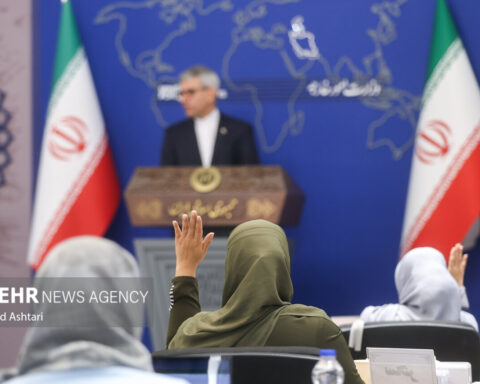
For Iran’s hardline media, al-Sharaa’s presence in Riyadh was sufficient evidence of betrayal. RFE/RL reported that conservative Iranian outlets condemned the meeting as proof of Syria’s “sharp pivot away from Tehran,” reflecting what the report called “growing anxiety in Tehran over the loss of Syria, once a crucial part of Iran’s regional strategy.” The anxiety is warranted — Syria under Assad was Iran’s land bridge to Hezbollah in Lebanon, the corridor through which weapons, money, and IRGC advisers moved for two decades.
Under al-Sharaa, that corridor is closed, and the man who closed it just accepted Saudi reconstruction money while refusing Israeli normalisation. For Tehran, the combination is worse than either element alone: Syria is not joining the Western camp, it is joining the Saudi camp, which Iran cannot bomb without bombing its own ceasefire mediator.
The Reconstruction Math
The World Bank published its Syria reconstruction assessment in October 2025, and the numbers explain why al-Sharaa stood at a Saudi investment forum and called Riyadh “the key.” Physical damage to Syria is assessed at $108 billion — roughly a third of Syria’s gross capital stock, destroyed. Total reconstruction cost, at the lower-bound estimate, is $216 billion, with the full range running from $140 billion to $345 billion. That $216 billion figure is nearly ten times Syria’s projected 2024 GDP. No country in the modern era has faced a reconstruction bill of that ratio.
| Metric | Figure | Source |
|---|---|---|
| Physical damage | $108 billion | World Bank, Oct 2025 |
| Total reconstruction cost (midpoint) | $216 billion | World Bank, Oct 2025 |
| Reconstruction cost range | $140B–$345B | World Bank, Oct 2025 |
| Ratio to Syria’s 2024 GDP | ~10x | World Bank, Oct 2025 |
| Saudi investment committed pre-summit | $6+ billion | Al Jazeera, Feb 7, 2026 |
| Saudi deals signed (Feb 2026) | Aviation, airline, real estate ($2.93B), telecoms ($1.07B) | Al Jazeera, Feb 7, 2026 |
| Trump visit total investment pledges | $600 billion | White House, May 2026 |
| Trump visit arms deal | $142 billion | Pentagon, May 2026 |
Saudi Arabia committed $6 billion in Syrian investment before the May summit even began. The February 2026 package included a new international airport for Aleppo, a low-cost Saudi-Syrian airline, a $2.93 billion real estate portfolio, and a $1.07 billion telecommunications project called SilkLink. These are not aid disbursements; they are commercial positions. The PIF’s 2026-2030 strategy, approved by MBS in April, is focused on maximising financial returns and increasing private-sector participation. Syria at $216 billion in reconstruction needs is not a charity case for Riyadh — it is a market, and MBS has first-mover advantage because he is the one who brought al-Sharaa in from the cold.
The Foundation for Defense of Democracies published a warning in February 2026 that Saudi and Gulf capital flows into Syria carry “terror finance risk,” arguing that HTS-linked networks could siphon reconstruction money. The FDD’s framing is adversarial — it is an organisation that has lobbied against any form of engagement with post-Assad Syria — but the underlying concern about governance capacity in a country whose institutions were destroyed by thirteen years of war is not unreasonable. Al-Sharaa’s answer, delivered at the FII forum, was that Syria would rebuild through investment rather than aid, implying commercial discipline rather than government-to-government transfers. Whether that discipline holds at the scale of $216 billion is the question no one in Riyadh is asking publicly.
What Is MBS Accumulating?
The Syria meeting was not an isolated diplomatic event. It fits a pattern that has become MBS’s signature since the Iran-war crisis began in February 2026: hosting the venue, brokering the introduction, taking credit for the outcome, and converting each successful convening into capital for the next one. The Arab League readmission of Syria on May 19, 2023, happened at a Saudi-hosted summit in Jeddah, and the first Saudi foreign minister visit to Damascus in over a decade — Prince Faisal bin Farhan in April 2023 — established the channel.
The FII appearance in October 2025 established al-Sharaa’s commercial credibility, and the May 2026 Riyadh summit produced the presidential meeting itself. Each step was Saudi-sequenced, and each step made the next one harder to refuse.
This is not selfless diplomacy. MBS has spent 2026 building what amounts to a convening monopoly over the region’s major diplomatic resets — Starmer’s Gulf tour produced a Lebanon statement that gave Saudi Arabia cover it could not have issued under its own name, Trump needed Riyadh as the stage for $600 billion in commercial theatre, and al-Sharaa’s path to Washington ran through the FII and the Saudi investment package. MBS is not solving these problems; he is positioning himself as the person you call when you need a problem solved in a room, and that room is always in Saudi Arabia.
The CSIS analysis of the Riyadh visit identified this pattern explicitly: MBS influenced both the substance (the sanctions lift) and the format (the in-person meeting). The analyst’s observation that Trump’s decision was shaped by MBS is not speculation — Trump said it himself, on camera, in Riyadh. What CSIS did not say, but the pattern implies, is that MBS is building a portfolio of brokered outcomes that he will cash in when the stakes are higher than Syria. Every successful mediation — Syria readmitted to the Arab League, Syria reconnected to Washington, Qatar running the Iran channel with Saudi awareness — adds to MBS’s argument that the eventual Iran deal cannot happen without him in the room.
The Iran Endgame Is the Prize
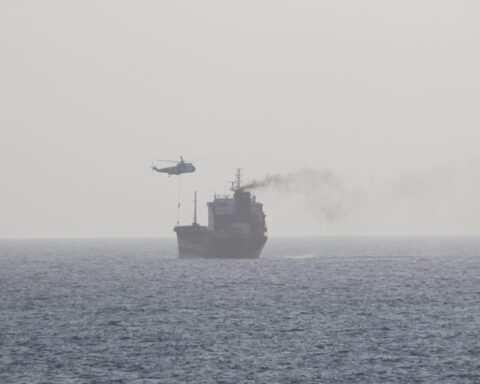
The Syria meeting matters most for what it is not about. Syria’s reconstruction needs are real, and the sanctions lift will accelerate capital flows, but the strategic stakes for MBS are elsewhere. The Iran war — now in its seventy-fifth day — has produced a ceasefire that is not holding, a Saudi military that struck Iran while vetoing America’s plan to do the same, and a Hormuz Strait that remains under a double blockade. Phase 2 of any deal — the nuclear question, the Hormuz reopening, the permanent security architecture — is the negotiation that will define the Middle East for the next decade. MBS wants a seat at that table, and every brokered meeting in Riyadh is an argument for why he should have one.
The Beijing summit earlier this month exposed MBS’s vulnerability. When Trump flew to meet Xi Jinping, Saudi Arabia was frozen out of the Hormuz endgame discussion. The US and China talked about Iran’s nuclear programme and strait management without Saudi input — a scenario that would leave MBS as the region’s largest oil exporter with no voice in the arrangement governing his export route. The Syria meeting in Riyadh was, in part, a corrective: a demonstration that MBS can produce diplomatic outcomes that Washington cannot achieve alone, on a timeline that Washington cannot control.
Iran’s reaction confirms the reading. When Tehran’s conservative media condemned al-Sharaa’s pivot as a betrayal, they were not worried about Syria’s reconstruction funding or its Abraham Accords position — they were worried about the map. Syria under Assad was Iran’s strategic depth — the supply line that justified billions in IRGC spending. That corridor is gone, and al-Sharaa closed it by taking Damascus while MBS financed the government that keeps it closed.
For Iran, every dollar of Saudi investment in Syria reinforces the permanent loss of its western front. MBS’s ability to deliver that outcome — keeping Syria in the Saudi orbit, financed by Saudi capital, while refusing Israeli normalisation — makes him the one actor in the region whom neither Washington nor Tehran can afford to exclude from the final Iran deal.
“It was MBS who influenced President Trump’s decision to not only announce the lifting of sanctions — which is, as we both know, a little more complicated — but to meet Sharaa in person.”
— CSIS analyst, May 2026
The Nuclear Contradiction
There is a contradiction at the centre of MBS’s accumulation strategy, and Senator Ed Markey named it in March 2026. “Trump and Secretary Rubio are not only reckless, they are hypocrites,” Markey said when reintroducing the No Nuclear Weapons for Saudi Arabia Act alongside Senator Merkley. “They are allowing Saudi Arabia, a belligerent and authoritarian nation, to develop nuclear weapons technologies while starting a war with Iran under the guise of preventing an Iranian nuclear bomb.” The bill would require any US-Saudi nuclear cooperation agreement — the Section 123 agreement that has been under negotiation since Trump’s first term — to receive an affirmative congressional vote.
The 123 agreement draft, as reported, does not prohibit Saudi enrichment — the full legal mechanics of the Saudi 123 nuclear agreement and how it functions as Washington’s two-tier nuclear framework are examined in detail. That asymmetry — waging a war partly justified by Iran’s uranium enrichment while negotiating a deal that permits Saudi enrichment — is the structural weakness in MBS’s broker position. He can convene Syria meetings and host arms deals and position Riyadh as the indispensable venue, but the moment the Iran endgame reaches the nuclear file, the question of Saudi nuclear ambitions becomes unavoidable. Trump’s “nuclear dust” rhetoric has already destroyed the ambiguity that any Iran deal requires, and the Markey bill — even if it does not pass — creates a congressional tripwire that MBS cannot broker away.
MBS’s response has been to separate the timelines. The Syria meeting, the arms deal, and the investment commitments all operate in the present tense — deliverables that Trump can announce, that markets can price, and that cameras can record. The nuclear question operates in the future tense, deferred to a Phase 2 that has no date, no format, and no agreed participants. MBS’s strategy is to accumulate so much broker capital in the present that when the nuclear conversation arrives, excluding him is more costly than accommodating him. Whether that calculation survives contact with the US Senate, with Iran’s IRGC, and with an Israeli government that has its own nuclear monopoly to protect is the open question that the Riyadh summit, for all its theatre, did not answer.
Frequently Asked Questions
When was the last US-Syria presidential meeting before the Riyadh summit?
March 26, 2000, in Geneva — President Clinton met Hafez al-Assad to discuss Golan Heights negotiations. The meeting produced no agreement and left no official minutes. Assad died on June 10, 2000. His son Bashar inherited the presidency, and no US president met a Syrian head of state again until Trump met al-Sharaa in Riyadh on May 14, 2026 — a gap of just over twenty-six years. During that interval, the US conducted military operations in Syria against ISIS from 2014 onward without any direct presidential channel to Damascus.
What exactly did Trump’s executive order do to Syria sanctions?
Trump signed an executive order terminating the Syria sanctions programme. Treasury issued General License 25, which authorises transactions with Syria’s interim government, its central bank, and state-owned enterprises — effectively unlocking commercial banking channels that had been closed since the Obama administration tightened sanctions in 2011. The State Department issued a 180-day Caesar Act waiver in parallel. The Caesar Act itself is legislation, not an executive order, meaning a permanent fix requires congressional action. The waiver must be renewed every six months, creating an ongoing political dependency that gives Congress — and the Markey-Merkley caucus — a recurring chokepoint.
What is the FDD’s objection to Saudi investment in Syria?
The Foundation for Defense of Democracies published an analysis in February 2026 titled “Foreign Investment in Syria’s Reconstruction Carries Terror Finance Risk.” The core argument is that HTS-linked financial networks, built during the civil war to fund operations in Idlib province, have not been fully dismantled and could capture portions of reconstruction capital. FDD’s concern is specifically about governance capacity: Syria’s financial regulatory institutions were hollowed out during thirteen years of war, and the interim government has not yet established anti-money-laundering systems that meet FATF standards. Al-Sharaa’s counter-argument — that commercial investment imposes market discipline that aid disbursements do not — has not been tested at the scale the World Bank’s $216 billion estimate implies.
How does al-Sharaa’s Abraham Accords refusal affect the Saudi normalisation track?
Al-Sharaa’s refusal and MBS’s conditional acceptance are complementary, not contradictory. MBS told Trump that Saudi Arabia wants to join the Abraham Accords but requires “a credible path to statehood for the Palestinians” — a condition Netanyahu cannot currently meet — while al-Sharaa cited the Golan occupation as making Syria’s case categorically different from the UAE’s or Bahrain’s. Both positions create pressure on Israel without requiring Saudi-Syrian public coordination. The practical effect is that normalisation is deferred across the board until either Netanyahu concedes on Palestinian statehood or a post-Netanyahu government changes the equation — CSIS assessed the latter is more likely.
What role did Erdogan play compared to MBS?
Erdogan joined the three-way session — Trump, MBS, and al-Sharaa — by telephone from Ankara, and Trump credited him alongside MBS when announcing the sanctions lift. Turkey’s influence on the Syria file is genuine: Erdogan backed Syrian opposition factions from 2011, maintained military presence in northern Syria, and has a direct relationship with al-Sharaa dating to the HTS years. But the difference between placing a phone call and hosting the venue is a difference of kind, not degree — MBS controlled the setting, the sequence, the $6 billion investment backdrop, and the audience. Erdogan influenced the decision; MBS staged it. Saudi Arabia’s Syria reconstruction positioning accelerated significantly in the days that followed, as detailed in Syria Is the Price of Saudi Restraint — and Washington Just Paid It.