BEIJING — On Sunday evening, Donald Trump told CBS News the April 8 ceasefire had “approximately a 1% chance of living” — and within hours, Beijing confirmed the dates for a state visit that will decide whether it does. The Trump-Xi summit opening May 13 is the first visit by a US president to China in nearly nine years, and the Iran war has turned it into something neither leader originally intended: the only diplomatic venue left where Hormuz can be reopened by people with the actual power to reopen it.
Saudi Arabia — the country bleeding 3.15 million barrels per day in lost production, posting a record $34 billion quarterly deficit, and watching its fiscal architecture buckle under a war it didn’t start — will not be in the room. Not as a party. Not as an observer. Not in any capacity that allows Mohammed bin Salman to shape the terms of a settlement that will determine whether his economy recovers in months or years. The kingdom spent three months building a security bloc around Washington, and Washington took that bloc to Beijing without him.
Table of Contents
- A Ceasefire That Died Four Times
- How Did China Become the Hormuz Operating System?
- What Xi Actually Wants From This Summit
- Why Is Saudi Arabia Frozen Out of Its Own Crisis?
- The $34 Billion Quarter and the 2027 Clock
- Saudi Arabia’s Parallel Track — and Its Ceiling
- What Can Come Out of Beijing?
- Why a Partial Fix Is the Worst Outcome for Riyadh
- Why Can Xi Afford to Wait — and Trump Can’t?
- What MBS Has Left
- Frequently Asked Questions
A Ceasefire That Died Four Times
The April 8 ceasefire was never stable, but the pace of its decomposition has outrun even the most pessimistic diplomatic assessments. The fourth Oman mediation round collapsed on May 11 — the same day Trump made his “1% chance” declaration — after Iran submitted a counterproposal that the White House called “garbage” and “totally unacceptable.” Tehran offered to dilute its high-enriched uranium and transfer it to a third country with a return clause, proposed an enrichment suspension shorter than Washington’s demanded 20-year moratorium, and insisted the US naval blockade be lifted before any nuclear facilities were touched. Trump rejected every element.
Axios reported the same day that Trump is actively weighing renewed military strikes. The Islamabad framework, which Pakistan had underwritten as both venue and enforcer since April, has produced four rounds of talks and zero binding agreements. Each round has followed the same pattern: Iran’s foreign ministry arrives with language Araghchi can defend publicly, the IRGC’s authorization ceiling prevents him from committing to anything operational, and the session ends with communiqués that describe “progress” in terms so vague they function as diplomatic white noise.
The structural problem hasn’t changed since the Oman round failed: Iran’s civilian government cannot deliver what the IRGC controls, and the IRGC will not negotiate through channels it considers beneath its operational authority. What has changed is that Beijing — not Islamabad, not Muscat, not Riyadh — is now the only actor that both sides believe can break the deadlock. When both Tehran and Washington look to the same capital for pressure on the other, that capital becomes the mediator whether it wants the title or not.
How Did China Become the Hormuz Operating System?
China’s position in this crisis wasn’t built in the last ten weeks. It was assembled over two decades of infrastructure decisions that most Western analysts treated as commercial transactions rather than strategic architecture. The 25-Year Comprehensive Cooperation Agreement signed in March 2021 committed Beijing to $400 billion in Iranian investment in exchange for crude priced at a minimum 12% below benchmark, with an additional 6-8% discount built into the structure. By 2025, China was importing 1.38 million barrels per day from Iran — 12% of its total crude intake — most of it rebranded as Malaysian, Indonesian, or Emirati oil to circumvent sanctions that Beijing publicly respected and privately circumvented through an elaborate network of ship-to-ship transfers and dark-fleet logistics.
The Middle East briefing 3,000+ readers start their day with.
One email. Every weekday morning. Free.
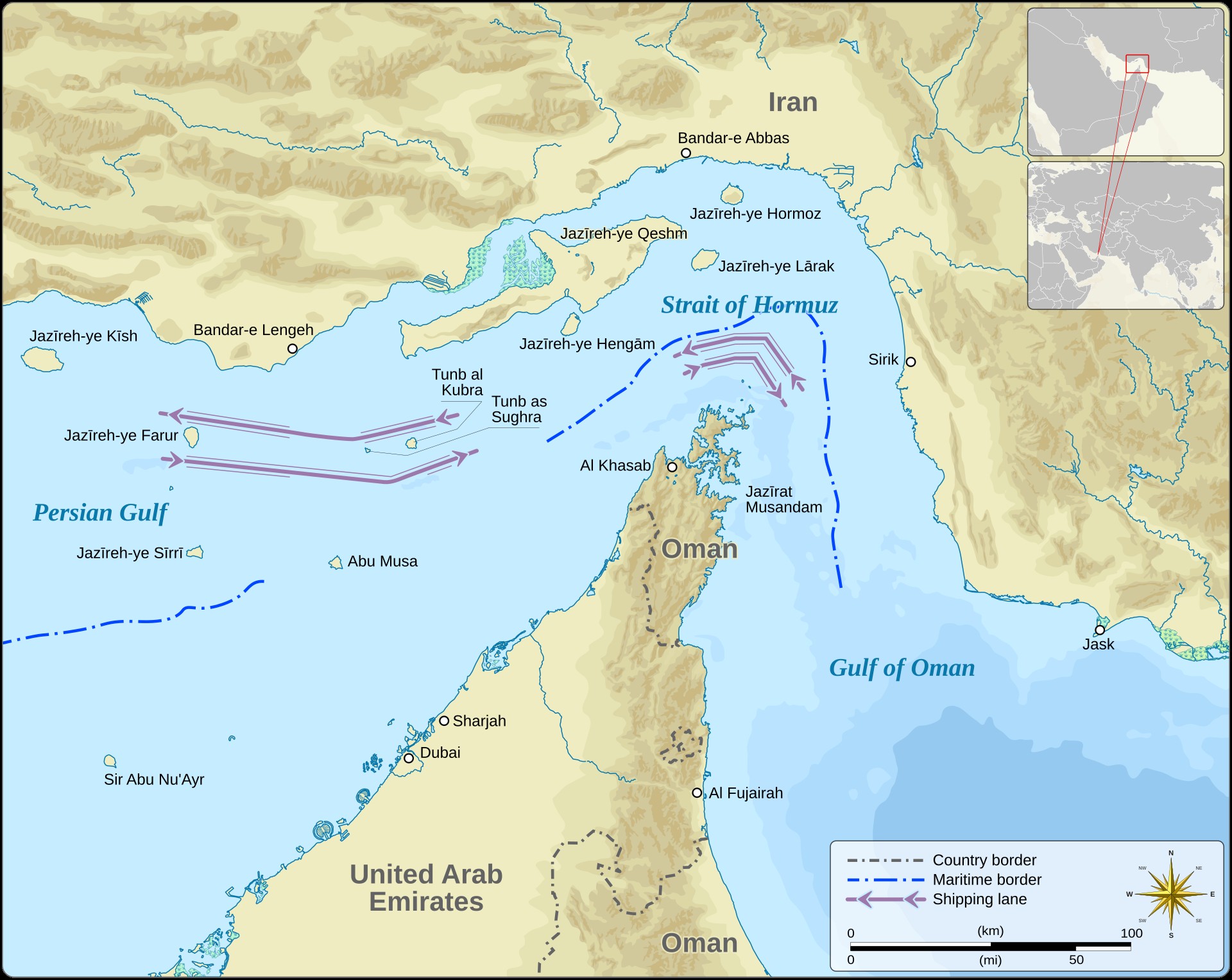
When Hormuz closed on February 28, that architecture didn’t collapse — it adapted. On April 6, the Qatari LNG carrier Al Daayen transited the strait at 8.8 knots bound for China, the first laden commercial passage since closure. The transit wasn’t brokered by Qatar’s foreign ministry or by US naval escort. It was intermediated by Beijing through yuan settlement via Kunlun Bank, outside the SWIFT system entirely. CNPC and Sinopec hold 8 million tonnes per annum in contracted Qatari LNG offtake plus 5% equity in Qatar’s North Field East expansion — structural motivation that turned a commercial interest into a diplomatic capability.
One week before the Trump-Xi summit, Chinese Foreign Minister Wang Yi met Araghchi in Beijing on May 6 and delivered language that was carefully calibrated to sound neutral while encoding Chinese priorities. “We believe that a comprehensive ceasefire brooks no delay, a resumption of hostilities is inadvisable, and persisting with negotiations is particularly important,” Wang said — a formulation that opposes both renewed US strikes and Iranian intransigence while positioning Beijing as the adult in a room of its own construction. Wang also called for Hormuz to reopen “as soon as possible,” adding that “the international community shares a common concern for restoring normal and safe passage through the Strait.” Araghchi’s response was warmer: “China is a close friend of Iran and bilateral cooperation will even become stronger under current circumstances.” Six days later, Wang Yi would skip the BRICS Delhi meeting entirely, sending China’s Ambassador to India instead — the same Trump scheduling conflict that kept him in Beijing also kept him out of the room where Araghchi and the Gulf ministers sat for the first time since the war began.
That exchange wasn’t a bilateral meeting — it was a pre-summit negotiation in which China stress-tested how far Iran would move before Trump arrived. Beijing played the same role on April 7, when it convinced Iran to accept Pakistan’s two-week ceasefire proposal that took nominal effect on April 8. China and Pakistan had already delivered a joint five-point peace initiative on March 31 calling for immediate ceasefire and Hormuz restoration, inserting Beijing as a co-architect of whatever settlement framework eventually emerges. The 2023 Iran-Saudi rapprochement — brokered by Xi in Beijing — is the proof of concept that both sides now cite when arguing China can deliver where others have failed.
What Xi Actually Wants From This Summit
The Western diplomatic consensus treats China’s Iran mediation as a favour Beijing might extend if sufficiently incentivized — a transactional read that misunderstands the structural position Xi occupies. China doesn’t need to be persuaded to engage on Hormuz. The strait’s closure costs Beijing more crude-transit exposure than any other single country: 37.7% of all oil and condensate flowing through Hormuz was bound for China before the war, and 45-50% of China’s total crude imports transited the waterway. What Xi needs is not motivation but terms — and the terms he wants serve Chinese interests that have almost nothing to do with Gulf stability.
The first objective is restoring Iranian crude flows at the discounted prices locked in under the 2021 cooperation agreement. Ten weeks of closure have not created a Chinese energy crisis — Beijing’s strategic reserves give Xi months of runway before any supply pressure becomes domestic — but the reserves are a buffer, not a substitute, and every month of drawdown reduces the cushion that gives Xi flexibility on Taiwan, on trade negotiations, and on the dozen other pressure points where strategic patience translates into strategic advantage. Restoring Iranian flows at $12-plus-per-barrel below Brent is worth more to China’s refining sector than any tariff concession Trump could offer.
The second objective is normalizing the yuan-settlement architecture that the Al Daayen transit proved operational. Before the war, Iranian oil moved through sanctions-evasion networks that were tolerated but never acknowledged. The Kunlun Bank mechanism used for Hormuz transits is different — it’s a Chinese state-owned financial institution processing energy transactions in yuan, outside SWIFT, with the implicit endorsement of the IRGC. If that architecture survives into whatever post-war settlement emerges, Beijing has built a working alternative to dollar-denominated energy trade that doesn’t require anyone’s permission to scale.
The third objective is the one that matters most for the summit itself: US acknowledgment of China as a legitimate Gulf security stakeholder. The 2023 Iran-Saudi deal gave Beijing a diplomatic trophy, but Washington treated it as a one-off rather than a precedent. If Trump flies to Beijing and negotiates a Hormuz settlement with Xi as co-guarantor, that precedent becomes permanent. David M. Hart of the Council on Foreign Relations identified the dynamic precisely: “Xi could use the summit to help reopen the strait, flexing China’s leverage over Iran. Trump needs this outcome more than Xi.”
“Xi could use the summit to help reopen the strait, flexing China’s leverage over Iran. Trump needs this outcome more than Xi.”
— David M. Hart, Senior Fellow, Council on Foreign Relations
Why Is Saudi Arabia Frozen Out of Its Own Crisis?
The exclusion is structural, not accidental. Saudi Arabia was not a party to the Islamabad talks throughout April. It was not consulted in the Oman rounds. It does not appear in any of the published frameworks — not the Pakistan-China five-point initiative, not the Witkoff 45-day phased proposal, not the Iranian counterproposals that have been submitted and rejected in sequence. Eric Alter of the Atlantic Council described it with a precision that Riyadh’s own diplomats have been careful to avoid: Gulf states face “missiles” while Washington faces “diplomatic embarrassment,” and the states absorbing the physical and economic damage have been excluded from the process that will determine when it stops.
The reasons are partly mechanical. The Islamabad track was structured as a US-Iran bilateral with Pakistan as host and enforcer. Adding Saudi Arabia would have required Iranian consent that was never forthcoming — Tehran views Riyadh as a belligerent, not a mediator, given Saudi basing rights for US forces and the Patriot batteries that have been intercepting Iranian missiles over Saudi cities since February. The Beijing track is even more exclusive: a head-of-state summit between nuclear powers on a bilateral agenda that spans trade, technology, Taiwan, AI, and rare earths. Iran is one agenda item among six, and Saudi Arabia has no bilateral relationship with Beijing that would justify inserting it into that conversation.
But the deeper reason is that Saudi Arabia’s influence doesn’t map onto the variables that matter in Beijing. China wants Iranian oil flowing cheaply. The US wants Hormuz open before the midterm political calendar makes military escalation attractive. Iran wants sanctions relief and sovereign recognition of its Hormuz role. Saudi Arabia wants the IRGC’s maritime authority dismantled, Iranian production capped so it doesn’t flood the market post-war, no sovereignty concession embedded in the final text, and its own exports restored to 10.4 million barrels per day. None of those Saudi objectives are Chinese interests. Several of them — particularly the production cap — are actively contrary to what Beijing wants, since a post-war Iran pumping at full capacity into a Chinese-discounted pipeline is exactly the outcome the 2021 cooperation agreement was designed to produce.
The $34 Billion Quarter and the 2027 Clock
The financial damage is no longer speculative. Saudi production crashed from 10.4 million bpd in February to 7.25 million bpd in March — a 3.15-million-barrel daily decline that the IEA called “the largest disruption on record.” The East-West Pipeline’s Yanbu terminal, which was supposed to be the bypass that saved Saudi export volumes, has a loading ceiling of 4-5.9 million bpd against a pipeline nameplate capacity of 7 million — and even that ceiling assumes no further IRGC strikes on pumping infrastructure, an assumption that the April 8 pipeline-station attack already invalidated once.
The fiscal arithmetic is brutal at every level of resolution. Saudi Arabia’s breakeven oil price sits at $108-111 per barrel when PIF commitments are included, according to Goldman Sachs and Bloomberg estimates. Brent is trading around $101. The kingdom posted a $34 billion deficit in Q1 2026 — 126 billion riyals — while military spending surged 26% year-on-year to cover PAC-3 interceptor replenishment, Iron Dome integration costs, and the operational tempo of defending a country that is simultaneously at war and pretending it isn’t a combatant. Goldman’s war-adjusted deficit projection runs to $80-90 billion for the full year against the government’s official $44 billion forecast, a gap that reflects the difference between Riyadh’s public accounting and its actual cash position.
The timeline has shifted in a way that compounds the exclusion problem. On Aramco’s Q1 earnings call, CEO Amin Nasser warned — according to CNBC and multiple outlets reporting on May 11 — that market normalization could slip to 2027 if Hormuz remains closed. That single sentence reframed the crisis from an acute emergency into a structural transition — and it is within that reframing that Beijing’s partial-fix scenario becomes most dangerous to Saudi interests. A Hormuz operating at 50% throughput with IRGC “coordination” authority in place would satisfy China’s crude-import needs, give Trump a diplomatic win he could sell domestically, and leave Saudi Arabia locked into a degraded export position for months or years while Iranian sovereignty over the waterway calcifies into precedent.
| Metric | Pre-War (Feb 2026) | Current | Gap |
|---|---|---|---|
| Crude production | 10.4M bpd | 7.25M bpd | -3.15M bpd (-30%) |
| Fiscal breakeven | $108-111/bbl | Brent ~$101/bbl | -$7-10/bbl shortfall |
| Q1 deficit | — | $34B (126B riyals) | Record quarterly loss |
| Full-year deficit (Goldman est.) | Official: $44B | War-adjusted: $80-90B | ~2x official forecast |
| Yanbu bypass ceiling | — | 4-5.9M bpd | 1.1-1.6M bpd below pre-war Hormuz capacity |
| Military spending YoY | — | +26% | PAC-3, Iron Dome, ops tempo |
Saudi Arabia’s Parallel Track — and Its Ceiling
Riyadh has not been passive. Foreign Minister Prince Faisal bin Farhan has maintained a diplomatic tempo that suggests a kingdom trying to build influence through speed alone — Ankara, then Doha, then London within a single week in early May. The security-bloc strategy that MBS has been assembling around Washington is real and well-resourced: it includes bilateral defence agreements, intelligence-sharing frameworks, and the kind of transactional alignment that has historically given Riyadh access to US decision-making at the highest levels. Saudi Arabia’s position — articulated through Atlantic Council channels and back-channel diplomatic language — is that it wants “a seat at the table, not just a ceasefire,” and seeks a settlement that addresses “all issues contributing to regional instability.”
The problem is that none of this creates purchase on the track that actually matters. Faisal called Araghchi on April 13, the day the US blockade took effect — behavioural evidence of a Saudi parallel channel to Tehran that exists but operates outside any formal framework. That call happened because Saudi Arabia has no mechanism to influence what comes out of Beijing, and back-channel phone calls to a foreign minister who cannot override IRGC operational commands are not a substitute for a seat at a summit where two nuclear-armed heads of state will negotiate the future of a waterway that Saudi Arabia’s economy depends on.
The ceiling on Saudi influence is visible in the architecture of the Beijing summit itself. Scott Bessent, the US Treasury Secretary, confirmed that Trump would not reschedule the visit regardless of the Iran stalemate — meaning the summit’s agenda is set by US-China bilateral priorities, not Gulf crisis management. Iran is one item among at least six, competing with trade tariffs, AI governance, rare-earth supply chains, and Taiwan for presidential attention. Secretary of State Rubio and other senior officials have been pressuring Beijing to help open Hormuz ahead of the summit, but the pressure runs through US-China channels, not US-Saudi-China channels. Riyadh’s input arrives, at best, as a variable in Washington’s calculations — never as a direct input into Beijing’s.
Chris Doyle of the Council for Arab-British Understanding captured the dynamic with uncomfortable clarity: “It would be a tremendous opportunity for China to be the broker in all of this.” The word “opportunity” is doing heavy work in that sentence — it frames Chinese mediation as a prize Beijing might claim, not a burden it might accept, and it contains no mention of Gulf consultation as a condition of that brokerage.
What Can Come Out of Beijing?
The summit spans three days — May 13 through 15 — and the range of possible outcomes on Iran runs from a joint statement of principles that means nothing to a framework agreement that restructures the entire Hormuz governance question. The most likely outcome sits uncomfortably between those poles: a US-China understanding on partial Hormuz reopening that gives Trump a headline, gives Xi a legitimacy win, and gives Iran enough ambiguity to claim it hasn’t conceded sovereignty — while leaving Saudi Arabia to absorb the consequences of whatever “coordination” mechanism the IRGC extracts as its price for letting ships through.
Beijing provided the White House with a specific pre-summit concession that reveals how seriously both sides are treating the Iran dimension: high-level assurances that China would not transfer surface-to-air missiles to Iran. That assurance — reported by CSIS — is the kind of concrete deliverable that suggests the Iran track is further advanced in US-China back channels than either side has acknowledged publicly. On May 2, China’s Ministry of Commerce ordered Chinese companies to disregard US sanctions on Iranian oil, calling them violations of international law, in a directive widely reported in Chinese state media. One day earlier, China’s National Financial Regulatory Administration ordered banks to stop extending new loans to five sanctioned refineries, a restriction simultaneously published by Bloomberg and Reuters. The simultaneous assertion and withdrawal of different forms of support is not contradictory — it is the textbook behaviour of a mediator who is calibrating pressure across multiple counterparties ahead of a deadline it controls.
That calibration was not only diplomatic. China secured a bilateral Hormuz transit exemption before the summit began — with a COSCO supertanker crossing Hormuz toll-free on May 13 as Trump’s aircraft touched down in Beijing, the direct operational result of the Araghchi–Wang Yi meeting eight days earlier.
Ali Wyne of the International Crisis Group identified Iran war discussions as one of two “pressing imperatives” at the summit, alongside trade — noting that the conflict positions China advantageously in discussions on technology supply chains and Taiwan. That framing matters because it means Hormuz is not a standalone negotiation in Beijing; it is a chip in a multi-issue bargain where concessions on one track can be traded for gains on another. Trump might accept a Hormuz arrangement that leaves IRGC coordination authority partially intact if Xi offers movement on rare-earth export controls or AI-chip restrictions. Saudi Arabia’s 3.15-million-barrel production gap does not register as a variable in that calculation.
“When both Tehran and Washington, despite their profound mistrust of each other, look to Beijing as the actor capable of influencing the other side, it becomes clear that China has become the central mediator in the conflict.”
— Shahrokh Saei, CGTN, May 7, 2026
The adversary framing deserves attention because it reveals what Beijing’s state media is pre-positioning as the narrative of the summit’s success. CGTN described Araghchi’s May 6 visit as “a turning point” and presented China as evolving “from distant economic partner toward responsible major power, more actively shaping pathways to peace.” PressTV, Iran’s English-language outlet, went further — Wang Yi described the war as “illegitimate,” and the summit was framed as Trump approaching Xi from a position of weakness. Both outlets cited China’s April 7 UN Security Council veto of the US resolution on Hormuz ship-escorting as evidence of structural alignment between Beijing and Tehran, a framing that makes Chinese “mediation” look rather less neutral than Wang Yi’s carefully balanced public language suggests.
Why a Partial Fix Is the Worst Outcome for Riyadh
The scenario that should alarm Saudi strategists is not a summit failure — it is a summit success that solves 60% of the problem. A partial Hormuz reopening that restores transit for Chinese-bound crude and LNG while maintaining IRGC “coordination” authority over the waterway achieves every Chinese objective simultaneously: Iranian oil flows restored at discount, yuan settlement normalized through Kunlun Bank channels, and China established as the Gulf’s indispensable security guarantor. It would also give Trump a tangible deliverable — “I reopened Hormuz” — that plays well on cable news without requiring the comprehensive nuclear settlement that has eluded four consecutive diplomatic rounds.
For Saudi Arabia, that scenario is worse than continued closure, because continued closure at least preserves the urgency that might eventually force a comprehensive settlement. A partial reopening that stabilizes at 50-60% of pre-war throughput removes the crisis pressure that is Riyadh’s only remaining source of bargaining power — no one negotiates the dismantlement of IRGC maritime authority when ships are moving — while locking Saudi exports into a structurally degraded position. The Yanbu bypass covers 4-5.9 million bpd. Pre-war Saudi exports ran at 7-7.5 million bpd through Hormuz plus the pipeline route. A partial reopening that lets Chinese tankers through but maintains the IRGC’s claim to “manage” the waterway does nothing for Saudi throughput unless Riyadh accepts the same coordination regime — which would mean acknowledging Iranian authority over the transit route that carries the majority of Saudi export revenue.
The Iranian parliament’s advancing 12-article Hormuz sovereignty law adds a domestic-legal dimension that makes partial arrangements especially dangerous. Every week that IRGC coordination authority operates as the de facto governance mechanism for Hormuz transit creates precedent that Iran’s legislature is actively codifying. Jodie Wen of Tsinghua University’s Center for International Security and Strategy offered the optimistic Chinese reading — “China will try its best to persuade Iran back to the negotiating table and let the Strait of Hormuz become as open as before” — but “as open as before” and “under the same legal framework as before” are not the same thing, and Beijing has shown no interest in insisting on the latter.
Why Can Xi Afford to Wait — and Trump Can’t?
The asymmetry that defines the Beijing summit is temporal, and it is measured in barrels. China entered the Hormuz crisis with 1.39 billion barrels in strategic petroleum reserve — approximately 120 days of net imports at pre-war consumption rates — plus 46 million barrels of Iranian crude sitting in floating storage across Asian anchorages. Erica Downs of Columbia University’s Center on Global Energy Policy assessed the position directly: “China has several options to manage disruptions of its energy imports from the Middle East in the near term.” That near-term buffer is Xi’s negotiating superpower, because it means he can afford to let the summit end without an Iran deal and return to the table in three months with an even stronger hand.
Trump cannot wait three months. Axios is already reporting that he is weighing renewed military strikes, a signal that the White House perceives the diplomatic window as closing rather than opening. The midterm political calendar creates a hard boundary on presidential patience — a war without visible progress is a war that becomes a liability — and the Saudi fiscal clock is ticking at $34 billion per quarter in deficit spending. Xi faces no equivalent domestic pressure. Chinese consumers are not paying war premiums at the pump because Beijing’s strategic reserves and diversified supply chains have insulated retail energy prices from the Hormuz disruption. The Chinese economy is not running a war-adjusted deficit. No Chinese city is within range of Iranian ballistic missiles.
This temporal asymmetry explains why the CFR assessment concluded that “Trump needs this outcome more than Xi” — and why that assessment should terrify Riyadh. A desperate buyer negotiates badly, and Trump is the desperate buyer in a room where Saudi Arabia’s interests are not represented by anyone with the power to protect them. The reopening, if it comes, will bear Chinese fingerprints and serve Chinese conditions: it will not be calibrated to restore Saudi export capacity to 10.4 million bpd or to dismantle the IRGC coordination regime that is strangling Saudi throughput.
What MBS Has Left
The options available to Mohammed bin Salman after the Beijing summit are narrower than at any point since the war began on February 28. The security-bloc strategy was designed to ensure that any settlement of the Iran crisis ran through Washington, where Saudi influence is deepest, rather than through multilateral frameworks where Riyadh competes with a dozen other voices. That strategy has produced the precise outcome it was engineered to prevent: the decisive negotiation is happening in a capital where Saudi Arabia has no treaty alliance, no military basing, and no institutional relationship that compares to the depth of the China-Iran cooperation agreement.
What Riyadh retains is economic weight and geographic reality — neither of which translates into summit-level influence but both of which will matter in the implementation phase of whatever Beijing produces. No Hormuz arrangement works without Saudi compliance, because Saudi tankers represent the largest single-country share of Hormuz traffic and Saudi cooperation with any IRGC-adjacent coordination mechanism is a political decision that MBS has not yet been forced to make. The kingdom also controls the OPEC+ framework, which remains the only institutional mechanism for managing the post-war production surge that will follow Hormuz reopening — a surge that could crash prices below $80 if uncoordinated, damaging Iranian revenue as much as Saudi revenue.
But implementation power is a consolation prize. The terms of the settlement — whether IRGC maritime authority is dismantled or legitimized, whether Iranian enrichment is capped or merely suspended, whether Hormuz governance reverts to UNCLOS norms or acquires a new Chinese-brokered overlay — will be set in Beijing by two leaders who are optimizing for their own bilateral relationship, not for the fiscal survival of a Gulf monarchy that bet everything on American partnership. The approximately 2,000 ships stranded and 20,000 seafarers marooned across the region — per IMO and International Transport Workers’ Federation estimates cited by the Atlantic Council — are a humanitarian crisis that adds urgency to the timeline, but urgency without agency is just pressure applied to someone else’s decision.
Trump lands in Beijing on Tuesday for a three-day summit. Whatever comes out of it will be presented to Riyadh as a framework to accept or reject — but not to amend, and not to renegotiate. The kingdom that spent $34 billion in a single quarter to stay in the war will learn the terms of the peace from a press conference in a language its crown prince does not speak.
Frequently Asked Questions
Why can’t Saudi Arabia join the Beijing summit?
The Trump-Xi summit is a bilateral head-of-state meeting between nuclear powers, covering trade, AI, Taiwan, rare earths, and Iran across a three-day agenda. Adding Saudi Arabia would require restructuring the format into a multilateral negotiation, which neither Washington nor Beijing has proposed. Iran, which views Saudi Arabia as a co-belligerent due to US military basing on Saudi territory, has not consented to Saudi participation in any mediation track — not in Islamabad, not in Oman, and not through Chinese channels. The kingdom’s influence arrives only indirectly, filtered through its relationship with Washington.
How much oil does China buy from Iran?
In 2025, China imported 1.38 million barrels per day from Iran, representing 12% of its total crude intake, according to Columbia University’s Center on Global Energy Policy. The majority was rebranded as Malaysian, Indonesian, or Emirati crude to circumvent sanctions. Under the 2021 cooperation agreement, China receives Iranian oil at a minimum 12% discount below benchmark prices, with additional 6-8% reductions built into the contract structure — making Iranian crude significantly cheaper than competing Gulf supplies. Before the war, China purchased more than 80% of all Iranian shipped oil.
What happens if Trump and Xi reach a partial Hormuz deal?
A partial reopening that restores Chinese-bound crude transit while maintaining IRGC “coordination” authority would leave Saudi Arabia in a structurally degraded export position. The Yanbu bypass pipeline handles 4-5.9 million bpd against pre-war Hormuz throughput of 7-7.5 million bpd, creating a 1.1-1.6 million barrel gap that cannot be closed without Hormuz access. Saudi Arabia would face a choice between accepting IRGC-managed transit — effectively acknowledging Iranian sovereignty claims over the waterway — or remaining locked at reduced export volumes while its competitors resume shipments under Chinese-brokered terms.
Does China have enough oil reserves to wait out the crisis?
China entered the Hormuz crisis with 1.39 billion barrels in strategic petroleum reserve — approximately 120 days of net imports — plus 46 million barrels of Iranian crude in floating storage across Asian ports, per Columbia CGEP data. This buffer means Xi Jinping faces no domestic energy emergency and can afford to let the summit pass without a deal, returning to negotiations in months with a stronger hand. By contrast, Saudi Arabia is burning through reserves at $34 billion per quarter in deficit spending, and Trump faces a narrowing political window that makes delay increasingly costly for Washington.
Would Saudi Arabia accept IRGC transit coordination to restore its export volumes?
That is the decision MBS has not yet been forced to make — and Beijing’s outcome will force it. Accepting IRGC “coordination” over Hormuz transit would restore throughput but effectively acknowledge Iranian sovereign authority over the waterway that carries the majority of Saudi export revenue. Rejecting it means remaining locked at Yanbu’s 4-5.9 million bpd ceiling while competitors who do accept the regime resume shipments. Riyadh’s leverage in that negotiation is its OPEC+ control and the fact that Saudi tanker volumes are too large for any Hormuz governance arrangement to ignore — but leverage in the implementation phase is a different, lesser thing than leverage over the terms themselves.
How Beijing’s Xinhua readout omitted Iran entirely while the joint declaration endorsed open navigation — and what that divergence reveals about China’s managed pivot — is analysed in Xi Jinping’s Hormuz Endorsement Was a Managed Chinese Pivot, Not a US Diplomatic Victory.