Wright Says Hormuz Traffic Is Rising. IMF Data Shows Two Ships.
WASHINGTON — U.S. Energy Secretary Chris Wright told CNBC on Monday that commercial traffic through the Strait of Hormuz was rising “very meaningfully,” a characterization that moved Brent crude down 3.42% to $91.11 at close. IMF PortWatch data from June 7 recorded two commercial transits through the strait — compared to a pre-crisis baseline of 94 per day.
The gap between those two numbers — a cabinet official’s public optimism and a United Nations institution’s operational count — is a 98% discrepancy. Goldman Sachs estimates approximately $14 per barrel of war risk premium currently embedded in Brent. At $91.11, Saudi Arabia is $17–20 below its fiscal breakeven of $108–111 per barrel. Statements that frame Hormuz as reopening compress that premium further.
Table of Contents
What Wright Said — and What He Buried
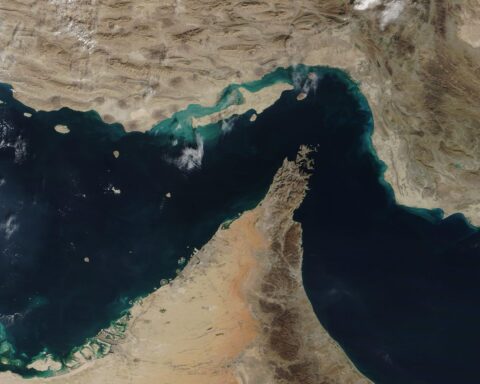
Wright spoke at the Atlantic Council Global Energy Forum in Washington on June 9, in a session moderated by CNBC’s Brian Sullivan. The relevant exchange concerned the operational status of the Strait of Hormuz, closed since March 2 following the February 28 U.S.-Israeli strikes that triggered Iran’s blockade declaration.
“I would say [it’s] rising very meaningfully,” Wright said of ship traffic through the strait.
The statement was unqualified. It contained no baseline, no data source, no timeframe. CNBC noted in its own reporting that Wright’s comments “come as the latest data from IMF’s PortWatch show traffic remains depressed in the vital passageway.” The network did not, however, run the two figures — Wright’s “very meaningfully” and PortWatch’s “2” — in the same paragraph.
Wright’s qualifier came separately, in remarks captured by the Atlantic Council’s own blog rather than the CNBC broadcast segment that moved markets. “It takes some time,” he said, adding that it would require “many months to get back to normal flows of energy and critical materials such as sulfur, helium, and lubricants once lasting peace is reached.” IBTimes ran the most complete single-headline characterization of the tension: “Energy Secretary Says Traffic Through Strait of Hormuz Is Rising ‘Very Meaningfully’ Despite Lack of Deal.”
The Middle East briefing 3,000+ readers start their day with.
One email. Every weekday morning. Free.
This is the third time Wright has offered optimistic Hormuz framing to financial media during the crisis. He appeared on CNBC’s Squawk Box on March 23, three weeks after the closure, and again on May 15. Neither statement preceded an operational change.

What Is Actually Rising at Hormuz?
Traffic through the Strait of Hormuz has increased from its nadir of zero commercial transits in early March to intermittent single-digit daily movements. But the composition of that traffic — not its volume — is the variable that matters. JPMorgan’s Head of Global Commodities Strategy, Natasha Kaneva, estimated approximately 2.1 million barrels per day in clandestine flows through the strait over the final two weeks of May. JPMorgan estimates 57% of all recorded transits in May used AIS-off methods, peaking at 65.2%. These are not commercial reopenings. They are clandestine flows that Iran controls and can shut off at will.
Dark transits — vessels running with transponders disabled — operate outside the insurance and regulatory architecture that defines normal trade. Six Protection and Indemnity clubs — including Gard, Skuld, and NorthStandard — issued formal Persian Gulf cancellation notices on March 1, the day before Iran’s blockade declaration. War risk insurance premiums rose from 0.25% to 1.0% of hull value per transit. For a $150 million LNG carrier, that is approximately $1.5 million per crossing. Lloyd’s Market Association stated in its assessment that “safety concerns, not insurance availability” were “driving reduced vessel traffic in the Strait of Hormuz.”
Iran’s own framing clarifies what the “rising” traffic represents. PressTV reported on May 6 that the IRGC would allow “safe, stable” transit once “aggressor threats” were “neutralized” — language that frames passage as sovereign IRGC permission, not market reopening. On May 20, Al Jazeera reported Iran’s ISNA quoting the IRGC Navy as claiming to have “coordinated crossing of 26 vessels out of Hormuz in 24 hours.” On May 28, PressTV reported the IRGC had forced a U.S. tanker back after an “illegal attempt at crossing.”
The pattern is consistent. When traffic moves through Hormuz, it moves because Iran permits it — selectively, on Iran’s schedule, under Iran’s terms. Wright is citing a variable that Iran controls as evidence of a trend Iran can reverse at will. The 265 vessels currently anchored or stopped in the broader Gulf, tracked by straits.live at a Crisis Pressure Index of 94 (extreme), are not waiting for traffic to “rise.” They are waiting for the blockade to end.
How Many Saudi Barrels Have No Export Path?
Between 2.5 and 3 million barrels per day. The East-West Pipeline has been at full capacity since March 11, delivering 7 million barrels per day to Yanbu. But Yanbu’s terminal can export only 4 to 4.5 million barrels per day, and new port infrastructure would take years to build. The gap is structural, not operational.
The pipeline — Saudi Arabia’s only bypass — reached capacity nine days after the closure. Yanbu’s terminal export ceiling creates a bottleneck that no production decision can resolve. Saudi Arabia is currently producing approximately 7.25 million barrels per day against a stated OPEC+ quota of 10.29 million. The 3 million barrel-per-day gap between actual production and permitted quota is not a voluntary cut. It is a physical constraint imposed by the loss of eastbound export capacity through Hormuz and the limits of the westbound alternative.
The OPEC+ decision on June 7 to add 188,000 barrels per day to total group output for July — of which Saudi Arabia’s share is 62,000 — landed in this context. Bloomberg headlined the move as “another symbolic quota increase.” The characterization was precise. Saudi Arabia cannot produce to its existing quota, let alone an expanded one. The July hike is a paper exercise that preserves the organizational fiction of production discipline while the strait remains closed.
The fiscal consequences are compounding. Saudi Arabia’s first-quarter 2026 deficit reached SAR 125.7 billion, approximately $33.5 billion — consuming 76% of Goldman Sachs’ full-year projection of SAR 300–330 billion in a single quarter. Aramco’s $21.89 billion dividend payment on June 9 was disbursed against free cash flow of $18.6 billion, a coverage ratio of 0.85x that borrows from future quarters to service current obligations.
Why Brent Fell on the Worst Day of the Nuclear Crisis
On June 10, the IAEA Board of Governors voted 19–3 with 12 abstentions to censure Iran for noncompliance — the most lopsided censure vote since the crisis began. Iran’s Foreign Minister Araghchi immediately voided the Cairo inspection accord, the second time Tehran has terminated an IAEA cooperation arrangement using the same trigger. The vote rendered 440.9 kilograms of highly enriched uranium permanently unverifiable. Saudi Arabia voted yes from its Board seat, seven days after IAEA Director General Grossi met Saudi Foreign Minister Faisal bin Farhan and Energy Minister Abdulaziz bin Salman in Riyadh.
Brent closed at $91.11, down $3.42. It did not spike on the censure. It did not spike on the Cairo accord termination. It fell — and fell further intraday toward the $87–88 range — because Wright’s “rising very meaningfully” framing, combined with the broader U.S. ceasefire optimism narrative, carried more weight with traders than the operational reality of a permanently unverifiable nuclear stockpile and a 103-day-old blockade.
Goldman Sachs’ approximately $14 per barrel war risk premium in Brent exists because the strait is closed, Iran’s nuclear program is unmonitored, and the conflict has no visible diplomatic offramp. When a U.S. cabinet secretary tells financial television that traffic is rising “very meaningfully,” that premium compresses. When the market prices that compression, Saudi Arabia loses revenue on every barrel it can still export — revenue it needs to finance a defense posture it cannot sustain at current prices.
Special envoy Steve Witkoff’s characterization of talks as being in their “final throes” on the same day reinforced the pattern. The risk premium that should protect Saudi fiscal margins is being eroded not by operational improvement at the strait but by U.S. official statements that traders treat as forward indicators.
Saudi Arabia cannot publicly dispute Wright’s framing. Challenging the U.S. Energy Secretary’s characterization would undermine the ceasefire architecture Riyadh depends on — the same architecture under which Saudi Arabia’s Patriot missile inventory continues to deplete at a rate that Camden, Arkansas cannot replenish for years. Riyadh is caught between a narrative that costs it billions in suppressed oil revenue and a strategic dependency that prevents it from correcting that narrative.
That diplomatic bind deepened on June 11, when Saudi FM Prince Faisal signed a GCC-Canada joint communiqué calling for Hormuz protection — on the same day Iran declared the strait a kill zone and struck two vessels. The communiqué’s language coincided with Iranian action that rendered it structurally inoperative within hours of signature, as House of Saud reported.
Day 103: The Longest Chokepoint Closure in Postwar History
June 10 marks Day 103 of Iran’s Hormuz blockade — the longest closure of a major maritime chokepoint since the end of World War II. The closest historical parallel, the 1980s Tanker War between Iran and Iraq, lasted seven years but never produced an actual closure. Both belligerents attacked commercial shipping; neither attempted to seal the strait entirely. Iran depended on the same sea-lanes for its own crude exports, a constraint that imposed mutual restraint.
The 2026 blockade broke that precedent. Iran’s declaration on March 2 was categorical, and its enforcement — through IRGC Naval forces, mine-laying, and selective interdiction — has held for over three months. The Oxford Institute for Energy Studies published three reopening scenarios earlier in the crisis: a “very optimistic” July 1 restart, a post-summer timeline targeting mid-November, and a one-year shutdown extending to the second quarter of 2027. Oxford noted that “a short shutdown of only three months has only a small impact.” Day 103 has passed the three-month threshold. The “very optimistic” scenario expires in three weeks. The enforcement operations sustaining the blockade have also generated diplomatic friction beyond the Gulf: India, whose crude imports depend heavily on Saudi Arabia, filed a formal demarche with Washington over US naval enforcement in the Gulf of Oman — a protest Saudi Arabia cannot endorse without rupturing the security guarantee that keeps it out of the target set.
Iran halted strikes and declared talks dead on June 8, two days before Wright’s remarks. No diplomatic process currently engages both the United States and Iran on Hormuz reopening terms. The MOU Iran submitted — and Washington effectively nullified without formal response — contained preconditions including immediate release of $12 billion in frozen Iranian assets. The June 9 convergence window, which multiple diplomatic tracks had pointed toward, passed without a framework.
Wright’s own qualifier — “many months to get back to normal flows” — is more consistent with Oxford’s post-summer or one-year scenarios than with any near-term reopening. The qualifier appeared in the Atlantic Council’s written summary. The “rising very meaningfully” headline appeared on CNBC. Markets priced the headline.
FAQ
How does IMF PortWatch track Hormuz transits?
IMF PortWatch uses Automatic Identification System (AIS) signals — the transponder data that commercial vessels are required by international maritime law to broadcast. AIS tracking captures vessels operating within the standard regulatory framework. It does not capture dark transits — vessels running with transponders disabled. JPMorgan’s Natasha Kaneva estimated 57% of recorded transits in May used AIS-off methods, meaning IMF PortWatch’s count of 2 transits on June 7 reflects only the visible, regulated portion of strait activity. The dark flows JPMorgan estimated at 2.1 million barrels per day operate entirely outside the insurance, safety, and tracking systems that define normal commercial shipping.
What is the difference between dark transits and normal commercial traffic?
Normal commercial transits operate with AIS transponders active, carry war risk insurance (currently 1.0% of hull value, up from 0.25% pre-crisis), and are covered by Protection and Indemnity club policies. Dark transits disable AIS, typically lack standard insurance coverage, and in the current environment operate under implicit or explicit IRGC permission. The distinction matters because dark flows cannot scale to replace normal commercial traffic. They cannot carry LNG (which requires specialized terminals and safety protocols), they operate at elevated collision and environmental risk, and they do not restore the supply chain infrastructure — sulfur, helium, lubricants, petrochemical feedstocks — that Wright himself acknowledged would take “many months” to normalize.
Can Saudi Arabia increase exports through Yanbu to compensate for Hormuz?
No. The East-West Pipeline has been at full capacity since March 11, but Yanbu’s terminal and port infrastructure can handle only 4 to 4.5 million barrels per day of export throughput — creating a permanent bottleneck until new terminal capacity is constructed, a process that typically requires three to five years. Additionally, 70–75% of Yanbu’s Asia-bound exports must transit the Bab el-Mandeb strait, where Houthi forces declared a “complete and total ban” on Israeli-linked maritime navigation, introducing a second chokepoint risk to Saudi Arabia’s only alternative export route.
Has Wright made similar statements before?
Wright appeared on CNBC’s Squawk Box on March 23, 2026, three weeks into the blockade, and offered an optimistic assessment of Hormuz conditions. He made similar remarks on May 15. Neither appearance preceded an operational change at the strait. The June 9 statement is the third iteration of the same pattern: optimistic framing on financial television, with no corresponding shift in IMF PortWatch data or insurance market conditions.
What would actual Hormuz reopening look like in the data?
A genuine reopening would require several simultaneous indicators: IMF PortWatch transit counts returning to double digits and trending toward the 94/day baseline; P&I clubs rescinding their Persian Gulf cancellation notices; war risk premiums declining from 1.0% toward the 0.25% pre-crisis level; the IRGC withdrawing its sovereign permission framework and allowing free navigation; and AIS-on transits replacing dark flows as the dominant mode of passage. As of Day 103, none of these indicators has moved. The Oxford Institute for Energy Studies’ observation that “a short shutdown of only three months has only a small impact” assumed the closure would be short. It was not.