The IMF Just Made Saudi Arabia’s Recovery Conditional on Iran Opening the Strait of Hormuz
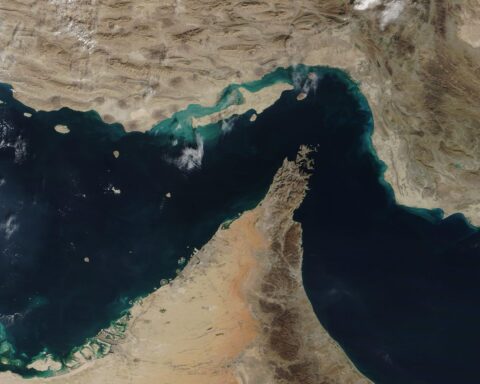
RIYADH — The International Monetary Fund published the concluding statement of its 2026 Article IV mission to Saudi Arabia on June 3, and the document contains a sentence that no prior IMF assessment of the Kingdom has ever included. Recovery, the mission states, is “contingent on maritime shipping through the Strait of Hormuz normalizing over the coming months.” The baseline forecast — GDP growth of approximately 2 percent in 2026, down from 4.5 percent in 2025 — does not merely assume normalisation. It requires it. If Hormuz does not reopen, the number does not hold.
That single conditionality transforms the Article IV from a fiscal forecast into something closer to a diplomatic constraint document. The IMF has no enforcement power and no lending relationship with Saudi Arabia. It does not need one. Article IV statements carry institutional authority that bond rating agencies, sovereign wealth fund counterparties, and creditors treat as the closest thing the multilateral system produces to a formal external verdict on a country’s fiscal position. The 2026 verdict says Saudi Arabia cannot recover on its own timeline. It recovers on Iran’s. The US-Iran courier architecture that both sides describe differently means that recovery timeline depends on a channel Riyadh cannot access and a counterparty it cannot reach.
Table of Contents
- What Did the IMF’s 2026 Article IV Actually Say About Saudi Arabia?
- The 2025 Baseline: Zero Hormuz, Broadly Balanced Risks
- Why Does the Hormuz Conditionality Matter for Saudi Fiscal Policy?
- The Fiscal Arithmetic Behind the Conditionality
- Who Can Use This Document as a Diplomatic Instrument?
- How Does Aramco’s Dividend Trap Compound the IMF Verdict?
- The East-West Pipeline Ceiling the IMF Praised but Did Not Measure
- What Riyadh Did Not Say
- The Greek Precedent and Sovereign Risk Repricing
- Frequently Asked Questions
What Did the IMF’s 2026 Article IV Actually Say About Saudi Arabia?
The IMF staff team, led by mission chief Azim Sadikov, visited Riyadh from April 28 to May 13, 2026. The concluding statement, published as PR 26181 on June 3, contains four structural assessments that collectively redefine the IMF’s posture toward the Kingdom.
First, the growth downgrade. The mission projects GDP growth of approximately 2 percent for 2026. That figure is lower than the IMF’s own April World Economic Outlook projection of 3.1 percent — itself already a 1.4-percentage-point cut from the January forecast of 4.5 percent. The Article IV number overtakes an already-revised estimate by a further full percentage point, and it does so conditionally. The 2 percent holds only if Hormuz normalises “in the coming months.”
Second, the disruption diagnosis. “The conflict and the ensuing curtailment of maritime traffic through the Strait of Hormuz have disrupted trade, weighing on the oil and non-oil sectors,” Sadikov’s statement reads. The language is categorical. The IMF does not say risks exist. It says disruption has occurred and is ongoing.
Third, the risk escalation. “The main risk is an escalation of the conflict, which could further impair shipping routes, damage energy infrastructure with associated output losses, and heighten uncertainty and financial sector risks.” Sadikov then adds a sentence that reaches beyond the current year: “A prolonged conflict could erode investor confidence and weaken medium-term growth and diversification prospects.” The medium-term language converts a wartime disruption into a structural threat to Vision 2030 itself.
The Middle East briefing 3,000+ readers start their day with.
One email. Every weekday morning. Free.
Fourth, the fiscal prescription. “The mission considers that a modest reduction in the non-oil primary deficit in 2026 remains appropriate, with spending reprioritisation as the first line of action to accommodate any fiscal response to the conflict.” The word “reprioritisation” is doing heavy work. The IMF is telling Riyadh to cut non-war spending to fund the war’s costs, not to borrow more or draw down reserves further. If the shock persists, fiscal loosening is available — but it “should be temporary, targeted, and transparent.”
The 2025 Baseline: Zero Hormuz, Broadly Balanced Risks
The scale of the shift becomes visible only against the 2025 Article IV. The IMF Executive Board concluded its 2025 consultation in August of that year. The staff concluding statement, published June 25, 2025, described Saudi risks as “mainly to the downside” from weaker oil demand and trade tensions. The Executive Board’s own assessment went further: Directors “viewed external and fiscal risks as broadly balanced.”
The word “Hormuz” does not appear in the 2025 concluding statement. Neither does “strait,” “shipping,” or “maritime.” The closest the 2025 document approaches a supply disruption is a single clause listing upside risks: “Oil prices could rise if the global recovery strengthens or in the case of disruptions to the global supply of oil.” Disruption, in 2025, was a price benefit. In 2026, it is the binding constraint on the entire forecast.
| Metric | 2025 Article IV (June 2025) | 2026 Article IV (June 2026) |
|---|---|---|
| GDP growth forecast | 4.5% (2025 actual) | ~2% (conditional on Hormuz) |
| Hormuz mentions | Zero | Central structural constraint |
| Risk characterisation | “Broadly balanced” (Board); “mainly downside” (staff) | “Main risk is escalation of the conflict” |
| Fiscal buffers language | “Ample” — absorb temporary shocks | “Important” — but reprioritisation needed first |
| Vision 2030 framing | Accelerated reform momentum | “Prolonged conflict could erode medium-term diversification” |
| Supply disruption | Upside price risk | Active, ongoing, named cause of contraction |
The 2025 statement praised Saudi “institutional resilience” and called for “countercyclical fiscal policy” supported by “ample fiscal buffers.” The 2026 statement still credits resilience — “the Saudi economy is demonstrating agility and resilience” — but wraps it inside a conditionality the 2025 document never imposed. The buffers are “important,” not “ample.” The shift from ample to important is the IMF’s way of saying the cushion is thinner than it was twelve months ago.
Jihad Azour, director of the IMF’s Middle East and Central Asia Department, had previewed part of this downgrade at the April 2026 Regional Economic Outlook, where he said Saudi Arabia “stands out, with growth projected at about 3.1 percent this year, supported by alternative oil pipelines.” The June Article IV mission’s own 2 percent projection supersedes Azour’s April figure — an internal IMF revision that occurred within six weeks.
Why Does the Hormuz Conditionality Matter for Saudi Fiscal Policy?
The conditionality matters because the IMF does not usually write forecasts with a single named geographic chokepoint as the load-bearing assumption. Standard Article IV practice attaches growth projections to policy variables — fiscal consolidation paths, monetary settings, structural reform timelines — that the assessed country can control. The 2026 Saudi forecast is attached to a variable Riyadh cannot control: whether Iran permits shipping through the Strait of Hormuz.
This makes the 2 percent figure functionally different from a normal IMF projection. It is not a forecast of what Saudi policy will produce. It is a forecast of what Saudi policy will produce if a foreign adversary allows it. The conditionality language — “contingent on maritime shipping through the Strait of Hormuz normalizing” — does not say “if oil prices recover” or “if global demand stabilises.” It names the specific physical bottleneck and the specific geographic feature. No IMF Article IV for any Gulf state has previously conditioned a baseline on a named chokepoint controlled by a third party.
The recovery timeline the IMF cannot specify now has a concrete obstacle: the sequencing inversion that has collapsed Phase 1 talks, with Iran demanding $12 billion in frozen-assets access before any Hormuz action, means the chokepoint conditionality the IMF built into Saudi Arabia’s growth baseline has no agreed trigger mechanism.
Saudi Arabia’s private de-escalation track with Iran has not produced a Hormuz reopening. The US-Iran MOU process has stalled, with Iran preparing to formally decline the American proposal around June 9. Oman’s mediation channel remains active but has yielded no transit agreement applicable to Saudi-flagged or Saudi-destined cargo beyond bilateral Iraqi exemptions. The IMF’s own mission dates — April 28 to May 13 — predate Iran’s June 1 suspension of MOU talks, the IRGC’s strikes on Kuwait, and the formal rejection timeline now converging on June 9.
The 2 percent baseline, in other words, was calculated before conditions deteriorated further. The conditionality it rests on is now less likely to be met than it was when the mission team left Riyadh.
The Fiscal Arithmetic Behind the Conditionality
Saudi Arabia’s Q1 2026 fiscal deficit reached SAR 125.7 billion ($33.5 billion), consuming 76 percent of the full-year SAR 165 billion deficit target in 90 days. Defence expenditure rose 26 percent year-on-year. Goldman Sachs revised its full-year 2026 deficit estimate to SAR 300–330 billion ($80–90 billion), equivalent to 6–6.6 percent of GDP — nearly double the official target.
The fiscal breakeven oil price — the Brent level at which Saudi revenues cover expenditures including PIF transfers — sits at $108–111 per barrel (Goldman Sachs/Wood Mackenzie estimates). Brent closed at $96.89 on June 3. At Saudi Arabia’s actual production rate of approximately 7.25 million barrels per day — an involuntary cut from the OPEC+ quota of 10.291 million b/d imposed by the Hormuz constraint — the daily revenue gap runs between $80 million and $101 million.
The National Debt Management Centre’s 2026 Annual Borrowing Plan projected SAR 217 billion in total financing needs: SAR 165 billion for the deficit plus SAR 52 billion in maturing obligations. The NDMC pre-funded approximately 90 percent of that requirement before the escalation. Goldman’s revised deficit estimate, using the top of its SAR 300–330 billion range, implies actual full-year financing needs of approximately SAR 382 billion — a SAR 165 billion unplanned gap requiring market access that was not scheduled and has not been secured.
| Fiscal Indicator | Figure | Source |
|---|---|---|
| Q1 2026 deficit | SAR 125.7B ($33.5B) | Saudi Ministry of Finance |
| Full-year target | SAR 165B | Saudi MoF 2026 budget |
| Q1 deficit as % of target | 76% | Bloomberg / MoF |
| Goldman revised full-year estimate | SAR 300–330B ($80–90B) | Goldman Sachs |
| Fiscal breakeven (PIF-inclusive) | $108–111/bbl | Goldman Sachs / Wood Mackenzie |
| Brent (June 3 close) | $96.89 | ICE |
| Actual production | ~7.25M b/d | IMF REO / HOS estimate |
| OPEC+ quota | 10.291M b/d | OPEC Secretariat |
| Daily revenue gap | $80–101M | Derived from breakeven vs. spot |
| Defence spending Q1 YoY change | +26% | Saudi MoF |
The IMF’s instruction to “reprioritise” spending rather than borrow or draw reserves further lands on this arithmetic. With the NDMC already at 90 percent of pre-planned borrowing capacity, additional market issuance would need to clear spreads that reflect the IMF’s own conditionality. Aramco bonds, Saudi sovereign sukuk, and PIF credit instruments all trade in a market that reads Article IV documents. The conditionality on Hormuz now embeds itself in the credit spread.
Who Can Use This Document as a Diplomatic Instrument?
Three actors gain operational use from the IMF’s language, and each deploys it differently.
Iran
Tehran’s state-aligned media had already previewed this frame. PressTV published “Saudi Vision 2030 in freefall as fiscal woes from US-Israeli war on Iran deepens” on May 22 — twelve days before the IMF statement. The Article IV now gives that narrative an institutional imprimatur. Iran’s negotiating team, which is preparing a formal rejection of the US MOU around June 9, can cite the IMF document to demonstrate that time is on Tehran’s side. Every month Hormuz remains constrained, the IMF’s own numbers say Saudi Arabia’s position deteriorates. The document converts Iranian intransigence from a cost into an asset.
US Treasury
The Article IV provides Washington with an externally validated pressure point. If the administration needs to accelerate Saudi concessions on oil production, pricing, or diplomatic positioning on the Iran deal, the IMF document furnishes the arithmetic. The 2 percent conditional growth figure, the SAR 165 billion unplanned financing gap, and the daily revenue shortfall are all now part of the public multilateral record. Treasury officials negotiating the parameters of any peace architecture can point to the IMF’s verdict as evidence that Riyadh’s leverage decays with time.
Aramco bondholders and sovereign credit analysts
Article IV documents are standard inputs to sovereign credit assessments by Moody’s, S&P, and Fitch. The conditionality language — recovery requires a variable Saudi Arabia does not control — is the kind of formulation that triggers watch-list reviews. Aramco’s quarterly dividend already exceeds its free cash flow, and the IMF’s own forecast says the coverage ratio cannot improve unless Hormuz reopens. The June 9 payment date falls six days after the Article IV publication — a sequencing that bond desks will note.
How Does Aramco’s Dividend Trap Compound the IMF Verdict?
Aramco’s Q1 2026 free cash flow of $18.6 billion fell short of the $21.89 billion quarterly dividend obligation. The coverage ratio of 0.85x means Aramco paid out more than it generated. PIF, which holds a 98.5 percent stake, received the bulk of that dividend. PIF’s own cash position has fallen to approximately $15 billion — a six-year low.
The IMF statement notes that “higher oil prices are expected to offset volume losses, generating a windfall that would reduce the current account and fiscal deficits in 2026.” This windfall assumption depends on Brent remaining elevated. But the war premium embedded in current prices — Goldman Sachs estimates $14 per barrel — exists precisely because Hormuz is constrained. If Hormuz normalises, the premium collapses. Wood Mackenzie’s “Quick Peace” scenario projects Brent at $80 per barrel, falling to $65 by 2027. At $80, the daily gap to breakeven widens from the current $80–101 million to approximately $200 million. At $65, it exceeds $300 million per day.
This is the trap the IMF document frames without naming. Recovery requires Hormuz to reopen. But Hormuz reopening removes the war premium that is partially offsetting the volume loss. Saudi Arabia’s fiscal position improves only in a narrow band: Hormuz normalises enough to restore export volumes but not enough to collapse the price. That band may not exist. The OPEC+ meeting on June 7 and the Aramco dividend payment on June 9 will test whether it does.
The East-West Pipeline Ceiling the IMF Praised but Did Not Measure
The Article IV statement credits Saudi Arabia’s “prompt rerouting of oil through the East-West pipeline and Red Sea ports, combined with Aramco’s overseas inventories” for having “helped limit the drop in oil deliveries.” The language is accurate. The inference the document leaves undrawn is that the rerouting buffer is at capacity.
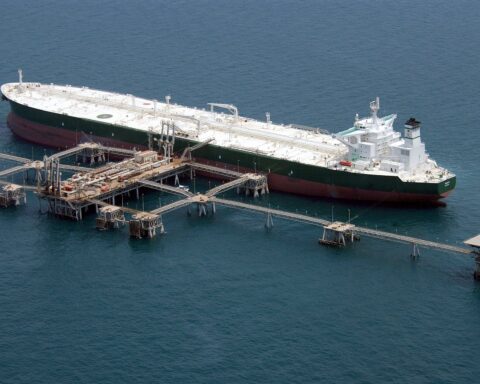
The East-West pipeline — the Petroline system connecting Abqaiq to the Yanbu terminal on the Red Sea — has a maximum design capacity of approximately 7 million barrels per day. At the current production rate of approximately 7.25 million b/d, the pipeline is operating at or above its designed ceiling. There is no incremental rerouting capacity available. Every additional barrel of production would need to transit Hormuz or not be produced at all.
The IMF’s praise for “diversified logistical and oil infrastructure” is therefore a description of what Saudi Arabia has already done, not what it can still do. The Yanbu option is exhausted. Aramco’s overseas storage drawdowns — inventories pre-positioned in Rotterdam, Sidi Kerir, and Okinawa — are finite and non-replenishable while Hormuz remains closed. The PIF’s recalibrated 2026–30 strategy, which the IMF statement calls “a welcome development,” was partly a response to this capacity ceiling: capital that cannot flow through Hormuz-dependent supply chains was redirected toward domestic projects that do not require maritime export.
Azour’s April characterisation — Saudi Arabia “supported by alternative oil pipelines” — was already optimistic. The June Article IV does not update it. The pipeline is not an alternative. It is the only route, and it is full. The broader commercial hub Riyadh has assembled on the back of that rerouting — open airports, diverted freight, airline windfall — is real but structurally insufficient: as Saudi Arabia’s wartime hub status and its record $34 billion deficit shows, the commercial gains cover roughly five percent of the fiscal gap the closure creates.
What Riyadh Did Not Say
The Saudi Ministry of Finance formally welcomed the 2025 Article IV consultation. A statement published on the MoF website on June 26, 2025, acknowledged the IMF’s assessment and outlined the Kingdom’s fiscal reform agenda in response. No equivalent statement accompanied the 2026 Article IV. As of June 3, the MoF website carries no response to PR 26181.
Al Arabiya, the Saudi-owned pan-Arab news network that functions as the Kingdom’s primary English and Arabic broadcast platform for economic messaging, has not covered the 2026 Article IV. The network covered the 2025 consultation and regularly carries IMF regional commentary, including Azour’s April 2026 remarks on the Regional Economic Outlook. The absence of coverage for a document that explicitly conditions Saudi recovery on a foreign chokepoint is itself a data point.
Competing international outlets covered the Article IV with varying degrees of precision. The National led with “resilient economy” framing and noted the “prolonged Iran war could weigh on medium-term outlook.” IndexBox produced the most accurate headline: “Recovery Tied to Strait of Hormuz.” AGBI softened the finding to “slower-growing but resilient.” None analysed the conditionality as a diplomatic instrument. None compared the 2025 and 2026 documents to identify the categorical shift from “broadly balanced” to “contingent on Hormuz.”
“Assuming maritime shipments through the Strait of Hormuz normalize in the coming months, a recovery could take hold, with growth this year notably lower but holding up at about 2 percent.”
The Saudi silence is consistent with a pattern. The Kingdom’s Ministry of Foreign Affairs has issued no public statement on the Iran conflict for more than ten days. The private diplomatic channel — the MBS-Macron call on May 31 discussing “maritime navigation security and freedom,” with no Élysée readout — suggests Riyadh is managing the Hormuz constraint through bilateral backchannel, not public engagement with multilateral assessments that name the constraint explicitly.
The Greek Precedent and Sovereign Risk Repricing
Saudi Arabia does not have an IMF programme. It has never sought one and shows no indication of doing so. The Kingdom’s sovereign debt-to-GDP ratio, while rising, remains below 30 percent. Reserves are large, though declining. The comparison to programme countries — Greece, Argentina, Pakistan — is structurally misplaced.
The relevant precedent is narrower. After 2010, IMF Article IV documents for Greece were cited by EU creditors, the European Central Bank, and bondholders to accelerate fiscal adjustment demands. The Article IV did not compel policy. It provided authoritative external cover for actors who wanted to impose conditions. The documents became instruments of leverage not because the IMF enforced them but because markets and creditors treated them as the definitive external assessment.
Saudi Arabia’s position differs in that it is not a debtor to the IMF or to European institutions. It differs in that its fiscal buffers, while stressed, are not exhausted. But the mechanism is the same. The 2026 Article IV gives every actor with a financial or diplomatic interest in Saudi Arabia’s trajectory — from sovereign wealth fund counterparties evaluating PIF co-investment terms, to bond traders pricing Aramco’s next issuance, to Iranian negotiators calibrating the cost of delay — an institutionally authoritative document that says: this country’s recovery depends on something it does not control.
“Beyond near-term effects, a prolonged conflict could erode investor confidence and weaken medium-term growth and diversification prospects.”
The IEA has separately characterised the Hormuz closure as “the largest supply disruption in the history of the global oil market.” The IMF document does not use that phrase. It does not need to. By conditioning the Kingdom’s own growth forecast on the chokepoint’s reopening, the Article IV achieves something the IEA characterisation does not: it places the cost of the disruption inside Saudi Arabia’s sovereign balance sheet and pins a number — 2 percent, conditional — to the damage.
Iran’s formal MOU rejection, expected around June 9, will arrive the same day as Aramco’s dividend payment and three days after the 41st OPEC+ ministerial meeting. The IMF document, published six days earlier, provides the fiscal backdrop for all three events. Sadikov’s mission team left Riyadh on May 13. The document they published three weeks later tells the Kingdom its recovery is contingent on a strait it cannot open, assessed in terms it did not choose, and read by actors whose interests are served by the constraint continuing. The June 7 OPEC+ ministerial adds a fourth dimension to that convergence: Saudi Arabia will absorb a pre-committed 188,000 b/d supply increase it cannot produce and cannot reverse, on a Brent price already $13–16 below its fiscal breakeven.
Azour described the Iran war as “an earthquake not seen in geopolitics and economics for five decades” (Arab News, 2026). The 2026 Article IV is the IMF’s seismograph reading. It measures the damage, conditions the recovery on forces beyond Riyadh’s control, and enters the public record where bondholders, adversaries, and allies will use it for purposes the IMF did not intend but cannot prevent.
Frequently Asked Questions
What is an IMF Article IV consultation and is it legally binding on Saudi Arabia?
An Article IV consultation is a regular (usually annual) health check the IMF conducts with each of its 190 member countries under Article IV of its Articles of Agreement. The resulting staff report and concluding statement are assessments, not binding programmes. Saudi Arabia has never entered an IMF lending arrangement and is not subject to IMF conditionality in the programme sense. The documents carry weight because bond rating agencies (Moody’s, S&P, Fitch), institutional investors, and sovereign credit desks treat them as the most authoritative independent fiscal assessment available for non-programme countries.
Has the IMF ever conditioned a Gulf state’s growth forecast on a specific geographic chokepoint before?
No prior IMF Article IV for any GCC member state — Saudi Arabia, UAE, Kuwait, Bahrain, Qatar, or Oman — has conditioned a GDP baseline on the normalisation of shipping through a named strait or waterway. The 2026 Saudi Article IV is the first to make a specific transit corridor the binding assumption of the growth forecast. Previous IMF documents for Gulf states referenced oil price volatility, OPEC+ compliance, and diversification progress as the primary forecast variables — all of which are at least partially within the assessed country’s policy control.
How does the IMF’s 2 percent growth figure relate to the April 2026 WEO projection of 3.1 percent?
The April 2026 World Economic Outlook projected Saudi GDP growth at 3.1 percent, a 1.4-percentage-point cut from the pre-war January forecast of 4.5 percent. The June 3 Article IV mission’s 2 percent projection is a further implicit downgrade — not a formal WEO revision but the mission team’s own assessment based on conditions observed during their April 28–May 13 visit. The WEO is a global forecast exercise published on a fixed schedule; the Article IV is a country-specific deep assessment. When the two diverge, markets typically weight the Article IV as more current and more granular.
What did the IMF say about Vision 2030 and PIF in the 2026 assessment?
The statement calls the “PIF’s recalibrated 2026–30 strategy, with its shift toward more selective capital allocation and greater private-sector crowding-in” a “welcome development.” This is diplomatic language for endorsing the scaling back of giga-projects. PIF cut NEOM’s construction commitment from $71 billion to $30 billion (AGBI, January 2026), applied an additional 15 percent capex reduction in April, and formally halted The Line on May 22 (Semafor). On Vision 2030 broadly, the IMF warns that “a prolonged conflict could erode investor confidence and weaken medium-term growth and diversification prospects” — the first time an Article IV has explicitly linked a military conflict to the viability of Saudi Arabia’s post-oil economic programme.
What happens if Hormuz does not normalise “in the coming months” as the IMF assumes?
The Article IV does not publish an alternative scenario in which Hormuz remains constrained, but it does state that Saudi Arabia “has the space to loosen the fiscal stance to cushion the economy” if the shock persists — subject to any loosening being “temporary, targeted, and transparent.” That formulation is standard IMF language for countries with fiscal room but no blank cheque. In practice, loosening on top of an already-deteriorated deficit would require unscheduled sovereign or quasi-sovereign issuance. The sovereign risk repricing that follows from the Article IV’s own conditionality — telling markets that recovery depends on a variable Riyadh does not control — is precisely what raises the borrowing cost for any such issuance. The IMF’s fiscal prescription and its conditionality work against each other: the document recommends borrowing headroom while simultaneously narrowing it.