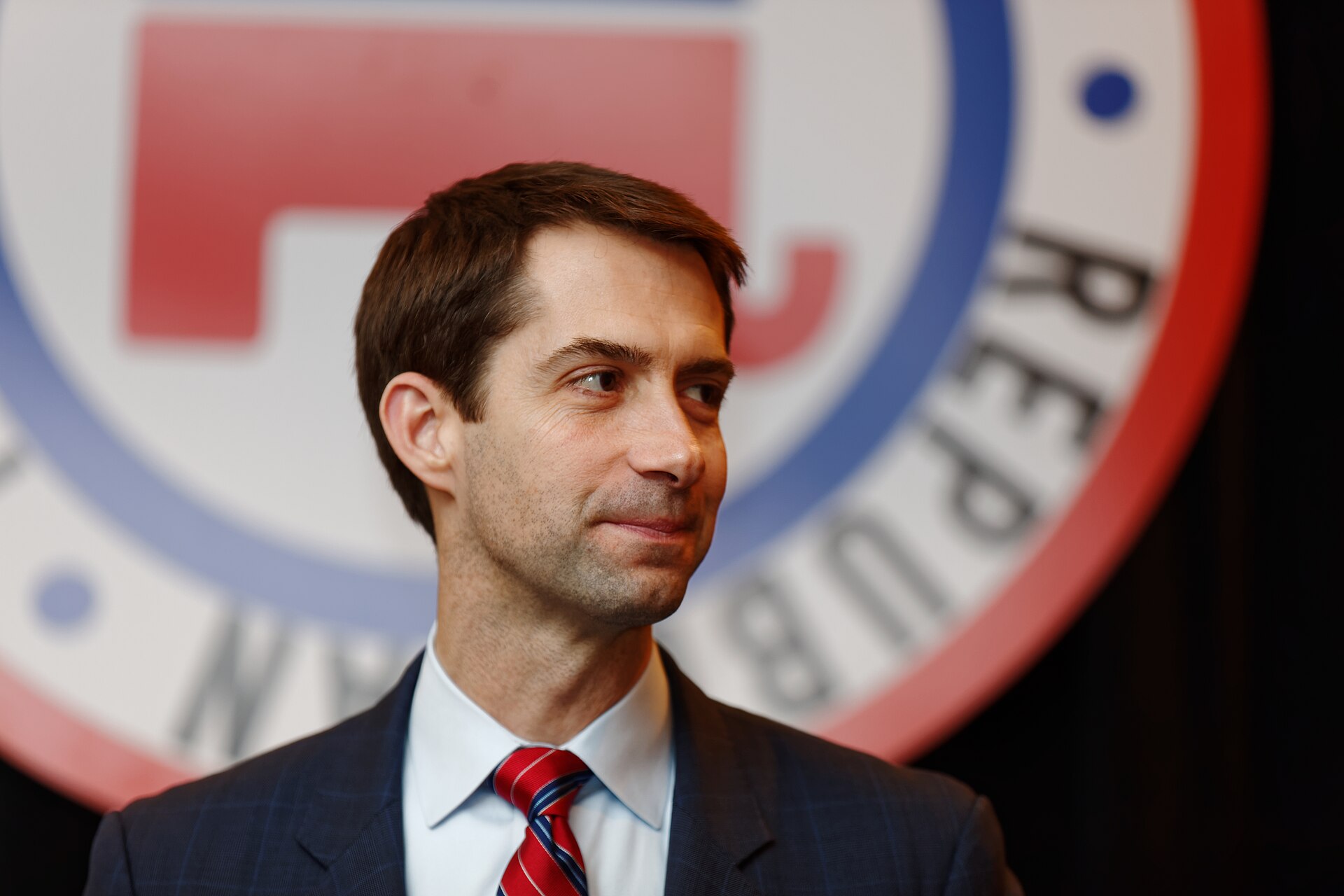

WASHINGTON — Senator Tom Cotton sent a formal letter to Treasury Secretary Scott Bessent on Thursday demanding immediate sanctions on Iran’s Persian Gulf Strait Authority, its officers, and any foreign entity that pays, processes, or facilitates toll payments for Strait of Hormuz passage — including Oman. The letter, first reported by the Washington Free Beacon on Friday, is the first Congressional action targeting the toll architecture Iran has operated since May 18.
Cotton named Oman directly, calling it “a major U.S. ally involved in helping Iran establish” a permanent toll system. Bloomberg reported May 21 that Iran and Oman are actively negotiating to formalize the PGSA into a permanent maritime governance mechanism — the same talks that constitute Saudi Arabia’s only indirect connection to Hormuz governance. If Treasury acts on Cotton’s demand, it would sanction the country Riyadh depends on for whatever remains of its influence over the strait.
Table of Contents
What Cotton Is Demanding
Cotton’s letter asks Bessent to impose sanctions under “existing authorities” on three categories of targets: the PGSA itself, its officers, and — the broadest category — “any foreign entity that pays, processes, or facilitates tolls to Iran for passage through the Strait of Hormuz.” The third category is where Oman falls. Cotton stated separately that he is “preparing legislation to further codify” the sanctions effort, though no draft bill has been introduced and no timeline was given.
His legal argument centers on the PGSA’s chain of command. “The PGSA operates directly under the Islamic Revolutionary Guard Corps (IRGC), a designated Foreign Terrorist Organization,” Cotton wrote, “meaning every dollar collected directly finances a sanctioned terrorist entity.” The IRGC was designated a Specially Designated Global Terrorist under Executive Order 13224 in October 2017 and a Foreign Terrorist Organization by the State Department in April 2019. Cotton’s letter treats the PGSA as an IRGC sub-entity, which — if Treasury accepts that characterization — would make toll payments functionally identical to financing a designated terrorist organization.
No other senators co-signed the letter. Treasury did not respond to press inquiries about Cotton’s specific demands, according to Benzinga. Cotton sits on the Senate Armed Services Committee and the Intelligence Committee. He is acting alone, but from positions that give the letter weight beyond a solo constituent request.
“I stand ready to work with you and am preparing legislation to further codify your efforts. In the meantime, I support the use of existing authorities to impose sanctions on the PGSA, its officers, and any foreign entity that pays, processes, or facilitates tolls to Iran for passage through the Strait of Hormuz.”
The HOS Daily BriefThe Middle East briefing 3,000+ readers start their day with.
One email. Every weekday morning. Free.
— Senator Tom Cotton, letter to Treasury Secretary Bessent, May 22, 2026
The Legal Architecture OFAC Already Built
Cotton is not asking Treasury to create a sanctions framework from scratch. The Office of Foreign Assets Control issued FAQ 1249 on April 28, warning that payments to the Iranian government or IRGC for Hormuz transit are not authorized for U.S. persons and create “significant sanctions exposure” for non-U.S. persons. The guidance was granular: it covered fiat currency, digital assets, offsets, informal swaps, and — in a detail suggesting OFAC had already mapped the PGSA’s payment architecture — “nominally charitable donations to the Iranian Red Crescent Society, Bonyad Mostazafan, or Iranian embassy accounts.”
Three days later, on May 1, OFAC issued a formal alert reiterating that toll payments carry sanctions risk. The specificity was unusual. OFAC does not typically enumerate shell-game payment channels unless it has intelligence on their active use.
Before either advisory, in April 2026, Treasury had already sent warning letters to financial institutions in four jurisdictions: China, Hong Kong, the UAE, and Oman. The inclusion of Oman — a country with a free-trade agreement in force since 2009 — was itself a signal that the administration viewed Muscat’s financial sector as a potential conduit. Treasury’s “Operation Epic Fury,” also launched in April, sanctioned a China-based oil refinery and roughly 40 shipping companies and tankers transporting Iranian crude, according to Fox Business.
The legal infrastructure, in other words, exists. Cotton’s letter asks Bessent to go further: to designate the PGSA as an entity, name its officers individually, and extend secondary sanctions to any foreign party — state or private — that touches the toll system. A Bracewell LLP analysis published in the National Law Review was explicit about the scope: “Given the administration’s goal of destroying the IRGC, any entity that pays the IRGC toll in any currency is still at risk for secondary sanctions.” Cotton is asking for escalation of enforcement, not creation of authority.
Why Did Cotton Name Oman?
On May 13, a delegation led by Abbas Baqerpour, Director General for International Legal Affairs at Iran’s Foreign Ministry, met Omani counterparts in Muscat to draft a bilateral framework requiring advance permits from both Iran and Oman before any vessel transits the strait, according to PressTV. Baqerpour held a separate meeting with Omani Foreign Minister Badr al-Busaidi. The talks were not secret — Iran’s state media reported them approvingly as steps toward formalizing Hormuz governance.
Eight days later, Bloomberg reported that Iran and Oman were negotiating a “permanent toll system” to formalize Iran’s control of Hormuz maritime traffic. Iranian Ambassador to France Mohammad Amin-Nejad told Bloomberg that “Iran and Oman must mobilize all their resources both to provide security services and to manage navigation in the most appropriate manner,” adding that the system would be transparent and that “those who wish to benefit from this traffic must also pay their share.”
Oman’s public position contradicts its negotiating posture. Transport Minister Said al-Maawali stated in April that Oman “signed all international maritime transport agreements” barring transit fees and that “no tolls can be imposed for crossing Hormuz,” according to Bloomberg and Al Jazeera. That statement has not been retracted. Nor has it been reconciled with the Baqerpour meetings or the Bloomberg reporting on permanent toll negotiations. Cotton’s letter exploits the gap between what Muscat says and what Muscat does.
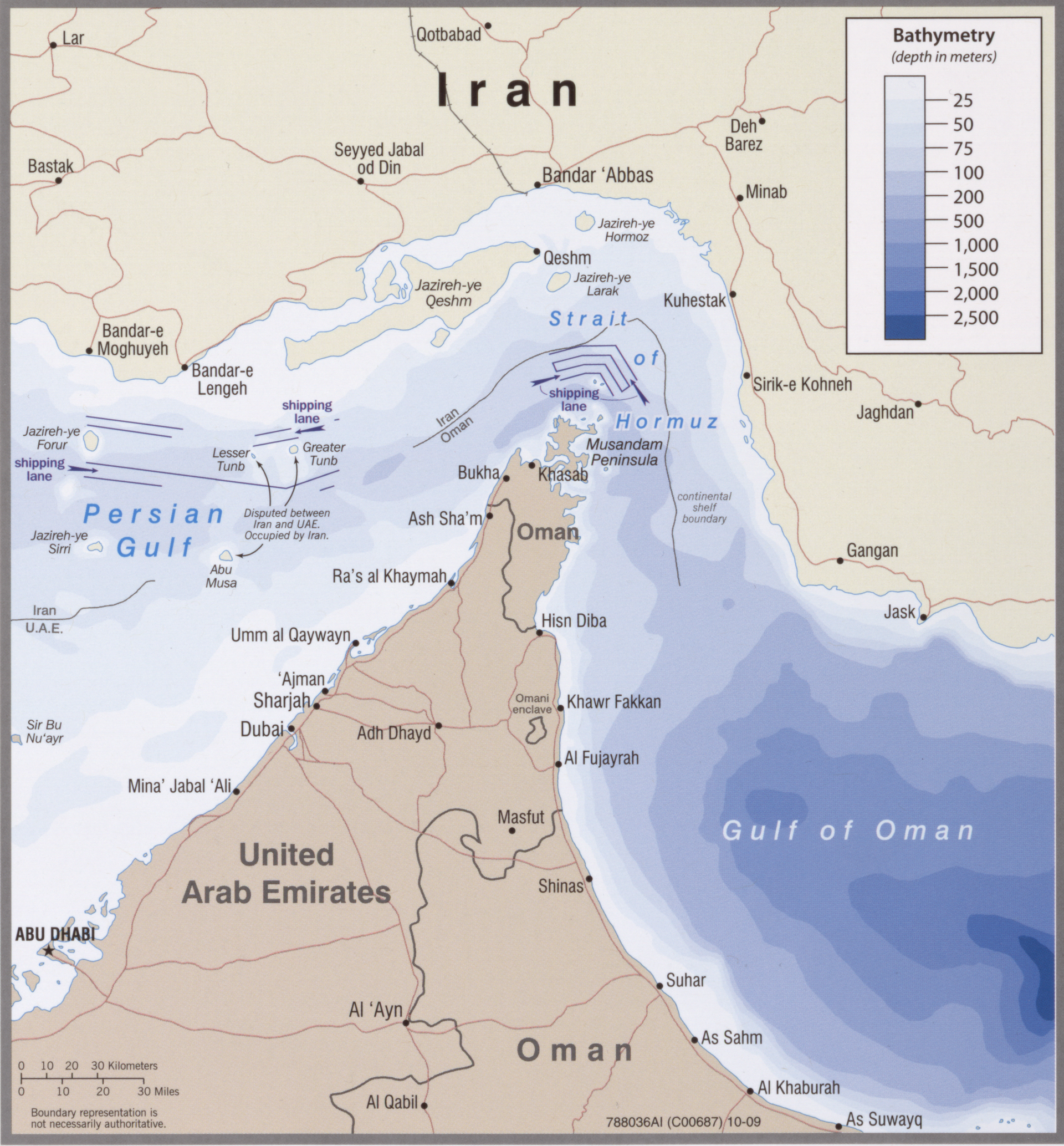
Oman was also the only GCC member absent from the five-nation letter to the International Maritime Organization protesting Iran’s Hormuz claims. Bahrain, Kuwait, Qatar, Saudi Arabia, and the UAE signed. Oman did not. The 1974 Iran-Oman maritime boundary treaty — which gives Oman jurisdiction over the inbound Hormuz shipping lane — places Muscat in a position that Cotton’s letter characterizes as facilitation and that Chatham House, in an April 2026 analysis, described more neutrally: “Oman may be considering a partnership with Iran over the Strait, which could be expanded to include more regional security partners.”
What Does This Mean for Saudi Arabia’s Hormuz Access?
Saudi Arabia has no bilateral diplomatic channel to Iran on Hormuz outside of Muscat. Chatham House confirmed this in its April 2026 analysis, noting separately that “Iran must be a party to any agreement over the Strait. Mediators should therefore consider options that are palatable to the regime.” Sanctions on the mediator make palatable options harder to construct.
Cotton’s letter does not mention Saudi Arabia. If Treasury designates Omani entities involved in facilitating the toll system, it would compromise the same Muscat architecture that Riyadh relies on for indirect access to Hormuz negotiations. Saudi Arabia was excluded from all five rounds of US-Iran negotiations, from Islamabad in April through Rome on May 23. The Oman channel was not a substitute for direct participation — it was the only available conduit. Carnegie’s Leber and Worby wrote in April that “the GCC has no seat at the table.”
Riyadh’s options are structurally constrained. Saudi Foreign Minister Prince Faisal bin Farhan publicly endorsed the Trump administration’s approach to Iran on May 20. Opposing a Republican senator’s sanctions demand targeting an Iran-linked entity would contradict that endorsement. Supporting Cotton’s demand would sever the Muscat channel. The Saudi foreign ministry has issued no statement on the letter.
Pakistan, the other intermediary with access to both Tehran and Riyadh, is constrained by its own contradictions. The Strategic Military Defense Agreement Pakistan signed with Saudi Arabia in September 2025 makes Islamabad simultaneously an Iranian interlocutor and a Saudi defense partner — a dual role that limits how far Pakistan can substitute for the Oman channel on Hormuz-specific governance. If Muscat is sanctioned or deterred from continuing its bilateral work with Tehran, no obvious replacement exists.
The CAATSA Precedent
Whether Washington would actually sanction Oman — a free-trade-agreement partner with a U.S. goods trade surplus of $634.3 million in 2024, according to USTR data — has a recent answer. In December 2020, the State Department sanctioned Turkey under CAATSA Section 231 for purchasing Russia’s S-400 air defense system. The designated entity was Turkey’s Presidency of Defense Industries. Asset freezes and export license bans followed. Turkey was the first NATO ally sanctioned under that authority.
The precedent establishes that treaty relationships and military partnerships do not exempt a country from U.S. sanctions over security architecture decisions. Turkey’s NATO membership — a deeper security commitment than any U.S.-Oman arrangement — did not prevent designation when Washington concluded that Ankara had crossed a red line on Russian military procurement.
There is a counter-precedent. India purchased the same S-400 system and was not sanctioned. The Biden administration declined to invoke CAATSA, citing strategic considerations in the Indo-Pacific. The divergence suggests that sanctions enforcement against allies is a political decision, not an automatic legal consequence. An unnamed legal expert told AGBI in May: “If secondary sanctions are enforced more aggressively, companies will have to make a straightforward calculation: if you want access to the US financial system, you comply; if not, you take the risk.” The question for Oman is which precedent Treasury applies — Turkey’s or India’s.
The rhetorical alignment between the administration and Cotton’s letter is complete. Secretary of State Marco Rubio called any Iranian tolling system “unacceptable, completely illegal, and a threat to the world” at Homestead Air Force Base on May 21. He separately said the toll regime would make a deal with Tehran “unfeasible.” President Trump stated: “We want it open, we want it free, we don’t want tolls.” Cotton’s letter asks Bessent to convert that rhetoric into three specific designations: the PGSA as an entity, its officers individually, and any foreign party — including Oman — that has touched the payment architecture. Treasury has not responded.
Background
Iran’s Persian Gulf Strait Authority began operations on May 18, 2026, charging up to $2 million per very large crude carrier for Hormuz transit. The PGSA operates under the IRGC, accepting payment in Chinese yuan and Bitcoin through IRGC-linked wallets. Russia, China, India, Iraq, and Pakistan are exempt from the toll. The IRGC entrenched the toll regime during a gap between US-Iran negotiating sessions that stretched to 39 days before the Rome round on May 23.
The PGSA was established on May 5, during a four-day suspension of U.S. military access to Prince Sultan Air Base. Its 12-article founding statute passed committee on April 21 and awaits a full chamber vote in Iran’s parliament — a step that would codify the toll as domestic law. The UN Security Council failed to act after Russia and China vetoed a Hormuz resolution on April 7, with 137 co-sponsors on the second draft. Iran published a formal map of the PGSA’s enforcement zone on May 22, with anchor points on UAE sovereign territory at Fujairah and Umm al-Quwain.
Cotton’s prior Iran-related legislation, the “No ICBMs or Drones for Iran Act” of 2023, targeted missile and drone proliferation. The PGSA letter shifts the focus from weapons programs to the economic infrastructure Iran has built at the chokepoint — a category of sanctions target that did not exist before May 2026.
Frequently Asked Questions
What currencies does the PGSA accept for toll payments?
The PGSA accepts Chinese yuan and Bitcoin, routed through IRGC-linked wallets. OFAC FAQ 1249, issued April 28, specified that sanctions exposure applies regardless of payment method — covering fiat currency, digital assets, offsets, informal swaps, and “nominally charitable donations” used as payment mechanisms. A Bracewell LLP analysis in the National Law Review concluded that payment currency is irrelevant: any entity paying the toll remains at risk of secondary sanctions under the administration’s stated goal of destroying the IRGC.
Could the US-Oman Free Trade Agreement shield Oman from sanctions?
The US-Oman FTA, in force since January 1, 2009, governs tariffs, market access, and investment protections. None of its provisions override OFAC designations or sanctions authorities under the International Emergency Economic Powers Act. Treasury has already included Oman among the four jurisdictions — alongside China, Hong Kong, and the UAE — that received warning letters about Iranian illicit financing flows in April 2026, indicating the administration does not view the FTA as a constraint on enforcement.
How has Iran responded to sanctions threats against the PGSA?
An unnamed Iranian source told the Tasnim News Agency that “no one in Iran drafts plans to please Trump” and that his reaction to the toll system “does not matter at all.” Iran’s army warned on May 10, via PressTV, that countries obeying U.S. sanctions “will certainly face problems” transiting the Strait of Hormuz. The PGSA’s founding statute is advancing through Iran’s parliament toward a full chamber vote that would codify the toll as permanent domestic law.
Has any other member of Congress acted on the Hormuz toll issue?
Cotton’s letter is the first Congressional action targeting the PGSA toll architecture specifically. No co-signatories were identified in available reporting. Separately, 52 senators and 177 House members have demanded zero enrichment as a condition of any US-Iran deal — a position that complicates nuclear negotiations but does not address the toll regime. NATO convened a Maritime Freedom Construct meeting in Helsingborg, Sweden, on May 21, but no GCC member attended, and Secretary Rubio characterized progress as “not there yet.”
What is the 1974 Iran-Oman maritime boundary treaty?
Iran and Oman signed a maritime boundary agreement in 1974 delineating jurisdiction over the Strait of Hormuz. Under its terms, Oman holds jurisdiction over the inbound (northbound) shipping lane — the lane through which tankers enter the Persian Gulf — while Iran controls the outbound lane. The PGSA’s enforcement zone, as mapped by Iran on May 22, extends beyond this bilateral framework: its eastern boundary reaches Fujairah and its western boundary extends to Umm al-Quwain, both on UAE sovereign territory. The 1974 treaty gives Oman a legal role in Hormuz governance that predates the current crisis by more than five decades — and that Cotton’s letter now characterizes as facilitation of Iranian sanctions evasion.