
The Custodian’s Trap: 1.2 Million Pilgrims, 400 Interceptors, and the Identity That Makes Cancellation Impossible
JEDDAH — The first pilgrims arriving for Hajj 2026 today are walking into the most dangerous mass gathering in modern history — and the Saudi state cannot tell them so without destroying the legitimacy architecture it has spent four decades building. Saudi Arabia has approximately 400 PAC-3 MSE interceptors remaining, 14 percent of its pre-war stockpile, to defend between 1.2 and 1.5 million pilgrims across a season that peaks five weeks after the ceasefire expires on April 22. The Custodian of the Two Holy Mosques title, formalized by King Fahd on October 27, 1986, to answer Ayatollah Khomeini’s charge that the House of Saud was unfit to guard Islam’s holiest sites, has converted Hajj from a religious obligation into a strategic vulnerability that no adversary had to engineer.
The threat does not need to materialize. The structural bind — cancellation validates the 1979 challenger, continuation exposes the 2026 reality — restructures Saudi decision-making whether or not a single Iranian missile is fired at the Hejaz.
Table of Contents
- What the Custodian Title Actually Requires
- The Arithmetic of 400 Interceptors
- Why Can’t MBS Cancel Hajj?
- The Ceasefire Gap: April 22 to May 26
- Iran’s Zero-Pilgrim Advantage
- What Are Sending Countries Doing About Hajj Security?
- The Ministry of Defence Photo and the Number It Didn’t Publish
- Has Hajj Ever Proceeded During Active War?
- How Many Layers of Air Defense Cover Makkah?
- The Bind That Built Itself
- Frequently Asked Questions

What the Custodian Title Actually Requires
The title Custodian of the Two Holy Mosques is not ornamental. King Fahd adopted it on October 27, 1986, replacing “His Majesty” — a deliberate downgrade of royal self-reference designed to achieve a specific political objective. The date matters: it came exactly seven years after two events that nearly fractured Saudi legitimacy in the Islamic world. The 1979 Iranian Revolution gave Khomeini a platform to argue that the House of Saud was morally unfit to steward Islam’s holiest sites. Weeks later, the Grand Mosque seizure in Mecca — which required French GIGN commandos to help resolve — demonstrated that Saudi Arabia could not even physically secure the Kaaba without non-Muslim military assistance.
Fahd’s answer was to root the monarchy’s legitimacy not in sovereignty, wealth, or military power but in custodianship. The title is a promise: the kingdom exists, in part, to ensure that Muslims can perform Hajj. Brookings Institution scholars have framed this with uncomfortable precision: Saudi Arabia’s control over the holy sites rests in international law and state sovereignty rather than in Islamic theology. The title bridges that gap. It converts a legal fact — the kingdom controls the Hejaz — into a theological covenant. Every Saudi ruler since 1986 has carried it.
The covenant has a corollary that no one discussed in peacetime: you cannot be Custodian of the Two Holy Mosques and simultaneously admit you cannot protect the people who come to pray there. The title does not permit the acknowledgment of incapacity. It does not have a force majeure clause. And in April 2026, it has created a decision framework in which every available option — cancellation, restriction, continuation, or public honesty about the air defense gap — damages the very legitimacy the title was designed to secure.
The Middle East briefing 3,000+ readers start their day with.
One email. Every weekday morning. Free.
The Arithmetic of 400 Interceptors
Saudi Arabia entered the war on March 3 with approximately 2,800 PAC-3 MSE interceptors. By April 7, when House of Saud compiled the first public aggregate count, the kingdom had intercepted 799 drones and 95 ballistic missiles — 894 threats in 36 days. Under standard PAC-3 engagement doctrine, each intercept typically consumes two or more rounds; the kingdom’s remaining stockpile sits at roughly 400 rounds, 14 percent of the pre-war level, implying an expenditure somewhere north of $9 billion at $3.9 million per interceptor.
Lockheed Martin’s Camden, Arkansas plant produces 620 PAC-3 MSE interceptors per year. A $4.76 billion contract signed in the war’s early weeks will eventually triple that rate to 2,000 per year — but that production line does not reach full capacity until 2028. Poland refused a Saudi request for Patriot battery transfer on March 31. The $16.5 billion emergency arms package Washington approved went to the UAE, Kuwait, and Jordan, not to Saudi Arabia. Iran, meanwhile, claims its arsenal has been fully replenished, a statement that intelligence analysts dispute in detail but not in direction — the IRGC retains at least 50 percent of its pre-war missile inventory.
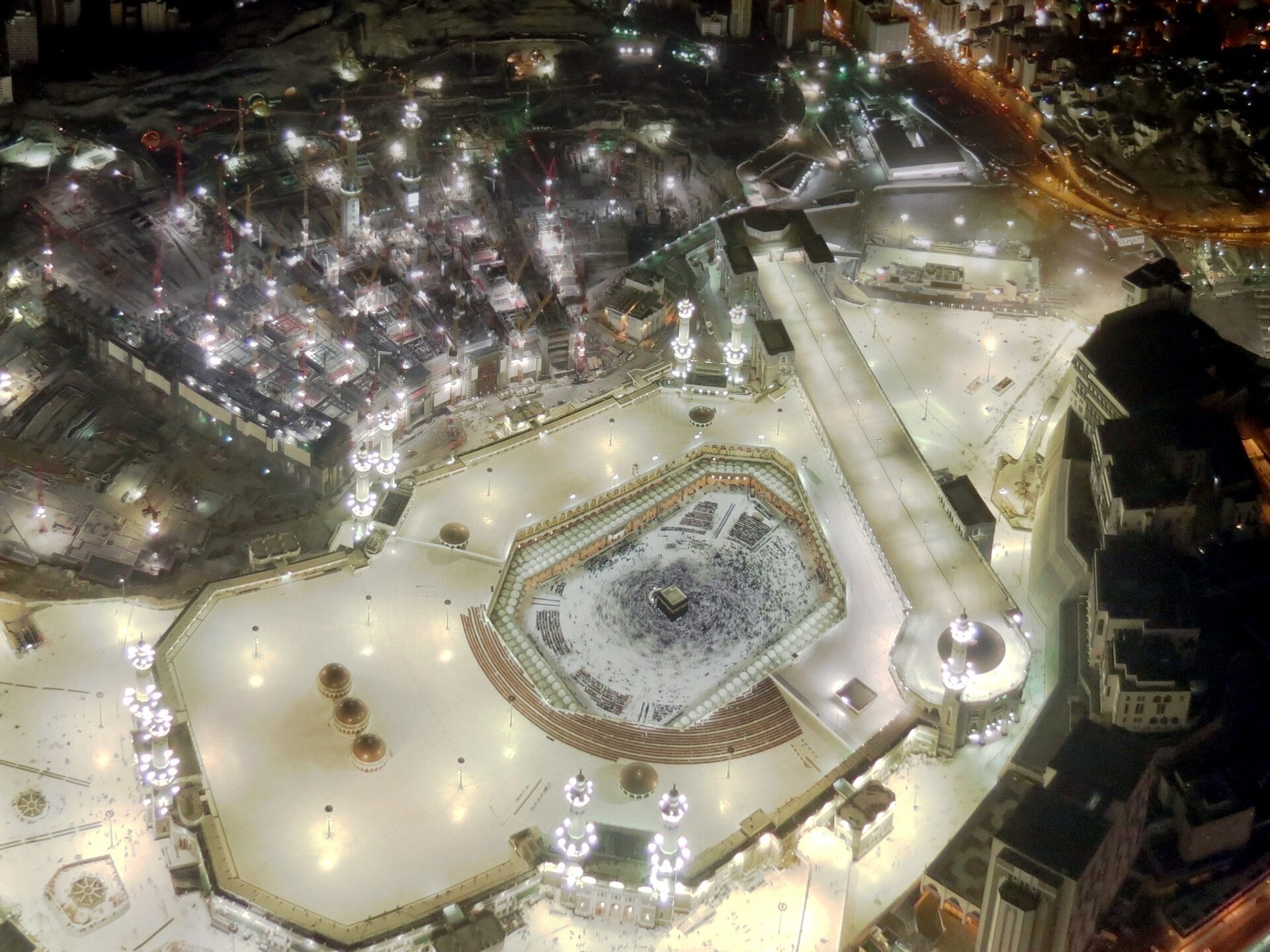
The mathematics at Hajj scale are brutal. If 1.2 million pilgrims arrive and Saudi Arabia has 400 interceptors allocated to the holy cities — an assumption that ignores the simultaneous defense requirements of Riyadh, Ras Tanura, Jubail, and the Eastern Province — the ratio is one interceptor for every 3,000 pilgrims. On the Day of Arafah, May 26, when the entire Hajj population converges on a 20-square-kilometer zone between Mina, Arafat, and Muzdalifah, that ratio applies to the single densest civilian mass gathering on earth. A PAC-3 battery covers roughly 15 to 20 kilometers against ballistic threats. Mina sits 8 kilometers from the center of Mecca — within a single battery’s umbrella, but only if the battery is positioned precisely and only if it is not simultaneously engaging threats inbound to other sectors.
Why Can’t MBS Cancel Hajj?
No Saudi ruler has cancelled Hajj since the kingdom’s founding. The only recent restriction — COVID-19 in 2020 and 2021 — reduced attendance to a few thousand domestic pilgrims, but it had two properties that 2026 does not: a universally understood justification (a global pandemic) and no adversary narrative to validate. Nobody could argue that restricting Hajj during COVID proved the House of Saud was unfit to guard the holy sites. The restriction proved the opposite — careful stewardship in the face of a public health crisis that every country on earth was managing simultaneously.
Cancellation in 2026 would hand Iran the argument Khomeini made in 1979: that the Saudi monarchy cannot protect Muslims who come to Mecca. The fact that Iran is the reason the holy cities face a threat does not neutralize this logic — it amplifies it. In the theological and political framework that the Custodian title was built to address, the question is not who created the danger but whether the Custodian can manage it. A Custodian who cancels the pilgrimage has answered in the negative. Middle East Eye’s editorial formulation — “Saudi Arabia does not own the Hajj” — captures the permanent ambient pressure: the kingdom administers a pilgrimage that belongs, in the Islamic consciousness, to the entire ummah. That administration is conditional on performance.
The COVID escape valve is also closed procedurally. In 2020, the World Health Organization’s pandemic declaration provided external cover — the restriction was a response to a universally recognized global emergency, not a unilateral Saudi security judgment. In 2026, there is no equivalent external declaration. The US Embassy in Riyadh issued a Level 3 “Reconsider Travel” advisory on April 7, advising US citizens to “reconsider participation in Hajj this year due to the ongoing security situation and intermittent travel disruptions.” But no Western government has told its citizens not to go. And no Muslim-majority government has withdrawn its Hajj delegation. MBS would have to be the one to say the words.

The Ceasefire Gap: April 22 to May 26
The ceasefire that took effect on April 8 expires on April 22. The Islamabad talks collapsed after 21 hours on April 12 without producing an extension mechanism. The Antalya Quad — Turkey, Pakistan, Saudi Arabia, and Egypt — met this week to explore extension frameworks, but no signatory has the authority to compel Iranian compliance, and the IRGC’s internal command structure, headless since Admiral Tangsiri’s killing on March 30, operates with decentralized autonomy that may not respond to whatever Tehran’s civilian government agrees to.
The calendar is the cruelest part. Indonesia’s 221,000 pilgrims — the single largest national contingent — have their first charter departure scheduled for April 22: the day the ceasefire expires. The pilgrimage peaks on May 26, the Day of Arafah, which falls 34 days after the ceasefire’s nominal end. The entire Hajj season, from first arrival to final departure, occurs inside a window in which no binding security arrangement covers the holy cities. Saudi Arabia’s five-layer air defense architecture over Makkah exists precisely for this contingency, but air defense systems do not create deterrence in the absence of diplomatic cover — they manage consequences after deterrence has failed.
The gap is not academic. Between April 22 and May 26, Saudi Arabia must defend the holy cities with a depleted interceptor stockpile, no resupply pipeline capable of delivering rounds before the season ends, and no diplomatic instrument that obligates Iran to hold fire. The coincidence of the Hajj arrival window and the ceasefire expiry was the identified structural risk from April 9 — and no intervening diplomacy has closed it.
Iran’s Zero-Pilgrim Advantage
In 1987, when 402 pilgrims died in political demonstrations in Mecca — 275 of them Iranians — Tehran had skin in the Hajj. Iran’s quota was 150,000 pilgrims. The deaths gave Khomeini both grief and a grievance, both domestic anger and international leverage. Saudi Arabia cut Iran’s quota to 45,000, severed diplomatic relations, and absorbed three years of Iranian boycott (1988–1990). The point is that both sides paid a price. The hostage logic was mutual: Saudi Arabia had to protect Iranian pilgrims on its soil, and Iran had to trust Saudi Arabia to do so.
In 2026, that symmetry has been destroyed. Saudi Arabia suspended all Iranian Hajj visas at the war’s start. No transport links exist between the two countries. Zero Iranians are in Mecca. This means Iran absorbs none of the hostage-deterrence logic that historically constrained its behavior toward the Hejaz during Hajj season. Tehran has no citizens to protect in the holy cities, no reputation to lose if something goes wrong there, and no constituency that would blame the IRGC for endangering Iranian pilgrims — because there are none. The 1987 framework, in which both states had nationals at risk and therefore both had incentives to restrain, has been structurally inverted.
Iran has not publicly threatened the holy cities. No confirmed IRGC state-media campaign targeting Saudi Hajj stewardship has appeared in April 2026 open sources. The IRGC’s declared target set remains focused on US military installations and energy infrastructure. But this silence is itself strategic. By keeping the holy cities out of its explicit targeting framework, Iran preserves the option without absorbing the blowback of desecrating Islam’s holiest sites. The threat does not need to be stated to restructure Saudi planning. It needs only to be plausible.
What Are Sending Countries Doing About Hajj Security?
Indonesia, the world’s largest Muslim-majority country and the largest single Hajj contingent, has published a three-scenario contingency plan. Minister of Hajj and Umrah Mochamad Irfan Yusuf laid it out publicly in a parliamentary briefing this month: Scenario 1, proceed with rerouted flights around closed airspaces; Scenario 2, Indonesia delays while Saudi Arabia accepts other countries’ pilgrims; Scenario 3, full Hajj suspension. President Prabowo Subianto’s formulation was precise and revealing: “As long as no statement was released by Saudi Arabia that prevents pilgrims’ departure, Insha’Allah Indonesia will carry on with it.” The implication is clear — Jakarta will not pull its citizens unless Riyadh asks, and Riyadh will not ask because asking would be an admission of incapacity that the Custodian identity prohibits.
Pakistan, which sends 180,000 pilgrims, is simultaneously the war’s primary mediator and a Hajj sending state, a dual role that gives Islamabad unusual insight into the actual security picture but no mechanism to act on it without collapsing its diplomatic position. India sends 175,025 pilgrims. The UAE has allocated 6,228 slots. Not one of these governments has publicly downgraded its Hajj participation. Canada advises against non-essential travel to Saudi Arabia; the US Level 3 “Reconsider Travel” advisory remains in force as of April 16. But advisory language and pilgrim withdrawal are different instruments, and no Muslim-majority government has deployed the latter.
The collective silence of sending countries is itself a data point. No government has demanded the interceptor counts or coverage assessments that would allow an independent security judgment. The Indonesian minister said the president asked him to make “the safety and security of pilgrims a top priority.” The Saudi Ministry of Defence published launcher photographs. Somewhere between those two statements, the actual risk sits unquantified — and every sending country has implicitly decided it is not their job to ask.

The Ministry of Defence Photo and the Number It Didn’t Publish
On April 12 and 13, the Saudi Ministry of Defence released imagery showing air defense launchers positioned around the holy cities. The caption read: “Air defense forces — an eye that never sleeps, its mission is the safety of Muslim pilgrims.” It was the first official visual confirmation that Saudi Arabia has pre-positioned missile defense assets specifically for Hajj. It was also, by omission, the most telling admission of the bind.
The imagery showed hardware. It did not show how much ammunition that hardware carries. No interceptor stockpile figure was published alongside. No coverage radius data. No threat assessment. No public acknowledgment that the kingdom has used 86 percent of its PAC-3 inventory in the war’s first five weeks. The photograph was designed to reassure — and the information architecture around it was designed to prevent the viewer from calculating whether that reassurance has a material basis. Prince Saud bin Mishaal bin Abdulaziz, Deputy Emir of Makkah, told the Hajj Permanent Committee that preparations had reached “95 percent readiness,” citing transport, accommodation, healthcare, and crowd flow. Zero security metrics. No mention of interceptors, coverage, or ceasefire contingency.
This is not incompetence. It is the Custodian bind in its operational expression. Publishing interceptor figures would confirm the depletion rate. Publishing coverage maps would show the gaps. Publishing a threat assessment would acknowledge that the holy cities face one. Each act of transparency undermines the title’s premise — that the Custodian has the situation in hand. And so the Ministry of Defence published a photograph of a launcher, and the Deputy Emir published a percentage, and the gap between what was shown and what was withheld is the exact shape of the structural problem.
Has Hajj Ever Proceeded During Active War?
The honest answer is: not like this. Hajj has been disrupted, restricted, attacked, and even suspended across 14 centuries, but the specific configuration of 2026 — the host country’s territory under active ballistic missile attack while pilgrims are in transit — has no clean precedent. The closest historical parallels illuminate by contrast. During World War II, Saudi Arabia restricted foreign pilgrims entirely from 1940 to 1945. During World War I, arrivals dropped from approximately 300,000 in 1912 to roughly 60,000 in 1916, but Hajj still proceeded. In neither case was the Arabian Peninsula itself a target.
The 930 AD Qarmatian sack of Mecca is the most extreme precedent — a radical Ismaili sect invaded the city during Hajj season, killed pilgrims in the Masjid al-Haram, and removed the Black Stone from the Kaaba, keeping it for 22 years. But the Qarmatians were attacking Mecca itself, not striking the host country’s wider territory while pilgrims transited through. The 1987 Mecca incident killed 402 people in political demonstrations, but the threat was internal and episodic, not the sustained external military campaign that Saudi Arabia faces in 2026. The Grand Mosque seizure of 1979 was a single building, resolved in two weeks. In every case, the disruption was either localized, internally generated, or occurred in an era before ballistic missiles and intercontinental air travel created the combination of vulnerability and scale that defines the 2026 season.
Robert R. Bianchi, a political scientist who has studied Hajj extensively, documented approximately 90,276 deaths performing Hajj and Umrah between 2002 and 2015 — in peacetime, with no adversary. Crowd crushes, stampedes, fires, heat, and disease already kill pilgrims at a rate that would constitute a national crisis in any other context; the 2015 Mina stampede alone killed at least 2,411 people by independent counts. Wartime adds a threat vector to a pilgrimage that already operates at the outer edge of what mass logistics can safely manage. The 2026 question is whether the kingdom can simultaneously manage crowd safety for over a million people and sustain multi-layered air defense with a depleted stockpile — without a ceasefire, and without the Custodian title permitting it to say so publicly if the answer is no.
How Many Layers of Air Defense Cover Makkah?
Saudi Arabia has assembled what may be the most layered air defense architecture ever deployed over a single urban area. Five systems, acquired from four countries, are stacked from the upper atmosphere to the rooftop level. THAAD provides the outermost shield, engaging ballistic missiles at altitudes up to 150 kilometers — high enough to intercept threats in the terminal phase of a trajectory from Iran’s western launch sites. Below that, the PAC-3 MSE serves as the primary mid-altitude layer, the workhorse system that has consumed 86 percent of its pre-war ammunition in five weeks of combat. The South Korean KM-SAM Block II covers the intermediate band. A directed-energy laser system, part of a Chinese-supplied counter-drone package, targets drones and slow-moving aerial threats that the missile systems are too expensive or too slow to engage. At the innermost ring, Skyguard rapid-fire cannons provide terminal point defense against anything that penetrates the outer four layers.
On paper, this is formidable. In practice, it is a system whose critical middle layer — the PAC-3 MSE — is operating at 14 percent of its pre-war capacity, whose resupply depends on a production line that will not reach surge output until 2028, and whose coverage geometry requires painful allocation choices. Makkah to Medina is 340 kilometers — wider than the distance from London to Birmingham. Defending both holy cities simultaneously requires multiple batteries positioned across that entire corridor, and every battery assigned to the Hejaz is a battery not defending Riyadh, not defending Jubail’s petrochemical complex, and not defending the Eastern Province oil infrastructure that funds everything.
The five-layer architecture answers the question of capability. The 400-interceptor figure answers the question of sustainability. These are different questions, and the distance between them is where the Hajj security problem lives. A country can build the most sophisticated air defense in the region and still run out of ammunition before the pilgrimage ends. The Lockheed surge contract is a 2028 solution to a 2026 problem, and no amount of launcher photography bridges the gap between the system’s design capacity and its current operational state.

The Bind That Built Itself
The Custodian of the Two Holy Mosques is a title that answers a question. The question was asked in 1979, by two different challengers on opposite sides of Islam’s sectarian divide — Khomeini from Tehran and Juhayman al-Otaybi from inside the Grand Mosque itself — and the question was the same: does the House of Saud deserve to control Mecca and Medina? King Fahd’s answer, seven years later, was to accept the premise and elevate the obligation. Not “we rule these cities” but “we serve these mosques.” It was a masterstroke of political theology, and it has defined the Saudi state’s self-conception for four decades.
The bind in 2026 is that every attribute of the Custodian identity now works against the state it was designed to protect. The Custodian cannot cancel Hajj — that concedes the incapacity Khomeini alleged. The Custodian cannot publicly acknowledge the air defense gap — that confirms the threat, which confirms the incapacity. The Custodian cannot ask for foreign military help in defending the holy cities — the 1979 Grand Mosque seizure, which required French commandos, is precisely the precedent that made the title necessary. And the Custodian cannot ignore the problem — 1.2 to 1.5 million pilgrims from every continent are arriving regardless, and each one is a person whose safety the title promises.
Iran did not engineer this trap. Iran walked into a war with a country whose identity architecture happened to include an obligation that converts mass religious gatherings into strategic vulnerabilities. The IRGC does not need to target Mecca — it needs only to continue striking Saudi territory elsewhere while Hajj is underway, forcing the kingdom to allocate its diminishing interceptor stockpile between economic infrastructure and the holy cities. The IRGC’s declaration of “full authority” over the Strait of Hormuz already demonstrated that decentralized Iranian commands act independently of whatever Tehran’s civilian negotiators promise. Every PAC-3 round expended over Jubail or Ras Tanura is a round unavailable over Mina on May 26. The Custodian identity does not permit the Saudi state to make that tradeoff publicly, or even to acknowledge that the tradeoff exists, because acknowledging it would validate every challenge to Saudi legitimacy that the title was created to answer.
The Hajj will proceed. It will proceed because it must, because the Custodian title has no exit clause and because 57 Muslim-majority countries are watching and because cancellation would inflict the precise legitimacy wound that four decades of Saudi statecraft have been designed to prevent. The 400 interceptors will be allocated. The five-layer defense will operate. The ceasefire may or may not be extended. And 1.2 million pilgrims will perform the rituals of Hajj in a valley 8 kilometers from the center of Mecca, under a missile defense umbrella that is, by the kingdom’s own published numbers, six-sevenths empty — during a war that the kingdom’s own identity will not permit it to describe honestly to the people it has promised to protect.
Frequently Asked Questions
When is the Day of Arafah in 2026, and why does it matter strategically?
The Day of Arafah falls on May 26, 2026 — 34 days after the ceasefire expires on April 22. It is the single day when all Hajj pilgrims converge on the Mina-Arafat-Muzdalifah zone, a roughly 20-square-kilometer area containing 100,000 air-conditioned tents at an elevation of approximately 400 meters. This is the densest point of the entire pilgrimage and the moment of maximum vulnerability. The entire convergence zone fits within a single PAC-3 battery’s coverage radius, but interceptor allocation on that day must compete with simultaneous defense requirements across multiple Saudi cities and economic installations.
Has any country withdrawn its Hajj delegation over the war?
No Muslim-majority country has withdrawn or reduced its Hajj delegation as of April 17, 2026, though overall attendance is projected at 1.2 to 1.5 million, down from 1.67 million in 2025. The reduction reflects aviation insurance costs, airspace closures, and Western travel advisories rather than formal governmental withdrawal. The UAE has allocated 6,228 slots. Saudi Arabia has not asked any sending country to reduce or postpone its contingent — a request that the Custodian identity framework would make extraordinarily difficult to issue even if the security assessment warranted it.
What is the Qarmatian precedent and how does it compare?
The Qarmatian sack of Mecca in 930 AD is the most extreme historical attack on the Hajj — a radical Ismaili sect invaded during the pilgrimage season, massacred worshippers inside the Masjid al-Haram, and stole the Black Stone from the Kaaba, holding it for 22 years. It remains the only historical instance of Mecca itself being attacked during Hajj by an external force. The 2026 situation differs structurally: the holy cities are not the declared target, the host country’s wider territory is under sustained bombardment, and the threat is not a ground invasion but ballistic missiles that can reach the Hejaz from 1,200 kilometers away in under ten minutes.
Could Saudi Arabia use the WWII precedent to restrict foreign pilgrims?
Saudi Arabia restricted all foreign pilgrims from 1940 to 1945, making it the only clean historical precedent for a host-imposed wartime Hajj restriction. However, the WWII restriction predated the Custodian title by 46 years and predated the 1979 legitimacy crisis that made the title necessary. Invoking the WWII precedent in 2026 would require MBS to acknowledge that the security situation in the kingdom is comparable to a world war — a statement that would undermine both the ceasefire narrative and the Custodian framework simultaneously. The COVID-19 restriction of 2020-2021 offered a more recent template, but it relied on a WHO-declared global pandemic for external justification. No equivalent external authority has declared the 2026 security situation a reason to restrict Hajj.
What happens to Saudi Arabia’s Custodian legitimacy if something goes wrong?
Every historical Hajj disaster — crowd crushes, stampedes, the 1987 demonstrations — was attributed to crowd management failure or isolated internal violence. That framing allowed Saudi Arabia to accept responsibility and improve systems without conceding that an external adversary had defeated it. A missile strike during Hajj would destroy that category distinction: it would be evidence that the Custodian failed to protect pilgrims from the precise threat — foreign military aggression on Islamic holy soil — that the title exists to preclude. No amount of subsequent crowd-management investment could address the underlying question the strike would have answered.