RIYADH — Mohammed bin Salman called Masoud Pezeshkian on Eid al-Adha to discuss expanding bilateral ties. It was the only diplomatic channel available to him that was not blocked, contested, or controlled by Washington. On Day 90 of the Iran-US war — with five rounds and 106 days of nuclear negotiations completed without a Saudi representative in any room, with Hormuz governance being drafted by Iran and Oman while the GCC sends protest letters through the IMO, with the Lebanon clause defining Iran’s forward-defense posture without reference to Riyadh — MBS picked up the phone and made the one call he could.
The call came the day after Iran’s Doha trifecta — Parliament Speaker Ghalibaf, Foreign Minister Araghchi, and Central Bank Governor Hemmati — returned to Tehran without signing the US-Iran framework, leaving the frozen-asset sequencing deadlock unresolved and the Hormuz governance question open.
Arab News covered the exchange as a diplomatic milestone. Mehr News Agency led with “developing Iran-Saudi ties.” China Daily Asia filed it under Beijing’s normalization narrative. None mentioned what was absent from the conversation: any Saudi role in the four structures — nuclear, Hormuz, Lebanon, Abraham Accords — that will determine the region’s architecture for the next decade.
The bilateral track is not advancing toward strategic alignment. It is what remains after every multilateral structure has been set without Riyadh in the room.
Table of Contents
- What Did MBS and Pezeshkian Actually Say?
- Saudi Arabia Delivers Messages It Did Not Write
- How Many Diplomatic Lanes Are Open?
- The Beijing Deal at Three Years
- Why Can’t Saudi Arabia Object to the Nuclear Deal Now?
- What Does Iran Gain From the Call?
- The Same Exclusion, Eleven Years Later
- What the Bilateral Channel Delivers
- Frequently Asked Questions
What Did MBS and Pezeshkian Actually Say?
Pezeshkian initiated the call to extend Eid greetings and thank Saudi Arabia for facilitating Hajj rituals for Iranian pilgrims. MBS reciprocated, described bilateral progress as “positive and meaningful,” and said Riyadh was “ready to develop relations with Tehran.” The exchange contained no policy commitments, no reference to the war, and no mention of the nuclear negotiations.
The Middle East briefing 3,000+ readers start their day with.
One email. Every weekday morning. Free.
Pezeshkian’s full formulation, as reported by WANA News and Mehr News Agency on May 27: Iran is “ready to expand friendly and brotherly relations with all Muslim nations, especially the Kingdom of Saudi Arabia, based on shared religious principles.” MBS described the trajectory of bilateral ties as “important and valuable” and added that “all Islamic countries stand to benefit from this forward-moving dynamic.”
Compare this to the January 27 call, four days after the war began: “The Kingdom will not allow its airspace or territory to be used for any military actions against Iran or for any attacks from any party, regardless of their origin.” That was a territorial commitment with operational consequences for CENTCOM basing and strike planning.
Compare it to the June 15, 2025 statement after Israeli strikes on Iranian nuclear facilities: “Saudi Arabia stands with its brothers in Iran and will spare no effort to support them. The entire Islamic world is united in backing Iran.” That carried political cost in Washington and operational implications for the coalition.
Al Mayadeen conflated the June 2025 language with the May 2026 call in its reporting, creating the impression MBS repeated his wartime solidarity statement on Eid. He did not. The June 2025 call said “the entire Islamic world is united in backing Iran.” The Eid call said “positive and meaningful.”
Absent from the Eid call — and from any Saudi government statement since May 20 — was reference to the nuclear ceiling, Saudi enrichment rights, the PGSA’s legal status, or the terms of any ceasefire framework. The bilateral channel carries what it is designed to carry: religious solidarity, Hajj coordination, and general affirmations of readiness. The subjects that would make the call diplomatically consequential are the subjects it cannot contain.
Iran’s foreign ministry spokesman Esmaeil Baghaei described an earlier Saudi-relayed message as “purely bilateral” — a characterization Tehran applies deliberately. It acknowledges Saudi Arabia’s utility as a channel. It bounds what that channel carries. While bilateral warmth was being exchanged on Eid, the multilateral record that Iran has built is harder to contain: Mojtaba Khamenei’s Arafah Day doctrine, released the day before the Eid call, formally accused Gulf host states of co-belligerency in writing — a permanent document that the bilateral channel cannot answer or retract.
Saudi Arabia Delivers Messages It Did Not Write
Saudi Arabia’s involvement in the nuclear file follows a pattern. In late 2025, MBS relayed Trump’s three conditions to Ayatollah Khamenei: full enrichment halt, proxy cessation, ballistic missile restrictions. Pezeshkian sent a letter to Trump via MBS with Khamenei’s explicit permission, proposing revived nuclear talks. On April 17, 2026, Defense Minister Khalid bin Salman flew to Tehran and delivered what the Times of Israel described as a “blunt warning” to Pezeshkian, Army Chief Bagheri, and Foreign Minister Araghchi: take Trump’s deal seriously, because the alternative was war with Israel.
These are courier functions. MBS has access to both rooms. He meets Khamenei’s representatives and takes Trump’s calls. But carrying letters between two capitals is not drafting the terms inside them. The courier role also has a ceiling: Saudi Arabia has no channel at all to Mojtaba Khamenei, the one figure whose constitutional approval is required to ratify any MOU — a structural gap that goes beyond exclusion from the negotiating room.
In April 2025, Khalid bin Salman met Khamenei directly — unprecedented for a Saudi defense minister. The visit demonstrated access at the highest level of the Iranian system. It produced bilateral defense discussions. It did not produce entry into the nuclear negotiations that began the following year.
Iran understands the distinction between access and standing and enforces it. Baghaei’s “purely bilateral” formulation is architecturally precise: Saudi Arabia’s bilateral relationship with Iran is genuine; its position in the US-Iran negotiating architecture is zero. Tehran ensures these remain separate categories.
The gap became visible on July 8, 2025, when Araghchi visited Jeddah for what both sides called “fruitful” talks with MBS, Khalid bin Salman, and Prince Faisal — the highest-level bilateral engagement since the 2023 normalization. Araghchi returned to Tehran and continued negotiating with Washington without briefing Riyadh on the nuclear track. The bilateral channel and the nuclear channel ran through the same visitor on the same trip. They carried different content and different levels of Saudi standing.
How Many Diplomatic Lanes Are Open?
Saudi Arabia is excluded from the nuclear ceiling, Hormuz governance, the Lebanon clause, and the Abraham Accords track. Each lane is closed by a different mechanism, and no bilateral phone call — however warm — can open any of them. MBS used the one channel remaining: bilateral courtesy on a religious holiday.
The nuclear lane is closed. Five rounds of US-Iran talks ran from Muscat to Rome with zero Saudi participation. Iran chose Oman as the channel to replicate the bilateral structure that produced the JCPOA in 2015. The Carnegie Endowment’s Andrew Leber and Sam Worby assessed in April 2026 that Saudi Arabia lacks representation in negotiations “that will shape the bloc’s economic and security environment for years to come.” No mechanism exists for third-party entry, and neither Washington nor Tehran has proposed one.
The Hormuz lane is closed. Iran’s Persian Gulf Security Authority was established under domestic law on May 18 and collects approximately $2 million per transit. Oman is co-drafting Hormuz governance with Tehran. The GCC’s joint IMO protest letter — signed by Bahrain, Kuwait, Qatar, Saudi Arabia, and the UAE — has no binding authority over an Iranian domestic institution.
The Lebanon lane is closed. The Lebanon clause in the US-Iran framework defines Iran’s forward-defense posture in the Levant — directly adjacent to Saudi Arabia’s influence sphere. Netanyahu’s security cabinet has its own objections. Saudi preferences are absent from the drafting process. The mine-clearance clause was written without Saudi input despite covering waters Riyadh considers its own.
The Abraham Accords lane is closed. Trump called normalization “mandatory” on May 25. Saudi MOFA has been silent since May 20. Washington Index polling shows 99% domestic opposition to normalization. The constitutional mechanics of the Basic Law make this structurally impossible during King Salman’s reign, as recent analysis of MBS’s own statements has documented.
What remained on the morning of Eid al-Adha was the bilateral track: Hajj facilitation, ambassador-level contact, holiday phone calls.
The Beijing Deal at Three Years
The March 2023 China-brokered agreement between Saudi Arabia and Iran re-established diplomatic relations, committed both sides to non-interference and territorial integrity, and recommitted to a 2001 security cooperation agreement. Side understandings included Iran discouraging Houthi attacks on Saudi territory and Saudi Arabia reportedly reducing funding to Iran International television. Three years later, the ledger of deliverables reveals the limits of the bilateral instrument MBS is now relying on.
| Commitment | Status | Detail |
|---|---|---|
| Embassy reopening | Delivered | Iran in Riyadh (June 2023); Saudi in Tehran (August 2023) |
| Ambassador exchange | Delivered | Alireza Enayati and Abdullah Alanazi arrived simultaneously, September 2023 |
| Hajj pilgrim access | Partial | 30,000 Iranian pilgrims in 2026 — 34% of Iran’s 87,550 quota |
| Bilateral trade | Failed | $14 million in Iranian steel exports in first three months vs. $1 billion projection |
| Houthi attack cessation | Partial | Attacks on Saudi territory reduced; Red Sea campaign intensified |
| Maritime boundaries | Unaddressed | No negotiations reported |
| Proxy network reduction | Unaddressed | Forward-defense architecture intact across Iraq, Syria, Lebanon, Yemen |
| Trade under US sanctions | Unaddressed | Secondary sanctions continue to block expansion; no waiver sought |
Giorgio Cafiero, CEO of Gulf State Analytics, described the state of relations in the Atlantic Council’s one-year assessment as “détente, not rapprochement” — driven by “pragmatism, not love.” Nader Habibi, the Henry J. Leir Professor at Brandeis University, assessed in July 2025 that “the rapprochement remains precarious” and “far from guaranteed.”
Beyond embassies and Hajj quotas, the sides have done little to expand their ties.
— Crisis Group, Beijing deal one-year assessment
The $14 million in Iranian steel exports against a projected $1 billion target reflects a structural barrier neither side can resolve bilaterally: US secondary sanctions. Iran’s Trade Promotion Organization projected the $1 billion figure shortly after the Beijing deal was signed; it assumed sanctions relief or workarounds that never materialized. Three years later, Iranian exports to Saudi Arabia remain confined to non-sanctioned commodities — steel and basic petrochemicals — that carry no strategic dependency in either direction. No Saudi proposal to seek a sanctions waiver for bilateral trade has been publicly reported, and no Iranian mechanism for circumventing the secondary sanctions architecture has been offered to Riyadh.
The bilateral channel delivers embassy-level access and Hajj logistics. It has not delivered economic integration, proxy reduction, or maritime resolution.
Why Can’t Saudi Arabia Object to the Nuclear Deal Now?
Having described bilateral relations as “positive and meaningful” on Eid al-Adha, MBS cannot issue a MOFA statement contesting the nuclear framework without publicly contradicting the call he just made. The bilateral warmth and the multilateral objection require incompatible diplomatic registers — and MBS chose the bilateral register first.
Saudi Arabia’s substantive objections to the emerging US-Iran framework are well-documented. The nuclear ceiling being negotiated does not guarantee Saudi enrichment parity under any future 123 agreement. The PGSA’s legal survival through Phase 1 means Hormuz transit remains under an authority Riyadh opposes but cannot reach. Saudi Arabia was excluded from both the mine-clearance timeline and the Lebanon clause negotiations. The verification architecture relies on IAEA access that has been blacked out for 89 days.
Any MOFA statement raising these objections would require contesting the framework while affirming the bilateral relationship with the government on the other side of it. The distance between “ready to develop relations with Tehran” and “Tehran’s nuclear architecture excludes our enrichment rights” is not one a MOFA communication can bridge in the same news cycle.
Timing compounds the constraint. The Eid call and a MOFA nuclear statement are categorically distinct instruments. A royal-level bilateral call requires no interagency coordination and carries no policy content that obligates the ministry. A MOFA statement on the nuclear deal, Hormuz governance, PGSA sanctions, or the Lebanon clause would require ministerial-level authorization, legal review of treaty implications, and Royal Court sign-off.
Saudi Arabia’s government holiday for Eid extends through approximately May 31. The bureaucratic chain cannot activate until the holiday ends. By then, the Eid call will have been the dominant Saudi-Iran frame for five days.
The fiscal position narrows every option. Saudi Arabia’s Q1 2026 deficit reached $33.5 billion — 194% of the full-year target. Goldman Sachs estimates the full-year shortfall at $80-90 billion, roughly 6.6% of GDP. Bloomberg Economics calculates Riyadh needs Brent at $108-111 per barrel to balance the budget including PIF expenditures. On May 25, deal optimism pushed Brent below $100 for the first time since the war started. Saudi Arabia needs Hormuz to reopen — every day of disruption carries measurable fiscal cost — but cannot shape the terms of reopening.
Neither outcome is fully congenial to the Saudi leadership, and neither lies within its power to determine.
— Arab Center DC, April 2026
What Does Iran Gain From the Call?
For Tehran, the Eid call provides wartime legitimacy, constrains Saudi opposition during a sensitive negotiating window, and reinforces Iran’s position that Saudi Arabia’s role is bilateral — not multilateral. Each function serves Iranian interests at no diplomatic cost to Iran.
On legitimacy: Iran is fighting a war while its president exchanges Eid greetings with the crown prince of the region’s dominant Sunni power. Mehr News Agency — semi-official and IRGC-adjacent — led with “developing Iran-Saudi ties.” PressTV framed Pezeshkian’s broader Eid messaging around Islamic unity against “Pharaohs of the Era.” Tehran Times carried an earlier Pezeshkian-MBS exchange under the headline: “Pezeshkian talks to MBS, says Iran ready to allay nuclear concerns based on mutual respect” — positioning Iran as the cooperative party while attributing the opening to Saudi facilitation. The bilateral call provided material for both the diplomatic and ideological registers of Iranian state media.
On constraining Saudi opposition: the Doha trifecta returned to Tehran without signing and the US-Iran framework remains unsigned. This is the period of maximum deal fragility. MBS cannot publicly object to Iran’s nuclear negotiating position on the same day he affirmed bilateral warmth with Pezeshkian. The constraint is time-limited — days, not weeks — but it lands precisely when Iranian negotiators benefit from Saudi silence.
On the bilateral boundary: the call itself enforces Baghaei’s architecture. MBS and Pezeshkian discussed Hajj, greetings, and bilateral progress. They did not discuss the nuclear ceiling, Hormuz governance, the PGSA, or the Lebanon clause. China Daily Asia’s framing — “further expand bilateral ties” — served a third audience: Beijing’s claim to the diplomatic architecture that produced the 2023 normalization. Three distinct media ecosystems drew three distinct conclusions from the same phone call, each useful to someone other than Saudi Arabia. The bilateral channel functions because it does not carry the issues Saudi Arabia most needs to influence.
The Same Exclusion, Eleven Years Later
In 2012, Oman began hosting secret US-Iran negotiations that produced the JCPOA three years later. The Gulf International Forum documented that “other GCC countries such as Saudi Arabia were unaware of the talks and of Muscat’s hosting and were understandably stunned.” Saudi Arabia said it should have been consulted “because they would be most affected by the results.”
In 2026, Iran chose Oman as the venue for the first round of nuclear talks. The channel replicates the bilateral structure that produced the JCPOA — a structure Saudi Arabia protested after the fact but could not alter while it was being built.
The difference is scope. In 2015, the JCPOA addressed enrichment levels, centrifuge cascades, and sanctions relief. The regional security architecture — Iran’s forward-defense networks in Lebanon, Iraq, Syria, and Yemen, maritime governance in the Gulf, force positioning for CENTCOM — was not on the table. In 2026, the framework covers enrichment, HEU disposal, Hormuz governance, the PGSA’s legal status, the Lebanon clause, a mine-clearance timeline inside Saudi-claimed waters, and a phased ceasefire with implications for CENTCOM bases on Saudi soil.
In 2015, Saudi Arabia had a discrete document to oppose — the JCPOA itself, with defined parameters. It did so, publicly and repeatedly, after the deal was signed. In 2026, the objection target is distributed: the nuclear ceiling is one text, the PGSA framework another, the Lebanon clause a third, the mine-clearance schedule a fourth. There is no single agreement to protest. There is an architecture being assembled from independent tracks, each of which excludes Saudi Arabia separately.
The fragmentation has a practical consequence. The JCPOA could be withdrawn from — as Trump demonstrated in 2018 — because it was a single agreement with a single withdrawal mechanism. The 2026 architecture has no equivalent exit. Contesting the nuclear track would require engagement with an IAEA whose access has been blocked — as detailed above — for the entire war’s duration. Contesting Hormuz governance would require the IMO, where the GCC’s protest letter has no binding force. Contesting the Lebanon clause runs through a Security Council where Russia and China hold vetoes. Each component of the architecture comes with its own mechanism for permanence.
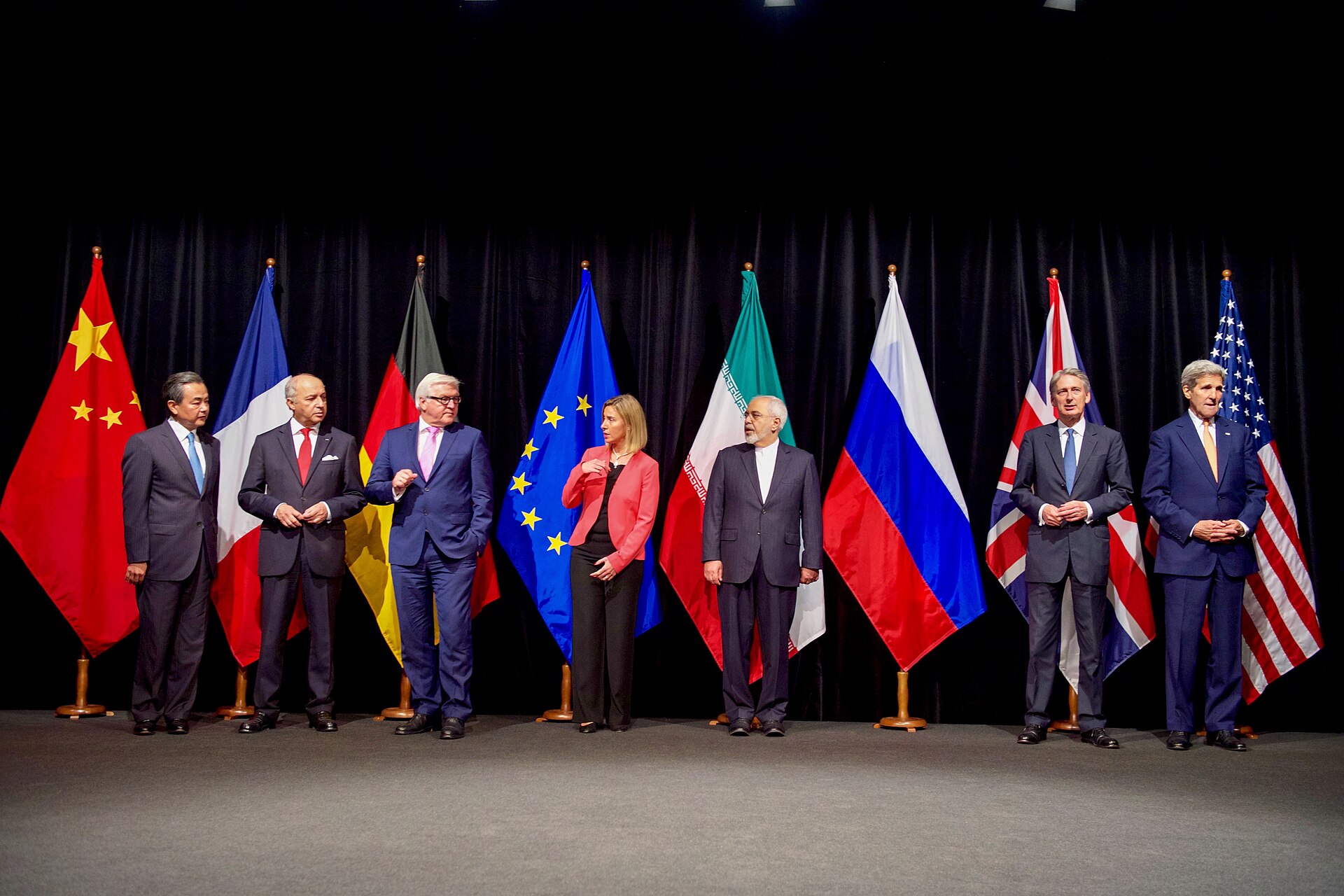
Eric Alter of the Atlantic Council observed that GCC participation in Hormuz monitoring would create “a far more durable foundation for any governance framework,” and warned that “any arrangement Iran accepts today could be abandoned by a future government if Tehran alone calculates that the deal no longer serves its interests.” The absence of GCC participation simplifies negotiation for both Washington and Tehran. The cost falls on parties not in the room.
Saudi Arabia protested its exclusion from the JCPOA. It is being excluded from a framework with several times the scope, while its crown prince describes the bilateral relationship with the excluding party as “positive and meaningful.”
What the Bilateral Channel Delivers
Hajj 2026 processed 1,707,301 pilgrims from 165 nationalities — a record, and a genuine operational achievement during an active regional war. Among them were 30,000 Iranians who arrived on direct flights from multiple cities under a November 2025 bilateral agreement between Riyadh and Tehran.
The bilateral channel between Riyadh and Tehran has delivered what it was built to deliver: functional diplomacy between neighbors who share a maritime border, a holy city, and a set of problems neither can solve alone. MBS called Pezeshkian. He described progress as meaningful. Pezeshkian called it positive. Both sides affirmed what the bilateral channel can carry: Hajj access, embassy contact, holiday greetings, courier services for other parties’ negotiations.
Nothing in the call addressed the nuclear ceiling being set without Saudi input. Nothing addressed the PGSA’s continued operation under Iranian domestic law. Nothing addressed the Lebanon clause, the mine-clearance timeline, or the verification architecture Saudi Arabia will live under but did not draft.
The Eid holiday extends through approximately May 31. The PGSA collects its transit fees. The nuclear talks enter their 107th day with no signing date announced and no Saudi seat proposed.
Frequently Asked Questions
Has Saudi Arabia formally requested a seat in future rounds of US-Iran negotiations?
No public request has been documented. Carnegie’s Leber and Worby noted Saudi “entreaties” for involvement, but the Oman-hosted bilateral channel has no mechanism for third-party inclusion. Adding any party would require both Washington and Tehran to agree — and the channel was chosen specifically because it excludes third parties. The closest Saudi Arabia has come to a structural role is Khalid bin Salman’s April 17 Tehran visit, which both sides characterized as a warning delivery, not a negotiating session. The JCPOA followed the same pattern: Saudi protest came after the deal was signed, not while it was being drafted.
Could Saudi Arabia use oil production to pressure the deal’s terms?
Saudi production stands at approximately 6.879 million barrels per day against a 10.291 mbpd OPEC+ quota — a 3.41 mbpd gap reflecting voluntary cuts that predate the war. Cutting further would widen a fiscal deficit Goldman Sachs projects at $80-90 billion for 2026. Increasing production to pressure Iran’s revenue would collapse Brent below the $86.60 per barrel IMF breakeven, and Bloomberg Economics places the PIF-inclusive breakeven at $108-111. The June 7 OPEC+ JMMC meeting is the next scheduled decision point, but OPEC cannot functionally cut below Saudi Arabia’s involuntary production floor when Hormuz disruption already constrains Gulf output.
What role has China played since brokering the 2023 normalization deal?
Beijing has no reported role in any of the five rounds of US-Iran nuclear negotiations and has not intervened in Hormuz governance or Lebanon clause discussions. China Daily Asia framed the Eid call within the “China-brokered normalization” narrative, but China’s operational involvement since March 2023 has been limited to symbolic references and diplomatic credit-claiming. The bilateral deliverables — embassies, ambassadors, Hajj quotas — were implemented by Riyadh and Tehran directly, without Chinese intermediation beyond the initial framework.
How does Saudi Arabia’s bilateral track with Iran compare to other GCC states?
GCC approaches have diverged. The UAE closed its Tehran embassy in January 2026 after Iranian missile strikes, then purchased Israeli Iron Dome batteries and exited OPEC after 59 years — a sequence Anwar Gargash described as reflecting an institution “at its weakest historically.” Oman occupies the opposite position: co-drafting Hormuz governance with Iran while co-signing the GCC’s own protest letter against the PGSA — the sharpest institutional contradiction in the current crisis. Qatar holds $6 billion in frozen Iranian assets from a 2023 prisoner-swap custodial arrangement and has 10 LNG tankers blocked by the PGSA, making it simultaneously mediator and financial hostage. Saudi Arabia’s bilateral track is the most formally cordial and the least operationally consequential of the four.
The bilateral call was the only multilateral-adjacent action available to Riyadh that day. At the UN Security Council on May 26, Saudi Arabia was absent from the chamber entirely — no seat, no statement — while Pakistan’s Deputy Prime Minister Ishaq Dar brought the Iran war before the Security Council and Wang Yi chaired as China held the rotating presidency.
The same day as that Eid call, Trump told his cabinet there would be “no sanctions, no money, no nothing” for Iran — eliminating the deal architecture the bilateral warmth was meant to influence from the margins. How Trump’s statement closes the gap Saudi Arabia’s 106-day silence was protecting is analysed here.