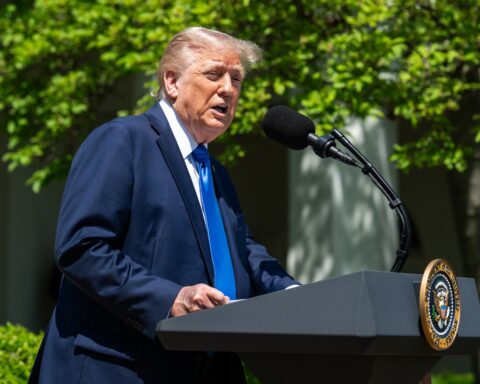
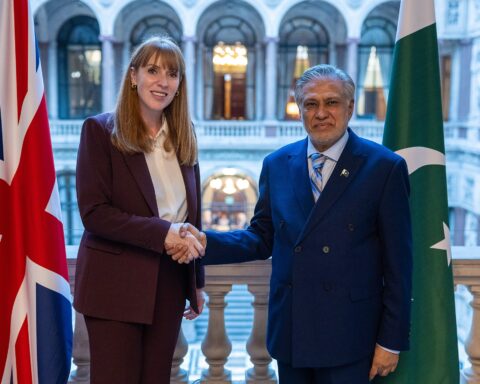
LONDON — Forty-one nations convened on April 2 to discuss reopening the Strait of Hormuz, and the country that has policed it for four decades — the country whose Fifth Fleet still operates from Bahrain, whose carrier strike group still patrols the Arabian Sea — refused to show up. The absence is not a snub or an oversight; it is the logical conclusion of a doctrine Donald Trump has stated in plain language: “Go to the strait and just take it, protect it, use it for yourselves.”
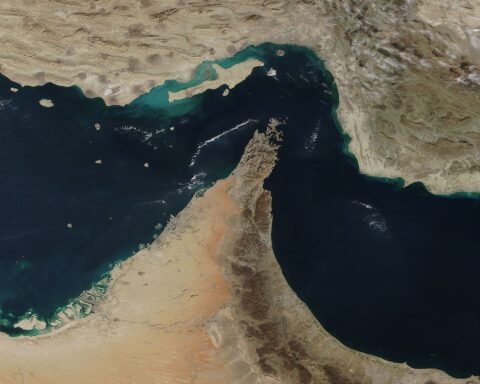
What that doctrine has produced, in practice, is a coalition with no operational mandate, no minesweeping capacity worth the name, and no command authority over the waterway through which 20 million barrels of oil pass every day — roughly one-fifth of all petroleum consumed on Earth. But the most striking absence from the April 2 virtual summit chaired by UK Foreign Secretary Yvette Cooper was not the United States. It was Saudi Arabia, the country with more crude trapped behind the Hormuz blockade than any other nation, and the country with the clearest financial incentive to let somebody else do the fighting. Riyadh’s decision to stay outside the coalition while simultaneously hosting American forces at King Fahd Air Base in Taif is not ambiguity or indecision — it is the most calculated hedge in the Gulf today, and the question is whether it can hold.
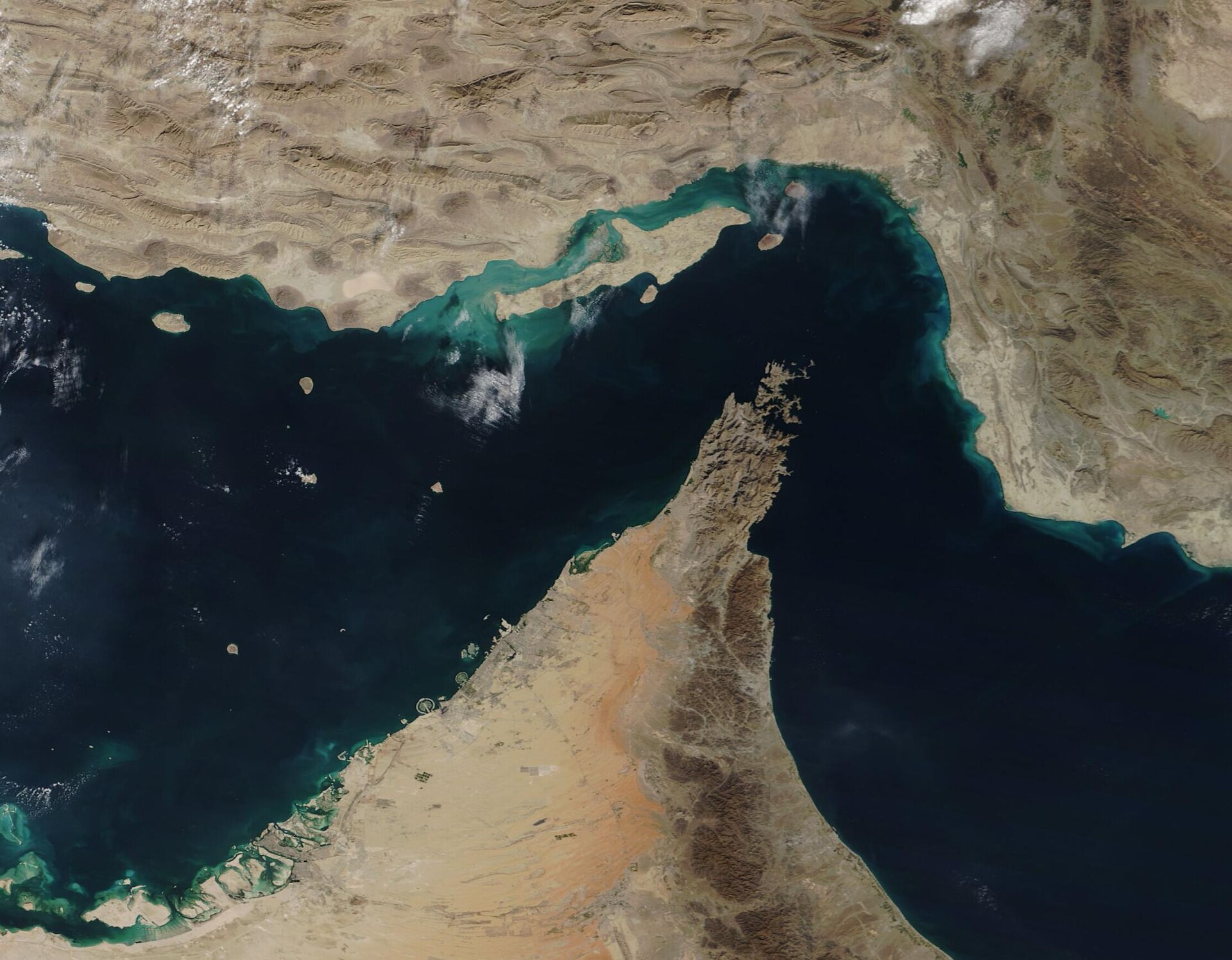
Table of Contents
- What the Coalition Actually Is — and What It Cannot Do
- Why Is the United States Absent From Its Own Alliance Architecture?
- The Saudi Hedge: Four Moves in Four Directions
- Does Saudi Arabia Benefit More From a Closed Strait Than an Open One?
- Iran’s Counter-Move: The Oman Protocol
- What Happens When Two Navies Without a Common Command Meet in a Minefield?
- The UAE Is Doing This Alone in the Gulf
- The European Commitment Problem
- Can Riyadh Avoid a Binary Choice?
- Frequently Asked Questions
What the Coalition Actually Is — and What It Cannot Do
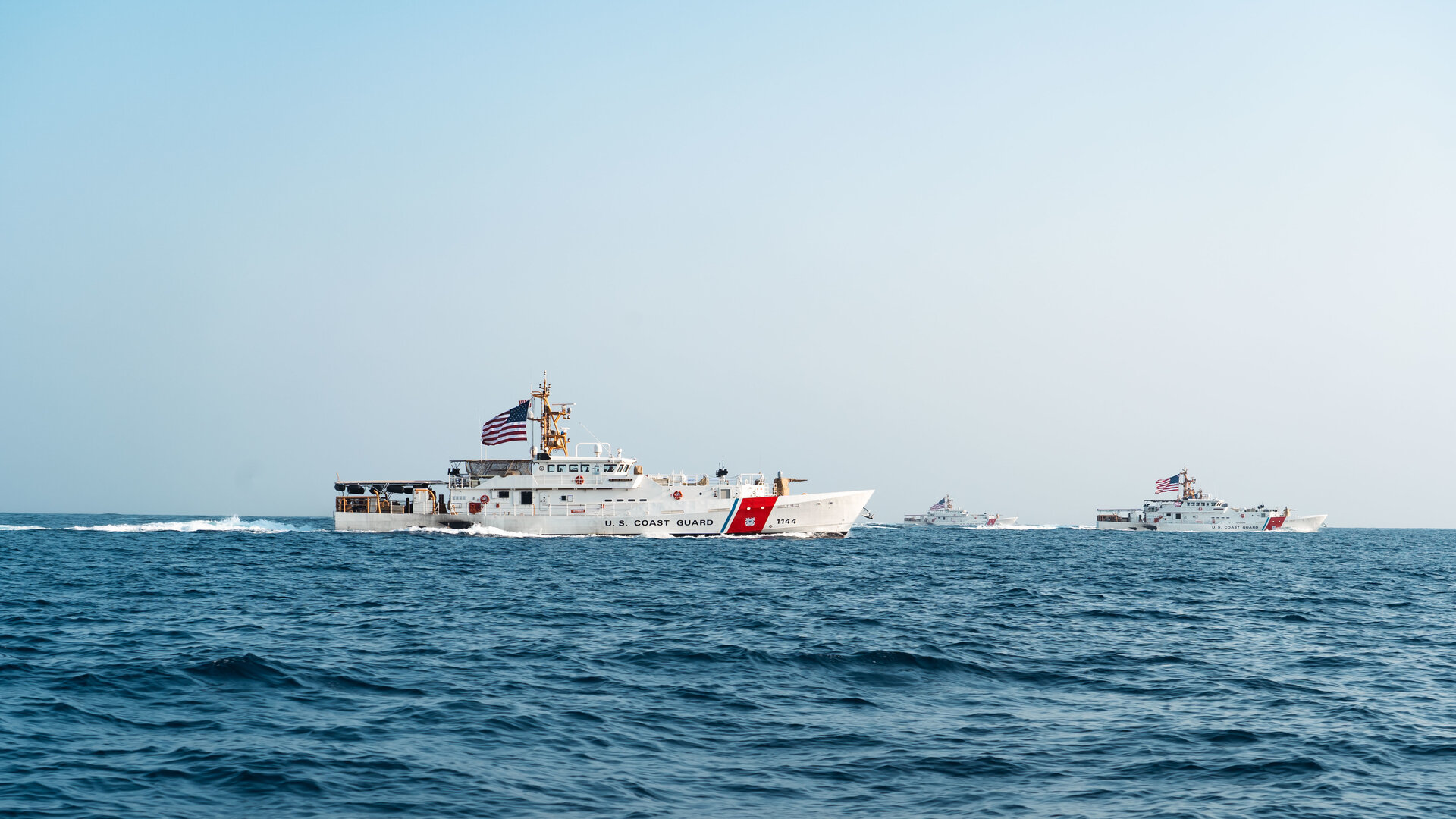
The April 2 summit was not a war council, and Yvette Cooper went out of her way to make sure nobody mistook it for one. The 41 signatories — spanning from the UK and France to Trinidad and Tobago, from Japan and Australia to Kosovo and Albania — committed to “the collective mobilisation of our full range of diplomatic and economic tools” aimed at a “safe and sustained opening” of the Strait of Hormuz. Military planners from the same nations were tasked to meet the following week to discuss “how to ensure security for shipping after the war has ended,” a formulation that explicitly defers any operational military mandate to the post-conflict period. The coalition, as Admiral James Stavridis — former Supreme Allied Commander of NATO — observed in Bloomberg, “does not include any commitment to send naval vessels or other resources” and amounts to “largely a gesture to placate President Trump.”
That assessment is harsh but accurate in one respect: the coalition’s military planning is explicitly post-conflict. Planners will “explore ways to marshal defence capabilities, including demining and escorting, once the conflict eases,” which means that while Iranian mines, drones, and anti-ship missiles continue to threaten the strait, the 41-nation grouping has no mandate to do anything about it. The practical implications are severe. Opening safe transit through Hormuz would require, according to US Naval Institute analysis, two swept channels each 2,000 yards wide covering roughly 200 square miles — and the United States has only one minesweeping-capable ship currently in theater. The coalition nations collectively possess even less mine countermeasure capability than Washington does.
The membership list reveals the structural problem. The confirmed signatories include the UK, France, Germany, Italy, the Netherlands, Canada, Japan, Australia, the UAE, Bahrain, South Korea, New Zealand, India, Denmark, Norway, Sweden, Finland, and a roster of smaller European and Caribbean states — while the United States, Saudi Arabia, Oman, Qatar, Pakistan, China, and Russia are absent. Of the nations present, only the UAE has committed warships, and only India and Japan possess blue-water navies with meaningful Gulf-deployable capacity. General Sir David Richards, former head of the UK Armed Forces, told The National that actually reopening Hormuz would require “might on NATO scale” — “close to the roughly 200,000 troops that the US and its allies assembled to invade Iraq in 2003.”
Why Is the United States Absent From Its Own Alliance Architecture?
The Fifth Fleet has operated from Bahrain since 1995. Combined Maritime Forces, headquartered in the same compound, runs Combined Task Force 152 — the multinational patrol covering the Persian Gulf through the Strait of Hormuz. For three decades, every serious maritime security operation in the Gulf has run through American command architecture. Trump has now dismantled that arrangement by fiat, not by withdrawing forces but by withdrawing commitment, telling allies in terms that left no room for diplomatic ambiguity: “The Hormuz Strait will have to be guarded and policed, as necessary, by other Nations who use it — The United States does not!”
This is not isolationism in the traditional sense — American forces are still in the Gulf, still flying from Saudi bases, still running strike operations against Iranian targets. What Trump has withdrawn is the organizing principle: the idea that the United States guarantees freedom of navigation as a global public good, underwritten by American naval power, in exchange for allied cooperation on American strategic priorities. Jim Krane, a non-resident fellow at the Arab Center in Washington, captured the transformation precisely: under Trump, “the US security force in the Gulf has transitioned from protector of trade to instigator of war.” The old bargain — oil for security — required the United States to keep the sea lanes open because American prosperity depended on stable energy markets. Trump’s bargain is different: the United States will fight Iran but will not reopen the strait, because reopening the strait benefits Europe, Japan, and South Korea more than it benefits an America that is now a net energy exporter.
The result is a situation without precedent in the post-1945 maritime order. A 41-nation coalition is forming to address a security challenge in waters where American forces are actively operating under a separate bilateral mandate, with no mechanism for coordination between the two. Karen E. Young, writing in Foreign Affairs on April 1 under the headline “A Post-American Persian Gulf?”, identified the core problem: Gulf states now face “a difficult reassessment of the growing risks of relying on US security provision.” The reassessment is not hypothetical or future-tense — it is happening in real time, and the coalition that met on April 2 is what it looks like when 41 countries try to fill a vacuum that the world’s dominant naval power created on purpose.
The Saudi Hedge: Four Moves in Four Directions
Saudi Arabia’s absence from the 41-nation coalition looks, at first glance, like passivity — a major Gulf state sitting out the most consequential maritime security gathering since the Tanker War of the 1980s. It is not passivity. What Riyadh is executing is a four-vector hedge that keeps every option open while committing to none, and each vector reveals how deliberate the positioning is.
First, the American vector: Saudi Arabia granted US forces access to King Fahd Air Base in Taif in mid-March, a base chosen specifically because it sits farther from Iranian drone threat ranges than Prince Sultan Air Base. This is the deepest bilateral military arrangement Riyadh has maintained with Washington during the war, and it continued without interruption on the same day the coalition met without Saudi participation. Second, the diplomatic vector: on April 2, the Saudi foreign minister made calls to both UN Secretary-General António Guterres and Russian Foreign Minister Sergei Lavrov — engaging both the multilateral system and Moscow on the same day London was chairing a coalition Riyadh had declined to join.
Third, the economic vector: the East-West Pipeline, Saudi Arabia’s Petroline bypass of the strait, is running at its physical ceiling of 7 million barrels per day. This still leaves roughly half of Saudi crude export capacity trapped by the Hormuz blockade, but it means Riyadh has a functioning — if inadequate — workaround that no other Gulf producer possesses at comparable scale. Fourth, the coalition-avoidance vector: Saudi Arabia did not sign the March 19 joint statement, did not sign the April 2 chairman’s statement, and has made no public commitment to the coalition’s post-conflict framework. The UAE and Bahrain are the only Middle Eastern states inside the grouping. Saudi Arabia, Oman, Qatar, Turkey, and Pakistan are all outside it.
This is not a country that has failed to make up its mind. This is a country that has made a very specific decision: to maintain maximum optionality by refusing to be locked into any single framework, whether American-led, European-led, or coalition-led. As of April 2, Saudi Arabia had signed no coalition statement, deployed no naval assets, and issued no public comment on the summit’s outcome.
Does Saudi Arabia Benefit More From a Closed Strait Than an Open One?
This is the question that nobody in Riyadh wants asked publicly, and the answer is more complicated than hawks or doves would prefer. The Al Jazeera Centre for Studies published an analysis identifying what it called misaligned Gulf incentives: if the Hormuz blockade remains selective — with Iranian forces allowing Chinese, Indian, Malaysian, and Pakistani vessels to transit freely while blocking coalition-member shipping — then Saudi Arabia and the UAE benefit from elevated oil prices while bearing limited additional risk from the blockade itself. Brent crude has peaked at $126 per barrel during the crisis, and every dollar above $80 translates directly into Saudi fiscal surplus. The incentive to free-ride on the military contributions of others is, as the analysis noted, structural rather than incidental.
But the free-rider calculus has limits that are approaching fast. Saudi Arabia’s Petroline bypass at 7 million barrels per day still leaves 6.23 million barrels stranded, and the pipeline itself remains vulnerable to Iranian missile and drone attack along its 1,200-kilometer route across the kingdom. The Hormuz closure is, according to the Dallas Federal Reserve and UNCTAD, “three to five times larger” than any previous geopolitical supply disruption — larger than the 1973 embargo, larger than the Iranian Revolution, larger than Iraq’s invasion of Kuwait. At 20 million barrels per day of lost transit capacity, representing 25 to 27 percent of all seaborne oil trade, the disruption is not a price spike that benefits producers — it is a structural fracture in global energy logistics that will eventually damage producers and consumers alike.
The distinction matters because Saudi Arabia’s free-rider position depends on the blockade remaining partial and temporary. If Iran tightens enforcement, if the war escalates, if pipeline infrastructure comes under sustained attack, then the equation changes from “elevated prices are good for us” to “our entire export model is under existential threat.” Riyadh appears to be betting that the conflict will be resolved — or at least contained — before that threshold is crossed, but the bet requires Iran to continue exercising restraint that it has no obligation to maintain. The fracture between Saudi Arabia and the UAE on this question is already visible: Abu Dhabi has committed corvettes, missile boats, and patrol vessels to the coalition; Riyadh has committed nothing.
Iran’s Counter-Move: The Oman Protocol
On the same day that 41 nations gathered under British chairmanship to discuss restoring freedom of navigation through Hormuz, Iran’s Deputy Foreign Minister Kazem Gharibabadi announced that Tehran and Muscat were in the “final stages” of drafting a transit monitoring protocol that would require advance coordination and permits for all vessels transiting the strait. The timing was not coincidental. The protocol is Iran’s institutional counter-move — an attempt to replace the coalition’s premise of universal freedom of navigation with a sovereignty-based framework in which Iran and Oman, as the two littoral states flanking the strait, exercise regulatory authority over who passes through and under what conditions.
Gharibabadi framed the protocol in deliberately anodyne language: “requirements will not mean restrictions, but rather to facilitate safe passage.” The reality is less benign. Iran is already operating a selective transit regime in which vessels from China, India, Malaysia, and Pakistan pass through Hormuz freely while ships flagged to coalition members or their allies are blocked. The Oman protocol would formalize that selectivity under a legal framework, transforming what is currently an act of war — blockading international shipping — into an administrative procedure requiring permits and coordination. If Oman signs, it would give Iran a partner with legitimate territorial claims over the strait’s southern shipping lane, complicating any coalition effort to force transit without littoral-state consent.
Iran’s Foreign Minister Abbas Araghchi, speaking on PressTV on April 1, was more direct than his deputy about the stakes: the strait is closed “only for the ships of those who are at war with us,” and any attempt to force it open would meet “a lot of strength waiting for them.” He added that Iran has “zero” trust in the United States and positioned Oman as a potential co-manager of post-war navigation — a framework that would permanently embed Iranian authority over the strait’s transit regime rather than restoring the pre-war status quo of unregulated passage. The coalition’s legal case rests on the United Nations Convention on the Law of the Sea, which guarantees transit passage through international straits; Iran’s counter-case rests on sovereignty and co-management, and the Oman protocol is designed to give that counter-case institutional form before the coalition can operationalize its own mandate.
What Happens When Two Navies Without a Common Command Meet in a Minefield?
The practical danger of the current arrangement — American forces operating bilaterally in the Gulf alongside a 41-nation coalition with no American participation — has a recent and uncomfortable precedent. Operation Aspides, the EU’s defensive naval mission in the Red Sea launched in 2024, operates separately from the US-led Operation Prosperity Guardian, with distinct rules of engagement and no unified command structure. In March of that year, the German frigate Hessen, operating under Aspides command, inadvertently locked its fire-control radar onto an American MQ-9 Reaper drone that it had initially classified as a hostile target. The incident was resolved without a shot being fired, but it demonstrated what happens when allied forces operate in the same contested waters under different command authorities with different rules of engagement: they nearly shoot each other.
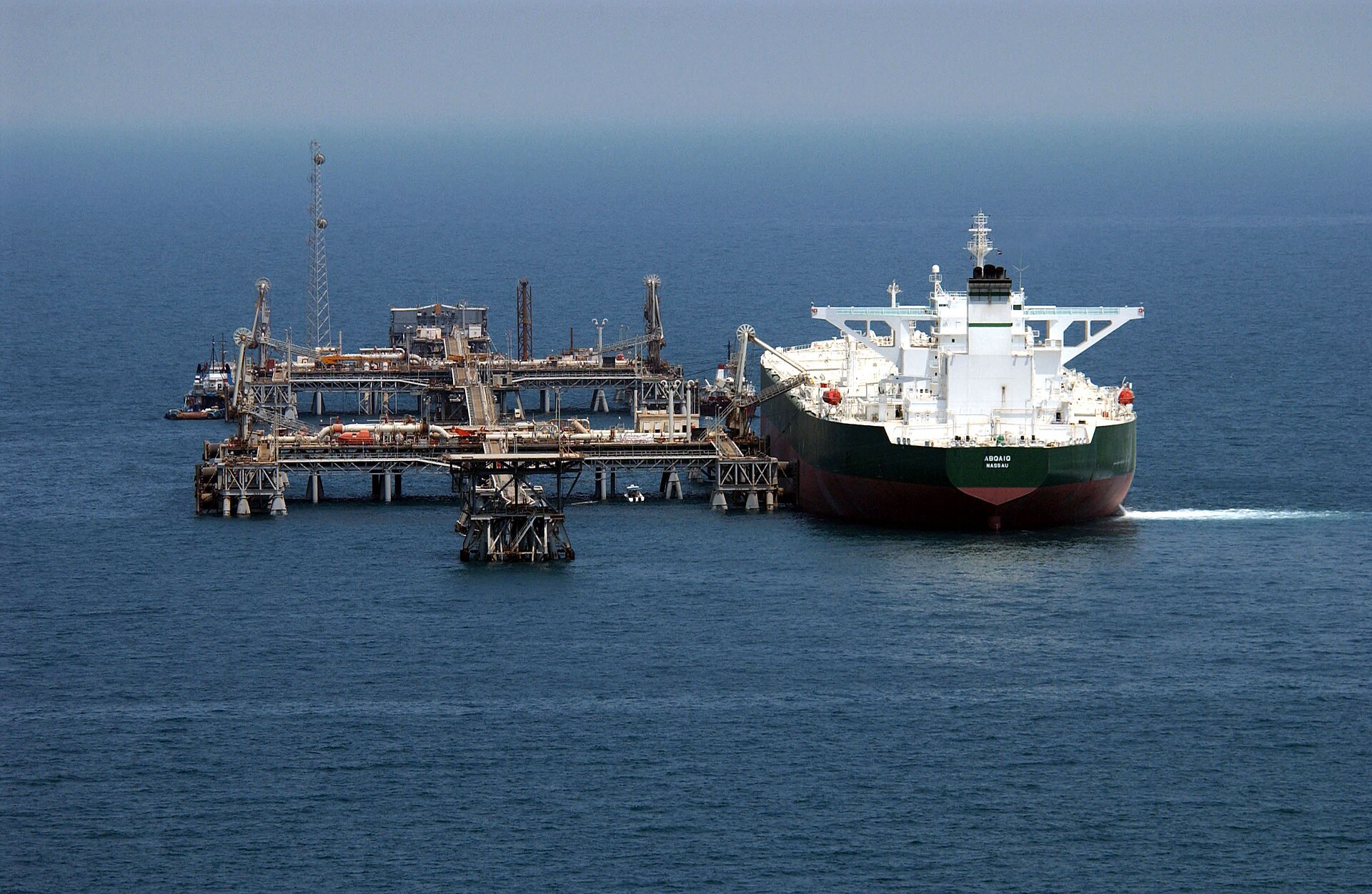
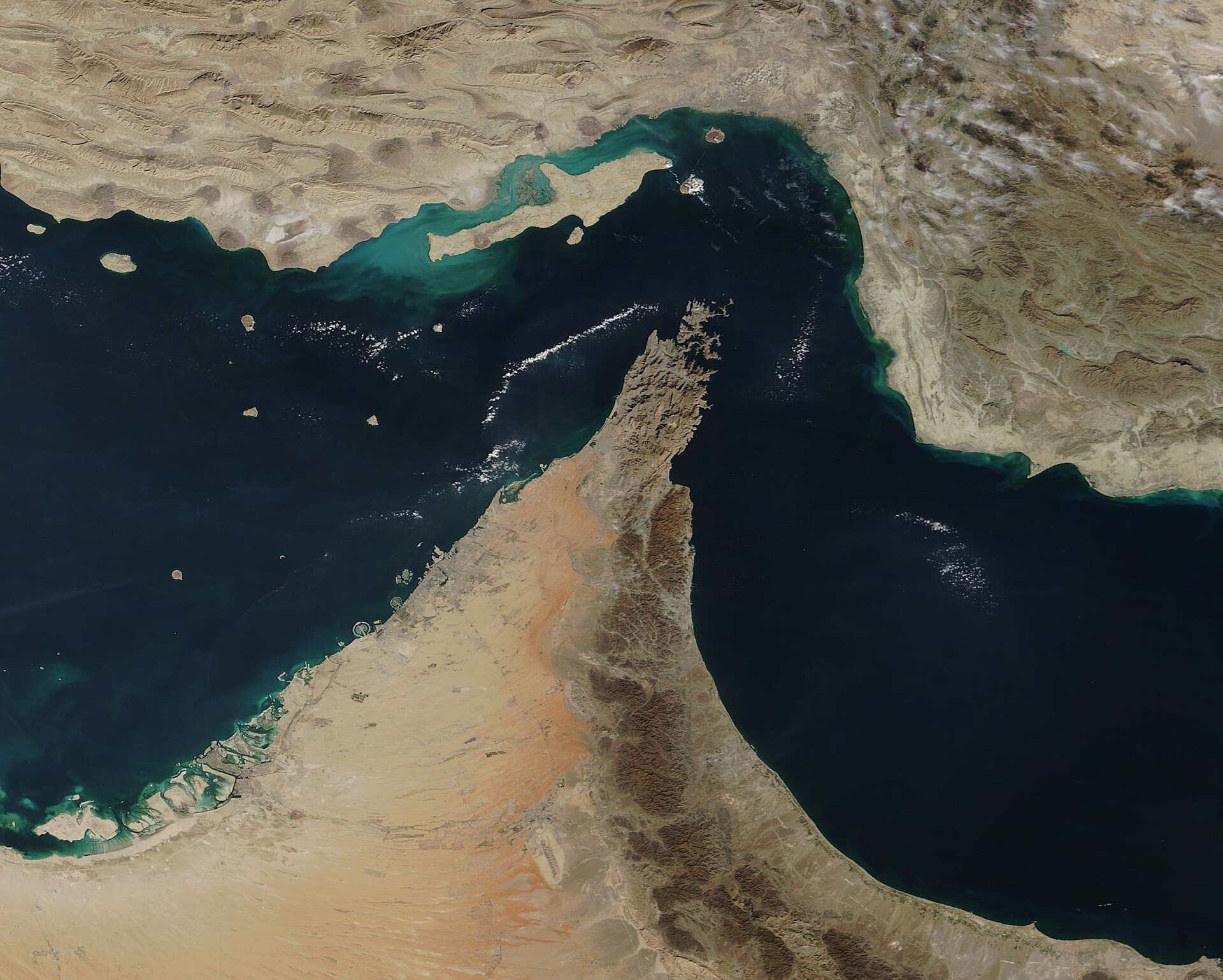
The Hormuz theater is far more complex than the Red Sea. The strait itself is 21 nautical miles wide at its narrowest point, with shipping lanes that pass within miles of Iranian coastal missile batteries, drone launch sites, and fast-attack craft bases. Naval analyst Tayfun Ozberk, writing for Naval News, calculated that warships escorting convoys through the strait would have “only seconds to respond” if attacked, and that without suppressing Iranian coastal threat capabilities, “any convoy system would operate under constant risk of ambush.” Now add a second variable: American naval assets operating under bilateral arrangements with Saudi Arabia and Bahrain, conducting strikes against Iranian targets, in the same waters where a European-led coalition is attempting to escort commercial shipping under a mandate that explicitly excludes military action during the conflict. The deconfliction problem is not theoretical — it is the defining operational risk of the current arrangement, and there is no protocol to manage it because no protocol has been negotiated.
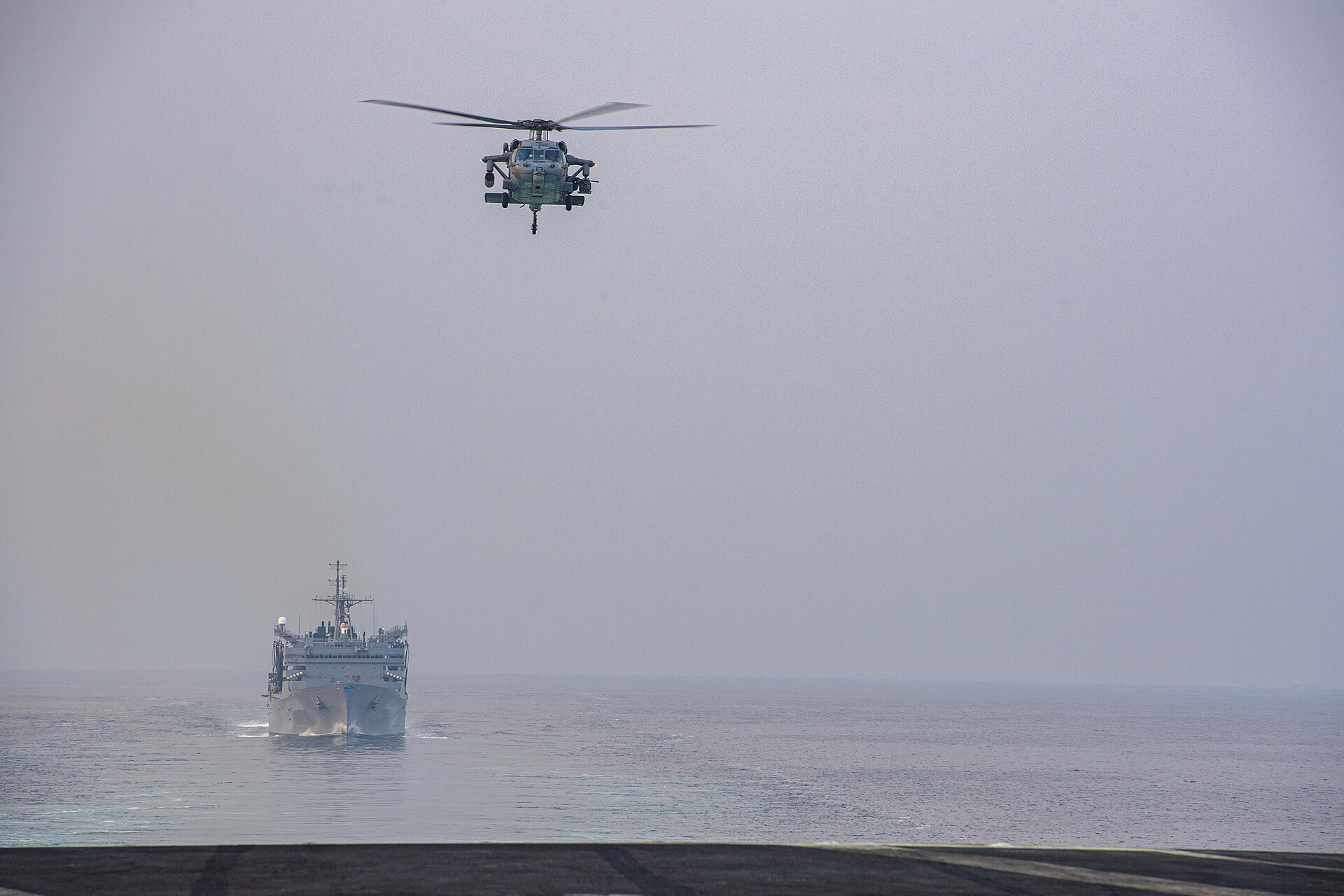
The Combined Maritime Forces structure that already exists in Bahrain was designed to avoid exactly this problem, but it was designed for a world in which the United States led and allies followed. The new coalition inverts that relationship, and the US Fifth Fleet has not been invited to participate. If a coalition escort vessel operating under European rules of engagement encounters an Iranian fast-attack craft that is simultaneously being tracked by an American destroyer operating under separate bilateral rules of engagement, who decides what happens next? The answer, at present, is nobody — and the precedent from Aspides suggests that “nobody” is not a safe answer in waters where reaction times are measured in seconds.
The UAE Is Doing This Alone in the Gulf
Of the six Gulf Cooperation Council member states, exactly one has committed warships to the coalition: the United Arab Emirates. Abu Dhabi’s announced deployment includes Baynunah-class corvettes armed with MM40 Exocet Block 3 anti-ship missiles with a range of 180 kilometers, Abu Dhabi-class corvettes, Falaj 2-class stealth patrol vessels, and Falaj 3-class missile boats — a meaningful surface combatant package by any regional standard, and a commitment that no European nation has matched. The UAE has simultaneously pushed Bahrain to co-sponsor a UN Security Council resolution authorizing “all necessary means” to protect transit through the strait, language deliberately modeled on the resolutions that authorized force in Libya in 2011 and Kuwait in 1990.
The UAE’s willingness to commit forces while Saudi Arabia hangs back reflects a divergence that predates the current crisis but has been sharpened by it. Abu Dhabi’s economic model is less dependent on crude oil exports than Riyadh’s, its ports — particularly Fujairah, which sits outside the strait on the Gulf of Oman — give it logistics infrastructure that can function even under full Hormuz closure, and its diplomatic posture has consistently been more interventionist than Saudi Arabia’s since Mohammed bin Zayed consolidated power. The Saudi-UAE fracture on this question is not a disagreement about tactics; it is a structural divergence in how the two countries assess risk, calculate interest, and position themselves in a post-American Gulf order.
| Gulf State | Coalition Status | Military Commitment | Strait Dependency |
|---|---|---|---|
| UAE | Member | Corvettes, patrol vessels, missile boats deployed | Moderate (Fujairah bypass) |
| Bahrain | Member | No warships committed; co-sponsoring UNSC resolution | High |
| Saudi Arabia | Absent | None; hosting US forces at King Fahd Air Base | High (6.23m bpd trapped) |
| Oman | Absent | None; drafting transit protocol with Iran | Moderate |
| Qatar | Absent | None | High (LNG exports) |
| Kuwait | Absent | None | Very high |
Bahrain’s role is diplomatic rather than military — hosting the coalition’s political framework and co-sponsoring the UNSC resolution without deploying naval assets of its own. The remaining GCC states — Oman, Qatar, and Kuwait — are entirely outside the coalition, each for different reasons: Oman because it is negotiating the transit protocol with Iran, Qatar because its LNG exports depend on Iranian goodwill in the strait, and Kuwait because it lacks the naval capacity to contribute meaningfully and the political will to provoke Tehran. The result is that the UAE is carrying the entire Gulf contribution to a coalition ostensibly formed to protect Gulf interests, a lopsidedness that Abu Dhabi is unlikely to tolerate indefinitely without demanding reciprocal commitments from its neighbors.
The European Commitment Problem
The 41-nation coalition is numerically dominated by European states, and the gap between European rhetoric and European military commitment is wide enough to sail a tanker through. France has not committed surface combatants. The UK has offered surveillance drones — useful for intelligence, useless for escorting convoys through mined waters under missile threat. Germany’s position was stated with unusual bluntness by Defense Minister Boris Pistorius: “This is not our war; we did not start it…sending more warships will likely not help achieve that.” German Chancellor Friedrich Merz went further: “To this day, there is no convincing plan for how this operation could succeed.” French President Emmanuel Macron confined himself to a single sentence of distance: “We are not party to the conflict.”
The European reluctance is not cowardice; it is a rational assessment of capability and risk. European navies have been hollowed out by three decades of post-Cold War peace dividends, and what remains is stretched across the Baltic (where Russian threats persist), the Red Sea (where Operation Aspides continues), and now potentially the Gulf. Finnish Prime Minister Alexander Stubb made the transactional nature of any European contribution explicit: he suggested that Europe might offer military support for Hormuz only in exchange for increased US assistance on Ukraine — conditioning Gulf security on a geopolitical trade that has nothing to do with the strait. Luxembourg’s Prime Minister Xavier Bettel was even more direct, calling Trump’s demand that allies police Hormuz “blackmail” and noting that NATO’s Article 5 does not apply because no NATO member has been attacked.
Michael Froman, president of the Council on Foreign Relations, characterized the March 19 seven-nation statement that preceded the full coalition as “a lukewarm commitment, to say the least.” The April 2 gathering was larger but no warmer in operational terms. Cooper’s language about “diplomatic and economic tools” and post-conflict planning is carefully calibrated to sound like action while committing to nothing that could put European forces in harm’s way before a ceasefire. The Europeans are, in effect, building a framework for a post-war order while the war is still being fought — which may be strategically sensible but does nothing for the ships currently unable to transit the strait or the 20 million barrels per day currently not flowing.
Can Riyadh Avoid a Binary Choice?
Saudi Arabia’s multi-vector hedge — American base access, coalition avoidance, pipeline maximization, omni-directional diplomacy — is viable only as long as the international environment permits ambiguity. Three developments could collapse that ambiguity into a binary choice, and each is plausible within the next sixty days.
The first is a coalition demand for Saudi participation. If the post-conflict military planning that Cooper has initiated produces an operational framework — even a limited one focused on demining and escort — the coalition will need Gulf state participation to have any credibility. The UAE cannot carry the Gulf contribution alone, and the geographic reality is that any sustained maritime operation in the strait requires Saudi port access, Saudi airspace, and Saudi logistical support even if Saudi warships are not directly involved. A formal request from the coalition — backed by the UK, France, Japan, and India — would force Riyadh to say yes or no, and either answer has costs. Joining would antagonize Tehran at a moment when Riyadh is maintaining back-channel communications through multiple intermediaries; refusing would confirm the free-rider perception and strain relationships with European and Asian energy customers who are bearing the cost of the blockade.
The second is an escalation of the Iran-Oman transit protocol into a formal sovereignty claim. If Tehran and Muscat sign a binding agreement requiring permits for strait transit, Saudi Arabia would face a framework that subordinates its most critical export route to Iranian regulatory authority. Riyadh could not accept that framework without conceding a permanent Iranian veto over Saudi oil exports, and it could not reject it without aligning explicitly with the coalition’s freedom-of-navigation position — which would mean joining the grouping it has spent weeks avoiding. The protocol, still in draft, is designed to create exactly this kind of pressure. Tehran has now taken that claim a step further: the structural gap between the US plan and Iran’s counter-conditions includes a formal demand for international recognition of Iranian sovereignty over the strait, formally presented as one of five ceasefire counter-conditions on March 25.
The third trigger is American pressure. Trump’s “just take it” doctrine is aimed at allies broadly, but its sharpest edge is pointed at the Gulf states whose wealth depends on the strait. If Washington decides that Saudi Arabia’s free-riding on American military operations — hosting US forces while refusing to join the coalition those forces are notionally supporting — is no longer tolerable, the bilateral relationship that underpins Riyadh’s entire security architecture comes under strain. The Saudi calculus assumes that hosting King Fahd Air Base is sufficient to maintain American goodwill; whether Trump agrees with that assumption is, at best, uncertain.
| Scenario | Trigger | Saudi Risk | Probability (analyst consensus) |
|---|---|---|---|
| Coalition demands Saudi participation | Post-conflict operational planning begins | Forced choice between coalition membership and Iranian antagonism | Moderate-high within 60 days |
| Iran-Oman protocol signed | Formal sovereignty claim over strait transit | Iranian regulatory veto over Saudi exports | Moderate; draft in final stages |
| US pressure on free-riding | Trump reassesses bilateral value of Saudi base access | Erosion of core security relationship | Uncertain; depends on war trajectory |
| Blockade tightens to include pipeline attacks | Iranian escalation targeting Petroline infrastructure | Total export disruption | Low-moderate but catastrophic if realized |
The historical parallel that matters is not the Tanker War of the 1980s — when the US led and allies followed — but the period immediately before Operation Earnest Will, when Kuwait explicitly asked both the United States and the Soviet Union to reflag its tankers, forcing Washington’s hand by threatening to invite Moscow into the Gulf. Kuwait’s move worked because it created a binary choice that the Reagan administration could not avoid. Saudi Arabia today faces a version of the same dynamic, except that the binary choice is being created not by a single ally but by the convergence of a European-led coalition, an Iranian-Omani counter-protocol, and an American president who has already decided that keeping the strait open is someone else’s problem.
Frequently Asked Questions
What is the legal basis for the 41-nation coalition to operate in the Strait of Hormuz?
The coalition’s legal framework rests on the United Nations Convention on the Law of the Sea (UNCLOS), specifically Part III governing transit passage through international straits, which guarantees all vessels the right of continuous and expeditious transit regardless of flag state. Iran ratified UNCLOS in 1998 but has periodically disputed its applicability to Hormuz, arguing that the strait falls under a separate bilateral arrangement with Oman as the two littoral states. The coalition’s position is further complicated by the fact that any military escort operation would likely require a UN Security Council resolution to authorize the use of force — and both Russia and China, which benefit from Iran’s selective transit regime allowing their vessels through, would almost certainly veto such a resolution. That veto threat materialized on April 3, when the Bahrain-drafted UNSC Hormuz resolution was stripped of Chapter VII enforcement authority after Russia and China rejected six successive drafts over 15 days. This legal ambiguity is precisely why the coalition has confined its military planning to the post-conflict period, when consent-based arrangements become more feasible than enforcement-based ones.
How does Iran’s selective transit regime weaken the coalition’s position?
Iran’s decision to allow vessels from China, India, Malaysia, and Pakistan to transit Hormuz freely while blocking coalition-member shipping is a deliberate strategy to fracture the universality principle that underpins the coalition’s legal and political case. By granting selective access, Tehran ensures that the world’s two most populous countries — which together consume roughly 25 million barrels of oil per day — have limited incentive to join enforcement operations against Iranian naval forces. China, which imports approximately 40 percent of its crude through Hormuz, has conspicuously refused to join the coalition despite being the single largest consumer of Gulf oil. The selective regime also creates a pricing arbitrage: Chinese and Indian refiners can access Gulf crude at contracted prices while European and Japanese buyers are forced onto more expensive alternative supply routes, giving Beijing and New Delhi a competitive energy advantage that they have no reason to surrender by joining a coalition that would eliminate it.
What happened during Operation Earnest Will that is relevant to today’s coalition?
Operation Earnest Will, which ran from 1987 to 1988 during the Iran-Iraq War, was the largest naval convoy operation since World War II and offers direct operational lessons for any attempt to reopen Hormuz. The operation began when the first reflagged Kuwaiti tanker, the Bridgeton, struck an Iranian mine on its very first convoy run on July 24, 1987 — an immediate demonstration that escorting ships through mined waters requires mine countermeasure capability that the US Navy lacked then and lacks now. At its peak, Earnest Will involved more than 30 American warships and relied on allied minesweepers from the UK, France, Italy, Belgium, and the Netherlands because the United States did not have sufficient MCM assets of its own. Iran adapted to the convoy system by shifting attacks to vessels in port rather than under escort, a tactic that would be even more effective today given the concentration of loading terminals in the upper Gulf. The operation succeeded only because the US was willing to engage Iranian forces directly, culminating in Operation Praying Mantis — the largest American surface naval engagement since World War II — which sank or damaged half of Iran’s operational navy in a single day.
Could China be persuaded to join the Hormuz coalition?
General Sir David Richards, former head of the UK Armed Forces, suggested that China and India “could potentially be persuaded” to join a reopening effort, but the incentive structure works against it. China currently receives unimpeded access to Gulf crude under Iran’s selective transit regime, meaning Beijing’s oil imports flow while European and Japanese competitors’ supplies are disrupted — a strategic advantage China would surrender by joining a coalition that antagonizes Tehran. China is also Iran’s largest oil customer and has deepened economic ties through the 25-year Comprehensive Strategic Partnership signed in 2021. Beijing’s calculus would change only if Iran revoked Chinese transit privileges — which would require a significant deterioration in Sino-Iranian relations — or if the economic damage from global supply disruption became severe enough to threaten Chinese domestic stability. Neither condition has been met, and Iran has every incentive to keep Chinese vessels transiting to prevent exactly the kind of universal coalition that could credibly challenge its control of the strait.
What is Saudi Arabia’s pipeline bypass capacity, and is it sufficient?
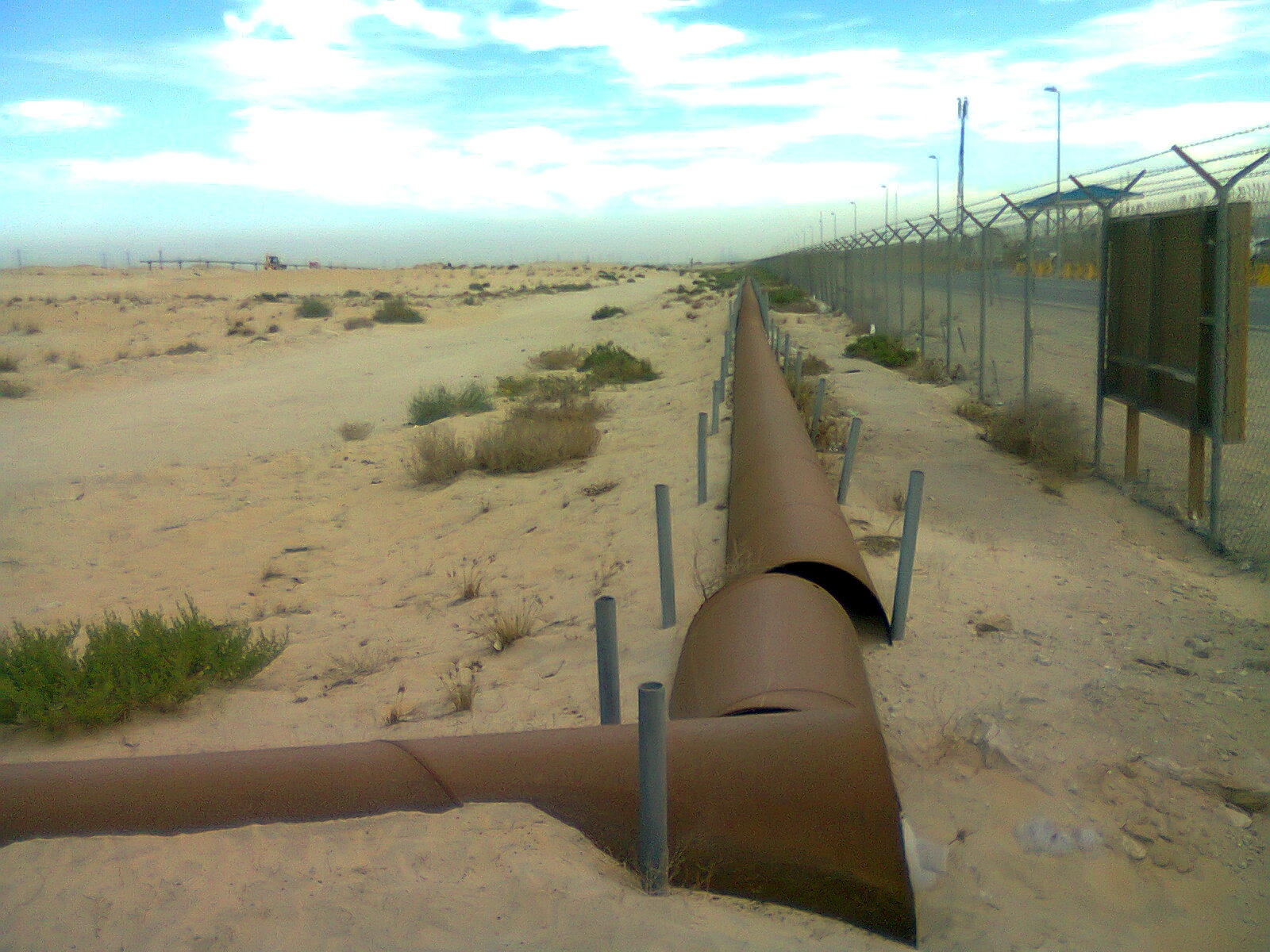
Saudi Arabia’s East-West Pipeline, also known as the Petroline, runs approximately 1,200 kilometers from the Eastern Province oil fields to the Red Sea port of Yanbu, bypassing the Strait of Hormuz entirely. The pipeline is currently operating at its physical maximum capacity of 7 million barrels per day, which represents roughly 53 percent of Saudi Arabia’s total crude export capacity of approximately 13.23 million barrels per day when including both crude and refined products. The remaining 6.23 million barrels per day — nearly half of Saudi export volume — remains trapped behind the Hormuz blockade with no alternative export route. The pipeline itself is not invulnerable: its above-ground pumping stations and exposed segments present targets for Iranian ballistic missiles and long-range drones, and a sustained Iranian campaign against pipeline infrastructure could reduce or eliminate the bypass capacity that currently gives Riyadh its margin of economic survival. Saudi Aramco has not disclosed whether hardening or redundancy measures have been implemented along the route since the war began.