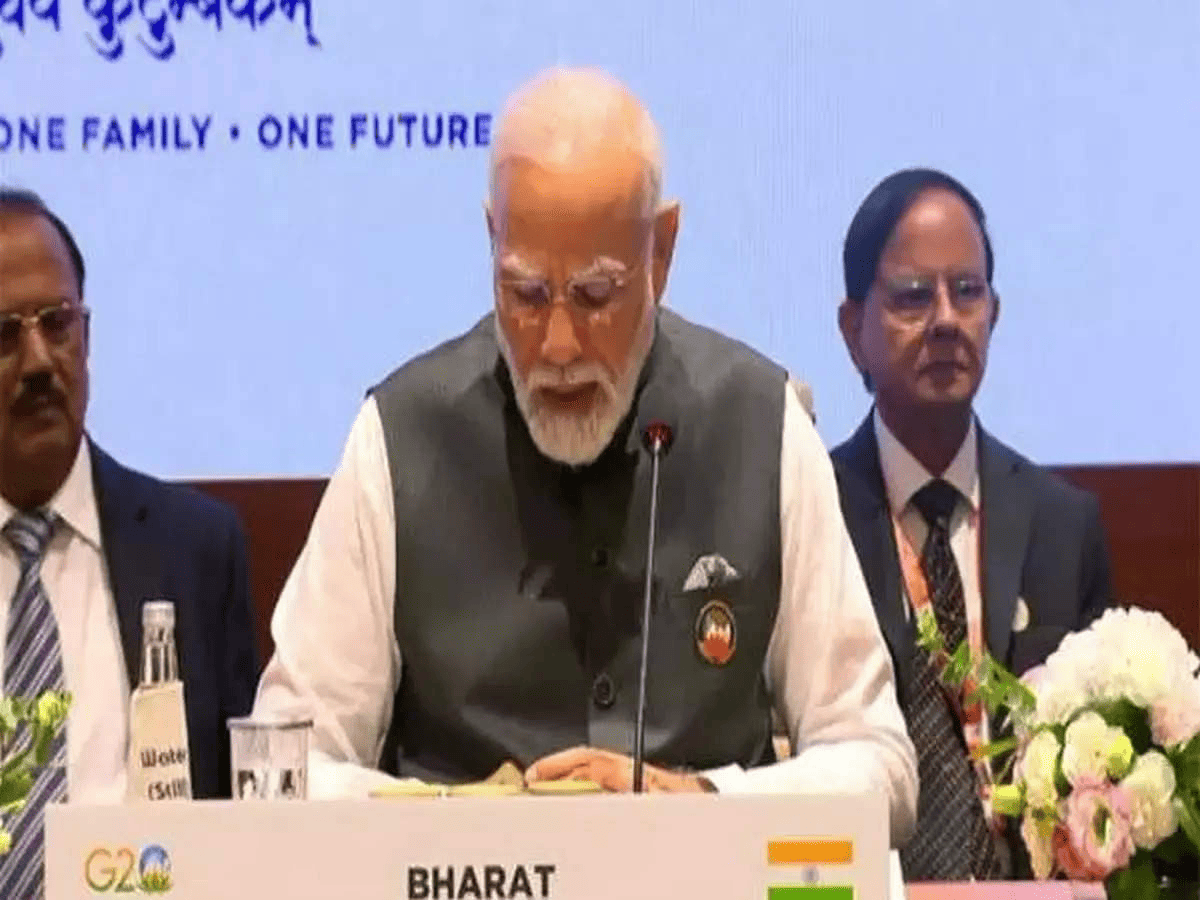

A momentous agreement was announced at the G20 Summit, as India, the United States, Saudi Arabia, and the European Union revealed plans for a groundbreaking India-Middle East-Europe shipping and railway connectivity corridor. Prime Minister Narendra Modi made this historic announcement alongside US President Joe Biden, Saudi Arabia’s Prime Minister Mohammed bin Salman, and leaders from the EU.
This revolutionary project marks the first of its kind, fostering cooperation on connectivity and infrastructure between India, the UAE, Saudi Arabia, the EU, France, Italy, Germany, and the US. Prime Minister Modi, speaking after the launch, expressed his warm welcome to all the participants, stating, “I am delighted to co-chair this event with my friend President Joe Biden. Today, we witnessed the conclusion of a historic and significant agreement. In the days to come, it will serve as an effective means for promoting economic integration between India, South Asia, and Europe.”
Addressing the attendees at the Bharat Mandapam venue, Prime Minister Modi emphasized that the mega-deal would provide sustainable direction to global connectivity and sustainability. He extended his congratulations to all the leaders involved in the implementation of this connectivity corridor.
“Strong connectivity and infrastructure serve as the bedrock for human civilization’s development. India has accorded utmost priority to this issue throughout its developmental journey. Alongside physical infrastructure, unprecedented investments are being made in social, economic, and financial infrastructure as well,” Prime Minister Modi stated. He added, “Through these endeavors, we are laying a robust foundation for a developed India. As a reliable partner, India has spearheaded infrastructure projects in railways, energy, and technology partnerships, particularly with nations in the Global South. Our focus lies in adopting a demand-driven and transparent approach.”
Prime Minister Modi also underscored the importance of respecting sovereignty and regional integrity. He emphasized that connectivity between nations not only enhances business opportunities but also fosters trust among them. “We firmly believe that connectivity between different countries not only contributes to economic growth but also builds trust. As we promote connectivity initiatives, we must adhere to international rules, respect the sovereignty of all nations, and uphold regional integrity,” Prime Minister Modi emphasized.
The infrastructure deal encompasses plans to connect Middle Eastern countries through an extensive network of railways, with shipping lanes from the region connecting to India. Jon Finer, the White House Deputy National Security Advisor, highlighted the significance of the project, stating, “This deal will benefit low and middle-income countries in the region, providing the Middle East with a critical role in global commerce. Its transparent nature and adherence to high standards make it highly appealing to the countries involved, as well as on a global scale.”
The Middle East briefing 3,000+ readers start their day with.
One email. Every weekday morning. Free.
Delving further into the initiative, Finer described it as more than simply a railway project, highlighting its comprehensive scope in both shipping and railways. “This project encompasses not just railways but also shipping. Its expansiveness, ambition, and groundbreaking nature should be understood by all,” Finer added.
Moreover, Finer applauded the project’s affirmative focus, aimed at serving underserved countries. “The way we perceive this infrastructure project is as an affirmative and positive venture. It has particular appeal for countries lacking adequate infrastructure. We are not imposing a zero-sum choice on these nations. In contrast to less ambitious initiatives, we are confident in the contrast provided by our project,” reiterated the White House Deputy National Security Advisor.
During the Partnership for Global Infrastructure Investment (PGII) and India-Middle East-Europe Economic Corridor program at the Bharat Mandapam, US President Joe Biden expressed enthusiasm, referring to the project as a highly significant endeavor. He thanked Prime Minister Modi for his contribution, stating, “This truly is a significant development. I want to express my gratitude to Prime Minister Modi. One Earth, One Family, One Future—that is the essence of this G20 Summit and the focus of this partnership we are discussing here today. Our aim is to build sustainable and resilient infrastructure, make quality infrastructure investments, and create a better future.”
Crown Prince of Saudi Arabia, Mohammed Bin Salman, also addressed the gathering, conveying his support for the integration of the initiative and the Economic Corridor project. He thanked all those involved in this foundational step of establishing this crucial economic corridor.
French President Emmanuel Macron, underscoring the importance of the project, stated, “With the European Commission’s presence here, we commit to investing alongside you on this road. This is a highly significant initiative, providing immense opportunities and connecting people from Asia, through the Middle East, to Europe. Our intention is not just to make commitments but to ensure tangible results after this commitment, particularly focusing on establishing the first global green trade road, which means creating net-zero transport infrastructure.”
Ursula von der Leyen, President of the European Commission, expressed her satisfaction with the unveiling of larger-scale projects. She announced two projects on that day, beginning with the India-Middle East-Europe economic corridor, which will facilitate the most direct connection to date between India, the Arabian Gulf, and Europe. She also announced the Trans African Corridor, embodying the spirit of these ambitious initiatives.