RIYADH — Iran’s 14-point Hormuz proposal, transmitted to Washington via Pakistan on the night of May 1, is not a peace offer. It is a map of what the Islamic Revolutionary Guard Corps will permit President Masoud Pezeshkian to concede — and, by omission, what it will not. Read clause by clause against the known authorization ceiling that governs Iranian decision-making, the document traces the precise boundary between what the elected president controls and what the IRGC command structure holds beyond his reach. President Trump’s rejection within 24 hours, capped by his May 2 declaration that the United States would be “better off without a deal,” confirms that Washington has reached the same conclusion from the opposite direction: no document the Iranian president can sign will be honored by the people who control the missiles and mines.
That mutual recognition — Tehran cannot deliver what it promises, and Washington no longer believes it should try — removes the ceasefire track that Saudi Arabia has quietly depended on since the war’s opening week. Riyadh now sits between a US partner pursuing what amounts to a regime-collapse objective and an IRGC that operates independently of any commitment the Iranian government makes. The 14-point document, Mojtaba Khamenei’s April 30 nuclear vow, and Trump’s same-day $8 billion arms package to Middle East allies are three data points that, taken together, describe a negotiating space that has closed.
The three threads — the proposal’s architecture, the contradictions in Trump’s War Powers filing, and Saudi Arabia’s structural exposure — converge on the same conclusion: the diplomatic window closed not gradually but in the span of 24 hours.
The House of Saud Daily Briefing
Saudi Arabia's news in 3 minutes, every morning. Free. See today's issue
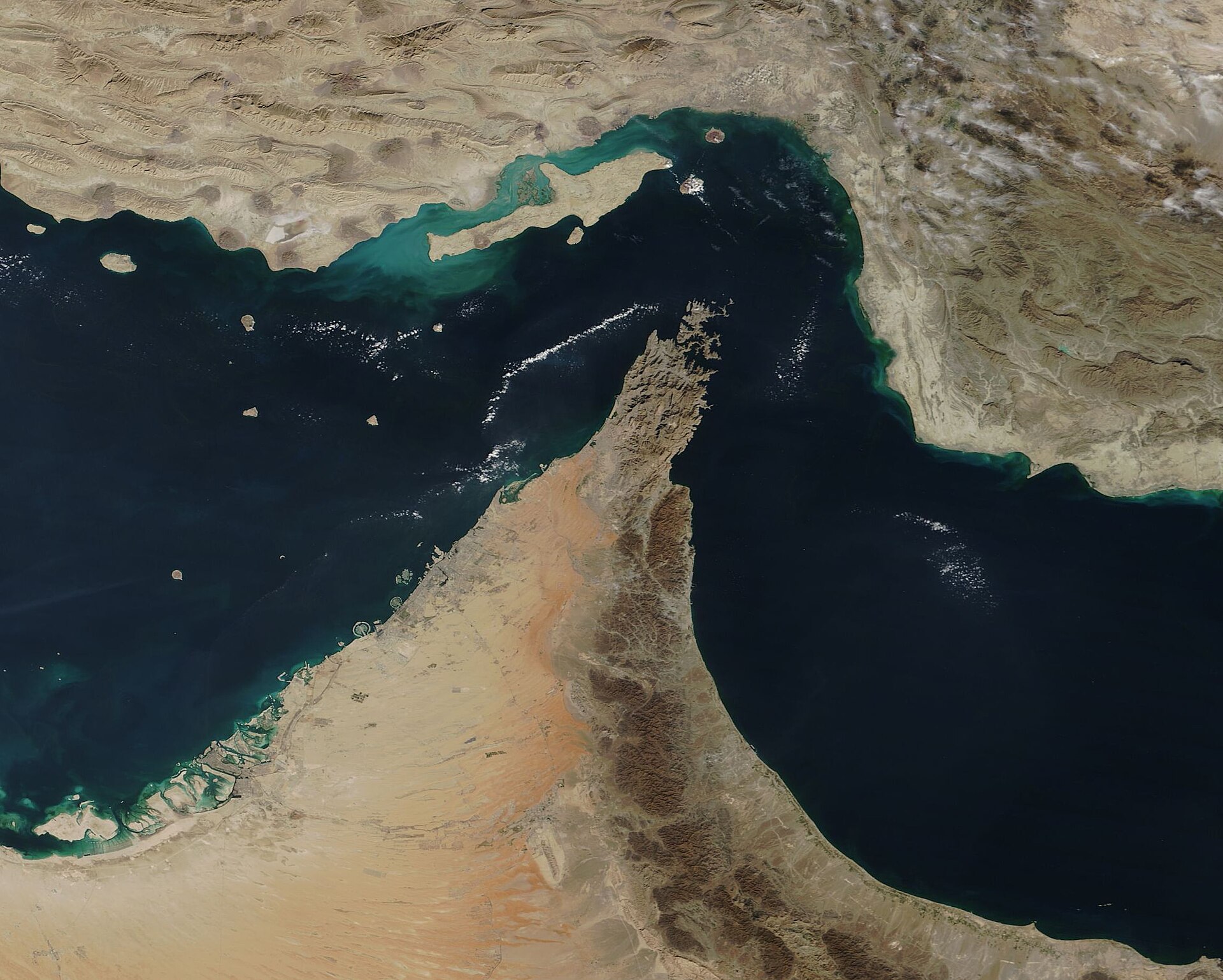
Table of Contents
- What Does Iran’s 14-Point Proposal Actually Concede?
- The Authorization Ceiling Made Visible
- Why Did Trump Reject the Proposal Within 24 Hours?
- The War Powers Filing and the Legal Contradiction
- What Does “Better Off Without a Deal” Mean for Saudi Arabia?
- Saudi Arabia’s Structural Exposure: Briefed but Not Included
- Can the Iranian Parliament Override Any Agreement on Hormuz?
- The Libya Model and the IRGC’s Institutional Memory
- Araghchi’s Phone Offensive and the Multilateral Audience
- Frequently Asked Questions
What Does Iran’s 14-Point Proposal Actually Concede?
Iran’s 14-point proposal drops one precondition: the demand that the US naval blockade end before Hormuz negotiations begin. Under the previous framework, Iran required strict sequencing — blockade lifted first, then maritime talks. The May 1 document removes that requirement, allowing parallel discussion of the blockade and Hormuz transit arrangements. This is a verifiable softening, confirmed by the Wall Street Journal on May 2, 2026.
The concession is real but narrow. It falls within the domain of issues that Pezeshkian and Foreign Minister Abbas Araghchi can negotiate without IRGC approval — procedural sequencing, diplomatic formatting, the structure of talks. What the document does not touch is more instructive. The WSJ reported that the proposal “softens some conditions but still postpones nuclear negotiations and leaves out the missile issue entirely.” Nuclear enrichment is deferred to an undefined “Stage 2.” The missile program is not mentioned at all — not deferred, not conditioned, but absent from the document as if the subject does not exist.
This pattern has been consistent across every iteration of Iran’s proposals since the war began. The original 10-point plan, delivered April 7–8, included nuclear and missile references that Trump called “not good enough.” The 45-day ceasefire framework reported by Axios and The National deferred both items to Phase 2. Araghchi’s third draft, delivered via Pakistan on April 28, narrowed the language further. Each iteration softens the Hormuz and blockade surface — the issues Pezeshkian can move — while hardening the nuclear and missile floor, which remains under IRGC and Supreme Leader authority. The 14-point document is the most refined expression of this pattern: maximum diplomatic flexibility on issues the president controls, absolute rigidity on issues he does not.
The Authorization Ceiling Made Visible
The concept of an IRGC authorization ceiling — the structural limit on what any Iranian president can concede without military command approval — has governed every stage of this conflict’s diplomacy. The 14-point document makes that ceiling legible in a single text.
Mojtaba Khamenei, serving as acting Supreme Leader during his father’s prolonged absence from public life, issued a written statement on April 30 vowing to “protect Iran’s nuclear and missile capabilities,” according to Business Standard and The Federal. That statement came exactly 24 hours before the 14-point proposal was transmitted to Pakistani mediators — the proposal that omits both nuclear and missile items. The gap between the supreme leader’s public position and the president’s diplomatic document is not a contradiction. It is the authorization ceiling made visible: Mojtaba stated what will not be negotiated, and Pezeshkian submitted a document that obeys that boundary.
The structural proof runs deeper than timing. Article 110 of the Iranian constitution gives the Supreme Leader sole authority over the IRGC. The president has zero operational authority over the Revolutionary Guards’ ground forces, Aerospace Force, Navy, intelligence service, Khatam al-Anbiya engineering arm, Basij, or Quds Force — each accountable only to the Supreme Leader’s office. When Pezeshkian publicly accused SNSC Secretary Ali Akbar Ahmadian Vahidi and Khatam al-Anbiya commander Mohammad Reza Abdollahi of blocking ceasefire compliance on April 4, he was not making a political accusation. He was describing a constitutional fact: the people who control the weapons operate outside his chain of command. That constitutional gap compounds the legitimacy question at Hormuz’s political core: the analysis of who actually stands behind Iran’s Hormuz offer is here.
Vahidi demanded that sanctioned SNSC deputy Ahmad Zolghadr join the Islamabad negotiating team and refused to include missile negotiations in any framework — conditions that directly shaped the April walkout. The 14-point document bears the marks of those constraints. The items Pezeshkian’s team can move — sequencing, Hormuz transit procedures, blockade conditions — are in the document. The items the IRGC controls — enrichment, missiles, mine clearance — are not. The proposal therefore functions as an authorization ceiling document: it tells you what Iran’s president is permitted to offer, which in turn tells you what the IRGC has withheld.
Why Did Trump Reject the Proposal Within 24 Hours?
Trump’s rejection followed a 24-hour hardening sequence. On May 1, he told Axios: “Iran wants to make a deal, but I’m not satisfied with it.” By May 2, speaking at Palm Beach, he had moved to a categorically different position: “Perhaps the US would be better off without a deal,” according to LaPresse. The shift from dissatisfaction to strategic indifference took one day.
The rejection was not impulsive. Trump expanded his condition set in the May 1 Axios interview to include the nuclear program, missile program, and proxy termination — three items the 14-point document either defers or excludes entirely. By demanding what the IRGC authorization ceiling structurally prevents Pezeshkian from offering, Trump established conditions he knows cannot be met. This is not a negotiating position designed to extract better terms. It is a framework designed to justify the absence of a deal.
The same-day actions confirm the intent. On May 2, the day of the “better off without” statement, CNN reported that the US fast-tracked $8 billion in arms sales to Middle East allies. The State Department issued a cable to embassies calling on governments to join the “Maritime Freedom Construct” — a joint naval force framework for Hormuz that would bypass any negotiated arrangement with Iran, according to Times of Israel and Al Jazeera reporting. These are not the actions of a government waiting for a better offer. They are the actions of a government building an alternative architecture that assumes no deal will be reached.
The 14-point rejection fits within a regime-change framework: if the objective is not a deal but the collapse of the Iranian system under sustained pressure, then any proposal — no matter how softened — is structurally insufficient, because the goal is not an agreement but the conditions that follow the absence of one.
The War Powers Filing and the Legal Contradiction
On May 1, the same day Trump declared himself “not satisfied” with Iran’s proposal, he filed a War Powers notice to Congress stating that hostilities in Iran “have terminated,” according to CNBC. The filing creates a legal architecture of extraordinary contradictions.
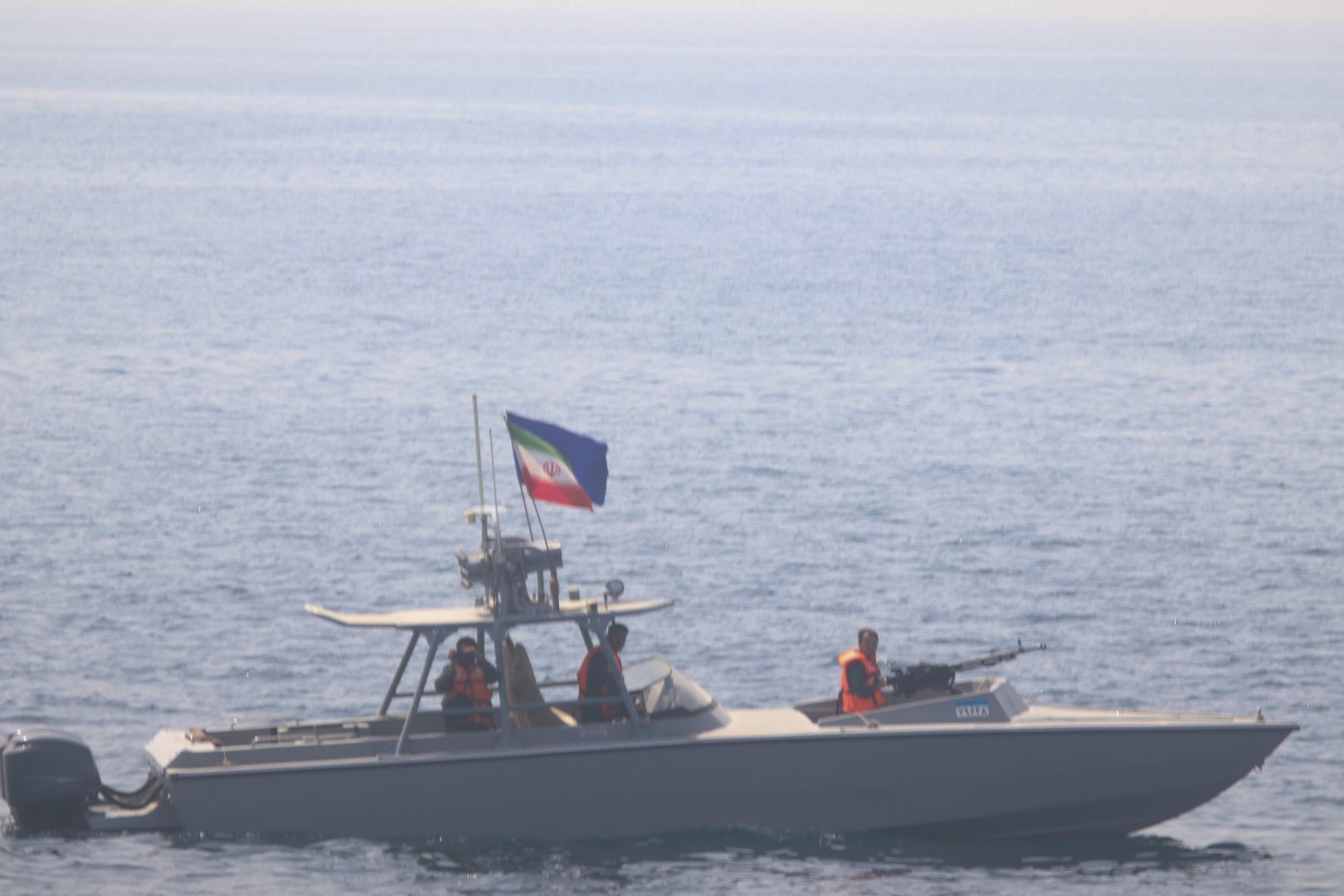
The US naval blockade, effective since April 13, remains active. The IRGC seized two vessels — MSC Francesca (11,660 TEU) and Epaminodas (6,690 TEU) — on April 22, per Bloomberg’s “double blockade” reporting. A senior Iranian military official told ABC News on May 2 that renewed conflict is “likely.” Defense Secretary Pete Hegseth posted on May 1 that Iran “will pay” for supporting Houthi attacks on merchant shipping. Only 45 transits have passed through Hormuz since the April 8 ceasefire — 3.6 percent of the pre-war baseline. CENTCOM’s 49-vessel redirect figure, confirmed by Treasury Secretary Bessent on May 3 alongside his declaration that Washington is “suffocating” Iran’s economy, updated that count from the May 1 figure of 40-plus.
The War Powers filing serves a specific legal function: it allows Trump to argue that continued military posture — the blockade, the arms sales, the Maritime Freedom Construct — requires no Congressional authorization because hostilities have officially ended. The declaration that war is over becomes the legal instrument for continuing the war’s infrastructure indefinitely. Congress cannot invoke the War Powers Resolution to constrain operations that the president has declared are not military operations.
For Saudi Arabia, the filing carries a different implication. A US president who declares hostilities terminated while maintaining a naval blockade and fast-tracking regional arms sales is signaling that the current posture — not peace, not war, but sustained coercive pressure — is the intended steady state. Bloomberg reported on April 16 that Gulf and European officials privately estimated a US-Iran deal could take six months. That estimate assumed both parties intended to reach one. After May 2, no such assumption survives.
What Does “Better Off Without a Deal” Mean for Saudi Arabia?
Trump’s “better off without a deal” formulation, applied to Iran for the first time on May 2, removes the diplomatic floor beneath Saudi Arabia’s security planning. Since the war began on February 28, Riyadh has operated on the assumption that US-Iran negotiations would eventually produce a framework — imperfect, delayed, but real — that would reopen Hormuz and restore Saudi export capacity. That assumption is no longer operative.
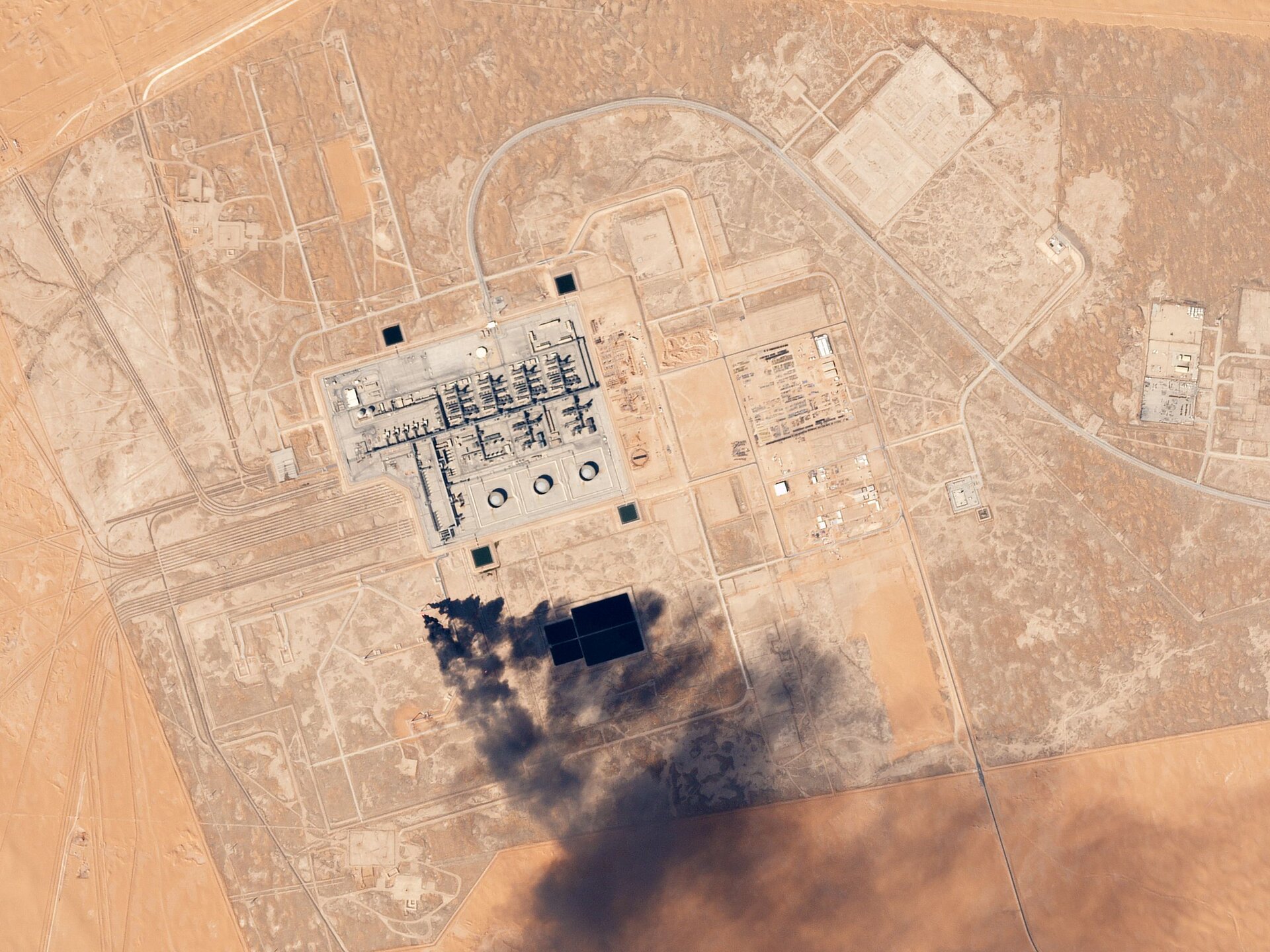
The numbers describe the exposure. Saudi March production fell to 7.25 million barrels per day, down from 10.4 million in February — a 30 percent collapse, the largest single-month decline in the kingdom’s modern history, according to the International Energy Agency. The Yanbu loading facility, operating through the East-West Pipeline bypass, has a ceiling of 5.9 million bpd against pre-war Hormuz throughput of 7–7.5 million bpd — a structural gap of 1.1–1.6 million bpd that no pipeline expansion can close in the near term. Brent crude sat at $108.10 per barrel on May 1, precisely at Saudi Arabia’s fiscal break-even floor of $108–111 per barrel as calculated by Bloomberg using PIF-inclusive methodology.
Saudi PAC-3 interceptor stocks have been depleted by approximately 86 percent since the war began, according to US defense industry estimates published in April 2026. Only two Avenger-class mine countermeasure vessels remain in theater after four were decommissioned from Bahrain in September 2025. The US blockade’s coercive architecture controls Arabian Sea entry while the IRGC controls Gulf of Oman exit — a double blockade that requires vessels to secure approval from both parties to transit, with neither party offering unconditional passage.
A US posture that no longer aims for a deal with Iran leaves Saudi Arabia dependent on the Maritime Freedom Construct — a multinational naval framework that does not yet exist, has no committed partners beyond the State Department cable, and would take months to establish even with full allied participation. The alternative is bilateral engagement with Iran outside the US framework, which Riyadh has been conducting quietly through the Saudi FM’s direct channel with Araghchi but cannot formalize without crossing Washington.
Saudi Arabia’s Structural Exposure: Briefed but Not Included
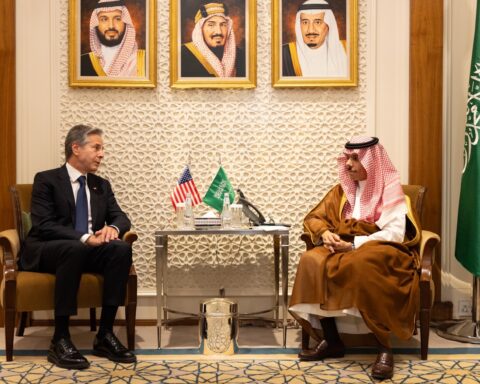
Saudi Foreign Minister Prince Faisal bin Farhan has constructed an extraordinary diplomatic position over the past week: fully informed on Iran’s proposals, actively engaged with all mediating parties, but formally excluded from every negotiating table. The architecture of that exclusion — and Faisal’s maneuvering within it — reveals the structural trap facing Riyadh.
Araghchi called Faisal from the air on April 27 while en route from Muscat to Islamabad, briefing him on the two-stage proposal structure before it was publicly disclosed or transmitted to Washington, according to Xinhua and prior HOS reporting on the Saudi FM’s Antalya positioning. The call — from a plane, between two capitals, to a foreign minister of a country not party to the talks — was itself a diplomatic signal. Iran wants Saudi Arabia to know what is being offered. It does not want Saudi Arabia at the table where the offer is discussed.
The day before, on April 26, Faisal conducted calls with four capitals in a single Sunday — Tehran (Araghchi), Kabul, Manama, and Doha — while simultaneously sitting at the Antalya Diplomacy Forum with the foreign ministers of Pakistan, Turkey, and Egypt, according to Arab News. Those four countries — Pakistan, Turkey, Egypt, and Qatar — constitute the mediation architecture from which Saudi Arabia is formally excluded. Faisal positioned himself physically alongside the mediators while conducting his own parallel diplomatic track with the parties.
Araghchi’s first in-person visit to any Gulf capital came on April 25–26 in Muscat, where he met Sultan Haitham bin Tariq at Al Baraka Palace — 58 days into the war. The choice of Muscat over Riyadh, Doha, or Abu Dhabi was deliberate: Oman is Iran’s historical interlocutor in the Gulf, and the meeting occurred one day before the Araghchi-Faisal call. The sequencing — Muscat meeting, then Saudi briefing call, then Pakistan transmission — traces the proposal’s path around Saudi Arabia rather than through it.
Saudi Arabia was formally excluded from the Islamabad April 10 bilateral talks, where Vice President Vance met Parliament Speaker Ghalibaf in the first direct US-Iran engagement since 1979. Faisal’s response has been to ensure Riyadh receives every document and hears every proposal without being bound by any framework it cannot influence. The result is a country with full situational awareness and zero structural leverage — the most informed bystander in the room.
Can the Iranian Parliament Override Any Agreement on Hormuz?
Even if Pezeshkian signed an agreement on Hormuz — overcoming the IRGC authorization ceiling, securing Supreme Leader ratification, and satisfying US conditions — the Iranian parliament is advancing legislation that could nullify it domestically. A 12-article Hormuz sovereignty law, sponsored by lawmakers Ahmadi and Rezayi Kouchi, would codify IRGC authority over the Strait in domestic Iranian law.
The bill represents a third authorization ceiling layer, distinct from both the IRGC command structure and the Supreme Leader’s constitutional authority. Parliamentary legislation operates on its own timeline, requires its own coalition, and — once enacted — creates a legal barrier that the executive cannot override without a separate legislative repeal. An executive agreement on Hormuz transit would be legislatively reversible the moment it was signed.
The parliamentary track also reveals the IRGC’s institutional strategy. By embedding Hormuz authority in statute rather than executive order, the Guards ensure that any future president — not just Pezeshkian — would face a domestic legal obstacle to any Hormuz concession. The law would survive changes in government, changes in Supreme Leader, and changes in IRGC command. It would make the authorization ceiling permanent and constitutional rather than contingent on the preferences of individual commanders.
Fars News, the IRGC-aligned outlet, described the 14-point proposal as Iran’s “red lines and a clear roadmap for ending the war” — not as concessions or offers, but as red lines. The framing tells you how the document is held internally: not as a diplomatic opening but as a statement of what Iran will not negotiate away. When an IRGC-aligned news agency calls a proposal “red lines,” the proposal has already been absorbed into the military-institutional framework rather than the diplomatic one.
The Libya Model and the IRGC’s Institutional Memory
The IRGC’s refusal to include nuclear and missile capabilities in any negotiating framework is not a bargaining tactic. It is an institutional conclusion drawn from a specific historical precedent that the Revolutionary Guards have studied extensively: Libya.
Muammar Gaddafi surrendered Libya’s nuclear program in December 2003 through negotiations with the United States and the United Kingdom. Eight years later, in October 2011, he was killed during a NATO-backed uprising. The interval between concession and regime termination — eight years — is long enough to be dismissed as coincidental by diplomats and short enough to be treated as causal by military planners. The IRGC treats it as causal.
The parallel gained explicit policy relevance in 2018, when then-National Security Adviser John Bolton publicly advocated the “Libya model” for North Korea denuclearization. North Korea immediately walked back from scheduled talks, and Kim Jong-un cited Libya directly as the reason. Bolton’s formulation — surrender your deterrent, and we will normalize relations — collapsed because Pyongyang watched what happened to the last leader who accepted it.
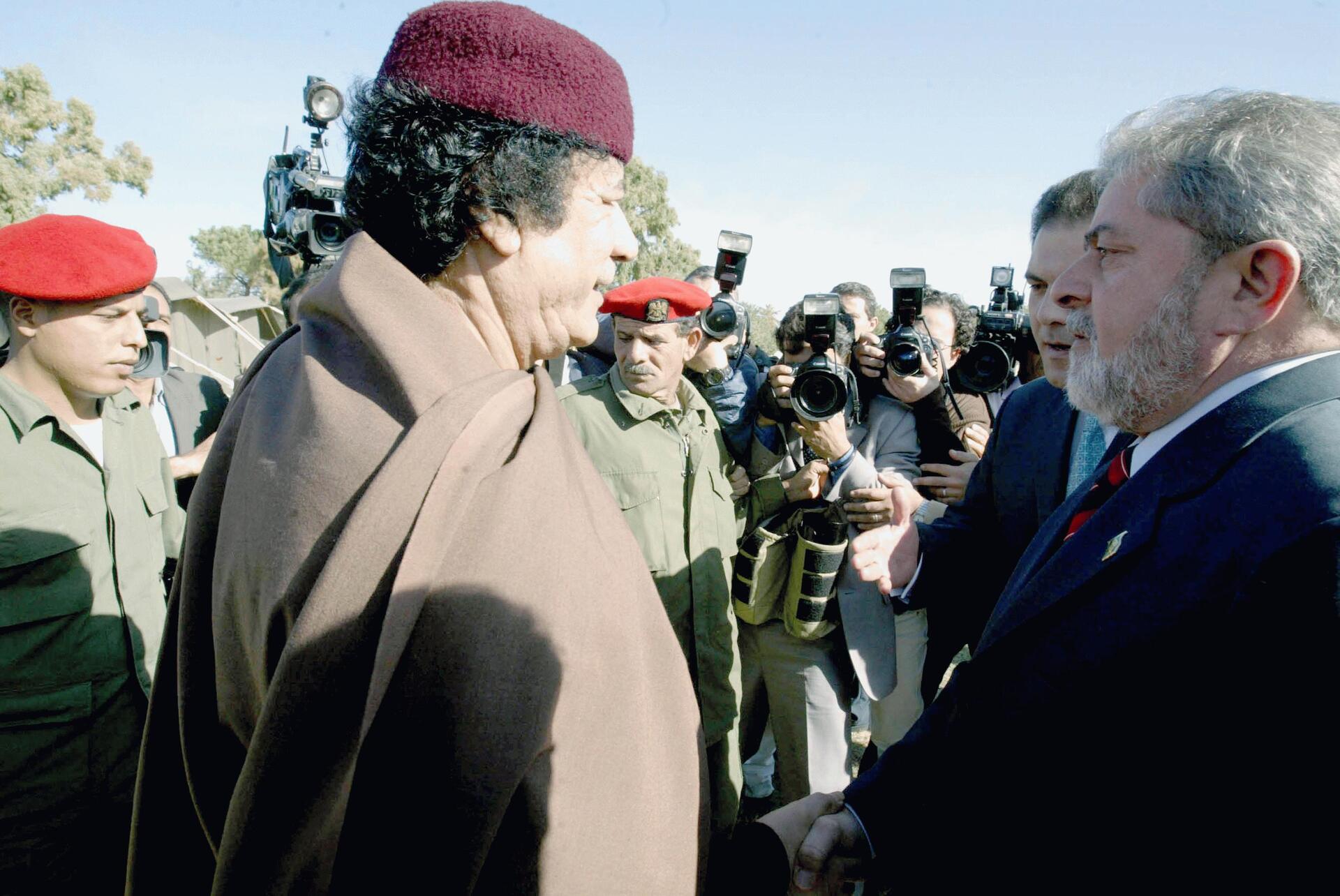
The Bulletin of the Atomic Scientists noted in March 2026 that Trump “wants regime change in Iran,” drawing explicit comparisons to the Libya trajectory. CNN confirmed on February 28, 2026 that the administration had launched a formal regime-change effort. For the IRGC, these are not analytical assessments — they are threat confirmations. A US president publicly pursuing regime change, combined with the Libya precedent, produces a single institutional conclusion: surrendering nuclear and missile capability equals regime termination on a variable timeline.
This is why the 14-point document excludes missiles entirely and defers nuclear items to an undefined Stage 2 that the IRGC has no intention of permitting. The exclusion is not a negotiating position to be bargained upward. It is an institutional survival response rooted in observed precedent. No Iranian president can override it because the conclusion is held by the institution that controls the weapons, not the institution that conducts diplomacy.
Araghchi’s Phone Offensive and the Multilateral Audience
Iran’s response to Trump’s May 2 rejection was not a defiant statement or a military threat from the Foreign Ministry. It was a coordinated phone offensive. Within hours of the “better off without a deal” declaration, Araghchi held calls with Turkey, Egypt, Qatar, Saudi Arabia, Iraq, Azerbaijan, and EU Foreign Policy Chief Kaja Kallas, briefing each on Iran’s “latest initiatives,” according to PBS NewsHour.
The strategy is legible. Iran is constructing a multilateral audience for a specific narrative: Tehran made a reasonable offer, softened its preconditions, and was rejected by an unreasonable United States pursuing regime change rather than negotiation. The audience for this narrative is not Washington — it is the mediating states (Pakistan, Turkey, Egypt), the Gulf stakeholders (Saudi Arabia, Qatar, Oman), and the European powers whose sanctions architecture Trump is trying to reactivate.
Kallas’s office confirmed she spoke with Araghchi on May 2 about “ongoing diplomatic efforts to reopen the Strait of Hormuz and long-term security arrangements.” The EU engagement matters because the US snap-back mechanism for reimposing international sanctions was already spent — the E3 triggered it on August 28, 2025, sanctions were reimposed September 27–28, and the mechanism expired October 18. Secretary Rubio’s April 18 call for the EU to reimpose Iran sanctions therefore asks for escalation beyond the existing framework, not activation of an existing one. Araghchi’s call to Kallas is a counter-move: maintaining European diplomatic engagement as a brake on additional sanctions pressure.
The dual-track structure persists even in the rejection’s aftermath. While Araghchi conducted his phone offensive, a senior Iranian military official — unnamed, but identified as military rather than diplomatic — told ABC News that renewed conflict is “likely.” The use of an unnamed military official as the threat vehicle, simultaneous with the foreign minister’s reassurance calls, is the IRGC-diplomacy architecture operating in its standard mode: diplomats offer, military threatens, and the two tracks run in parallel without formal coordination.
For Saudi Arabia, Araghchi’s inclusion of Riyadh in his post-rejection call list confirms the bilateral channel between Faisal and Araghchi remains active. The Saudi FM received the proposal before Washington and was briefed on the rejection simultaneously with the mediating states. Riyadh is being treated as a stakeholder — but a stakeholder in a process that no longer has a plausible endpoint. Iran’s concurrent move at the UN Security Council — filing a $270 billion counter-reparations claim against Saudi Arabia and five other Arab states for co-belligerence — may have created an unexpected opening in that same deadlocked process.
The 14-point document will be remembered not as a failed peace offer but as the clearest available map of Iran’s internal power structure in wartime. It shows what Pezeshkian controls (sequencing, procedures, diplomatic tone) and what he does not (enrichment, missiles, mines, IRGC force posture). Trump’s rejection confirms the US has read the same map and concluded that the territory the president controls is too small to matter.
Saudi Arabia’s position after May 2 is defined by the intersection of two conclusions it cannot influence. Washington has decided that no achievable deal serves its interests. The IRGC has decided that the items Washington demands — nuclear program, missiles, proxy networks — are existential and non-negotiable. Between those two positions, there is no diplomatic space for a framework that reopens Hormuz and restores Saudi export capacity.
What remains is the steady state: a blockade that both sides enforce from opposite ends, a ceasefire that expired April 22 with no extension mechanism, Saudi production 30 percent below pre-war levels, and a fiscal position balanced on the edge of break-even at $108 Brent. Riyadh has full situational awareness — Faisal has ensured that — but awareness without leverage is surveillance, not strategy. The kingdom’s next move cannot come from inside the US-Iran framework, because that framework no longer exists. It will have to come from outside it.
The 14-point proposal also set a structural clock running: Iran demands the US lift the Arabian Sea blockade within 30 days, an ultimatum that expires June 1–2 — the first days after Hajj pilgrims begin departing, when kinetic action no longer risks mass pilgrim casualties. Iran’s 30-day blockade deadline and the undeliverable June tripwire it creates are examined in full.
Frequently Asked Questions
What are the 14 points in Iran’s Hormuz proposal?
The full text of the 14-point document has not been publicly released as of May 2, 2026. What is confirmed through WSJ and PBS NewsHour reporting: the proposal removes the precondition that the US blockade must end before Hormuz talks begin, defers nuclear negotiations to a second stage, excludes the missile program entirely, and was transmitted via Pakistani mediators on the night of May 1–2. The document’s genealogy traces back through four prior iterations — the 10-point plan (April 7–8), the US 15-point counterproposal, the 45-day ceasefire framework, and Araghchi’s April 28 third draft — each of which narrowed the nuclear and missile language while broadening the Hormuz and sequencing flexibility.
Why is Pakistan the intermediary rather than Oman or Qatar?
Pakistan assumed the mediator role after hosting the Islamabad Accord framework in early April and facilitating the Vance-Ghalibaf face-to-face on April 10 — the first direct US-Iran contact since 1979. Pakistan’s unique position stems from three overlapping roles: it serves as Iran’s protecting power in the United States (since 1992, handling consular functions in the absence of diplomatic relations), it signed the Saudi-Pakistan Mutual Defense Assistance agreement in September 2025, and the 27th Constitutional Amendment concentrated foreign policy authority under Army Chief General Munir rather than the elected government. Pakistan simultaneously owes Saudi Arabia $5 billion in loans maturing June 2026 and maintains Iran’s only state-level communication channel with Washington — a structural leverage position no other mediator holds.
How long would Hormuz mine clearance take if a deal were reached?
Using the 1991 Kuwait mine clearance operation as the benchmark — 200 square miles cleared over approximately 51 days — a comparable Hormuz operation faces a critical capacity gap. The US Navy decommissioned four Avenger-class mine countermeasure ships from Bahrain in September 2025, leaving only two MCM vessels in theater. At reduced capacity, Pentagon planners have estimated six months minimum for post-deal clearance even under cooperative conditions. During that period, Hormuz transit would remain restricted regardless of any diplomatic agreement, meaning the gap between a signed deal and restored shipping capacity would extend well into 2027.
Has the EU snap-back sanctions mechanism been exhausted?
Yes. The E3 (UK, France, Germany) triggered the UN snap-back mechanism on August 28, 2025. International sanctions were reimposed on September 27–28, 2025. Russia and China attempted a counter-resolution to extend the JCPOA framework but failed — that procedural endpoint arrived October 18, 2025. Secretary Rubio’s April 18, 2026 call for EU sanctions reimposition therefore asks European governments to impose additional national or EU-level sanctions beyond the UN framework, which requires new political consensus rather than activation of an existing mechanism. This is substantively different from snap-back and faces resistance from EU member states maintaining commercial ties with Iran through humanitarian and energy exemptions.
What is the Maritime Freedom Construct and does it have international support?
The Maritime Freedom Construct is a US-proposed multinational naval force framework for securing Hormuz transit without an agreement with Iran. The State Department circulated a cable to embassies in late April and early May 2026 urging governments to join. As of May 2, no country has publicly committed forces to the framework. The construct would require participating navies to escort commercial vessels through both the US-controlled Arabian Sea checkpoint and the IRGC-controlled Gulf of Oman passage — a dual-authorization corridor that makes unilateral naval escort operationally complex. Historical precedent is the 1987–88 Operation Earnest Will tanker convoy escorts, which operated under different conditions: a single-sided Iranian threat rather than the current double blockade architecture.
That operational uncertainty sharpened on May 2 when IRGC deputy commander Asadi issued an on-record warning via Fars News that renewed Iran-US conflict is “likely” — the most senior public war threshold statement from Iran’s apex joint command since the ceasefire.
Iran’s decision to publish the rejected sequencing terms — surfacing Washington’s “no” within 24 hours of receiving it — is examined in depth in Iran Told Everyone Washington Rejected the Hormuz Deal — Because the Rejection Was the Product, which traces how the disclosure functioned as a blame-assignment mechanism rather than a diplomatic escalation.
Washington’s public counter-architecture to Iran’s 14-point proposal — Trump’s dismantlement demand as a coercive floor, Witkoff’s back-channel as the actual negotiating track, and Saudi Arabia’s exposure to the timeline mismatch between them — is documented in Trump’s Two Iran Tracks Run on American Time, Not Riyadh’s. The proposal’s demand that China and Russia serve as enforcement guarantors gained a live test on May 6, when Araghchi arrived in Beijing eight days before Trump to ask Wang Yi precisely that question — and to discover whether the Blocking Rules invocation four days earlier meant anything beyond a sovereignty declaration.
The US MOU’s acceptance of Hormuz-first sequencing — and why that acceptance structurally transforms the 14-point framework from a negotiating document into an IRGC authorization mechanism — is analysed in Washington’s Hormuz-First Concession Hands the IRGC a Structural Veto Over Nuclear Talks.
What Araghchi secured from Wang Yi during that May 6 meeting — and how Iran used Beijing to lock China into a Hormuz reopening narrative that excluded Saudi Arabia from its drafting — is detailed in Araghchi Went to Beijing to Write Trump’s Talking Points Before Riyadh Got the Memo.
The House of Saud Daily Briefing
Saudi Arabia's news in 3 minutes, every morning. Free. See today's issue