Iran’s de facto blockade of the Strait of Hormuz has cut maritime traffic through the world’s most critical oil chokepoint by 70%, trapping an estimated 20 million barrels per day of crude supply behind a wall of cancelled insurance policies, anchored tankers, and the explicit threat of Iranian naval force. For Saudi Arabia, which ships approximately 7.5 million barrels per day — the majority through Hormuz — this is not a disruption. It is an existential test of the Kingdom’s energy infrastructure, its pipeline alternatives, and the financial architecture of Vision 2030 itself.
The blockade, now entering its third day alongside the US-Israeli strikes that killed Supreme Leader Khamenei, has already sent Brent crude up 8.48% to $79.05 per barrel. Analysts expect prices to breach $85-90 when markets open Monday. If the blockade holds through the week, triple-digit oil is not a forecast — it is arithmetic.
What Is Happening at the Strait of Hormuz Right Now?
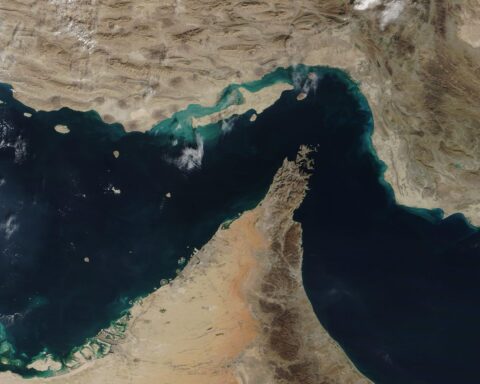
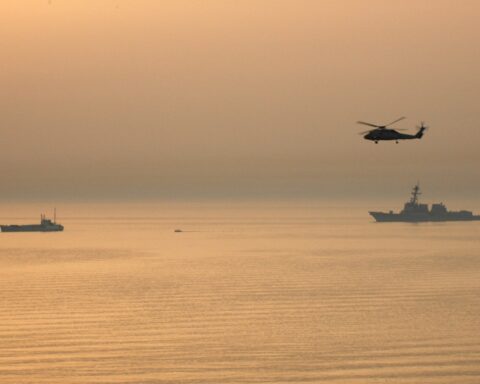
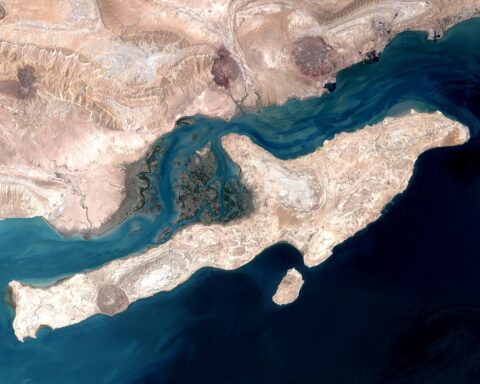
Iran has declared that no ship is allowed to pass through the Strait of Hormuz, effectively imposing a maritime blockade on the 21-mile-wide corridor that connects the Persian Gulf to the open ocean. Ship-tracking data shows traffic has dropped approximately 70% since the declaration, with over 150 vessels now anchoring outside the strait rather than attempting transit.
The only ships still moving through are Iranian-flagged and Chinese-flagged vessels. Every other maritime nation has pulled back. Marine insurers have cancelled war risk coverage for the zone entirely, and where policies remain available, premiums have surged 50%. German shipping giant Hapag-Lloyd has imposed a War Risk Surcharge of $1,500 to $3,500 per container for any cargo routed through or near the strait.
This is not a partial disruption or a theoretical threat. The strait is functionally closed to commercial traffic. The last time anything approaching this level of disruption occurred was during the 1987-88 Tanker War, when Iran mined portions of the waterway during the Iran-Iraq War and the United States launched Operation Earnest Will to escort reflagged Kuwaiti tankers through the danger zone. But even during that conflict, traffic never dropped 70%. The 2019 tanker attacks attributed to Iran — which struck the Japanese-owned Kokuka Courageous and the Norwegian-owned Front Altair — caused temporary alarm but no sustained blockade.
The Middle East briefing 3,000+ readers start their day with.
One email. Every weekday morning. Free.
What is happening now has no modern precedent.
How Much Saudi Oil Is Trapped Behind the Blockade?
Saudi Arabia exports roughly 7.5 million barrels of crude oil per day. The majority of those exports load at terminals along the Kingdom’s Eastern Province coast — Ras Tanura, the world’s largest offshore oil loading facility, and Ju’aymah — both of which feed directly into the Persian Gulf and require transit through the Strait of Hormuz to reach global markets.
Two weeks later, the IEA confirmed the worst: the Hormuz closure had become the largest oil supply disruption in recorded history, with global output plunging 8 million barrels per day and 500 tankers stranded in the Gulf.
At current export rates, every day the strait remains closed costs Saudi Arabia approximately $590 million in gross crude revenue at $79 per barrel. If prices reach the $100 mark that multiple analysts now consider probable by midweek, the daily revenue at stake rises to $750 million — revenue that funds the sovereign wealth fund, underwrites the NEOM megaproject, and services the Kingdom’s growing debt obligations tied to Vision 2030 infrastructure.
But the blockade does not merely delay revenue. It disrupts the intricate logistics chain that connects Saudi crude to refineries in Japan, South Korea, India, and Europe. Tankers that cannot transit Hormuz cannot load at Eastern Province terminals. Storage fills up. Production must eventually be curtailed if there is nowhere to put the oil. Saudi Aramco’s tank farms at Ras Tanura hold significant strategic reserves, but they are not infinite. If the blockade persists beyond seven to ten days, production cuts become unavoidable — regardless of OPEC+ agreements or Saudi policy preferences. The consequences for Europe are especially severe — the Hormuz closure has handed Saudi Arabia unprecedented energy leverage over the continent, with European gas storage at its lowest level in a decade.
The scale of Asia’s vulnerability to the Hormuz closure is staggering — India, Japan, South Korea, and China together face the worst energy crisis in half a century, with some nations holding reserves measured in days rather than months.
Can Saudi Arabia Bypass Hormuz Through the East-West Pipeline?
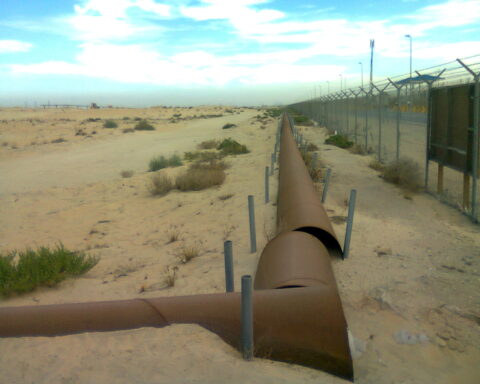
Saudi Arabia possesses one critical piece of infrastructure that no other Gulf state has: the East-West Pipeline, also known as the Petroline. This 1,200-kilometer pipeline runs from the oil fields of the Eastern Province across the Arabian Peninsula to the port of Yanbu on the Red Sea coast, bypassing the Strait of Hormuz entirely. Its rated capacity is approximately 5 million barrels per day.
In theory, this pipeline is precisely the strategic insurance policy it was designed to be when first constructed in 1981, during the Iran-Iraq War, for exactly this scenario. Crown Prince Mohammed bin Salman has repeatedly cited Saudi Arabia’s pipeline infrastructure as evidence of the Kingdom’s strategic resilience.
In practice, the calculus is far more complicated.
First, the pipeline’s 5-million-barrel-per-day capacity cannot replace the full 7.5 million barrels per day that Saudi Arabia exports. Even at maximum throughput, 2.5 million barrels per day remain stranded. Second, the pipeline does not operate at maximum capacity under normal conditions; actual throughput depends on maintenance schedules, the grade of crude being shipped, and the receiving capacity at Yanbu’s terminals. Ramping to full capacity takes days, not hours.
Third — and this is the factor that transforms a manageable crisis into a potentially catastrophic one — the Red Sea is not safe either.
Why Is the Red Sea Route Under Threat Too?
Yemen’s Houthi movement, which has been conducting strikes on Red Sea shipping since late 2023, is now preparing to escalate in direct response to the US-Israeli strikes on Iran. Multiple intelligence assessments indicate that the Houthis are positioning to effectively close the Bab el-Mandeb strait — the 20-mile-wide chokepoint at the southern entrance to the Red Sea through which all Yanbu-loaded tankers must pass to reach European and Asian markets via the Suez Canal.
Commercial shipping that had tentatively begun returning to Red Sea routes in early 2026 has now shelved those plans indefinitely. The insurance market that was already stretched to breaking point over Hormuz has no remaining capacity to underwrite Red Sea transits. A tanker loaded at Yanbu that cannot safely pass Bab el-Mandeb is a tanker that cannot reach its destination — unless it rounds the entire African continent via the Cape of Good Hope, adding 10 to 14 days and millions of dollars in fuel and charter costs to every voyage.
The disruption to Suez Canal traffic has placed enormous pressure on Egypt, which depends on canal tolls for a significant share of its foreign currency revenue. Yet Cairo has refused to be drawn into the conflict, calculating that Egypt’s calculated neutrality — however costly in the short term — is preferable to the economic devastation that direct involvement would bring.
This creates what maritime analysts are calling the double chokepoint scenario: both of Saudi Arabia’s maritime export routes — Hormuz to the east and Bab el-Mandeb to the west — closed or functionally impassable simultaneously. This has never happened before in modern history. Not during the 1973 oil embargo. Not during the Iran-Iraq War. Not during the Gulf War of 1990-91.
If both chokepoints close, Saudi Arabia’s only remaining export option is pipeline delivery to Yanbu for tankers willing to take the Cape route — at vastly reduced volumes, vastly increased costs, and vastly extended delivery times. The Kingdom’s position as the world’s swing producer — the reliable supplier that keeps global markets stable — would be functionally suspended. For a deeper look at the pipeline’s actual capacity, terminal bottlenecks, and what Aramco’s emergency Red Sea pivot means for Asian crude buyers, read our full analysis of Aramco’s East-West Pipeline lifeline.
What Does the Insurance Market Collapse Mean for Gulf Shipping?
The marine insurance market is the invisible infrastructure of global trade. No ship sails without coverage. When insurers withdraw, shipping stops — regardless of whether a single missile has been fired at a single vessel.
As of March 2, 2026, the insurance market for Persian Gulf and Red Sea transits has effectively seized up. War risk premiums — the additional coverage required for vessels entering conflict zones — have surged 50% for the few policies still available. Most major underwriters at Lloyd’s of London have simply cancelled coverage outright. A tanker owner who sends an uninsured vessel through the strait risks not just the ship and its crew, but the entire cargo — potentially $150 million or more of crude oil per VLCC (Very Large Crude Carrier).
Hapag-Lloyd’s War Risk Surcharge of $1,500 to $3,500 per container is the visible tip of a much larger cost structure. That surcharge applies to container shipping — consumer goods, manufactured products, food — the same goods that Gulf states depend on imports for 85 percent of their consumption, creating a civilian food security crisis that compounds the energy supply shock. For bulk commodities like crude oil, the cost multiplier is even more severe. Charterers report that war risk premiums for VLCCs transiting the Gulf have jumped from approximately 0.1% of hull value to effectively unquotable in 72 hours. The full scope of Saudi Arabia’s food security crisis is examined in a dedicated analysis of Saudi Arabia’s food security crisis.
The insurance collapse creates a self-reinforcing cycle. Ships stop transiting because they cannot get coverage. Because ships stop transiting, the risk assessment worsens. Because the risk assessment worsens, premiums rise further. Breaking this cycle requires either a military escort guarantee — as the United States provided during Operation Earnest Will in 1987-88 — or the removal of the underlying threat. Neither appears imminent. The parallels to the 1980s are unmistakable, but the scale is far greater — what is unfolding now is a Second Tanker War in which Iran’s mines and missiles have achieved what eight years of the original conflict could not: the complete shutdown of the world’s most important shipping lane.
How Does This Compare to Previous Strait of Hormuz Crises?
The current blockade is, by every measurable metric, the most severe disruption to Strait of Hormuz traffic in history. A direct comparison with previous crises makes the scale clear.
| Crisis | Year | Traffic Impact | Duration | Oil Price Impact |
|---|---|---|---|---|
| Iran-Iraq War (Tanker War phase) | 1987-88 | ~15-20% reduction | ~14 months | Moderate; offset by Saudi spare capacity |
| Iranian mine-laying incidents | 1987 | Temporary; US Navy cleared mines | Weeks | Spikes of 5-10% |
| Tanker attacks (Kokuka Courageous, Front Altair) | 2019 | Minimal; traffic continued | Days | Brief 4% spike |
| Abqaiq-Khurais drone/missile attack | 2019 | None (attacked production, not shipping) | Weeks to restore production | 15% spike, recovered within two weeks |
| Current Hormuz blockade | 2026 | ~70% reduction | Ongoing (Day 3) | 8.48% and rising; $100+ expected |
During the 1987-88 Tanker War, the United States deployed a naval task force to escort reflagged Kuwaiti tankers through the strait under Operation Earnest Will. That operation required months of diplomatic negotiation, the physical reflagging of Kuwaiti vessels under the American flag, and the deployment of warships and minesweepers. It was effective — but it took time, and the geopolitical context was different. Iran in 1987 was fighting an eight-year war of attrition with Iraq and had limited capacity to sustain a full blockade.
Iran in 2026, despite the decapitation strike that killed Khamenei, retains significant naval assets in the Persian Gulf: fast attack craft, anti-ship missiles, submarine-launched mines, and shore-based missile batteries along the Iranian coastline that overlooks the strait. The IRGC Navy has spent decades preparing for exactly this scenario. The narrow geography of Hormuz — 21 miles wide, with shipping lanes only two miles across — means that even a degraded Iranian military can pose a credible threat to commercial traffic. These naval capabilities are part of Tehran’s complete offensive weapons inventory, which extends far beyond the strait into every theatre of the current conflict.
What Is the Global Economic Fallout?
The Strait of Hormuz carries approximately 20 million barrels of oil per day — roughly 20% of the world’s total petroleum supply. Removing that volume from global markets, even partially, triggers price effects that cascade through every sector of the global economy.
Brent crude has already risen 8.48% to $79.05 per barrel as of Sunday trading. Analysts at major banks expect prices to open between $85 and $90 when full trading resumes Monday. Oxford Economics estimates that if crude sustains at $100 per barrel, the impact adds 0.6 to 0.7 percentage points to global inflation — a figure that sounds modest in isolation but represents hundreds of billions of dollars in additional costs borne by consumers, manufacturers, and governments worldwide. As our earlier analysis detailed, the energy price shock from this conflict was already severe before the blockade began. The blockade transforms a price shock into a potential supply crisis.
The effects extend far beyond crude oil. Liquefied natural gas (LNG) from Qatar — the world’s largest LNG exporter — also transits Hormuz. Petrochemical feedstocks, refined products, and fertilizer precursors that sustain agriculture across three continents all flow through the strait. Japan imports approximately 80% of its crude through Hormuz. South Korea imports roughly 70%. India imports about 60%. For these economies, a sustained blockade is not an inconvenience — it is an energy emergency that threatens industrial output, electricity generation, and food production. The blockade also compounds Saudi Arabia’s acute water vulnerability — the Kingdom produces 70 percent of its drinking water from desalination plants clustered along the Gulf coast, and any disruption to these facilities would create a humanitarian crisis within 72 hours.
Container shipping is affected in parallel. The $1,500-$3,500 per container surcharge imposed by Hapag-Lloyd will be passed directly to consumers in the form of higher prices for everything from electronics to clothing to food. Supply chains that were only just recovering from the Houthi-driven Red Sea disruptions of 2024-2025 now face a second, simultaneous chokepoint closure.
What Does This Mean for Saudi Aramco and Vision 2030?
Saudi Aramco, the world’s most valuable energy company and the financial engine of the Saudi state, faces a direct threat to its operational and financial planning. The company’s ability to deliver crude to customers on schedule — the foundational promise of its commercial relationships — is now in question for the first time since the 2019 Abqaiq-Khurais attacks temporarily knocked out 5.7 million barrels per day of production.
The difference is that Abqaiq was a supply-side shock: production was hit, but export routes remained open, and Saudi Aramco restored output within weeks. The OPEC+ wartime decision to boost output further complicates the picture, adding barrels to a market that cannot physically move them through the strait. The Hormuz blockade is a demand-delivery shock: oil is being produced but cannot reach buyers. This distinction matters because it affects not just revenue but contractual obligations, customer confidence, and the long-term pricing power that underpins Aramco’s valuation.
Vision 2030, Crown Prince Mohammed bin Salman’s economic diversification program, depends on sustained oil revenue to fund its transition away from oil dependence — a paradox that the current crisis makes painfully literal. The Public Investment Fund (PIF), which finances NEOM, The Line, and dozens of other megaprojects, derives the majority of its capital from Aramco dividends and government oil revenue transfers. Every day that exports are disrupted is a day that PIF’s funding pipeline narrows.
Further Aramco share offerings — a key element of the Kingdom’s strategy to raise non-oil capital — become significantly harder to execute in a market environment where the company’s core business faces the most severe logistical threat in its history. Institutional investors do not buy into uncertainty of this magnitude, regardless of the underlying asset quality.
What Are Saudi Arabia’s Military and Strategic Options?
Saudi Arabia’s immediate military posture is defensive. The Kingdom confirmed that Iranian missiles targeted Prince Sultan Air Base and King Khalid International Airport in Riyadh during the initial retaliatory strikes, but stated that all incoming projectiles were intercepted. The Saudi air defense network — anchored by Patriot PAC-3 batteries and supplemented by the THAAD system — appears to have performed as designed.
But defending against ballistic missiles is a different challenge than reopening a maritime chokepoint. Saudi Arabia does not have the naval capacity to independently guarantee safe passage through the Strait of Hormuz. That task falls to the United States Fifth Fleet, based in Bahrain, and whatever multinational coalition can be assembled.
The Kingdom’s strategic options break down along three axes.
Pipeline maximization. Ramping the East-West Pipeline to its full 5-million-barrel-per-day capacity is the fastest actionable step. Even with the Red Sea threat, tankers loading at Yanbu can potentially reach markets via the Cape of Good Hope route, albeit at sharply increased cost and time. Every barrel moved through the pipeline is a barrel that does not need to cross Hormuz.
Diplomatic engagement. Saudi Arabia has historically maintained back-channel communication with Iran, even during periods of extreme tension. The 2023 China-brokered normalization agreement demonstrated that both nations prefer managed competition to open conflict. Yet Beijing’s response to the current crisis — prioritising its own energy security over solidarity with Tehran — suggests the limits of Chinese mediation when American military power is deployed. Whether those channels remain viable after the death of Khamenei and amid active military operations is uncertain — but the Kingdom has strong incentive to try.
Coalition coordination. Saudi Arabia’s security relationship with the United States is the bedrock of its external defense posture. A modern-day Operation Earnest Will — US naval escorts for commercial shipping through the strait — is the most plausible path to reopening the waterway. But that requires American political will, sufficient naval assets in theater, and a willingness to risk direct confrontation with whatever remains of Iran’s IRGC Navy.
How Long Can Saudi Arabia Sustain an Export Disruption?
Saudi Arabia maintains substantial fiscal reserves, but those reserves are calibrated against a particular set of assumptions — none of which included a simultaneous closure of both the Strait of Hormuz and the Bab el-Mandeb.
The Kingdom’s foreign exchange reserves stood at approximately $430 billion as of late 2025. Government spending commitments for 2026 — including Vision 2030 capital expenditure, military procurement, public sector salaries, and social subsidies — were budgeted against an assumed oil price of approximately $78-80 per barrel and uninterrupted export flows. If exports drop by even 30% for a sustained period, the fiscal math breaks.
Higher oil prices partially offset lower volume — Saudi Arabia earns more per barrel even as it sells fewer barrels — but only up to a point. A barrel that cannot be loaded onto a tanker generates zero revenue regardless of its notional price. And the Kingdom’s customers are not obligated to wait indefinitely. Asian refiners who cannot receive Saudi crude will turn to alternative suppliers — the United States, Brazil, Guyana, West Africa — creating market share losses that may persist long after the strait reopens.
The Strategic Petroleum Reserve (SPR) releases that consuming nations will inevitably announce provide temporary relief on the demand side but do nothing to solve Saudi Arabia’s export logistics. The problem is not a shortage of oil in the world. It is a blockage in the primary artery through which Gulf oil reaches the world.
What Happens Next?
The next 72 to 96 hours will determine whether this crisis remains a severe but manageable disruption or escalates into the worst energy supply emergency since the 1973 Arab oil embargo.
Three triggers to watch.
Monday market open. Brent crude’s response when full trading resumes will signal how the global market prices the probability of a sustained blockade. A move above $90 suggests that traders see this lasting weeks, not days. A move above $100 suggests months.
Houthi action at Bab el-Mandeb. If the Houthis follow through on threats to close the Red Sea chokepoint, the double blockade scenario becomes reality. Saudi Arabia’s pipeline bypass becomes functionally useless for reaching European and East Asian markets at competitive cost and speed. This is the scenario that energy strategists describe as the worst case — and it is now plausible rather than theoretical.
US naval response. The US Fifth Fleet and any additional carrier strike groups deployed to the region have the firepower to contest the blockade, but force alone does not reopen shipping lanes. Mine clearance, sustained escort operations, and the restoration of insurance market confidence all take time. During Operation Earnest Will, it took months to establish a reliable escort regime. The US military may not have months.
For Saudi Arabia, this crisis arrives at the worst possible moment. The Kingdom is simultaneously managing the direct military threat from Iranian missile strikes, the collapse of the diplomatic normalization it had painstakingly built with Tehran, the financial stress of declining export volumes on Vision 2030 commitments, and the strategic reality that its most valuable asset — the ability to supply the world with oil on demand — is now hostage to a 21-mile stretch of water that it does not control.
The Strait of Hormuz has always been Saudi Arabia’s greatest vulnerability. For decades, that vulnerability was theoretical. As of March 2, 2026, it is not.
FAQ
Is the Strait of Hormuz fully closed to all shipping?
Not technically, but functionally yes for most commercial traffic. Iran has declared that no ships are permitted to pass, and ship-tracking data confirms a 70% drop in transits. Only Iranian-flagged and Chinese-flagged vessels continue to move through. The cancellation of war risk insurance by major underwriters means that even vessels physically capable of transiting cannot do so without exposing their owners to uninsured losses potentially exceeding $150 million per voyage.
How much oil passes through the Strait of Hormuz daily?
Under normal conditions, approximately 20 million barrels of crude oil per day transit the Strait of Hormuz, representing roughly 20% of global petroleum supply. In addition to crude oil, significant volumes of liquefied natural gas from Qatar, refined petroleum products, and petrochemical feedstocks pass through the same corridor. Saudi Arabia alone accounts for approximately 7.5 million barrels per day of that flow.
Can Saudi Arabia export oil without using the Strait of Hormuz?
Partially. The East-West Pipeline (Petroline) can move up to 5 million barrels per day from the Eastern Province to Yanbu on the Red Sea, bypassing Hormuz entirely. However, this covers only about two-thirds of Saudi Arabia’s total export volume, and the Red Sea route itself faces threats from Houthi forces at the Bab el-Mandeb strait. If both chokepoints are blocked, tankers loading at Yanbu must take the far longer and costlier route around the Cape of Good Hope.
What happened during the last major Strait of Hormuz crisis?
The most severe previous disruption was the 1987-88 Tanker War during the Iran-Iraq conflict, when Iran mined the strait and attacked commercial tankers. The United States responded with Operation Earnest Will, escorting reflagged Kuwaiti tankers through the waterway. Traffic was reduced by an estimated 15-20% at peak disruption — far less than the 70% decline observed in the current crisis. The 2019 tanker attacks caused brief alarm but no sustained disruption.
How high could oil prices go if the blockade continues?
Brent crude has already risen 8.48% to $79.05 per barrel. Analysts project $85-90 at Monday’s market open, with $100 or higher considered likely if the blockade persists through the week. Oxford Economics estimates that sustained $100 oil adds 0.6-0.7 percentage points to global inflation. If the double chokepoint scenario materializes — Hormuz and Bab el-Mandeb both closed — some energy analysts have modeled prices reaching $120-150, levels not seen since the 2008 spike.
The Hormuz closure has forced Aramco into an unprecedented logistical pivot, redirecting millions of barrels through the East-West Pipeline to the Red Sea port of Yanbu. A detailed analysis of Aramco’s emergency rerouting plan and the four scenarios for Saudi export capacity reveals the scale of the challenge facing the world’s largest oil company.
That emergency reroute unfolded at a pace no energy analyst predicted. Within eleven days of the blockade, Saudi Arabia had effectively relocated its oil export centre of gravity from the Persian Gulf to the Red Sea — a wartime energy pivot that moved seven million barrels to the Red Sea and redefined the Kingdom’s relationship with its own pipeline infrastructure.