Table of Contents
- Pioneer and Chief Head West
- The Mine Clearance Gap Since September 2025
- Why Do Wooden-Hulled Ships From 1992 Matter More Than New LCS?
- IRGC Seizes Two Ships Hours After Ceasefire Extension
- What Does Iran’s Mine Arsenal Look Like?
- The Closing Window
- Background: The $1,000 Mine and the $250 Million Repair Bill
- Frequently Asked Questions
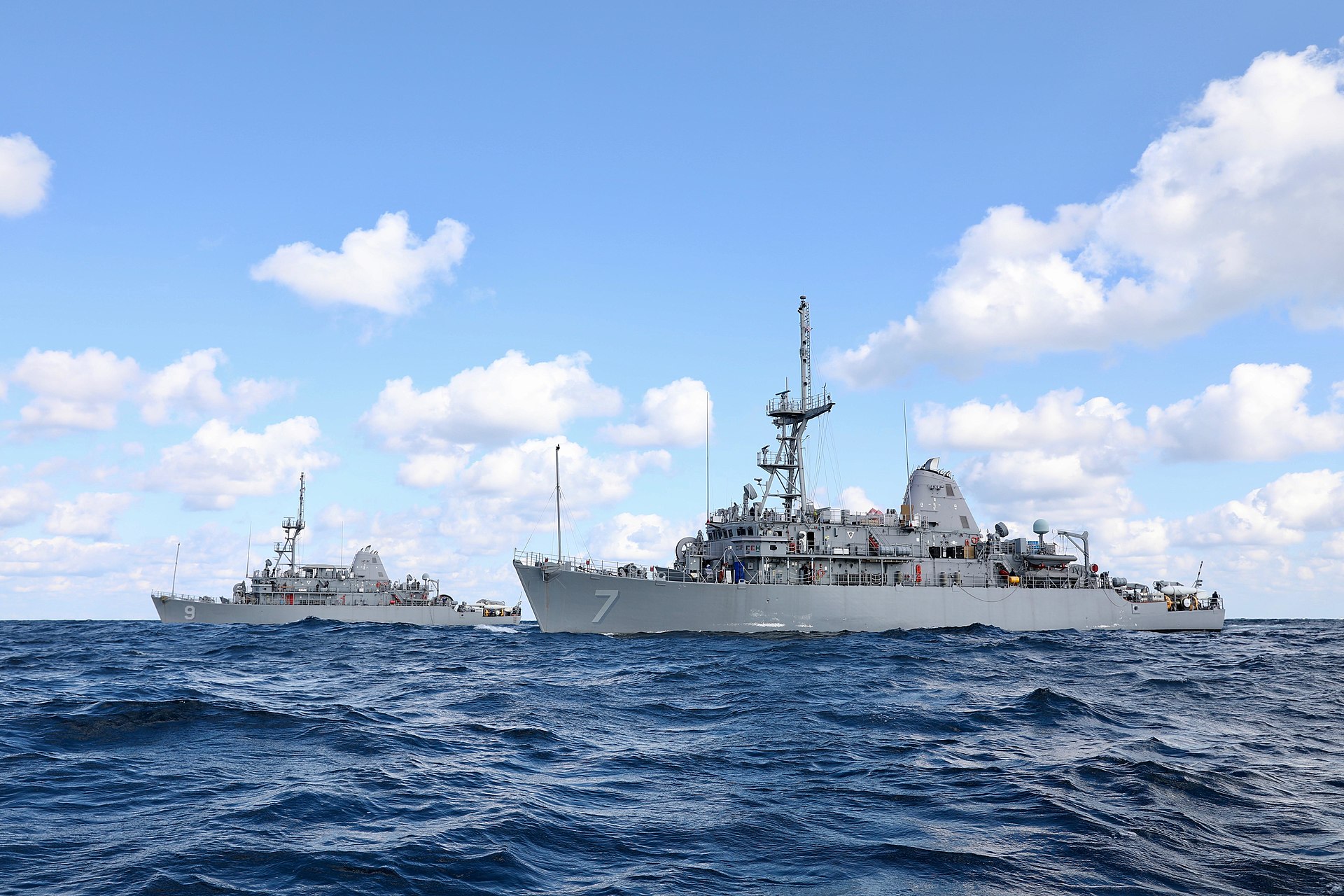
WASHINGTON — Two U.S. Navy mine countermeasures ships — USS Pioneer (MCM-9) and USS Chief (MCM-14) — are transiting the Indian Ocean toward the Persian Gulf, closing a mine-clearing capability gap that has persisted since the Navy decommissioned its four Bahrain-based Avenger-class ships in September 2025. Their arrival, expected between April 22 and April 27, comes as the IRGC seized two commercial vessels in the Strait of Hormuz on April 22 and Brent crude crossed $100 per barrel for the first time since the war’s opening days.
The convergence is not coincidental. Pioneer and Chief represent half the U.S. Navy’s entire remaining Avenger-class fleet — four ships total, all homeported at Sasebo Naval Base, Japan. Their deployment to CENTCOM’s area of responsibility, first reported by Stars and Stripes on April 16, restores a dedicated mine-hunting capability the Navy has lacked in the Gulf for seven months. In that interval, Iran’s control over Hormuz has rested in part on the knowledge that the U.S. had no purpose-built ships to clear the mines the IRGC has threatened to lay.
The IRGC’s seizure of MSC Francesca and Epaminondas on April 22 — hours after President Trump extended the ceasefire indefinitely at Pakistan’s request — suggests Tehran is asserting facts on the water before that clearance capability becomes operational.
Pioneer and Chief Head West
Pioneer (commissioned 1992) and Chief (commissioned 1994) arrived in Singapore on April 8 and departed April 10, heading west through the Strait of Malacca, according to Stars and Stripes. A resupply stop near Phuket followed around April 14. By April 16, both were formally reported en route to CENTCOM.
The transit math is straightforward. Singapore to Bahrain covers approximately 3,500 to 4,000 nautical miles. Avenger-class ships sustain 10 to 12 knots. That places arrival between April 22 and April 27 — a window that opened the same day the IRGC acted in the strait.
The USS Boxer Amphibious Ready Group — Boxer (LHD-4), Portland (LPD-27), and Comstock (LSD-45), carrying the 11th Marine Expeditionary Unit with approximately 2,500 Marines and F-35B Lightning II jets — was still transiting the Indo-Pacific near Guam as of April 20, according to the USNI News Fleet Tracker. Theater arrival is expected by end of April. The Boxer ARG would provide the escort and air-defense umbrella under which Pioneer and Chief would operate inside mined waters. The multinational dimension of that escort mission gained new complexity on April 22, when a 30-nation conference at Northwood PJHQ co-chaired by Britain and France began planning a parallel armed convoy and mine-clearance architecture for the strait — one that notably did not include Saudi Arabia.
The Middle East briefing 3,000+ readers start their day with.
One email. Every weekday morning. Free.
The Mine Clearance Gap Since September 2025
On September 25, 2025, the Navy decommissioned USS Devastator (MCM-6), USS Dextrous (MCM-13), USS Gladiator (MCM-11), and USS Sentry (MCM-3) at Naval Support Activity Bahrain, ending more than 30 years of continuous forward-deployed mine countermeasures presence in the Gulf, as reported by USNI News. The four ships were replaced by three Littoral Combat Ships: USS Canberra (LCS-30), USS Santa Barbara (LCS-32), and USS Tulsa (LCS-16).
The swap was not like-for-like. Avenger-class ships have wooden hulls sheathed in fiberglass — a construction choice driven by mine warfare’s foundational requirement: the ship hunting the mine cannot itself trigger it. Wood and fiberglass produce a near-zero magnetic signature, allowing Avengers to enter mine-infested waters directly. LCS hulls are aluminum. They must remain outside the mine field and deploy stand-off systems — unmanned vehicles and helicopter-towed sensors — to do the work.
The Pentagon’s testing office delivered its verdict in March 2026, as reported by Navy Times on April 1: it could not determine the reliability or effectiveness of the LCS mine countermeasures mission package. The MH-60S helicopter counter-mine system “demonstrated low reliability prior to fleet release.” The unmanned surface vehicle was found “not operationally suitable.” Emma Salisbury, a researcher at the Foreign Policy Research Institute and the Royal Navy Strategic Studies Centre, wrote that sensors aboard these systems are “ineffective in turbid, shallow waters” — a description that applies to much of the Persian Gulf and nearly all of the Strait of Hormuz.
The institutional roots run deeper. Salisbury identified the 2006 dismantlement of Mine Warfare Command, or MineWarCom, as “the institutional blow” from which U.S. mine countermeasures capability never recovered. MineWarCom had been the central organization sustaining MCM doctrine, training, and procurement advocacy. Its elimination removed the bureaucratic champion for a mission the Navy has historically treated as a lesser priority — until mines are in the water.
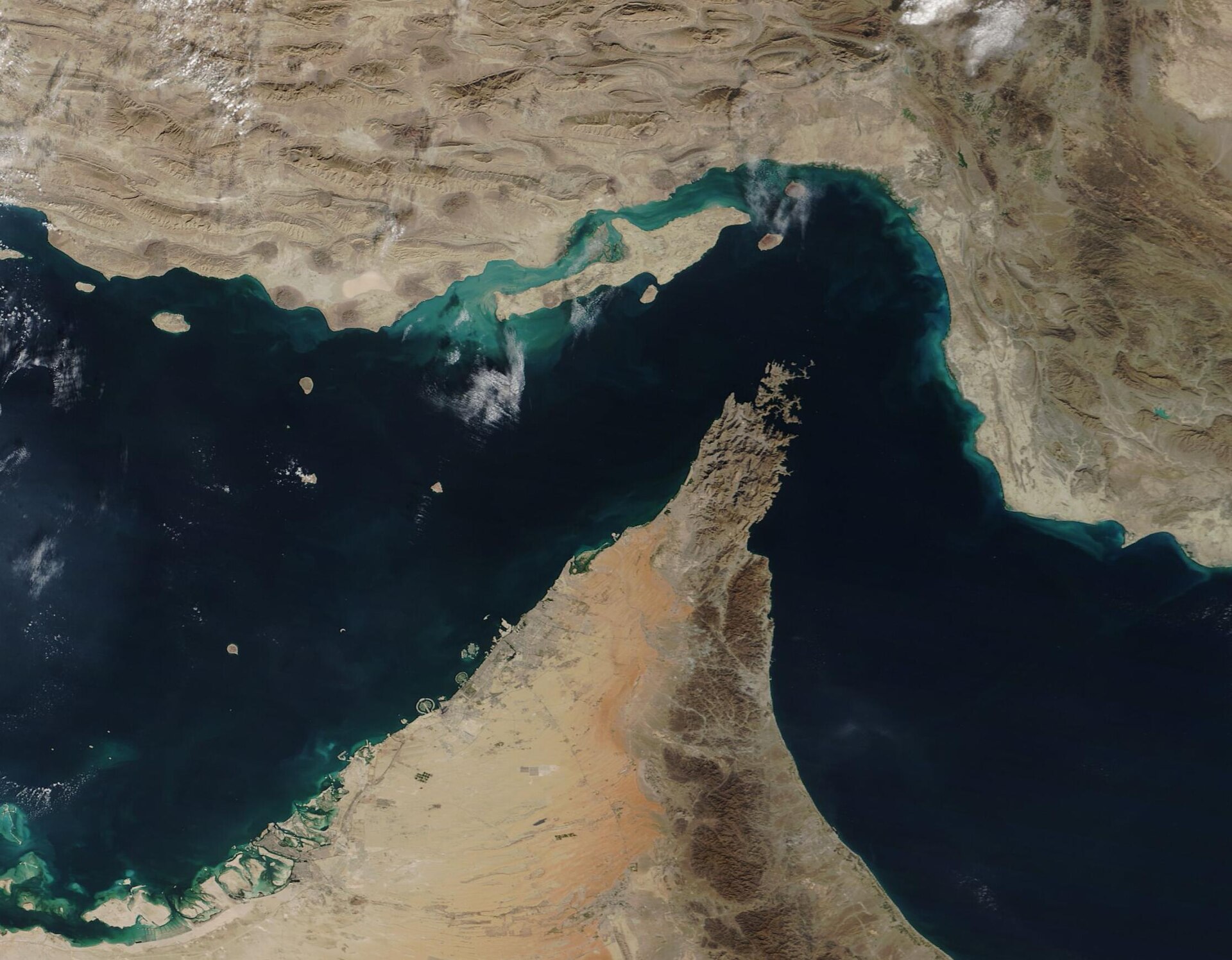
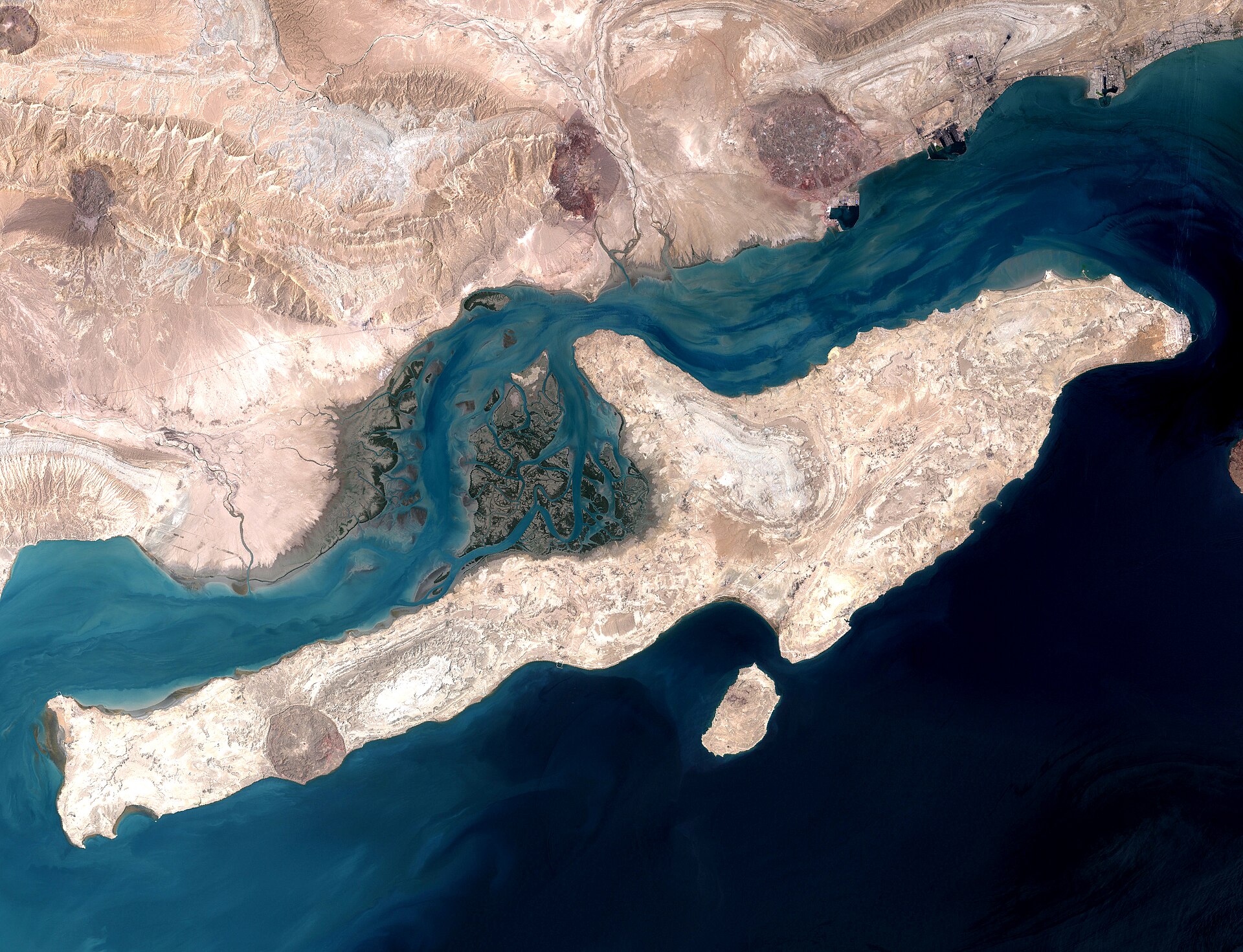
The IRGC published a chart between February 28 and April 9 marking the standard Hormuz shipping lanes as a danger zone, redirecting vessels into a five-nautical-mile channel between Qeshm and Larak islands inside Iranian territorial waters. The 1991 Kuwait mine clearance operation — using four Avenger-class ships to clear approximately 200 square miles — took 51 days, according to Jane’s. That benchmark has defined the mine threat’s temporal dimension throughout this crisis: even if the U.S. decided to clear the strait, it would take nearly two months with the ships it no longer had in theater.
Pioneer and Chief change that arithmetic. Not immediately — they will need to integrate with theater forces, receive operational briefings, and potentially coordinate with the Boxer ARG for escort — but their presence restores a capability whose absence Iran has exploited since September.
Why Do Wooden-Hulled Ships From 1992 Matter More Than New LCS?
The question carries its own answer in the procurement history. Chief of Naval Operations Adm. Daryl Caudle told Navy Times on April 1 that “purpose-built ships are still the best answer for dedicated mine warfare.” He also defended the LCS package, saying “when the capability embarked on an LCS is full up, it’s a very, very good package.” The qualifier — “full up” — is the problem. The Pentagon’s testing office found that it is not full up, and may not be for years.
Bryan Clark, a naval analyst at the Hudson Institute, told Jane’s that unmanned MCM systems could clear mines “within a few weeks” but only “given a permissive environment.” The Strait of Hormuz under IRGC threat is not a permissive environment. Iranian fast-attack craft, shore-based anti-ship missiles, and the IRGC’s stated willingness to fire on minesweepers — backed by a specific account from Parliament Speaker Mohammad Baqer Ghalibaf — make it among the most contested waterways on earth.
“If a minesweeper moved even slightly forward from its position, we would definitely fire at it… The Americans requested 15 minutes and agreed to order the minesweeper to return, and the order was given and they withdrew.”Mohammad Baqer Ghalibaf, Iranian Parliament Speaker, recounting Islamabad ceasefire talks (CNBC; Pravda USA)
Ghalibaf — himself a former IRGC Aerospace Force commander from 1997 to 2000 — delivered this account during the Islamabad negotiations. The IRGC subsequently declared U.S. minesweeping a “truce violation,” reported by IRNA. Whether Ghalibaf’s version of the minesweeper standoff is fully accurate matters less than what it reveals about Iran’s red lines: Tehran treats mine clearance not as a defensive or navigational activity but as an act of war.
Against that backdrop, Pioneer and Chief’s wooden hulls are not anachronisms. They are the only U.S. Navy ships that can enter a mined channel without triggering the weapons they are hunting. The four Avenger-class ships remaining — Pioneer, Chief, USS Patriot (MCM-7), and USS Warrior (MCM-10) — represent the entirety of the Navy’s organic mine-hunting capacity. Sending half of them to the Gulf is a commitment the Navy does not make lightly.
IRGC Seizes Two Ships Hours After Ceasefire Extension
On April 22, IRGC naval forces seized the Panama-flagged MSC Francesca and the Liberia-flagged Epaminondas in or near the Strait of Hormuz, according to NBC News. Both vessels had disabled their Automatic Identification System transponders before entering the area. A third vessel was fired upon. By end of day, both seized ships were stationary off the Iranian coast.
The IRGC stated that both vessels “had endangered maritime security by operating without the required authorization and by tampering with navigation systems,” according to the NBC News report. The IRGC separately claimed that Francesca was “linked to Israel” — a framing consistent with the administrative-enforcement posture Tehran has maintained since April 9, when it declared “full authority to manage the Strait.”
The timing demands attention. The seizures came hours after Trump extended the ceasefire indefinitely on April 21 at Pakistan’s request, as reported by CNBC and Time. An anonymous Iranian adviser told Time on April 22 that the extension “means nothing.” The IRGC’s operational behavior — seizing ships the morning after the extension — confirmed the assessment in kinetic terms.
While the seizures were the kinetic signal, Iran’s hardline political institutions delivered a simultaneous rhetorical one: Judiciary Chief Mohseni-Ejei threatened prosecution of negotiators on the same morning, and Parliament Speaker Ghalibaf publicly reinforced the IRGC position — details covered in Iran’s Judiciary Chief and IRGC Answer Trump’s Ceasefire Extension with Missile Parade and Prosecution Threat.
Brent crude rose above $100 per barrel on April 22, reaching $100.91 by 11:18 a.m. ET according to CNBC — the first triple-digit print since the war’s opening days. VLCC rates on the benchmark Middle East-to-China route had already hit a record $423,000 per day. The seizures pushed the premium higher. Saudi Arabia’s actual March production of 7.25 million barrels per day, down from a pre-war baseline of 10.4 million bpd according to the IEA, means the kingdom is producing below its fiscal break-even threshold of $108 to $111 per barrel even as prices rise — the revenue loss from reduced volume outpaces the gain from higher prices.
Daniel Byman, a senior fellow at the Center for Strategic and International Studies and a professor at Georgetown University, wrote in April that “Washington retains the capacity to clear mines, escort shipping, and suppress Iranian naval assets using Marines and special operations forces. Yet this is not a costless proposition.” The cost calculus is precisely what Iran’s seizures, mine threats, and minesweeper confrontations are designed to inflate.
What Does Iran’s Mine Arsenal Look Like?
The International Institute for Strategic Studies estimated Iran’s total mine inventory at 5,000 to 6,000 weapons. Al Jazeera reported on April 13 that deployed types include the Maham-3 moored influence mine, which uses magnetic and acoustic sensors; the Maham-7 seabed mine, designed to evade active sonar; and the Chinese-designed EM-52 rocket-propelled mine, capable of engaging targets from depths of up to 200 meters. The Stimson Center assessed that Iran retains 80 to 90 percent of its small-boat minelaying fleet — the delivery vehicles that would actually emplace weapons in the shipping lanes.
Alexandru Cristian Hudisteanu, a retired Romanian naval officer, told Al Jazeera on April 13 that “the mined area does not have to be everywhere to be everywhere in the minds” of those transiting. The observation captures the asymmetric logic of mine warfare: the threat of mines can be as disruptive as mines themselves. A single confirmed mine in the Hormuz traffic separation scheme would halt commercial transits until the channel is verified clear — a process that, using the 1991 Kuwait benchmark, could take weeks even with dedicated MCM ships.
| Ship | Hull Number | Commissioned | Status | Location |
|---|---|---|---|---|
| USS Pioneer | MCM-9 | 1992 | Active — en route CENTCOM | Indian Ocean (est.) |
| USS Chief | MCM-14 | 1994 | Active — en route CENTCOM | Indian Ocean (est.) |
| USS Patriot | MCM-7 | 1991 | Active | Sasebo, Japan |
| USS Warrior | MCM-10 | 1993 | Active | Sasebo, Japan |
| USS Devastator | MCM-6 | 1990 | Decommissioned Sept. 25, 2025 | N/A |
| USS Dextrous | MCM-13 | 1993 | Decommissioned Sept. 25, 2025 | N/A |
| USS Gladiator | MCM-11 | 1993 | Decommissioned Sept. 25, 2025 | N/A |
| USS Sentry | MCM-3 | 1989 | Decommissioned Sept. 25, 2025 | N/A |
Gen. Joseph Votel, the former CENTCOM commander, told the Stimson Center in 2026 that “mines are not just physical obstacles” but are “used to buy time.” The framing applies directly to the current standoff. Every day the mine threat suppresses Hormuz transit without a single mine being confirmed in the water, the IRGC achieves a strategic effect — disrupted shipping, elevated insurance premiums, diverted tankers — without expending a weapon or triggering a military response.
Bradley Peniston of Defense One placed the asymmetry in dollar terms: “A determined adversary finds cheap ways to hurt technologically advanced forces.”
The Closing Window
The operational logic connects three events that occurred within 48 hours of each other: Trump extended the ceasefire on April 21; the IRGC seized two ships on April 22; Pioneer and Chief’s estimated arrival window opened on April 22.
The IRGC has treated minesweeping as a red line throughout the conflict. Ghalibaf’s account of the Islamabad standoff — in which the U.S. allegedly withdrew a minesweeper at Iran’s demand within 15 minutes — was amplified through Tasnim and IRNA as evidence that Iran retains an operational veto even during the ceasefire. The IRGC officially classified U.S. mine clearance as a “truce violation.”
The arrival of purpose-built MCM ships would erode that veto. Not overnight — Pioneer and Chief need escort, intelligence preparation of the battlespace, and operational clearance that may take days or weeks after arrival. But the direction is unambiguous. Adm. Brad Cooper, the CENTCOM commander, stated on April 11: “Today, we began the process of establishing a new passage and we will share this safe pathway with the maritime industry soon to encourage the free flow of commerce.”
Tasnim had already warned that vessels “approaching the Strait of Hormuz will be considered cooperation with the enemy, and any violating vessel will be targeted.” The IRGC Navy command structure remains headless: IRGC Navy commander Rear Adm. Alireza Tangsiri was killed on March 30, and no named successor has been announced in 23 days. Operational decisions are being made by subordinate commanders without clear top-level authorization — a structure that increases the risk of escalation at the tactical level.
The seizure of MSC Francesca and Epaminondas fits the pattern of the IRGC establishing precedents before capability shifts arrive. In the seven months since the Avenger decommissions, Iran declared the standard shipping lanes a danger zone, redirected vessels through Iranian territorial waters, fired on ships, and built an administrative framework — authorization requirements, transit fees, AIS mandates — that amounts to a de facto sovereignty claim over international waters. Each action was taken in the absence of U.S. mine-clearing capability. Pioneer and Chief’s arrival begins to close that absence.
Goldman Sachs projects a war-adjusted Saudi fiscal deficit of 6.6 percent of GDP. The kingdom’s Yanbu bypass handles 4 to 5.9 million bpd against a pre-war Hormuz throughput of 7 to 7.5 million bpd, leaving a structural export gap of 1.1 to 1.6 million bpd. Iran’s Bab el-Mandeb threat against Saudi Arabia’s remaining Red Sea export corridor compounds the pressure. Every day that mines — real or threatened — suppress Hormuz transit, that gap persists.
Two wooden-hulled ships built in the early 1990s are now central to whether the mine-clearing capability gap closes — or the IRGC’s de facto veto over Hormuz holds.
Background: The $1,000 Mine and the $250 Million Repair Bill
On April 14, 1988, the guided-missile frigate USS Samuel B. Roberts (FFG-58) struck an Iranian M-08 contact mine during Operation Earnest Will, the U.S. escort mission protecting Kuwaiti tankers during the Iran-Iraq War. The blast tore a 15-foot hole in the hull, broke the keel, and flooded the engine room. No sailors were killed, but repairs took 18 months and cost $90 million — approximately $250 million in 2026 dollars, as noted by Peniston at Defense One. The mine that caused the damage cost an estimated $1,000 to manufacture.
Four days later, on April 18, 1988, the U.S. launched Operation Praying Mantis, destroying two Iranian oil platforms and sinking two Iranian naval vessels. It remains the largest U.S. naval surface engagement since World War II. The sequence — mine strike, followed by retaliatory escalation — illustrated both the provocative power of mines and the difficulty of calibrating a response to an anonymous weapon that could have been laid weeks earlier.
The pattern of the United States scrambling mine countermeasures assets to the Gulf after a crisis begins, rather than pre-positioning them, repeated itself in 2026. The September 2025 decommissions removed the forward-deployed capability. The February 28, 2026, Iranian strikes that opened the war found no U.S. MCM ships in theater. Seven months later, Pioneer and Chief are transiting from Japan — nearly 4,000 nautical miles at Avenger-class speeds, a transit of two to three weeks.
Frequently Asked Questions
How long would it take Pioneer and Chief to clear mines from the Strait of Hormuz?
The 1991 Kuwait operation cleared approximately 200 square miles in 51 days using four Avenger-class ships. Pioneer and Chief are only two ships. The Strait of Hormuz traffic separation scheme covers a narrower area but presents different challenges: stronger currents, deeper channels in some sections, and the active threat of Iranian interference. Bryan Clark of the Hudson Institute told Jane’s that unmanned systems could work faster but only in a “permissive environment” — a condition not present at Hormuz. A realistic estimate for two Avengers operating with escort in a contested environment has not been publicly assessed, but the 51-day benchmark with double the ship count suggests clearance would measure in months, not weeks.
Could Iran actually close the Strait of Hormuz with mines?
Full closure is unlikely; functional disruption is not. The more difficult question is attribution: moored and seabed mines give no immediate signal of who laid them or when. Under the laws of armed conflict, a state laying mines in international waters is required to notify mariners — Iran has not done so. That legal silence cuts both ways: it leaves operators uncertain whether a threat is real, and it complicates any U.S. military response by removing the clean attribution that Operation Praying Mantis had in 1988. War-risk insurance premiums in the northern Gulf have already repriced to reflect the threat; a single confirmed mine deployment would not need to cause a casualty to trigger further increases. The insurance market does not require proof; it prices possibility.
What happens to the two Avenger-class ships still in Japan?
USS Patriot (MCM-7) and USS Warrior (MCM-10) remain at Sasebo. Their retention in the Western Pacific reflects a separate mine threat: the Taiwan Strait scenario that has driven U.S. Indo-Pacific planning since at least 2022. Deploying all four remaining Avengers to the Gulf would leave the Navy with zero organic MCM capability in the Pacific — a trade-off the Navy has evidently decided not to make. The decision to send two of four, rather than all or none, reflects the competing demands on a capability the Navy allowed to shrink to single digits.
Why did the Navy decommission the Bahrain MCM ships in September 2025?
The four Bahrain-based Avengers had exceeded 30 years of service, and the Navy’s shipbuilding plan designated the Littoral Combat Ship’s mine countermeasures mission package as the replacement. The LCS was intended to replicate MCM capability using modular systems — unmanned vehicles, helicopter-towed sensors — rather than dedicated hulls. The Pentagon’s March 2026 testing report found those systems unreliable. The timing of the decommissions — five months before the Iran war — was not deliberate, but the capability gap it created has shaped the conflict’s maritime dimension.
Has the U.S. established the “new passage” Adm. Cooper announced on April 11?
CENTCOM has not publicly released details of the safe passage corridor Cooper referenced. Establishing a verified mine-free channel requires the mine-hunting assets that Pioneer and Chief represent. The LCS-based systems in theater have not demonstrated the reliability to certify a passage as clear with confidence sufficient for commercial shipping. Until Pioneer and Chief are operational in theater and a swept channel is verified, Cooper’s announcement remains an intention, not a completed action. The broader authorization gap between Iran’s diplomatic clearances and IRGC operational orders is analyzed in India’s Authorization-Ceiling Injury: The IRGC Fired on Ships That Held Iranian FM Clearance.
The six-month mine-clearance timeline that Pioneer and Chief must execute—and why GPS-guided mines make 1991 benchmarks obsolete—is analyzed in The Six-Month Sentence: How the Hormuz Mine-Clearing Timeline Defines Saudi Arabia’s Fiscal Horizon.
The three-carrier deployment that USS Pioneer and USS Chief are supporting—and the shoot-on-sight rules now governing the strait they are tasked to clear—is covered in Three US Carriers Converge on Hormuz Under Shoot-on-Sight Rules.