Table of Contents
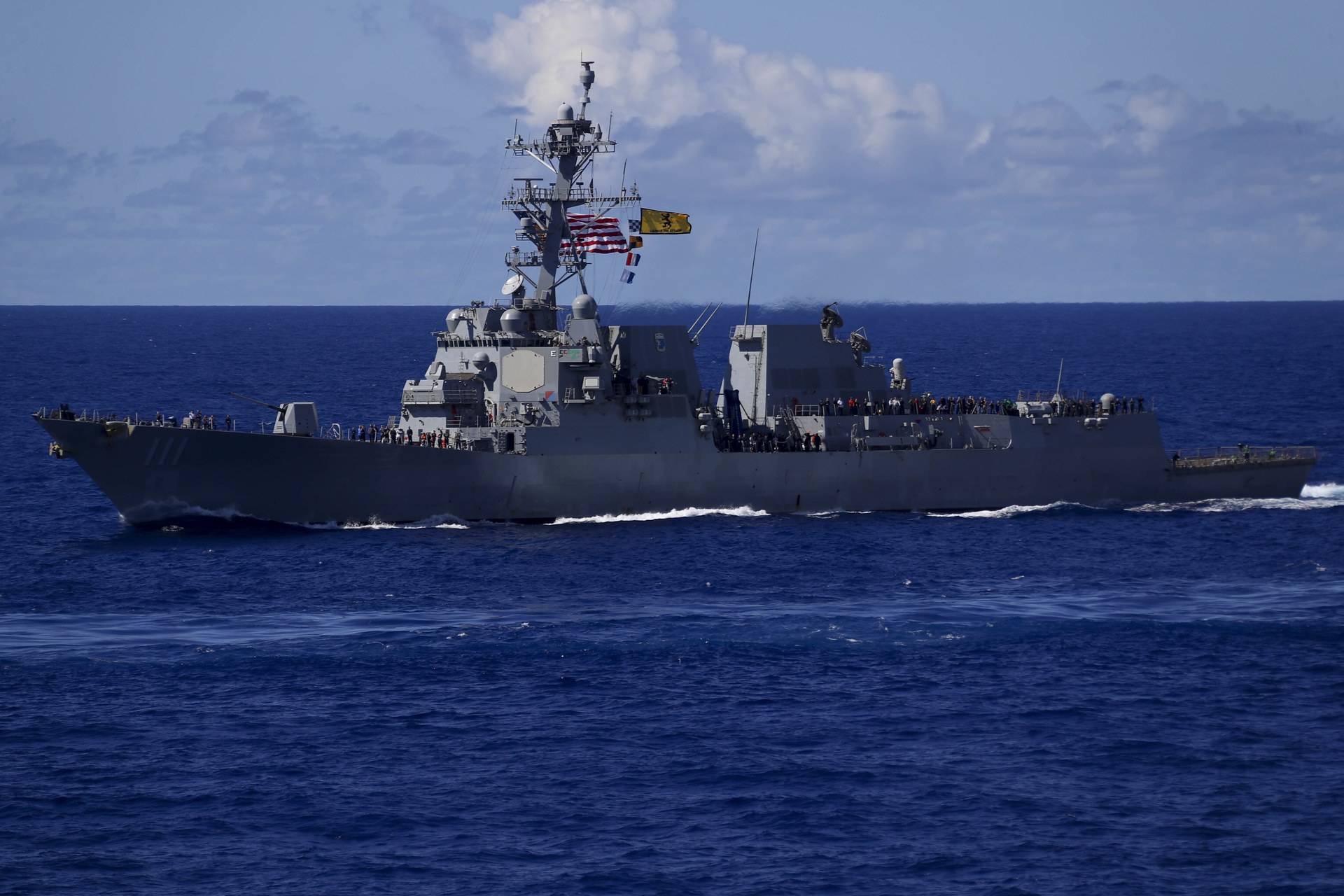
WASHINGTON — The US Navy fired 5-inch rounds from the guided-missile destroyer USS Spruance into the engine room of the Iranian container ship Touska on April 19, 2026, disabling its propulsion after a six-hour standoff in the Arabian Sea and completing the first physical vessel seizure under the Hormuz blockade announced on April 13. Marines from the 31st Marine Expeditionary Unit rappelled from helicopters to board the nearly 900-foot ship, which was under US Treasury sanctions and en route to Bandar Abbas, according to CNN and the Jerusalem Post.
The seizure did three things simultaneously. It proved that Operation Epic Fury — the US naval blockade of Iranian ports — is enforceable, not performative. It destroyed the remaining diplomatic runway toward Islamabad Round 2 peace talks, which Iran abandoned within hours. And it started a 48-hour countdown: the ceasefire expires April 22 with no extension mechanism in place and no parties at the table.
Six Hours in the Arabian Sea
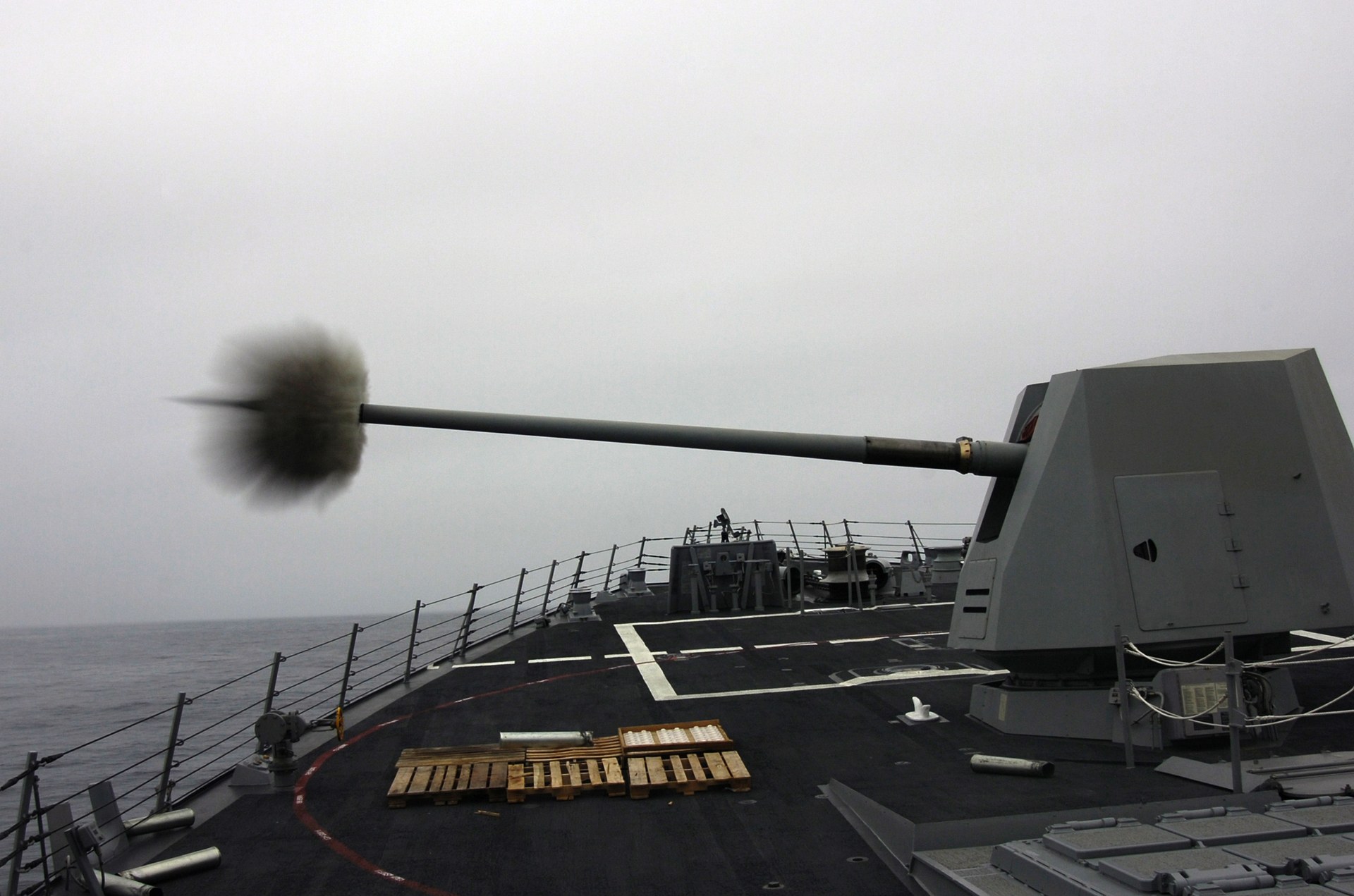
The Touska had been flagged for sanctions violations by the Office of Foreign Assets Control before the blockade began. When intercepted by the Spruance — an Arleigh Burke-class destroyer carrying MK 45 5-inch guns — the vessel refused to comply with orders to stop, according to CNBC. The standoff lasted six hours.
President Donald Trump described the outcome on Truth Social: “We stopped them right in their tracks by blowing a hole in the engine room.” The language was characteristically blunt but operationally accurate. The Spruance fired into the engine compartment to disable propulsion without sinking the vessel, a calibrated use of force that CNN described as consistent with visit, board, search, and seizure protocols under maritime interdiction doctrine.
The boarding itself was a textbook opposed-vessel seizure. Marines from the 31st MEU fast-roped onto the deck from helicopters once the ship was dead in the water, secured the crew, and assumed custody of the vessel and its cargo, the Daily Caller reported. No casualties were confirmed on either side.
Before the Touska, the blockade had operated through compellence short of force. CNBC reported that US warships had diverted or halted more than 25 commercial vessels since April 13 — turning them around with radio warnings, shadowing, and the implicit threat of force. The Touska was the first captain to call the bluff. It was not a bluff.
The Middle East briefing 3,000+ readers start their day with.
One email. Every weekday morning. Free.
From Deterrence to Enforcement
Operation Epic Fury deployed roughly 27 US Navy vessels — approximately 41% of the active fleet globally — and more than 10,000 personnel to enforce a blockade targeting Iranian ports, not the Strait of Hormuz itself. The distinction matters under international law. Under the law of naval warfare, a blockade is lawful if it is effective and does not impede neutral shipping through international straits, NPR reported. By targeting only vessels bound for or departing Iranian ports, the US maintains its UNCLOS framework — the same framework Iran’s failed toll scheme violated three times over, according to Nevitt at Emory and Just Security.
The Center for Strategic and International Studies published an analysis on April 20 that framed the current situation with precision:
The conflict has settled into a paradoxical equilibrium: Iran has sought to disrupt global energy flows through a de facto blockade of the Strait of Hormuz, while the United States has responded by ‘blockading the blockaders,’ blocking traffic to and from Iranian ports. The current standoff is no longer a clash of capabilities but rather a struggle of political endurance and bargaining leverage.
— CSIS analysis, April 20, 2026
Robin Brooks at the Brookings Institution was more direct about the economic logic. “Leaning on this money machine sends the economy into a tailspin, giving the mullahs much needed motivation to negotiate in earnest,” he told Fortune. “As Iran’s oil exports collapse, there’ll be no cash for imports, so activity implodes, the currency goes into a devaluation spiral, and hyperinflation ensues.”
The theory is clean. Iran’s OFAC General License U expired on April 19 without renewal, cutting off the legal pathway Indian refiners had used to purchase Iranian crude. The blockade seals the physical pathway. Iran’s Central Bank memo — leaked and reported in Iranian media — projected 180% inflation and a 12-year recovery timeline. Brooks’s devaluation spiral may already be underway.
But the theory assumes Iran responds to economic pain with concessions rather than escalation. The Touska tested that assumption within hours.
What Did Iran Actually Do in Response?
Khatam al-Anbiya — the IRGC’s central military command — issued a statement calling the seizure “armed piracy” and promising retaliation. “The aggressive America, by violating the ceasefire and committing maritime piracy, attacked one of Iran’s commercial ships,” the statement read, according to Republic World. “The Armed Forces of the Islamic Republic of Iran will soon respond to and retaliate against this armed piracy.”
The command specified that retaliation was delayed pending confirmation of crew safety — a detail that suggests internal debate about proportionality, or at minimum, an effort to control the escalation timeline. Iran’s foreign ministry spokesperson Esmaeil Baghaei told NBC News that the US actions “are in no way indicative of seriousness in pursuing a diplomatic process.”
Then came the drones. Iran’s Tasnim News Agency — IRGC-aligned — reported that the Islamic Republic “launched drone strikes toward several U.S. military vessels in the area” within hours of the seizure, according to UPI and the Malay Mail. No independent confirmation of damage or even impact has emerged. CENTCOM had not issued a statement confirming engagement as of April 20.
The gap between claim and evidence is by now a pattern. As this publication documented in its analysis of Iran’s authorization ceiling, Tasnim and Fars have published unverified strike claims throughout the conflict — NewsGuard catalogued “50 Lies in 25 Days” from Iranian state media, and CENTCOM has denied false claims at least six times since hostilities began.
The IRGC also escalated its broader Hormuz posture. Euronews reported that the IRGC issued a blanket order: “No vessel should make any movement from its anchorage in the Persian Gulf and the Sea of Oman, and approaching the Strait of Hormuz will be considered as cooperation with the enemy.” More than 800 tankers are already stranded in the region, according to shipping data. The order attempts to freeze the remaining commercial traffic entirely.
The question is who controls Iran’s actual response. President Pezeshkian accused IRGC commander Vahidi and Abdollahi on April 4 of wrecking the ceasefire from within. Under Article 110 of Iran’s constitution, the president has zero authority over IRGC military operations. Khamenei has been absent for more than 50 days as of April 20, with only audio contact through his son Mojtaba. Vahidi controls escalation. Pezeshkian controls press conferences.
Why Did Islamabad Round 2 Collapse?
The timing was either catastrophic or deliberate. The Touska seizure occurred hours before the scheduled opening of Islamabad Round 2, the follow-up to the direct Vance-Ghalibaf talks that produced the framework — however fragile — for a ceasefire extension. Iran announced on April 20 that there was “no decision” on sending negotiators, Al Jazeera reported.
Baghaei’s formulation was careful: “There were no plans for the next round of negotiations.” Not a withdrawal — a denial that plans existed. The distinction matters diplomatically. Iran can claim it never committed to Round 2, avoiding the appearance of walking away from peace while effectively walking away from peace.
The blockade was designed as coercive diplomacy — pressure to force Iran to the table. But the Touska seizure inverted the logic. Seizing an Iranian vessel seven days into a blockade, hours before talks, demonstrated enforcement capacity at the cost of diplomatic credibility. Iran’s negotiating position was already constrained by the IRGC’s internal veto — Vahidi refused to allow missile negotiations at Islamabad Round 1 and demanded his deputy Zolghadr on the delegation. The seizure gave the IRGC faction the pretext it needed to kill talks entirely without appearing to be the spoiler.
Pakistan — which had positioned itself as the sole enforcement mechanism for any ceasefire — was left holding an empty venue. Foreign Minister Ishaq Dar told reporters of “new dialogue in coming days,” but the structural problem remains: the ceasefire expires April 22, the parties are not talking, and the IRGC has already reversed its own foreign minister once on Hormuz.
Saudi Arabia Asked the US to Stop
The Wall Street Journal reported — cited by the Palestine Chronicle — that Saudi Arabia formally petitioned the United States on April 20 to lift the blockade, fearing Iranian retaliation against Red Sea shipping and Bab al-Mandeb transit routes. The request landed on the same day the Touska was seized.
The petition exposes the structural contradiction in Riyadh’s position. Saudi Arabia benefits from the blockade: Iranian oil exports collapsing means less competition for the Asian market share Saudi Aramco lost during the first weeks of conflict, when Saudi production crashed from 10.4 million bpd in February to 7.25 million bpd in March — a 30% drop, per the IEA. The Petroline pipeline to Yanbu, reactivated at 7 million bpd capacity, bypasses Hormuz but cannot replace the full pre-war throughput of 7–7.5 million bpd through the strait. The structural gap remains 1.1–1.6 million bpd.
But Saudi Arabia also fears the blockade. An Iran forced into a corner — exports collapsing, economy spiralling, no diplomatic off-ramp — is an Iran with nothing left to lose in the Gulf. The IRGC’s counter-target list, published by Fars News, includes eight bridges across four countries, the King Fahd Causeway, and Saudi energy infrastructure. Ras Tanura has already been hit. The Khurais field remains 300,000 bpd offline with no announced restoration timeline.
Brent crude stood at $95.17 per barrel on April 20. The IEA has projected peak-scenario prices well above $100 per barrel for Q2. Goldman Sachs estimates Saudi Arabia’s war-adjusted fiscal deficit at 6.6% of GDP — double the official 3.3% projection. Every escalation that pushes Brent higher helps the fiscal arithmetic but increases the probability that Saudi infrastructure becomes a target again.
Mohammed bin Salman is navigating a corridor that narrows by the day. The blockade degrades Iran’s capacity to fund military operations — including the missile and drone campaigns that have struck Saudi territory. But the blockade also eliminates the diplomatic track that might produce a ceasefire extension before April 22. Riyadh’s petition to Washington amounts to an admission: the cure may be worse than the disease.
Can Anything Save the April 22 Ceasefire?
The ceasefire expires in approximately 48 hours. The Soufan Center has confirmed there is no extension mechanism built into the existing framework. The parties are not at the table.
Iran has announced no plans for further talks. An Iranian cargo ship is in US custody with a hole in its engine room.
The structural obstacles are not new. As this publication has documented, Iran’s authorization ceiling means that even a willing president cannot commit the IRGC to terms. Vahidi and the Supreme National Security Council control military operations. Khamenei — absent 50 days as of April 20 — is the only constitutional authority who can override the IRGC, and he is not overriding anything.
The IRGC commander’s prior statement, reported by The Week, frames the stakes from Tehran’s perspective: “If war resumes, Iran will use missiles built just this month. War will become global this time.” The threat may be bluster. The missile inventory is not.
Pakistan’s capacity to broker is exhausted. Turkey’s Foreign Minister Fidan called Round 1 “sincere” — a diplomatic adjective that typically precedes the word “but.” Egypt has offered no public mediation framework. Oman, the traditional back channel, is constrained by its own Hormuz geography.
What remains is the CSIS formulation: a struggle of political endurance. The US has demonstrated it will enforce the blockade with gunfire. Iran has demonstrated — or at least claimed — it will respond with drones. Saudi Arabia has demonstrated it wants neither outcome. The ceasefire clock runs to zero on April 22 with no hand on the dial.
Background: The Tanker War Precedent
The last major US-Iran naval engagement was Operation Praying Mantis on April 18, 1988 — 38 years and one day before the Touska seizure. In that action, the US Navy destroyed two Iranian surveillance platforms, sank the frigate Sahand and the patrol boat Joshan, and damaged the frigate Sabalan. It was the largest US Navy surface engagement since World War II.
The International Court of Justice ruled in 2003 that Operation Praying Mantis could not be justified as measures necessary to protect US essential security interests — a legal finding that hangs over current operations, though the US has not formally acknowledged the parallel.
Iran’s own tanker-war tactics during the 1980–88 Iran-Iraq War established the counter-blockade precedent the IRGC now invokes. Time magazine reported that Iranian attacks on merchant shipping during that conflict killed 37 American sailors aboard the USS Stark in 1987 and created the conditions for the US naval escort operations that culminated in Praying Mantis. The current IRGC “danger zone” declaration — mapping standard shipping lanes as hostile territory — mirrors the 1987–88 playbook almost exactly.
The difference is scale. In 1988, the US deployed a carrier battle group and several surface combatants. In 2026, Operation Epic Fury involves 27 vessels, 10,000 personnel, and 41% of the active fleet. The Iranian navy in 1988 had conventional frigates. The IRGC Navy in 2026 has anti-ship ballistic missiles, drone swarms, and a mining capability that the US cannot counter at pre-war levels — the four Avenger-class mine countermeasure ships at Bahrain were decommissioned in September 2025.
FAQ
What cargo was the Touska carrying?
US officials have not disclosed the vessel’s full manifest as of April 20. The Touska was a container ship — not a tanker — suggesting mixed commercial cargo rather than crude oil or refined petroleum. The vessel was under OFAC sanctions for prior violations, which means any cargo aboard is subject to seizure under US law regardless of contents. CNN reported that Trump referred to potential “spoils of war,” indicating the administration may catalogue and publicize the manifest as part of the pressure campaign.
Has the US Navy boarded Iranian vessels before during this conflict?
Not during the current hostilities. The Touska is the first physical boarding and seizure under Operation Epic Fury. Prior enforcement actions since April 13 involved radio warnings, shadowing, and course diversions of commercial vessels — compellence measures short of direct contact. The last US detention of Iranian military personnel was in 2016, when the US Navy briefly held ten Iranian sailors aboard small patrol boats in the Persian Gulf — a far smaller-scale incident, resolved within 24 hours through diplomatic channels, involving no vessel seizure.
What does this mean for commercial shipping insurance rates?
War-risk insurance premiums for Gulf transit had already reached 5–10% of hull value before the seizure, according to Lloyd’s market data from early April. The Touska incident — combined with the IRGC’s blanket order freezing all vessel movements — is expected to push rates higher and extend the coverage exclusion zone. Lloyd’s Joint War Committee had already designated the Persian Gulf, Gulf of Oman, and Arabian Sea as listed areas requiring additional premium. With 800+ tankers stranded and VLCC day rates at record levels exceeding $400,000 per day, the insurance market is pricing in sustained conflict, not resolution.
Could Iran legally challenge the seizure at the ICJ?
Iran filed a case at the International Court of Justice after Operation Praying Mantis and secured a partial ruling in 2003 that the US action was disproportionate. A similar challenge to the Touska seizure is legally available but practically irrelevant to the current timeline. ICJ proceedings take years. The ceasefire expires in 48 hours. Iran’s immediate response will be military, not judicial — as the Khatam al-Anbiya statement made explicit.
What is the 31st Marine Expeditionary Unit?
The 31st MEU is a forward-deployed Marine air-ground task force normally based in Okinawa, Japan. It comprises approximately 2,200 Marines with organic aviation, ground combat, and logistics elements — a self-contained force capable of amphibious assault, humanitarian assistance, and, as demonstrated on April 19, opposed vessel boarding. Its redeployment from the Indo-Pacific to the Arabian Sea represents a capability trade-off: assets committed to the Iran blockade are assets unavailable for contingencies in the Taiwan Strait or South China Sea.
The oil-price dimension of the blockade’s escalation timeline is detailed in The Peace Dividend Saudi Arabia Cannot Collect: at $97 Brent, Riyadh remains $11–14 below its fiscal break-even, and the “sell the fact” dynamic means any ceasefire announcement would send prices lower before a single additional barrel reaches the market.