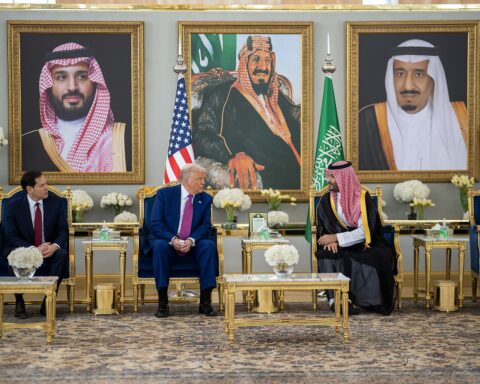
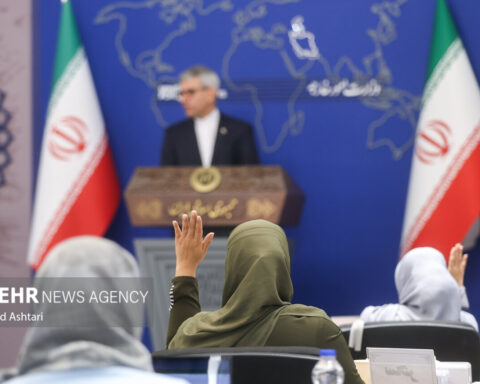
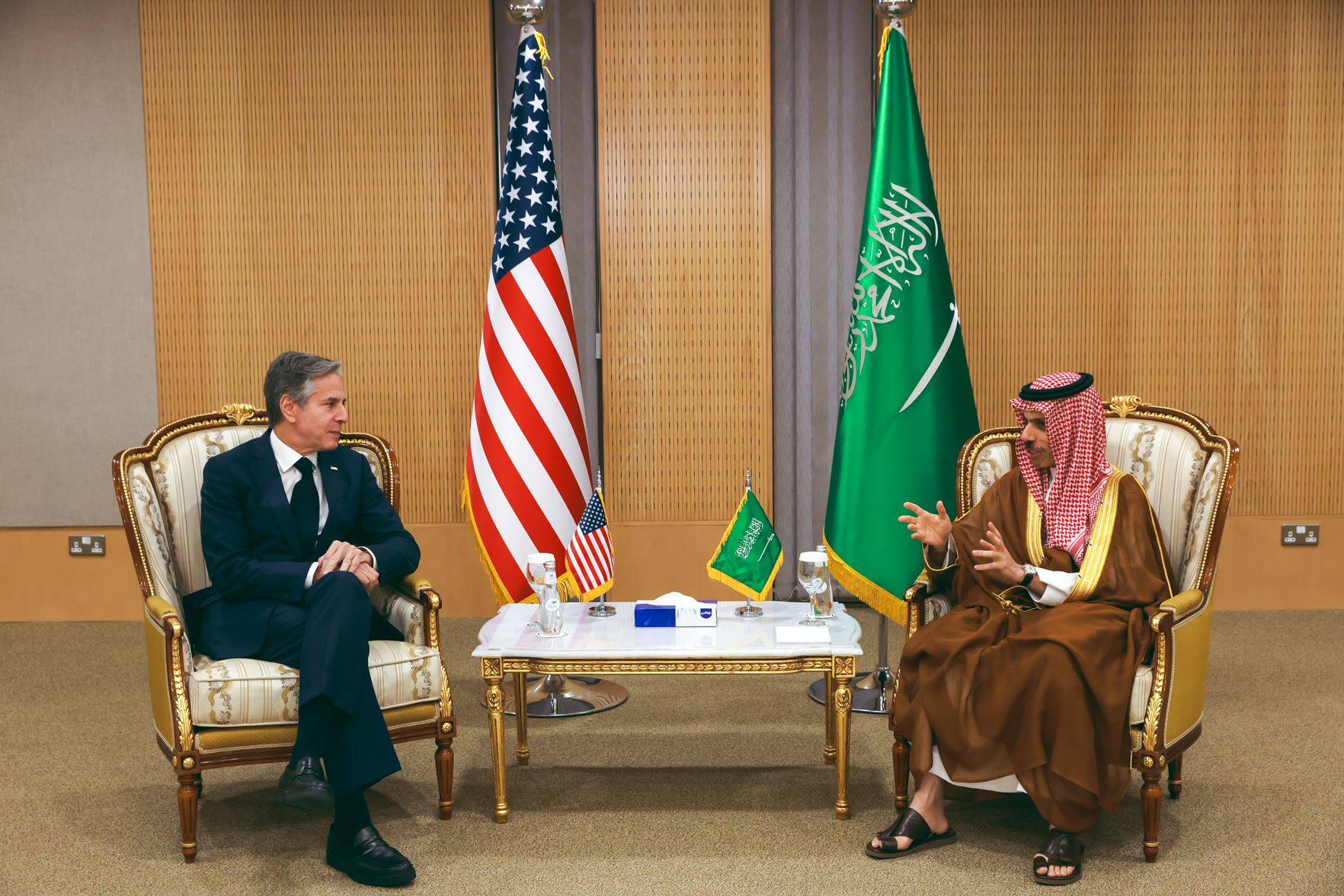
JEDDAH — Saudi Foreign Minister Prince Faisal bin Farhan took a phone call from UN Secretary-General António Guterres on Tuesday, April 29 — the same day the 60-day War Powers clock expired on the Iran conflict and one day after the GCC’s hardest collective communique in a generation declared that any attack on one member state constitutes an attack on all. The call was not a courtesy. It was the political legitimization of a parallel diplomatic instrument that bypasses the Security Council entirely, routing Hormuz diplomacy through the Secretary-General’s good-offices authority — a track that Russia and China closed the front door on three weeks ago but structurally cannot block through the back.
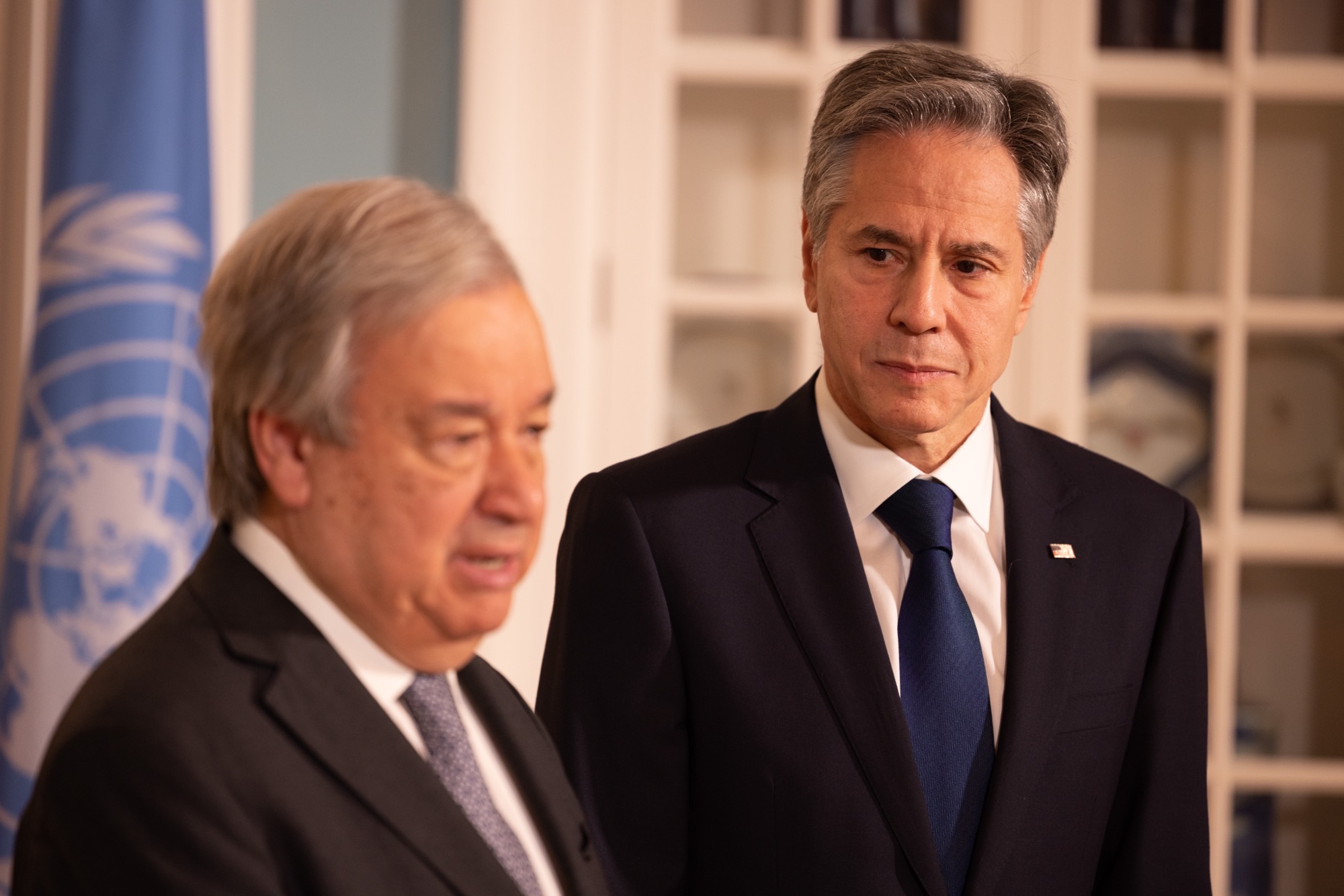
The mechanism is already built. Guterres appointed Jean Arnault of France as personal envoy for the Middle East conflict on March 25. Two days later, he established a fertilizer and essential-goods task force under UNOPS Executive Director Jorge Moreira da Silva. From the Security Council floor on April 27, Guterres offered his mediation services directly to the parties, invoking the Black Sea Grain Initiative as proof that wartime shipping corridors work. Prince Faisal’s call the next business day, backed by a six-nation GCC summit communique using the phrase “categorical rejection,” converts that offer from a Secretary-General’s suggestion into a politically mandated negotiating channel.
- The Veto-Proof Architecture
- What Are Good Offices and Why Can’t Russia and China Block Them?
- The GCC Summit Communique as Political Mandate
- Why Does the War Powers Deadline Matter for This Call?
- The Fertilizer Corridor: Seven Days to Deploy, No Political Will to Launch
- Why Has Guterres Not Invoked Article 99?
- Moscow and Beijing’s Structural Problem
- What Can the Good-Offices Track Not Do?
- FAQ
The Veto-Proof Architecture
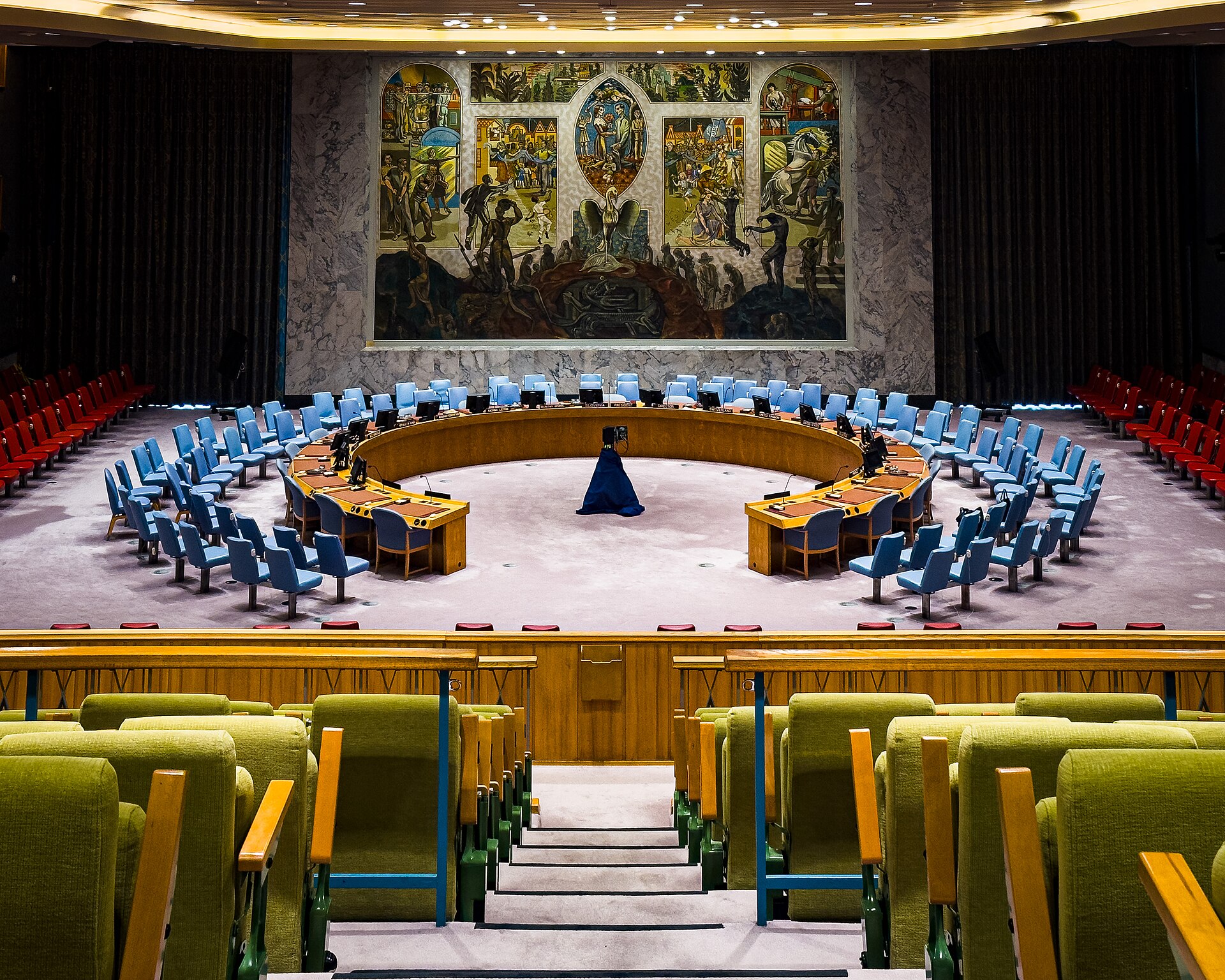
On April 7, Russia and China vetoed a Bahrain-sponsored Security Council resolution that demanded Iran “immediately cease all attacks against merchant and commercial vessels and any attempt to impede transit passage or freedom of navigation in the Strait of Hormuz.” The vote was 11-2, with Colombia and Pakistan abstaining — a supermajority in any other international body, but irrelevant under Chapter VII rules where a single permanent member’s no kills the text. Bahrain’s foreign minister said the Council had “failed to shoulder its responsibility.” He was right, but that failure was also the end of the multilateral pressure track as anyone in Riyadh understood it.
What followed was not retreat but rerouting. Within 48 hours of the veto, Saudi diplomatic activity shifted to bilateral and institutional channels that operate outside Council procedure entirely. Prince Faisal made three calls in rapid succession in late April — to counterparts and to Guterres himself — constructing what amounts to a mediation architecture that Washington has declined to build and the Security Council can no longer authorize.
That diplomatic repositioning is part of a wider Saudi strategy that now extends to both competing military coalitions at Hormuz: Saudi Arabia’s refusal to endorse either Project Freedom or the UK-France escort framework constitutes a structural veto that neither Washington nor London can override.
The Middle East briefing 3,000+ readers start their day with.
One email. Every weekday morning. Free.
The distinction between a Security Council resolution and the Secretary-General’s good offices is not procedural hair-splitting. A resolution under Chapter VII carries binding legal force, authorizes enforcement mechanisms, and can be blocked by any of the five permanent members. Good offices carry no binding authority at all — they are the Secretary-General’s personal diplomatic engagement, offered at his discretion, requiring no vote, no agenda item, and no formal document. Russia vetoed the Bahrain resolution. Russia cannot veto a phone call to Riyadh, a Jean Arnault visit to Tehran, or a fertilizer corridor proposal transmitted directly to port authorities. The instrument is weaker, but it exists. The Council track is stronger, but it is dead.
What Are Good Offices and Why Can’t Russia and China Block Them?
Good offices is the softest instrument in the UN diplomatic toolkit — and currently the only one available for Hormuz. The Secretary-General offers himself or a designated envoy as a neutral channel between parties to a dispute. There is no resolution, no mandate, no enforcement mechanism. The authority derives entirely from the Secretary-General’s moral and institutional standing, plus the consent of the parties involved. It works when parties want a face-saving way to talk. It fails when they don’t.
Guterres has already operationalized three components of a good-offices infrastructure for this conflict. The first is personnel: Jean Arnault, appointed March 25, brings nearly 40 years of UN mediation experience and carries the title “Personal Envoy on the Middle East Conflict and its Consequences” — a designation broad enough to encompass Hormuz, the nuclear dimension, and the humanitarian fallout simultaneously. Guterres described Arnault’s mandate as doing “everything possible to support all the efforts for mediation, all the efforts for peace, to be in contact with all the parties.” The second component is operational: the fertilizer task force under Jorge Moreira da Silva at UNOPS, established March 27, with a concrete mechanism for vessel verification and designated coordination zones. The third is rhetorical positioning: Guterres’s April 27–28 appearance at the Security Council high-level debate on maritime security, where he stated from the floor that his “good offices remain available” — language that in UN diplomatic grammar means the offer is active, not hypothetical.
The structural reason Russia and China cannot block this track is that good offices require no Council authorization. The veto power applies exclusively to Security Council decisions. The Secretary-General’s authority to engage in good offices derives from Article 99 of the Charter and from customary practice dating to Dag Hammarskjöld’s tenure, who described Article 99 as the provision that “transformed the Secretary-General from a purely administrative official to one with an explicit political responsibility.” Russia can object to the Secretary-General’s engagement — Moscow has complained about UN mediation overreach before — but objection is not obstruction. There is no procedural mechanism to prevent Guterres from picking up the phone.
The GCC Summit Communique as Political Mandate
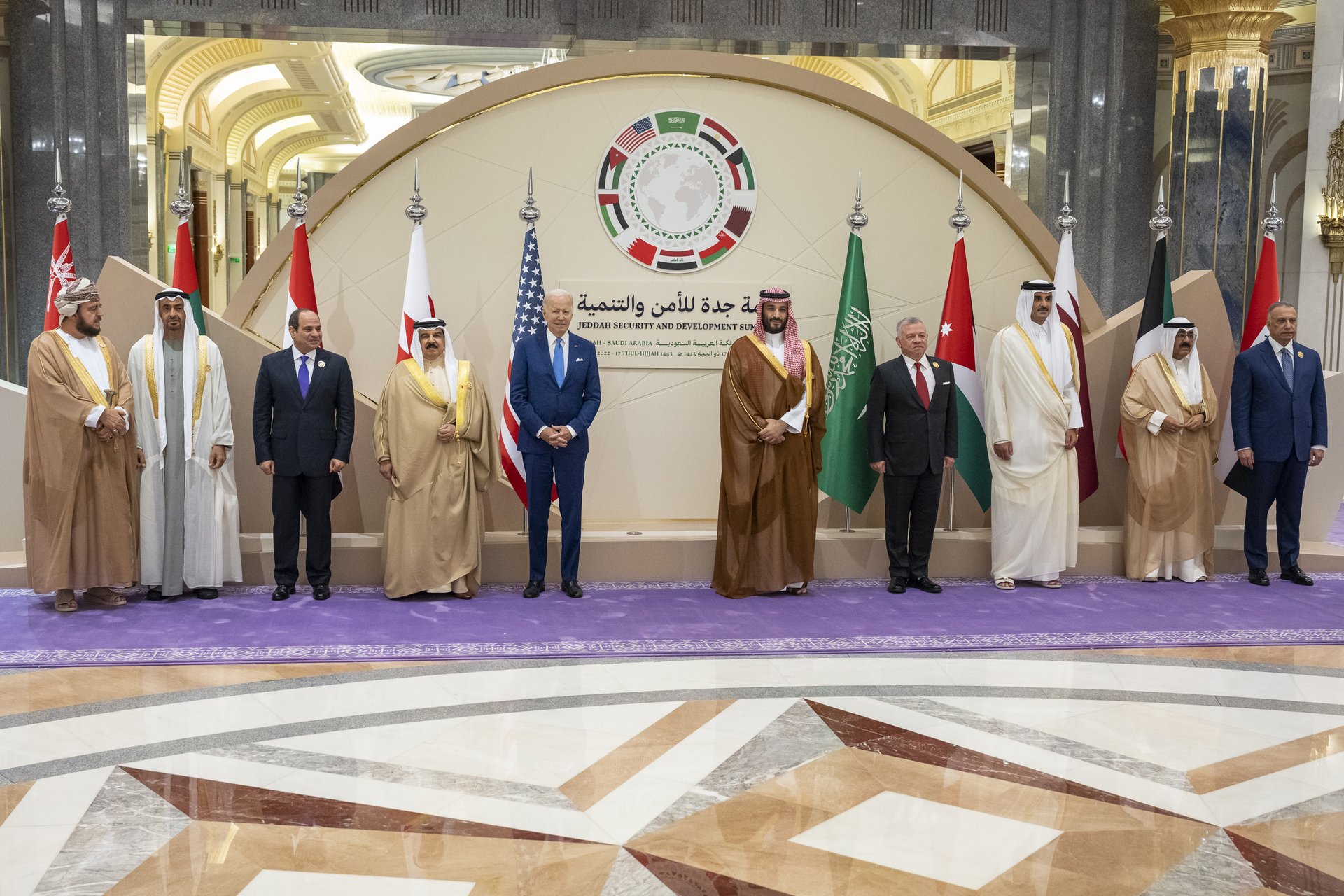
The timing of the Faisal-Guterres call is inseparable from the GCC “Decisiveness Summit” that concluded in Jeddah the day before. Chaired by Crown Prince Mohammed bin Salman, the summit produced a communique whose language went further than any collective GCC statement since the coalition intervention in Yemen — and in some respects further than that.
Three phrases matter. “Categorical rejection” of Iran’s Hormuz closure is the diplomatic equivalent of a legal finding: it declares the act illegitimate, not merely unwelcome. “Maximum Readiness” signals military posture coordination across all six member states. And “any attack on one GCC member is an attack on all” is a mutual-defense formulation borrowed directly from NATO’s Article 5 — unprecedented in GCC communique language and aimed squarely at Iran’s campaign of dispersed infrastructure strikes that have hit Saudi Arabia, Bahrain, and Kuwait since February 28.
The communique performs a specific function for the Faisal-Guterres call. When Prince Faisal speaks to the Secretary-General on April 29, he is not speaking as one foreign minister requesting UN engagement. He is transmitting the collective political will of six states representing combined GDP exceeding $2.3 trillion, ranked among the world’s largest humanitarian donor blocs. The summit itself had complications — UAE President Sheikh Mohammed bin Zayed did not attend — but the communique text was unanimous. That unanimity converts the good-offices track from a Saudi bilateral initiative into a GCC-endorsed diplomatic channel.
This matters because good offices work best when the requesting party carries political weight and the Secretary-General can point to broad-based support for engagement. The April 2 Security Council presidential statement on UN-GCC cooperation — the first of its kind — already established the institutional framework, recognizing the GCC’s “position and expertise in understanding and promoting regional sustainable peace and security” and encouraging regular GCC Secretary-General briefings to the Council. Prince Faisal’s call to Guterres on April 29 activates that framework for a specific purpose.
Why Does the War Powers Deadline Matter for This Call?
April 29 is not an arbitrary date for this phone call. It is the 60th day since the February 28 US strikes on Iran, which means the War Powers Resolution’s clock — the statutory limit on unauthorized military operations — formally expires. The Senate has defeated Democratic resolutions to invoke war powers and force withdrawal five times. Republican Senators Lisa Murkowski, Thom Tillis, Susan Collins, and John Curtis have signaled interest in an authorization vote, but Senate Majority Leader John Thune has no plans to bring an Authorization for Use of Military Force to the floor. President Trump retains the option to extend the clock 30 days by certifying that troop-safety requirements necessitate continued operations during withdrawal.
The War Powers expiry creates a specific diplomatic window. If Congress neither authorizes nor terminates the conflict, the US military presence enters a legal grey zone that foreign governments — including Saudi Arabia — must factor into their own planning. A good-offices track through the Secretary-General provides Riyadh with a diplomatic instrument that does not depend on the US military posture remaining stable. Should the War Powers situation produce a drawdown, a reduction in naval blockade enforcement, or even a political crisis in Washington over authorization, the Guterres channel continues to operate independently.
This is consistent with Saudi Arabia’s broader diplomatic posture throughout the conflict. Riyadh has consistently built parallel tracks rather than relying on any single channel. Prince Faisal’s mediation architecture in late April — engaging Moscow, Beijing, and now the Secretary-General — distributes diplomatic risk across multiple instruments so that the failure of any one does not collapse the entire effort. The War Powers deadline adds urgency to that distribution: the American track faces a domestic constitutional question that no Saudi diplomat can influence, making the UN track more valuable precisely because it is decoupled from US domestic politics.
The Fertilizer Corridor: Seven Days to Deploy, No Political Will to Launch
The most concrete element of Guterres’s Hormuz infrastructure is also the most stalled. The fertilizer and essential-goods corridor, established under UNOPS on March 27, has a functioning mechanism on paper: shipping agents submit vessel data to an online database, UN monitors deployed to ports across the Gulf verify cargo contents, and approved vessels transit through designated coordination zones. Da Silva has said publicly that the system needs “seven days” to become operational once political will materializes. That will has not materialized — Gulf states and Iran are both contesting the corridor’s premise before it has moved a single vessel.
The corridor faces opposition from both sides and ambivalence from the middle. A Gulf diplomat, quoted by PassBlue, criticized Guterres for introducing the proposal “without consulting Gulf countries beforehand.” Bahrain’s UN representative called the scope “limited” and said it “does not fully address current security threats.” The core Gulf objection is structural: the corridor mechanism implicitly grants Iran a coordination role over Strait transit, which Gulf states read as legitimizing Iranian authority over waters that UNCLOS designates as an international strait subject to transit passage rights. Iran’s ambassador, for his part, said “any UN ship they are allowed to pass the Hormuz Strait, there is no problem for that” — language that asserts Iranian permission authority over the very waterway the corridor is meant to open.
The American position is silence. US Ambassador Mike Waltz was briefed on the proposal but offered no public endorsement — a gap that Sam Vigersky of the Council on Foreign Relations has argued reflects Washington’s reluctance to validate any mechanism that could be read as normalizing the Hormuz closure. Vigersky has also criticized the task force’s institutional design, arguing that OCHA — the UN’s humanitarian coordination body — should lead the effort rather than UNOPS, mirroring the structure that made the Black Sea Grain Initiative effective.
The humanitarian arithmetic makes the delay increasingly untenable. Roughly 30% of global fertilizer trade transits Hormuz. The World Food Programme estimates 45 million additional people face acute hunger if the strait stays closed through the planting season, and the FAO projects cereal yield declines of up to 50% in key African regions for the 2026–27 growing cycle. Da Silva’s own assessment — “we can’t wait until everything has been fixed…if we don’t get some solution immediately the crisis will be very significant and severe” — frames the corridor as a humanitarian triage measure rather than a diplomatic concession. The Faisal-Guterres call may be the political signal needed to unblock at least partial implementation, but the Gulf states’ objections about Iranian authority remain unresolved.
Why Has Guterres Not Invoked Article 99?
Article 99 of the UN Charter empowers the Secretary-General to bring to the Security Council “any matter which in his opinion may threaten the maintenance of international peace and security.” It is the strongest procedural tool in the Secretary-General’s arsenal — and Guterres has not used it for the Iran war, despite having invoked it as recently as December 2023 over Gaza.
The reason is strategic, not constitutional. Article 99 has been formally invoked exactly four times in 80 years. Hammarskjöld used it in 1960 for the Congo crisis, producing Resolution 143 — but that worked because all five permanent members wanted action and needed procedural cover to take it. Kurt Waldheim invoked it in 1979 during the Iran Hostage Crisis, producing unanimous Resolution 457. Pérez de Cuéllar used it in 1989 for the Lebanese civil war, generating a presidential statement. Guterres himself invoked it for Gaza in December 2023, and the result was a US veto of the subsequent ceasefire resolution.
The pattern is clear: Article 99 succeeds when permanent members want to act but need a procedural mechanism to do so. It fails when a permanent member is actively shielding the target. Russia and China have already demonstrated their position with the April 7 double veto. Invoking Article 99 would force a Council session, place Hormuz on the formal agenda, and generate considerable media attention — but it would end in the same 11-2 vote. Former Secretary-General U Thant warned that “nothing could be more divisive or useless than for the Secretary-General to invoke Article 99 in a situation where there is no real possibility of the Security Council agreeing on any useful positive role.” Guterres appears to have internalized that lesson.
What Guterres is doing instead is more interesting. His food-emergency framing at the April 27–28 maritime debate — warning that Hormuz disruptions threaten to “exacerbate food insecurity for millions of vulnerable people” and that “when the Strait of Hormuz is strangled, the world’s poorest and most vulnerable cannot breathe” — is Article 99 language without the formal invocation. He is building a public record that documents the threat to international peace and security, positions the humanitarian consequences as the Secretary-General’s concern, and reserves the formal invocation as an escalation option if the good-offices track fails. The IEA’s Fatih Birol calling the Hormuz disruption the “biggest energy security threat in history” — 13 million barrels per day offline — provides the evidentiary foundation for that eventual invocation without triggering it prematurely.
Moscow and Beijing’s Structural Problem
Russia and China vetoed the Bahrain resolution on complementary but distinct grounds. Russia’s Ambassador Vassily Nebenzia argued the text presented “Iranian actions as the sole source of regional tensions while illegal attacks by the United States and Israel were not mentioned at all.” China’s Ambassador Fu Cong said the draft “failed to capture the root causes and the full picture of the conflict in a comprehensive and balanced manner.” Both announced plans to introduce an alternative text — a competing UNSC draft that would frame the conflict as “unprovoked armed aggression against a sovereign UN member state,” reversing the moral polarity entirely.
The double veto achieved its immediate objective: killing Council action on Hormuz. But it created a secondary problem that neither Moscow nor Beijing fully controls. By blocking the Council track, they pushed Hormuz diplomacy into channels where the veto does not apply — the Secretary-General’s good offices, the General Assembly’s “Uniting for Peace” mechanism, bilateral diplomatic engagement, and the fertilizer corridor all operate outside Chapter VII authority. The Suez Crisis of 1956 established the precedent: when Britain and France vetoed Council action, the General Assembly convened an emergency special session and created UNEF — the first UN peacekeeping force — without the vetoing powers having any procedural mechanism to block it.
Russia’s structural interest in the Hormuz status quo is economic. Sustained high oil prices and the erosion of US energy market dominance both serve Moscow’s revenue and geopolitical position. Any mechanism that reopens the strait reduces that advantage. China’s interest is more ambiguous: Beijing benefits from lower energy prices and unimpeded Chinese cargo transit, but opposes any framework that validates the GCC’s collective posture against Iran, which China views as a partner in the multipolar order it is constructing. The fertilizer corridor presents China with a specific dilemma — supporting it benefits Chinese shipping and food security interests while opposing it aligns China with famine risk in Africa and South Asia, where Beijing has spent decades building diplomatic capital.
What Can the Good-Offices Track Not Do?
The good-offices mechanism that Prince Faisal’s call activates has real structural limits that no amount of diplomatic skill can overcome. Good offices produce frameworks for negotiation, not binding outcomes. They require the consent of all parties — and Iran has not formally responded to the Guterres engagement beyond Iravani’s conditional statement about UN-flagged vessels. The mechanism cannot compel Iran to reopen the strait, cannot authorize enforcement action against vessels that violate a corridor agreement, and cannot override the IRGC’s operational control of the waterway.
Iran’s own diplomatic positioning complicates the track further. Tehran’s April 27 proposal links Hormuz reopening to the removal of the US naval blockade and an end to the war, with nuclear negotiations deferred. Araghchi was in Moscow on April 27 — the same day Guterres addressed the Council — keeping the Russian channel active as a parallel track and a veto shield simultaneously. Iran’s flurry of bilateral diplomacy is designed to maintain optionality: engage enough channels that no single mediator gains decisive leverage, while ensuring that Moscow and Beijing remain structurally committed to blocking Council action. The risk for Riyadh is that Washington’s nuclear-first framing — Rubio calling Iran’s Hormuz terms “extortion” while calling the nuclear proposal “better than expected” — means a deal could solidify that resolves the centrifuge question while leaving Saudi Arabia’s 30-percent production collapse structurally unaddressed.
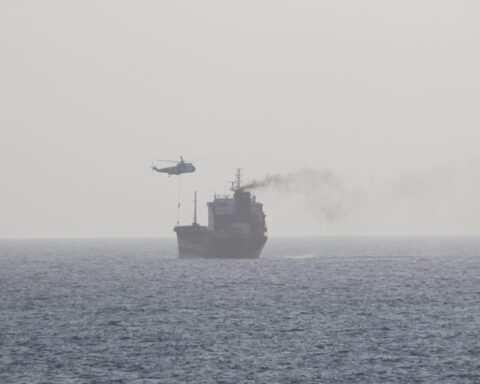
The operational reality on the ground further constrains the track. Only 45 vessel transits have occurred since the April 8 ceasefire — 3.6% of the pre-war baseline. The IRGC seized the MSC Francesca (11,660 TEU) and the Epaminodas (6,690 TEU) on April 22, the same day Iran’s foreign ministry declared the strait “completely open.” Ghalibaf formally linked Hormuz reopening to US blockade removal on the same date. Guterres’s appeal from the Council floor — “open the Strait, let ships pass, no tolls, no discrimination” — was addressed to an entity, the IRGC, that does not take instructions from UN Secretaries-General.
The good-offices track is a diplomatic workaround for a military problem. It cannot substitute for the Council authority that Russia and China destroyed on April 7. What it can do — and what the Faisal call is designed to ensure it does — is maintain an active, politically legitimized negotiating channel that outlasts the current military phase. If the War Powers situation produces American withdrawal or drawdown, if the IRGC’s command structure reconsolidates after Tangsiri’s killing and Khademi’s death, if Khamenei resurfaces from his now 60-day absence — the Guterres channel will still be open. Diplomatic instruments are judged not by whether they solve crises but by whether they survive them. The Security Council track did not survive the April 7 vote. Whether the good-offices track survives will depend on whether Guterres can convert the Faisal call, the GCC mandate, and the humanitarian emergency into enough political pressure to make both sides prefer talking through Arnault to escalating without him. The task became harder on the same morning: Trump posted an AI gun image warning Iran “NO MORE MR. NICE GUY” as Tehran formally asserted legal rights over Hormuz — adding another escalatory signal into precisely the diplomatic environment Arnault is being asked to manage.
Frequently Asked Questions
Can the UN General Assembly override the Russia-China veto on Hormuz?
Not in a binding sense. Under the “Uniting for Peace” resolution (377A), first used during the Suez Crisis in 1956, the General Assembly can convene an emergency special session when the Security Council is deadlocked by veto and recommend collective measures — including the use of armed force. But GA resolutions are recommendations, not binding decisions. Their power is political legitimacy, not legal compulsion. What the GA can do, as Patrick Rosenow of the IPI Global Observatory has argued, is provide the Secretary-General with a formal mandate to advance Hormuz mediation — converting his good-offices role from discretionary to institutionally directed. This would not give Guterres enforcement authority, but it would make it politically costly for any party to refuse engagement with his envoy.
Has Iran agreed to participate in the Secretary-General’s good-offices process?
Iran has not formally accepted or rejected the good-offices track as a whole. Its positioning is selective: Iran’s UN Ambassador Iravani stated that “any UN ship they are allowed to pass the Hormuz Strait, there is no problem for that,” which implicitly endorses the fertilizer corridor while asserting Iranian authority over transit permissions. Iran’s April 27 proposal links broader Hormuz reopening to US blockade removal and war termination — conditions that place the good-offices track inside a larger negotiating framework rather than treating it as a standalone mechanism. Araghchi’s simultaneous visit to Moscow on April 27 signals that Iran intends to keep the Russian bilateral channel as its primary diplomatic instrument, using the UN track as a secondary venue where Tehran can appear cooperative without making binding commitments.
What is the Black Sea Grain Initiative and why does Guterres keep citing it?
The Black Sea Grain Initiative was a July 2022 agreement brokered by the UN and Turkey that created a safe corridor for Ukrainian grain exports through the Black Sea during the Russia-Ukraine war. Over its 13-month lifespan before Russia withdrew in July 2023, it moved 33 million metric tons of food to 45 countries and helped reverse a global spike in food prices. Guterres cites it because it is the only recent precedent for a UN-brokered wartime shipping corridor — and because its institutional architecture (joint coordination center, vessel inspections, designated transit lanes) closely mirrors what the Hormuz fertilizer task force is designed to replicate. The critical difference: the Black Sea initiative had Russian consent, at least initially. The Hormuz corridor requires Iranian consent from an IRGC command structure that has demonstrated it operates independently of the civilian government’s diplomatic commitments.
How many days would it take to implement the fertilizer corridor if political agreement is reached?
UNOPS Executive Director Jorge Moreira da Silva has stated the system needs seven days to become operational once political will exists. The structural bottleneck is not technical but diplomatic: the online vessel database and UN port monitors are ready, but the corridor requires Iran to accept a UN verification role over vessels entering its adjacent waters — something the IRGC’s April declarations of “full authority” over the strait make functionally incompatible with neutral UN oversight. African planting season ends in May 2026, meaning the window for restoring fertilizer supply before the 2026–27 growing cycle closes within weeks. Every week of delay narrows the range of outcomes from bad to worse.
What happened to Saudi Arabia’s previous approach to the Security Council?
Saudi Arabia has historically preferred to operate outside the Security Council rather than through it. In 2013, Saudi Arabia was elected to a non-permanent Council seat and declined it — the only country in UN history to reject the position — citing the Council’s “double standards” and inability to resolve the Syrian conflict. That decision, communicated via a Foreign Ministry statement (A/68/599), reflected a deliberate strategic choice: Riyadh concluded that bilateral diplomacy, GCC coordination, and institutional relationships with the Secretary-General’s office produced more reliable outcomes than Council membership, where the veto system could nullify Saudi priorities at any moment. The current engagement through Guterres’s good-offices track is consistent with that 2013 posture — it routes Saudi diplomatic weight through an instrument the Kingdom can influence without subjecting its objectives to the veto gauntlet that destroyed the Bahrain resolution on April 7.