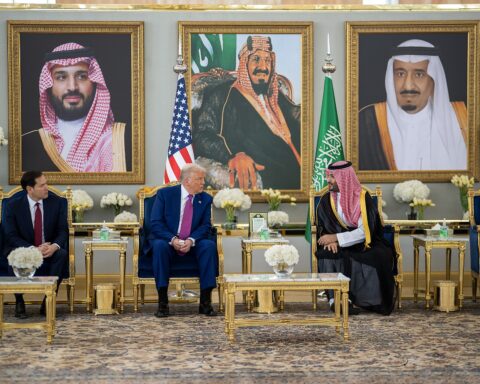
TEHRAN — When Vladimir Putin told Araghchi on April 27 that he had “received a message from the Supreme Leader of Iran,” he confirmed that Mojtaba Khamenei can communicate — but not that he can command. The authorization ceiling that has paralyzed Iranian decision-making since February 28 does not dissolve because a message reached St. Petersburg; it relocates, routing through a foreign head of state what should flow through the Supreme National Security Council and into the IRGC’s operational chain. A diplomatic signal carried by Russia’s president to Iran’s foreign minister is not the same instrument as a binding directive from the Supreme Leader to the commanders who control the missiles, the mines, and the Strait of Hormuz. Iran’s war apparatus has operated for 59 days under a structural ambiguity about who, exactly, is authorized to stop it — and Putin’s disclosure on April 27 did nothing to resolve that question.
Table of Contents
- The St. Petersburg Meeting and What Putin Actually Said
- What Does Khamenei’s Message to Putin Mean for Iran’s Chain of Command?
- The Board Model: How Iran Is Actually Governed
- Why Can’t Iran’s Supreme Leader Issue Direct Orders to the IRGC?
- Araghchi’s 72-Hour Circuit and the Mandate Problem
- What Was Russia’s GRU Director Doing in the Room?
- The JCPOA Precedent: Why Back-Channels Don’t Bind the IRGC
- Two Military Chains, One Contradiction
- Pakistan’s Clock and the Decision-Making Vacuum
- Frequently Asked Questions
The St. Petersburg Meeting and What Putin Actually Said
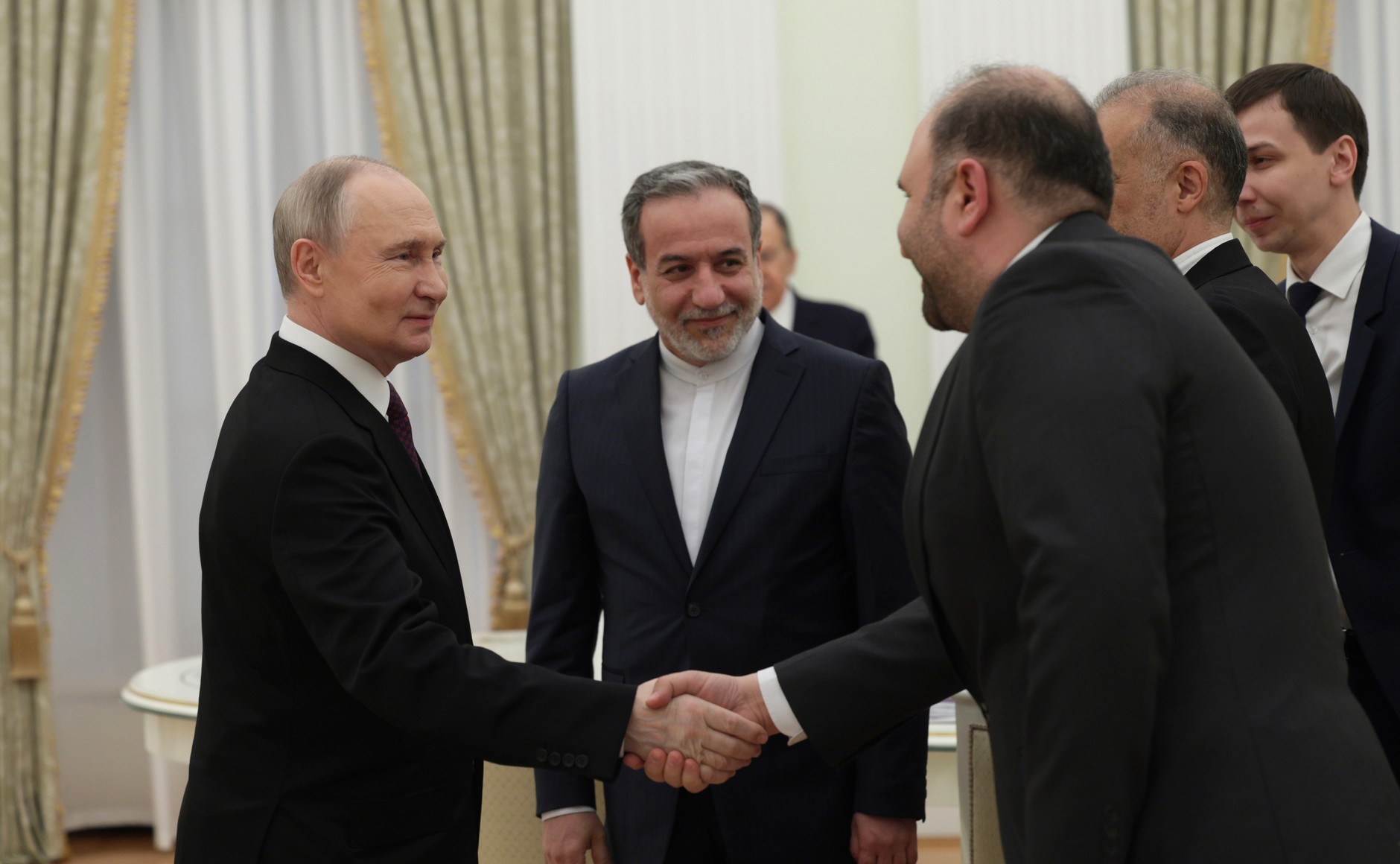
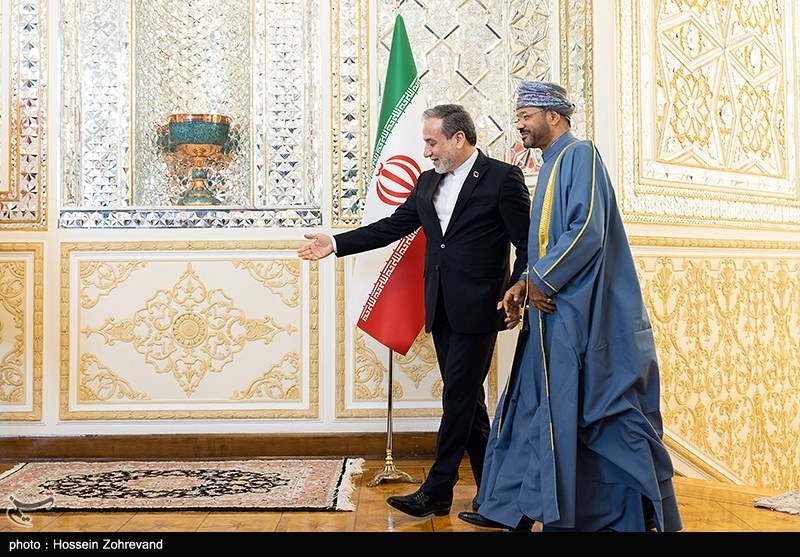
The April 27 meeting at the Boris Yeltsin Presidential Library in St. Petersburg was not a routine bilateral exchange. Putin’s delegation included Foreign Minister Sergei Lavrov, presidential aide Yuri Ushakov, and Admiral Igor Kostyukov, the director of Russia’s military intelligence agency, the GRU. Araghchi arrived with Deputy Foreign Minister Kazem Gharibabadi and Ambassador Kazem Jalali — diplomats, not military commanders. The asymmetry in the two delegations tells its own story: Russia brought its intelligence chief; Iran brought its foreign ministry.
Putin’s language was precise and revealing. “I received a message from the Supreme Leader of Iran,” he said, using the past tense — the message predated April 27, delivered through a separate channel, and the meeting served as acknowledgment of receipt rather than the moment of delivery. He then asked Araghchi to “convey to the Supreme Leader my appreciation for his message and my best wishes for his good health and well-being,” a formulation that simultaneously confirmed communication and raised the question of Mojtaba Khamenei’s physical condition — a leader who had made no verified public appearance since his appointment seven weeks earlier.
Putin added: “We see how courageously and heroically the Iranian people are fighting for their independence and sovereignty… we will do everything that serves your interests so that peace can be achieved as soon as possible.” The Kremlin readout, distributed via TASS within hours, framed the exchange as evidence of deepening Russia-Iran strategic ties — a framing that omitted any reference to Kostyukov’s presence or the military intelligence dimension of the meeting.
What Does Khamenei’s Message to Putin Mean for Iran’s Chain of Command?
Mojtaba Khamenei’s message to Putin confirms the Supreme Leader retains the capacity for diplomatic signaling through trusted foreign intermediaries. It does not confirm he retains the capacity to issue binding operational directives to the IRGC, which operates through a separate institutional channel — the Supreme National Security Council, chaired by SNSC Secretary Ali Akbar Zolghadr, with IRGC Commander Ahmad Vahidi as the dominant military voice.
The distinction between diplomatic communication and operational command is not academic. When Ali Khamenei authorized the 2015 JCPOA, he did so through an explicit public endorsement — his “heroic flexibility” framing — precisely because the IRGC’s institutional leadership understood that a back-channel signal was insufficient to bind their compliance. The public statement served as a direct order to the military establishment, transmitted through Iran’s formal constitutional apparatus, visible to every commander in the chain. A message routed through Putin to Araghchi travels an entirely different circuit: foreign leader to foreign minister, bypassing the SNSC, bypassing Vahidi, bypassing the field commanders who control Iran’s missile batteries and naval mines in the Strait of Hormuz.
The Middle East briefing 3,000+ readers start their day with.
One email. Every weekday morning. Free.
Three Reuters/Al-Monitor sources described Mojtaba’s function in terms that carry direct implications for the Putin channel. His “role is largely to legitimize decisions made by his generals rather than issue directives himself,” they reported on April 28.
The Board Model: How Iran Is Actually Governed
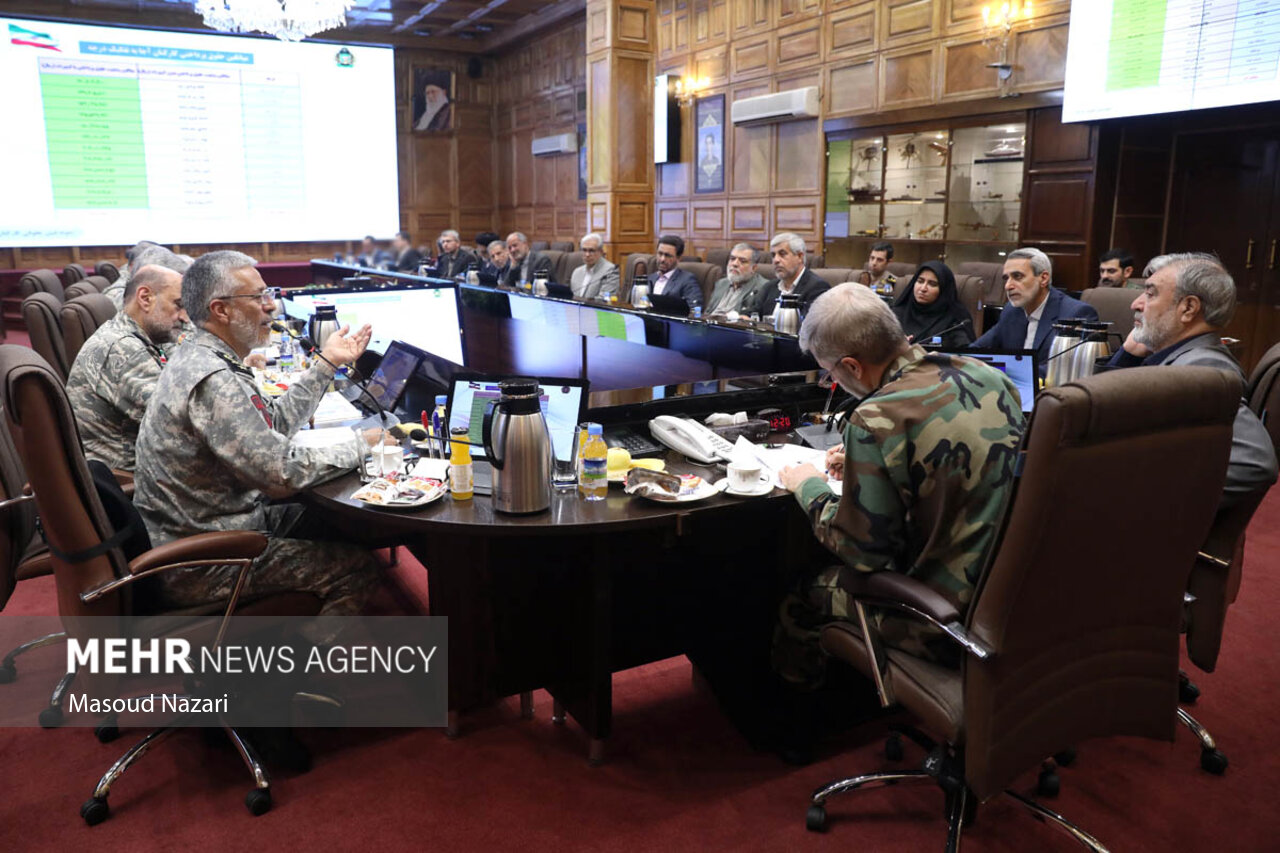
Time magazine reported on April 21 that Iran is now governed under what insiders describe as a “board” model, with Mojtaba operating “as one voice within a broader consensus-building process among security elites.” The board’s other members include Hossein Taeb, the former IRGC intelligence chief who now holds sufficient authority to recall Iran’s negotiating delegation to Tehran; Mohsen Rezaei, the former IRGC commander-in-chief and current Expediency Council secretary; and Ghalibaf, the parliament speaker with his own IRGC Aerospace Force pedigree from 1997 to 2000.
The board governance framework — Taeb, Rezaei, and Ghalibaf operating without constitutional authority to bind the IRGC — is the subject of a dedicated structural analysis: Three Men, No Authority: Iran’s Troika Cannot Deliver the Hormuz Deal Saudi Arabia Needs, which examines why the diffuse command structure that replaced Mojtaba’s formal authority makes any Hormuz agreement constitutionally impossible to ratify.
This governance architecture emerged from physical necessity. Mojtaba Khamenei sustained injuries in the February 28 attack that killed his father: three leg surgeries with a possible prosthesis, burns to his face and lips that may impair speech, and hand surgery. His wife and son were killed in the same strike. He communicates via handwritten notes in sealed envelopes, carried by couriers traveling by car and motorcycle along side roads to avoid electronic tracking, according to Israel Hayom and Tribune India reporting from late April.
The board model means the Putin message likely required consensus approval before dispatch — it was not a unilateral Supreme Leader decision but a product of institutional deliberation among security elites who may disagree on its implications. Taeb’s demonstrated authority to recall the negotiating delegation means any flexibility Araghchi shows in response to the Putin channel can be overridden by a board member who occupies no formal constitutional office but commands sufficient institutional loyalty within the IRGC to countermand the foreign minister.
Why Can’t Iran’s Supreme Leader Issue Direct Orders to the IRGC?
The authorization ceiling — the structural inability of Iran’s diplomatic apparatus to bind its military apparatus to any agreement — persists because Mojtaba Khamenei has not made a single public appearance, issued any verified audio or video statement, or directly addressed the IRGC command structure in 51 days since his appointment on March 8. The IRGC’s chain of command runs from the Supreme Leader’s office through the SNSC to Vahidi and then to field commanders. Without direct, verifiable engagement at the top of that chain, Vahidi has filled the vacuum.
“All critical and sensitive leadership positions must be selected and managed directly by the IRGC until further notice,” Vahidi declared on April 22, a statement reported by Euronews. The phrase “until further notice” establishes the IRGC’s autonomous authority as the default condition, reversible only by an explicit countermand from the Supreme Leader — a countermand that no one inside Iran’s institutional apparatus has received.
President Pezeshkian made this dynamic explicit on April 4 when he publicly named Vahidi and IRGC Quds Force commander Abdollahi as the officials who wrecked the ceasefire by deviating from the negotiating delegation’s mandate. His accusation was a confession of impotence: under Article 110 of Iran’s constitution, the authority to command the IRGC belongs exclusively to the Supreme Leader, not the president. A message routed through Putin — foreign ministry to foreign head of state — carries no more constitutional weight than Pezeshkian’s April 4 public complaint, which the IRGC ignored.
Araghchi’s 72-Hour Circuit and the Mandate Problem
Araghchi’s itinerary between April 25 and April 28 — Islamabad to Muscat to St. Petersburg and back to Islamabad — reveals a foreign minister operating at maximum diplomatic velocity while the system behind him decelerates. His proposal, reported by Axios and the Washington Post on April 27, prioritizes Hormuz reopening and war termination while deferring nuclear negotiations entirely, a framework that Iran formally removed from the current diplomatic agenda on April 26-27.
The Hormuz-first proposal is diplomatically coherent. It is also precisely the kind of flexibility that triggers the authorization ceiling. SNSC Secretary Zolghadr filed a formal complaint, reported by Reuters/Al-Monitor on April 28, that Araghchi “surpassed his mandate” by showing flexibility on regional groups and nuclear enrichment during the earlier Islamabad round. This is not a new pattern: when Araghchi declared Hormuz “completely open” on April 17, the IRGC reversed him within hours through Tasnim, Fars, and Mehr — the same media ecosystem that lawmaker Mahmoudi used to threaten impeachment.
The St. Petersburg stop adds a layer. By meeting Putin and delivering the Supreme Leader’s message, Araghchi acquires the appearance of operating with the highest possible authorization. But the appearance of authorization and its institutional reality are different things. Hossein Taeb retains the demonstrated ability to recall the delegation. Zolghadr has already complained formally about mandate violations. Vahidi’s “until further notice” declaration, reported by Euronews on April 22, remains the operative framework for IRGC command decisions.
What Was Russia’s GRU Director Doing in the Room?
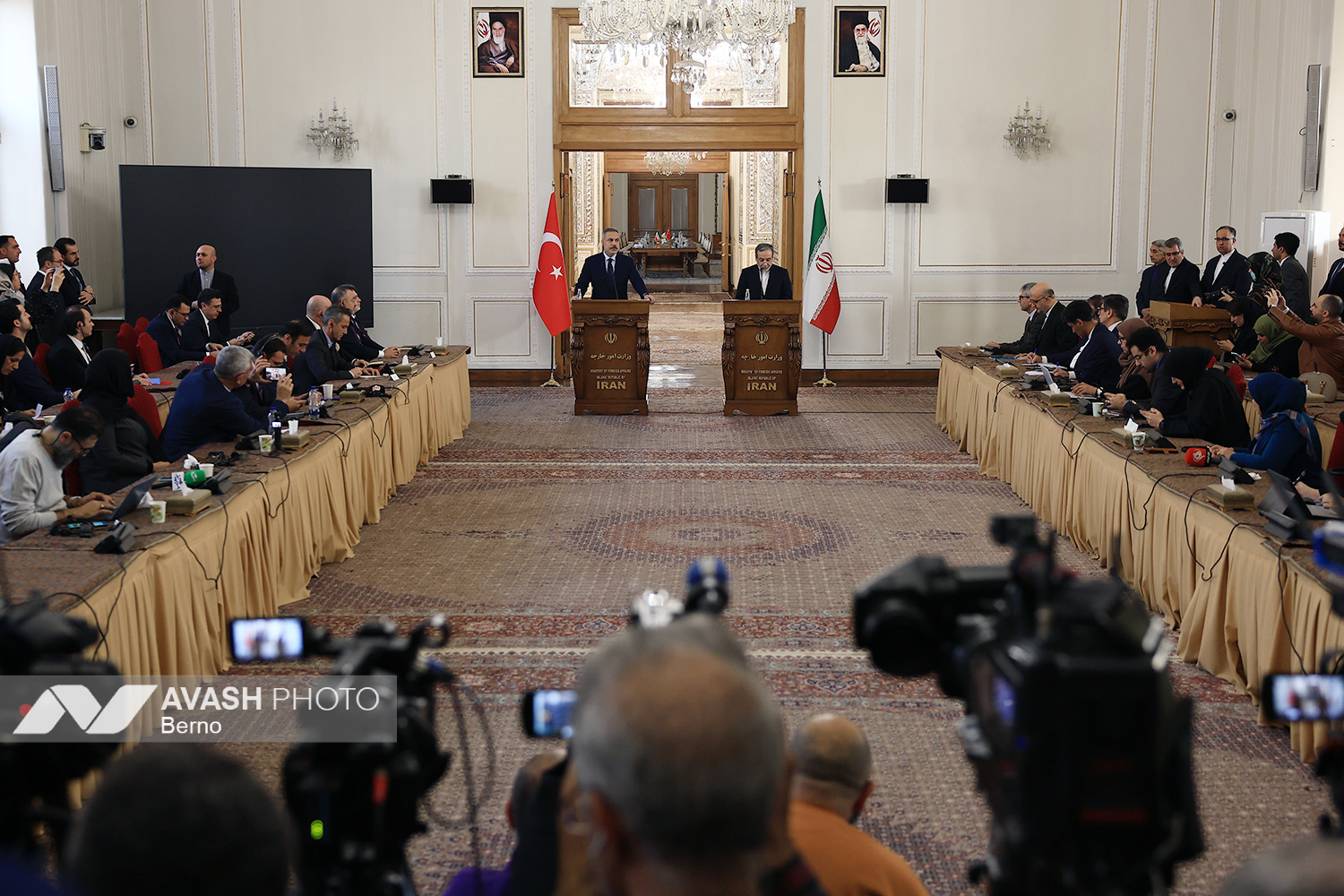
Admiral Igor Kostyukov’s presence at a meeting ostensibly about a Supreme Leader’s diplomatic message is the detail that competing coverage has largely ignored. Kostyukov runs Russia’s military intelligence agency, the GRU, which the Washington Post reported on March 6 has been providing Iran with targeting intelligence on U.S. military assets — ship positions, aircraft locations — since February 28, a flow of information that has “allegedly improved Iran’s precision strike capabilities.”
A GRU director does not attend a diplomatic courtesy call. Kostyukov’s inclusion means the meeting had a military intelligence dimension that the Kremlin readout, focused entirely on Putin’s warm words about Khamenei’s message, did not disclose. The Iranian side brought no military equivalent — no IRGC representative, no defense ministry official, no intelligence counterpart. Araghchi’s delegation was composed entirely of foreign ministry diplomats.
This asymmetry raises a question the Putin message framing obscures: is Russia simultaneously facilitating Iran’s diplomatic track through the foreign ministry channel while sustaining its military track through the GRU intelligence channel? Al-Monitor was the only outlet to connect Kostyukov’s presence to the broader military intelligence relationship, but even that reporting stopped short of examining what it means for the authorization ceiling. If Kostyukov’s targeting intelligence continues to flow to IRGC field commanders — commanders who are not bound by whatever Araghchi negotiates in Islamabad — then the St. Petersburg meeting served two functions that operate at cross-purposes: Putin receives the Supreme Leader’s peace message while providing the targeting data for the next strike through a separate institutional channel the Kremlin readout did not mention. The Russia-as-custodian relationship runs on the same dual-track logic that has defined Iran’s own fractured command structure since February 28.
The JCPOA Precedent: Why Back-Channels Don’t Bind the IRGC
The history of Supreme Leader communication through indirect channels is a history of IRGC non-compliance. Between 2012 and 2014, President Obama sent multiple back-channel letters to Ali Khamenei through the Oman channel — the same intermediary framework that has functioned for decades at the foreign minister and presidential level. Throughout the entire period of active back-channel communication, IRGC Quds Force operations continued uninterrupted in Iraq, Syria, Lebanon, and Yemen. The letters changed nothing about IRGC behavior because they traveled through a diplomatic channel the IRGC treats as separate from its operational chain of command.
When Hassan Rouhani spoke with Obama by phone in September 2013 — the first direct U.S.-Iran presidential communication since 1979 — he claimed “full authority” to negotiate. The authorization was never made explicit through the formal Supreme Leader-to-IRGC channel. IRGC hardliners attacked Rouhani on his return to Tehran, and the nuclear negotiations required two more years of painstaking work before the 2015 JCPOA was finalized. Even then, the deal held only because Ali Khamenei issued his public “heroic flexibility” endorsement — a statement made directly, visibly, through Iran’s domestic institutional apparatus, not through a foreign intermediary.
Mojtaba Khamenei’s message to Putin inverts every element of the 2015 precedent: private rather than public, routed through Moscow rather than the SNSC, delivered to a foreign minister the IRGC has already overruled multiple times. The method compounds the problem — handwritten notes carried by motorcycle couriers on side roads preserve physical security at the expense of the institutional visibility the IRGC’s compliance history requires. Ali Khamenei’s 2015 endorsement required standing before cameras and spending domestic political capital in full view of the military establishment. The 2026 channel runs in the opposite direction, through a third country’s president, at maximum deniability and minimum institutional authority.
Two Military Chains, One Contradiction
On April 28, the day after Putin disclosed the Khamenei message, Iranian Army spokesman Akraminia declared that “conditions remain those of wartime.” This statement, reported by ABC7, came from the Regular Army — a separate institutional chain from the IRGC, with its own command structure, its own assessment of the battlefield, and its own posture toward the diplomatic track. Iran now has two military establishments publicly contradicting its foreign minister’s peace circuit, each through distinct institutional channels.
The IRGC Navy’s “full authority” declaration over the Strait of Hormuz, issued on April 5 and reiterated on April 10 while Araghchi was in Islamabad, established the IRGC’s autonomous operational posture. The IRGC Navy commander who authorized the declaration — Rear Admiral Ali Tangsiri — was killed on March 30, and as of April 28, no named successor has been publicly announced. The command is headless but operational, executing standing orders from a dead commander in an institutional framework where the Supreme Leader’s direct engagement would be required to change those orders.
Vahidi sits at the apex of this structure, but his authority derives from the vacuum above him, not from a formal delegation of Supreme Leader powers. The distinction matters because any ceasefire agreement requires someone with the institutional authority to order the IRGC Navy to stand down in Hormuz, the IRGC Aerospace Force to halt missile operations, and IRGC field commanders across the theater to observe the terms. Araghchi cannot issue those orders. Pezeshkian has publicly admitted he cannot. And Pakistan, the only remaining enforcement mechanism, has no institutional leverage over any of these commanders.
Pakistan’s Clock and the Decision-Making Vacuum
The Pakistani assessment of Iran’s internal dysfunction is the most operationally consequential data point to emerge from the April 28 Reuters/Al-Monitor reporting. A senior Pakistani official involved in the mediation described the Iranian side in terms that quantify the authorization ceiling’s practical effects: “The Iranians are painfully slow in their response. There is apparently no one decision-making command structure. At times, it takes them 2 to 3 days to respond.”
Two to three days per response cycle means the 72-hour diplomatic windows that Araghchi’s shuttle diplomacy creates are consumed almost entirely by internal Iranian deliberation. By the time a consensus position emerges from the board model — requiring alignment among Mojtaba, Taeb, Rezaei, Ghalibaf, and Vahidi, with Zolghadr monitoring mandate compliance — the diplomatic context may have shifted. The Mashhad mural incident, in which Putin first referenced the Khamenei message, demonstrated how quickly the information environment moves while Tehran’s internal clock runs at its own pace.
This temporal mismatch has direct consequences for the ceasefire framework. Araghchi can propose Hormuz-first sequencing in Islamabad, fly to Muscat to secure Omani endorsement, present the Supreme Leader’s backing in St. Petersburg, and return to Islamabad — all within 72 hours. The IRGC’s response to any agreement he reaches will take two to three days to formulate, during which field commanders operate under Vahidi’s “until further notice” standing orders and the Regular Army’s “conditions remain those of wartime” posture. The senior Pakistani mediator’s April 28 assessment — “painfully slow,” “no one decision-making command structure,” two to three days per response — is not a diplomatic complaint. It is a description of a system where the question of who is authorized to say yes has not been resolved in 59 days of war.
“The Iranians are painfully slow in their response. There is apparently no one decision-making command structure. At times, it takes them 2 to 3 days to respond.” — Senior Pakistani official involved in mediation, April 28, 2026
Frequently Asked Questions
Did Khamenei’s message to Putin contain specific ceasefire terms?
The Kremlin readout did not disclose the message’s content, and no Iranian source has published its terms. The message was delivered to Russia’s president through the foreign ministry channel, not to military counterparts through intelligence channels — the routing itself indicates it was not operationally specific. The board model’s consensus requirement, combined with the Pakistani mediator’s observation that Iran takes two to three days per decision cycle, means that a message containing specific operational terms would have required days of internal deliberation before dispatch; the April 27 timing, given other known constraints on the board’s agenda, makes a general diplomatic signal the more probable content.
Can Russia enforce Iranian compliance with any agreement Araghchi negotiates?
Russia has no institutional mechanism to compel IRGC compliance. The GRU intelligence relationship — targeting data on U.S. military assets flowing since February 28 — gives Moscow leverage over Iran’s military operations but not the kind that translates into enforcement of diplomatic commitments. Historically, Soviet and Russian leverage over Iranian military decision-making has been limited to arms supply conditionality, and even that mechanism failed to constrain IRGC operations during the 1980-88 Iran-Iraq War when Moscow was supplying both sides. Putin’s April 27 framing — “we will do everything that serves your interests” — positions Russia as a facilitator, not an enforcer, leaving the enforcement gap that has defined the authorization ceiling problem since the war’s earliest weeks.
Why did Iran remove nuclear negotiations from the current agenda?
Iran’s formal removal of nuclear talks on April 26-27 aligns with IRGC institutional preferences: Tasnim reported that Araghchi’s visits would not include nuclear negotiations, a framing consistent with Vahidi’s resistance to any constraints on enrichment capacity. The removal also reflects the collapse of external leverage mechanisms — the E3 snap-back was triggered on August 28, 2025, reimposed September 27-28, and the mechanism itself expired on October 18, 2025, meaning the international community’s primary non-military nuclear enforcement tool no longer exists. Iran holds 440.9 kilograms of uranium enriched to 60 percent as of June 2025, the last date IAEA inspectors had access before Iran terminated monitoring on February 28, 2026. The deferral puts the nuclear file beyond the reach of any near-term ceasefire framework.
How does the courier communication system affect Mojtaba Khamenei’s authority?
The system degrades institutional authority in three specific ways that the physical security rationale does not offset. First, it eliminates real-time responsiveness: hours of latency on each message cycle compounds the Pakistani mediator’s two-to-three-day decision lag, meaning the board’s response time is partly a function of courier travel, not just deliberation. Second, it prevents verification — a handwritten note’s authenticity depends entirely on the courier chain’s integrity, which the board members who receive the notes have every institutional incentive to interpret flexibly when it suits their position. Third, it makes the “heroic flexibility” model of 2015 physically impossible: Ali Khamenei’s public television endorsement worked because the IRGC could see it; a note arriving by motorcycle on a rural highway carries none of that institutional visibility, and the IRGC’s compliance history suggests it demands the former, not the latter.
What would it take to actually lower the authorization ceiling?
The 2015 JCPOA precedent establishes the minimum threshold: a public, verifiable statement from the Supreme Leader, transmitted through Iran’s domestic institutional apparatus, explicitly authorizing the IRGC to comply with specific terms. For Mojtaba, this would require either a video appearance — which his injuries may preclude — or a formal written decree delivered through the SNSC to Vahidi and published domestically, carrying the Supreme Leader’s seal and authenticated through channels the IRGC recognizes as binding. A message relayed through Putin, however diplomatically useful, does not meet any element of this threshold. The gap between what Mojtaba can communicate and what the IRGC is institutionally required to obey remains the defining structural constraint of the war’s diplomatic track.