{“content”: “
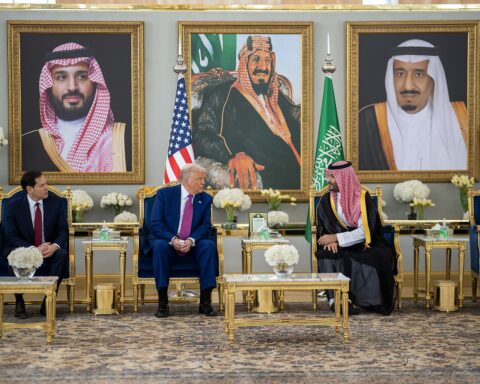
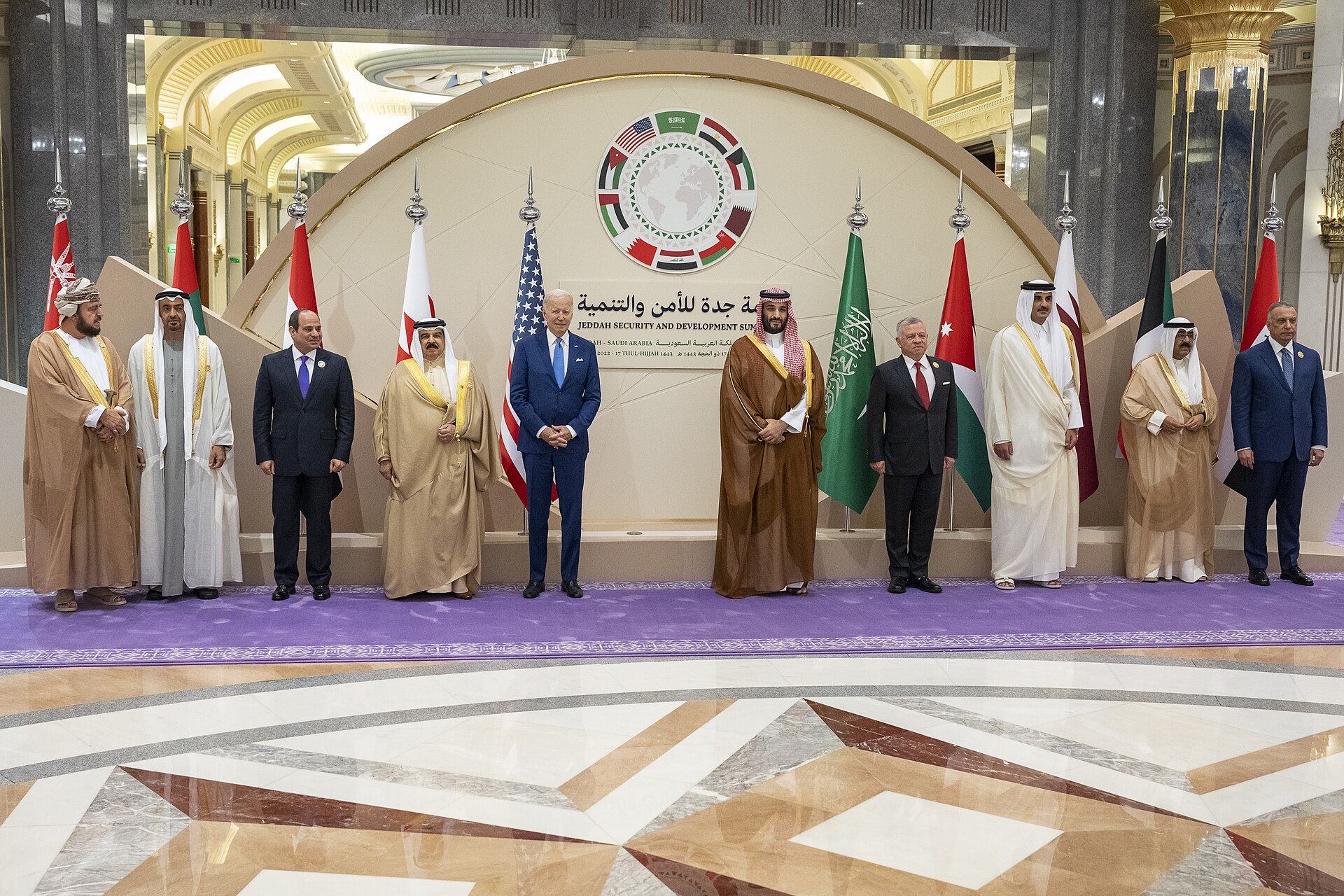
JEDDAH u2014 Mohammed bin Salman chaired the GCC’s first wartime summit on April 28, secured a collective-defense declaration that formally treats an attack on any member state as an attack on all six, and ordered the creation of a Gulf Strategic Reserve u2014 all on the same day the UAE announced it was quitting OPEC after 59 years, and its president did not bother to show up. The Jeddah “Decisiveness Summit” produced the most aggressive collective security communique in the GCC’s 45-year history, invoking UN Charter Article 51 and shifting the alliance’s stated posture from de-escalation to “Maximum Readiness.” But the most revealing signal came not from what was said inside the room, but from who was missing from it u2014 and what Abu Dhabi announced while the communique was still being drafted.
n
Five summit outputs, the structural gap between their ambition and enforcement history, the UAE’s simultaneous OPEC exit as counter-programming, and what the Gulf Strategic Reserve directive reveals about Riyadh’s timeline assumptions for the Strait of Hormuz u2014 each of these deserves examination in turn.
n
The Middle East briefing 3,000+ readers start their day with.
One email. Every weekday morning. Free.
Table of Contents
n
- n
- What Did the GCC “Decisiveness Summit” Actually Declare?
- The Article 51 Invocation and Its Enforcement Problem
- Why Was MBZ Absent from the Jeddah Summit?
- The UAE’s OPEC Exit as Strategic Counter-Programming
- What Does the Gulf Strategic Reserve Tell Us About Hormuz?
- The Gulf Railway Directive and Wartime Infrastructure Logic
- Araghchi in Moscow: Iran’s Counter-Offer
- The Gargash Speech That Preceded the Summit
- What the Summit Cannot Fix
- Frequently Asked Questions
- n
n
n
n
n
n
n
n
n
n
n
n
n
n
What Did the GCC “Decisiveness Summit” Actually Declare?
n
The 19th GCC Consultative Meeting, formally designated the “Decisiveness Summit,” produced five directives that collectively represent the sharpest pivot in Gulf collective security posture since the organization’s founding in Abu Dhabi on May 25, 1981. MBS chaired the proceedings in Jeddah on April 28-29, with Qatar’s Emir Sheikh Tamim bin Hamad Al Thani, Bahrain’s King Hamad bin Isa Al Khalifa, and Kuwait’s Crown Prince Sheikh Sabah Khaled Al Hamad Al Sabah attending in person. The UAE sent Foreign Minister Abdullah bin Zayed u2014 not President Mohammed bin Zayed.
n
The centrepiece declaration u2014 “Our Security is a Red Line; Any Attack on One is an Attack on All” u2014 invoked UN Charter Article 51, the self-defence provision that authorises collective military action in response to armed attack. The communique formally shifted GCC posture “from de-escalation to Maximum Readiness,” the first time the alliance has codified an elevated collective military footing in its institutional language. GCC Secretary-General Jasem Mohamed Albudaiwi used the platform to state that the council “categorically rejected the illegal Iranian measures to close the Strait of Hormuz,” describing Iran’s actions as violations of “international law, the UN Charter, and principles of good neighbourliness.”
n
Three additional directives accompanied the security declaration: the immediate establishment of a Gulf Strategic Reserve for commodities and fuel (no capacity figure was publicly specified), the “accelerated completion” of a Unified Early Warning System for ballistic missiles and UAVs, and the “urgent execution” of the 2,177-kilometre Gulf Railway network at an estimated cost of $250 billion, with a December 2030 target and the Doha-Riyadh segment earmarked for June 2026 operations. Sheikh Tamim described the gathering as embodying “the unified Gulf position toward current developments, requiring intensified coordination and consultation.”
n
The context for all five directives is the Iran war, now in its 60th day. GCC states have collectively endured approximately 5,655 missiles and drones across all member states since hostilities began on February 28. Saudi Arabia’s oil production crashed 30 per cent between February and March, falling from 10.4 million barrels per day to 7.25 million bpd according to the IEA. Brent crude sat at $111.16 on April 28, barely above the kingdom’s fiscal break-even of $108-111 per barrel.
n
n
The Article 51 Invocation and Its Enforcement Problem
n
The “attack on one is an attack on all” language is not new to GCC institutional architecture u2014 it is a restatement of the 2000 Joint Defence Agreement signed in Manama on December 31, 2000. That agreement, modelled on NATO’s Article 5, committed member states to “proceed promptly to assist any State…that suffers aggression…by taking any necessary action, including the use of military force,” according to Qatar’s Al Meezan legal portal. The Decisiveness Summit’s contribution is not the principle but the timing: this is the first collective defence communique issued after actual simultaneous multi-state external attacks, transforming the doctrine from deterrent theory to post-attack codification.
n
The enforcement gap, though, has not closed. The 2000 JDA was modelled on NATO Article 5 but omitted NATO’s automatic trigger mechanism. Activation remains opt-in u2014 and the GCC’s track record on collective action under the JDA is precisely one deployment in 25 years. When Saudi Arabia sent roughly 1,000 troops and the UAE contributed approximately 500 police to Bahrain in March 2011 under the Peninsula Shield Force banner, Kuwait and Oman sent no ground troops at all. That intervention was framed as an internal-security response to the Arab Spring protests, the inverse of the 2026 external-threat scenario, but it exposed the structural reality that GCC collective defence has always functioned as a Saudi-led coalition of the willing rather than an automatic alliance.
n
The Peninsula Shield Force itself tells the story. Created between 1982 and 1984 with an initial strength of 10,000 soldiers, it proved what analysts have described as “virtually useless” during Iraq’s invasion of Kuwait in 1990. That structural gap persists: on April 24, 2026, Iraq-based fiber-optic drone strikes on Kuwait’s northern border posts exposed a threat corridor the GCC’s entire air defence architecture was not designed to face. The GCC Unified Military Command was renamed from “Joint Peninsula Shield Forces Command” in 2021 u2014 a symbolic upgrade that added no structural integration. Hesham Alghannam of the Carnegie Middle East Center wrote in February 2026 that the GCC “lacks unifying frameworks for economic and political pursuits” despite its founding mandate, and that “persistent tension between collective security aspirations and intra-GCC political rivalries has hampered” joint defence initiatives.
n
What the Decisiveness Summit changes is the political calculus around opt-in. When the 2000 JDA was a theoretical commitment, a member state could decline activation without political cost because no attack had occurred. After 5,655 missiles and drones across multiple member states, declining to act on the “attack on one” clause would constitute a visible defection u2014 one that the absent UAE president’s empty chair has already previewed.
n
Why Was MBZ Absent from the Jeddah Summit?
n
Mohammed bin Zayed Al Nahyan, President of the UAE and ruler of Abu Dhabi, did not attend the first in-person GCC summit since the Iran war began. He sent Foreign Minister Abdullah bin Zayed in his place. Semafor described the absence as an “intentional snub” to MBS, delivered on the same day Abu Dhabi announced the UAE’s departure from OPEC u2014 a pairing of signals whose simultaneity was, as Anwar Gargash might put it, “a premeditated plan, not a decision made in 24 or 48 hours.”
n
The MBZ absence is the detail that makes the rest of the summit legible. A collective-defence declaration means something different when one of the six signatories u2014 the one with the second-largest military in the Gulf and a production capacity of 4.85 million bpd u2014 sends its foreign minister to sign on its behalf. The “attack on one is an attack on all” clause, already weakened by the 2000 JDA’s opt-in structure, becomes a statement of aspiration rather than capability when the state best positioned to contribute to collective action is simultaneously signalling its independence from the Saudi-led institutional framework.
n
Mehran Haghirian, Director of Research at the Bourse & Bazaar Foundation, assessed on April 14 that “no unified GCC approach to managing the crisis or its aftermath has emerged,” and that “the war reinforced existing positions rather than creating consensus.” MBZ’s absence is the physical manifestation of that assessment. The UAE has pursued a distinct Iran policy for years u2014 the 2019 drawdown from Yemen, the 2023 rapprochement with Tehran, the consistent resistance to Saudi-led escalation frameworks u2014 and the war has not changed Abu Dhabi’s calculation that its security is better served by bilateral hedging than by collective commitment under Saudi chairmanship.
n
Andrew Leber of Carnegie wrote in March 2026 that “only collective action among the GCC states is likely to get them out of this dilemma.” The Decisiveness Summit was MBS’s attempt to create the institutional framework for that collective action. MBZ’s response was to skip it and announce an OPEC exit instead.
n
The UAE’s OPEC Exit as Strategic Counter-Programming
n
The UAE announced its withdrawal from OPEC and OPEC+ on April 28, effective May 1, ending 59 years of membership dating to 1967. UAE Energy Minister Suhail Al Mazrouei framed the exit as a “policy-driven evolution aligned with long-term market fundamentals.” ADNOC CEO Sultan Al Jaber called it “sovereign” and aligned with the UAE’s “long-term energy strategy.” Neither statement addressed the timing u2014 which is the only part that matters.
n
The numbers tell the strategic story. UAE production capacity stands at 4.85 million bpd. Its March 2026 production was 1.9 million bpd, a 44 per cent decline from its pre-war output of roughly 3.4 million bpd, with approximately 1.3 million bpd of near-term rampable spare capacity available above its current depressed output level. Outside OPEC’s quota system, Abu Dhabi is now free to increase production unilaterally u2014 a direct challenge to Saudi Arabia’s price-management architecture at the precise moment Riyadh can least afford a price war. Saudi production has already crashed to 7.25 million bpd, Goldman Sachs has estimated the kingdom’s war-adjusted fiscal deficit at 6.6 per cent of GDP (against the official 3.3 per cent projection), and Brent is sitting barely above the $108-111 fiscal break-even that includes PIF expenditure.
n
The Washington Post framed the exit as “a blow to Saudi Arabia” driven by wartime opportunism and long-standing quota resentment. That captures the economics but misses the institutional signal. By announcing the OPEC exit on the same day as the Decisiveness Summit, Abu Dhabi delivered a message that no amount of collective-security language can obscure: the UAE is willing to participate in GCC security declarations (via its foreign minister) while simultaneously dismantling the Saudi-led economic coordination framework (via its energy ministry). The OPEC exit and the summit attendance were not contradictions u2014 they were a coherent statement of UAE strategic autonomy, timed for maximum legibility.
n
No major news outlet connected both events as a unified signal. Reuters covered the summit as a response to Iranian strikes without surfacing MBZ’s absence or the OPEC exit timing. Al Jazeera ran the summit and the OPEC exit as separate stories. The National, Abu Dhabi’s English-language paper of record, covered both with continuity framing. Only Semafor named the MBZ absence as an “intentional snub” u2014 and even Semafor treated the OPEC exit as a parallel development rather than the second half of a coordinated statement. The absence of Saudi consultation before the OPEC announcement confirmed what the empty chair already suggested. The full timeline of the withdrawal — from Abu Dhabi’s 2021 quota dispute through the formal May 1 exit — and its consequences for Saudi price management are documented in UAE Exits OPEC After 59 Years, Stripping Saudi Arabia of Its Last Enforcement Lever.
n
n
What Does the Gulf Strategic Reserve Tell Us About Hormuz?
n
The directive to establish a Gulf Strategic Reserve for commodities and fuel is, on paper, a prudent wartime measure. No capacity figure was publicly specified, no timeline was given beyond “immediate establishment,” and no institutional architecture was announced. But the directive’s existence encodes an assumption that is more revealing than its details: the GCC is planning for a prolonged period in which the Strait of Hormuz does not function as a commercial shipping corridor.
n
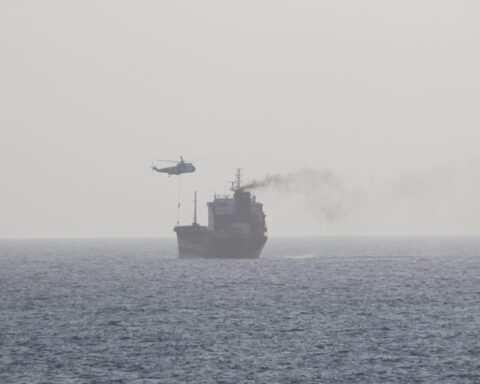
The current state of Hormuz supports that assumption. Approximately 45 vessels have transited the strait since the April 8 ceasefire u2014 3.6 per cent of the pre-war baseline, according to shipping data compiled in the double-blockade analysis. The IEA’s Fatih Birol has described 13 million bpd offline globally as “the biggest energy security threat in history.” The IRGC published charts designating the standard shipping lanes as a danger zone and redirected vessels into a 5-nautical-mile channel between Qeshm and Larak islands, inside Iranian territorial waters. Iran’s Foreign Minister Araghchi declared the strait “completely open” on April 24, but the IRGC seized the MSC Francesca (11,660 TEU) and the Epaminondas (6,690 TEU) on April 22, two days before that declaration. Speaker Ghalibaf formally linked Hormuz reopening to the removal of the US naval blockade on the same day.
n
Saudi Arabia’s existing bypass infrastructure u2014 the East-West Pipeline running to Yanbu on the Red Sea u2014 has an effective loading ceiling of 5.9 million bpd against a pre-war Hormuz throughput of 7-7.5 million bpd, leaving a structural gap of 1.1-1.6 million bpd that no pipeline expansion can close within the war’s timeline. The Gulf Strategic Reserve directive implicitly acknowledges this gap. If Hormuz were expected to reopen within weeks, a strategic reserve would be a bureaucratic exercise. The fact that MBS pushed it through as a summit-level directive, alongside missile defence acceleration and railway urgency, suggests Riyadh’s planning horizon for Hormuz closure extends well beyond the current ceasefire’s April 22 expiry u2014 and possibly beyond the Hajj season that begins with the Makkah cordon sealing on April 18.
n
Mine clearance alone would require an estimated 51 days based on the 1991 Kuwait benchmark, covering approximately 200 square miles of waterway, with only two Avenger-class mine countermeasure ships remaining in theater after the US Navy decommissioned four from Bahrain in September 2025. The strategic reserve is not preparation for a temporary disruption u2014 it is infrastructure for a new normal.
n
The Gulf Railway Directive and Wartime Infrastructure Logic
n
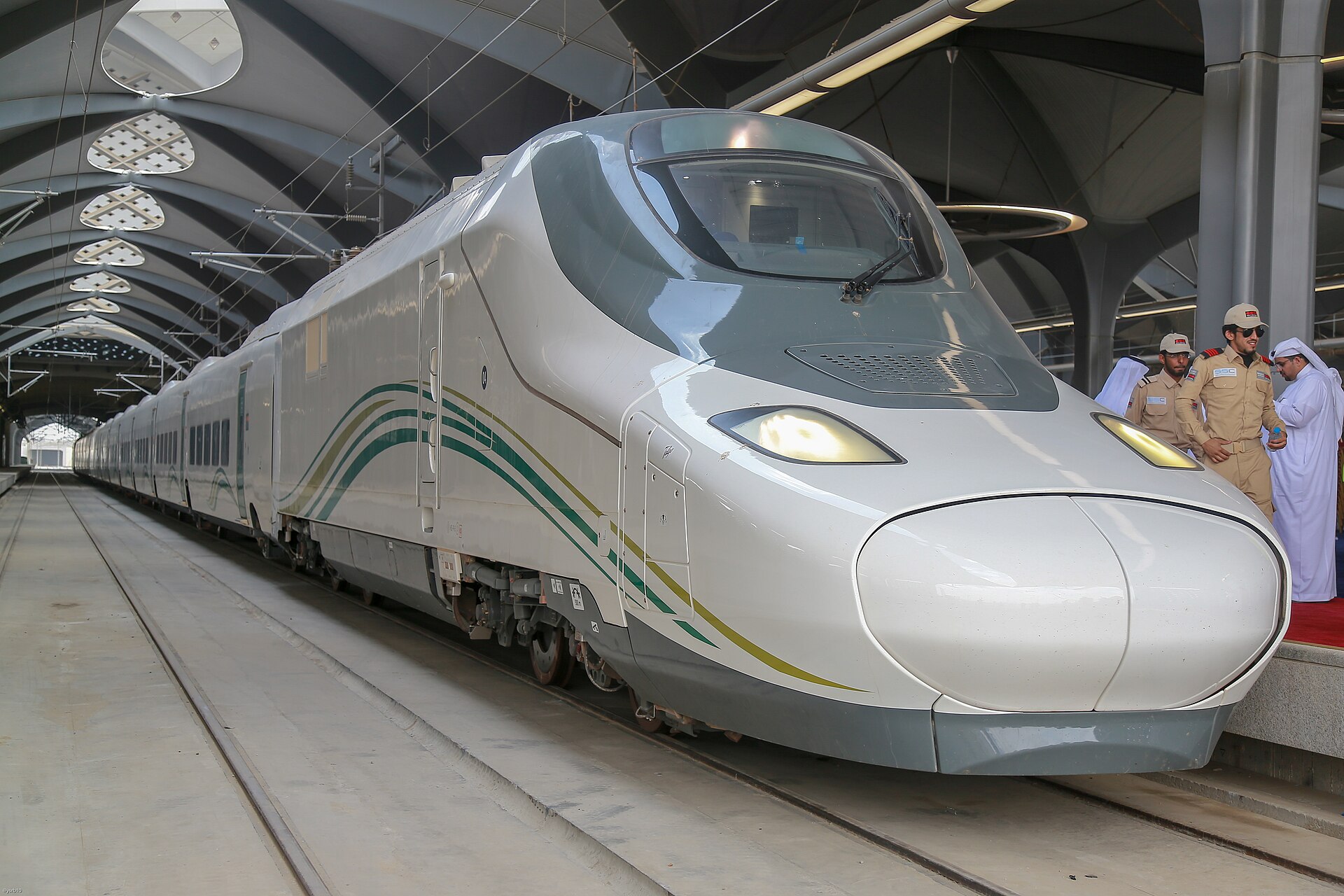
The “urgent execution” directive for the Unified Gulf Railway transforms a long-delayed infrastructure project into a wartime priority. The 2,177-kilometre network, with an estimated cost of $250 billion and a December 2030 completion target, would connect all six GCC capitals. The Doha-Riyadh segment is targeted for June 2026 operations u2014 less than two months from the summit date, a timeline that suggests the segment was already near completion before the war accelerated its political urgency.
n
The railway’s military logic is straightforward. The war has demonstrated that maritime shipping through Hormuz is now a contested corridor, aviation operates under persistent drone and missile threat (GCC airspace restrictions remain in place across multiple member states), and road infrastructure u2014 as the King Fahd Causeway closure on April 7 demonstrated u2014 is vulnerable to single-strike interdiction. A rail network running through interior desert terrain offers a transport corridor that is harder to interdict than a bridge, harder to blockade than a strait, and harder to close than airspace. The $250 billion price tag, which would have been politically difficult to justify in peacetime, becomes defensible when the alternative is 3.6 per cent of pre-war Hormuz throughput.
n
The June 2026 Doha-Riyadh target also carries a diplomatic signal. Qatar and Saudi Arabia restored relations in January 2021 after the 2017-2021 blockade, but economic integration has moved slowly. A functioning rail link between the two capitals within two months would represent the most tangible bilateral infrastructure the rapprochement has produced u2014 and it would give Qatar, which has its own LNG-export vulnerability through Hormuz, a physical connection to Saudi Arabia’s Red Sea bypass corridor. Sheikh Tamim’s presence at the summit, and his endorsement of the “unified Gulf position,” reads differently when a Doha-Riyadh railway is eight weeks from operation.
n
n
Araghchi in Moscow: Iran’s Counter-Offer
n
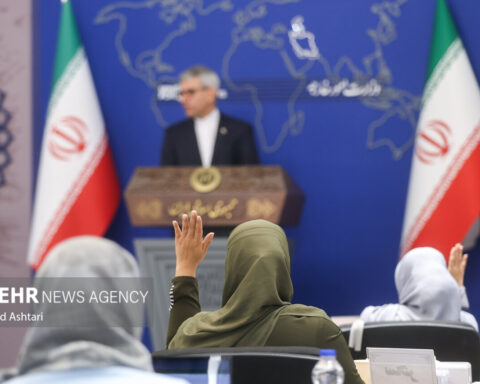
While MBS chaired the Decisiveness Summit in Jeddah, Iran’s Foreign Minister Abbas Araghchi was in Moscow on April 27-28, meeting Vladimir Putin and pitching what he described as “endogenous collective security mechanisms free from American intervention.” The counter-programming was deliberate. The same logic applies at the bilateral level: how Iran has engineered the Saudi-UAE split — using private disclosures of threats against Abu Dhabi as a weapon inside Riyadh rather than a warning to the Emirates — runs parallel to Tehran’s broader effort to prevent coherent GCC collective action. Iran’s preferred response to the GCC’s US-anchored collective defence model is not a rival military alliance but an alternative security order in which littoral states u2014 meaning Iran u2014 manage the Strait of Hormuz through self-financing toll mechanisms and bilateral navigation agreements, without American naval presence.
n
The Araghchi proposal inverts the GCC framework on every axis. Where the Decisiveness Summit invoked UN Charter Article 51 and implied US security guarantees, Iran offers regional autonomy. Where the GCC communique “categorically rejected” Iran’s Hormuz measures, Araghchi’s framework would legitimise IRGC control of the strait as sovereign coastal-state management. Where MBS pushed for a Unified Early Warning System to defend against Iranian missiles, Araghchi pitched Moscow as a guarantor of a security order in which the missiles would not need to fly because Iran’s maritime authority would be recognised by treaty.
n
The Moscow venue is itself a signal. Russia has its own interests in a non-American Gulf security architecture u2014 reduced US naval presence increases Russian diplomatic leverage, and Iran’s continued oil exports under sanctions evasion serve Russian interests by keeping alternative supply on the market. Putin’s willingness to host Araghchi during the GCC summit suggests Moscow is positioning itself as the broker for Iran’s counter-framework, just as Pakistan has positioned itself as the broker for ceasefire enforcement. Neither broker has the leverage to deliver what they are selling, but both are accumulating diplomatic equity from the attempt.
n
Qatar’s FM spokesman Majed Al-Ansari offered the most direct response to the dual-framework competition: “We do not want to see a frozen conflict that ends up being thawed every time there is a political reason.” That formulation acknowledges what neither the Jeddah communique nor the Moscow pitch addresses u2014 that collective security declarations and counter-proposals alike are meaningless if the underlying conflict remains unresolved. The full implications of that warning u2014 including why Qatar’s 80 billion QIA buffer means Doha can survive a frozen Hormuz that would be fiscal catastrophe for Riyadh u2014 are examined in Qatar Named the Failure Mode. Saudi Arabia Is Living It.
n
The Gargash Speech That Preceded the Summit
n
The most candid assessment of the GCC’s strategic position came not from the summit itself but from Anwar Gargash, the UAE’s Presidential Diplomatic Adviser, speaking at the Gulf Creators forum at Atlantis The Palm in Dubai on April 27 u2014 one day before the Decisiveness Summit opened. Gargash delivered four statements that, taken together, constitute the most extraordinary public admission of collective failure by a senior Gulf official since the 2003 Iraq invasion.
n
n
“Unfortunately, the GCC’s position is the weakest in history, considering the nature of the attack and the threat it poses.”
n
u2014 Anwar Gargash, UAE Presidential Diplomatic Adviser, Gulf Creators forum, April 27, 2026n
n
n
He followed that with a structural indictment: “Every Gulf state has pursued a policy of containing Iran, and all of those containment policies have failed…They have failed miserably.” He described the Iranian attack as “a premeditated plan, not a decision made in 24 or 48 hours,” and declared that “we have never witnessed, in the history of the Gulf, an Iranian attack of this scale, scope and ferocity.” These are not the words of a diplomat preparing his president’s attendance at a unity summit the following morning u2014 they are the words of an official pre-framing his president’s absence.
n
Gargash’s speech operates on two levels. As public analysis, it is accurate: the GCC’s position is historically weak, containment has failed, and the Iranian attack was unprecedented. As political positioning, it explains why MBZ stayed home. If the GCC’s position is “the weakest in history” and every containment policy has “failed miserably,” then a collective-defence declaration is an exercise in institutional performance rather than strategic substance u2014 and Abu Dhabi’s time is better spent repositioning unilaterally (OPEC exit, bilateral hedging, maintaining its own Iran back-channel) than committing to a framework Gargash has just publicly described as failed.
n
The speech also contains a buried challenge to MBS. By saying “every Gulf state” pursued failed containment, Gargash included Saudi Arabia u2014 the state that chairs the summit, commands the largest military, produces the most oil, and has driven GCC Iran policy for decades. The Decisiveness Summit was MBS’s answer to that charge: new institutions, new commitments, new urgency.
n
What the Summit Cannot Fix
n
The Decisiveness Summit produced real institutional outputs u2014 the collective-defence declaration, the strategic reserve directive, the railway acceleration, the early-warning system mandate. These are not empty gestures. They represent genuine bureaucratic momentum toward the kind of integrated Gulf security architecture that analysts like Andrew Leber at Carnegie have argued is the only viable path forward. The TASI closed at roughly 11,180 on April 28, up 0.10 per cent on the day and 5.52 per cent for April u2014 its 2026 high u2014 suggesting that Saudi markets, at least, priced the summit as stabilising.
n
But the summit cannot fix the three structural problems that define the GCC’s wartime position. The first is the enforcement gap: the “attack on one” declaration lacks an automatic trigger, and the 2011 Bahrain precedent u2014 Kuwait and Oman opting out u2014 has not been superseded by any binding mechanism. The UAE’s decision to send its foreign minister rather than its president to sign the communique is itself a demonstration that opt-in remains the operative principle.
n
The second is the production gap. Saudi output at 7.25 million bpd, with Yanbu’s bypass ceiling at 5.9 million bpd and Hormuz functionally closed, means the kingdom cannot export at pre-war levels regardless of what the summit declares. The UAE’s OPEC exit adds a new variable: if Abu Dhabi begins ramping its 1.3 million bpd of spare capacity outside the quota system, it will do so at Riyadh’s expense in a market where Saudi fiscal break-even and spot price are nearly touching. UAE Ambassador Yousef Al-Otaiba’s April 14 statement that “a simple cease-fire isn’t enough” and that the Gulf needs “a conclusive outcome” addressing all Iranian threats suggests Abu Dhabi’s price for genuine collective action is a maximalist war aim that Riyadh may not share.
n
The third is the absence problem u2014 not just MBZ’s chair at the summit, but the deeper absence of consensus on what the GCC is for in a wartime context. Gargash said containment failed. Haghirian said the war reinforced existing positions rather than creating consensus. Alghannam said persistent rivalries have hampered joint defence. The Decisiveness Summit’s answer to all three assessments was a communique. The communique’s answer to Hormuz, to 5,655 missiles, to a 30 per cent production crash, and to an ally quitting OPEC on the same day, is a set of directives that require the cooperation of a member whose president declined to attend. Iran’s subsequent filing of a $270 billion counter-reparations claim against Saudi Arabia and five other Arab states at the UN Security Council — naming all six as co-belligerents based on CENTCOM’s own commendations — has since reframed the reparations deadlock the summit left unresolved.
n
n
Iran’s parliament is advancing a 12-article Hormuz sovereignty law. The US blockade commander has said enforcement will continue “as long as it takes.” The ceasefire that expired on April 22 has no extension mechanism. And the Gulf Strategic Reserve that MBS ordered into existence has no announced capacity, no timeline, and no institutional home u2014 because the institution that would house it just held a summit where one-sixth of its membership showed up in the form of a foreign minister, and the absent president’s diplomatic adviser had already explained, the day before, that the whole enterprise was “the weakest in history.” The railway, at least, runs on tracks.
n
Frequently Asked Questions
n
How does the GCC’s 2026 “attack on one” declaration differ from NATO’s Article 5?
n
NATO’s Article 5 includes an automatic consultation and response trigger u2014 when invoked (as it was after September 11, 2001), all members are treaty-bound to treat the attack as an attack on themselves and respond accordingly. The GCC’s 2000 Joint Defence Agreement, which the Decisiveness Summit reaffirmed, has no automatic trigger. Activation requires individual member-state consent, making it structurally closer to a mutual-assistance pact than a collective-defence guarantee. The GCC has never invoked the JDA for an external military threat in its 25-year existence.
n
What is the Peninsula Shield Force’s operational history?
n
The Peninsula Shield Force was established between 1982 and 1984 with a nominal strength of 10,000 troops, headquartered at King Khalid Military City in Hafr Al-Batin, Saudi Arabia. It has been deployed once: to Bahrain in March 2011, when approximately 1,500 Saudi and UAE personnel entered under the PSF banner to support the Bahraini government during Arab Spring protests. The force played no role in the 1990-91 Gulf War despite being created specifically for collective defence against external aggression, and it has not been activated during the 2026 Iran conflict.
n
Could the UAE’s OPEC exit trigger a price war with Saudi Arabia?
n
A full price war is unlikely in current conditions because both producers are operating well below capacity due to war damage and Hormuz closure. The risk materialises in a post-conflict scenario: if Hormuz reopens and the UAE ramps its 1.3 million bpd of spare capacity without OPEC quota constraints while Saudi Arabia simultaneously restores its 3.15 million bpd of lost output, the combined supply surge could drive Brent below Saudi Arabia’s $108-111 fiscal break-even. The 2020 Saudi-Russia price war, which briefly sent oil below $20, began with a similar structural disagreement over production restraint between allies.
n
What would a Gulf Strategic Reserve require to be operationally meaningful?
n
The US Strategic Petroleum Reserve, the global benchmark, holds approximately 400 million barrels in underground salt caverns along the Gulf of Mexico coast, with a maximum drawdown rate of 4.4 million bpd. For the GCC to build a comparable facility, it would need underground or above-ground storage capacity of at least 200-300 million barrels, located at or near Red Sea export terminals (to bypass Hormuz dependency), with pipeline connections to refineries in each member state. Construction timelines for comparable facilities have historically ranged from 5-10 years. The summit directive specified “immediate establishment” but provided no capacity target, suggesting the initial reserve may rely on existing commercial storage rather than purpose-built infrastructure.
n
Has Iran responded to the Decisiveness Summit’s collective-defence declaration?
n
No direct Iranian government response to the summit communique had been indexed as of April 29. Iran’s counter-programming took the form of Araghchi’s Moscow visit on April 27-28, where he pitched “endogenous collective security mechanisms free from American intervention” to Putin. IRGC-aligned media (Tasnim, Fars, Mehr) focused on internal Iranian authorisation battles rather than the GCC summit. Iran’s parliament is separately advancing a 12-article Hormuz sovereignty law that would codify IRGC maritime authority over the strait u2014 a legislative track that predates and operates independently of the summit’s declarations.
n”}