
{“content”: “
MUSCAT u2014 Three men can kill any Iran deal Donald Trump signs, and none of them work for him. The fourth round of indirect US-Iran talks ended in Muscat on Sunday after roughly three hours of Omani shuttle diplomacy, with both sides agreeing only that they had not yet agreed u2014 the same outcome as rounds one, two and three, except this time Iran tabled a regional enrichment consortium designed to land on Mohammed bin Salman’s desk forty-eight hours before Trump’s plane does.
n
The diplomatic geometry around Trump’s May 13 Riyadh trip has hardened into something close to a structural trap. Steve Witkoff cannot deliver a deal Benjamin Netanyahu will accept, because Netanyahu went on CBS this weekend and demanded the 440 kilograms of 60%-enriched uranium be physically removed from Iranian soil u2014 “you go in, and you take it out” u2014 a condition Witkoff’s own 14-point framework does not impose. Witkoff cannot deliver a deal Hossein Vahidi will accept either, because Iran’s defence minister and the IRGC command structure he speaks for retain authorisation veto under Article 110 of the constitution, a fact Iranian President Masoud Pezeshkian himself confirmed on April 4. And Witkoff cannot deliver a deal MBS will accept if the asking price for a US-Saudi 123 Agreement turns on dismantling the very enrichment capability Iran has just offered to share with Riyadh. Three vetoes, structurally independent. Solving one does not unblock the others.
n
The Middle East briefing 3,000+ readers start their day with.
One email. Every weekday morning. Free.
Table of Contents
n
- n
- Why does the deal architecture have three independent veto points?
- Netanyahu’s 60 Minutes soft launch
- The Vahidi ceiling and Article 110
- What is Iran’s enrichment consortium gambit?
- Why does the Saudi 123 asymmetry matter so much?
- What happened at the Muscat fourth round?
- The Witkoff contradictions
- Trump’s arrival into a pre-positioned trap
- Where does the deal go from here?
- FAQ
- n
n
n
n
n
n
n
n
n
n
n
n
n
n
Why does the deal architecture have three independent veto points?
n
Any Iran nuclear agreement must clear three separate political bodies that do not answer to each other, and none of them answers to Trump. The Israeli prime minister can refuse to ratify because Israel was never a formal party to the Witkoff framework. The IRGC and its political-military patron Hossein Vahidi can refuse to authorise because Iran’s elected government does not control them. And Saudi Arabia can refuse to participate in the regional architecture if the terms offered to Riyadh are inferior to those Tehran is being denied. None of these three vetoes can be unlocked by concessions to the other two.
n
That is the difference between this round and the JCPOA negotiation of 2015. Under Obama, the asymmetry of pressure flowed in one direction: the P5+1 imposed sanctions, Iran wanted relief. Today the asymmetry has fractured. Trump arrives in Riyadh on Tuesday as a buyer in a market where the seller has multiple counterparties, the inspectors have been ejected from the warehouse, and the product on offer has been re-priced to include reparations, sovereignty over the Strait of Hormuz, and an end to the US naval blockade. Trump called that counter-offer “TOTALLY UNACCEPTABLE!” on Truth Social on Saturday. He did not, however, say it was off the table.
n
The mechanical problem facing the White House is that the three veto-holders do not even share a common language about what the deal is for. For Netanyahu, the deal is about ensuring Iran can never weaponise the 440 kilograms it already possesses u2014 and his demand that the material be physically removed is a demand the Witkoff team has never made in writing. For Vahidi and the IRGC, the deal is about reparations, sovereignty and lifting the blockade, with enrichment as a constitutional redline. For MBS, the deal is the pivot instrument through which Saudi Arabia secures parity with Iran, parity with the UAE, and a civilian enrichment programme of its own. Three negotiating tables. One mediator. No overlap.
n

n
Netanyahu’s 60 Minutes soft launch
n
The single most under-reported event of the Iran deal cycle happened on American prime-time television over the weekend. Netanyahu sat with CBS for a 60 Minutes interview aired May 10 and May 11, told the network the war “is not over,” and laid out a uranium-removal demand that exceeds anything the Witkoff team has ever publicly endorsed. “You go in, and you take it out,” Netanyahu said of the 60%-enriched stock. The verb structure was operational. He was not describing a future deal. He was describing a future operation.
n
In the same interview Netanyahu announced he wanted to begin drawing down the $3.8 billion annual US military assistance package to zero, and that he wanted to “start now” rather than wait for the next Congress. The two positions were calibrated together. By demanding uranium removal Israel positions itself outside the Witkoff framework. By demanding aid drawdown Israel positions itself outside the dependency relationship that historically gave Washington veto power over Israeli military choices. The Daily Beast on Saturday described it as Netanyahu “soft launching breaking from US” u2014 a phrase that overstates the rupture but correctly identifies the optionality being constructed.
n
Israel’s calculation here is shaped by what Haaretz reported on Sunday: Netanyahu acknowledged the Hormuz standoff “wasn’t foreseen” by the Israeli planning cell. That admission matters. It means the Persian Gulf Strait Authority u2014 the uniformed Iranian transit-permit bureaucracy that went operational on May 5 u2014 was not modelled in Israeli war-game iterations before the conflict began. Eric Brewer, a former senior US intelligence analyst, told Reuters last week that Iran “still possesses all of its nuclear material, as far as we know,” with roughly half believed to be buried inside the Isfahan tunnel complex. The Israeli demand to “take it out” is therefore a demand to do something the United States itself has not been willing to attempt under any of the four options reportedly briefed to Trump.
n
Netanyahu also convened the Israeli security cabinet on May 6, hours after Axios published the 14-point Witkoff MOU, and told ministers he would speak to Trump about “Iran developments.” The order of operations was not subtle. Witkoff floats a framework that allows Iran’s HEU to remain inside Iran under safeguards. Netanyahu convenes his cabinet. Netanyahu goes on American network television. Netanyahu publicly demands a condition the framework does not contain. Trump arrives in Riyadh four days later.
n

n
The Vahidi ceiling and Article 110
n
The second veto sits inside Iran’s own constitution. Article 110 vests authority over the armed forces u2014 including the IRGC u2014 in the Supreme Leader, not the elected president. Pezeshkian confirmed publicly on April 4 that Defence Minister Hossein Vahidi and IRGC Commander Ali Abdollahi were “acting unilaterally and driving escalation,” and stated that their policies “had destroyed any remaining chance of a ceasefire.” That admission from an Iranian president that his own defence minister was sabotaging his diplomacy was, in the literal constitutional sense, an admission that the man Pezeshkian appointed to head the negotiating government cannot deliver the actor whose signature is needed to ratify a deal.
n
Vahidi has since declared that “all critical and sensitive leadership positions must be selected and managed directly by the IRGC until further notice” u2014 a sentence that, taken literally, dismantles civilian chain of command for the duration of the war. The Foundation for Defense of Democracies “five men running Iran” construct, published in March, excludes Pezeshkian entirely from the decision-making core. Mojtaba Khamenei, the Supreme Leader’s son, was reported by CNN on May 8 to be alive and “actively taking part in formulating war strategies” while receiving medical treatment for burns to his face, arm, torso and leg sustained during the opening phase of the conflict.
n
The most operational expression of the Vahidi ceiling came on May 9, when IRGC Aerospace Commander Majid Mousavi told Iranian state media that Iranian missiles and drones were “already locked onto American targets” awaiting launch orders. Two days before a Muscat round in which Iran’s own foreign minister was meant to be exploring de-escalation, the IRGC’s air arm was publicly threatening kinetic action against US forces. That is not noise. That is the IRGC publicly placing a ceiling on what Araghchi can sign, by demonstrating that the political-military structure capable of escalation operates outside the Foreign Ministry’s authority. The dual-track was fully operational on Round 4 day itself: Araghchi called Saudi FM Faisal on May 11 while Khamenei briefed Abdollahi the day before — the civilian and military tracks running in parallel, toward opposite ends. The single most damaging illustration of this gap is Trump’s public claim, made in late April, that Iran had verbally committed to surrendering its nuclear stockpile u2014 a claim Iran’s Foreign Ministry categorically denied the following day. As the HEU verbal commitment dispute shows, once either party has spoken publicly about what was agreed in confidence, the constructive ambiguity any deal requires is gone.
n
The operational expression of that ceiling is not limited to missiles and statements. On May 12, Kuwait announced the arrest of four uniformed IRGC officers who physically infiltrated Bubiyan Island by sea on May 1, opening fire on Kuwaiti soldiers u2014 during the active ceasefire period. Two colonels on a six-man clandestine landing team is precisely the rank structure a rogue operation would avoid: colonels create diplomatic exposure that a rogue planner cannot afford. The Bubiyan arrests make the Vahidi ceiling visible not as a constitutional technicality but as a command architecture that generates real boots on real foreign soil, simultaneously with every round of talks the elected government was conducting in Muscat.
n
| Veto holder | Constitutional basis | Public position May 11 | What Trump can offer |
|---|---|---|---|
| Netanyahu / Israel | Sovereign non-party to Witkoff framework | Uranium must be physically removed; war “not over” | No purchase outside aid drawdown Netanyahu is already requesting |
| Vahidi / IRGC | Article 110 (Supreme Leader controls armed forces) | Missiles “locked onto American targets”; enrichment “no compromise” | No purchase; Pezeshkian channel structurally non-binding |
| MBS / Saudi Arabia | Sovereign equity holder in regional security architecture | Iran consortium proposal received; US-Saudi 123 unresolved | Enrichment parity or war-burden subsidy; both expensive |
n
n
Pakistan’s role makes the ceiling more visible, not less. When Pakistani Foreign Minister Ishaq Dar’s military counterpart Field Marshal Asim Munir visited Khatam al-Anbiya headquarters u2014 Abdollahi’s command u2014 on April 16, the enforcement architecture of the ceasefire was being negotiated directly with the men Pezeshkian had publicly accused. The Iranian elected government was, in the diplomatic mechanics of the moment, a bystander. Mousavi’s “locked onto American targets” declaration was therefore aimed at Tehran as much as Washington u2014 a reminder to Pezeshkian’s negotiators that the IRGC retains both the legal authorisation and the operational capacity to override them in real time.
n
What is Iran’s enrichment consortium gambit?
n
Iran tabled a regional nuclear enrichment consortium at Muscat on Sunday u2014 a proposal that, if it travelled no further, would still represent the boldest diplomatic intervention of the war. Under the concept, Iran would enrich uranium to below weapons-grade and make material available to partner Arab states under IAEA safeguards, with permanent partner-nation representatives embedded inside Iranian enrichment sites. The named potential partners are Saudi Arabia and the United Arab Emirates, with optional US involvement. Witkoff’s team denied the proposal was under formal discussion. That denial is itself diagnostic: a formal discussion would imply Saudi receptivity, and the US cannot afford to confirm or deny Saudi receptivity until Trump has spoken to MBS.
n
The intellectual provenance of the idea predates the war. Former Iranian nuclear negotiator Seyed Hossein Mousavian and Princeton physicist Frank von Hippel published a version of the multinational-fuel-cycle concept in the Bulletin of the Atomic Scientists in October 2023, sixteen months before the first IRGC missile crossed into Gulf airspace. What changed in May 2026 is the asymmetric political utility of the same proposal. In 2023 the consortium was framed as a confidence-building mechanism between Tehran and the West. On May 11 2026 it is functioning as a wedge instrument between Riyadh and Washington. Iran International, which has been institutionally hostile to the Tehran government, characterised the consortium as “new hope for an old idea in Iran talks” u2014 language that should not be possible from a Saudi-funded outlet unless the audience the article was written for is Saudi, not Iranian.
n
Middle East Eye reported last week that Saudi and Omani officials had separately proposed building a nuclear enrichment facility in the Gulf alongside Iran u2014 confirming the concept was already circulating in Gulf capitals before the Muscat round formalised it. The Saudi-Omani interest is not incidental. It allows Riyadh and Muscat to accept Iran’s offer without appearing to import a Tehran-authored idea. It pre-positions a Gulf precedent that complicates US insistence on zero Iranian enrichment. And it gives MBS a card to play at the May 13 bilateral that he did not hold before Araghchi flew to Riyadh on May 10.
n

n
Why does the Saudi 123 asymmetry matter so much?
n
A 123 Agreement is the US legal instrument that permits civilian nuclear cooperation between Washington and a foreign government. The United Arab Emirates signed a 123 in 2009 that explicitly prohibits enrichment and reprocessing u2014 the so-called “gold standard.” The draft US-Saudi 123 Agreement currently moving through Trump administration review does not contain the same language. The Arms Control Association reported in February 2026 that the administration is “leaving the door open to enrichment” u2014 a finding confirmed in the Report to Congress submitted under the Atomic Energy Act process. The asymmetry is not theoretical. It is in the text.
n
The Washington Institute laid out the consequence in February: “From the Gulf Arab perspective, if Iran is going to be allowed to enrich uranium and retain its nuclear-capable missiles, why shouldn’t they be permitted to acquire similar capabilities?” That sentence is the trap. If Trump signs a 123 that lets Saudi Arabia enrich, the UAE’s 2009 agreement contains a renegotiation clause that automatically reopens its terms. If Trump signs a deal with Iran that bans Iranian enrichment, MBS is offered less than Iran would have had under the JCPOA u2014 at which point the Saudi 123 becomes politically untenable inside the Kingdom. And if Trump signs a deal with Iran that permits limited Iranian enrichment, the Iranian consortium proposal becomes the obvious vehicle for Saudi participation, embedding Tehran inside the regional fuel cycle on terms Washington cannot police.
n
n
“If Iran is going to be allowed to enrich uranium and retain its nuclear-capable missiles, why shouldn’t they be permitted to acquire similar capabilities?”The Washington Institute, February 2026
n
n
The Saudi public position has been carefully agnostic. Foreign Minister Faisal bin Farhan met Araghchi in Riyadh on May 10 u2014 the day before the Muscat round u2014 and separately called the Qatari Prime Minister to discuss ceasefire mechanics on the same day. The sequencing is the message. Iran’s foreign minister was inside the Saudi foreign ministry’s perimeter twenty-four hours before he tabled the consortium at Muscat, and seventy-two hours before Trump lands in Riyadh. Whatever Faisal told Araghchi, the diplomatic choreography ensured the offer would arrive on MBS’s desk through both an Iranian and an Omani channel before the American counter-pressure could be applied.
n
The consortium offer is, in the formal sense, a sovereignty trap: accepting it embeds Iran inside Gulf security architecture; rejecting it forces MBS to publicly forgo a capability he is otherwise negotiating to acquire from Washington. Either response strengthens Iran’s position. The only neutral response is the one Faisal chose u2014 receive the offer, do not publicly characterise it, wait for Trump.
n
What happened at the Muscat fourth round?
n
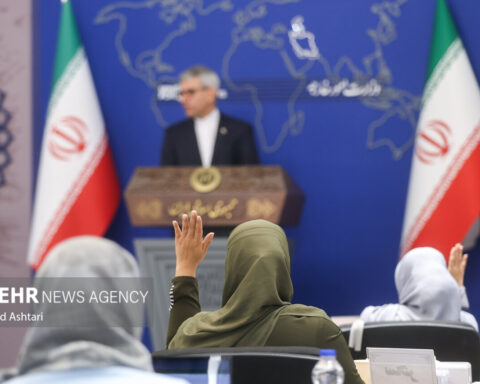
The fourth round of US-Iran indirect talks ran roughly three hours under Omani Foreign Minister Badr al-Busaidi’s shuttle, ended with both sides agreeing to continue, and produced one operationally consequential new element: Iran tabled the consortium proposal and Witkoff denied it was under formal discussion. Araghchi told reporters afterwards that “enrichment is a subject that should definitely continue and there is no room for compromise on that,” but added that limits on “dimensions, amount and level” were possible “for trust-building.” That second clause is the negotiable surface. The first is the redline.
n
The talks were preceded on May 10 by Iran’s formal counter-offer to the Witkoff 14-point MOU. The Iranian terms: war reparations, full Iranian sovereignty over the Strait of Hormuz, end to all oil sanctions, lifting of the US naval blockade imposed April 13, and release of seized Iranian assets. Trump’s response on Truth Social ran four words and one exclamation mark: “TOTALLY UNACCEPTABLE!” The Washington Post reported the same day that the counter-offer reversed the trajectory Axios had identified on May 6, when its 14-point MOU report described the parties as “the closest the parties had been to an agreement since the war began.”
n
| Deal parameter | US opening position | Iran counter-offer May 10 | Analyst consensus midpoint |
|---|---|---|---|
| Enrichment moratorium | 20 years, zero enrichment | 5 years, enrichment continues | 12-15 years, capped enrichment |
| HEU disposition | Hand over ~440 kg (Netanyahu: remove physically) | Down-blending under IAEA | Down-blending plus export of residual |
| Hormuz status | Both sides lift restrictions | Full Iranian sovereignty (PGSA) | Joint transit regime, no toll |
| Sanctions / blockade | Phased relief tied to compliance | Immediate full lifting | Phased relief, snap-back retained |
| Reparations | Not on table | On table, amount unspecified | Not on table |
n
n
The structural significance of the Muscat outcome is not what was agreed but what was not contested. Witkoff did not publicly reject the consortium concept. He denied formal discussion. The distinction matters. A public rejection would have foreclosed the option Trump may want available in Riyadh, if MBS turns out to be receptive. A denial of formal discussion preserves all options without committing to any of them. Iran’s counter-offer was designed to be unsignable, which is precisely why Araghchi tabled the consortium alongside it u2014 the consortium gives MBS something to want, the unsignable counter-offer gives him reason to want it sooner rather than later.
n
The Witkoff contradictions
n
Steve Witkoff’s negotiating posture has shifted four times in five weeks. In early April he told reporters Iran could enrich at 3.67% u2014 the JCPOA ceiling. By late April he had reversed: “An enrichment program can never exist in the state of Iran ever again.” The Arms Control Association published a report in April titled “U.S. Negotiators Were Ill-Prepared for Serious Nuclear Talks With Iran,” which catalogued the inconsistencies and noted that Witkoff’s team appeared to lack the technical depth to maintain a coherent position under Iranian counter-pressure. Iran International reported the contradictions to a Persian-language audience, ensuring they circulated inside Iran’s own negotiating apparatus.
n
Witkoff’s 14-point MOU as reported by Axios on May 6 contained: a 30-day detailed negotiation window; both sides lifting Hormuz restrictions; Iran handing over its 440-kilogram HEU stock; snap IAEA inspections; an enrichment moratorium with the duration unresolved. The framework was deliberately ambiguous on the central question of whether Iran could enrich at all after the moratorium ended. That ambiguity was the deal. Netanyahu’s CBS interview closed the ambiguity from the Israeli side by demanding physical removal. Araghchi’s Muscat statement closed it from the Iranian side by declaring no-compromise. The 14-point MOU now exists as a document neither principal will publicly endorse, with Witkoff as its sole defender inside a US administration whose Defence Secretary, Pete Hegseth, has separately committed to maintaining the naval blockade “as long as it takes.”
n
James M. Lindsay of the Council on Foreign Relations summarised the position on May 7: “Trump has big decisions to make, but none of his options are appealing, and whatever choice he makes will have consequences that ripple across the globe.” Lindsay’s framing matters because it does not treat the deal as failed. It treats every plausible deal outcome as costly. That is the analytic posture of a serious observer who has noticed that the three vetoes are not bugs in the negotiation u2014 they are the structure.
n

n
Trump’s arrival into a pre-positioned trap
n
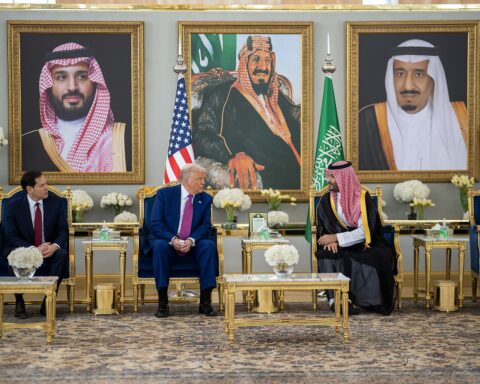
Trump departs for the Gulf on May 13 with stops in Saudi Arabia, Qatar and the UAE. Israel is not on the itinerary, a fact that Israeli officials have privately characterised as the loudest diplomatic signal of the trip. In Riyadh the schedule includes the bilateral with MBS, the Saudi-US Investment Forum, and the GCC summit. The Atlantic Council’s pre-trip analysis argued the Trump-MBS meeting “should centre on Iran nuclear strategy” u2014 meaning MBS’s position on enrichment will determine whether Iran’s consortium gambit gets traction or dies on arrival.
n
The diplomatic geometry by Tuesday will be the following. Iran has already presented the consortium to Faisal in Riyadh, then to the US through Omani shuttle. MBS has not publicly responded. Netanyahu has publicly demanded a uranium-removal condition Trump’s own envoy has not endorsed. Vahidi has publicly authorised IRGC threats of kinetic action against US forces while Araghchi is in the negotiating room. The Defence Security Cooperation Agency notified Congress on May 2 of a $3.5 billion sale of 1,000 AIM-120C-8 AMRAAM missiles to Saudi Arabia u2014 a transaction that requires Saudi acceptance, signalling that on the military side Riyadh’s relationship with Washington is functional even as the political-nuclear file is being contested.
n
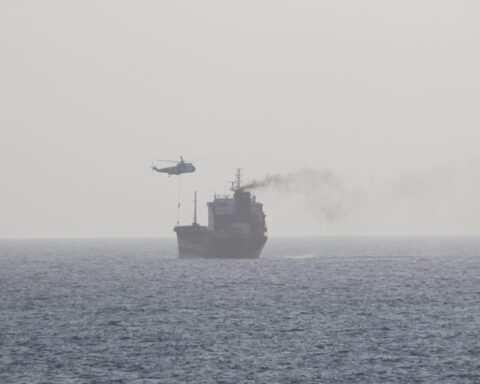
Brent crude closed Friday at roughly $105.76 a barrel, up 4.92% on the week. WTI sat at $100.30, up 4.96%. The price action is not a panic. It is a sustained reflection of the fact that only 45 vessels have transited Hormuz since the April 8 ceasefire u2014 3.6% of the pre-war monthly baseline u2014 and that the PGSA’s permit regime, declared operational on May 5, has effectively re-priced sovereign risk on Gulf hydrocarbons. The PGSA is the operational embodiment of Iran’s May 10 sovereignty demand u2014 already running, already collecting transit data, and already structurally incompatible with the Witkoff framework’s “both sides lift restrictions” language.
n
What Trump cannot do in Riyadh is make MBS choose between the Iranian offer and the American framework, because the American framework is incomplete on the question MBS most needs answered: will Saudi Arabia be permitted to enrich? Until that answer is in writing, the Iranian offer is the more concrete proposition on the table. Iran has handed MBS a document. Trump has not.
n
Where does the deal go from here?
n
The veto architecture makes certain outcomes more probable than others, but it does not make any outcome certain. The most probable trajectory is the one that has held since the April 8 ceasefire: continued talks without agreement, continued PGSA operations without naval confrontation, continued Israeli pressure without unilateral Israeli action, continued IRGC threats without missile launches. That trajectory is not stable indefinitely u2014 the Witkoff MOU envisaged a 30-day window, which expires in early June u2014 but it is the trajectory the three vetoes collectively reinforce.
n
A less probable but more consequential trajectory runs through the consortium. If MBS receives the proposal favourably during the May 13 bilateral, and if Trump permits even tacit US engagement with the concept, the regional architecture shifts in a single step. The UAE’s 123 renegotiation clause activates. The US-Saudi 123 has to be rewritten to match whatever terms Iran is given. The Israeli veto becomes louder, not weaker, because Netanyahu cannot accept a regional fuel cycle that includes Iranian enrichment, and his CBS interview was the early positioning for that fight. Saudi Arabia condemned Iran’s strikes on GCC infrastructure in March, but condemnation is not refusal u2014 the Kingdom can hold both positions simultaneously, and likely will.
n
The least probable trajectory is the one Netanyahu sketched on 60 Minutes: a kinetic operation to physically remove the 440 kilograms from Isfahan. The technical barriers are extreme. Roughly half the material is buried inside a tunnel complex, and Brewer’s “as far as we know” caveat concedes that Western intelligence does not have full visibility on disposition. A removal operation would require ground forces inside Iranian territory, which neither the Pentagon nor the Trump White House has shown appetite for. The interview was therefore not a plan. It was a price tag on Israeli acquiescence to anything less.
n
The three vetoes are not symmetrical in their failure modes. Netanyahu’s veto fails publicly and loudly u2014 he goes on television, he gives interviews, he convenes the cabinet. Vahidi’s veto fails operationally u2014 missiles get locked onto targets, IRGC commanders give statements, the elected government issues contradictions the IRGC ignores. MBS’s veto fails silently u2014 Faisal receives, Faisal does not characterise, the bilateral happens behind closed doors and the readout is calibrated. Only the third veto can be hidden from public view, which is why the Iranian consortium gambit is structurally optimised to exploit it. Tehran has put MBS in a position where the silent veto is the most powerful, the least observable, and the one Trump can do least to anticipate before he lands.
n
FAQ
n
What is a 123 Agreement and why does Saudi Arabia’s matter for Iran talks?
n
A 123 Agreement is the legal instrument under Section 123 of the US Atomic Energy Act of 1954 that permits civilian nuclear cooperation between the US and a foreign government. The Trump administration is currently reviewing a draft Saudi-US 123 that omits the enrichment prohibition language present in the UAE’s 2009 agreement. The Atomic Energy Act process requires a Report to Congress, which has confirmed the draft leaves enrichment open. The Saudi 123 is the legal pivot point that Iran’s consortium proposal is designed to exploit, because the consortium offers Riyadh enrichment access through Tehran that the Saudi 123 would otherwise have to provide through US partnership.
n
How much weapons-grade uranium could Iran produce from its current stock?
n
Iran’s 440 kilograms of 60%-enriched uranium can be further enriched to weapons-grade in approximately 25 days per device using an IR-6 centrifuge cascade u2014 a timeline first published in Institute for Science and International Security modelling and not formally contested by US intelligence. The total stockpile is theoretically sufficient for multiple devices if all material were converted, though no public assessment claims Iran has the warhead-design or weaponisation capacity to convert quickly. Inspection access to verify these figures was terminated when the IAEA’s Iran mission was suspended on February 28, 2026.
n
Why is Pakistan involved in the ceasefire enforcement architecture?
n
Pakistan’s role emerged organically because Field Marshal Asim Munir, the army chief, retained channels to both Iranian IRGC leadership and Saudi government counterparts that no Western party could replicate. Munir’s visit to Khatam al-Anbiya HQ on April 16 u2014 visiting commanders Pezeshkian had publicly accused u2014 illustrated that ceasefire enforcement runs through the IRGC’s military hierarchy rather than the elected Iranian government. Pakistan’s $5 billion Saudi loan, which matures in June 2026, gives Riyadh continued financial purchase over Islamabad’s enforcement role. Pakistan is also Iran’s protecting power in the United States, a function dating to 1992, which gives it formal diplomatic standing in any future direct US-Iran contacts. CBS News confirmed on May 12 that Pakistan was simultaneously sheltering Iranian military aircraft at Nur Khan during the ceasefire period — a revelation that adds a third function to Pakistan’s contradictory role: not just mediator and protecting power, but active participant in Iranian force protection.
n
What happens if the Witkoff MOU 30-day window expires without agreement?
n
The 30-day window opened with the May 6 Axios report and would expire in early June. There is no automatic consequence written into the framework. The likeliest practical outcome is a phased extension under continued Omani shuttle, a model both sides have already used through four rounds. The political risk is that Trump’s domestic calendar u2014 including the GCC summit and the post-Riyadh trip readouts u2014 creates pressure to declare either a breakthrough or a failure before the window closes. A declared failure would re-empower the IRGC authorisation ceiling by removing the Pezeshkian channel’s diplomatic cover, and would re-energise Netanyahu’s case for the kinetic option his CBS interview previewed.
n
Could Trump bypass the three vetoes through executive action?
n
Only partially. Trump can lift sanctions through executive order, can suspend the naval blockade through Department of Defense direction, and can recognise Iranian Hormuz transit-permit authority through bilateral declaration u2014 all without congressional approval. He cannot, however, force Israeli ratification, force IRGC compliance, or force Saudi participation in a regional fuel cycle. The veto-holders sit outside the US executive branch’s reach. Executive action can shift the cost of vetoing, but cannot eliminate the veto. The constitutional ceilings inside Iran (Article 110) and the sovereign agency of Israel and Saudi Arabia are not within Trump’s unilateral authority to override.
Does US munitions depletion change the calculus for any of the three veto-holders?
Yes, materially. Operation Epic Fury expended roughly 80 percent of the US JASSM-ER inventory and up to 80 percent of available THAAD interceptors, leaving the Pentagon’s restrike capacity well below the threshold required to replicate the first campaign’s scale. That constraint changes the IRGC’s veto calculus most directly: the military deterrent that would otherwise make rejecting a deal costly is now structurally weaker than it was in February 2026. The practical consequence is that all three veto-holders can hold their positions at lower risk than they could three months ago — a dynamic examined in detail in Trump Wants to Resume the Iran War. The Arsenal Says He Cannot.
n
Does US munitions depletion change the calculus for any of the three veto-holders?
n
Yes, materially. Operation Epic Fury expended roughly 80 percent of the US JASSM-ER inventory and up to 80 percent of available THAAD interceptors, leaving the Pentagon’s restrike capacity well below the threshold required to replicate the first campaign’s scale. That constraint changes the IRGC’s veto calculus most directly: the military deterrent that would otherwise make rejecting a deal costly is now structurally weaker than it was in February 2026. The practical consequence is that all three veto-holders can hold their positions at lower risk than they could three months ago — a dynamic examined in detail in Trump Wants to Resume the Iran War. The Arsenal Says He Cannot.
n
A May 13, 2026 ISW assessment identified Vahidi specifically as “driving decisionmaking over Iran’s war and negotiating posture,” confirming that the IRGC veto described above remains operationally active: Vahidi has reportedly refused to authorize missile negotiations and his intervention contributed to the Islamabad walkout. The full ISW analysis is examined in ISW Says Iran Believes It Holds the Upper Hand. The CIA Data Supports It.
n
On May 14, 2026, Iran’s judiciary has now added a third institutional veto to the authorization ceiling: Chief Justice Mohseni-Ejei’s court issued binding rulings declaring legal authority over tanker seizures in the Strait of Hormuz — rulings that no foreign ministry MOU has a mechanism to vacate.
n”}
On May 14, 2026, Iran’s judiciary has now added a third institutional veto to the authorization ceiling: Chief Justice Mohseni-Ejei’s court issued binding rulings declaring legal authority over tanker seizures in the Strait of Hormuz — rulings that no foreign ministry MOU has a mechanism to vacate.