JEDDAH — Saudi Arabia’s terminal missile defense over the Hajj corridor has fallen to between 80 and 150 PAC-3 MSE interceptors — enough to absorb four to seven Houthi ballistic missile salvos before the shield over Mecca, Medina, and the Arafah plain is empty. No resupply is possible before the Day of Arafah on May 26, when approximately 1.5 million pilgrims will gather on a fixed, 33-square-kilometer plain twenty kilometers southeast of Mecca for the holiest twenty-four hours in the Islamic calendar.
The kingdom entered the Iran war on April 8 with roughly 2,800 PAC-3 MSE rounds distributed across 16 Patriot batteries and 108 launchers. Sustained engagement against 894 aerial threats consumed approximately 2,400 rounds between March and early April, leaving roughly 400 in the national stockpile — an 86 percent depletion rate documented by CSIS analysts Mark Cancian and Chris Park. A $9 billion Congressional notification for 730 replacement interceptors was filed on January 30, but the sole production facility in Camden, Arkansas, builds approximately 620 rounds per year for all global customers. The order exceeds a full year of output. First delivery is not expected before mid-2027.
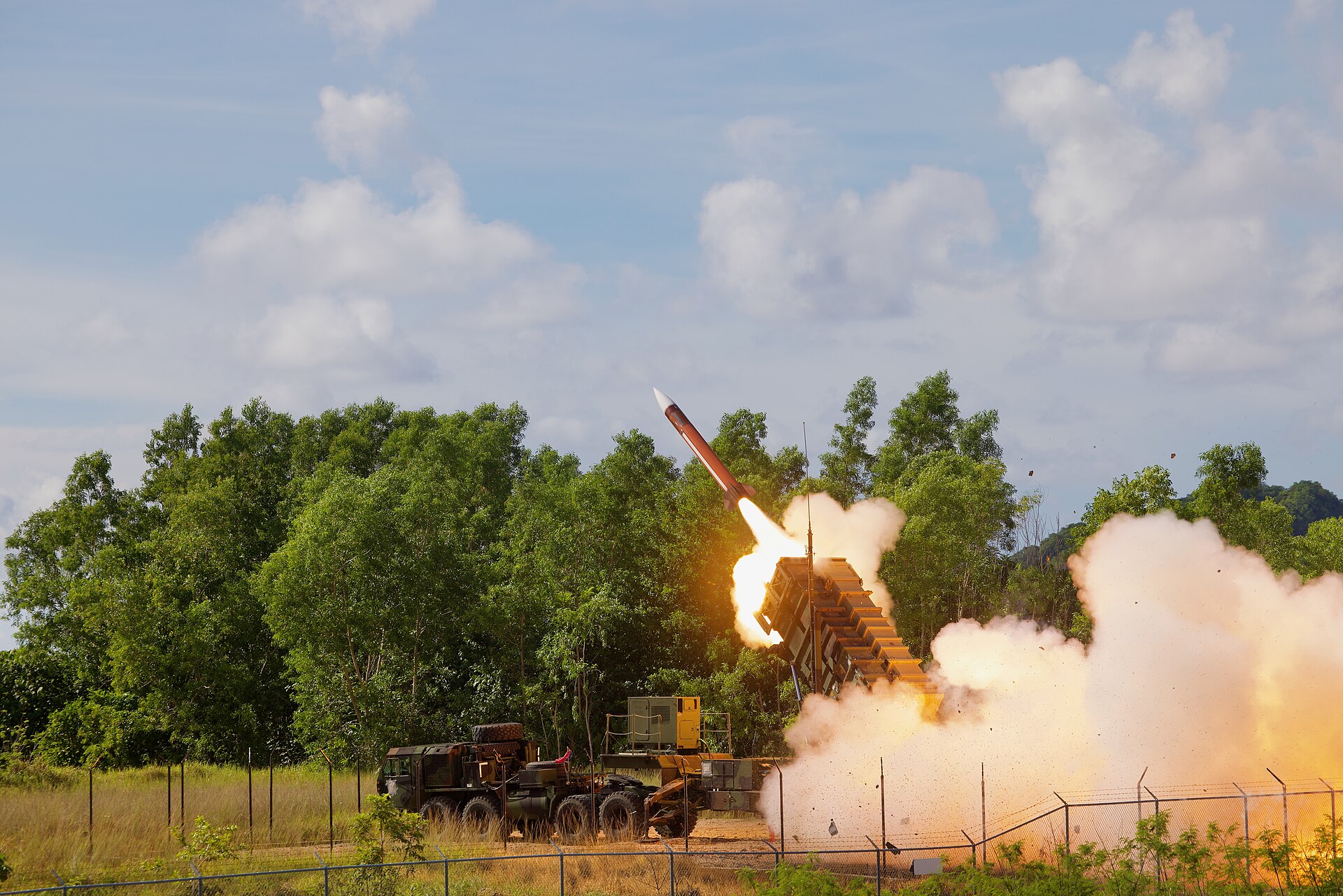
Table of Contents
- What Remains of Saudi Arabia’s PAC-3 Stockpile?
- Four Corridors, One Reserve
- How Many Salvos Can the Hejaz Shield Absorb?
- The Resupply Arithmetic
- Why Can’t Saudi Arabia Borrow Interceptors?
- Has Anyone Pledged Not to Strike During Hajj?
- The Silence Doctrine
- The Custodian’s Exposure
- Frequently Asked Questions
What Remains of Saudi Arabia’s PAC-3 Stockpile?
Saudi Arabia’s PAC-3 MSE stockpile has fallen from approximately 2,800 pre-war rounds to roughly 400 as of mid-May 2026 — an 86 percent depletion rate. The kingdom expended approximately 2,400 interceptors against 894 aerial threats between March 3 and April 7, 2026, the most intensive air defense campaign in the Middle East since the 1991 Gulf War.
The CSIS report “Last Rounds?” — published April 24, 2026, by analysts Mark Cancian and Chris Park — provided the most rigorous public accounting of the consumption rate. The report confirmed that half of the entire US pre-war PAC-3 MSE inventory was expended in the first 39 days of the Iran campaign alone. Saudi Arabia’s consumption tracked proportionally, and with less margin for error: the kingdom has no domestic interceptor production capacity, no allied stockpile within transfer distance, and no alternative terminal defense system rated for ballistic missile engagement at the altitudes where Houthi weapons become lethal.
“Half of the U.S. pre-war inventory of PAC-3 MSE was expended in the first 39 days. Rebuilding to pre-war levels for the seven munitions will take from one to four years as missiles in the pipeline are delivered.”
Mark Cancian and Chris Park, CSIS, “Last Rounds?”, April 24, 2026
The HOS Daily BriefThe Middle East briefing 3,000+ readers start their day with.
One email. Every weekday morning. Free.
Before the war, the 2,800 rounds were distributed across approximately 16 Patriot batteries and 108 M902 launchers covering the kingdom’s primary threat axes. The engagement tempo during the high-intensity phase was without peacetime precedent: 894 threats intercepted in 35 days, including 799 drones, 86 ballistic missiles, and 9 cruise missiles. To put the compression in context — between 2015 and the April 2022 Yemen ceasefire, the Houthis conducted nearly 1,000 rocket and missile attacks and over 350 drone strikes across seven years, according to ACLED data. The 2026 campaign condensed that entire historical volume into just over a month.
Defense Secretary Pete Hegseth told the Senate Armed Services Committee on May 12 that American munitions shortages had been “foolishly and unhelpfully overstated.” It was his third public denial since March. The same month, CSIS data showed that US Army PAC-3 stocks had already fallen to roughly 25 percent of the volume the Pentagon considers necessary — a pre-existing deficit that predated the Iran campaign and contributed to the Trump administration’s decision to suspend interceptor supplies to Ukraine. Hegseth’s assurance and the CSIS data describe two different realities. Only one of them determines what happens over the Arafah plain on May 26.
Four Corridors, One Reserve
The remaining 400 rounds are not a single reserve that commanders can dispatch where needed. They are distributed across four geographically fixed defense corridors, each protecting assets that Saudi Arabia cannot leave uncovered. Patriot batteries are not mobile artillery — redeployment between corridors requires logistics convoys, technical crews, and system recalibration measured in days, making real-time reallocation during a multi-front threat functionally impossible.
| Defense Corridor | Protected Assets | Estimated Allocation |
|---|---|---|
| Eastern Province | Ras Tanura, Abqaiq, Jubail — Aramco critical infrastructure | ~100–120 rounds |
| Yanbu | SAMREF refinery, Red Sea export terminal | ~50–80 rounds |
| Riyadh | Capital metropolitan area, government facilities | ~100–120 rounds |
| Hejaz (Mecca–Medina) | Grand Mosque, Prophet’s Mosque, Arafah, Mina, Muzdalifah | ~80–150 rounds |
Sources: Defence Express; houseofsaud.com prior coverage. Allocations are estimates based on known battery positions, standard US engagement doctrine, and the geographic distribution of protected assets.
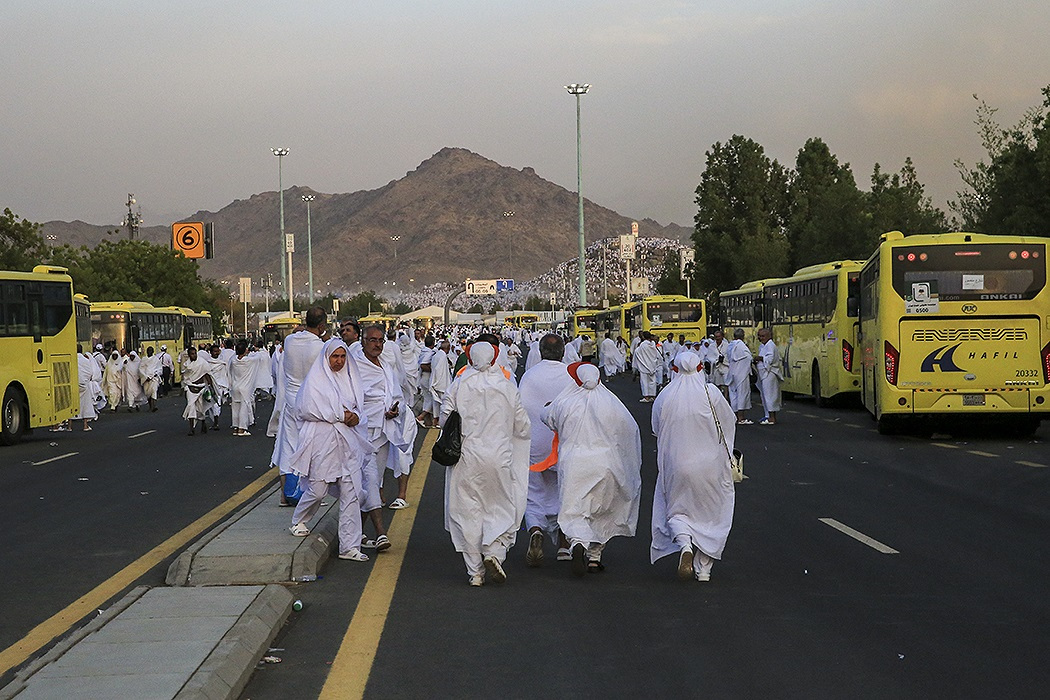
The Hejaz allocation carries a constraint that separates it from every other corridor. The Eastern Province protects oil infrastructure whose destruction would be financially devastating but physically recoverable — Aramco rebuilt the Abqaiq processing facility after the September 2019 drone and cruise missile attack within weeks. Yanbu is a single-point refinery complex. Riyadh is a population center with dispersed targets across a large metropolitan area. The Hejaz corridor protects something with no recovery calculus: a religious obligation performed by 1.5 million people at a fixed location, on a fixed date, in open terrain with no shelter and no alternative venue.
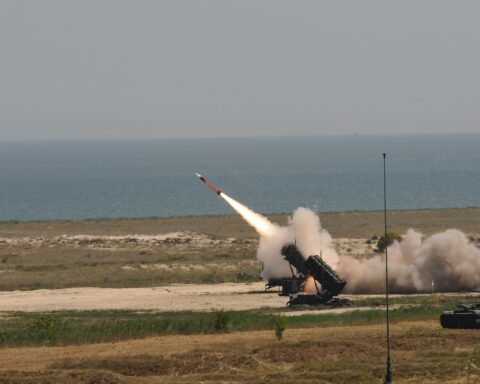
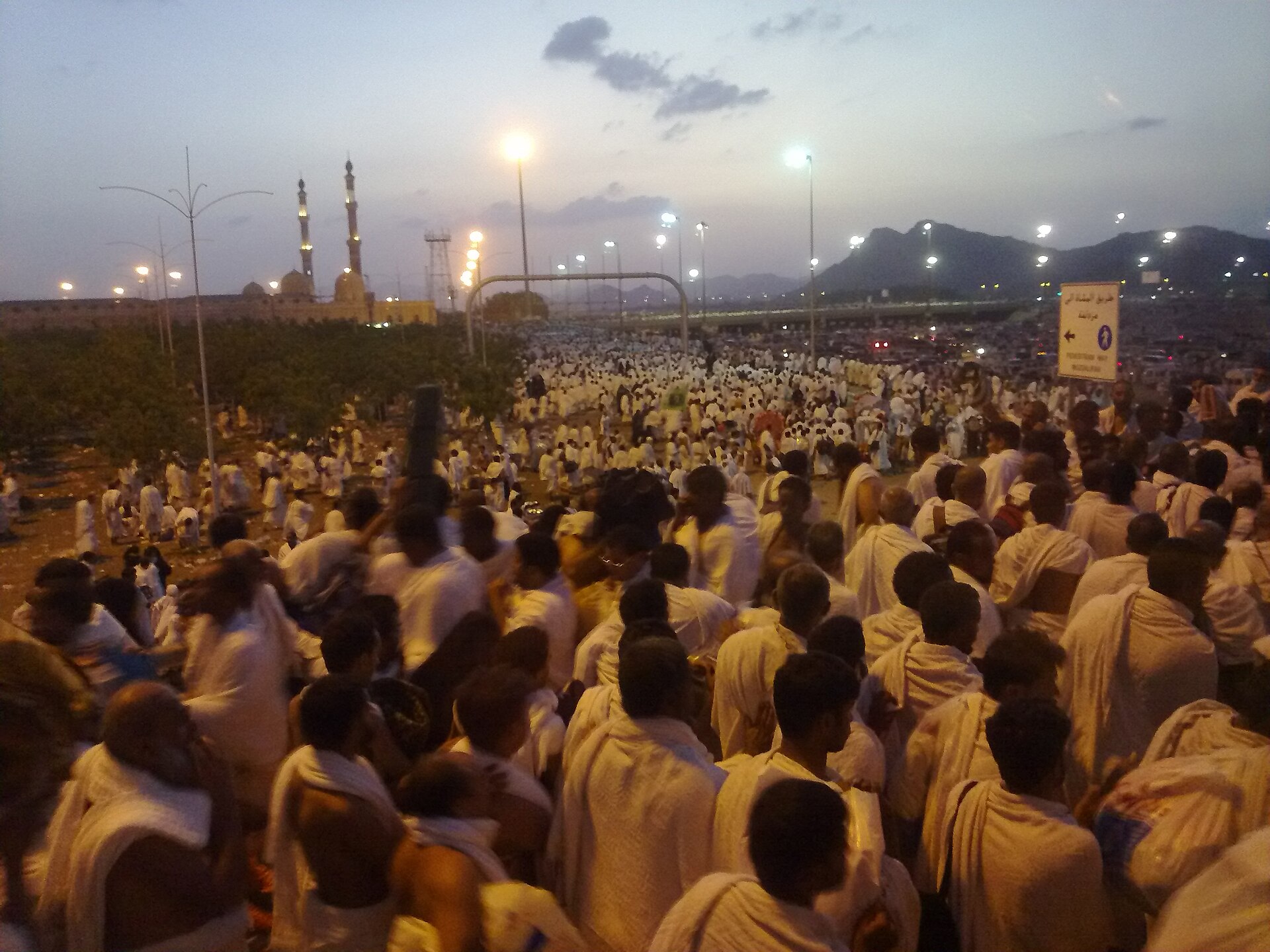
A single PAC-3 MSE battery has an engagement radius of approximately 15 to 20 kilometers against ballistic missiles, covering roughly 700 to 1,250 square kilometers of geometric area. By area alone, one battery could nominally overshadow the Arafah plain’s 33 square kilometers — but area geometry is not how terminal missile defense works. Patriot batteries engage threats arriving on specific ballistic trajectories; each battery’s fire-control radar covers assigned threat sectors, not a uniform 360-degree sphere. The primary Houthi approach axes toward the Hejaz run from the south through the Asir corridor, from the southwest across the Red Sea, and from the east through the Rub’ al-Khali. A single battery positioned to cover one axis leaves the others open. The Arafah plain alone spans 33 square kilometers, but adding Mina (approximately 20 square kilometers) and Muzdalifah (roughly 10 square kilometers), the full Hajj footprint extends across more than 60 square kilometers along a corridor pilgrims traverse on foot over three days — on multiple threat axes simultaneously. Multi-axis defense of that corridor requires a minimum of three to four batteries to avoid coverage gaps that a coordinated attack could exploit. At standard loadout, that battery count would consume most or all of the Hejaz allocation in launcher capacity, before a single round is fired.
How Many Salvos Can the Hejaz Shield Absorb?
At the IRGC’s demonstrated peak salvo size of 11 simultaneous ballistic missiles and standard 2:1 engagement doctrine — two PAC-3 MSE interceptors fired per incoming threat — each salvo requires 22 rounds to intercept. The Hejaz allocation of 80 to 150 rounds can absorb between three and seven full salvo engagement cycles before the magazine is empty.
The 2:1 ratio is not conservative doctrine imposed by cautious planners. It is the minimum engagement standard that US Army air defense training prescribes to achieve acceptable probability of kill against a maneuvering ballistic missile in its terminal phase. A single PAC-3 MSE round has a published hit probability well above 90 percent under test conditions, but test conditions do not include electronic countermeasures, debris fields from prior intercepts, or the compressed decision timelines of a simultaneous multi-missile arrival. Firing two rounds per threat is how Patriot operators close the gap between test-range performance and battlefield reality.
At 80 rounds — the low end of the Hejaz estimate — three full salvos consume 66 rounds, leaving 14 in reserve. That residual cannot complete a fourth engagement cycle against an 11-missile salvo. At 150 rounds, seven cycles are possible, with approximately 16 rounds remaining. The math assumes clean engagements under conditions that favor the defender. It does not account for decoys, which the IRGC deployed alongside warheads during the April campaign to force additional interceptor expenditure. It does not account for simultaneous drone swarms arriving from the Asir corridor — Yemen’s northern approach to the Hejaz — which saturate lower-tier air defenses and may compel Patriot operators to engage threats below the system’s optimal design envelope.
A sustained campaign of one salvo per day would exhaust the Hejaz allocation in under a week. A coordinated multi-axis attack — armed drones from Yemen through Asir province, ballistic missiles on parabolic trajectories over the Red Sea — could compress that timeline to hours. The Houthis have demonstrated both capabilities simultaneously. During the 96-hour Hajj peak window from Arafah through the days of Tashreeq, the terminal defense reserve operates with no resupply and no rotation. What is loaded in the launchers on the morning of May 26 is what Saudi Arabia has.
The Resupply Arithmetic
The sole global manufacturer of PAC-3 MSE interceptors is Lockheed Martin’s facility in Camden, Arkansas. In 2025, the Camden line produced approximately 620 rounds per year for all customers worldwide — the United States, Saudi Arabia, Japan, South Korea, Germany, the Netherlands, and other allied nations with Patriot-equipped forces. Every round Saudi Arabia receives is a round another ally does not.
| Resupply Milestone | Date | Detail |
|---|---|---|
| DSCA Congressional notification | January 30, 2026 | 730 PAC-3 MSE rounds, $9 billion total package |
| Camden baseline annual output | 2025–2026 | ~620 rounds/year for all global customers |
| Lockheed Martin expansion contract | April 10, 2026 | $4.761 billion; target 2,000 rounds/year |
| Earliest Saudi FMS delivery | Mid-2027 | 14+ months from Day of Arafah 2026 |
| 2,000/year production target | End of 2030 | 4.5 years from present |
The Defense Security Cooperation Agency notified Congress of the $9 billion sale on January 30, before the war began. The package includes 730 PAC-3 MSE rounds, missile launcher conversion kits, automated logistics systems, classified software, technical support, and training munitions. The 730-round order — sized against peacetime consumption models and training attrition — exceeds a full year of Camden’s global production capacity. At wartime depletion rates, 730 rounds would sustain approximately fourteen days of engagement at the peak intensity Saudi Arabia experienced in March and April.
On April 10 — two days after the Iran war started — Lockheed Martin was awarded a $4.761 billion production contract targeting 2,000 rounds per year. That target is not achievable before the end of 2030, according to Breaking Defense and The Aviationist. The four-and-a-half-year gap between contract and target reflects the physical constraints of scaling solid-fuel rocket motor production, seeker assembly manufacturing, and Ka-band guidance component supply chains. Urgency and funding cannot compress those timelines. A new clean room does not produce guidance seekers on the day its walls go up.
Between the Congressional notification in January and the first possible delivery in mid-2027, Saudi Arabia’s Hajj corridor operates on what it already has. The FMS pipeline is a future solution to a present inventory. For every Hajj between now and the first Camden delivery, the Hejaz allocation draws from a stockpile that shrinks with every engagement and grows by nothing.
Why Can’t Saudi Arabia Borrow Interceptors?
No allied nation can surge PAC-3 interceptors to the Hejaz corridor before Arafah. Greece’s ELDYSA battery is committed to Yanbu, 400 kilometers from Mecca. The UAE’s Patriot assets are politically unavailable following the Saudi-UAE military cooperation fracture. US stockpiles are at 25 percent of Pentagon-stated requirements.
Greece has operated a Patriot PAC-3 battery at Yanbu since September 2021 under the ELDYSA expeditionary air defense mission. On March 19, 2026, that Greek-operated battery intercepted and destroyed two Iranian ballistic missiles targeting the SAMREF oil refinery — a defensive engagement the Greek Defense Ministry confirmed fell within the ELDYSA mandate. Riyadh requested extension of the Greek deployment through November 2026, and Athens granted it. But the Greek battery sits at Yanbu, protecting a refinery complex approximately 400 kilometers northwest of Mecca. Redeploying it to the Hejaz would strip the Yanbu terminal — through which a substantial share of Saudi Arabia’s already-stressed Red Sea oil exports flow — of its only terminal missile defense.
The more obvious candidate for rapid reinforcement would be the United Arab Emirates, which operates Patriot batteries and has refined its air defense network through years of Houthi threat exposure. That path is closed. Bloomberg reported on May 15 that UAE President Mohammed bin Zayed called Crown Prince Mohammed bin Salman requesting a coordinated military response to Iran; Saudi Arabia refused. The refusal formalized a fracture that had been operational since December 30, 2025, when Saudi forces struck a UAE-backed Southern Transitional Council shipment in Yemen — the first kinetic engagement between nominal coalition partners. A UAE Patriot surge to the Hejaz is operationally feasible and politically dead.
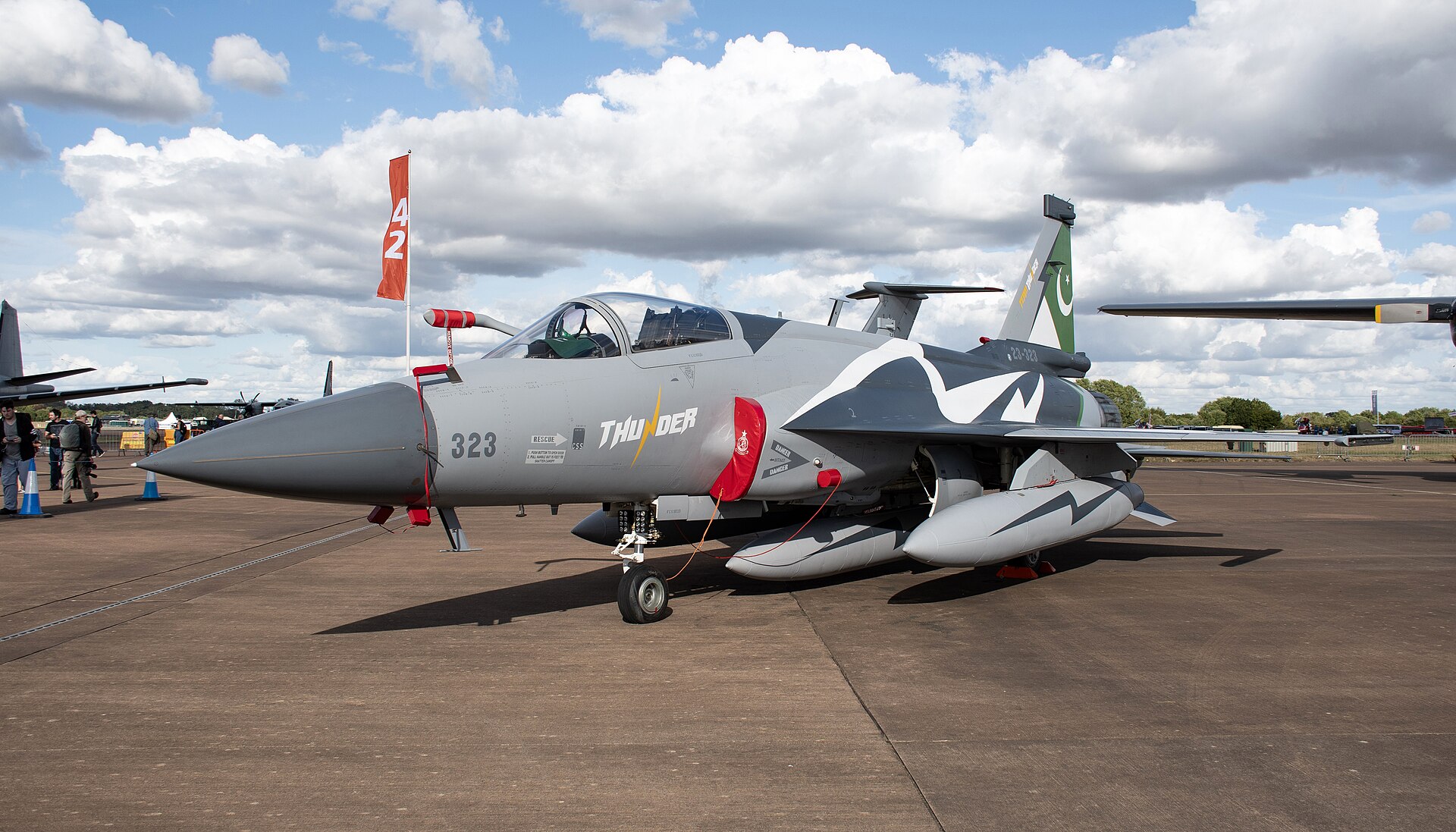
Pakistan deployed HQ-9 air defense systems and 8,000 troops to Saudi Arabia under the September 2025 Saudi Mutual Defense Agreement. Those assets are stationed at Eastern Province facilities supporting Aramco infrastructure, not the Hejaz. The HQ-9 is a Chinese-origin system that operates on an independent fire-control architecture — it cannot be integrated into the Patriot network without months of systems engineering and software adaptation. Even if Riyadh ordered a redeployment, the HQ-9 would arrive at the Hejaz without the ability to coordinate with existing Patriot batteries, creating a layered defense in name only.
US stockpiles are the last theoretical source, and they are structurally constrained. American PAC-3 reserves had already fallen to approximately 25 percent of the volume the Pentagon considers operationally necessary before the Iran war began — a deficit The Economist and Military Times reported as a primary factor in the suspension of interceptor transfers to Ukraine. Emergency drawdown from US forward-deployed batteries in Japan, South Korea, or the Gulf would reduce coverage over installations that face the same Iranian and North Korean threat envelopes. No US combatant commander has publicly offered to thin their own coverage to replenish a Saudi corridor.
Has Anyone Pledged Not to Strike During Hajj?
No state or non-state actor involved in the Iran war has issued a public assurance of non-targeting during the 2026 Hajj. Iran has made no commitment to restrain the Houthis during the pilgrimage period. The Houthis issued what their Political Bureau called a “final warning” to Saudi Arabia on May 12, with no Hajj exception or restraint language attached.
Houthi Political Bureau member Muhammad Al-Bukhaiti posted archival footage of a previous Aramco attack on social media that day, writing: “This is the last warning for Saudi Arabia. This is a final opportunity that cannot be delayed. Our patience has run out. Saudi Arabia continues to avoid fulfilling its obligations in the peace process with Yemen.” The statement was directed at Saudi Arabia’s posture toward the Yemen peace process. It contained no Hajj-specific language — no exemption, no pledge of restraint during the pilgrimage window, no acknowledgment that a religious gathering of 1.5 million people two weeks away might warrant operational pause.
“This is the last warning for Saudi Arabia: This is a final opportunity that cannot be delayed. Our patience has run out. Saudi Arabia continues to avoid fulfilling its obligations in the peace process with Yemen.”
Muhammad Al-Bukhaiti, Houthi Political Bureau, posting on X, May 12, 2026 (via MEMRI/JTTM)
On May 23, Iran’s parliament speaker and chief nuclear negotiator Mohammad Bagher Ghalibaf met Pakistan’s Army Chief General Asim Munir in Tehran. He told reporters afterward: “Our armed forces have rebuilt themselves during the ceasefire period. If the US foolishly restarts the war, the consequences would be more crushing and bitter.” The statement was calibrated toward Washington, but its implication for the Hejaz is direct. Iran’s forces have reconstituted during the ceasefire. Saudi Arabia’s interceptor supply has not. The asymmetry has widened while five rounds of US-Iran negotiations have produced no deal and no security guarantees for Gulf states.
The absence of a non-targeting pledge is not without historical context. In October 2016, the Houthis launched a Burqan-2H ballistic missile that Saudi forces intercepted approximately 65 kilometers from Mecca — outside the Hajj period, but close enough to demonstrate that the holy city’s proximity does not function as a deterrent. In May 2019, two missiles targeting Mecca province were intercepted; the Houthis denied that Mecca itself was the intended target. Neither incident produced a lasting commitment to non-targeting. In 2022, Houthi spokesmen occasionally framed their strikes as directed only against “aggressors” and military targets, but no such framing appears in the May 2026 communications. The rhetorical restraint, such as it was, has been replaced by the language of final warnings and expired patience.
The Silence Doctrine
Saudi Arabia has not publicly acknowledged the PAC-3 depletion rate. No official military statement has addressed the interceptor inventory. No ministry has issued guidance to pilgrims about the air defense posture over the Hajj corridor. The kingdom’s missile defense status is classified — and the classification serves a function that extends well beyond operational security.
If Riyadh were to confirm that 86 percent of its pre-war interceptor stockpile has been consumed and that the Hejaz corridor operates on fewer than 150 rounds, two consequences would follow immediately. The first is a crisis of pilgrim confidence. Many of the 1.5 million expected attendees have saved for years and traveled from dozens of countries to fulfill a religious obligation that cannot be rescheduled. Hajj must be performed at least once in a lifetime for every Muslim who is physically and financially able; there is no rain-check mechanism. A public depletion disclosure during the final approach to Arafah would force individual pilgrims into a real-time risk assessment for which they have no comparable precedent — and it would deliver that assessment without providing an actionable alternative. The pilgrimage either proceeds or it does not. There is no middle option.
The second consequence would be diplomatic. The January FMS notification was filed ten weeks before the war began. The 730-round order was sized against peacetime models that assumed attrition rates a fraction of what the campaign actually produced. The gap between what was ordered and what is needed — and between when it was ordered and when it might arrive — would become a public record of allied logistics planning that failed to anticipate the most predictable munitions consumption scenario of the past decade. Washington shares the interest in avoiding that audit. Defense Secretary Hegseth’s repeated insistence that shortages have been “overstated” operates as the American complement to Saudi silence: both governments need the numbers to stay out of public view.
The result is a shared posture of non-disclosure that functions as strategy by default. Riyadh cannot afford the pilgrim confidence crisis. Washington cannot afford the reliability exposure. The silence holds as long as nothing happens during the Hajj window that forces the inventory into public view — a condition that depends entirely on the restraint of adversaries who have made no promise of restraint. The US Embassy’s Level 3 “Reconsider Travel” advisory, historically unprecedented for a Hajj-specific warning, communicates through bureaucratic channel what neither government will say in plain language. The advisory cites “terrorism” and “missile and drone attacks.” It does not cite PAC-3 inventory levels. It does not need to.
The Custodian’s Exposure
King Salman’s formal title — Custodian of the Two Holy Mosques, held by every Saudi monarch since 1986 — is not ceremonial. It is the constitutional foundation of the kingdom’s claim to administer the Hajj and the basis of Saudi legitimacy across the Muslim world. A successful strike, or even a debris event from a partially intercepted missile, during the Day of Arafah would be evaluated not as a military failure but as a custodial one. The distinction matters because military failures can be addressed with procurement and rearmament. Custodial failures erode something that procurement cannot restore.
The 1987 Hajj massacre established the template. On August 1, 1987, a confrontation between Iranian pilgrims and Saudi security forces in Mecca killed 402 people. Iran’s Supreme Leader Khomeini called for the overthrow of the Saudi royal family. Tehran severed diplomatic relations with Riyadh. Saudi Arabia’s administration of the Hajj became a contested question across the Islamic world — not because of the security failure itself, but because the failure occurred under the custodian’s watch, at the custodian’s site, during the custodian’s event. Riyadh spent the next three decades rebuilding the institutional trust that a single day had fractured. A missile arriving on the Arafah plain during the standing prayer — even one intercepted in a burst of debris over a crowd with no shelter — would reopen every question the kingdom believed it had answered.
The 2026 Hajj attendance is already registering the risk. Approximately 1.5 million pilgrims are expected, roughly 40 percent below the 2019 peak of 2,487,000 — the steepest single-year non-pandemic decline in modern Hajj history. The drop follows the US Embassy’s Level 3 advisory, the continued IRGC entrenchment at Hormuz, and the broader security environment of a conflict that remains technically under ceasefire but operationally unresolved. The attendance figure is itself a metric of custodial confidence — and the reading, at roughly 60 percent of recent capacity, is the lowest outside the COVID-19 restrictions that limited the 2020 Hajj to 10,000 domestic participants.
Crown Prince Mohammed bin Salman has staked Vision 2030 on transforming Saudi Arabia from oil exporter to diversified modern economy. The Hajj is the one Saudi function that operates on constraints no amount of capital can alter — a fixed location, a fixed date, open terrain, no alternative venue. The terminal defense reserve over that plain, seventy-two hours before the Day of Arafah, holds somewhere between 80 and 150 PAC-3 MSE rounds. The next delivery from Camden, Arkansas, is not expected before mid-2027.
Frequently Asked Questions
What is the PAC-3 MSE interceptor and how does it work?
The PAC-3 Missile Segment Enhancement is a hit-to-kill kinetic energy interceptor — it destroys incoming threats by direct body-to-body impact at closing speeds above Mach 5, rather than through a blast fragmentation warhead. Each round weighs approximately 312 kilograms and costs roughly $5.4 million. It uses a Ka-band active radar seeker for autonomous terminal guidance in the final seconds of flight, allowing it to adjust trajectory independently of the ground-based fire-control radar. The MSE variant replaced earlier PAC-2 and GEM-T interceptors, which relied on proximity-fuzed fragmentation, and is the only Patriot-family interceptor rated by the US Army for ballistic missile defense. It is manufactured exclusively at Lockheed Martin’s Camden, Arkansas plant — the sole global production source.
Could THAAD cover the gap over the Hajj corridor?
Saudi Arabia operates THAAD (Terminal High Altitude Area Defense) batteries, but the two systems defend at different altitude layers and are not interchangeable. THAAD intercepts at altitudes between 40 and 150 kilometers against medium- and intermediate-range ballistic missiles during their descent phase, well above the atmosphere. The primary Houthi threat mix — short-range ballistic missiles like the Burqan series and armed drones including the Samad family — operates at altitudes below THAAD’s engagement floor. PAC-3 MSE provides the low-altitude terminal layer, the final intercept opportunity before impact. A THAAD battery stationed over Mecca would not engage a Houthi missile or drone at the altitude where it becomes lethal to people on the ground. The two systems are designed to work in sequence, not as substitutes.
What would a debris event during Arafah mean in practice?
Even a successful PAC-3 intercept produces debris. The hit-to-kill engagement shatters the incoming warhead and missile body into fragments that fall along the original ballistic trajectory. Against a missile intercepted at the outer edge of a PAC-3 engagement envelope — roughly 15 to 20 kilometers from the battery — debris scatters across a footprint of several square kilometers. On the Arafah plain, pilgrims stand in open desert terrain wearing ihram — two unstitched white cloths with no protective equipment — without overhead cover. The Day of Arafah is performed outdoors, on foot, across 33 square kilometers with limited vehicular access and no rapid evacuation infrastructure. A debris field from even one intercepted missile would likely produce casualties, a mass-casualty response in a location that lacks the medical infrastructure of a permanent settlement, and a global media event broadcast live across the Islamic world.
Has Saudi Arabia ever restricted Hajj attendance for security reasons during wartime?
Saudi Arabia reduced Hajj attendance to approximately 10,000 domestic participants in 2020 and 60,000 in 2021 under COVID-19 public health protocols, demonstrating that the kingdom possesses the institutional mechanism to cap or restrict pilgrimage access. Those restrictions were framed as health measures and received broad acceptance from the Organization of Islamic Cooperation and the Muslim World League. A wartime attendance restriction would carry fundamentally different implications — it would constitute an admission that the Custodian of the Two Holy Mosques cannot guarantee the physical safety of the pilgrimage, a concession without precedent in the modern Saudi state. The 2026 attendance decline to approximately 1.5 million appears to be market-driven — individual pilgrims responding to travel advisories and security reporting — rather than state-imposed. No Saudi authority has publicly recommended that pilgrims reconsider attendance.