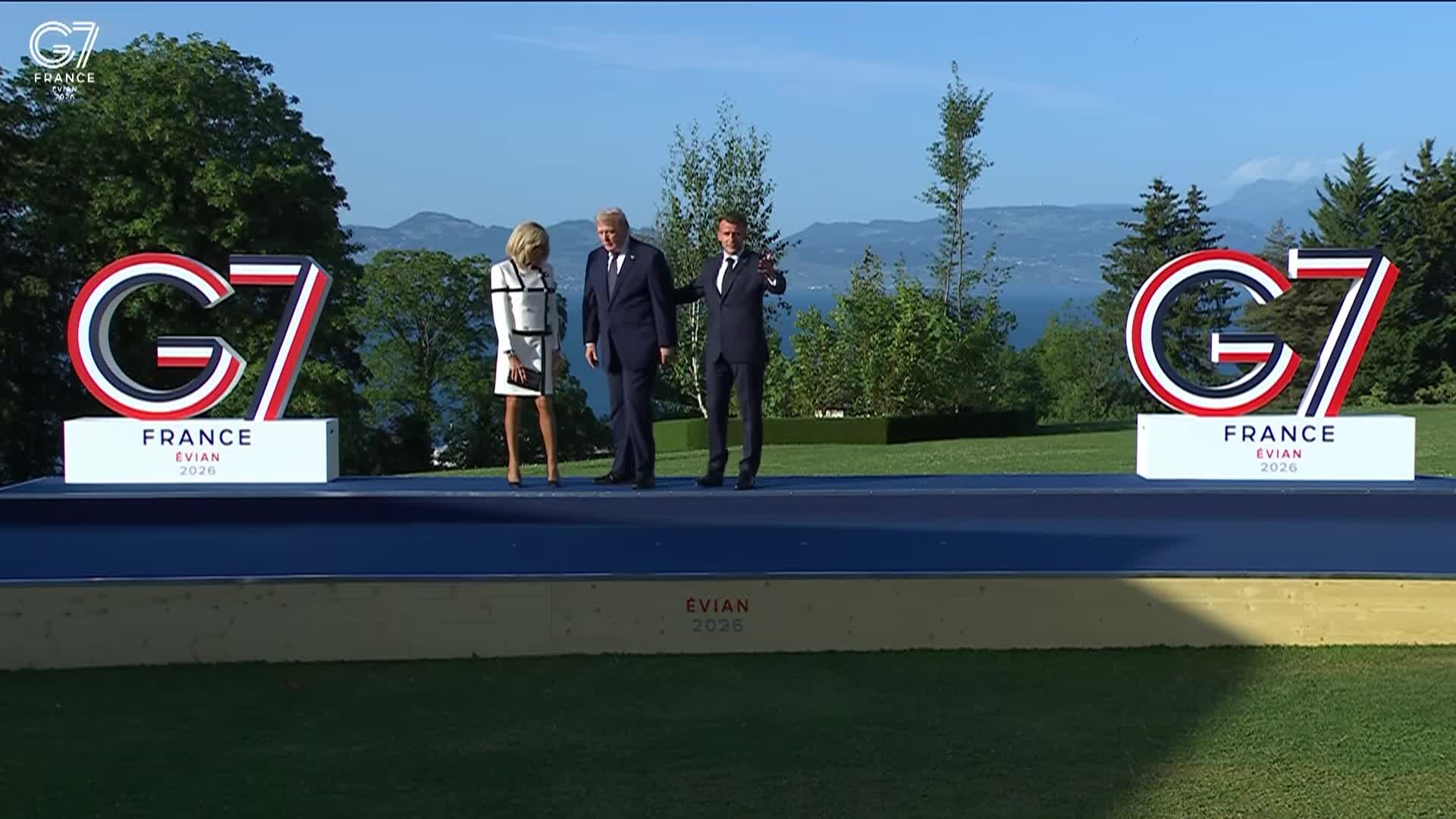

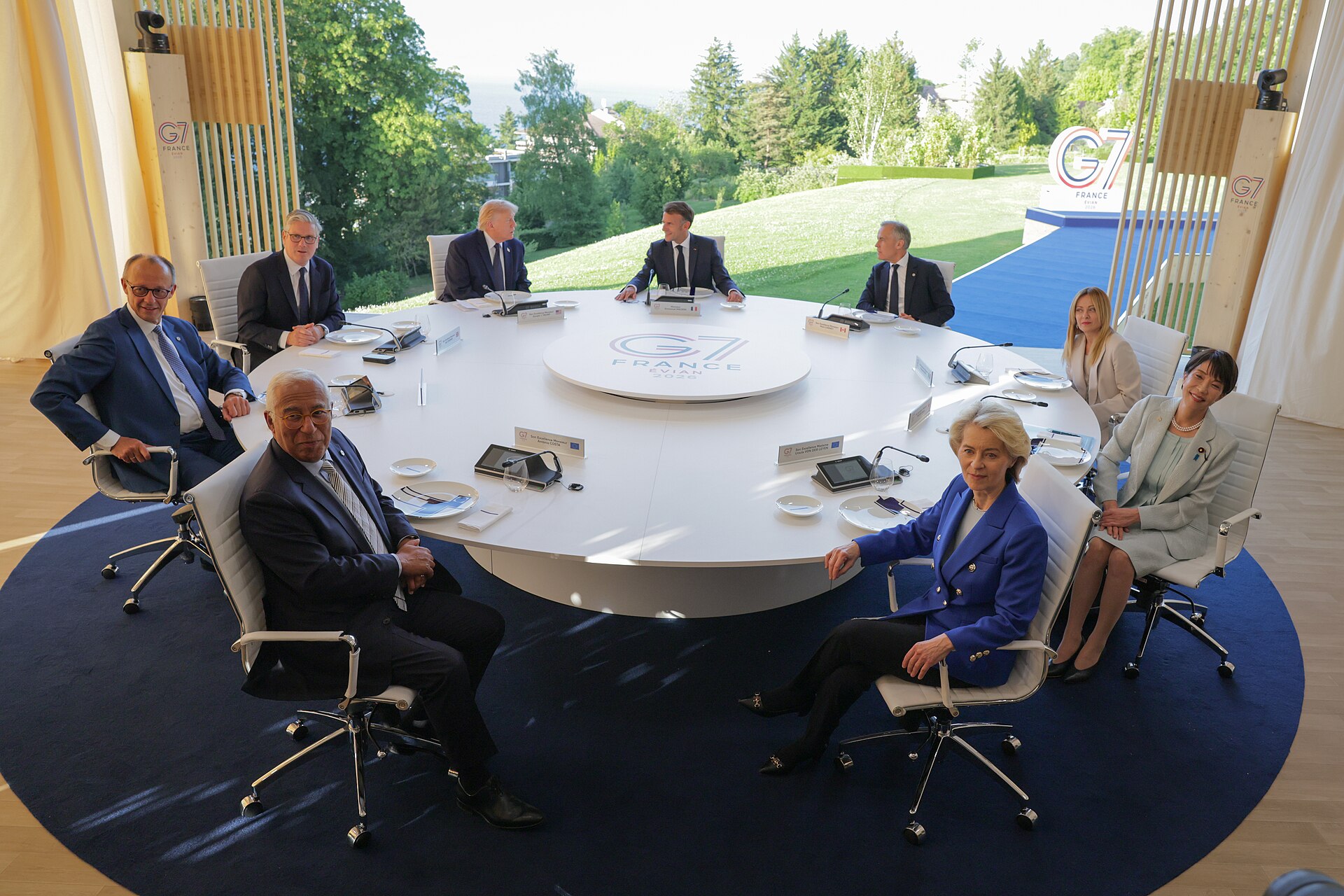
ÉVIAN — Six of the world’s leading military powers told the G7 summit on June 16 they would deploy a “strictly defensive and independent mission” to sweep mines from the Strait of Hormuz, and within hours the American president told them he did not need their help — a split that leaves the legal authority to clear the waterway through which 38 percent of all crude transiting Hormuz must pass in a state that neither side’s plan can resolve on its own. Donald Trump, speaking to reporters at the Élysée-hosted summit in the French Alpine resort town, said he did not “think we are going to need much help” on demining because “ships are starting to go out now” and that by Friday the strait would be “completely opened,” a timeline that contradicts both the Pentagon’s private six-month full-clearance estimate and the 40-to-50-day swept-lane confidence threshold cited by Western maritime security sources.
The gap between the two positions is not rhetorical — it is operational, and every additional week it persists costs Saudi Arabia roughly $38.5 million in Persian Gulf Strait Authority fees alone, on top of the $25-to-$28 per barrel fiscal gap between current Brent prices of roughly $83 and the kingdom’s $108-to-$111 breakeven. The joint statement, signed by the United Kingdom, France, Germany, Italy, the Netherlands, and Japan, was drafted in language designed to sidestep the precise legal obstacle Iran raised one day earlier: Tehran’s June 15 notification to the United Nations that all Hormuz transit must proceed “in coordination with the competent Iranian authorities,” a formulation that asserts exactly the coastal-state consent the allied statement is engineered to avoid requiring.
Table of Contents
- Two Theories of Reopening, Stated on the Same Day
- What Does ‘Strictly Defensive and Independent’ Actually Mean?
- Why Does Iran Insist on Coordination Authority?
- The Demining Clock and Saudi Arabia’s Daily Bill
- Who Is Clearing Mines — and Who Is Not
- Does the MOU Authorize Anyone to Clear Anything?
- Background: Hormuz, Corfu, and the Consent Problem
- Frequently Asked Questions
Two Theories of Reopening, Stated on the Same Day
Trump’s comments at Évian amounted to a claim that the strait is already functionally reopening under American supervision alone. “They’re doing a little hunting for a couple of mines that they’ve already found, but it’s essentially ships are starting to go out now,” he told reporters, according to Bloomberg. Pentagon spokesperson Sean Parnell had previously called the privately circulated six-month full-clearance estimate “false” and “dishonest,” according to The Hill — but neither Parnell nor Trump offered a replacement timeline, and no US official has publicly stated when commercial tanker traffic could resume at pre-conflict volumes.
The six-nation statement, published simultaneously through the Norwegian and French foreign ministry portals, described something categorically different: not a bilateral US cleanup but a multilateral “strictly defensive and independent mission to reassure commercial shipping and conduct mine clearance operations.” The word “independent” does the heaviest lifting. It signals that the clearing force would operate without requiring authorization from any party to the conflict — meaning neither Iran nor the United States — and without embedding within the existing US-led Operation Project Freedom, which launched May 4, paused May 6 after sinking 16 Iranian minelayers, and has not resumed at scale since.
These are not two versions of the same plan at different levels of ambition. They are two incompatible theories of what physically reopens a waterway where war-risk insurance premiums have surged to 1 percent of ship value — five times the pre-conflict rate of 0.2 percent, according to The National — and where the humanitarian and commercial stakes of the two timelines diverging further are covered in the background section below.
What Does ‘Strictly Defensive and Independent’ Actually Mean?
The phrase is not diplomatic boilerplate — it is a legal construction, and understanding what it is designed to avoid requires reaching back to 1949. The International Court of Justice’s Corfu Channel ruling established that while a state has the right to transit an international strait without coastal-state consent, it does not have the right to conduct minesweeping in that strait without such consent. The United Kingdom had the right to sail warships through the Corfu Channel, the court found, but when it returned to sweep the mines that had damaged HMS Saumarez and killed 44 sailors, that operation — conducted without Albania’s permission — constituted “a violation of Albanian sovereignty.”
The Middle East briefing 3,000+ readers start their day with.
One email. Every weekday morning. Free.
The six-nation statement’s “strictly defensive” framing is an attempt to characterize mine clearance not as an offensive military operation requiring coastal-state consent but as an exercise of self-defense inherent to transit passage under UNCLOS Articles 37 through 44, which provide that “suspension of transit passage is not permitted.” As the Lawfare Institute and Just Security noted in their 2026 analysis, “international law provides robust protections for transit passage rights, but it provides no reliable mechanism for enforcing them when a State actor is willing to violate them at scale.” The allied formulation is designed to thread that needle — to clear mines under a defensive-transit theory that has never been tested at the ICJ and that Iran’s June 15 UN notification is specifically constructed to challenge.
Trump’s position, by contrast, appears to rest on no legal theory at all. If the United States is clearing mines unilaterally under Operation Project Freedom, it is doing so under the authority of its own military command, not under any framework that addresses Iran’s coastal-state claims. The six allies are at least attempting to construct a legal basis for operating without Iranian consent. Trump is operating as though the question does not exist.
Why Does Iran Insist on Coordination Authority?
Tehran’s June 15 notification to the United Nations stated that non-hostile ships may transit the Strait of Hormuz but must do so “in coordination with the competent Iranian authorities” — language that does not name the Persian Gulf Strait Authority directly but describes its function precisely. The PGSA, established by Iranian decree on May 5 and sanctioned by OFAC on May 27 without ceasing to operate, charges approximately $1 per barrel for transit through the 5-nautical-mile Qeshm-Larak corridor, a fee Iran describes as payment “for services rendered” rather than as a toll — a distinction that matters because the MOU draft prohibits tolls but not service fees, and because UNCLOS Article 26(2) permits charges for “specific services rendered to the ship.”
Iran’s insistence on coordination authority serves three functions simultaneously: it asserts sovereign control over the waterway, it preserves the PGSA’s revenue mechanism which generates an estimated $2 million per VLCC transit, and it establishes a legal trigger that any minesweeping conducted without Iranian coordination violates Iran’s rights under international law — exactly the Corfu Channel precedent that the six-nation statement is designed to avoid invoking. The IRGC reinforced this position operationally on June 15 when it issued a radio warning — “This is the last warning” — to the US destroyer conducting mine clearance operations near the strait, a confrontation that occurred on the same day Iran signed the MOU.
Iran has also claimed to have “coordinated passage of 26 vessels out of Hormuz in 24 hours” as proof that the PGSA functions as a legitimate maritime authority, according to Al Jazeera reporting from May 20 — making the argument that the coordination regime is not a blockade but a regulatory framework, and that foreign military clearance operations would disrupt an already-functioning transit system. The Iranian parliament codified the transit fee structure on March 30-31, before the MOU draft existed, making the fee regime a matter of domestic law rather than a negotiating position that a deal could simply override.
The Demining Clock and Saudi Arabia’s Daily Bill
The disagreement between Trump and the six allies is not abstract for Saudi Arabia — it is a clock running at $5.5 million per day. The kingdom’s 5.5 million barrels per day of crude that transits Hormuz faces PGSA fees of roughly $1 per barrel, totaling approximately $2 billion per year if the fee regime persists at current rates, and the East-West Pipeline is already maxed at 7.0 million barrels per day with no spare capacity to reroute the Hormuz-dependent volume. Every month the demining dispute extends costs Saudi Arabia roughly $165 million in PGSA exposure; at the Pentagon’s privately estimated six-month timeline, nearly $990 million — a figure that does not include the fiscal damage from Brent trading at roughly $83 against the kingdom’s $108-to-$111 per barrel breakeven.
The competing timelines make the financial exposure a variable, not a constant. Trump’s claim that the strait will be “completely opened” by Friday implies days, not weeks. Western maritime security sources cited by TASS put the swept-lane confidence threshold at 40 to 50 days — already the most optimistic professional estimate and one that assumes the Maham-7 mine’s sonar-defeating casing can be reliably detected in a single sweep pass. The Pentagon’s private six-month figure for full Traffic Separation Scheme clearance addresses a different question — not when the first swept lane opens but when commercial insurers will treat the strait as safe enough to remove the war-risk premium that currently adds 1 percent of ship value per transit.
Saudi Arabia has no seat in the forum that will determine which timeline prevails. The kingdom was the only invited Arab state absent from the June 16 G7 Arab-leaders session at Évian that addressed Hormuz reopening, mine clearance, and nuclear sequencing — a session attended by Egypt, Qatar, and the UAE. It has no role in the allied demining framework, no position in the US-Iran bilateral track, and no operational contribution to any mine clearance force.
“I don’t think we are going to need much help.”
— Donald Trump, G7 Évian, June 15-16, 2026 (Bloomberg)
Who Is Clearing Mines — and Who Is Not
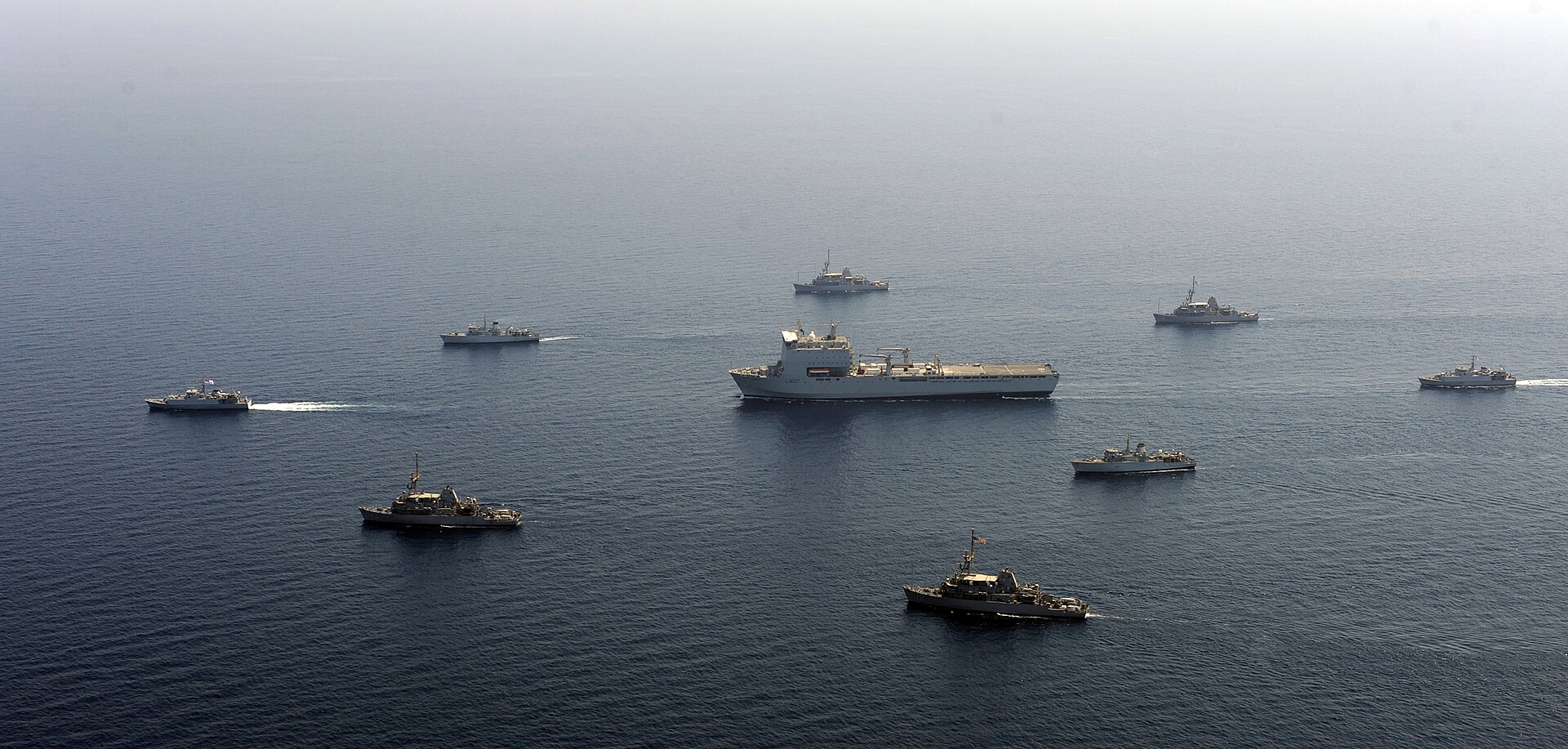
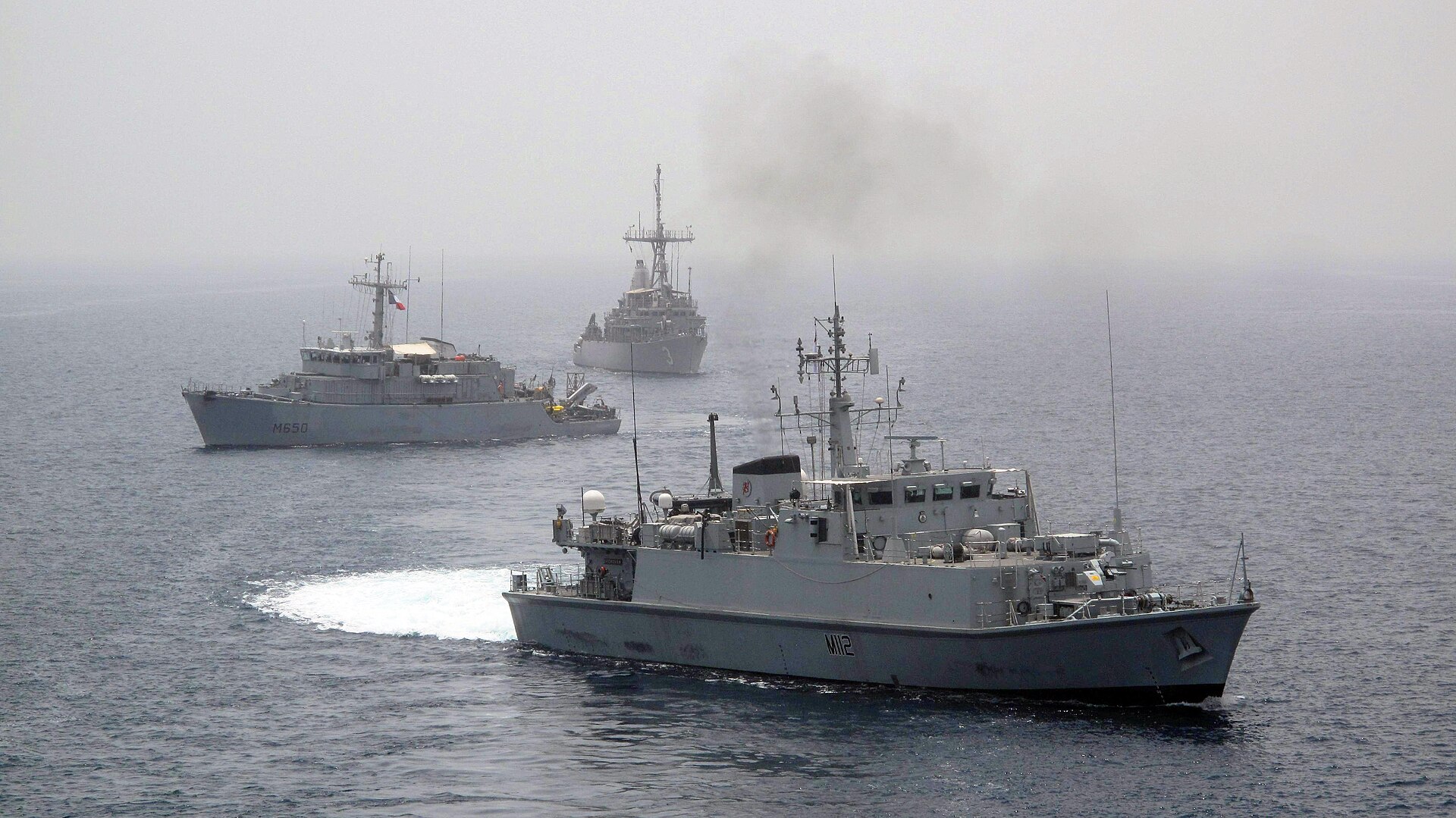
The military assets converging on the strait reflect the six-nation plan, not Trump’s go-it-alone posture. The French aircraft carrier Charles de Gaulle is already positioned in the Arabian Sea, according to ABC News. The UK’s RFA Lyme Bay reached Gibraltar carrying the RNMB Ariadne mine-hunting unmanned surface vehicle, a deployment Naval News described as part of a broader allied clearance posture. France has approached 35 countries to join the demining coalition, according to AOL wire reporting from June 16, and a 38-nation political support framework was announced on May 12 through the UK government portal — though political support and operational contribution are different commitments, and the number of nations willing to put mine countermeasure vessels in the water rather than signatures on a communiqué remains substantially smaller.
The Chatham House assessment from May 2026 framed the coalition’s purpose not as military victory but as cost imposition: the goal “should not be to defeat Iran militarily but to alter its cost-benefit analysis by making any attacks on shipping consistently ineffective and increasingly escalatory.” That framework is compatible with the six-nation “strictly defensive” formulation but incompatible with Trump’s description of a problem already solved. If mines are “a couple” that have “already been found,” as Trump stated, a 38-nation coalition and a carrier strike group are a disproportionate response. If the Maham-7’s sonar-defeating casing makes detection unreliable in single-pass sweeps, as defense analysts have documented, they are the minimum necessary force — and Trump’s refusal of allied help extends a timeline Saudi Arabia cannot afford.
UNSCR 2817, adopted during the crisis, affirmed that Gulf littoral states “are not parties to the hostilities” — language that reinforces Saudi Arabia’s non-combatant status but also, paradoxically, limits the kingdom’s legal basis for participating in military clearance operations, even if it wanted to. Saudi Arabia cannot clear the mines, cannot authorize anyone else to clear them, and cannot control the timeline on which the parties who can clear them choose to act.
| Scenario | Timeline | PGSA fee exposure | Source |
|---|---|---|---|
| Trump claim (“completely opened”) | Days | ~$5.5M/day until clear | Bloomberg, June 15-16 |
| Swept-lane confidence | 40-50 days | ~$220M-$275M | TASS/Western maritime sources |
| Pentagon private (full TSS) | 6 months | ~$990M | Washington Post, April 22 |
| Ongoing PGSA annual rate | 12 months | ~$2B/year | PGSA $1/barrel × 5.5M bpd |
Does the MOU Authorize Anyone to Clear Anything?
The MOU text, as reported through the draft versions circulated by IRNA and described by US and Iranian officials, grants no mine clearance authority and names no clearance party. It addresses Hormuz as a diplomatic subject — the strait should reopen, tolls are prohibited — but provides no operational framework for how mines are to be removed, by whom, under what legal authority, or on what timeline. The document that both sides endorsed is, on the specific question of what physically reopens the waterway, silent.
This silence is the gap through which the Évian disagreement flows. Trump treats the MOU as though signing it reopens the strait — “ships are starting to go out now,” he said, as if the act of political agreement dissolves the physical presence of mines in the shipping lane. The six allies treat the MOU as a political precondition that unlocks the harder question: who has the authority to conduct clearance operations in a strait where one coastal state insists on coordination rights, another has sovereign claims on Oman’s side, and no UNSC Chapter VII resolution has authorized forcible action against the mining state.
The Corfu Channel precedent is instructive precisely because it addressed this gap. Albania had mined the channel. The United Kingdom had the legal right to transit it. But when Britain returned to sweep the mines — an operation that served the interests of every maritime state — the ICJ still found that doing so without Albania’s consent violated sovereignty. Seven decades later, the legal architecture has not changed, and the six-nation statement’s carefully constructed “strictly defensive and independent” language is an attempt to build a new exception within it rather than a reflection of settled law.
Background: Hormuz, Corfu, and the Consent Problem
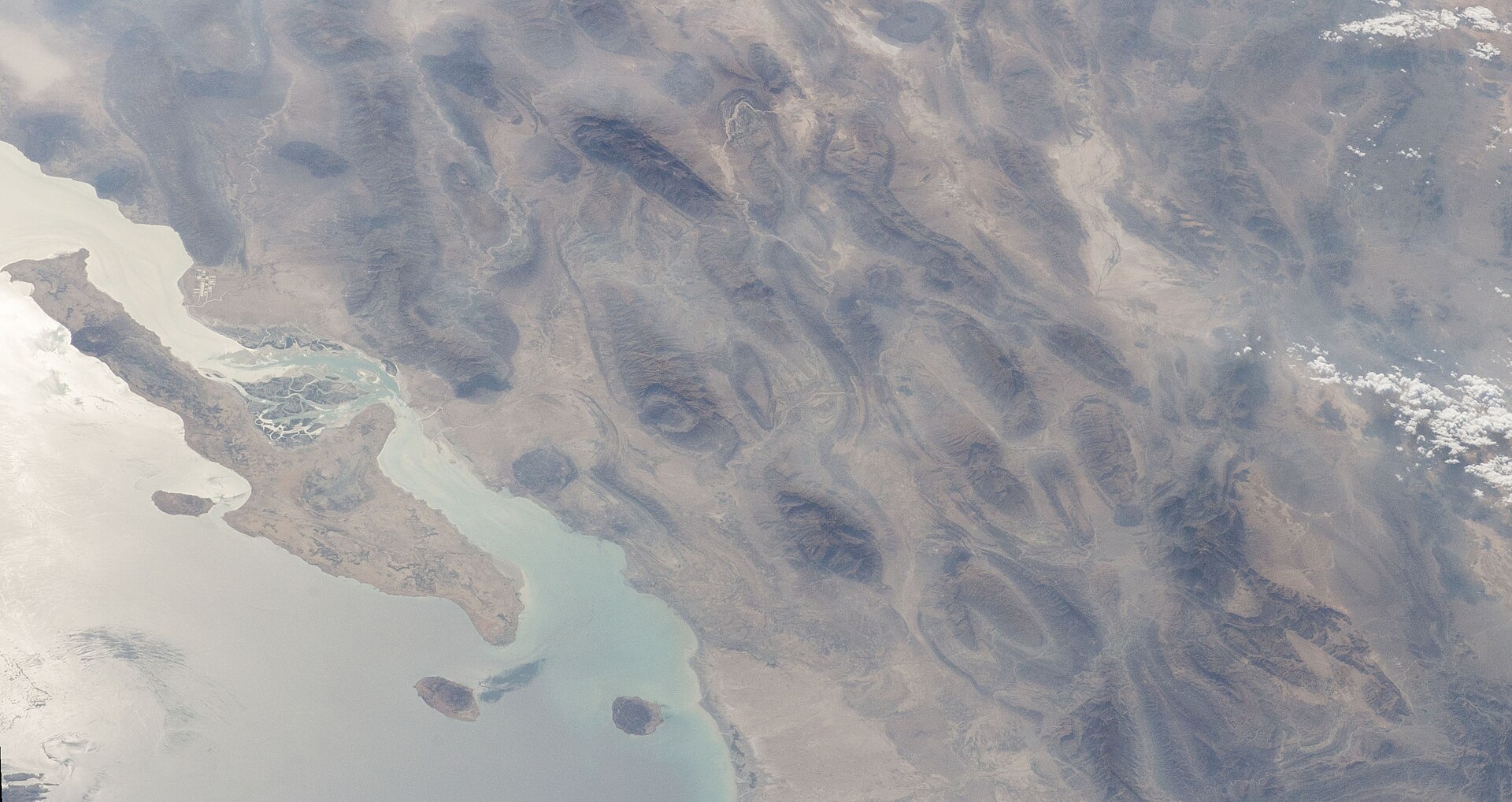
The Strait of Hormuz handled roughly 150 vessel transits per day before the current crisis reduced that number to between 5 and 17, according to Gulf News and IndexBox data. The 33-kilometer-wide passage between Iran and Oman carries approximately 20 percent of global oil supply and Saudi Arabia’s 5.5 million barrels per day — roughly 38 percent of all crude transiting Hormuz. Its effective closure since the escalation has stranded more than 800 heavy commercial vessels, trapped 20,000 seafarers aboard roughly 2,000 ships including six cruise liners according to UN News, and driven war-risk insurance premiums from 0.2 percent to 1 percent of ship value — with some reports of costs rising 4,000 times above pre-crisis rates, per The National.
Operation Project Freedom, the US-led military response, launched on May 4 with approximately 15,000 troops, sank 16 Iranian minelayers in its initial phase, and paused on May 6 after what officials described as “great progress,” according to Army Recognition and Al Jazeera. It has not resumed at the same scale. The mines that remain include the Maham-7, a weapon specifically designed to defeat minesweeping operations: its glass-reinforced polymer casing does not return a sonar signature, its three-axis magnetic sensor and subsonic acoustic trigger allow it to distinguish between minesweeping equipment and actual vessel hulls, and at 150 kilograms of payload in a 440-by-980-millimeter housing, it is small enough to be difficult to locate visually, as documented by defense analyst H.I. Sutton at Covert Shores and The Defense News.
The historical precedent most directly relevant to the current crisis is Operation Earnest Will, the 1987-1988 US-led operation that reflagged Kuwaiti tankers during the Iran-Iraq Tanker War. France, the United Kingdom, Italy, and the Netherlands all deployed minesweepers to the Persian Gulf during that operation — but the clearing took place in the wider Gulf, not in the Hormuz passage itself, and it proceeded without any requirement for Iranian coordination. The current situation is legally distinct: Iran has explicitly asserted coordination authority over the strait, has established an institutional mechanism (the PGSA) to exercise it, and has codified the fee structure through parliamentary legislation — none of which existed during Earnest Will.
Frequently Asked Questions
Has any international tribunal ruled on whether “defensive” minesweeping can bypass coastal-state consent?
No tribunal has tested the specific theory embedded in the six-nation statement. The ICJ’s 1949 Corfu Channel ruling addressed offensive minesweeping without consent and found it unlawful, but the “strictly defensive” framing used by the UK, France, Germany, Italy, the Netherlands, and Japan is a novel construction that attempts to characterize clearance as an exercise of transit-passage rights under UNCLOS rather than as a military operation requiring sovereign consent. Whether this distinction would survive judicial scrutiny is untested, and Iran’s June 15 UN notification appears designed to create the factual record for a future legal challenge.
Could the UN Security Council authorize forcible mine clearance under Chapter VII?
In theory, a Chapter VII resolution could override Iran’s consent requirement by declaring the mining a threat to international peace and security and authorizing member states to “use all necessary measures” to clear the waterway. In practice, Russia and China — both of which hold UNSC vetoes and both of which are exempt from PGSA fees under Iran’s current pricing structure — have shown no willingness to support such a resolution. UNSCR 2817, the resolution adopted during the crisis, affirmed that Gulf littoral states “are not parties to the hostilities” but stopped well short of authorizing forcible clearance, and no draft Chapter VII text has been circulated.
What happens to war-risk insurance premiums if only a swept lane opens rather than full TSS clearance?
Maritime insurance underwriters distinguish between a swept lane — a narrow corridor confirmed clear by mine countermeasure vessels — and full Traffic Separation Scheme clearance, which certifies the entire navigable width of the strait. A swept lane could allow some commercial traffic to resume, but underwriters would likely maintain elevated war-risk premiums, currently at 1 percent of ship value, until the TSS is fully cleared and independently verified. For a VLCC carrying $150 million in crude, the difference between a 0.2 percent peacetime premium and a 1 percent war-risk premium is approximately $1.2 million per transit — a cost passed to the exporting nation in the form of reduced netback prices, with Saudi Arabia as the largest single-exporter affected.
Why was Saudi Arabia absent from the Évian session on Hormuz?
Saudi Arabia was the only invited Arab state that did not attend the June 16 G7 Arab-leaders session at Évian that addressed Hormuz reopening, mine clearance, and nuclear sequencing. Egypt, Qatar, and the UAE all participated. Crown Prince Mohammed bin Salman declined the G7 invitation for the third consecutive summit, and the kingdom sent a foreign-minister-level delegation rather than a head-of-state representative, according to reporting on the Évian summit.
How many mines are believed to remain in or near the strait?
No official public count has been released by CENTCOM, the allied coalition, or the Pentagon. Operation Project Freedom sank 16 Iranian minelayers in its May 4-6 phase, but the number of mines those vessels had already deployed before being sunk has not been disclosed. Defense analysts have noted that Iran’s mine inventory, built over decades with both domestically produced weapons like the Maham-7 and older contact mines, is estimated in the thousands, though what proportion was deployed specifically in the Hormuz shipping lanes versus in defensive coastal positions remains classified. Trump’s characterization of “a couple of mines that they’ve already found” is not consistent with the allied coalition’s mobilization of carrier strike groups, dedicated mine countermeasure vessels, and unmanned underwater vehicles for what the six-nation statement describes as a full clearance mission.