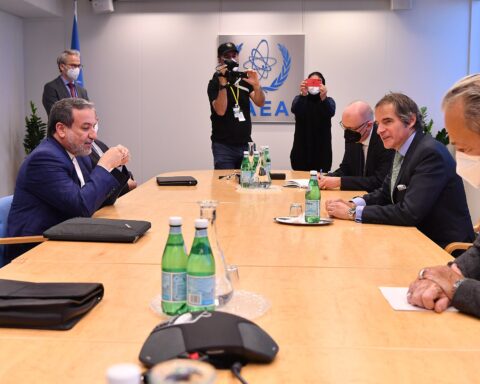
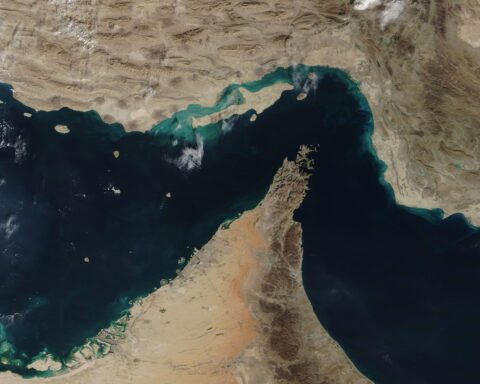
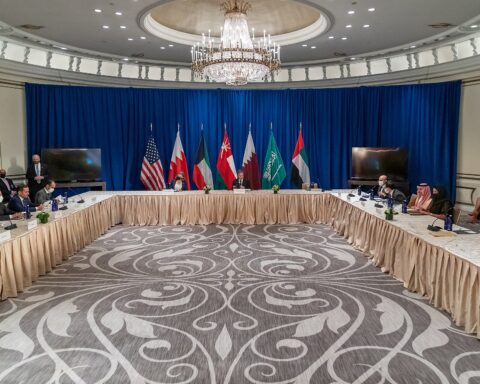
DUBAI — Iran’s Islamic Revolutionary Guard Corps declared on October 17 that the Strait of Hormuz is closed and that “the passage of ships of various nationalities through the strait is prohibited,” according to IRNA as reported by Capital News Point and Middle East Eye. The declaration marks the first time both the IRGC and Iran’s Foreign Ministry have used identical closure language simultaneously, removing the diplomatic ambiguity that Western governments had treated as proof the strait remained navigable.
For months, the operational reality and the legal classification have diverged. Iran mined the strait, attacked tankers, demanded email-based transit coordination and warned that non-compliant vessels would “burn in the fire” of their reliance on the U.S. military, as Rear Admiral Ali Ozmaei of the IRGC Navy warned on October 17 (Sunday Guardian / Dawn, citing ISNA). But until this week, Tehran’s Foreign Ministry maintained a different posture — describing the strait as operating under Iranian monitoring while the IRGC declared it closed. That gap gave Washington, Riyadh and London legal room to treat the situation as disruption rather than blockade. In October, the Foreign Ministry used language it had previously avoided — matching the IRGC’s declaration word for word.
The question is what changes — under UNCLOS, the San Remo Manual and the laws of armed conflict — when a state formally declares an international strait closed, and why Riyadh, Washington and London are choosing to treat it as a military fact rather than a legal one.
Table of Contents
- What Did Iran Actually Declare on October 17?
- Why Does a Declaration Matter If the Strait Was Already Mined?
- The Foreign Ministry Closed the Escape Hatch
- Does Iran’s Closure Meet the Legal Definition of a Blockade?
- What Legal Responses Does a Declared Blockade Allow?
- The Insurance Market Already Decided
- How Many Ships Are Still Transiting Hormuz?
- Who Benefits From Calling It a Blockade?
- FAQ
What Did Iran Actually Declare on October 17?
The IRGC Navy announced that the passage of commercial ships of all nationalities through the Strait of Hormuz is prohibited, citing IRNA (Capital News Point / 24newshd / Middle East Eye, October 17–18, 2026). IRGC spokesman Sardar Mohebi argued that a functioning Hormuz would carry approximately 125 ships per day with roughly 20 million barrels of crude; since those levels are absent, the strait should “therefore be considered closed” (Capital News Point, citing IRNA, October 17, 2026).
The declaration added operational teeth. All traffic must coordinate with the IRGC and use Tehran-approved corridors, with approval requested by email (Sunday Guardian live blog, October 17, 2026). Rear Admiral Ozmaei warned that vessels crossing without authorisation would “burn in the fire of their reliance on the US military” (Sunday Guardian / Dawn, citing ISNA, October 17–18, 2026).
Hours after the announcement, the IRGC claimed a supertanker carrying more than two million barrels struck a mine early on October 17 after switching off its radar and using an “unauthorised route” (Tehran Times / Arab Times Online, October 17–18, 2026). The vessel’s name, flag and cargo owner have not been independently confirmed.
The Middle East briefing 3,000+ readers start their day with.
One email. Every weekday morning. Free.
This was the third major declaration. Iran first declared the strait “closed until further notice” in July 2026 after a cargo ship was struck. In August it extended the claim to include Omani waters (Washington Times, August 2026; Capital News Point, October 17, 2026). The October statement went further: it claimed the right to prohibit all passage and defined the conditions — email coordination, approved corridors, IRGC oversight — under which any transit could occur.
Deputy Sayyari of Iran’s government said flatly: “The Strait of Hormuz is closed. Any passage through the waterway must be coordinated, with vessels transiting without coordination facing consequences” (Tehran Times, October 2026). Parliament Speaker Ghalibaf said the strait “will not be opened until Iran’s seven conditions based on the Islamabad memorandum are met” (Washington Times / Reuters, August 2026).
Why Does a Declaration Matter If the Strait Was Already Mined?
A formal declaration that an international strait is closed is a legal instrument, not a description of military activity. The mines, the tanker attacks and the email-based permit regime Iran imposed earlier were operational facts — they could be characterised as acts of war, piracy, or maritime enforcement depending on which legal framework a state chose to invoke. A declared closure forces the question.
Under the laws of armed conflict, there is a distinction between attacking ships that happen to be in a waterway and declaring that the waterway is closed to all traffic. The first is a series of military incidents. The second is an assertion of sovereign control — a claim that Iran has the right to regulate passage through waters that UNCLOS designates as an international strait open to all.
UNCLOS Article 37 states that “all ships and aircraft enjoy the right of transit passage, which shall not be impeded” (Atlantic Council, Braw, 2026). Article 44 says strait states “shall not hamper transit passage” and provides no right to suspend it. Iran signed but never ratified UNCLOS. Tehran’s consistent legal position is that transit passage is a treaty right, not customary international law — meaning non-UNCLOS parties such as the United States and Israel receive only innocent passage, and Iran is not bound by Article 44’s non-suspension rule (Alexander Lott, EJIL:Talk!, March 10, 2026; Konstantinos Deligiannis-Virvos, Opinio Juris, May 6, 2026).
The counter-argument, advanced by the U.S. and most law-of-the-sea scholars, holds that transit passage through Hormuz has become customary international law through decades of state practice — an argument grounded in the Corfu Channel case of 1949. If so, Iran’s declaration violates customary law regardless of its UNCLOS ratification status.
No state has ever successfully declared an international strait closed in modern maritime law. The 1980–88 Tanker War saw Iran and Iraq attack hundreds of vessels, but neither state formally declared Hormuz closed, and Western naval forces escorted shipping through (History Today / Britannica / EJIL:Talk!). What Iran has done in October 2026 has no modern precedent.
The Foreign Ministry Closed the Escape Hatch
The signal that separates October from every prior Iranian statement is the alignment between the IRGC and the Foreign Ministry. For months, Iran’s Foreign Ministry maintained a softer posture — stopping short of the IRGC’s closure declarations while describing shipping as moving under Iranian monitoring. Western governments treated that gap as evidence the IRGC was posturing beyond Tehran’s official position — that Iran’s diplomatic establishment did not endorse the closure and that the declarations were military bluster, not state policy.
That gap is gone. In October, Baghaei said: “Security will not return to the Strait of Hormuz as long as the United States maintains its blockade and economic pressure.” He rejected U.S. claims that the strait had reopened (Tehran Times, October 2026). Deputy Sayyari — an FM-level official, not a military commander — used the same language as the IRGC: “The Strait of Hormuz is closed” (Tehran Times, October 2026).
When both the military and the foreign ministry of a state use identical language to describe the legal status of an international waterway, other states lose the basis for treating the declaration as anything other than official policy. The diplomatic escape hatch that Washington and London relied on in June — the argument that the closure was an IRGC position, not an Iranian government position — no longer holds.
Ghalibaf reinforced the alignment from the legislative branch, tying reopening to the seven conditions of the Islamabad memorandum framework (Washington Times / Reuters, August 2026). Three branches of the Iranian state — military, executive, legislative — are now saying the same thing.
Does Iran’s Closure Meet the Legal Definition of a Blockade?
Under the San Remo Manual on International Law Applicable to Armed Conflicts at Sea (1994), which is widely considered to reflect customary laws of armed conflict at sea, a blockade requires “effective prevention of access of vessels and aircraft of all States” to a coastal area (Rule 95). The manual permits belligerents to close a strait to enemy vessels but requires respect for neutral transit rights (Rule 27).
Alexander Lott, a research professor at the Norwegian Centre for the Law of the Sea at UiT, argued in March 2026 that “Iran’s closure has been mistakenly characterized as a de facto blockade.” His reasoning: an effective blockade requires the prevention of access by vessels and aircraft “of all States,” and since U.S. and Israeli warships could still transit, Iran’s closure did not meet the legal threshold (EJIL:Talk!, March 10, 2026).
That analysis was written before daily visible transits fell to six. Windward AI data tracked visible daily transits falling from 18 on October 7 to just six by mid-October (gCaptain, October 2026). CENTCOM said 135 ships had been turned around since the blockade began on July 14 (CBS News, October 10, 2026). CENTCOM simultaneously rejected the October declaration, stating that commercial traffic including 20 million barrels of crude was still moving (IranWire / gCaptain, October 2026).
Whether October’s facts now satisfy the San Remo Manual’s effectiveness test is genuinely unresolved. Lott’s March threshold — that U.S. warships can still transit — may not hold if the question shifts from military access to commercial shipping access. Six visible commercial transits a day through a waterway that carried 130 to 140 ships daily before the war (Chronicle.lu / Reuters, August 2026) is a reduction of more than 95 per cent.
Konstantinos Deligiannis-Virvos, a PhD research fellow at the Norwegian Centre for the Law of the Sea at UiT, has argued that “threatening to attack any vessel regardless of flag is not lawful under customary law” and that “interference with neutral export products may occur only through a lawful blockade” (Opinio Juris, May 6, 2026). Iran’s declaration — which claims the right to prohibit passage by vessels “of various nationalities” — appears to assert exactly the kind of universal interference that Deligiannis-Virvos describes as unlawful unless conducted under a formal blockade.
What Legal Responses Does a Declared Blockade Allow?
If Iran’s declaration is treated as a blockade under international law, it changes what responses are legally available to states affected by it. A blockade is an act of war. States whose commerce is blocked acquire rights of self-defence and, under certain readings of international law, the right to use force to break the blockade — rights that are less clearly available in response to individual maritime incidents, however numerous.
Saudi Arabia has so far framed the Hormuz situation through diplomatic and economic channels. Prince Faisal told the UN General Assembly in September that the international community had been “absent” (The National, September 28, 2026). Saudi Arabia asked the UN Security Council to act (Al Jazeera, October 9, 2026). The EU-GCC summit is set for Riyadh on October 24, co-chaired with the crown prince (The National, October 8, 2026) — more than 75 per cent of EU imports from the GCC are fuel (European Commission via The National, October 8, 2026).
But none of these responses engage with the declaration as a legal act. Riyadh has not invoked the right of self-defence against a blockade. Washington has not challenged the closure under UNCLOS or customary law. London has not demanded a freedom-of-navigation assertion through the strait. All three are treating the situation as operational military activity — a series of attacks and disruptions — rather than a declared closure of an international waterway.
Prof. Marc Weller of Chatham House has treated the dispute as a freedom-of-navigation question for all maritime states, noting that any proposed resolution “relies on multilateral institutions to implement it” (Chatham House, April 2026). John Norton Moore, a law-of-the-sea professor who represented the U.S. in UNCLOS negotiations, warned: “We will see backsliding in straits” (Atlantic Council issue brief).
The strategic choice not to classify Iran’s declaration as a blockade may be deliberate. Calling it a blockade triggers obligations — to respond, to enforce, to challenge — that none of the three capitals may want to assume before the U.S. midterm elections on November 3. Trump said on October 8 that the U.S. “will not be attacking Iran at any time prior to the midterm elections” and that the Hormuz blockade remains in “full force” (The National, October 8, 2026).
The Insurance Market Already Decided
While governments debate the legal classification, the insurance market has priced the strait as closed. Hull war-risk premiums reached 10 per cent of hull value, with Lloyd’s List reporting “double-digit millions of dollars per trip” (Lloyd’s List, October 2026). The International Union of Marine Insurance estimated total marine insurer losses from the conflict at $1.5 to $2 billion (TankerBrief, 2026).
Six Protection and Indemnity clubs — Gard, Skuld, NorthStandard, London P&I, American Club and Steamship Mutual — cancelled non-poolable charterers’-liability war-risk extensions with approximately 72 hours’ notice around March 5 (TankerBrief / Lloyd’s List, 2026). The market pattern echoes the Suez crisis of 1956, when marine insurers withdrew Suez transit cover approximately 48 hours before the canal was physically blocked — the market moved faster than military reality (TankerBrief, 2026).
TankerBrief’s analysis described the mechanism precisely: the strait “closed on risk and price, not on cancellation of all cover.” The U.S. $40 billion reinsurance facility “insures the steel, not the voyage” (TankerBrief, 2026). The distinction matters: the ship is covered; the transit is not. An owner can sail through Hormuz and remain insured for fire, collision and total loss. But the war-risk premium for that single voyage may exceed the cargo’s margin.
Maersk is now discharging containers outside the strait and moving cargo overland to Jebel Ali, charging $1,000 per container on any Hormuz transit (Loadstar, October 2026). Around 180 vessels were reported anchored near Fujairah and Khor Fakkan in mid-August (Nautica Post, August 14, 2026). The Gulf–China VLCC rate stood at $1.2 million per day, against roughly $80,000 a year earlier (bdnews24 / LSEG, October 5, 2026).
The insurance market does not need a legal classification. It prices risk. And the risk price for transiting Hormuz in October 2026 says the strait is closed — whatever governments choose to call it.
How Many Ships Are Still Transiting Hormuz?
The transit collapse detailed in the legal analysis above is reflected across every available tracking source. The straits.live tracker listed the strait as “effectively closed to commercial shipping” as of October 18 (gCaptain / straits.live, October 2026). UKMTO — Britain’s Maritime Trade Operations service — counted twelve ship attacks in the week of October 13 alone, while simultaneously acknowledging it was undercounting; the institution that produces that data has no warship in the strait to act on it.
| Metric | Figure | Source |
|---|---|---|
| Pre-war daily transits | 130–140 ships/day | Chronicle.lu / Reuters, Aug 2026 |
| Visible daily transits, Oct 7 | 18 | Windward AI via gCaptain, Oct 2026 |
| Visible daily transits, mid-Oct | 6 | Windward AI via gCaptain, Oct 2026 |
| Ships turned around since July 14 | 135 | CENTCOM via CBS News, Oct 10, 2026 |
| Vessels anchored at Fujairah/Khor Fakkan | ~180 | Nautica Post, Aug 14, 2026 |
| Gulf–China VLCC rate | $1.2 million/day | bdnews24 / LSEG, Oct 5, 2026 |
| Hull war-risk premium | 10% of hull value | Lloyd’s List, Oct 2026 |
| Maersk Hormuz surcharge | $1,000/container | Loadstar, Oct 2026 |
CENTCOM’s claim that 20 million barrels of crude were still moving through the strait (IranWire / gCaptain, October 2026) and Mohebi’s argument that absent traffic levels prove the strait is closed are not contradictory. A small number of VLCCs carrying large cargoes under military escort does not constitute the open commercial transit that UNCLOS Article 37 envisions. A VLCC rate now fifteen times its pre-war level signals a voyage priced as a combat operation, not a commercial transit.
Who Benefits From Calling It a Blockade?
Iran’s formal declaration creates a paradox. If the closure meets the legal threshold for a blockade, it gives Iran rights it previously lacked — specifically, the right under the San Remo Manual to intercept neutral cargo as contraband. Under international maritime law, interference with neutral cargo requires a lawful blockade as justification. Before this declaration, Iran’s attacks on neutral tankers had no legal basis even under the laws of armed conflict. A declared and effective blockade would retroactively provide one.
But the same declaration creates stronger legal grounds for other states to respond with force. A blockade is an act of war under international law. States whose commerce is blocked — Saudi Arabia, Kuwait, Qatar, the UAE, Iraq — would have clearer legal authority to use force to break it. The Makkah Defence Agreement, activated in October with Pakistani and Turkish forces (Al Jazeera, October 6, 2026), could invoke blockade-breaking as a collective defence measure under the UN Charter.
This explains why no capital has rushed to apply the label. Riyadh gains the right to respond but also assumes the obligation to act. Washington gains legal clarity but faces the political cost of pre-election escalation. Tehran gains a legal framework for its enforcement actions but exposes itself to the full range of military responses that blockade law permits.
Iran’s Araghchi presented a seven-day roadmap via Qatar in September — Hormuz would reopen in return for the U.S. lifting its blockade, sanctions waivers and roughly $12 billion in frozen assets (Al Jazeera, September 25, 2026). Trump rejected the plan. The Wall Street Journal reported that he expects renewed bombing after the midterms (Hurriyet / WSJ, September 26, 2026). Until November 3, the legal classification of the strait serves as a holding pattern — ambiguity as strategy.
The Tanker War of 1980–88 lasted eight years with hundreds of vessels attacked and neither Iran nor Iraq ever declared the strait closed. The precedent mattered: an undeclared campaign of attacks is messy, costly and politically manageable. A declared closure is a legal fact that demands a legal response. Iran has now crossed that line. The question is whether anyone on the other side will acknowledge it.
Elisabeth Braw of the Atlantic Council observed that Hormuz “functioned as foreseen under UNCLOS” until the conflict began on February 28, 2026 (Atlantic Council issue brief). Eight months later, the legal order that governed the world’s most important oil chokepoint has been replaced by email-based permission from the IRGC. London is preparing to co-host the EU-GCC summit on October 24 while treating that replacement as a military disruption, not a legal revolution.
FAQ
Has Iran declared a blockade under international law?
Iran has not used the word “blockade.” The IRGC and Foreign Ministry have declared the strait “closed” and “passage prohibited,” which functions as a blockade declaration in substance without adopting the legal terminology. This matters because a formal blockade under the San Remo Manual (Rule 95) requires effectiveness — the prevention of access by vessels of all states. Iran may be avoiding the term to sidestep the effectiveness test while still claiming enforcement rights. No state has formally challenged this framing at the International Maritime Organization or the International Court of Justice.
Can Iran legally close the Strait of Hormuz?
Iran’s legal position rests on its non-ratification of UNCLOS. Tehran argues that transit passage is a treaty right, not customary international law, meaning it does not bind Iran under Article 44’s prohibition on suspending transit. The April 2026 Security Council resolution urging coordinated defence of Hormuz shipping was vetoed by Russia and China, 11–2 with two abstentions (Dawn, April 7, 2026). The veto eliminated the most direct multilateral enforcement mechanism for transit rights, leaving the legal challenge to bilateral or unilateral action.
What happened during the 1980–88 Tanker War?
Iran and Iraq attacked more than 400 merchant vessels between 1980 and 1988, but the strait was never completely closed and no state formally declared it so. The U.S. launched Operation Earnest Will in 1987 to escort reflagged Kuwaiti tankers. The legal framework at the time treated each attack as an individual incident, not a systemic closure. That Iran has now gone further than either belligerent did during the Tanker War — issuing a formal closure declaration backed by all branches of government — is itself unprecedented in modern maritime law.
What is the Islamabad memorandum that Iran says must be met?
The Islamabad Memorandum of June 17, 2026 provided for 60 days of toll-free Hormuz passage, the lifting of the U.S. blockade within 30 days, a reconstruction plan of at least $300 billion, and Iran-Oman talks on the strait’s future administration (Iran International, June 17, 2026). The memorandum collapsed on July 8 after three ships including the Saudi-flagged Wedyan were hit near Hormuz and CENTCOM struck more than 80 targets in southern Iran (The New Arab, July 8, 2026). Ghalibaf’s October statement ties Hormuz reopening to the memorandum’s seven conditions — a framework that no longer has any active negotiations.
Could a force majeure clause be triggered by Iran’s declaration?
No source has addressed whether a formal IRGC declaration — as distinct from operational attacks or mine incidents — triggers force majeure clauses in shipping contracts. Charterers whose vessels cannot transit Hormuz have until now relied on war-risk clauses and safe-port provisions. Whether a state declaration of closure, particularly one endorsed by both military and diplomatic branches, constitutes a force majeure event is an untested legal question in maritime commercial law. No court has yet been asked to rule.