
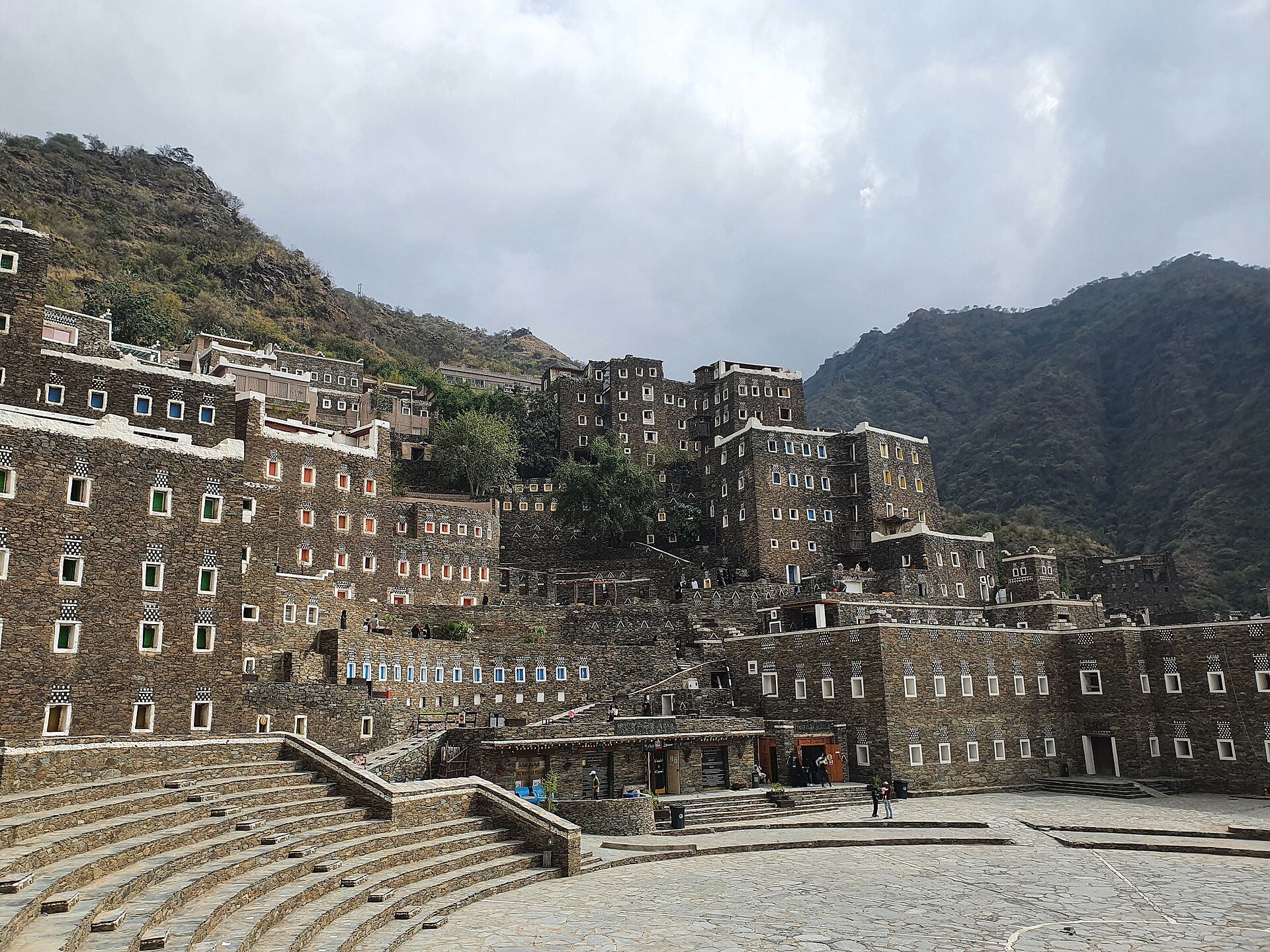
Rijal Almaa is the most visually striking heritage village in Saudi Arabia. Tucked into a narrow valley roughly 50 kilometres west of Abha, it sits at the junction where ancient trade routes once linked Yemen to Mecca and Medina through the Asir highlands. The village’s roughly 60 multi-storey stone towers — some reaching eight floors — cascade down a mountainside in a formation that looks almost impossible from a distance. If you are planning a wider Abha and Asir itinerary, Rijal Almaa is the single destination you should not skip. It is the centrepiece of the region’s cultural heritage, a living museum of Asiri architecture, and a candidate for UNESCO World Heritage status.
Best Time to Visit: October to March (mild highland weather, 15–25°C)
Getting There: 50 km west of Abha by car — about 1–1.5 hours via mountain roads
Visa Required: Yes — tourist e-visa
Budget: $10–30/day (museum entry SAR 20, no accommodation on-site)
Must-See: Heritage Museum in Al Alwan Palace, stone tower houses, Al-Qatt Al-Asiri wall art
Avoid: Driving the mountain route at night — hairpin turns with no lighting
Why Rijal Almaa Matters
Rijal Almaa is more than 900 years old. For centuries it functioned as a crossroads village where traders carrying frankincense, spices, and goods between Yemen and the Hejaz rested and resupplied. The village’s people — the Rijal Almaa tribe — were known as warriors and scholars. Historical records note that the tribe sent 700 soldiers to the Battle of Al-Qadisiyah in 636 CE, one of the decisive confrontations of early Islamic expansion, and later stationed a garrison in Medina to help protect the Prophet’s city.
That martial and commercial heritage is written into the architecture. The tall stone houses were defensive by design: narrow windows doubled as lookout points, and the sheer height of the towers gave residents a commanding view over the valley approaches. Today those same towers are what draw visitors from across the Kingdom and beyond. The village is among Saudi Arabia’s most important heritage villages, and its traditional architecture has no equivalent anywhere else in the Arabian Peninsula.
History of Rijal Almaa
Origins and Trade Route Significance
The village’s location was strategic by design. Positioned in the Wadi Hali valley at approximately 18°12’N 42°16’E, Rijal Almaa sat on one of the primary north-south corridors linking the lowlands of Tihama and the coast of Yemen to the highland interior and, ultimately, to the holy cities of Mecca and Medina. Caravans carrying goods from the Indian Ocean trade — arriving through the ports of Aden and Al Hudaydah — would climb into the Asir mountains and pass through Rijal Almaa before continuing north. This made the village a natural rest stop, a market, and a toll point all at once.
The wealth that accumulated from centuries of trade funded the construction of the tower houses that define the village today. Wealthier families built taller structures, and the height of a family’s tower was a direct statement of status. The ground floors were used for storage and livestock, the middle floors for daily family life, and the upper floors for reception rooms — the majlis — where guests were entertained and business conducted.
The Tribe and Its Military Legacy
The Rijal Almaa tribe is part of the larger Banu Shahr tribal confederation. Their participation in the Battle of Al-Qadisiyah in 636 CE is a point of pride recorded in local historical accounts. The tribe also played a role in defending the region against various incursions over the centuries, and their reputation as formidable fighters contributed to the village’s ability to maintain its independence and commercial importance. When you visit the heritage museum, several sections are dedicated to the tribe’s military artefacts — swords, daggers, shields, and chain mail — alongside documents recording their role in early Islamic campaigns.
Modern Recognition
Rijal Almaa’s significance was formally recognised in 2015 when the Saudi Commission for Tourism and Antiquities launched a rehabilitation project to restore the village. In 2017, the village was awarded the Prince Sultan bin Salman Prize for Urban Heritage — one of Saudi Arabia’s most prestigious cultural honours. In January 2018, the Saudi Commission for Tourism and National Heritage approved Rijal Almaa’s candidacy for UNESCO World Heritage status, and the village now appears on UNESCO’s Tentative List. In 2023, Crown Prince Mohammed bin Salman included it in the Soudah Peaks development project, a major initiative to develop the Asir highlands as an international tourism destination while preserving its heritage.
What to See in Rijal Almaa
The Tower Houses
The roughly 60 multi-storey tower houses are the main attraction and the reason most visitors come. Built from local stone with clay mortar and wooden beams, they feature distinctive coloured window shutters and exterior decorations. The construction technique is indigenous to the Asir region: load-bearing stone walls taper slightly as they rise, with wooden courses (known as “tawaliq”) inserted between stone layers to add flexibility and earthquake resistance. Some towers reach eight storeys, making them among the tallest traditional structures in the Arabian Peninsula.
The exteriors are striking, but the interiors are where the artistry becomes extraordinary. Many rooms retain their original Al-Qatt Al-Asiri wall decorations — geometric patterns painted directly onto the white gypsum plaster that coats the interior walls. The upper-floor reception rooms were the most elaborately decorated, as these were the spaces where the family’s wealth and taste were displayed to visitors.
Rijal Almaa Heritage Museum
The heritage museum is housed in the Al Alwan Palace, a four-century-old structure that was once the residence of the village’s most prominent family. The museum was established in 1985 and contains more than 2,000 artefacts and documents spread across 19 exhibition sections. The collections include traditional Asiri clothing, agricultural tools, weapons, household items, manuscripts, and jewellery. Several rooms have been restored to show how families lived in the tower houses, with traditional furnishings and wall decorations intact.
The museum is open from 9:00 AM to 9:00 PM daily, with closures during prayer times. Entry costs SAR 20 (approximately $5.30 USD). It is worth allowing at least an hour to walk through properly, though visitors with a strong interest in traditional crafts or architecture could easily spend two hours.
Al-Qatt Al-Asiri Wall Art
In 2017, UNESCO inscribed Al-Qatt Al-Asiri on the Representative List of the Intangible Cultural Heritage of Humanity. This traditional art form — practised exclusively by women — involves painting bold geometric patterns on the interior walls of homes. The designs feature triangles, rhombuses, zigzag lines, and floral-inspired motifs applied over a base layer of white gypsum. The colours are vivid: deep reds, blues, greens, and yellows, often outlined in black to create sharp definition.
Rijal Almaa is one of the best places in Saudi Arabia to see Al-Qatt Al-Asiri art in its original context. The patterns here tend to be smaller and more intricate than in other Asiri villages, with dense, finely outlined compositions that reflect the village’s wealth and the skill of its women artists. The knowledge was passed from mother to daughter through generations of communal painting sessions, where women of different ages would gather to decorate a home’s interior together. Several rooms in the heritage museum preserve original examples, and local artisans occasionally demonstrate the technique for visitors.
If the art form interests you, the broader tradition is explored in depth at facilities in Abha city, and you can see related traditional Saudi handicrafts — including weaving and pottery — in workshops across the Asir region.
The Village Amphitheatre
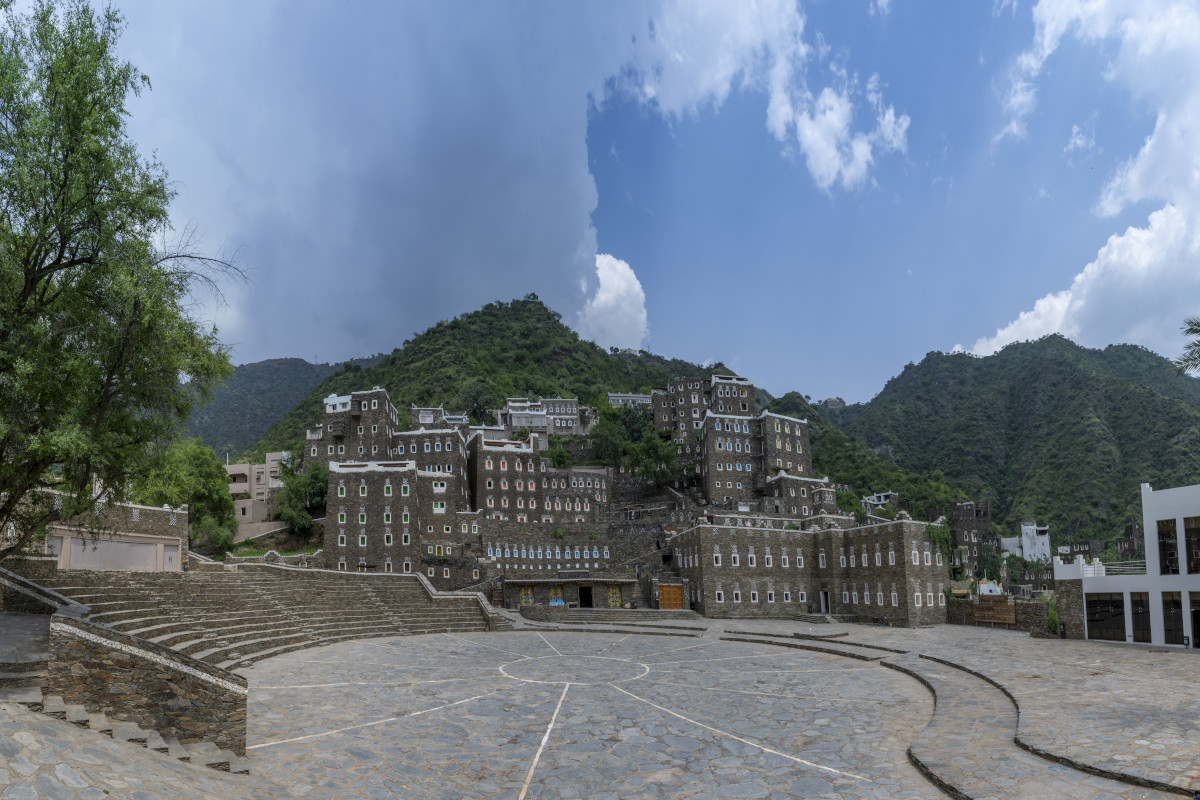
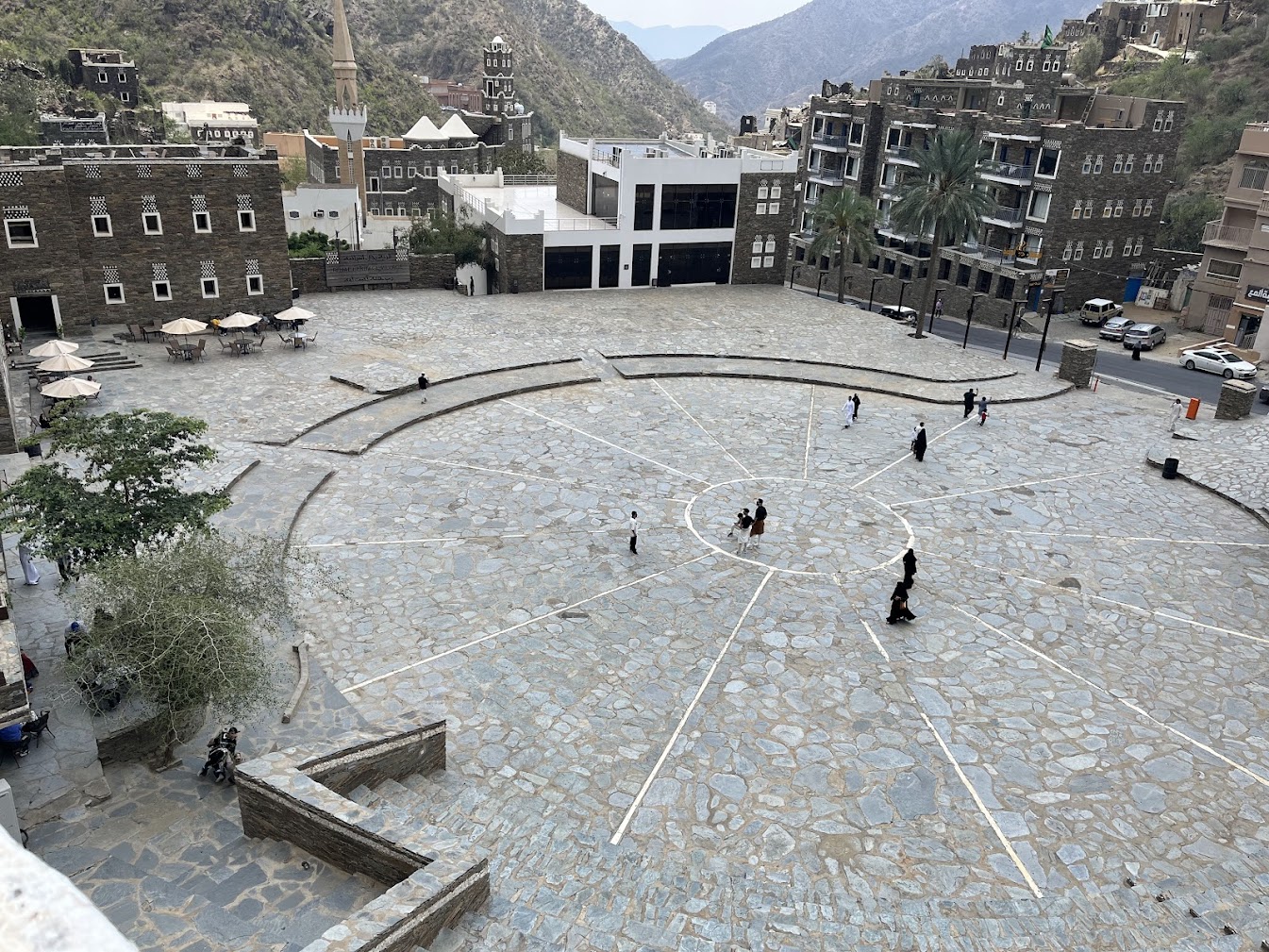
The open amphitheatre at the base of the village serves as both a community gathering space and the primary viewing platform for visitors. The semicircular stone seating area faces the tower houses, which rise dramatically up the hillside. During cultural festivals and events — particularly during the annual Rijal Almaa Summer Festival — the amphitheatre hosts performances of traditional Asiri music and dance, including the flower dance (raqs al-azouf), where men wear garlands of aromatic herbs and flowers on their heads.
The Surrounding Mountains
The village sits in a valley flanked by the Sarawat Mountains, which rise to over 2,500 metres in the Asir region. The vegetation here is remarkably green compared to the rest of Saudi Arabia, particularly between October and March when highland mists and occasional rainfall keep the slopes lush. Juniper trees, wild olive, and acacia dominate the surrounding terrain. The drive to and from Rijal Almaa is itself a highlight — the mountain roads pass through terraced agricultural land, hanging villages, and viewpoints over the Tihama coastal plain far below. For dedicated hikers, the Asir National Park is nearby, and the region offers some of Saudi Arabia’s finest hiking trails.
Getting to Rijal Almaa
From Abha
Rijal Almaa is approximately 50 kilometres west of Abha, but the mountain roads mean the drive takes 1 to 1.5 hours depending on your route and driving experience. There are two main approaches:
- The mountain route (shorter, more scenic): This road cuts directly through the Sarawat range with dramatic switchbacks and steep gradients. The views are spectacular, but the road demands confident driving. It passes through mist-covered mountain passes and terraced villages. Not recommended at night or in heavy fog.
- The southern route (longer, easier): This road loops south through flatter terrain before approaching the village from below. It takes 20–30 minutes longer but is more comfortable for less experienced mountain drivers.
- Abha city: The regional capital offers the Abha cable car ride across the valley, the Art Street murals, and Shada Palace Museum. Base yourself here for access to the entire region.
- Asir National Park: Saudi Arabia’s first national park covers 300 square kilometres of highland terrain with hiking trails, wildlife viewing, and mountain viewpoints.
- Al Habala (Hanging Village): A village once accessible only by rope ladders, now reached by cable car. The dramatic cliff-side setting is unlike anything else in the Kingdom.
- Thee Ain Village: Located in the neighbouring Al Baha province, Thee Ain is another beautifully preserved stone village with a similar architectural tradition, set around a natural spring.
- Jabal Sawda: At 3,015 metres, this is the highest point in Saudi Arabia and is located within the Soudah area near Abha. The views from the summit stretch over the Tihama plain to the Red Sea coast.
- Abha and the Asir Region — The complete guide to Saudi Arabia’s mountain escape
- Asir National Park — Hiking, wildlife, and visitor information for Saudi Arabia’s first national park
- Thee Ain Village — Al Baha’s ancient stone heritage village and natural spring
- Saudi Arabia Heritage Villages — Preserved mountain villages across the Kingdom
- Riyadh to Abha Road Trip — The 950 km drive through desert, steppe, and mountain
- Saudi Arabia Travel Guide 2026 — The complete guide to visiting the Kingdom
- Saudi Arabia Visa Guide — Every visa type explained
There is no public transport to Rijal Almaa. Your options are renting a car at Abha Airport or booking a guided tour. Several local operators run half-day and full-day tours from Abha, typically priced between SAR 200–400 per person depending on group size.
From Other Cities
Abha Regional Airport (AHB) receives domestic flights from Riyadh, Jeddah, and Dammam. The flight from Riyadh takes about 1.5 hours and is operated by Saudia and flynas. From Jeddah, the flight is approximately one hour. For those who prefer a road trip, the Riyadh to Abha drive covers roughly 950 kilometres and takes 9–10 hours, passing through dramatic landscape changes from central desert to highland greenery.
The nearby city of Khamis Mushait is about 30 minutes east of Abha and serves as an alternative base if Abha hotels are fully booked.
Best Time to Visit
The Asir highlands have a climate unlike anywhere else in Saudi Arabia. While the lowlands and central deserts bake under temperatures exceeding 45°C in summer, Abha and its surroundings stay relatively cool year-round thanks to the altitude (Abha sits at 2,270 metres above sea level).
| Season | Months | Temperature | Conditions |
|---|---|---|---|
| Peak (best) | October–March | 10–25°C | Clear skies, lush green landscapes, comfortable walking |
| Summer | June–September | 15–30°C | Mist and occasional rain; popular with Saudi domestic tourists escaping the heat |
| Shoulder | April–May | 15–28°C | Warm and dry, fewer visitors, wildflowers in bloom |
The coolest months — December through February — bring nighttime temperatures as low as 5–10°C in the highlands. Pack layers. The summer season (June–September) is when Saudi families escape the heat by heading to Abha and Asir, so accommodation fills up and prices rise. For international visitors, October to March offers the best combination of weather, lower crowd levels, and photographic conditions.
Practical Tips for Visitors
What to Wear
The Saudi dress code applies in Rijal Almaa as elsewhere. Women should wear loose-fitting clothing that covers the arms and legs, though an abaya is not required for non-Saudi women. Men should wear trousers or long shorts below the knee. Comfortable walking shoes are essential — the village paths are uneven stone, and you will be climbing steps between levels.
Photography
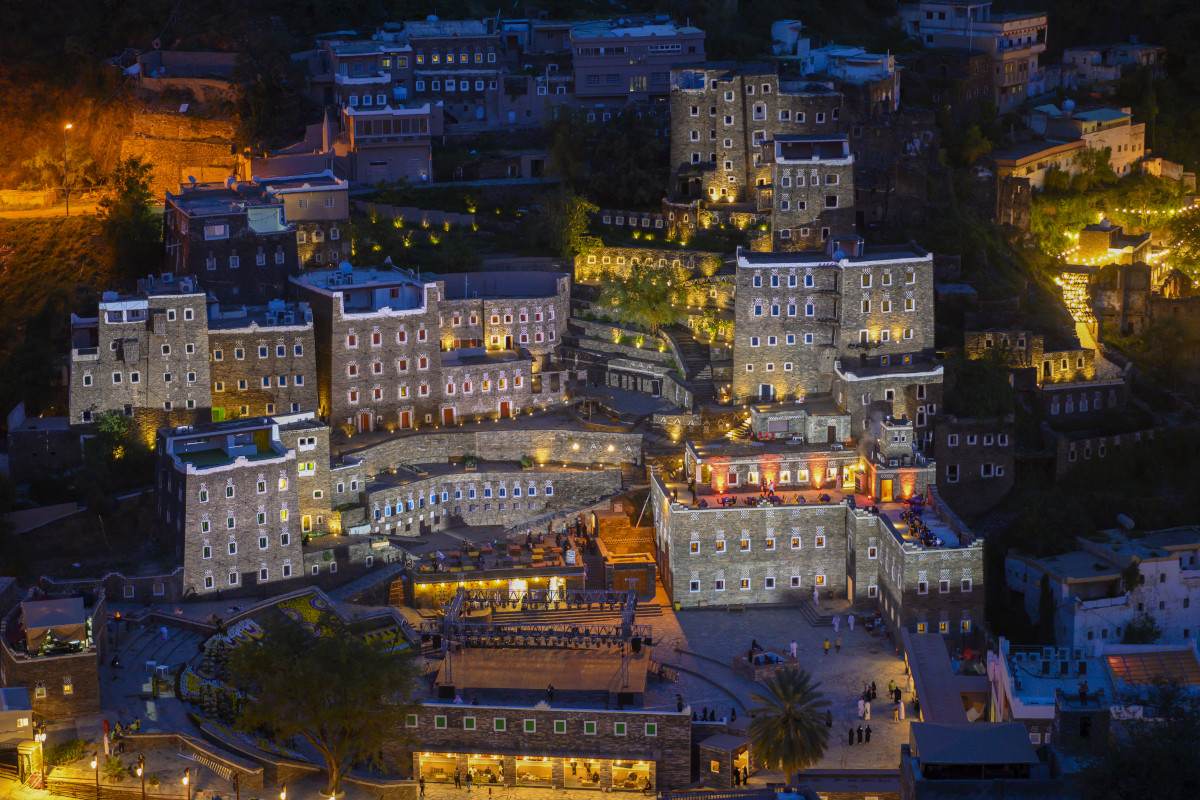
Rijal Almaa is one of the most photogenic sites in Saudi Arabia, and photography is permitted throughout the village and museum. The best light for exterior shots is early morning (before 10 AM) or late afternoon (after 4 PM), when the sun hits the tower facades at an angle. After dark, the illuminated village is spectacular — bring a tripod if you are serious about night photography. The photographer’s guide to Saudi Arabia covers equipment and logistics for the Asir region in detail.
Time Needed
Allow a minimum of 2–3 hours in the village: one hour for the museum, one hour for walking through the tower houses and village paths, and additional time for photography and the amphitheatre. A half-day trip from Abha (including driving) is comfortable. If you want to combine the visit with a stop at a mountain viewpoint or terraced village along the route, plan a full day.
Food and Facilities
There are small cafes and kiosks near the village entrance selling drinks, snacks, and simple meals. For a proper Asiri lunch — including traditional dishes like aseeda (wheat porridge) and mandi — you will find better options back in Abha or in the small towns along the road. There are no hotels in Rijal Almaa itself; all accommodation is in Abha or Khamis Mushait.
Tip: Bring water and sun protection even during cooler months. The highland sun is deceptively strong at altitude, and the walk through the village involves exposed sections with limited shade.
Soudah Peaks and the Future of Rijal Almaa
In 2023, Crown Prince Mohammed bin Salman announced the Soudah Peaks project, a SAR 11 billion development plan to transform the Asir highlands into a premium mountain tourism destination. The project covers an area of 627 square kilometres across the Soudah and Rijal Almaa areas and aims to include luxury resorts, adventure tourism facilities, and cultural attractions — all built around the existing natural and heritage landscape rather than replacing it.
For Rijal Almaa specifically, the Soudah Peaks plan includes improved access roads, enhanced visitor facilities, and a cultural centre. The project’s approach to heritage preservation will be watched closely, as it must balance the demands of international tourism with the village’s fragile stone structures and living cultural traditions. The UNESCO World Heritage candidacy — still pending — adds another layer of scrutiny and protection.
The broader Saudi Arabia travel landscape is evolving rapidly under Vision 2030, and Rijal Almaa sits at the intersection of two of the programme’s key objectives: heritage preservation and tourism diversification. Whether the village can absorb significantly more visitors without losing its character is the central question for the years ahead.
Nearby Attractions
Rijal Almaa works well as part of a broader Asir itinerary. Within easy reach are several sites worth combining into a multi-day visit: