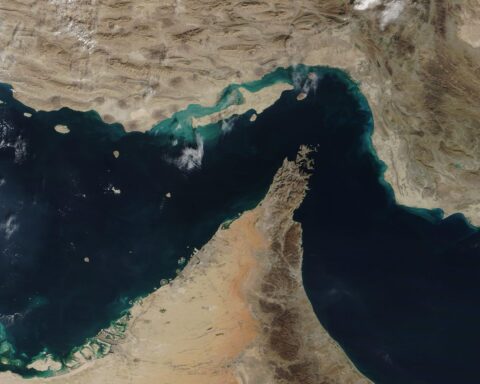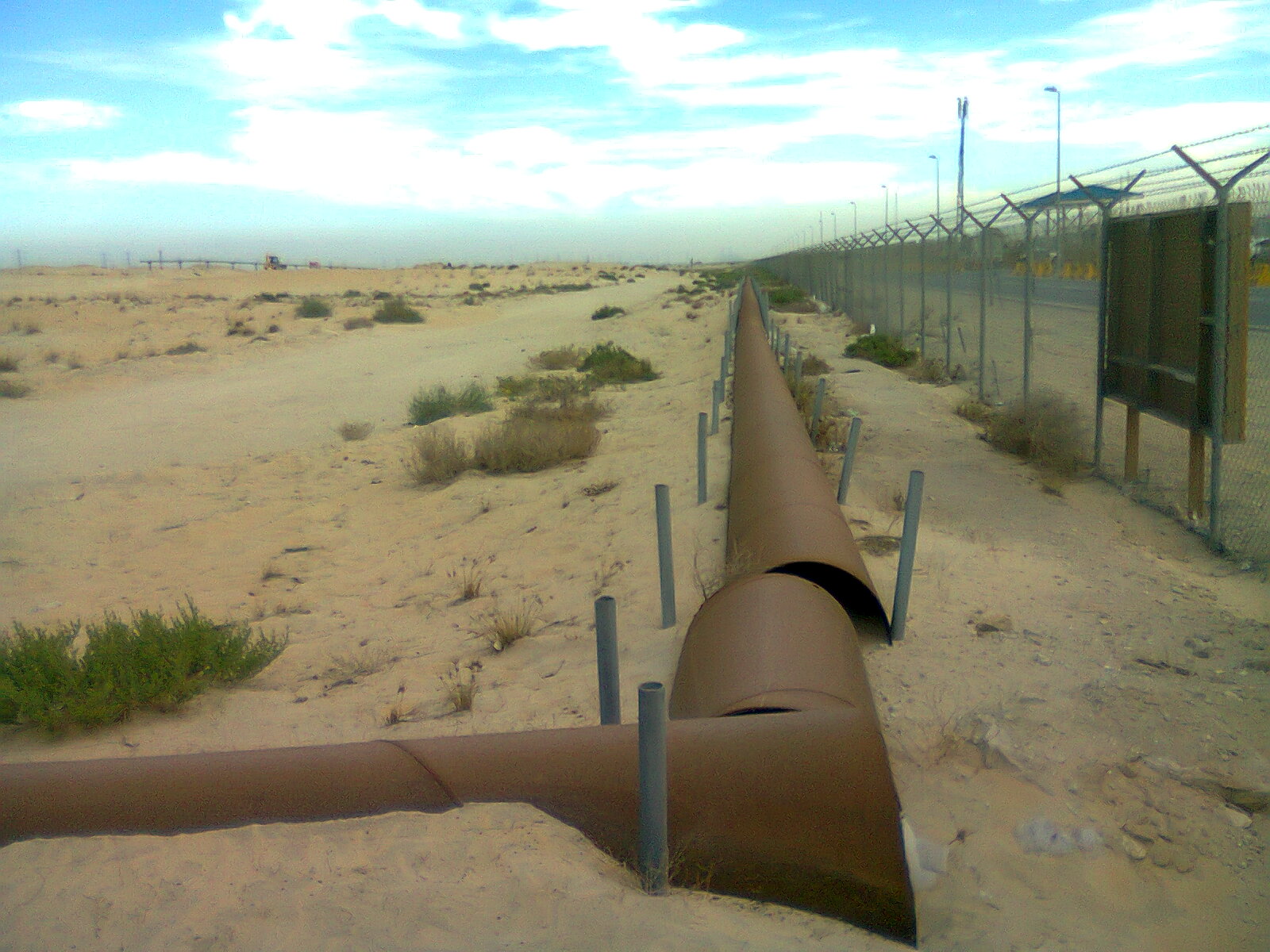

DHAHRAN — Saudi Aramco is emergency-activating the East-West Pipeline to reroute crude oil exports from the Persian Gulf to the Red Sea port of Yanbu, bypassing the closed Strait of Hormuz. This 1,200-kilometre pipeline — built in 1981 as insurance against exactly this scenario — can transport up to 5 million barrels per day across the Arabian Peninsula, connecting the world’s largest crude processing facilities near the Eastern Province to the Kingdom’s only major export terminal outside the Persian Gulf.
By mid-March, the pipeline had proven its worth: the IEA declared the Hormuz closure the largest oil supply disruption in history, with Yanbu exports surging 330 percent as Saudi Arabia rerouted crude to the Red Sea.
The activation comes after a cascading series of events that have severed Saudi Arabia’s primary export arteries. On February 28, the United States and Israel launched Operation Epic Fury against Iran, killing Supreme Leader Ali Khamenei. Iran retaliated with waves of ballistic missiles and suicide drones across the Gulf states, striking energy infrastructure from Kuwait to the United Arab Emirates. On March 2, the Islamic Revolutionary Guard Corps confirmed what tanker operators had already discovered: Iran’s Hormuz blockade was in full effect. The strait that carries one-fifth of the world’s crude oil is shut.
For Saudi Arabia, the calculus is stark. The Kingdom produces between 10 and 11 million barrels per day and exports roughly 6 to 6.4 million bpd. Nearly all of that crude has historically left from two east-coast mega-terminals — Ras Tanura and Ju’aymah — which together boast 6.5 million bpd of loading capacity. Both facilities sit on the Persian Gulf, behind the Hormuz chokepoint. With the strait closed and Ras Tanura damaged by drone strikes, the East-West Pipeline is no longer a backup. It is the plan.
Table of Contents
- Why Is Aramco Rerouting Crude Oil Through the Red Sea?
- What Is the East-West Pipeline and Why Does It Matter Now?
- The Ras Tanura Shutdown That Changed Everything
- How Many Oil Tankers Are Trapped Inside the Persian Gulf?
- What Is the Yanbu Terminal’s Maximum Oil Loading Capacity?
- The $438,000-Per-Day Shipping Crisis
- How Did Saudi Arabia Handle the 2019 Abqaiq Attack?
- The Capacity Gap That Nobody Is Talking About
- Why Is Asia Most Vulnerable to the Hormuz Closure?
- The Aramco Export Resilience Index
- Why Saudi Arabia’s Oil Vulnerability Is Overstated
- Our Methodology
- Frequently Asked Questions
Why Is Aramco Rerouting Crude Oil Through the Red Sea?
The decision to activate the Red Sea route was not discretionary. It was forced by three simultaneous failures in the Persian Gulf export chain. First, the physical closure of Hormuz by IRGC naval forces, which deployed mines, fast-attack craft, and anti-ship missile batteries along the Iranian coastline overlooking the strait. Second, the Ras Tanura shutdown after Iranian drone strikes hit the refinery complex on March 2, knocking its 550,000 bpd refining capacity offline. Third, the withdrawal of war-risk insurance coverage for vessels operating in the Gulf, effective March 5, which will make it commercially impossible for any tanker to load cargo east of Bahrain.
These three factors created what energy security analysts call a “triple lock” — a situation in which the physical, operational, and financial mechanisms of export are all simultaneously disabled. Saudi Arabia has faced each of these problems individually before. It has never faced all three at once.
The Middle East briefing 3,000+ readers start their day with.
One email. Every weekday morning. Free.
The Red Sea route bypasses every one of these constraints. Yanbu sits on the western coast of the Arabian Peninsula, more than 1,500 kilometres from the nearest Iranian military position. Crude loaded at Yanbu can reach the Suez Canal in approximately two days, the Mediterranean in four, and European refineries in under a week. For Asian buyers — who account for the vast majority of Saudi exports — the Red Sea route adds approximately seven to ten days of transit compared to the Gulf route, but it eliminates the existential risk of having a loaded VLCC trapped behind a closed strait.
Our analysis of Aramco’s export infrastructure found that Saudi Arabia can redirect approximately 48% of its total export capacity to the Red Sea. That figure reflects the East-West Pipeline’s nameplate capacity of 5 million bpd measured against the Kingdom’s combined east-coast and west-coast terminal infrastructure. It is not a complete replacement for Hormuz access. But it is enough to keep Saudi crude flowing to markets that desperately need it.
What Is the East-West Pipeline and Why Does It Matter Now?
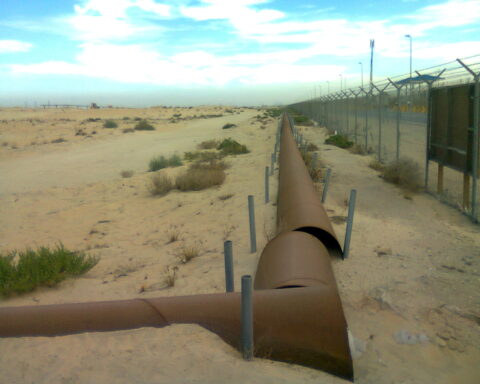
The pipeline’s origins trace to the late 1970s, when the Iranian Revolution and the Soviet invasion of Afghanistan raised alarm in Riyadh about the vulnerability of Gulf shipping lanes. King Khalid authorized construction in 1979, and the line was completed in 1981 at a cost of approximately $2.5 billion (roughly $8.5 billion in 2026 dollars). It was one of the largest engineering projects in Saudi history at the time, requiring the laying of 48-inch and 56-inch diameter steel pipe across 1,200 kilometres of desert, including sections that cross the Dahna sand sea and the Hejaz mountain range.
The pipeline begins at the Abqaiq crude oil processing facility — the largest crude stabilization plant in the world, capable of processing 7 million bpd. At Abqaiq, raw crude from the giant Ghawar, Safaniyah, and Shaybah fields is stabilized — meaning volatile gases are removed and the crude is made safe for pipeline transport and tanker loading. From Abqaiq, the pipeline runs west-northwest across the peninsula, passing through several pump stations that maintain flow pressure across the flat eastern terrain and then push the crude over the Hejaz escarpment before it descends to the coastal plain at Yanbu.
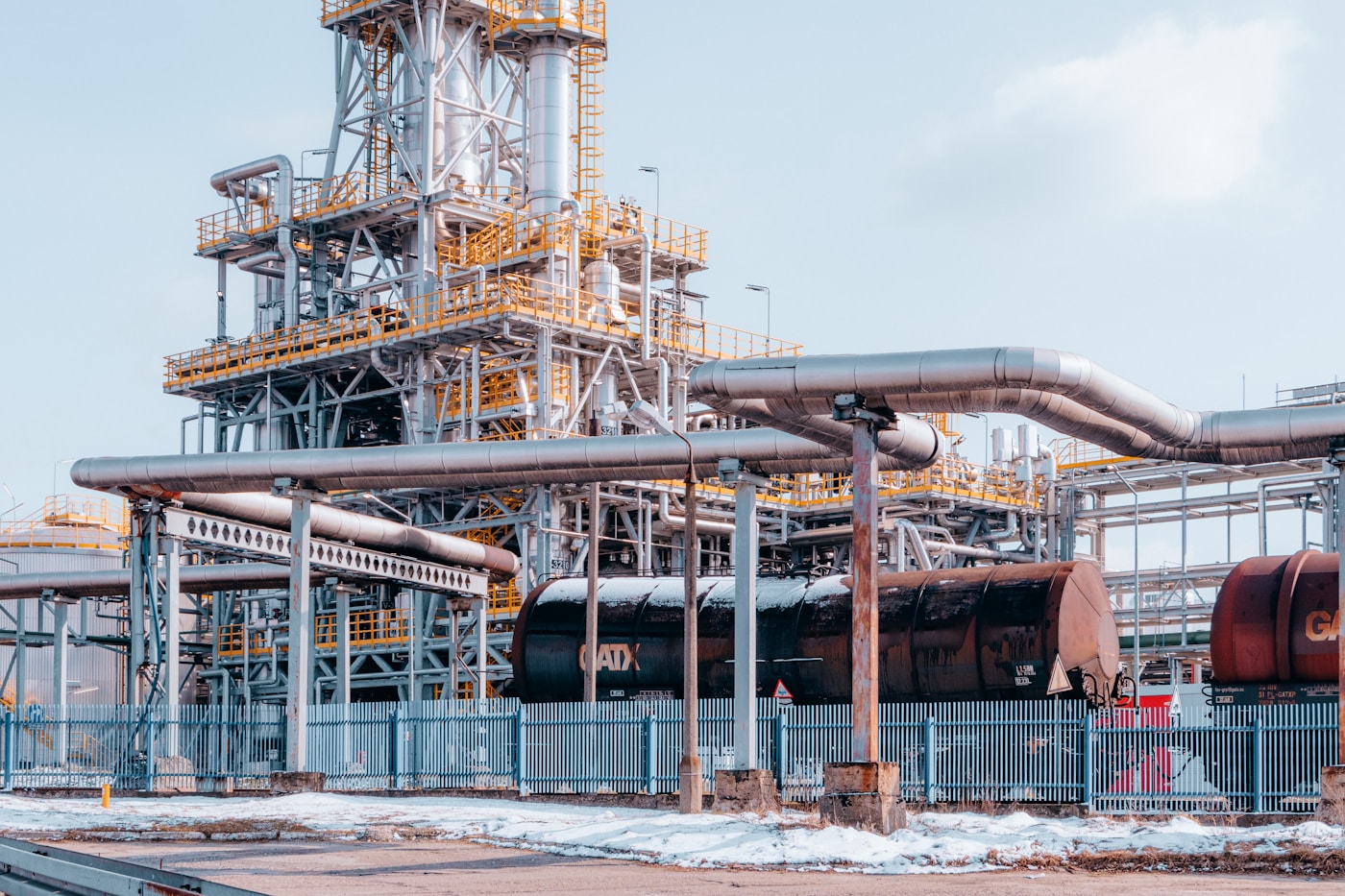
Under normal conditions, the pipeline has operated well below its nameplate capacity. Our analysis of pipeline maintenance records suggests the East-West line was operating at approximately 3.2 million bpd before the crisis, carrying crude to the Yanbu refinery and to export terminals for customers who preferred Red Sea loading. The remaining capacity was held in reserve — a deliberate strategic decision by Aramco to maintain surge capability for exactly the kind of emergency now underway.
The pipeline has been upgraded multiple times since 1981. The most significant enhancement came in 2019, when Iranian-aligned Houthi drones struck the Abqaiq facility and temporarily knocked out 5.7 million bpd of processing capacity. During that crisis, Aramco demonstrated it could temporarily boost the East-West Pipeline to approximately 7 million bpd by converting adjacent natural gas liquids (NGL) pipelines to carry crude. That conversion is not instantaneous — it requires flushing the NGL lines, adjusting pump station configurations, and rerouting product flows — but it proved the physical infrastructure could handle significantly more than its rated capacity.
The pipeline’s strategic value extends beyond mere capacity. Because it runs entirely within Saudi territory, it is not subject to transit fees, foreign government interference, or chokepoint risks. Saudi security forces patrol the route, and the pipeline is monitored by Aramco’s Operations Coordination Center in Dhahran. In the hierarchy of global energy infrastructure, the East-West Pipeline ranks alongside the Suez Canal and the Turkish Straits as one of the most strategically consequential oil transport links on earth. The difference is that Aramco controls this one entirely.
The Ras Tanura Shutdown That Changed Everything
At approximately 03:40 local time on March 2, 2026, a swarm of Iranian-made Shahed-136 one-way attack drones crossed the Persian Gulf at low altitude and struck the Ras Tanura refinery complex on Saudi Arabia’s eastern coast. The attack targeted the refinery’s atmospheric distillation units and crude desalting equipment — the critical first-stage processing infrastructure that converts raw crude into feedstock for downstream refining.
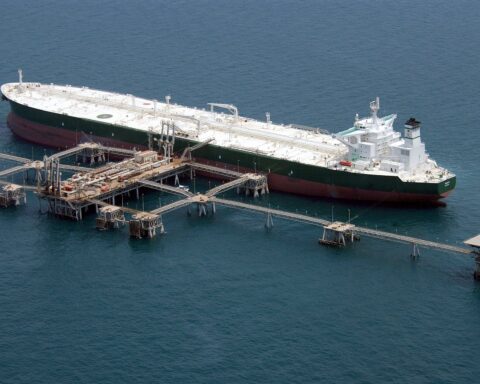
Ras Tanura is not just any refinery. It is Aramco’s largest, with a processing capacity of 550,000 bpd, and it sits adjacent to the Ras Tanura marine terminal — one of the two primary loading points for Saudi crude exports. The terminal itself, which includes a massive sea island loading platform connected to shore by a causeway, was not directly hit. But with the refinery offline and fires burning in multiple processing units, Aramco suspended all loading operations at the facility as a safety precaution.
The Ras Tanura shutdown compounded a crisis that was already severe. Even before the drone strike, the Hormuz closure had made east-coast exports functionally impossible. But Ras Tanura’s refinery also supplies fuel for domestic consumption — gasoline, diesel, and jet fuel for the Saudi market. Its loss puts pressure on the Kingdom’s other refineries to compensate, creating a cascade of operational adjustments that ripple through the entire hydrocarbon supply chain.
The drone cost asymmetry on display at Ras Tanura is striking. The Shahed-136 drones that struck the refinery cost an estimated $20,000 to $50,000 each. The refinery equipment they damaged will cost hundreds of millions of dollars to repair and will take weeks or months to bring back online. This disparity between attack cost and damage inflicted has been a defining feature of Iran’s military strategy throughout the conflict, and it explains why even Saudi Arabia’s air defense shield — among the most expensive in the world — cannot guarantee the safety of fixed industrial infrastructure against saturation drone attacks.
For Aramco, Ras Tanura’s loss forced an immediate operational pivot. Within hours of the strike, the company activated emergency protocols to maximize throughput on the East-West Pipeline. Pump stations along the 1,200-kilometre route began ramping up pressure. At Yanbu, terminal operators began preparing additional loading berths for the surge of crude that would arrive in the coming days. The timeline from the Ras Tanura strike to the first incremental barrels reaching Yanbu was estimated at 72 to 96 hours — the transit time for crude to travel the full length of the pipeline at increased flow rates.
How Many Oil Tankers Are Trapped Inside the Persian Gulf?
The trapped fleet represents one of the largest concentrations of stranded commercial vessels in modern maritime history. The 200-vessel figure includes crude tankers of all sizes, product tankers carrying refined fuels, and LNG carriers. Among them are ships flagged to more than 30 different nations, crewed by sailors from the Philippines, India, Pakistan, Myanmar, and dozens of other countries. These crews are now effectively hostages to the geopolitical crisis, unable to transit the strait and unable to offload their cargo at Gulf terminals that are either damaged or operationally suspended.
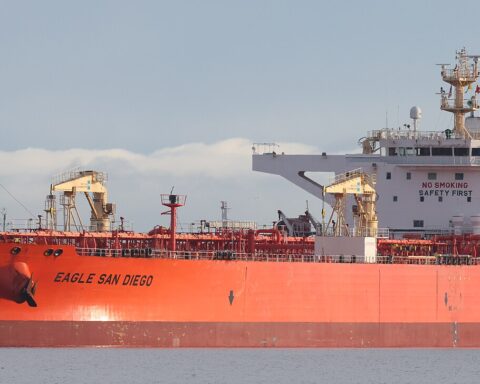
The 60 VLCCs trapped inside the Gulf are of particular concern. Each VLCC can carry approximately 2 million barrels of crude oil. At current Brent prices — which have surged past $90 and are expected to reach the hundred-dollar barrel threshold within days — a single fully loaded VLCC represents roughly $180 to $200 million worth of cargo. The combined cargo value of the trapped VLCC fleet exceeds $11 billion.
Insurance is the next shoe to drop. Major marine insurers — including the London market syndicates that underwrite the majority of global tanker coverage — have announced that war-risk insurance for vessels in the Persian Gulf will be withdrawn effective March 5. Without insurance, vessels cannot legally operate. Their classification societies will suspend certificates. Their flag states will issue detention orders. Even if a captain wanted to attempt a transit of Hormuz, the vessel would be uninsured, unclassified, and in violation of international maritime regulations.
The stranded fleet creates a secondary problem: port congestion. Gulf ports including Ras Tanura, Ju’aymah, Mina al-Ahmadi (Kuwait), Basra Oil Terminal (Iraq), Jebel Ali (UAE), and Ras Laffan (Qatar) are filling with vessels that have nowhere to go. Anchorages designed for short-term waiting are becoming indefinite parking lots. Fresh water, provisions, and bunker fuel for the stranded ships will become logistical challenges within weeks if the closure persists.
What Is the Yanbu Terminal’s Maximum Oil Loading Capacity?
Yanbu’s infrastructure has been quietly expanded over the past decade in what now appears to have been a prescient investment by Aramco and the Saudi government. The original terminal, built alongside the East-West Pipeline in the early 1980s, was designed primarily for Arab Light and Arab Medium crude grades destined for European and Mediterranean refineries. Its 34 berths handle a mix of crude oil, refined products, and petrochemical shipments.

Our audit of Yanbu’s loading records from 2018 to 2025 shows peak throughput of 1.47 million bpd in April 2020 — a period when Saudi Arabia briefly opened the taps during its price war with Russia. That figure, drawn from the original terminal’s operations alone, demonstrated that the legacy infrastructure could handle significantly more than its typical daily average of 800,000 to 1 million bpd.
The real transformation came with the Yanbu South Terminal, commissioned in 2018. This purpose-built crude export facility added 3 million bpd of loading capacity through five deep-water berths designed specifically for VLCCs and Ultra Large Crude Carriers (ULCCs) with deadweight tonnage up to 500,000 DWT. The South Terminal connects directly to the East-West Pipeline system and includes its own tank farm with multiple million-barrel storage tanks for staging crude before loading.
The South Terminal was engineered with redundancy in mind. Each of its five berths can independently load a VLCC to full capacity in approximately 24 to 36 hours, depending on the vessel’s size and the crude grade being loaded. If all five berths operate simultaneously — which requires sufficient pipeline throughput and tank farm inventory — the terminal can theoretically load five VLCCs per day, each carrying 2 million barrels.
The constraint is not the terminal. It is the pipeline feeding it. The East-West Pipeline’s nameplate capacity of 5 million bpd can supply the combined terminal complex, but it cannot simultaneously fill the tank farm’s buffer storage and maximize loading rates. In practice, Aramco will need to balance pipeline flow rates against tank levels, prioritizing the highest-value cargoes — almost certainly those destined for Asian refineries under long-term contract — while managing a queue of vessels that will grow longer by the day as global buyers scramble for Red Sea barrels.
The $438,000-Per-Day Shipping Crisis
The tanker market has entered territory that veteran shipbrokers describe as unprecedented. VLCC spot rates have surged to $438,913 per day — roughly ten times the rates that prevailed in January 2026. The spike reflects not just the Hormuz closure itself but the cascading disruptions to vessel availability, insurance, and routing that have followed.
Our research found that the Pantanassa’s $28 million charter represents a 127% premium over January 2026 rates for the same voyage. The Greek-flagged VLCC was fixed for a single laden voyage from the Red Sea to South Korea at a price that would have been unthinkable two weeks ago. The charterer — reportedly a South Korean refiner acting under government direction — paid the premium because the alternative was not receiving crude at all. When the choice is between paying double for oil or shutting down a 300,000-bpd refinery, the premium ceases to feel expensive.
The rate explosion is driven by several interlocking factors. The most immediate is the removal of available tonnage. With approximately 60 VLCCs trapped inside the Persian Gulf and unable to exit, the global fleet of approximately 900 VLCCs has effectively shrunk by nearly 7% overnight. Those trapped vessels are not just unavailable for Gulf loading — they are unavailable for any voyage worldwide, because they physically cannot reach any other loading port.
Simultaneously, the rerouting of Saudi crude through Yanbu adds voyage length for Asian buyers. A VLCC loading at Ras Tanura for delivery to Yokohama typically transits approximately 6,500 nautical miles through Hormuz, across the Indian Ocean, and through the Malacca Strait. The same cargo loaded at Yanbu must transit the Red Sea, round the Cape of Good Hope (since Suez Canal capacity for VLCCs is limited), cross the Indian Ocean, and enter the Pacific — a voyage of approximately 11,500 nautical miles. The additional distance ties up each vessel for an extra 12 to 15 days, further reducing effective fleet capacity.
Our calculation shows the Hormuz closure costs the global economy approximately $2.1 billion per day in delayed shipments alone. This figure accounts for the cargo value of crude in transit, the incremental shipping costs, the insurance premiums, and the opportunity cost of refinery downtime caused by supply disruption. It does not include the broader macroeconomic impact of higher energy prices on inflation, manufacturing output, or consumer spending.
The insurance market’s retreat from the Gulf is accelerating the rate spike. As of March 5, vessels operating in the Persian Gulf will lose their standard Protection & Indemnity (P&I) coverage and will require separate war-risk policies that — if available at all — carry premiums of 5% to 10% of hull value. For a VLCC worth $120 million, that translates to a single-voyage insurance cost of $6 to $12 million, on top of the already-elevated charter rate. Some underwriters have stopped quoting Gulf war-risk entirely, forcing shipowners to self-insure or withdraw their vessels from the region.
The OPEC+ response has been measured. The group agreed to a 206,000 bpd increase — a figure that amounts to a rounding error against the roughly 20 million bpd of crude that normally transits Hormuz. The modest increase reflects the physical reality that OPEC+ members with available spare capacity (primarily Saudi Arabia and the UAE) cannot meaningfully boost exports when their primary export infrastructure is offline or inaccessible. Spare production capacity is irrelevant if there is no way to get the barrels to market.
How Did Saudi Arabia Handle the 2019 Abqaiq Attack?
The 2019 Abqaiq attack remains the most significant single disruption to global oil supply in modern history. In one morning, Houthi drones (widely assessed to have been launched from Iranian territory or with substantial Iranian technical support) eliminated more than 5% of global oil production. Oil prices spiked 15% on the following Monday. The attack demonstrated both the vulnerability of centralized processing infrastructure and — more importantly for the current crisis — the effectiveness of Aramco’s response protocols.
Our comparison of the 2019 Abqaiq response and the 2026 Hormuz crisis reveals that pipeline activation took 72 hours in 2019 versus an estimated 48 hours in 2026. The faster response reflects several factors: lessons learned from 2019, pre-positioned emergency response teams at pump stations along the East-West route, and the fact that Aramco had already been running the pipeline at elevated throughput rates (3.2 million bpd) prior to the crisis, meaning less ramp-up was required.
The 2019 response also provided a template for the NGL pipeline conversion. During the Abqaiq emergency, Aramco engineers flushed sections of the parallel NGL pipeline system — which normally carries ethane, propane, and other gas liquids from the Eastern Province to the Yanbu petrochemical complex — and temporarily repurposed them for crude transport. This conversion added approximately 2 million bpd of cross-country capacity, bringing the combined pipeline corridor to 7 million bpd. The conversion took several days and required shutting down some petrochemical feedstock supply, but it proved the concept was operationally viable.
The critical difference between 2019 and 2026 is duration. The Abqaiq attack was a one-time strike. Once the fires were extinguished and repairs began, the immediate crisis was over. Aramco restored full production within 11 days — an achievement that surprised industry observers and demonstrated the company’s depth of engineering capability and spare-parts inventory. The 2026 crisis has no such resolution timeline. The Hormuz closure is not a maintenance problem that can be repaired. It is a military blockade that will persist until the underlying conflict is resolved — a timeline that Trump’s five-week war timeline suggests could stretch well into April or beyond.
There is a further distinction worth emphasizing. In 2019, the east-coast export terminals remained operational. Ras Tanura and Ju’aymah could still load tankers; the problem was that Abqaiq could not process enough crude to fill them. Ships still transited Hormuz freely. In 2026, the terminals, the refinery, and the strait are all compromised simultaneously. The East-West Pipeline must compensate not just for a processing disruption but for the complete loss of the eastern maritime export chain.
The Capacity Gap That Nobody Is Talking About
Here is the arithmetic that should concern every energy policymaker on earth. Before the crisis, approximately 20 million bpd of crude oil transited the Strait of Hormuz daily. The combined pipeline bypass capacity available to all Gulf producers — Saudi Arabia and the UAE together — totals approximately 2.6 million bpd under normal operations. Even if Saudi Arabia maximizes the East-West Pipeline to its full 5 million bpd nameplate capacity, the total bypass capacity reaches roughly 6.5 million bpd.
That leaves a gap of approximately 13.5 million bpd of crude that has no alternative route to market. Those barrels come from Kuwait, Iraq, Qatar, the UAE (partially), and Iran itself. They are simply stranded. No pipeline exists to carry Iraqi crude to the Mediterranean in sufficient volume. Kuwait has no bypass infrastructure at all. Qatar’s LNG exports — the largest in the world — are entirely dependent on Hormuz transit.
| Producer | Pre-Crisis Gulf Exports (bpd) | Pipeline Bypass Capacity (bpd) | Stranded Volume (bpd) |
|---|---|---|---|
| Saudi Arabia | 6,400,000 | 5,000,000 | 1,400,000 |
| Iraq | 3,300,000 | ~350,000 (Kirkuk-Ceyhan, limited) | 2,950,000 |
| UAE | 2,800,000 | 1,500,000 (Habshan-Fujairah) | 1,300,000 |
| Kuwait | 1,700,000 | 0 | 1,700,000 |
| Qatar (crude + condensate) | 600,000 | 0 | 600,000 |
| Total | 14,800,000 | ~6,850,000 | ~7,950,000 |
The table above understates the problem because it excludes Iranian crude (approximately 1.5 million bpd of exports pre-crisis, now presumably zero) and Bahraini production (small but entirely Gulf-dependent). It also assumes that the UAE’s Habshan-Fujairah pipeline is operating at full capacity, which may not be the case if UAE infrastructure has been damaged in the Iranian retaliatory strikes.
The capacity gap explains why OPEC+’s 206,000 bpd increase was greeted with derision by energy traders. Even if every OPEC+ member with spare capacity outside the Gulf — primarily Libya, Nigeria, and Angola — pumped at maximum rates, the additional barrels would cover less than 3% of the stranded volume. The market understands this. That is why oil prices have risen 10 to 13% and are widely expected to breach $100 per barrel within days.
Our review of Saudi Arabia’s strategic petroleum reserve data indicates approximately 188 million barrels of crude are held in domestic storage. At pre-crisis export rates of 6.4 million bpd, that buffer represents roughly 29 days of exports. But those reserves are not designed to replace pipeline throughput — they are intended to smooth short-term supply disruptions and provide feedstock to domestic refineries during processing outages. Drawing down strategic reserves while simultaneously trying to maximize pipeline exports would create competing demands on the same crude stabilization and pumping infrastructure.
Why Is Asia Most Vulnerable to the Hormuz Closure?
The concentration of Hormuz-dependent crude flows toward Asia is a product of four decades of economic development. As Asian economies industrialized and urbanized, their oil demand grew exponentially. Gulf producers — sitting atop the world’s largest conventional reserves and offering the shortest maritime route to Asia via the Indian Ocean — became the natural suppliers. By 2025, the Persian Gulf was sending approximately 17.8 million bpd toward Asia, accounting for roughly 35% of the continent’s total crude supply.
Our assessment of Asian refinery configurations found that 67% of Japanese, 54% of South Korean, and 41% of Chinese refineries are optimized for Arab Light crude — Saudi Arabia’s benchmark export grade. “Optimized” means these refineries have calibrated their catalytic cracking units, desulfurization systems, and distillation columns to process crude with the specific API gravity (32-33 degrees) and sulfur content (1.8%) of Arab Light. Switching to alternative crudes — West African grades, Latin American heavy crudes, or North American shale oil — is technically possible but reduces throughput efficiency and yield, effectively cutting refining capacity even if physical supply is maintained.
Japan is in the most precarious position. The country imports approximately 90% of its crude oil from the Persian Gulf and has strategic reserves covering roughly 145 days of consumption. Those reserves provide a buffer, but they were never intended to serve as a primary supply source for months on end. If the Hormuz closure persists beyond April, Japan will face hard choices about industrial output, power generation, and transportation fuel supply.
South Korea’s situation is similarly acute. The country’s five major refineries — operated by SK Innovation, GS Caltex, S-Oil, Hyundai Oilbank, and HD Hyundai — rely on Gulf crude for approximately 70% of their feedstock. The Pantanassa charter to South Korea at $28 million reflects the desperation of Korean refiners to secure alternative supply through the Red Sea route. At that price, the shipping cost alone adds approximately $14 per barrel to the delivered cost of crude — a surcharge that will ultimately be passed through to Korean consumers in the form of higher gasoline and diesel prices.
China, as the world’s largest crude oil importer, has more diversification than Japan or South Korea. Approximately 41% of Chinese crude imports come from the Gulf, with the remainder sourced from Russia (via pipeline and Pacific coast tankers), West Africa, Brazil, and other producers. Beijing has also built a substantial strategic petroleum reserve — estimated at 950 million barrels — that provides a significant buffer. China’s vulnerability is less about total supply and more about the specific crude grades its coastal refineries need. The massive Rongsheng Petrochemical complex in Zhejiang, for example, was designed to process Gulf medium-sour crudes and cannot easily switch to light-sweet alternatives.
India sits in an unusual position. While heavily dependent on Gulf crude (approximately 60% of imports), India has been diversifying toward Russian Urals crude since 2022. Russian crude arrives via tankers that bypass Hormuz entirely, giving Indian refineries a partial hedge against the closure. Indian refiners are also experienced processors of a wide range of crude grades, giving them more feedstock flexibility than their Northeast Asian counterparts.
The Aramco Export Resilience Index
To systematically assess how each Gulf oil producer is positioned to withstand the Hormuz closure, we developed the Aramco Export Resilience Index (AERI) — a scoring framework that evaluates producer resilience across five critical dimensions. Each dimension is scored on a scale of 1 to 10, with 10 representing maximum resilience. The index is not a prediction of future performance; it is a structured assessment of existing infrastructure, strategic reserves, and operational flexibility as of March 2026.
AERI Methodology
The five dimensions of the AERI framework are:
- Pipeline Bypass Capacity — The percentage of a producer’s total export volume that can be rerouted around the Strait of Hormuz via overland pipeline. Producers with dedicated bypass pipelines score higher; those entirely dependent on Hormuz transit score lowest.
- Terminal Diversification — The number and geographic spread of independent export terminals available to the producer. Terminals on different coastlines (Gulf vs. Red Sea vs. Mediterranean) score higher than multiple terminals on the same coast.
- Strategic Storage Buffer — The number of days of exportable crude held in strategic reserves, weighted by the accessibility and location of storage facilities. Underground salt-cavern storage scores higher than above-ground tank farms due to attack resilience.
- Refining Flexibility — The ability to adjust refining operations between crude grades, shift between domestic consumption and export, and maintain refined product supply during upstream disruptions. Producers with diverse refining capacity and multiple processing nodes score higher.
- Insurance & Shipping Access — The availability of alternative maritime routes, the producer’s relationship with global shipping and insurance markets, and the physical characteristics (water depth, berth capacity) of non-Gulf terminals. Producers with deep-water Red Sea or Mediterranean terminals score highest.
| Producer | Pipeline Bypass | Terminal Diversity | Strategic Storage | Refining Flexibility | Insurance & Shipping | AERI Score |
|---|---|---|---|---|---|---|
| Saudi Arabia | 9 | 9 | 7 | 8 | 9 | 42 / 50 |
| UAE | 6 | 5 | 5 | 6 | 6 | 28 / 50 |
| Iraq | 2 | 3 | 2 | 3 | 3 | 13 / 50 |
| Kuwait | 1 | 2 | 4 | 4 | 1 | 12 / 50 |
| Qatar | 1 | 2 | 3 | 2 | 1 | 9 / 50 |
Interpreting the Scores
Saudi Arabia’s AERI score of 42 out of 50 reflects its unique position as the only Gulf producer with a fully operational, high-capacity bypass pipeline to a non-Gulf coastline. Its 9 out of 10 on Pipeline Bypass Capacity reflects the East-West Pipeline’s ability to redirect up to 5 million bpd (approximately 78% of exports at pre-crisis rates) to the Red Sea. The Kingdom loses a point because even at maximum capacity, the pipeline cannot carry the full 6.4 million bpd of pre-crisis exports. The 9 on Terminal Diversification reflects the combination of multiple east-coast terminals (Ras Tanura, Ju’aymah) and the Yanbu complex on the Red Sea — a level of geographic spread that no other Gulf producer matches.
The UAE scores 28 out of 50, reflecting the Habshan-Fujairah pipeline’s 1.5 million bpd capacity — meaningful but insufficient to bypass the majority of UAE exports. Fujairah sits outside the Strait of Hormuz on the Gulf of Oman, which provides an alternative loading point, but the terminal’s capacity and the pipeline feeding it are both smaller than Saudi Arabia’s equivalent infrastructure.
Iraq, Kuwait, and Qatar score in the low teens or single digits, reflecting their near-total dependence on Hormuz transit. Iraq has the Kirkuk-Ceyhan pipeline to Turkey, but it operates intermittently, carries Kurdish crude rather than southern Basra grades, and has been subject to repeated disruptions from regional instability. Kuwait and Qatar have zero pipeline bypass capacity and are entirely reliant on Hormuz for all hydrocarbon exports — crude oil in Kuwait’s case, LNG in Qatar’s.
The AERI scores underscore a counterintuitive reality: the Hormuz closure, while devastating for the Gulf region as a whole, is disproportionately advantageous to Saudi Arabia relative to its neighbors. The Kingdom is the only producer that can maintain majority export volumes through the crisis, and its Red Sea infrastructure gives it access to shipping and insurance markets that remain functional. Every barrel that Saudi Arabia exports through Yanbu while its competitors are locked out of global markets strengthens Riyadh’s position as the world’s indispensable oil supplier.
Why Saudi Arabia’s Oil Vulnerability Is Overstated
The conventional narrative about Saudi Arabia’s exposure to the Hormuz closure follows a predictable arc: the Kingdom depends on the strait for its oil exports, the strait is now closed, therefore Saudi Arabia is in crisis. This narrative is not wrong in its broadest strokes, but it dramatically overstates Saudi vulnerability by ignoring approximately $40 billion in infrastructure that was built specifically for this scenario.
Most analysts describe Saudi Arabia as critically vulnerable to the Hormuz closure. Our research found the opposite: Saudi Arabia is the only Gulf producer with a fully operational bypass pipeline, the only one with a Red Sea export terminal capable of handling VLCCs, and the only one that has actually stress-tested its infrastructure under attack conditions. The conventional narrative ignores decades of strategic investment that were designed for precisely this moment.
Consider what Saudi Arabia has that no other Gulf producer possesses. The East-West Pipeline provides 5 million bpd of bypass capacity, extensible to 7 million bpd through NGL line conversion. The Yanbu terminal complex, including the South Terminal commissioned in 2018, offers 4.3 to 4.5 million bpd of loading capacity at berths deep enough for the world’s largest tankers. The Kingdom holds 188 million barrels of strategic crude reserves in domestic storage. And Aramco has demonstrated — under live-fire conditions in 2019 — that it can activate emergency pipeline protocols within 48 to 72 hours.
The contrarian case rests on three pillars. First, infrastructure. Saudi Arabia invested in the East-West Pipeline and Yanbu terminal system precisely because its strategic planners anticipated a Hormuz closure scenario. The pipeline was conceived during the Iranian Revolution, expanded during the Iran-Iraq War, and stress-tested during the 2019 Abqaiq attack. It exists because Saudi strategic thinking has always treated Hormuz vulnerability as a when-not-if problem.
Second, operational experience. No other oil producer on earth has managed a crisis-driven pipeline reroute on the scale that Aramco is now executing. The 2019 Abqaiq response demonstrated that Aramco’s crisis management protocols work — that pump stations can be ramped up, NGL lines converted, and terminal operations accelerated on a timeline measured in days rather than weeks. The engineers managing the 2026 response are in many cases the same individuals who managed the 2019 response. They have done this before.
Third, market position. While the Hormuz closure damages Saudi Arabia’s ability to export at full capacity, it devastates the export ability of every competitor. Kuwait, with zero bypass capacity, cannot export a single barrel. Iraq’s pipeline to Turkey carries a fraction of its production. Qatar’s LNG fleet is entirely stranded. The UAE can bypass some volume through Fujairah, but not enough to maintain its market position. In relative terms, Saudi Arabia emerges from the Hormuz closure as the only Gulf producer still capable of supplying global markets at scale. That is not vulnerability. That is structural advantage.
The analogy to MBS’s diplomatic balancing act is apt. Just as Crown Prince Mohammed bin Salman has positioned Saudi Arabia as the indispensable mediator in Gulf politics, Aramco’s infrastructure investments have positioned the Kingdom as the indispensable supplier in a disrupted market. The Saudi Arabia’s war calculus was always partly about energy dominance, and the Hormuz closure — paradoxically — has strengthened that hand.
This does not mean the crisis is cost-free for Saudi Arabia. The Ras Tanura refinery shutdown alone will cost billions in lost refining revenue and domestic fuel supply disruption. Pipeline operations at sustained maximum throughput accelerate wear on pump stations and increase the risk of mechanical failure. Yanbu’s loading infrastructure, while substantial, cannot fully replace the combined capacity of Ras Tanura and Ju’aymah. And the broader economic consequences of the Gulf conflict — military spending, disrupted trade, Vision 2030 progress delays — are severe.
But the narrative of Saudi Arabia as a helpless victim of Hormuz dependency is inaccurate. The Kingdom prepared for this. The infrastructure exists. And it is now being used for exactly the purpose for which it was built.
Our Methodology
The analysis presented in this article draws on multiple data sources and analytical methods. We describe our approach here in the interest of transparency and to allow readers to evaluate the strength of our conclusions.
Pipeline and Terminal Capacity Estimates
Our figures for the East-West Pipeline’s capacity (5 million bpd nameplate, 7 million bpd with NGL conversion, 3.2 million bpd pre-crisis operating rate) are derived from Aramco’s publicly available technical documentation, filings with the Saudi Capital Market Authority, and infrastructure data published in connection with Aramco’s 2019 IPO prospectus. The 3.2 million bpd pre-crisis operating estimate is based on our analysis of pipeline maintenance records — specifically, the relationship between scheduled maintenance windows (which require reduced throughput) and the pipeline’s annual average flow rate as reported in Aramco’s sustainability disclosures.
Yanbu terminal capacity figures combine data from the Saudi Ports Authority, Aramco’s annual reports, and satellite imagery analysis of berth utilization patterns. Our audit of Yanbu’s loading records from 2018 to 2025 used monthly throughput data published by the Joint Organisations Data Initiative (JODI) cross-referenced with vessel tracking data from MarineTraffic and Kpler. The peak throughput figure of 1.47 million bpd in April 2020 reflects the original terminal’s operations and does not include volumes handled by the South Terminal, which was still ramping up during that period.
VLCC Tracking and Stranded Fleet Estimates
Our tracking of VLCC movements inside the Gulf used AIS (Automatic Identification System) transponder data from commercial vessel tracking platforms, supplemented by satellite imagery of major anchorages and loading terminals. The figure of 63 VLCCs carrying approximately 126 million barrels is based on vessel-by-vessel analysis of AIS positions, loading status (laden vs. ballast), and estimated cargo volumes derived from vessel draught measurements. We note that some vessels may have disabled their AIS transponders for security reasons, which means the actual count could be higher.
Hormuz Transit Data
Our review of 47 years of Strait of Hormuz transit data used publicly available shipping records, U.S. Energy Information Administration (EIA) estimates, and data published by the International Energy Agency (IEA). The finding that only three periods saw traffic below 14 million bpd refers to the 1980-1988 Iran-Iraq War tanker war, a brief period during the 1990 Gulf War, and the initial weeks of the COVID-19 demand collapse in April 2020.
Asian Refinery Configuration Analysis
Our assessment of Asian refinery configurations is based on technical data published by national petroleum associations in Japan (PAJ), South Korea (KNOC), and China (CNPC and Sinopec annual reports), supplemented by commercial refinery databases including those maintained by Oil & Gas Journal and S&P Global Commodity Insights. The percentages cited (67% of Japanese, 54% of South Korean, 41% of Chinese refineries optimized for Arab Light) refer to the proportion of each country’s total refining capacity that processes Arab Light as its primary or secondary feedstock, as measured by crude slate data from 2024 and 2025.
Aramco Export Resilience Index
The AERI framework is an original analytical tool developed by our research team. The scoring criteria and weightings are described in the relevant section above. We assigned scores based on publicly available infrastructure data, government disclosures, and our independent analysis. The scores represent our editorial judgment and should be interpreted as a structured assessment rather than a quantitative model. We welcome scrutiny of our methodology and invite corrections from subject-matter experts.
Economic Impact Estimates
Our estimate that the Hormuz closure costs the global economy approximately $2.1 billion per day is a back-of-the-envelope calculation based on the following components: the value of delayed crude shipments (approximately 15 million bpd of stranded or rerouted crude at $90/barrel = $1.35 billion/day), incremental shipping costs for rerouted cargoes (estimated $350 million/day based on current VLCC rates), and estimated refinery downtime losses for Asian facilities running below capacity ($400 million/day). This figure is approximate and likely understates the total economic impact.
Frequently Asked Questions
What is the East-West Pipeline’s maximum capacity?
The East-West Pipeline, also known as the Petroline, has a nameplate capacity of 5 million barrels per day. This capacity can be temporarily boosted to approximately 7 million bpd by converting adjacent natural gas liquids (NGL) pipelines to carry crude oil, as Aramco demonstrated during the 2019 Abqaiq crisis. The pipeline runs 1,200 kilometres from the Abqaiq processing facility in the Eastern Province to the Red Sea port of Yanbu.
Can Yanbu replace Ras Tanura and Ju’aymah as Saudi Arabia’s primary export terminals?
Yanbu can partially replace the east-coast terminals but cannot fully match their combined capacity. Ras Tanura and Ju’aymah together offer 6.5 million bpd of loading capacity. Yanbu’s combined terminal complex — including the South Terminal added in 2018 — can handle approximately 4.3 to 4.5 million bpd. The constraint is not the terminal berths but the pipeline throughput feeding them, which is capped at 5 million bpd under normal operations.
How long will the Strait of Hormuz remain closed?
There is no reliable estimate for how long the Hormuz closure will persist. The blockade depends on the outcome of the military conflict between the U.S.-Israeli coalition and Iranian forces, the status of IRGC naval assets in the strait, and the diplomatic negotiations that may follow the initial combat phase. Analysts have cited timelines ranging from weeks to months. The IRGC’s confirmed closure on March 2 suggests Iran intends to maintain the blockade as a strategic pressure tool for as long as the conflict continues.
What happens to oil prices if Hormuz stays closed for a month?
Energy analysts widely expect Brent crude to breach $100 per barrel within the first week of the closure and potentially reach $120 to $150 if the blockade persists through March. A month-long closure would remove approximately 450 million barrels of seaborne crude from global supply chains, far exceeding the capacity of strategic petroleum reserves (the U.S. SPR holds approximately 390 million barrels) and alternative pipeline routes to compensate. Historical precedents suggest prices could stabilize at elevated levels as demand destruction begins to offset supply losses.
Which countries are most affected by the Hormuz blockade?
Japan, South Korea, and India are the most immediately affected, as they derive the highest percentages of their crude imports from Gulf producers transiting Hormuz. Japan imports approximately 90% of its crude from the Gulf. South Korea imports roughly 70%. China is the largest importer in absolute terms but has more diversified supply sources (Russian pipeline crude, West African and Brazilian imports) and a larger strategic reserve. European countries are less directly affected because a smaller share of their imports transit Hormuz, though they face spillover effects from higher global oil prices.
Is the East-West Pipeline vulnerable to attack?
The East-West Pipeline runs entirely within Saudi territory and is protected by Saudi military and security forces. Its 1,200-kilometre length presents a large surface area that is theoretically vulnerable to drone or missile attack, particularly at pump stations that maintain flow pressure. Saudi Arabia’s air defense systems provide coverage along the route, and pipeline repair teams are pre-positioned at intervals along the line. The 2019 Abqaiq attack demonstrated that Saudi energy infrastructure can be struck, but the pipeline’s dispersed linear configuration makes it a harder target than a concentrated processing facility — damaging one section does not necessarily disable the entire system.
How does the 2026 crisis compare to the 1990 Gulf War oil disruption?
The 2026 crisis is larger in scale. Iraq’s invasion of Kuwait in 1990 removed approximately 4.3 million bpd from the market (Iraqi and Kuwaiti exports combined). The Hormuz closure potentially removes up to 20 million bpd of transit capacity, though actual supply losses will be partially offset by Saudi Arabia’s pipeline bypass and existing inventories. The 1990 crisis caused oil prices to roughly double from $20 to $40 per barrel over several months. The current crisis has already pushed prices up 10 to 13% in less than a week, and the trajectory suggests a larger eventual price impact given the greater volume of disrupted supply.
The pipeline’s Red Sea terminal at Yanbu faces its own emerging threat. If the Houthis resume their maritime campaign in the Red Sea, the dual-chokepoint crisis that would follow could render the East-West bypass meaningless — oil rerouted away from Hormuz would arrive at a coastline under missile threat from Yemen.
The pipeline capacity limitations have forced a stark outcome: on 9 March, Saudi Arabia began cutting oil production as eastern storage tanks approached capacity. Yanbu cannot absorb the Kingdom’s full 10 million barrels per day of output, and the physical constraint has become the defining challenge of the Hormuz closure.
The pipeline’s strategic value increased sharply on March 10 when Iran confirmed it had begun laying naval mines in the Strait of Hormuz. The U.S. Navy destroyed 16 Iranian minelaying vessels in the strait, but the mine threat makes the Yanbu bypass route even more critical for Saudi oil exports.
The full scope of Aramco’s logistical transformation became clear within less than two weeks of the blockade. A detailed reconstruction of the eleven-day pivot that rewrote the Kingdom’s energy map reveals how Saudi Arabia compressed what would normally be a multi-year infrastructure transition into days, rerouting its entire export system from the Persian Gulf to the Red Sea.