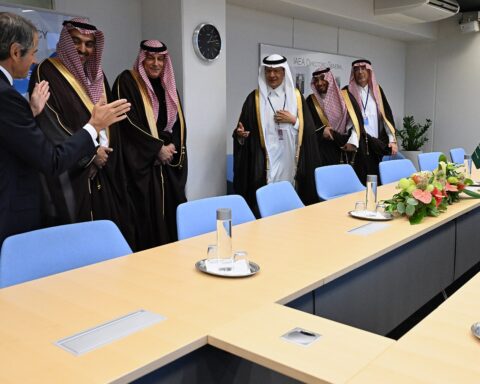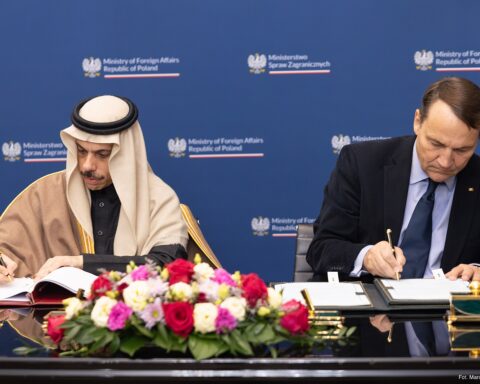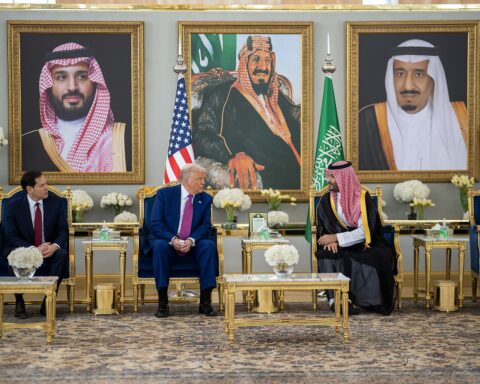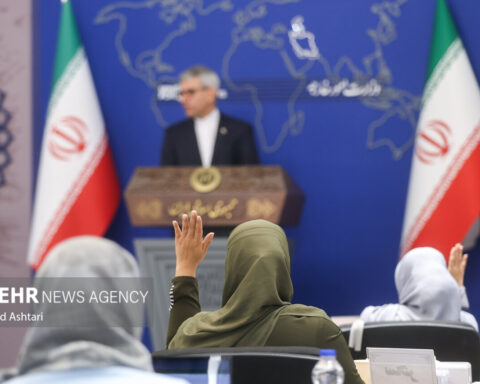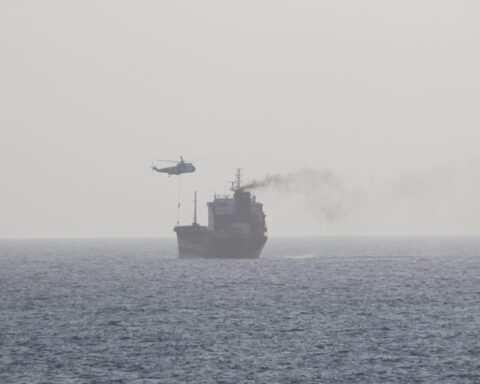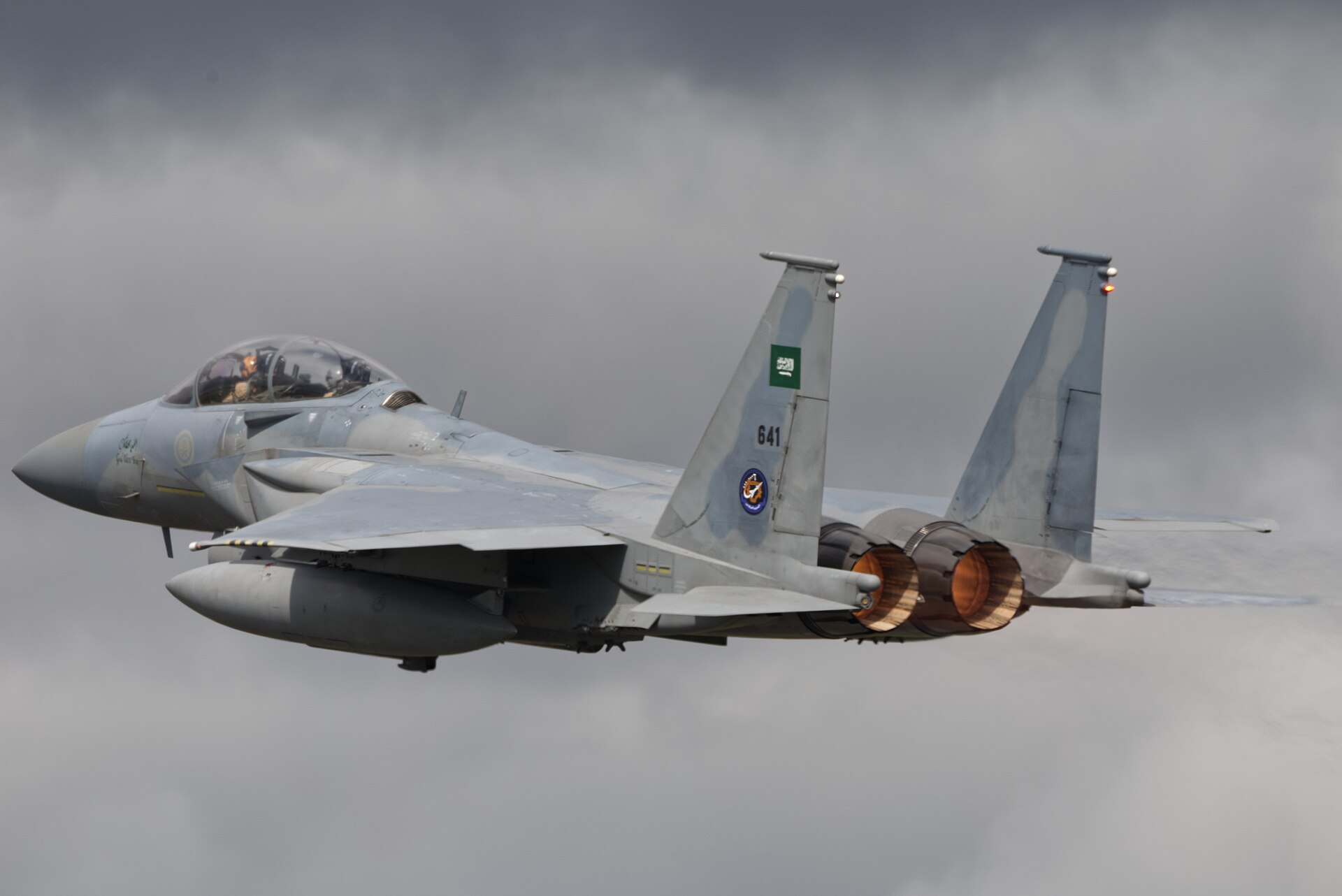

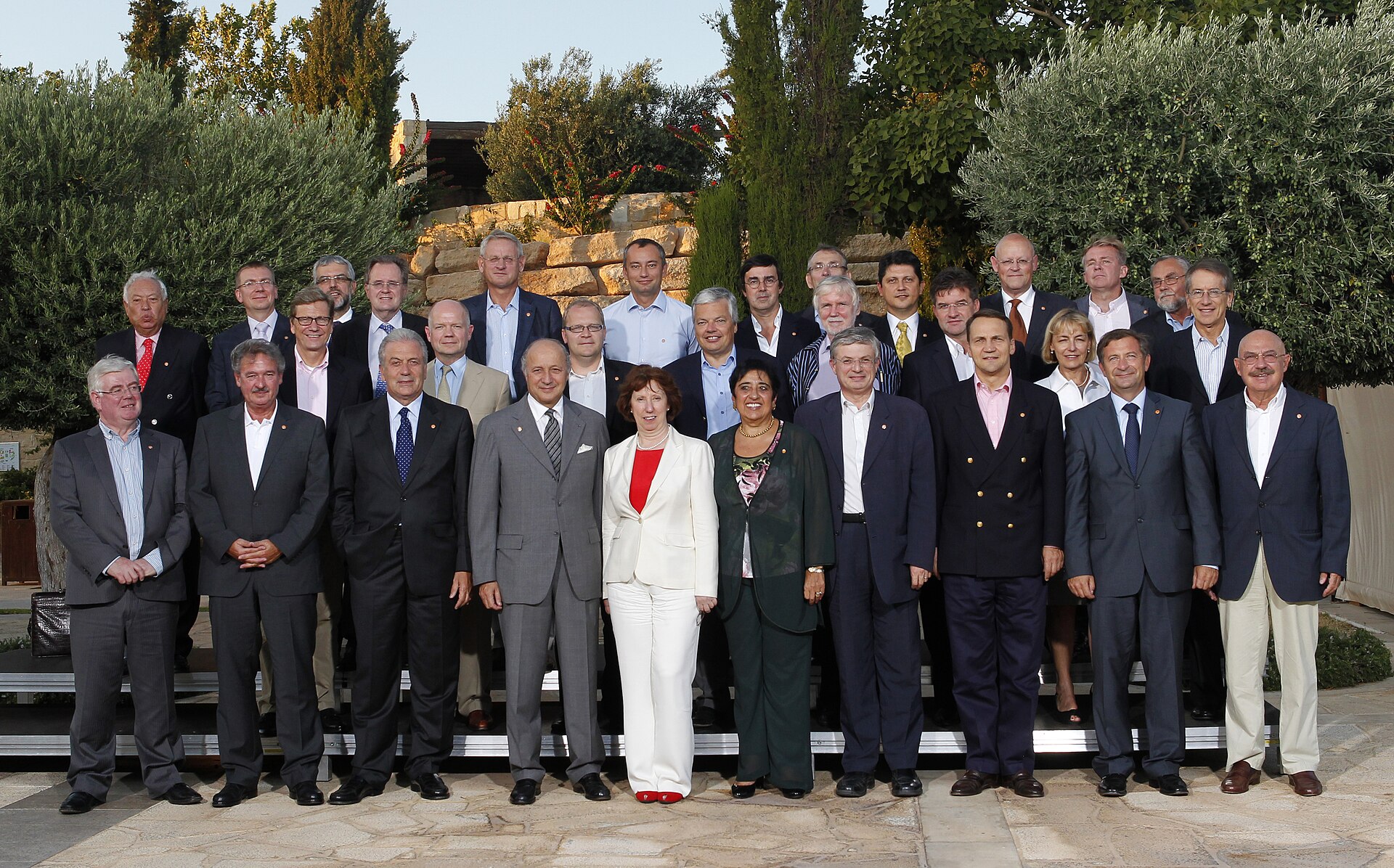
LIMASSOL — Prince Faisal bin Farhan walked into the EU Gymnich foreign ministers’ meeting in Cyprus on May 27, ending more than 10 days of Saudi diplomatic silence with a handshake for India’s Jaishankar and a seat at a European table. He arrived while the analytical wreckage of the “exclusion thesis” continued to pile up around a Reuters exclusive confirming that Royal Saudi Air Force jets struck Iranian drone and missile-launch sites on Iranian soil in late March — the first known direct Saudi military action against Iran in the modern history of the Gulf.
The story that dominated 90 days of coverage — Saudi Arabia as passive victim, sidelined from negotiations it should have led, absorbing Iranian missiles while Washington cut deals on its behalf — was never the full picture. It was the picture Riyadh wanted the world to see, because the Ministry of Foreign Affairs silence that analysts read as impotence was functioning as operational cover for a shadow war the Kingdom was already fighting, and the diplomatic invisibility that commentators mistook for irrelevance was buying the time and deniability MBS needed to prosecute an undeclared military campaign against a nuclear-threshold adversary.
Table of Contents
- What Did Saudi Arabia Strike on Iranian Soil?
- The Silence That Produced a 76 Percent Reduction
- Why Did the Exclusion Thesis Survive for 90 Days?
- Eight Steps to Undeclared War
- How Does Covert Belligerency Change Saudi Arabia’s Legal Exposure?
- The Backchannel That Survived the Bombs
- Why Did Bin Farhan Choose Limassol Over Washington?
- The Cost of the Shadow
- Frequently Asked Questions
What Did Saudi Arabia Strike on Iranian Soil?
Saudi Arabia’s Royal Saudi Air Force conducted “numerous, unpublicized” strikes on Iranian drone and missile-launch sites on Iranian territory in late March 2026, according to a Reuters exclusive (May 12) confirmed by two Western and two Iranian officials. The Wall Street Journal separately verified the strikes on May 16, reporting the RSAF also hit Iranian-backed Kataib Hezbollah communications and drone-operations facilities in southern Iraq near the Saudi border.
The proximate trigger was the most consequential single Iranian attack of the war: the March 27 barrage that destroyed a Boeing E-3G Sentry AWACS and a KC-135 Stratotanker at Prince Sultan Air Base, erasing Saudi Arabia’s airborne early-warning capability in a single salvo and leaving the Kingdom dependent on a diminished US ISR fleet already 54 Reapers short of its operational minimum. The RSAF’s response, kept entirely out of public view, targeted the Iranian launch infrastructure responsible for more than 430 missiles and drones that had struck Saudi territory since February 28 — infrastructure that was actively being used, not mothballed for future contingencies.
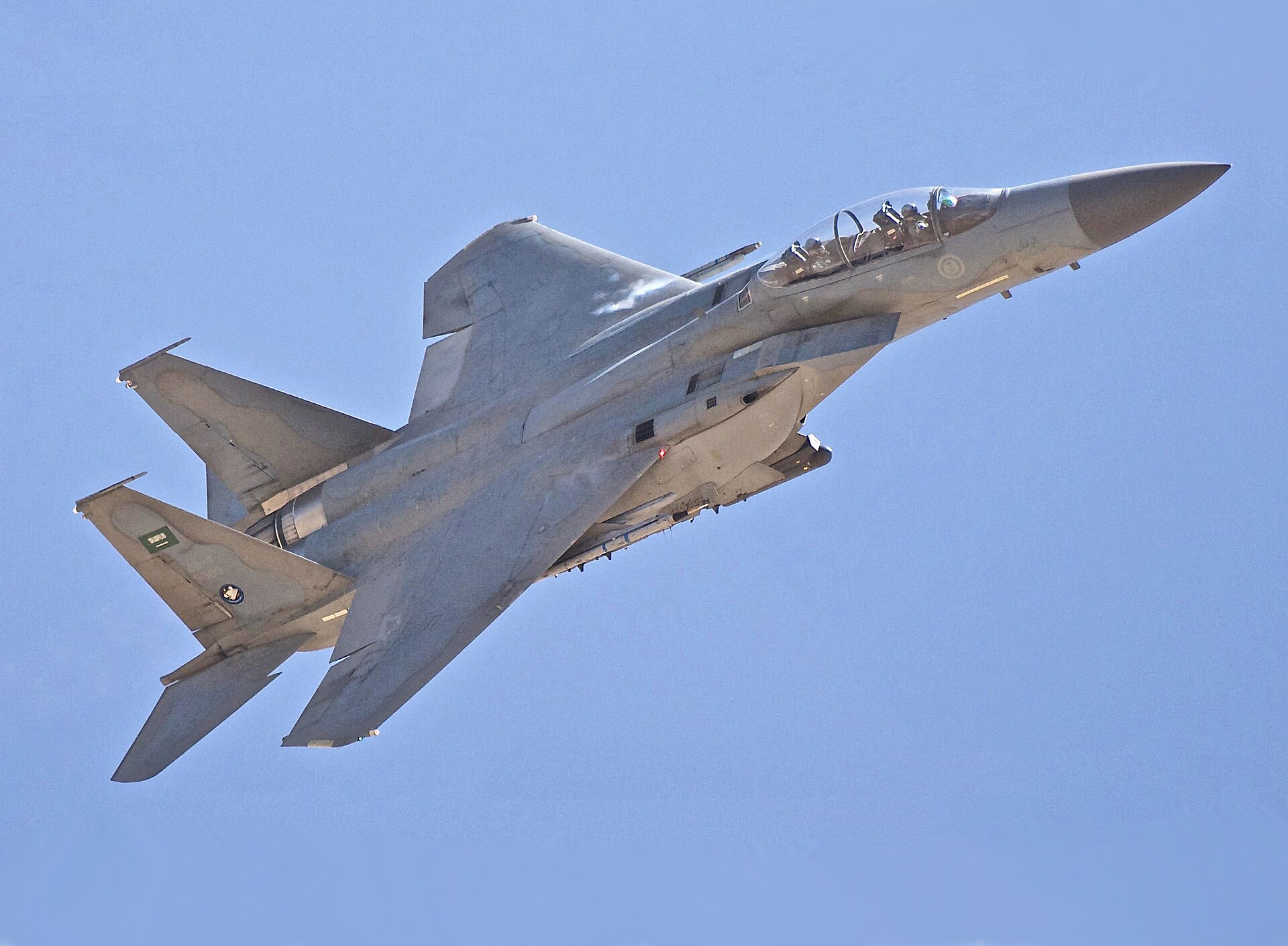
What distinguishes the Saudi operation historically is not the act of sustained air warfare (Riyadh has conducted a continuous air campaign in Yemen since March 2015) but the identity of the target: sovereign Iranian territory, struck by Saudi aircraft for the first time since the founding of the modern Kingdom. Reuters published the confirmation 35 days after the April 7 US-Iran ceasefire — timing that reads less as accidental leak than controlled disclosure, confirming military resolve without disrupting the de-escalation that Riyadh’s own strikes had already helped produce.
The Silence That Produced a 76 Percent Reduction
The covert strikes worked — not as a knockout blow, but as a bilateral price signal that restructured Iran’s cost-benefit calculation within a single week. Iranian attacks on Saudi territory fell from more than 105 drone and missile strikes in the week of March 25-31 to approximately 25 in the week of April 1-6, a 76 percent reduction documented by Reuters that preceded the formal US-Iran ceasefire of April 7 by several days and was achieved entirely outside the multilateral negotiating framework that consumed Washington’s attention.
The Middle East briefing 3,000+ readers start their day with.
One email. Every weekday morning. Free.
The mechanism was as unusual as the strikes themselves: according to Reuters, Riyadh informed Tehran in advance that strikes were imminent — framed not as coordination but as a warning that the Kingdom would no longer absorb attacks without imposing costs. The advance notice functioned as deliberate strategic communication, ensuring Iran could not claim surprise and securing a measure of de-escalation control by signalling that the strikes were retaliatory and bounded rather than the opening phase of a broader campaign. Gregory Brew, senior Iran analyst at Eurasia Group, identified the defining feature: “neither Saudis nor Iranians publicized attacks” — the mutual silence being structurally necessary for both parties to preserve the bilateral channel the strikes had just forced into existence.
The result reframes the entire timeline of the war’s de-escalation phase: Saudi military pressure produced the conditions that the US-Iran negotiating track then codified, meaning the bilateral informal ceasefire predated and arguably conditioned the formal one. Dr. Ofer Israeli of Ashkelon Academic College captured the operational doctrine at work in Modern Diplomacy on May 20: Saudi Arabia had done all four simultaneously in late March, and the 76 percent reduction in Iranian attacks is the measurable evidence that the doctrine delivered.
Uncertainty itself is becoming an instrument of influence. Gulf states now signal capability without full disclosure, impose costs without open acknowledgment, negotiate while coercing, and preserve deniability while demonstrating resolve.
Dr. Ofer Israeli, Ashkelon Academic College, Modern Diplomacy, May 20, 2026
Why Did the Exclusion Thesis Survive for 90 Days?
The exclusion thesis survived because Riyadh cultivated it. Every public signal — five rounds of US-Iran talks with zero Saudi participation, 106 days of MOU negotiations, MOFA silence stretching past 10 days — supported the reading that MBS was a bystander to his own fate, when the silence was operational cover for direct Saudi military strikes on Iranian soil.
The thesis was always analytically true at the diplomatic table and always structurally incomplete as a description of Saudi wartime behaviour. Saudi Arabia was excluded from the nuclear negotiations (where enrichment limits and HEU disposal are settled by parties with technical knowledge and the means to enforce them), from the PGSA governance framework (where Iran sets transit fees and the US determines enforcement posture), and from the frozen-assets sequencing deadlock that sent Iran’s trifecta home from Doha without a signature. None of that exclusion prevented Riyadh from running its own bilateral military track — a track that produced the 76 percent attack reduction before the formal ceasefire existed and was arguably more effective, in raw security terms, than five rounds of unsigned memoranda. What that exclusion costs in commercial terms — through Iran’s three-tier Hormuz toll system charging Saudi crude million per transit while exempting India — is the subject of Iran’s Hormuz Toll System Charges Million for Saudi Crude and Exempts India.
Ali Vaez, Iran Project Director at the International Crisis Group, described the dynamic as demonstrating “pragmatic recognition on both sides that uncontrolled escalation carries unacceptable costs.” Mona Yacoubian at CSIS went further, observing that the government’s silence on the covert-strike reports may signal “a more aggressive posture” to Tehran, pointing to “fragmentation and the differing response among Gulf countries.” The fragmentation point matters because the UAE was simultaneously running its own covert operation — an airstrike on Iran’s Lavan Island oil refinery around April 8, conducted in coordination with Israel according to the Wall Street Journal and Bloomberg — but with a different operational logic entirely, targeting high-value economic infrastructure where Riyadh targeted the military launch sites that were actively killing its soldiers.
Justin Teller, writing in International Policy Digest, offered the sharpest version of the counter-argument: Saudi foreign policy under MBS reflects “reactive opportunism” rather than coherent recalibration, with “Riyadh’s attempt to act simultaneously as a Western security partner, a regional mediator, and a conciliatory actor toward Iran” blurring strategic lines. The charge contains a real observation — Saudi Arabia did hold contradictory positions simultaneously — but the covert-strike disclosure suggests the contradiction was the strategy rather than a failure of it, and that the blurred lines were drawn deliberately rather than emerging from institutional incoherence.
Eight Steps to Undeclared War
The Saudi escalation ladder that analysts documented in real time was always presented as a sequence of reactive measures, each one forced by Iranian aggression that left Riyadh with narrowing options. The covert-strike disclosure adds an eighth step that reframes all the preceding ones: the moves that looked like reactions were, by late March, running in parallel with offensive military operations that Saudi Arabia chose not to disclose.
| Step | Date | Action | Visibility |
|---|---|---|---|
| 1 | Feb 28 – Mar 10 | Absorption: Saudi Arabia absorbs initial Iranian missile and drone strikes | Public |
| 2 | Mar 5 – Mar 15 | Condemnation: MOFA statements, UN appeals, diplomatic protests | Public |
| 3 | Mar 10 – Mar 18 | Mobilisation: Peninsula Shield Force activated, reserves called | Public |
| 4 | Mar 19 | Ultimatum: Bin Farhan — Saudi patience “is not unlimited” | Public |
| 5 | Mar 21 | Severance: Iranian military attaché + 4 staff expelled, 24-hour deadline | Public |
| 6 | Mar 23 | Base Access: King Fahd Air Base (Taif) opened to US offensive operations | Semi-public |
| 7 | Mar 25 | Collective Defence: Six Arab nations invoke UN Article 51 | Public |
| 8 | Late March | Direct RSAF strikes on Iranian drone and missile-launch sites on Iranian soil | Covert |
The table reveals a structural feature the step-by-step narrative obscured: the escalation was not purely linear. Step 5 (expelling the military attaché on March 21 with a 24-hour deadline) severed the last formal military communication channel with Tehran, while step 8 (the covert strikes, days later) required precisely the kind of backchannel communication that the formal severance was designed to deny. Saudi Arabia was severing its public military ties to Iran at the same moment it was establishing covert military contact through the advance-warning mechanism Reuters described — performing a rupture for the diplomatic audience while preserving operational connectivity for the military one.
The most consequential transition was between steps 6 and 8, the space between hosting US offensive operations at King Fahd Air Base and conducting independent Saudi strikes on Iranian territory. Step 6 made Saudi Arabia a co-belligerent under the Chatham House/ICRC framework developed by Alexander Wentker, Miles Jackson, and Lawrence Hill-Cawthorne; step 8 made it an independent combatant operating outside the US command structure, a qualitative escalation that transforms the legal basis for every subsequent Iranian strike on Saudi infrastructure.
Bin Farhan’s March 19 statement that Saudi patience with Iranian attacks “is not unlimited” reads differently after the Reuters disclosure — not as the frustrated warning of a sidelined foreign minister, but as a calibrated signal from a government that had already decided to act and was constructing public justification for an operation days away. The statement’s deliberate ambiguity on timing (“not unlimited” without specifying when patience would end) functioned as an escalation signal to Iran while preserving the deniability Riyadh needed to keep the strikes covert when they came. Every step on the ladder, reviewed after the disclosure, contains this dual quality: a public performance of restraint running parallel to private preparation for military action.
How Does Covert Belligerency Change Saudi Arabia’s Legal Exposure?
Under the Chatham House/ICRC co-belligerency framework, Saudi Arabia satisfies all four cumulative criteria for co-party status in an international armed conflict: a pre-existing conflict, actions related to hostilities, operations supporting one party, and an official state decision to provide that support. The covert RSAF strikes on Iranian soil add a dimension the framework’s four criteria did not need to contemplate — Saudi Arabia as independent combatant, not merely a supporting party.
The legal exposure is compounding rather than sequential: hosting US forces at Prince Sultan Air Base established co-belligerency; opening King Fahd Air Base in Taif to US offensive strike operations deepened it; the covert RSAF strikes on Iranian territory created a separate, bilateral armed conflict whose existence Saudi Arabia has never publicly acknowledged. Under international humanitarian law, the consequence is that Saudi military and economic infrastructure became lawful targets for Iran not merely because Riyadh was hosting a US ally’s combat operations, but because it was prosecuting its own offensive campaign — a distinction that transforms the legal basis for every Iranian strike on Saudi territory from late March onwards, retroactively providing Iran with a self-defence justification Riyadh has spent three months denying existed. The death of Abd Rabbuh Mansur Hadi on May 28 sharpened this exposure: Hadi’s 2015 letter was the last legal instrument Saudi Arabia possessed for any of its military campaigns — and there is no equivalent document authorising the 2026 conflict.
Iran’s state media response to the Reuters disclosure suggests Tehran understood this asymmetry immediately. PressTV, the English-language state broadcaster, did not quote any Iranian government official by name — a pointed editorial choice — but characterised Saudi Arabia as having provided “ample use of its territory” for US-Israeli operations and advised Gulf states against “contributing to the aggression.” Tasnim, the IRGC-affiliated outlet, dismissed the Reuters reporting as “a complex enemy design to create the perception of internal tension,” while IRNA and Fars News maintained complete silence on the covert strikes. The absence of official Iranian confirmation is structurally necessary: acknowledging that Saudi strikes produced a 76 percent reduction in Iranian attacks would confirm that IRGC operations were degraded by a Gulf state’s air force — a concession the Islamic Republic’s deterrence posture cannot absorb.
The legal question now shadowing every post-ceasefire negotiation is whether the covert-strike disclosure constitutes an admission of belligerency that opens Saudi Arabia to future Iranian claims — not military claims in the immediate term, but legal and financial ones pursued through international forums where Riyadh’s undeclared war becomes the basis for reparation demands. The Kingdom cannot counter such claims without first acknowledging the strikes it spent 90 days concealing, creating a disclosure trap where legal defence requires the very admission that compounds legal exposure.
The Backchannel That Survived the Bombs
On March 16 — days before the covert RSAF strikes began — Iranian Ambassador Ali Reza Enayati told Voice of Emirates from Riyadh that “communication with Saudi officials continues” and that relations “are progressing normally.” The statement is extraordinary in retrospect, because what was progressing normally included Saudi preparations to bomb Iranian military infrastructure, and what continued was a diplomatic channel that survived the bombing and functioned as the medium through which both sides managed the de-escalation that followed.
Communication with Saudi officials continues. Relations are progressing normally.
Ali Reza Enayati, Iranian Ambassador to Saudi Arabia, Voice of Emirates, March 16, 2026 — days before RSAF strikes on Iranian soil
The dual-track structure — covert military strikes running in parallel with a civilian diplomatic backchannel — has direct precedent in Israel’s “Campaign Between the Wars” in Syria from 2013 to 2019, where hundreds of acknowledged-but-deniable airstrikes on Iranian positions occurred while diplomatic channels between Jerusalem and Moscow (and indirectly, Tehran) remained operative. The Assad regime neither confirmed nor retaliated publicly, and Israel did not formally claim the strikes until 2019-2020, when acknowledgment became diplomatically useful. Saudi Arabia’s March 2026 approach follows identical operational logic: impose costs, signal bounded resolve, deny the adversary a political or legal pretext for symmetric escalation, and use controlled post-facto disclosure to confirm capability without reopening the conflict.
The parallel extends further than the Israeli precedent, reaching back to 1987, when the US Navy reflagged Kuwaiti tankers during Operation Earnest Will while Gulf states — including Saudi Arabia — provided basing, intelligence, and logistics for American operations against Iran without formally declaring belligerency, crossing the IHL threshold operationally while denying it politically. Nearly four decades later, Riyadh was not merely providing logistics for someone else’s war; it was flying its own sorties, striking its own target list, and managing its own de-escalation — while maintaining a posture of diplomatic exclusion that kept it off the hook for every institutional decision, from the MOU terms to the PGSA fees to the constitutional fracture between Araghchi and Vahidi that determines whether any deal Iran signs actually holds.
Enayati’s performance of normalcy was not naive — it was structurally necessary for Iran, too, because public acknowledgment that Saudi Arabia had struck Iranian territory would have demanded a public Iranian response at a moment when Tehran’s priority was the MOU negotiations and the $24 billion in frozen assets those negotiations might unlock. On the covert strikes, Enayati later offered a carefully lawyered non-denial: “If Iran had carried out such operations, it would have claimed responsibility explicitly” — an observation about Iranian practice that studiously avoided addressing Saudi practice. The bilateral silence purchased something both governments needed: the time and space to de-escalate without either side having to explain why it was doing so.
Why Did Bin Farhan Choose Limassol Over Washington?
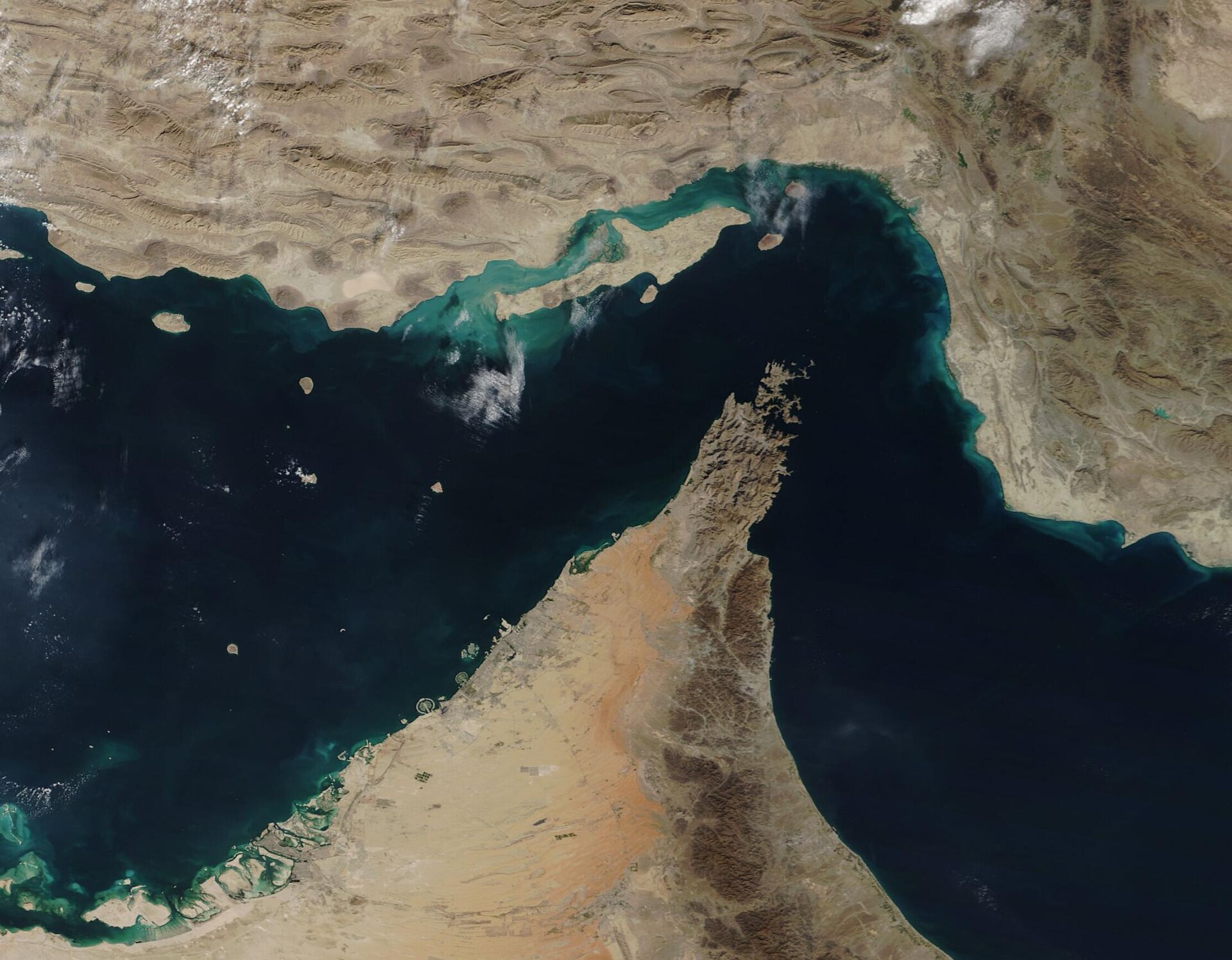
Bin Farhan’s first public appearance after more than 10 days of MOFA silence came not at a US-hosted forum, not at a GCC summit, and not at the UN Security Council (where Pakistan’s FM Dar spoke on May 26 while Saudi Arabia stayed away), but at the EU Gymnich informal foreign ministers’ meeting in Limassol, Cyprus. Saudi Arabia and India were the only non-EU states invited, and the agenda explicitly included Hormuz freedom of navigation and IMEC supply chain security.
The Gymnich agenda placed bin Farhan inside precisely the institutional framework that Saudi Arabia’s post-war positioning requires — one where Riyadh has been structurally excluded from both the US-centric alternatives (the PGSA, which it neither designed nor governs) and the European-led ones (the UK-France 40-nation Hormuz coalition headquartered at Northwood, where Saudi Arabia holds no seat). Italy’s Foreign Minister Tajani linked the Saudi presence directly to IMEC, describing the India-Middle East-Europe corridor as a framework that “would increase Italian exports” — a commercial rationale that aligns with Riyadh’s post-Hormuz trade redesign around Egyptian Mediterranean links, Arabian Sea routes bypassing Bab al-Mandab, and European-financed connectivity frameworks that do not require US military guarantees or Iranian permission to operate.
The bilateral meeting with India’s Jaishankar adds a second dimension: India is both the largest single buyer of Saudi crude at risk from Hormuz disruption and the anchor state of the IMEC corridor that offers Saudi Arabia an alternative export infrastructure. Bin Farhan appearing in Limassol with Jaishankar rather than in Washington with Rubio or in Riyadh with a GCC counterpart is a statement about where Saudi Arabia sees its post-war institutional relationships forming — inside European and Indian commercial frameworks rather than the American security architectures that made the Kingdom a target without making it safe.
The timing compounds the signal: bin Farhan emerged from diplomatic silence at the exact moment the PGSA faced its first OFAC SDN designation (May 28, the day after Gymnich concluded), CENTCOM struck Iranian targets from bases on Saudi soil without informing Riyadh, and the MOU negotiations stalled on a $24 billion frozen-assets deadlock in which Saudi Arabia has zero participation. Limassol offered what none of the US-centric or GCC forums could: a table where Saudi Arabia’s covert belligerency was not a liability, IMEC made it a valued partner, and no one was asking why the MOFA had been silent for 10 days while the war continued.
The Cost of the Shadow
The shadow war produced a 76 percent reduction in Iranian attacks and a bilateral de-escalation that preceded the formal ceasefire, but it did so at costs the disclosure is now making visible. Saudi Arabia’s PAC-3 interceptor inventory stands at approximately 400 rounds from a pre-war stock of 2,800 — an 86 percent drawdown in three months — and the covert strikes, while degrading Iranian launch infrastructure, did not halt the attrition of a defensive asset that cannot be replenished at wartime consumption rates. Saudi oil export capacity fell 54 percent during the conflict (from 7.3 million to 3.33 million barrels per day), contributing to a first-quarter fiscal deficit of SAR 126 billion — nearly three-quarters of the Kingdom’s full-year deficit target consumed in 90 days, with Brent trading at $96.57 against a Saudi breakeven of $108-111 per barrel.
The interceptor attrition that ran alongside the covert strikes created a parallel vulnerability. Saudi Arabia consumed more Patriot interceptors than any other country in the system’s history during the conflict — yet was excluded from the emergency authorization Washington used to fast-track Patriot resupply to Qatar, Kuwait, the UAE, and Israel. The waiver gap, the remaining stockpile ceiling, and what it means for Saudi air defense capacity are examined here.
The structural cost of covert belligerency is that Riyadh now occupies a position it designed to avoid: it is a confirmed party to a bilateral armed conflict with Iran (under IHL standards it cannot credibly dispute), it is exposed to future legal and financial claims it cannot counter without acknowledging the strikes, and it has demonstrated a capability — independent RSAF operations on Iranian territory — that Iran will factor into every future energy and security calculation involving the Kingdom. The shadow bought time and de-escalation; the disclosure bought credibility and deterrence. Whether the exchange was worth it depends on whether the bilateral channel the strikes created — the channel through which both sides managed the de-escalation — survives the transition from covert understanding to public knowledge.
The interaction between the covert strikes and the PGSA’s operational timeline is the structural consequence no competing analysis has identified: the bilateral de-escalation that Saudi military pressure produced in early April created the post-ceasefire security environment in which Iran felt confident enough to impose a formal toll system on the Strait of Hormuz on May 18, collecting $2 million per transit for 11 days before OFAC designated the PGSA on May 28. Saudi Arabia’s covert war helped produce the conditions under which Iran institutionalised the very toll system that now taxes Saudi-bound shipping — a second-order consequence that transforms the de-escalation victory into a governance loss. Riyadh cannot challenge the PGSA’s legitimacy without acknowledging the role its own strikes played in creating the post-ceasefire environment that made the toll operational.
The full shape of that bilateral architecture — the covert strikes, the 76 percent attack reduction, the Enayati back-channel, and the Helsinki-model non-aggression framework Riyadh floated to the Financial Times — is examined in Saudi Arabia Built a Private De-Escalation Track With Iran. The MOU’s Death Makes It the Only One Left. That analysis shows how the bilateral de-escalation Saudi military pressure enforced on the ground became, after the MOU’s June 9 collapse, the only architecture with any prospect of containing the conflict.
MBS privately told Trump that the US-Israeli campaign was a “historic opportunity” to reshape the region and pressed for American ground forces to seize Iranian energy infrastructure and topple the government, according to the New York Times — a request the White House declined to confirm, with Press Secretary Karoline Leavitt stating she would not “comment on the president’s private conversations.” The gap between what MBS was requesting from Washington (regime change) and what the RSAF was conducting independently (bounded retaliatory strikes with advance warning and built-in de-escalation) is the clearest evidence that the shadow war was not improvised but designed — that the public advocacy for maximum escalation and the private prosecution of limited, deniable military action were complementary tracks serving the same objective: ensuring Saudi Arabia emerged from the war with both its deterrent credibility restored and its diplomatic options intact.
Bin Farhan walked into Limassol carrying that dual portfolio — a Kingdom that struck Iran and saw the strikes work, a MOFA that went silent while the de-escalation held, and a post-war positioning play routed through Brussels and New Delhi rather than through the Pentagon or the GCC secretariat. The shadow war worked because both sides agreed it did not exist — and the question facing MBS now is what happens when the world has been told it did. That answer arrived on Eid al-Adha: the Ministry of Defence confirmed Saudi Arabia’s Mina martyr camp — the first official acknowledgment of war dead, placed inside a Hajj logistics notice where the diplomatic cost of disclosure is lowest.
Frequently Asked Questions
Did Saudi Arabia coordinate its strikes on Iran with the United States?
The available reporting does not indicate formal US-Saudi coordination for the RSAF strikes on Iranian territory. Reuters described the advance warning to Tehran as a Saudi decision communicated through bilateral channels, not through the US command structure. Saudi Arabia and Kuwait conducted separate strikes on Iranian-backed militia targets near the Saudi-Iraqi border — operations reported by Reuters and Al-Monitor (May 14) — that appear operationally distinct from the concurrent US-Israeli campaign. The distinction between coordination and deconfliction carries legal weight: coordination implies joint command and deepens co-belligerency exposure, while deconfliction implies parallel but independent operations — a difference that shapes how international tribunals would assess Saudi Arabia’s wartime status under IHL.
What legal options does Iran have now that Saudi Arabia’s strikes are publicly confirmed?
Iran’s most direct legal avenue against Saudi Arabia runs through the UN Charter and customary international law rather than a bilateral treaty, since the two states have no instrument comparable to the 1955 Treaty of Amity that Iran has used against the United States. A claim before the International Court of Justice would require Iran to formally allege that Saudi strikes on Iranian territory constituted an unlawful armed attack — which simultaneously confirms that IRGC launch infrastructure was successfully degraded by a Gulf state’s air force, a concession the Islamic Republic’s deterrence posture cannot absorb. Iran also cannot invoke UN Charter Article 51 self-defence retroactively without opening its own conduct — more than 430 missiles and drones fired at Saudi territory since February 28 — to counter-claims before the same forum. The bilateral silence purchased by both sides in late March was not merely diplomatic; it was pre-emptive legal risk management on both ends.
What does Saudi Arabia’s covert strike capability mean for future Gulf security?
The RSAF’s demonstrated ability to conduct independent offensive operations on Iranian soil fundamentally alters the Gulf security equilibrium that has prevailed since the 1980s, when GCC states outsourced deterrence to the United States in exchange for basing rights. Bilal Saab, former Pentagon adviser and former Pentagon adviser and Gulf security analyst, described the UAE’s parallel covert strikes as the “operationalization” of Gulf alignment with the US and Israel, warning there would be “no friendly return on something like this” — a characterisation that applies with greater force to Saudi Arabia, whose strikes targeted military rather than economic infrastructure and whose advance warning to Tehran demonstrated an independent command decision that was not dependent on US authorisation. The demonstrated capability also constrains Saudi diplomatic options going forward: Riyadh can no longer credibly present itself as a neutral mediator in any future US-Iran negotiation, a role it sought as recently as the 2023 Beijing-brokered rapprochement with Tehran, because covert belligerency and mediation are mutually exclusive postures under both international humanitarian law and standard diplomatic practice.
Why was the Reuters report published 35 days after the ceasefire?
Reuters’ four sources — two Western officials and two Iranian officials — are the structural tell: the story required active cooperation from both sides to publish, not just a leak from one. An unilateral Saudi or Western leak would have produced a one-sided account; the Iranian sourcing gave the story its confirmation and its authority. Both governments had reason to allow disclosure by mid-May: the ceasefire was holding, the de-escalation could no longer be undone, and an uncontrolled leak at a diplomatically inconvenient moment — say, during a new round of MOU talks — carried greater risk than a managed confirmation when the bilateral channel was already stable. The Wall Street Journal’s separate verification on May 16 (four days later) suggests the disclosure window was coordinated rather than spontaneous, with both outlets receiving access in the same short window after both parties decided the story could surface.