DHAHRAN — Aramco priced May-loading Arab Light crude to Asia at +$19.50 per barrel over the Oman/Dubai average — the highest official selling price in the company’s history, more than double the previous wartime record of +$9.35 set during the Russia-Ukraine shock of May 2022, and a $17.00 single-month increase from April’s +$2.50. Yet the number that matters is not $19.50. A Bloomberg survey of refiners and traders published March 30 had anticipated a premium of approximately $40 per barrel. Aramco left $20.50 on the table. The gap between what the market expected and what Riyadh charged is not a pricing error or a bureaucratic lag. It is the price of keeping China, India, Japan, and South Korea solvent on Saudi crude — and diplomatically quiescent — at the most dangerous moment for Gulf energy infrastructure since 1990.
Table of Contents
- Anatomy of a Record: From +$2.50 to +$19.50
- Why Did Aramco Not Price at $40?
- The Term Contract vs. Spot Market Distinction
- Asian Buyer Diplomacy and the Pricing Subsidy
- How Does Aramco Avoid the War-Profiteering Charge?
- The Regional Split: Europe at +$27.85, America at +$0.35
- Saudi Fiscal Arithmetic at $109 Brent
- Does Iran Have a Competing Pricing Instrument?
- OSP Historical Context
- Frequently Asked Questions
Anatomy of a Record: From +$2.50 to +$19.50
The scale of the May hike requires some historical scaffolding. Before Iran’s strikes on Gulf energy infrastructure began in late February, Aramco’s Asian OSP had been drifting in a familiar band. The April premium stood at +$2.50 per barrel over Oman/Dubai — competitive, designed to hold volume against Russian Urals crude, which had captured roughly 40% of Indian imports. In December 2024, during a period of pre-war oversupply, Aramco cut its Asian OSP by up to $2 per barrel below neutral to defend market share against precisely that Russian competition. The company’s pricing desk has long operated with a market-share reflex: when volumes are threatened, premiums compress.
That reflex was overridden on April 6, 2026. The $17.00 single-month increase dwarfs every previous adjustment. The largest prior single-month hike — $4.40 in April 2022, which lifted the premium to $9.35 — came during the first weeks of Russia’s invasion of Ukraine, when traders feared Russian supply would vanish from global markets. The May 2026 move is nearly four times that size. At +$19.50, Aramco’s Arab Light premium to Asia now exceeds the entire price of a barrel of Saudi crude during several periods of the 1990s.
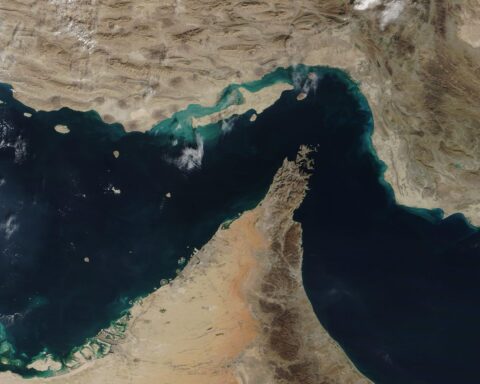
The trigger is physical, not speculative. On March 2, S&P Global Platts suspended nominations of crude grades loading inside the Strait of Hormuz from the Dubai benchmark, reducing deliverable grades to Murban (loading at Fujairah, outside the strait) and Oman crude. The benchmark contraction reflected reality: insured tanker traffic through Hormuz had collapsed, and the IRGC’s selective transit-fee system — effectively a franchised toll corridor — had made loading schedules from Ras Tanura, Juaymah, and Kharg Island unpredictable at best. Dubai spot crude climbed to nearly $170 per barrel during the March assessment window.
Why Did Aramco Not Price at $40?
The Bloomberg survey expectation of $40 was priced off that $170 spot environment. Traders and refiners surveyed by Bloomberg were, rationally, extrapolating from the market they could see: a benchmark stripped of most deliverable crude, spot cargoes trading at panic premiums, and physical supply from the Gulf constrained by both Hormuz disruption and Saudi Arabia’s own 39% export decline from February levels. At $40 over Oman/Dubai, Aramco would have been tracking the spot market — matching the price signal that physical scarcity was already generating.
Aramco chose not to. The $20.50 discount to market expectation translates, on a 5-million-barrel-per-day export program now routing predominantly through the East-West Pipeline to Yanbu, to a daily revenue concession in the hundreds of millions of dollars. Even on reduced volumes — Saudi exports were running approximately 5 million bpd through Yanbu, roughly 70% of pre-war capacity — the foregone revenue across May loadings is measured in the low billions. Aramco’s pricing desk does not leave billions on the table by accident.
The Middle East briefing 3,000+ readers start their day with.
One email. Every weekday morning. Free.
The Term Contract vs. Spot Market Distinction
The mechanical explanation for the $20.50 gap — absent from Reuters, Bloomberg, and OilPrice.com coverage of the OSP release — lies in the structural difference between the markets Aramco was pricing into. The OSP applies to term contract barrels: long-standing supply agreements with Aramco’s largest and most stable customers. China’s Sinopec and PetroChina, India’s Indian Oil Corporation and Bharat Petroleum, Japan’s ENEOS and Idemitsu, South Korea’s SK Innovation — these are buyers who lift Saudi crude month after month, year after year. They are the bedrock of Aramco’s $104.7 billion in adjusted net income and $85.4 billion in free cash flow reported for fiscal year 2025.
The $40 expectation, by contrast, was anchored to a spot market that had become structurally distorted. When Platts suspended Hormuz-loading grades from the Dubai benchmark, the remaining deliverable crudes — Murban and Oman — became proxies for the entire Gulf barrel. TotalEnergies demonstrated the distortion’s magnitude: the French major purchased approximately 70 cargoes of UAE and Oman crude loading in May, booking over $1 billion in profit from the benchmark spike. Asked about the trades, TotalEnergies told the Financial Times it “does not comment on its trading activities.”
Setting the OSP at $40 would have meant pricing term barrels as if they were spot barrels — imposing on long-standing contract buyers the full cost of a benchmark dislocation caused by war, not by supply-demand fundamentals. The risk was not abstract. At $40 over Oman/Dubai, Asian refiners would have faced an unprecedented cost shock on their largest single crude source. Contract renegotiation, buyer flight to US WTI exports, accelerated uptake of Russian Urals, or outright refusal to lift cargoes were all plausible responses. Aramco’s December 2024 behavior — cutting premiums to defend share against exactly those alternatives — suggests the pricing desk modeled these scenarios explicitly.
Asian Buyer Diplomacy and the Pricing Subsidy
The diplomatic dimension of the $20.50 gap is where the pricing decision becomes a foreign policy instrument. Saudi Arabia’s four largest Asian crude customers — China, India, Japan, and South Korea — are each navigating the Iran conflict with a preference for inaction. China has positioned itself as a Hormuz intermediary, brokering the transit of Qatar’s Al Daayen LNG carrier through IRGC-controlled waters and maintaining crude purchases from Iran through yuan-denominated channels outside SWIFT. India accepted OFAC General License U and began importing Iranian crude for the first time since May 2019, displacing Saudi market share from 16% to 11% of Indian imports. Japan committed 80 million barrels to the IEA’s 400-million-barrel strategic reserve release on March 11. South Korea committed 22.46 million barrels and capped domestic fuel prices for the first time in nearly 30 years.
Each of these countries has a domestic political incentive to avoid being drawn into the conflict. Each also has an economic incentive to keep buying Saudi crude at manageable premiums rather than scrambling for alternatives on a distorted spot market. By pricing at $19.50 instead of $40, Aramco effectively subsidizes that passivity. The subsidy is implicit — no MOU, no side letter — but the signal is legible to every trading desk and energy ministry in Asia: stay on our term contracts, and we will not extract the full scarcity rent the war has generated.
The alternative — pricing at $40 and forcing Asian buyers into the full cost of the Hormuz disruption — would have accelerated exactly the dynamics Riyadh fears most. Indian refiners, already testing Iranian crude under GL U, would have had stronger commercial justification to increase volumes from Tehran. Chinese state refiners, already operating a parallel Hormuz transit system through IRGC intermediation, would have been handed a price argument for expanding that channel. The OSP restraint is, in this reading, a competitive instrument deployed against Iran’s own crude pricing — which, through exempted corridors and Chinese intermediation, may be reaching Asian buyers at sub-market rates.
How Does Aramco Avoid the War-Profiteering Charge?
The political economy of pricing at $19.50 rather than $40 extends beyond Asian buyer retention. At the moment the OSP was released, Brent crude stood at $109.03 per barrel — up only $2.87 from the $106.16 level at the conflict’s outbreak on February 28. WTI, in the anomalous inversion that has persisted for weeks, traded at $111.81 — above Brent, a spread configuration that reflects US domestic supply tightness and Gulf export disruption simultaneously. The moderate Brent move, set against an active Gulf war that has struck Ras Tanura loading infrastructure and placed the King Fahd Causeway on IRGC counter-target lists, is itself partly a function of the Yanbu bypass holding Saudi export volumes at 70% of pre-war capacity.
Had Aramco set the OSP at $40 — effectively pricing Arab Light to Asia above $200 per barrel in absolute terms when added to the Oman/Dubai base — the political optics would have been severe. The charge of war profiteering, already implicit in RUSI’s characterization of the conflict as “an oil war between Iran and Saudi Arabia,” would have become explicit. The Trump administration, which privately received MBS’s request for US ground troops and regime change in Iran, would have faced domestic pressure over fuel costs traceable to a Saudi pricing decision. The IEA’s 400-million-barrel reserve release was designed to contain precisely this kind of price transmission from Gulf conflict to consumer pumps.
At $19.50, Aramco captures a record premium — extracting more per barrel than at any point in its history — while maintaining the position that it is pricing responsibly in a crisis. The gap between “highest ever” and “what the market expected” is wide enough to serve as a political shield. Tsvetana Paraskova of OilPrice.com characterized the pricing as Aramco “including a significant premium for geopolitical risk, aiming to maximize revenue from limited supplies without causing buyers to cut demand.” The framing — maximize without destroying — is the operative logic.
The Regional Split: Europe at +$27.85, America at +$0.35
Aramco’s regional pricing for May loadings reinforces the reading that the Asian OSP is deliberately restrained. Arab Light to Northwest Europe was set at +$27.85 per barrel over ICE Brent — a premium that, applied to Brent at $109, prices European-bound Saudi crude at approximately $137 per barrel. Arab Light to the United States was set at +$0.35 per barrel over the Argus Sour Crude Index (ASCI), an increase of just $0.40 from the prior month. The US premium is negligible.
The three-way split reflects three different competitive environments. In the US Gulf Coast market, Saudi crude competes directly with domestic shale production and Canadian heavy grades; WTI’s inversion above Brent has made the US market self-sufficient enough that Saudi barrels are marginal. The $0.35 premium is a placeholder — Aramco maintaining contract relationships without competing for incremental volume. In Europe, the loss of Russian pipeline crude since 2022 and the tightening of Mediterranean sour crude supply from Libya and Iraq have created a structural premium environment that Aramco can price into without diplomatic cost. European refiners have fewer alternatives and less political sensitivity to Gulf pricing than Asian buyers do.
The Asian premium of $19.50 sits between these poles — higher than the US by an order of magnitude, lower than Europe by $8.35 in OSP differential terms. The positioning is consistent with a strategy that treats Asian term contracts as the volume backbone of the export program and European spot-adjacent contracts as the margin enhancer.
| Destination | Benchmark | Premium | Change from April |
|---|---|---|---|
| Asia | Oman/Dubai avg. | +$19.50/bbl | +$17.00 |
| Northwest Europe | ICE Brent | +$27.85/bbl | n/a |
| United States | ASCI | +$0.35/bbl | +$0.40 |
Saudi Fiscal Arithmetic at $109 Brent
The restraint carries a fiscal cost that Riyadh can measure precisely. The IMF estimates Saudi Arabia’s central government fiscal breakeven at $86.60 per barrel. Bloomberg Economics places the breakeven at approximately $94 per barrel when PIF operational outlays are included. The full capital-expenditure version — incorporating PIF’s construction pipeline across NEOM, the Red Sea Project, and Diriyah Gate — pushes the breakeven to roughly $111 per barrel, according to industry estimates. At Brent $109.03, Saudi Arabia is below the full-capex breakeven and only $15 above the central government threshold. That position has since deteriorated significantly: as of April 13, the Yanbu export ceiling means Brent at $102 delivers no more revenue than $75 with full Hormuz access — the May OSP restraint, combined with volume constraint, has converted a price windfall into a fiscal paradox.
The fiscal context is already strained. Saudi Arabia’s 2025 fiscal deficit reached SAR 276.6 billion (approximately $73.7 billion), up from SAR 115.6 billion in 2024 — a deterioration that predated the conflict. Goldman Sachs projected the 2026 deficit at 6 to 6.6% of GDP, or $80 to $90 billion, before accounting for war-related disruptions. Chatham House analysts observed in March that “Saudi Arabia will be able to claw back some of its revenue losses thanks to higher oil prices, but its financial position was already showing signs of strain before the war, with a fiscal deficit of 5.3 per cent of GDP in 2025, and capital spending being cut back.”
Against this backdrop, the $20.50 per barrel of foregone revenue on every Asian-bound cargo is not trivial. On 3 million barrels per day of Asian-bound term contract volumes (a conservative estimate given the shift to Yanbu), the daily revenue concession is approximately $61.5 million — or $1.85 billion over a 30-day loading month. That sum exceeds Aramco’s daily base dividend payment to the Saudi government. The decision to price at $19.50 rather than $40 is, in fiscal terms, a choice to fund buyer loyalty over budget consolidation — a prioritization that only makes sense if the diplomatic returns are valued above the fiscal ones.
Does Iran Have a Competing Pricing Instrument?
Iran’s pricing leverage operates through a different mechanism. PressTV reported on March 14 that “Saudi Arabia cuts oil output by 20% as Iran continues to control traffic in Strait of Hormuz” — framing the Hormuz disruption as an Iranian strategic success. The framing is self-serving but not entirely wrong. The IRGC’s selective transit-fee system — charging approximately $2 million per passage through the strait — functions as a competing pricing instrument that operates on the physical layer rather than the contractual one. Iranian crude transiting via exempted corridors, with China as intermediary buyer and yuan-denominated payment flowing through Kunlun Bank outside SWIFT, may reach Asian refineries at prices that materially undercut Saudi term contract levels.
The structural competition is asymmetric. Aramco prices through a transparent, monthly OSP process that is visible to every market participant and energy ministry. Iran prices through opacity — undisclosed discounts, intermediated logistics, sanctions-evasion infrastructure that adds cost but avoids the official premium structure entirely. RUSI analysts have framed the broader conflict as “an oil war between Iran and Saudi Arabia,” with Iran deliberately targeting Gulf energy infrastructure to compress Saudi export capacity and accelerate leverage over Asian buyers. The OSP restraint can be read as Aramco’s counter-move: if Iran is competing on price through the grey market, Aramco competes on price through the official one, accepting a lower premium to keep term buyers from drifting toward Iranian alternatives.
The competition is playing out most visibly in India. Saudi market share in Indian crude imports has fallen further, displaced by both the dominant Russian Urals position and Iranian crude arriving under the OFAC General License U framework. Indian Oil Corporation and Bharat Petroleum face a compliance trap — GL U provides no escrow mechanism, and Iranian crude premia above Brent of $6 to $8 per barrel are themselves elevated — but the political signal from New Delhi is that India will diversify supply away from any single Gulf producer. Aramco’s OSP restraint is partly aimed at slowing that diversification.
OSP Historical Context
Aramco’s pricing history since the 2020 price war reveals an institution that uses OSP adjustments as strategic instruments, not passive reflections of market conditions. The pattern is consistent: in periods of oversupply or competitive threat, premiums compress or go negative to defend volume; in periods of supply disruption, premiums rise but never to the level the spot market would justify. The May 2026 OSP follows this template at an unprecedented scale.
| Month | Premium (Oman/Dubai) | Context |
|---|---|---|
| April 2020 | -$6.00/bbl (approx.) | Saudi-Russia price war; maximum volume strategy |
| May 2022 | +$9.35/bbl | Previous all-time record; Russia-Ukraine shock |
| December 2024 | ~-$2.00/bbl (below neutral) | Pre-war oversupply; defending share vs. Russian Urals |
| April 2026 | +$2.50/bbl | Early weeks of Hormuz disruption |
| May 2026 | +$19.50/bbl | Current record; Iran war / Hormuz closure |
The previous largest single-month hike — $4.40 in April 2022 — came during a period when traders feared Russian crude would be permanently removed from the market. That fear proved overstated; Russian barrels found alternative buyers in India and China, and Aramco subsequently moderated premiums. The May 2026 hike reflects a physical disruption — the effective closure of the Strait of Hormuz to insured tanker traffic — that is qualitatively different from a sanctions-driven rerouting.
The OPEC+ decision of April 5 to increase output by 206,000 barrels per day for May — a continuation of the scheduled voluntary-cut unwind — exists largely on paper given the Hormuz constraints. The additional barrels, even if produced, face the same bottleneck that pushed Aramco to reroute through the East-West Pipeline. ENR analysts noted that “Hormuz bypass infrastructure was sized for a short disruption. This is not that.” The IEA, for its part, lowered its 2026 oil demand growth forecast to 640,000 barrels per day, citing economic uncertainty and elevated prices as demand-destruction risks. Oxford Economics projects GCC GDP to contract 0.2% in 2026, with Qatar facing a potential 14% GDP collapse — a figure that contextualizes Saudi Arabia’s relative resilience through the Yanbu bypass as a competitive advantage within the Gulf itself.
Frequently Asked Questions
What is Aramco’s OSP and how is it calculated?
Aramco’s Official Selling Price is a monthly differential — expressed as a premium or discount — set against regional benchmarks for each destination. For Asian buyers, the benchmark is the average of Oman and Dubai crude assessments. For Northwest Europe, it is ICE Brent. For the United States, it is the Argus Sour Crude Index. The OSP is announced around the 5th of each month for the following month’s loadings and applies exclusively to term contract volumes — long-standing supply agreements with refiners who lift Saudi crude regularly. Spot cargoes trade at separate, market-determined premiums. The distinction matters because term contract pricing reflects a relationship between producer and buyer, while spot pricing reflects instantaneous supply-demand conditions. In May 2026, the spot market — with Dubai at nearly $170 per barrel — and the term market diverged by the widest margin on record.
How does the $19.50 OSP compare to absolute crude prices?
The OSP is a differential, not an absolute price. To calculate the delivered cost, add the premium to the Oman/Dubai benchmark average. With Oman/Dubai trading at approximately $160-170 per barrel in the March-April assessment window (reflecting the Platts benchmark contraction), Arab Light delivered to Asian term buyers in May would cost roughly $180-190 per barrel — still well below what spot cargoes of comparable quality have been trading at. For context, Brent crude — the global benchmark, which loads from the North Sea outside any conflict zone — traded at $109.03 on April 6. The divergence between Brent and the Dubai/Oman complex is itself a measure of the Hormuz risk premium, running at approximately $50-60 per barrel.
Could Aramco raise the OSP further in June?
The trajectory depends on two variables: the physical status of Hormuz and the pace of the East-West Pipeline ramp. The Yanbu bypass is operating at 7 million bpd throughput capacity, with approximately 5 million bpd in actual exports — suggesting some headroom for additional volume if pipeline integrity holds. If Hormuz remains effectively closed to insured traffic and the 45-day ceasefire framework reported by Axios and The National on April 6 fails to materialize, June OSP could rise further. However, each incremental dollar of premium increases the risk of buyer pushback, contract renegotiation, or accelerated substitution toward Russian, US, or Iranian crude. The $19.50 level already tests the tolerance of Indian refiners operating on thin downstream margins and Japanese refiners whose government has committed 80 million barrels of strategic reserves to price suppression.
Trump’s subsequent acknowledgment that US gasoline prices may stay elevated “around the same, or maybe a little bit higher” through November has since transformed the variable from a ceasefire timeline to an electoral one. The full fiscal implication of that November anchor for Saudi Arabia’s Yanbu-constrained revenue position is examined in a subsequent analysis.
Trump’s subsequent acknowledgment that US gasoline prices may stay elevated “around the same, or maybe a little bit higher” through November has since transformed the variable from a ceasefire timeline to an electoral one. The full fiscal implication of that November anchor for Saudi Arabia’s Yanbu-constrained revenue position is examined in a subsequent analysis.
Why is the US OSP only +$0.35 when Asia is +$19.50?
The US Gulf Coast refining complex is structurally different from Asia’s. American refiners have access to abundant domestic shale crude (WTI traded at $111.81 on April 6, above Brent in an unusual inversion), Canadian heavy grades via pipeline, and Latin American medium-sour barrels from Colombia, Brazil, and Guyana. Saudi crude is a marginal supplier to the US, not a baseload one. Aramco’s near-zero US premium reflects competitive reality: raising it would simply redirect US refiners to domestic or hemispheric alternatives. The ASCI benchmark itself is anchored to Mars Blend and other Gulf of Mexico sour crudes, which have their own supply dynamics unrelated to Hormuz. Aramco maintains US term contracts for strategic diversification rather than volume or margin.
What happens to Aramco’s dividend if the pricing restraint persists?
Aramco distributed $85.5 billion to shareholders in fiscal 2025, comprising base and performance-linked dividends. The Saudi government, which holds a 98.5% stake through the Public Investment Fund and direct ownership, is the primary beneficiary. The base dividend — approximately $20 billion per quarter — is considered sacrosanct by Aramco’s board. Performance-linked distributions, however, are tied to free cash flow, which was $85.4 billion in 2025. If the pricing restraint persists while export volumes remain at 70% of pre-war levels and the fiscal deficit continues widening (Goldman Sachs projects 6 to 6.6% of GDP for 2026), the performance-linked component faces compression. The IMF’s $86.60 central government breakeven provides a floor beneath which dividend sustainability becomes a board-level discussion — and at $109 Brent, that floor is only $22 away. The full ownership loop behind this exposure — PIF, Aramco, SABIC, and Sadara as a single simultaneous balance-sheet crisis — is examined in The $3.7 Billion Debt Clock Saudi Arabia Cannot Stop. How Aramco’s spare capacity calculus intersects with the IRGC counter-strike threat is the subject of Kharg Goes Dark and Aramco Faces a $612 Million Daily Bet. Ceasefire day one provided the first test of market assumptions: only 15–20 ships transited Hormuz in the first 24 post-ceasefire hours, a throughput gap that Brent’s 15-percent single-day drop did not price in. By April 10, the market dislocation had deepened: Brent has dropped a cumulative 10 percent while zero oil tankers have cleared the strait, a divergence that futures positioning has yet to correct. Hours later, the East-West Pipeline itself was struck: an IRGC drone hit a pump station on ceasefire day, eliminating the bypass economics that the May OSP had been priced against. With Brent crashing $18.64 in a single session on April 8, the resulting Aramco OSP inversion — May term contracts now roughly $15 above spot — confronts Asian refiners with the largest per-barrel incentive to defect from term agreements in the modern OSP era.
The delivery constraint underlying that inversion became explicit on April 11, when Aramco restricted April liftings to Arab Light from Yanbu only — confirming that the record May OSP was set against an export slate that the East-West Pipeline strike has since made physically impossible to fulfil in full.
By April 10, the full scope of the May OSP mispricing had crystallised into a structural market dislocation: dated Brent at $131.97 sat $35 above ICE front-month futures, a super-contango with no precedent in the 39-year history of the assessment — with Saudi Arabia trapped between a physical market that priced scarcity and a paper market that priced ceasefire.
Beneath the OSP headline, Aramco’s bilateral crude allocation architecture to Asian buyers reveals how the Kingdom is managing term buyers as the June OSP repricing approaches — rationing barrels government-to-government while the commercial queue faces a premium no refiner can economically justify.
The pricing mechanism examined here has since produced a concrete consequence: Saudi Arabia’s China crude shipments halved in May as the +$19.50/bbl OSP collided with a spot market that had fallen to $91–96, cutting total volumes to an estimated 20 million barrels — the lowest on record.