TEHRAN — The Islamic Revolutionary Guard Corps is tonight the sole functioning command authority in Iran, operating without civilian oversight or constitutional restraint as President Trump’s April 7 deadline expires at 8 p.m. Eastern time. Supreme Leader Mojtaba Khamenei, appointed March 9 after the airstrike that killed his father, remains unconscious and incapacitated in Qom — unable, according to a diplomatic memo shared with Gulf allies and reported by The Times of London on April 7, “to be involved in any decision-making by the regime.” The question facing Washington, Riyadh, and every mediator still working the phones is not whether Iran will accept a ceasefire tonight. It is whether any ceasefire Iran accepts could be implemented at all.
Table of Contents
- What Happened to Mojtaba Khamenei
- The Word Iran Chose for Its Supreme Leader: Janbaz
- Who Commands Iran Tonight
- Why Can’t the SNSC Simply Issue a Ceasefire Order?
- Has Anyone Tried to Impose Civilian Control on Vahidi?
- The 1989 Precedent That No Longer Applies
- Iran’s Five Conditions and the Structural Impossibility of Phase One
- What Happens When Trump’s Deadline Expires Tonight?
- The Ceasefire No One Can Verify
- FAQ
What Happened to Mojtaba Khamenei
Iranian authorities said it was a minor leg injury. The February 28 airstrike that killed Supreme Leader Ali Khamenei, his wife, his mother, and one of his sons had, according to Tehran’s initial statements, left Mojtaba with only superficial wounds. The Times of Israel reported in March that he was ambulatory; UPI noted on March 11 that the regime described the injuries as not life-threatening. Within days of the strike, the Assembly of Experts — under what Iran International described as “repeated contacts and psychological and political pressure” from IRGC commanders — appointed Mojtaba as Iran’s third supreme leader on March 9.
He has not been seen since. No video. No audio recording. No verified photograph taken after the appointment. His first message to the nation was read aloud by a television presenter, a fact Euronews documented on March 12. On April 6, after IRGC Intelligence Chief Maj. Gen. Majid Khademi was killed in a dawn strike, PressTV published a statement attributed to Mojtaba declaring that “Iran’s forces are not deterred by the assassinations of commanders.” It was transmitted in writing. The Times of Israel liveblog noted the absence of any video or audio accompaniment — the same pattern that has held for twenty-nine consecutive days.
On the morning of April 7, the same format was used for a second time: a written eulogy for Khademi, read aloud by a state broadcaster over a still photograph, with no video or audio of Khamenei himself. HOS reported that the eulogy was released on the same morning that intelligence reports shared with Gulf allies described Khamenei as unconscious and not involved in decision-making — a simultaneous assertion and refutation of the regime’s claim of functioning leadership. Reuters’ April 11 reporting subsequently confirmed a different picture: Khamenei is mentally sharp but governing by audio conference due to disfiguring wounds, with public appearance weeks away — which is constitutionally worse for ceasefire ratification than incapacitation would be.
US Director of National Intelligence Tulsi Gabbard told the House Intelligence Committee in March that Mojtaba was “very seriously injured” and that “the decision-making is unclear about what’s happening in the Iranian leadership.” A US intelligence official, speaking to reporters on March 23, put it more bluntly: “We don’t think the Iranians would go through all this trouble to choose a dead man as supreme leader, but at the same time we have no proof he is holding the reins.”
The Word Iran Chose for Its Supreme Leader: Janbaz
Iranian state television began referring to Mojtaba as “janbaz” — a term Euronews explained on March 12 is reserved in the Islamic Republic’s honorific lexicon for veterans disabled in service of the state, most commonly applied to soldiers maimed in the 1980-88 Iran-Iraq War. The word carries religious weight: a janbaz has sacrificed his body for the revolution. It also carries an unintended admission. The regime was framing its supreme leader’s condition not as a temporary setback but as a permanent state of physical sacrifice.
The Middle East briefing 3,000+ readers start their day with.
One email. Every weekday morning. Free.
PressTV, in a March 12 broadcast, presented the succession as constitutionally seamless — the Assembly of Experts had met, the vote had been taken, the new leader was in place. IRNA, the state news agency, framed Iran’s rejection of the 45-day ceasefire framework on April 6 as a sovereign demand for “a permanent end to the war,” attributing coherent strategic agency to a government whose commander-in-chief has been unconscious for the better part of a month. The gap between the language and the reality is the story Washington and its Gulf partners are trying to assess tonight.
Who Commands Iran Tonight
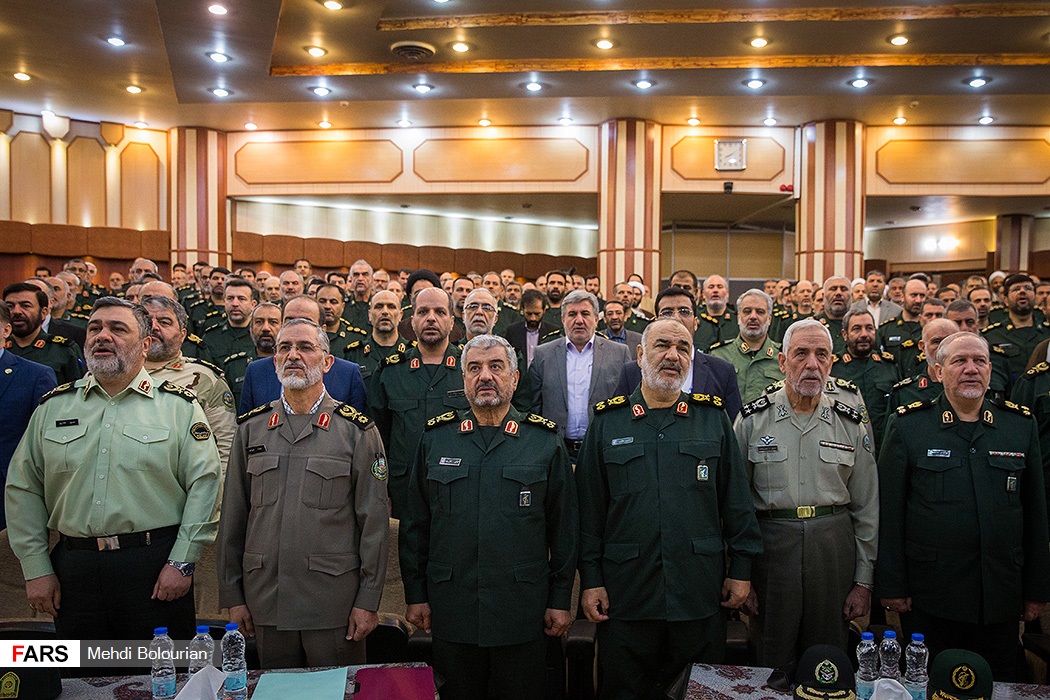
Three men control Iranian state power as of April 7, 2026. All three are IRGC veterans. None holds elected office. The first is Ahmad Vahidi, the IRGC commander-in-chief, whom Ali Akbar Mousavi Khoeini — a former Iranian parliamentarian now at George Mason University — described to NBC News in unambiguous terms: “Vahidi is in charge of the country. Ghalibaf doesn’t have the strength to confront him.” The second is Mohammad Bagher Zolghadr, an IRGC figure whom Vahidi compelled President Pezeshkian to appoint as Secretary of the Supreme National Security Council on March 24, a move the Atalayar analyst Gustavo de Arístegui characterized as having been made “against his own dissatisfaction.” The third is Mohsen Reza’i, the wartime IRGC commander from 1980 to 1997, now serving as military adviser to Mojtaba — or more precisely, adviser to the security cordon around him.
Ali Alfoneh of the Arab Gulf States Institute described the resulting arrangement to NBC News as Iran transforming “into a military dictatorship.” The Foundation for Defense of Democracies, in an April 6 analysis titled “5 Men Now Running Iran,” reached a similar institutional conclusion. The Soufan Center’s March 26 assessment placed all three men in the hardliner camp opposed to any negotiated end to the conflict. De Arístegui, writing on April 6 for Atalayar, compressed the situation into a single judgment: “a dictatorial and mafia-style oligarchy in military uniform.”
The IRGC’s dominance is not implicit. Iran International reported in late March that Vahidi had personally blocked presidential appointments and declared that “all critical and sensitive government positions must be selected and overseen directly by the IRGC.” Two senior Iranian sources told the Times of Israel they feared “the IRGC’s domination of the system would further transform the Islamic Republic into a military state with only a thin veneer of religious legitimacy.” One of those sources drew a comparison to the late Ali Khamenei, noting he “had been able to rein in the IRGC, balancing its views against those of political and clerical elites. But the IRGC may now get the final say in major decisions in the future.” That future arrived weeks ago.
Why Can’t the SNSC Simply Issue a Ceasefire Order?
Article 176 of the Iranian constitution states that the Supreme National Security Council determines national security policy “within the framework of general policies stipulated by the supreme leader.” It adds an operative clause that every diplomat working the Iran file tonight has memorized: all SNSC decisions are only “effective after the confirmation by the Supreme Leader.” The Iran Chamber Society’s published constitutional text and the US Institute of Peace’s Iran Primer both cite this provision as the mechanism that gives the supreme leader a veto — and a ratification function — over every national security decision the state makes.
Tonight, that mechanism is broken. Mojtaba Khamenei is in Qom, unconscious by the assessment of US and Israeli intelligence relayed to Gulf allies. The IRGC’s “military council” has, according to Times of Israel sources citing Iran International, established a strict security cordon around him, restricting access to government reports and blocking all communication between the supreme leader and the civilian leadership, including President Pezeshkian. Even if Pezeshkian and his foreign ministry negotiated a ceasefire tonight — even if mediators in Pakistan, Egypt, or Turkey produced a text all parties signed — the document would lack the constitutional confirmation that Article 176 requires.
This is not a theoretical problem. It means a ceasefire signed tonight would be, under Iran’s own legal framework, constitutionally unconfirmed. Vahidi could comply with it or not. Zolghadr could present it to the SNSC or not. No civilian institution has the authority to compel either man to do anything, because the one office that does — the supreme leader — is occupied by a man who cannot exercise it.
Has Anyone Tried to Impose Civilian Control on Vahidi?
President Masoud Pezeshkian has tried. Iran International reported in late March that he privately warned IRGC commanders that without a ceasefire, Iran’s economy faces “total collapse in three to four weeks.” The warning was delivered before the Zolghadr appointment — before, that is, Vahidi demonstrated that the president’s policy preferences were irrelevant to IRGC personnel decisions. Pezeshkian issued the March 24 decree appointing Zolghadr to the SNSC under what de Arístegui described as duress. The decree carried the president’s signature and the IRGC’s preferences. It was a capitulation documented in the language of administrative routine.
The IRGC’s institutional capture did not begin on February 28. It accelerated. Iran International reported that on the day of the airstrike itself, IRGC commanders attempted to appoint a new supreme leader, bypassing the Assembly of Experts entirely — a move that would have eliminated even the procedural veneer of clerical authority. They reverted under pressure, but the instinct was recorded: the IRGC’s first reaction to the decapitation strike was to claim the supreme leader’s chair for itself. Iran’s April 6 rejection of Trump’s Hormuz deadline confirmed the same dynamic — the authorization ceiling is Vahidi, and Vahidi has no public interest in a deal.
Kaitlyn Hashem of the Stimson Center observed on March 26 that Israel’s assassination campaign has led to the promotion of “IRGC old-timers who are likely to prove more hostile to the U.S. and less nimble in negotiating an end to the war.” This is the structural irony of the decapitation strategy: every commander killed is replaced by someone older, more ideological, and less susceptible to diplomatic pressure. Vahidi, Zolghadr, and Reza’i are not products of the post-2015 JCPOA diplomatic ecosystem. They are products of the 1980s war with Iraq, the 1990s Hezbollah build-out, and the 2000s nuclear standoff. Their professional formation occurred in an era when Iran’s negotiating position was that it did not negotiate.
| Position | Name | IRGC Background | Ceasefire Stance |
|---|---|---|---|
| Supreme Leader (incapacitated) | Mojtaba Khamenei | Non-military; served as Vakil of the Office of the Supreme Leader, 2008-2026 | No verified position since March 9 |
| IRGC Commander-in-Chief | Ahmad Vahidi | Career IRGC; Interpol Red Notice (Argentina, AMIA bombing) | Opposed — blocked civilian appointments, rejected presidential authority |
| SNSC Secretary | Mohammad Bagher Zolghadr | IRGC veteran; US-sanctioned; appointed under duress March 24 | Opposed — installed by Vahidi over Pezeshkian’s objection |
| Military Adviser to Supreme Leader | Mohsen Reza’i | IRGC Commander, 1980-1997; Iran-Iraq War | Assessed hardliner — Soufan Center, March 26 |
| President (civilian, marginalized) | Masoud Pezeshkian | None — reformist physician | Warned of economic collapse in 3-4 weeks without ceasefire |
The 1989 Precedent That No Longer Applies
When Ayatollah Ruhollah Khomeini died on June 3, 1989, the transition — while internally contested — produced a functioning civilian-clerical command structure within hours. President Ali Akbar Hashemi Rafsanjani and the incoming Supreme Leader Ali Khamenei managed the succession through the Assembly of Experts. The Washington Institute’s analysis of that transition notes that the then-IRGC Commander, Mohsen Reza’i, had been instructed by Khomeini to merge the IRGC with the regular Iranian army — a command the IRGC resisted but that illustrated the principle: the supreme leader gave orders, and the IRGC, however reluctantly, acknowledged that authority.
The Washington Institute’s “Supreme Succession” assessment draws the contrast explicitly: “Unlike in 1989, the Revolutionary Guards and other powerful Iranian institutions will probably play an outsize role in determining and influencing the next Supreme Leader.” The 1989 model assumed a functioning supreme leader who could issue directives and a clerical establishment that retained independent institutional weight. In 2026, the supreme leader is unconscious. The clerical establishment’s role was reduced to ratifying the IRGC’s preferred candidate under the same psychological and political pressure Iran International documented at the time of the appointment. The same Mohsen Reza’i who was the subordinated IRGC commander in 1989 is now the senior military adviser to the figure nominally above the entire command structure — a figure who cannot speak, cannot appear, and cannot confirm any SNSC decision under Article 176.
The structural inversion is complete. In 1989, civilian authority directed military power. In 2026, military power has absorbed civilian authority. The difference is not one of degree.
Iran’s Five Conditions and the Structural Impossibility of Phase One
On March 25, a “senior political-security official” told PressTV that Iran had set five conditions for ending the war: a complete halt to aggression, concrete prevention mechanisms, reparations, the end of hostilities across all regional fronts, and recognition of Iranian sovereignty over the Strait of Hormuz. The official added: “Iran will end the war when it decides to do so and when its own conditions are met.” The fifth condition — Hormuz sovereignty recognition — is the one that collapses the phased ceasefire architecture that mediators have been building since late March.
The Axios-reported 45-day ceasefire framework, sourced to four officials and backed by mediators Pakistan, Egypt, and Turkey, deferred Hormuz and Iran’s highly enriched uranium program to a second phase. Phase One was to be the ceasefire itself — a pause in hostilities to create space for a comprehensive deal. But Iran’s fifth condition makes Phase One contingent on a Phase Two outcome. If Hormuz sovereignty must be recognized before Iran ends the war, and Hormuz is a Phase Two agenda item, then Phase One cannot begin until Phase Two concludes. The framework is circular. The twice-aborted Vance mission illustrated the same dynamic: mediators building architecture on a foundation neither side has agreed to pour.
Trump called Iran’s counter-proposal “significant but not good enough” on April 6, according to CNN’s live coverage. The language was unusually restrained for a president who had, hours earlier, threatened to “decimate every bridge” and shut down “every power plant” in Iran — escalatory rhetoric from his Power Plant Day and Bridge Day announcement. The restraint may reflect intelligence awareness that there is no one on the other side capable of delivering a yes.
What Happens When Trump’s Deadline Expires Tonight?
The April 7, 8 p.m. ET deadline is the latest in a sequence Trump has imposed and then extended. The original deadline was March 23, and it has been shifted multiple times since, a pattern ABC News and Al Jazeera have both documented. Each extension has been accompanied by escalatory language — the bridge and power plant threats, the Easter Sunday Truth Social post — and followed by a period of ambiguity about whether the deadline was real. Tonight’s deadline arrives with the same structural question attached: does Trump enforce it, extend it again, or redefine it?
The enforcement problem is bilateral. On the American side, MBS privately urged Trump to send ground troops into Iran for regime change, according to reporting by the New York Times and the Washington Post — a request Trump has not acted on but has not foreclosed. On the Iranian side, enforcement runs into the command-authority gap: even if Vahidi wanted to accept a last-minute deal — and every assessment from the Soufan Center, Stimson, and Atalayar suggests he does not — he would need to route it through an SNSC whose decisions require confirmation from a supreme leader who is, per The Times of London’s April 7 report, unable to be involved in any decision-making. Trump’s deadline expires into a constitutional void.
The deadline also expires into a military reality. Iran’s information warfare apparatus has claimed twelve US aircraft destroyed, against a verified toll closer to four enemy kills, six self-destroyed, and two-plus unconfirmed — a gap that NewsGuard documented as part of a broader campaign it catalogued as “50 Lies in 25 Days.” CENTCOM has issued six formal denials. The IRGC’s investment in the narrative of American losses makes any ceasefire concession harder to sell internally: a force that has told its population it is winning the air war cannot easily explain why it has agreed to stop fighting.
The Ceasefire No One Can Verify
The structural problem is not who signs a ceasefire. It is who enforces compliance on the Iranian side after signature. In any arms-control or ceasefire framework, the signing authority must be able to compel subordinate units to comply. The supreme leader, under Iran’s constitutional design, is that authority — the principal who can impose costs on a military agent that defects from an agreement. Tonight, the principal is in a hospital bed in Qom, behind an IRGC security cordon that blocks communication with the civilian government.
The IRGC is therefore simultaneously the decision-making authority and the force that would need to comply with any ceasefire order. It is the issuer and the enforcer. There is no civilian institution capable of imposing compliance costs on the IRGC if it decides — unit by unit, commander by commander — to continue operations after a ceasefire is announced. The decentralized command autonomy that the IRGC has exercised throughout the war — firing missiles, directing proxy operations, managing the Hormuz transit-fee system — does not require central authorization. It can continue without one. Saudi Arabia has been named co-guarantor of a ceasefire it cannot neutrally enforce; now the other guarantor — the Iranian state itself — cannot enforce one either.
De Arístegui’s Atalayar assessment on April 6 put the conclusion plainly: “the only figure who can authorise an agreement — Vahidi — has no public interest in one.” Mousavi Khoeini, the former parliamentarian, told NBC News that “the power is in the hands of the Revolutionary Guard and the most radical faction of the Revolutionary Guard.” The Stimson Center’s Hashem noted that the commanders now in charge are “less nimble in negotiating an end to the war” — a diplomatic way of saying they were not selected for their diplomatic skills.
The senior Iranian sources who spoke to the Times of Israel feared exactly this outcome: a system in which the IRGC “get the final say in major decisions” without the balancing influence of clerical or civilian elites. That balancing influence required a functioning supreme leader. Iran does not have one. What it has is a janbaz — wounded in the service of the revolution, silent for twenty-nine days, and constitutionally required to confirm every national security decision the state makes. The clock runs out tonight at 8 p.m. Eastern. The confirmation will not come.
When Iran’s SNSC did issue its ceasefire halt order on April 7 — crediting Khamenei’s “guidance” while simultaneously declaring the war was not over — the same authorization gap identified here made that halt order structurally unenforceable: a command issued in the name of a leader who has not appeared, directed at 31 provincial IRGC corps whose decentralized autonomy was built to survive exactly this kind of leadership vacuum.
Frequently Asked Questions
Is Mojtaba Khamenei still legally the Supreme Leader of Iran?
Yes. The Assembly of Experts appointed him on March 9, 2026, and no body has revoked the appointment. Under the Iranian constitution, only the Assembly of Experts can remove a supreme leader, and only for incapacity assessed by a panel of judges and physicians — a process that has never been initiated in the Islamic Republic’s history. The IRGC’s security cordon around Mojtaba means the Assembly cannot independently verify his condition, creating a paradox: the body empowered to assess incapacity cannot access the person it would need to assess. The Washington Institute’s “Supreme Succession” analysis noted that the IRGC’s role in managing the succession has no constitutional basis — it was an extralegal intervention that produced a legally recognized outcome.
Could Iran’s parliament or judiciary override the IRGC and negotiate a ceasefire independently?
Not under the current constitutional structure. The Majlis (parliament) has no war-powers authority equivalent to the US Congress; national security decisions are constitutionally routed through the SNSC, now controlled by Zolghadr. The judiciary, led by the head of the judicial branch, has no security mandate. Speaker Ghalibaf — whom Mousavi Khoeini assessed as lacking “the strength to confront” Vahidi — has made no public attempt to assert legislative authority over the war. Iran’s Guardian Council, which vets legislation for constitutional compliance, is itself subject to supreme leader authority and has issued no public statement on the command-authority question since February 28.
What is the IRGC’s legal basis for controlling access to the Supreme Leader?
There is none in the written constitution. Article 110 vests command of the armed forces in the supreme leader; Article 176 requires his confirmation of SNSC decisions. Neither article grants any military body authority to restrict access to the supreme leader or control the flow of information to his office. The IRGC’s security cordon is, in constitutional terms, an extralegal measure that the regime has not publicly acknowledged or justified. Iran International’s reporting characterized it as a “military council” arrangement, a term with no Iranian constitutional definition. The precedent it most closely resembles is not Iranian but Soviet — the Politburo management of ailing General Secretaries Brezhnev, Andropov, and Chernenko in 1982-85, where the defense and security apparatus managed public perception of leaders who could no longer govern.
Has the IRGC ever defied a Supreme Leader’s direct order?
In 1989, Mohsen Reza’i resisted Khomeini’s directive to merge the IRGC with the regular Iranian army — a command the Washington Institute documented as having been issued directly by Khomeini before his death. The IRGC delayed and ultimately avoided full implementation. In 1988, Reza’i wrote to Khomeini opposing acceptance of UN Resolution 598, which ended the Iran-Iraq War, arguing the IRGC could continue fighting; Khomeini overruled him and accepted the resolution in what he called “drinking the cup of poison.” In both cases, a living, functioning supreme leader was able to impose his will, however reluctantly. The 2026 configuration removes that possibility. No one can force Vahidi to drink anything.
What happens if Trump enforces his deadline and Iran has no one authorized to negotiate a halt?
The military escalation continues without a diplomatic off-ramp on the Iranian side. Trump has threatened to “decimate every bridge” and target “every power plant” — language Al Jazeera and ABC News reported on April 7. If those strikes proceed, the IRGC’s response would be determined by the same three-man command structure — Vahidi, Zolghadr, Reza’i — that has rejected every ceasefire proposal to date. Pezeshkian has already warned of economic collapse without a ceasefire; that warning has not altered IRGC behavior. The command structure now running Iran was assessed by every major security institute as opposed to any negotiated end — not because of miscalculation, but because these men were not selected for their willingness to negotiate. The deadline may expire, but the command gap that makes diplomacy structurally impossible will remain after it does. On April 7, Brigadier General Zolfaqari formalized this operational reality by issuing the IRGC’s pre-deadline retaliation commitment through the Khatam al-Anbiya headquarters — removing all restraint on Gulf energy targeting and converting the IRGC’s autonomous command structure into a public, irreversible doctrine. That decentralized autonomy produced its first confirmed post-ceasefire outcome on April 8, when IRGC drones struck Kuwait’s Mina Al Ahmadi refinery and desalination plants hours after the halt order was issued. The Kuwait April 8 strikes are documented here. The on-record presidential confirmation of that command gap — Pezeshkian’s April 4 confrontation with Taeb in which he accused Vahidi and Abdollahi of wrecking the ceasefire — and the constitutional framework that permitted it are analyzed here.