
ABU DHABI — The consensus framing of the Saudi-UAE relationship in May 2026 treats the two countries as allies under strain — a partnership stressed by war, tested by divergent threat assessments, and complicated by the usual Gulf rivalries over quotas and influence. The consensus framing is inadequate. What the United Arab Emirates is executing is not a drift, a recalibration, or a temporary divergence born of wartime disagreement. It is a parallel-state strategy: a systematic construction of redundant institutions, bilateral defense architecture, and energy infrastructure designed to perform every strategic function Saudi Arabia performs — production, projection, partnership with Washington — at lower cost, with fewer vulnerabilities, and without the Hormuz dependency that has trapped Riyadh in a fiscal and strategic crisis it cannot resolve.
The evidence is sequential and compounding. On April 27, Anwar Gargash, the UAE President’s diplomatic adviser, publicly declared the GCC’s collective response to Iranian aggression “the weakest in history.” Four days later, on May 1, the UAE exited OPEC and OPEC+ — ending 58 years of membership and removing 14 percent of former OPEC capacity from any quota discipline. On May 20, an Emirati official statement framed the UAE’s security posture alongside “regional and international partners” — a phrase that runs parallel to the GCC, not inside it. Between those dates, ADNOC confirmed that construction on a second West-East pipeline — one that will substantially expand Fujairah export capacity and reduce the UAE’s Hormuz dependency by 2027 — is 50 percent complete and accelerating because of the war.
None of these moves are bilateral complaints. They are structural exits from shared institutions, executed during the quarter in which Saudi Arabia posted a fiscal deficit equal to 194 percent of its full-year target, PIF cash reserves hit a six-year low of $15 billion, and Riyadh’s own pipeline bypass capacity remained maxed out at 7 million barrels per day against a 9-to-10 million bpd export requirement that makes the Strait of Hormuz permanently necessary. The UAE is not breaking with Saudi Arabia because of the war. It is using the war — and the fiscal, infrastructural, and diplomatic weaknesses the war has exposed — to build the case that Washington’s Gulf anchor should be Abu Dhabi, not Riyadh. And the structural problem for Mohammed bin Salman is that he cannot rebuke the strategy without confirming the weakness it exploits.
Table of Contents
- What Did the UAE Signal on May 20?
- Fifty-Eight Years of OPEC Membership Ended in a Sentence
- Why Is Abu Dhabi Moving During Saudi Arabia’s Weakest Quarter?
- The Pipeline Asymmetry Washington Can Read
- How Did the UAE Become Washington’s “Major Defense Partner” While Saudi Arabia Did Not?
- The Bloomberg Call: MBZ Asked, MBS Said No, Washington Watched
- What Does “Weakest in History” Mean When the Speaker Leaves Four Days Later?
- The Response MBS Cannot Give
- FAQ
What Did the UAE Signal on May 20?
On May 20, an Emirati official statement described UAE security coordination with “member states of the Gulf Co-operation Council, alongside regional and international partners.” The phrase places the GCC as one input among several, running alongside — not containing — the UAE’s bilateral relationships with Washington, Tel Aviv, and New Delhi. This is diplomatic architecture, not diplomatic language.
The statement was not a press conference remark or an off-the-cuff formulation. It was an official release distributed through state media, which in the UAE means it was reviewed by the Ministry of Presidential Affairs before publication. The word “partners” — unmodified, unspecified — is doing the structural work. In GCC diplomatic convention, the bloc is the primary frame: member states coordinate “within the GCC framework” or “through the GCC.” The May 20 formulation inverts this hierarchy. The GCC is listed first but treated as one venue among several for security consultation, placed alongside unnamed regional and international partners that almost certainly include Israel and may include India.
The Middle East briefing 3,000+ readers start their day with.
One email. Every weekday morning. Free.
This matters because of who is reading it. Michael Ratney, the former US Ambassador to Saudi Arabia now at CSIS, wrote in March 2026 that Riyadh believes the UAE refuses to accept the dominant role Saudi Arabia has “always” played in anchoring the Gulf monarchies — and believes it always will play that role. The May 20 statement is Abu Dhabi’s answer: it does not reject Saudi Arabia’s self-image directly, but it builds an alternative frame in which that self-image is irrelevant to operational security. The GCC exists; the UAE participates; but the GCC is not the ceiling of Abu Dhabi’s security relationships, and the “partners” who sit alongside it are the ones writing the operational architecture for a post-Hormuz Gulf.
The timing is also a signal. May 20 was the same day Saudi Foreign Minister Prince Faisal bin Farhan publicly endorsed President Trump’s decision to cancel a planned strike on Iran — confirming Riyadh’s accommodationist posture toward the government that had launched approximately 2,800 to 3,000 missiles and drones at Emirati targets, according to the Soufan Center’s May 14 IntelBrief. The UAE released its “partners” framing on the day Riyadh praised restraint, creating a single-day contrast visible to every embassy in Washington: Saudi Arabia choosing accommodation, the UAE signaling that its security architecture extends beyond any institution Riyadh anchors.
Fifty-Eight Years of OPEC Membership Ended in a Sentence
The UAE’s withdrawal from OPEC and OPEC+ on May 1 was announced with the bureaucratic brevity of a country that had already made the decision months earlier. What ended was not merely a quota arrangement but a 58-year institutional relationship — the longest-standing formal economic coordination mechanism between Gulf Arab producers, and the one in which Saudi Arabia held unquestioned dominance as swing producer and de facto cartel leader.
The numbers exposed by the exit are stark. The UAE’s final OPEC+ quota sat just under 3.5 million barrels per day. ADNOC’s stated maximum sustainable capacity is 4.85 million bpd, with a target of 5 million bpd by 2027 following a $150 billion spending program. The gap between what OPEC allowed the UAE to produce and what the UAE can produce is at least 1.35 million bpd — capacity that Abu Dhabi will now deploy to market price signals without Saudi consent, Saudi coordination, or Saudi veto. Cinzia Bianco, a visiting fellow at the European Council on Foreign Relations, described the exit as “the latest expression of a strategic shift accelerated by the Iran war, as Abu Dhabi has spent years pursuing geopolitical and geoeconomic influence on its own terms and is now increasingly unbound by Arab and Muslim consensus politics or inherited institutions such as OPEC.”
The first OPEC+ meeting without UAE participation took place on May 3 — two days after the exit — and approved 188,000 barrels per day in additional voluntary output increases. It was the first formal cartel decision in 58 years made without UAE input, and it unfolded in a market where Saudi Arabia, as the remaining dominant producer, now faces the prospect of a former member flooding unconstrained barrels into an already-anxious environment. The EIA’s May 2026 Short-Term Energy Outlook projects Brent at $79 per barrel by 2027 as Middle East production normalizes — a price that House of Saud has already identified as structurally below Saudi Arabia’s IMF-estimated fiscal breakeven of $90 per barrel. Every unconstrained UAE barrel that reaches market at $79 widens Riyadh’s deficit.
The OPEC exit is not primarily an oil-market play. It is an institutional signal — the first time a GCC founding member has formally withdrawn from a multilateral economic institution in which Saudi Arabia held structural leadership. The GCC itself has no enforcement mechanism; OPEC was the closest thing the Gulf had to a binding economic coordination structure between its two largest producers. Removing the UAE from that structure strips away the institutional architecture that made Saudi Arabia’s economic dominance automatic rather than negotiated. Bianco’s assessment that “a decades-old Gulf order is fading, and another is taking shape” is not analytical hyperbole. It is a description of what happens when the bloc’s second-largest economy decides that the bloc’s rules cost more than independence.
Why Is Abu Dhabi Moving During Saudi Arabia’s Weakest Quarter?
Saudi Arabia’s Q1 2026 fiscal deficit of $33.5 billion consumed 194 percent of the full-year deficit target in three months. PIF cash reserves stand at approximately $15 billion — a six-year low representing just 1.6 percent of $912 billion in assets under management. The UAE’s parallel-state strategy is timed to the quarter when these numbers became public, and the sequencing is not coincidental.
The fiscal asymmetry between Saudi Arabia and the UAE has existed for years, but the war has converted a structural difference into a strategic vulnerability that Abu Dhabi can exploit in real time. Saudi Arabia’s Q1 deficit — documented in the context of PIF’s $7 billion wartime bond issuance — is not a temporary cash-flow mismatch. It reflects the compound pressure of Khurais’s 300,000 bpd offline capacity with no public restoration timeline, construction awards that collapsed from $71 billion in 2024 to $30 billion in 2025, and a Vision 2030 spending profile designed for $80-plus oil that now faces an EIA forward curve of $79 per barrel by 2027. Goldman Sachs projects the actual 2026 Saudi deficit at $80 to $90 billion — three to four times the official $27 billion budget target. PIF’s $7 billion bond sale, 3.4 times oversubscribed at a $23.8 billion orderbook, demonstrates that markets will still lend to Saudi Arabia — but at wartime spreads and on an implicit sovereign guarantee that Fitch’s “virtually certain” government-related entity designation makes explicit.
The UAE does not face comparable pressure. IMF April 2026 World Economic Outlook projections show UAE GDP growth at 5 percent in 2026 versus Saudi Arabia’s 4 percent, on a base where Abu Dhabi’s fiscal position is cushioned by ADIA’s estimated $900-plus billion in assets and a production cost structure among the lowest in the world. The UAE is not spending down reserves to sustain a transformation program financed at prices the market no longer supports; it is spending on capacity expansion that will generate returns at any oil price above $40 per barrel.
This is the structural context that converts the parallel-state strategy from a diplomatic repositioning into an economic argument addressed directly at Washington. One Gulf state is running a $33.5 billion quarterly deficit with pipeline capacity maxed out and Hormuz dependency unresolvable. The other has surplus capacity coming online, a Hormuz bypass pipeline at 50 percent completion, and a defense partnership designation that Saudi Arabia has never received. The comparison does not need to be articulated in diplomatic cables. The quarterly earnings calls articulate it. And Abu Dhabi’s strategic sequencing — Gargash’s speech on April 27, OPEC exit on May 1, the “partners” language on May 20 — ensures that each institutional departure arrives in Washington’s inbox during the weeks when Saudi Arabia’s fiscal exposure is most visible.
The Pipeline Asymmetry Washington Can Read
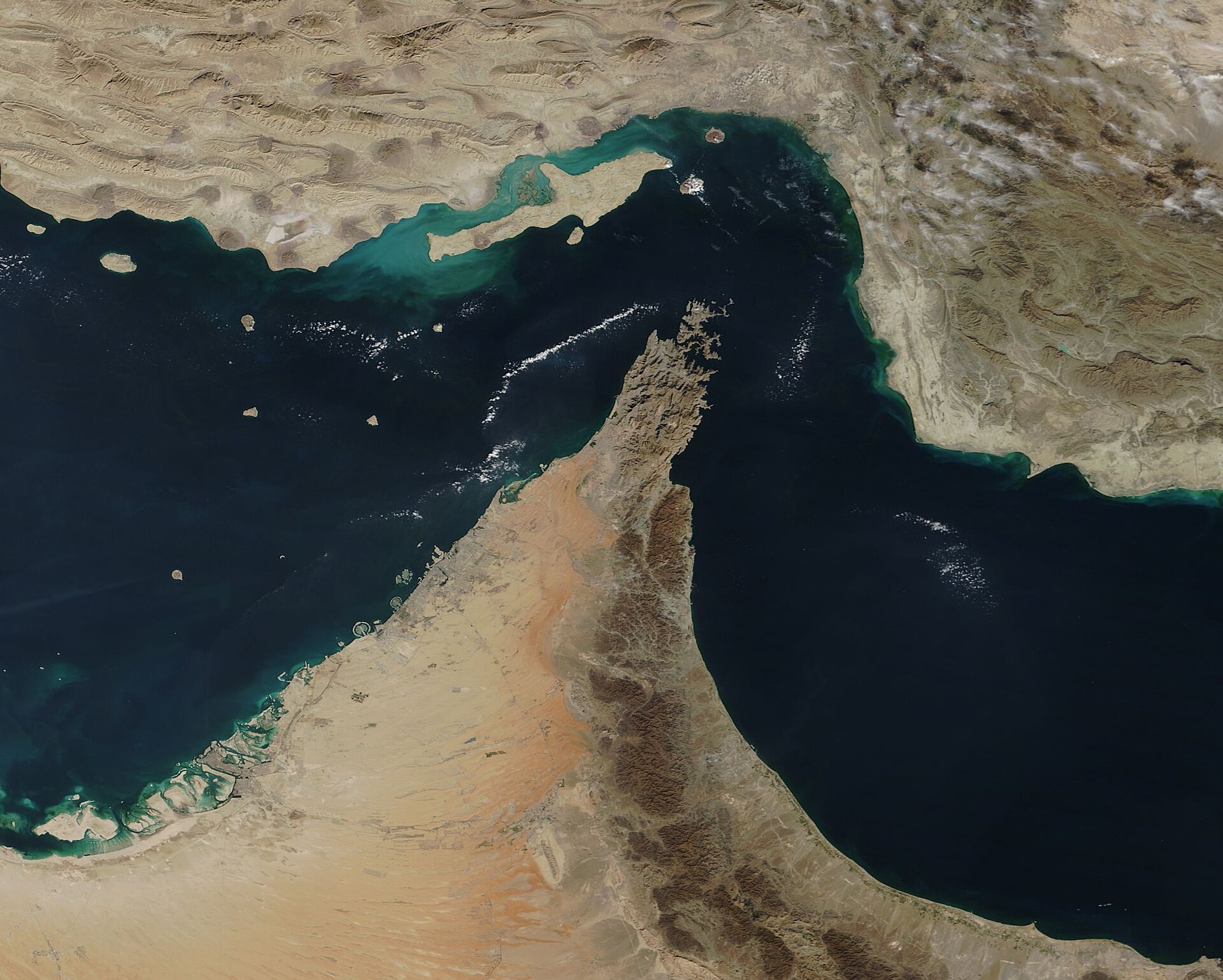
The physical infrastructure tells the story with fewer words than any diplomatic communiqué. Saudi Arabia’s East-West Pipeline — the Petroline system running from Abqaiq to Yanbu on the Red Sea — operates at its maximum capacity of 7 million barrels per day, per Aramco’s Q1 2026 disclosure. Saudi Arabia exports 9 to 10 million bpd. The arithmetic is permanent: even at full pipeline throughput, 2 to 3 million barrels per day must transit the Strait of Hormuz. There is no announced expansion. As long as the IRGC operates its permanent toll architecture at the strait, Saudi Arabia’s export infrastructure has a chokepoint that Abu Dhabi is engineering out of existence.
The UAE’s position is the structural mirror image. The existing Habshan-Fujairah pipeline — the Abu Dhabi Crude Oil Pipeline, or ADCOP — carries 1.8 million bpd from inland production to Fujairah on the Gulf of Oman, bypassing Hormuz entirely. ADNOC’s second West-East pipeline, confirmed at 50 percent completion by ADNOC’s CEO on May 20, will substantially expand Fujairah export capacity by 2027. Once operational, the UAE will have the infrastructure to route the overwhelming majority of its exports around Hormuz — a strategic asymmetry that Saudi Arabia, producing nearly twice as much, cannot replicate given a permanent 2-to-3-million-bpd exposure to the strait.
This asymmetry is legible to every defense planner and energy strategist in Washington, and the UAE has ensured it stays legible by accelerating pipeline construction in response to the war. The signal is not subtle: while Saudi Arabia remains structurally tethered to a chokepoint that Iran and Oman are writing governance rules for without Saudi participation, the UAE is building physical independence from the same chokepoint on a timeline that will be complete before Aramco’s CEO expects Hormuz normalization — which he placed, in a CNBC interview on May 11, at “until 2027.” The UAE’s pipeline will be finished before the strait reopens normally. Saudi Arabia’s dependency persists regardless.
For Washington, the pipeline comparison answers a question that no diplomatic communiqué needs to ask: which Gulf partner can guarantee oil exports reach market regardless of what Iran does at Hormuz? By 2027, the answer will clearly favor the UAE — and Abu Dhabi is making certain that every energy adviser in the National Security Council understands the timeline, the capacity figures, and the contrast.
How Did the UAE Become Washington’s “Major Defense Partner” While Saudi Arabia Did Not?
The United States designated the UAE a “Major Defense Partner” on September 23, 2024 — a status previously granted only to India, in 2016. A formal Letter of Intent was signed in May 2025 between the UAE Minister of State for Defense Affairs and US Secretary of Defense Pete Hegseth. Saudi Arabia has not received an equivalent designation, and RUSI explicitly frames this gap as a “strategic advantage” for Abu Dhabi over Riyadh.
The Major Defense Partner designation is not honorary. It unlocks streamlined defense trade, technology transfer, and integrated planning mechanisms that sit above standard Foreign Military Sales. The UAE is the only Middle Eastern country — and only the second country globally, after India — to hold this status. The May 2025 LOI established specific operational pillars: defense innovation through the Defense Innovation Unit and Tawazun Council, integrated air and missile defense architecture, and the Texas National Guard State Partnership Program. These are not aspirational frameworks written for summit communiqués. They are integration mechanisms with budgets, timelines, and operational staff.
RUSI’s October 2024 commentary, titled “Defence and Connectivity: The UAE Becomes Washington’s Super Ally,” stated the designation “reinforces the Emirati strategic advantage over Saudi Arabia, since the Israel–Hamas war and regional instability have slowed — and in some cases stopped — both Riyadh’s regional strategy (including its diplomatic normalisation with Israel) and its pursuit of its international goals (such as a new defence pact with the US).” The Foundation for Defense of Democracies reinforced this assessment in February 2026, describing the UAE as “the most operationally competent Arab ally the United States has and is consistently aligned with U.S. and Israeli interests,” while noting that Saudi Arabia “must tone down its posturing against Israel while enjoying U.S. security guarantees, and Riyadh does not acquire F-35 planes unconditionally.”
The MDP designation predates the Iran war by five months. The war has converted a bilateral defense achievement into a structural positioning advantage that compounds monthly. Iran targeted the UAE with approximately 2,800 to 3,000 missiles and drones — according to the Soufan Center’s May 14 IntelBrief, more than any other country in the region, including Israel. The Soufan Center noted that this disproportionate targeting “has driven the UAE into a close partnership with the U.S. and Israel” rather than deterring it. Tehran’s calculus — that punishing the Abraham Accords signatory would fracture UAE-US-Israel convergence — produced the opposite result. The UAE absorbed the heaviest missile campaign in the modern Middle East, accelerated defense integration, and emerged with a partnership architecture that Saudi Arabia cannot replicate: Riyadh has not normalized with Israel, has not sought MDP status, and has chosen an accommodationist posture toward the same Iran targeting Abu Dhabi.
The Jewish Institute for National Security of America captured the trajectory in its 2026 assessment “The Emirati Moment,” describing the UAE as having “evolved from a commercially oriented federation of city-states into a regional power with an interventionist agenda, an ideological project, and a vision for regional order that culminated in the Abraham Accords in 2020.” The Iran war did not create this evolution. It stress-tested it under fire — and the UAE passed while Saudi Arabia’s alternative approach left Riyadh without the defense designation, without the bilateral architecture, and without the ability to guarantee its own export infrastructure through a strait it does not control.
The Bloomberg Call: MBZ Asked, MBS Said No, Washington Watched
Bloomberg reported on May 15 that Mohammed bin Zayed held a series of calls with Mohammed bin Salman and other Gulf leaders shortly after the US-Israeli bombing of Iran began on February 28. MBZ’s message was direct: the Gulf states needed to coordinate a collective military response to deter Iran. Bloomberg reported that the Trump administration “was aware of the UAE-led Gulf deliberations and wanted the Saudis and Qataris to join a coordinated military response.” Saudi Arabia and Qatar refused. Saudi Arabia’s refusal coincided with the PSAB suspension that grounded 43 US aircraft — and a subsequent Trump-MBS call restored access on terms that remain undisclosed; the undisclosed terms of the second call are the missing variable in any accounting of what Riyadh conceded or extracted from Washington during that week.
The refusal itself was a strategic choice with defensible logic — House of Saud covered the calculus in its analysis of why MBS, MBZ, and the Emir of Qatar stopped a strike they might need later. The threat of Iranian retaliation against Saudi oil infrastructure, the Hajj calendar constraint, and the fiscal impossibility of absorbing further production disruptions all argued for restraint. But the Bloomberg reporting reveals something the refusal’s defenders have not addressed: the call happened with full US visibility. Washington did not observe the Saudi-UAE divergence after the fact; it watched in real time as the UAE proposed collective action, Saudi Arabia declined, and Abu Dhabi proceeded to pursue bilateral defense coordination with the United States and Israel without Gulf partners. Every subsequent element of the parallel-state strategy — the MDP Letter of Intent implementation, the OPEC exit, the pipeline acceleration — unfolds in the context of a US administration that watched Saudi Arabia say no to coordinated defense and the UAE say yes to bilateral alternatives.
The Soufan Center’s IntelBrief, published the day before Bloomberg’s account, framed the divergence in terms that track the parallel-state thesis directly: “The Iran war has widened differences between Saudi Arabia, which favors accommodation with Iran and Iran-backed regional actors, and the United Arab Emirates, which believes military confrontation with Iran and its allies can produce transformative change.” This is not a disagreement about tactics within a shared strategic framework. It is a fundamental split about whether Iran is a country to be managed through diplomacy or a threat to be confronted through force — and the UAE has positioned itself on the side of that question that Washington, under this administration, occupies. The Bloomberg call is the moment the parallel-state strategy became visible to the one audience that matters most. Abu Dhabi asked the question, Riyadh answered it, and the Pentagon recorded both.
What Does “Weakest in History” Mean When the Speaker Leaves Four Days Later?
Anwar Gargash declared the GCC’s collective response to Iranian attacks “the weakest in history” at the Gulf Influencers Forum on April 27 — four days before the UAE exited OPEC. The sequencing transforms a critique into an exit statement: Gargash diagnosed the institution’s failure publicly, then the UAE withdrew from its most binding shared economic mechanism. Diagnosis preceded departure by design, not coincidence.
Gargash’s remarks were the most senior public critique of GCC collective security by any member-state official in the organization’s 45-year history. He stated that Gulf states’ longtime policies of containment through diplomacy and trade “have failed miserably” and called for “comprehensive reassessment” — language that frames the GCC’s entire security model as not merely inadequate in this war but fundamentally misconceived as a doctrine. He also called for restoration of “Gulf unity and solidarity” while acknowledging it was “not at the level required by the challenges and events of today” — naming the deficit without proposing the GCC as the institution capable of filling it.
The four-day gap between the speech and the OPEC exit is the tell. Gargash did not speak in the aftermath of the exit to justify a decision that had already generated headlines. He spoke before it, to establish the rationale for what the foreign-policy community was about to witness. The audience in Washington, London, and Brussels heard the diagnosis — GCC security has failed, containment has failed, comprehensive reassessment is required — and then, four days later, watched the UAE act on the diagnosis by withdrawing from the institution where Saudi Arabia’s economic leadership was most formalized. The logic is never stated as a syllogism, but the timeline states it clearly enough for anyone reading the calendar.
Carnegie Endowment’s analysis of GCC dynamics during the war warned that conflict pressures can encourage “zero-sum thinking in the bloc’s two main economic powerhouses” — and the GDP concentration makes the zero-sum mathematics inescapable. Saudi Arabia holds approximately 50 percent of GCC GDP; the UAE holds approximately 38 percent on a PPP-adjusted basis, per Carnegie’s own estimate. Together, they account for roughly 88 percent of GCC economic weight. When Britain signed a trade deal with the GCC on May 20, it signed with a bloc whose two dominant economies are operating on divergent strategic trajectories, incompatible threat assessments, and — since May 1 — different institutional memberships in the organization that historically coordinated their production. The GCC as an economic entity requires Saudi-UAE coherence to function as more than a letterhead. That coherence no longer exists, and Gargash made certain that its absence was narrated — publicly, by name, four days before the structural evidence arrived.
The Response MBS Cannot Give
The structural trap facing Mohammed bin Salman is that every plausible response to the UAE’s parallel-state strategy validates the strategy’s premise. If Riyadh publicly criticizes Abu Dhabi’s OPEC exit, it confirms that Saudi Arabia’s cartel leadership depends on members who stay voluntarily — and that the UAE’s departure matters precisely because Saudi Arabia cannot replace the production discipline unilaterally. If MBS confronts the “partners” language, he draws attention to the fact that the UAE’s bilateral relationships with Washington and Tel Aviv now run parallel to the GCC framework rather than through it. If Saudi Arabia seeks its own Major Defense Partner designation, it must normalize with Israel — the precondition the UAE met in 2020 and the one Riyadh has repeatedly declined, most recently after the October 7 collapse of the 2023 Saudi-US-Israel framework. And if MBS simply ignores the divergence, he cedes the narrative to Abu Dhabi, which is already writing the story of a Gulf order in which Saudi Arabia’s structural dominance is a legacy arrangement rather than an operational reality.
Ratney at CSIS captured the psychological dimension with precision: “The Saudis believe the UAE does not accept the dominant role Saudi Arabia has historically played — indeed, always will play — in anchoring a stable system of Arabian monarchies.” The qualifier “always will play” reveals the assumption the UAE’s strategy is designed to erode. Saudi Arabia’s self-conception includes permanence — the idea that its size, its custodianship of the Two Holy Mosques, its oil reserves, and its population make Gulf primacy a structural fact rather than a contingent arrangement requiring renewal. The UAE’s parallel-state strategy does not contest any of those underlying facts. It simply builds an alternative structure in which those facts are irrelevant to the question Washington is actually asking: which Gulf state can deliver security cooperation, energy reliability, and institutional alignment without the fiscal, infrastructural, and diplomatic vulnerabilities that the war has exposed?
A December 30, 2025 Saudi airstrike on a UAE-backed Southern Transitional Council weapons shipment in Yemen demonstrated that Riyadh is not passive in the face of Emirati positioning. Kinetic responses in the Yemeni theater are tactical instruments applied to a tactical problem. The UAE’s strategy is institutional, fiscal, and infrastructural — operating on timelines and in domains where airstrikes are not a relevant counter. Abu Dhabi is not contesting Saudi Arabia’s ability to project military force. It is contesting the structural assumptions that make Saudi Arabia the default Gulf anchor for American strategy, and it is doing so during the precise quarter when those assumptions are most visibly strained by numbers Riyadh cannot hide and dependencies Riyadh cannot resolve.
The war did not cause this divergence. The roots trace back to the UAE’s unilateral 2019 troop withdrawal from Yemen, the Abraham Accords in 2020, and the quota disputes that simmered through 2021 and 2022. But the war — and the fiscal hemorrhage, the pipeline limitations, the Hormuz dependency, the failed collective-defense call, and the accommodationist diplomatic posture it has forced Saudi Arabia to adopt — gave the UAE the conditions under which a parallel-state strategy becomes not just plausible but legible to the audience that matters. Abu Dhabi is building the institutions, the infrastructure, and the bilateral architecture of an alternative Gulf anchor. Riyadh is watching it happen in real time. And the constraint that makes the trap complete is that acknowledging the construction confirms the need for it — while silence lets the construction continue uncontested. The quadrilateral alignment that IISS has identified may soon have a fifth dimension: not a new member, but a Gulf state that decided the old membership was no longer worth the dues.
The technology dimension of this divergence is increasingly concrete. While the UAE built G42 into a $1.5 billion enterprise AI company with US government security clearance and Microsoft backing, PIFâs HUMAIN has enlisted Goldman Sachs to raise SAR 20 billion (~$5.3 billion) in project financing for data centres and GPU chips â a direct answer to G42âs model, built on a Vision 2030 AI pivot that has contracted to a single defensible bet as megaprojects retreat.
Frequently Asked Questions
Could the UAE rejoin OPEC?
The OPEC Statute provides for readmission by majority vote of existing members, but historical precedent suggests exits are sticky: Qatar left in January 2019 and has shown no indication of returning after seven years. The UAE’s situation is structurally different from Qatar’s smaller-producer departure because Abu Dhabi’s $150 billion capacity expansion program was designed with post-OPEC economics. ADNOC’s return on that investment depends on producing at or near capacity — roughly 5 million bpd by 2027 — without quota constraints. Readmission would require accepting a quota below capacity, which would strand tens of billions in capital expenditure. The exit is not a negotiating position; it is the economic logic of the spending program catching up with the institutional membership that constrained it.
How does the rift affect GCC military interoperability?
The GCC maintains the Peninsula Shield Force, a joint military formation of approximately 40,000 troops headquartered at King Khalid Military City in Hafar al-Batin, Saudi Arabia. The force has been deployed only once in its 40-plus-year history — to Bahrain in 2011 during the Arab Spring protests — and has never been operationally tested against a state-level military threat. The UAE’s Major Defense Partner designation creates a parallel track: US-origin defense technology, intelligence-sharing protocols, and integrated air and missile defense planning that flow through bilateral UAE-US channels rather than GCC collective architecture. The May 2025 LOI’s integrated air and missile defense pillar specifically establishes bilateral interoperability standards that do not extend to GCC-level systems. The result is a two-tier Gulf defense architecture — one tier integrated with the US at the highest classification level, and a second that exists on paper at the GCC level but has never fired a shot in a real contingency.
Why can’t Saudi Arabia match the UAE’s defense partnership with Washington?
The Major Defense Partner designation and the bilateral architecture it enables were unlocked by a precondition Saudi Arabia has not met: normalization with Israel. The UAE’s Abraham Accords (2020) were the qualifying condition for MDP consideration and remain a foundational element of the UAE-US-Israel trilateral alignment that the Iran war has accelerated. Saudi Arabia’s path to equivalent status runs through normalization — but the 2023 Saudi-US-Israel framework collapsed after October 7 and has not been revived. Polling conducted within Saudi Arabia during the war period consistently registers deep public opposition to normalization with Israel during an active conflict involving Israeli military operations, creating a domestic political constraint that did not exist when MBS was negotiating the pre-October 7 framework. The defense partnership MBS needs to match Abu Dhabi’s positioning requires the normalization his domestic constituency would reject — a structural impossibility the UAE did not create but benefits from.
In the same period, MBS has continued signaling normalization readiness through private channels. Evangelical Trump ally Mike Evans reported that MBS said he would recognize Israel “today,” identifying King Salman as the sole obstacle — the dynastic constraint on Saudi-Israel normalization and how MBS may be using his father’s veto as cover.
Is the UAE’s parallel-state strategy vulnerable to an oil price collapse?
Abu Dhabi’s fiscal breakeven price is estimated by the IMF at roughly $50 to $55 per barrel — approximately $35 to $40 below Saudi Arabia’s breakeven of $90-plus. At $60 Brent, the UAE runs a manageable fiscal position while Saudi Arabia faces a deficit that would dwarf the current $33.5 billion quarterly figure. The deeper vulnerability is not price but timeline. The EIA and IEA both project that global oil demand growth decelerates after 2030 as electrification of transport and industry accelerates in major consuming economies. ADNOC’s 5-million-bpd target is a bet on the 2026-to-2035 window — the final decade of peak hydrocarbon demand — where unconstrained production at high volumes generates the capital base for a post-oil economic transition. If the demand inflection arrives earlier than projected, the UAE’s strategy of maximizing extraction becomes a race against a clock that also runs for Saudi Arabia but at a higher breakeven cost.
Has Saudi Arabia responded institutionally to the UAE’s OPEC exit?
Not publicly, and the silence is a strategic calculation. Saudi Energy Minister Prince Abdulaziz bin Salman — who personally managed the contentious quota negotiations with the UAE in 2021 — has made no public statement on the implications of the exit for OPEC production discipline or cartel coherence. Aramco’s Q1 2026 earnings call did not reference UAE production as a market variable. The kingdom’s public posture treats the exit as a sovereign decision by a member state with no structural consequences for OPEC’s ability to manage supply — a framing that becomes less tenable with every month that UAE production rises toward 5 million bpd outside any coordinating mechanism. Acknowledging the exit’s strategic weight would confirm that OPEC’s discipline depends on voluntary compliance by members who now have the option of producing without constraint, which would invite market pricing that assumes weaker cartel cohesion and push Brent closer to the $79 level that breaks Saudi Arabia’s fiscal math. Both the UAE and Saudi Arabia are accumulating structural advantages they cannot officially name: the gains Riyadh cannot name — wartime crude revenue, Red Sea corridor income, and non-oil resilience — each depend on conditions Riyadh publicly demands end, mirroring the same logic that forces Abu Dhabi to avoid labelling its own positioning as a strategic departure.