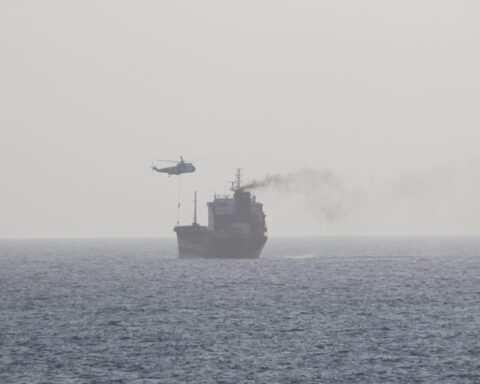
WASHINGTON — On April 12, 2026, Donald Trump posted a single word on Truth Social that sixty-four years of American maritime lawyers had spent their careers avoiding. He called the US Navy’s enforcement action at the Strait of Hormuz a “blockade” — the precise legal term that President Kennedy’s State Department counsellor warned him never to use during the Cuban Missile Crisis, because it would constitute an act of war and hand adversaries the legal standing to respond in kind. Trump used it anyway, without multilateral authorization, without coalition backing (the United Kingdom explicitly refused to participate), and during a nominal ceasefire that his own administration brokered five days earlier.
The consequence is not tactical but doctrinal. The US Freedom of Navigation program is built on the legal premise that transit passage through international straits cannot be restricted. By blockading the world’s most strategically consequential international strait, Washington has done to its own legal architecture what no adversary could: demonstrated that transit passage rights are conditional, enforceable by the powerful, and available for suspension when politically convenient. Every FON operation the US Navy runs from this point forward — in the South China Sea, the Taiwan Strait, the Black Sea — now carries an asterisk that Beijing, Moscow, and Tehran will cite for decades.
Contents
- What Did Abram Chayes Tell Kennedy in 1962?
- The Word Kennedy Refused and Trump Chose
- Five Legal Requirements, Zero Met
- How Does a Blockade Kill the FON Program?
- Beijing’s Precedent Machine
- What Does Saudi Arabia’s Silence Actually Cost?
- The Ally Who Walked Away
- Can You Blockade During a Ceasefire?
- Frequently Asked Questions
What Did Abram Chayes Tell Kennedy in 1962?
On September 10, 1962 — six weeks before US reconnaissance confirmed Soviet missiles in Cuba — State Department Legal Adviser Abram Chayes produced a memorandum that would shape the most dangerous thirteen days of the Cold War. The memo identified a straightforward problem: a naval blockade of Cuba would not be legally valid “because we are not in a state of war with Cuba.” Chayes was not offering an academic opinion; he was flagging a structural vulnerability. Dean Rusk had already told Congress that a blockade was an act of war, and Lyndon Johnson, then Senate Majority Leader, had said the same thing on the record. If Kennedy used the word “blockade,” the Soviet Union would have standing under international law to treat the US action as belligerent — and to respond accordingly.
When the ExComm convened on October 19, 1962 to decide how to respond to the Soviet missiles, Chayes proposed the term “defensive quarantine” as a legal substitute. The distinction was not cosmetic. A blockade under customary international law implies a state of war, requires formal declaration, and triggers belligerent rights for the blockading power — but also for the adversary. A quarantine, by contrast, was framed as a limited, defensive measure under the Rio Treaty and the OAS Charter, which allowed the US to secure multilateral authorization before enforcement began.
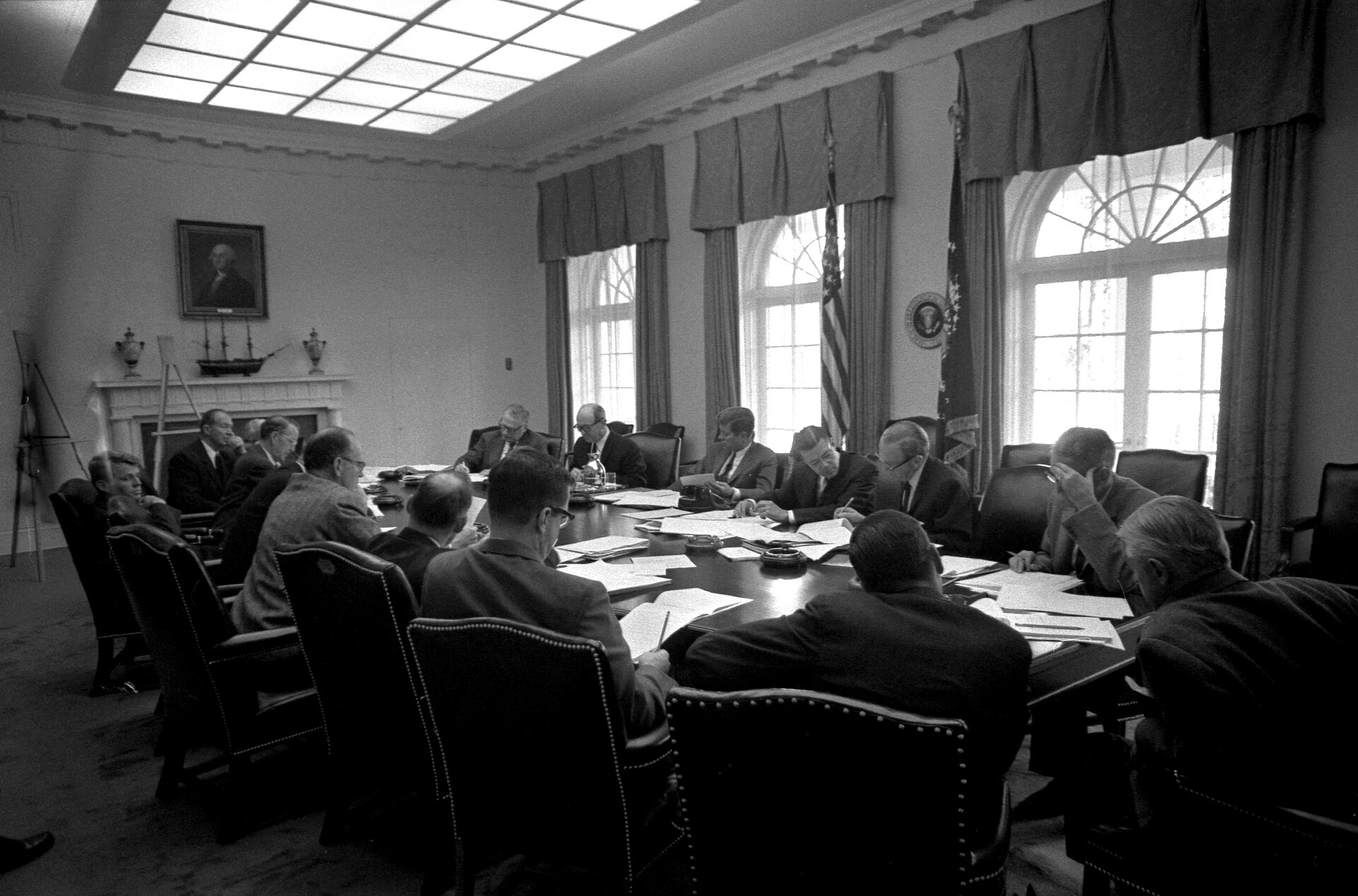
That authorization came on October 23, 1962, when the Organization of American States voted unanimously to support the quarantine. Robert Kennedy later described this vote as the legal turning point: “It was the vote of the Organization of American States that gave legal basis for the quarantine — changed our position from that of an outlaw acting in violation of international law into a country acting in accordance with twenty allies.” The OAS vote did not make the quarantine legal in any absolute sense — international law scholars have debated that for six decades — but it created a multilateral framework that deprived the Soviet Union of clean legal standing to escalate. Kennedy’s word discipline and Chayes’s legal architecture together produced an outcome where the US could enforce a maritime restriction without surrendering its broader legal position on freedom of navigation.
Trump’s April 12 declaration reversed every element of Kennedy’s approach. No word discipline, no multilateral authorization, no coalition of willing participants, no legal framework beyond a Truth Social post declaring the US Navy would block “any and all Ships trying to enter, or leave, the Strait of Hormuz.” CENTCOM subsequently narrowed the operational scope to Iranian ports and toll-paying vessels, but the presidential language was already on the record — and in international law, the declaratory statement of the head of state is what adversaries cite.
The Middle East briefing 3,000+ readers start their day with.
One email. Every weekday morning. Free.
The Word Kennedy Refused and Trump Chose
The gap between “quarantine” and “blockade” is not semantic — it is the distance between legal defensibility and legal self-destruction. Under customary international law, a blockade is an act of war. It triggers the law of naval warfare, activates belligerent rights for both sides, and exposes neutral states hosting the blockading power’s military assets to co-belligerent liability under frameworks like the San Remo Manual. A quarantine, as Chayes framed it in 1962, sidesteps these triggers by operating under a regional security framework (in Kennedy’s case, the OAS) rather than the law of armed conflict.
Kennedy understood this distinction because his lawyers told him and he listened. The ExComm transcripts show the legal discussion was not an afterthought bolted onto a military decision already made; it shaped the decision itself. When General Curtis LeMay pushed for airstrikes and dismissed the quarantine as weak, Kennedy and his advisers held firm — not because they were dovish, but because they recognized that the legal framing of the action would determine whether the Soviet Union could escalate with international support or would be forced to back down in isolation. The legal architecture was the strategy.
Trump’s use of “blockade” suggests either that no equivalent legal advice was sought, or that it was sought and ignored. The former is alarming; the latter is worse. Because the word is now embedded in a presidential declaration — amplified by every wire service, archived by every foreign ministry, parsed by every maritime law faculty on earth — and it cannot be unsaid. CENTCOM’s operational clarification, narrowing enforcement to Iranian-flagged vessels and ships paying Iran’s toll, does not alter the legal character of the presidential declaration. In international law, a state’s intent is judged by its highest authority’s public statements, not by subordinate operational adjustments.
Five Legal Requirements, Zero Met
A naval blockade under customary international law must satisfy five requirements to be considered lawful: formal declaration with notification to all affected states, specification of commencement date and geographic limits, effectiveness (the blockading force must be capable of actually enforcing the restriction), impartiality (neutral vessels heading to non-blockaded ports must not be interfered with), and proportionality to the military objective. Trump’s declaration fails all five in ways that are not marginal but categorical.
| Requirement | 1962 Cuba | 2026 Hormuz |
|---|---|---|
| Formal declaration with diplomatic notification | Presidential proclamation + OAS resolution + diplomatic notes to USSR | Truth Social post; no diplomatic notifications reported |
| Specified commencement and geographic limits | October 24, 10:00 AM EDT; 500-nautical-mile arc from Cuba | No specified start time; “Strait of Hormuz” (undefined boundaries) |
| Effectiveness | 183 US Navy ships enforced the quarantine zone | DDG-121 + DDG-112 transited April 11; carrier strike group present but Hormuz is 21 nautical miles wide with Iranian shore batteries on both sides |
| Impartiality toward neutral shipping | Only Soviet-flagged vessels carrying offensive weapons were stopped | CENTCOM carved out non-Iranian vessels — but Trump’s declaration said “any and all Ships” |
| Multilateral authorization | Unanimous OAS vote (October 23, 1962) | None. UK explicitly refused. No regional body consulted |
The impartiality problem is particularly acute. CENTCOM’s operational narrowing — targeting only Iranian-flagged vessels and ships that have paid Iran’s toll — creates a discriminatory blockade that distinguishes between vessels based on their commercial relationship with one party. Under the San Remo Manual’s codification of blockade law, a blockade that selectively targets vessels based on flag state or commercial activity is not a blockade at all; it is an interdiction, which carries a different and less defensible legal character. But because the president called it a “blockade,” the US is stuck with the legal consequences of the term the president chose, applied to an operation that does not meet the term’s own requirements.
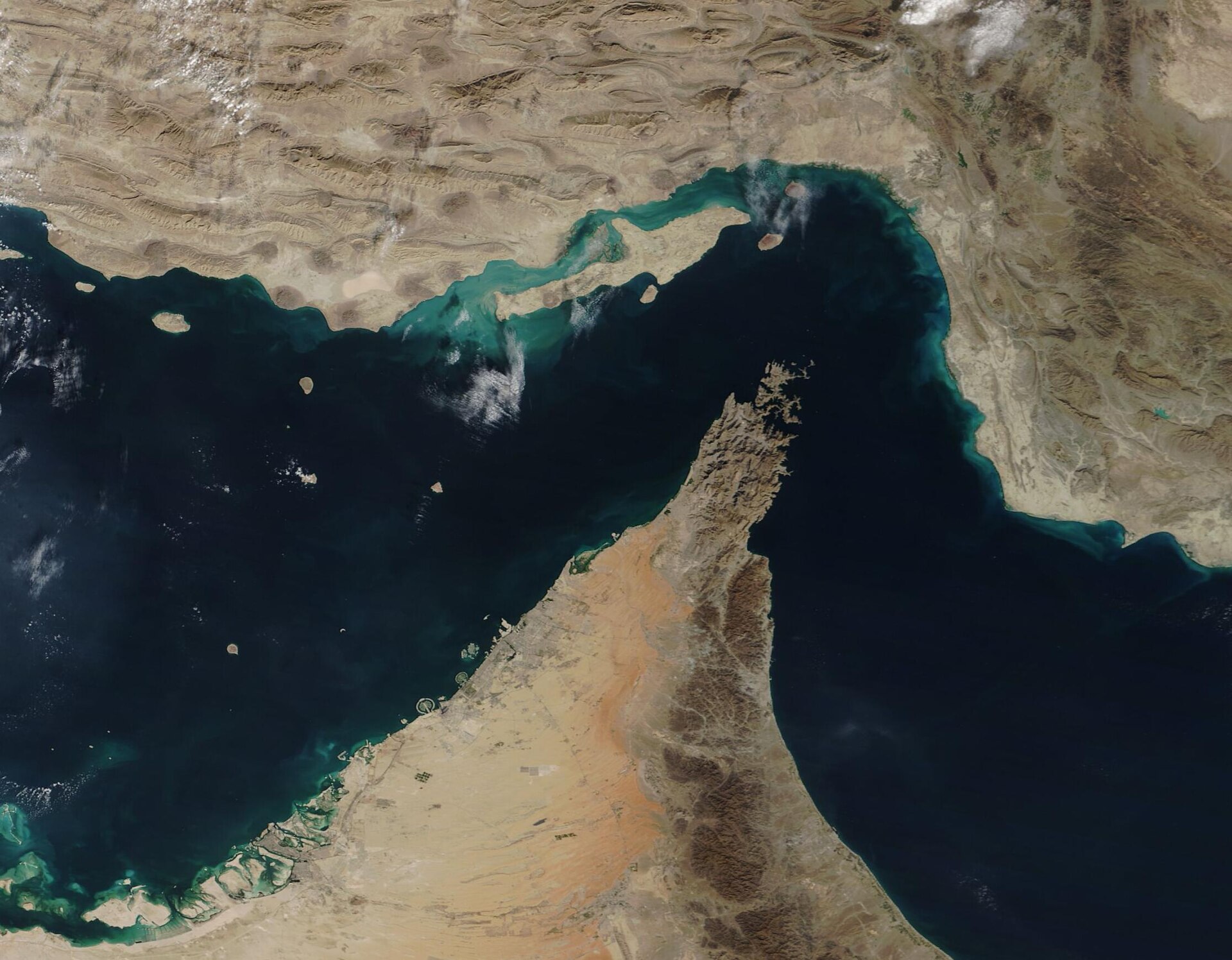
The effectiveness requirement presents its own problem. The Strait of Hormuz is twenty-one nautical miles wide at its narrowest point, with Iranian Revolutionary Guard Corps shore batteries, fast-attack craft, and mine-warfare capabilities on both flanks. The IRGC Navy declared “full authority to manage the Strait” on April 5 and again on April 10, and has turned back commercial vessels administratively since late March. A blockade that cannot prevent the adversary from simultaneously operating its own maritime control regime in the same waterway is not effective in the legal sense — it is a competing claim to authority, which is precisely the kind of contested jurisdiction that the law of the sea was designed to prevent.
How Does a Blockade Kill the FON Program?
The US Freedom of Navigation program is, at its core, a legal argument backed by warships. Since 1979, and formally since Reagan’s 1983 directive, the US Navy has conducted approximately thirty operational assertions per year — sailing through waters that coastal states claim as restricted, to demonstrate that the US does not recognize “excessive maritime claims.” The legal foundation for every one of those assertions is the principle that transit passage through international straits, as codified in UNCLOS Article 37, cannot be suspended, restricted, or conditioned by the coastal state. This is what the US tells China every time a destroyer sails within twelve nautical miles of an artificial island in the South China Sea. This is what the US tells Iran every time it invokes freedom of navigation in the Persian Gulf.
What the US has now done at Hormuz is impose exactly the kind of restriction on transit passage that the FON program exists to challenge. The blockade — by the president’s own word — restricts the passage of vessels through an international strait based on their flag state and commercial relationships, conditions that UNCLOS Article 37 explicitly prohibits. Legal analysts writing in Lawfare identified the structural contradiction before Trump even used the word: “The transit passage legal regime assumes uninterrupted navigation through international straits, while the law of naval warfare permits interference with shipping during armed conflict.” The US is now on both sides of that doctrinal gap simultaneously — enforcing a blockade at Hormuz while running FON operations elsewhere to assert that straits cannot be blockaded.
James Kraska, professor of international maritime law at the Naval War College, described the pre-blockade Hormuz situation as a “Legal Vortex” — a longstanding disagreement between the US and Iran about UNCLOS applicability that force alone could not resolve. Iran’s toll regime, which Kraska said violated “the rules of transit passage,” was already creating a doctrinal problem. But Iran’s violation of transit passage rights and the US violation of transit passage rights are not offsetting penalties. They are compounding erosions of the same legal architecture that benefits the US far more than it benefits Iran, because the US is the power that invokes transit passage rights globally, in dozens of straits and contested waters, as the legal basis for its naval posture.
The arithmetic is blunt. The US runs FON operations in the South China Sea, the Taiwan Strait, the Black Sea approaches, the East China Sea, and the Persian Gulf — in every one of those theaters, asserting that coastal states cannot restrict transit passage through international straits. In the South China Sea alone, the US conducted multiple island-intrusive FON operations in recent years. After Hormuz, the Chinese response to every one of those operations will include a single sentence: the US blockaded the Strait of Hormuz in April 2026, restricting transit passage through an international strait in violation of the same UNCLOS Article 37 it cites against us. That sentence is unanswerable, because it is factually accurate.
Beijing’s Precedent Machine
China receives approximately one-third of its oil through the Strait of Hormuz. Iran had already granted preferential transit to Chinese-destined shipments — along with Russian, Indian, Iraqi, and Pakistani vessels — as part of its selective enforcement regime announced on March 26. The US blockade, which intercepts toll-paying vessels, is therefore functionally targeting Chinese-destined energy supplies: not because the US intends to blockade China, but because the operational mechanics of interdicting Iran’s toll-collection system inevitably interfere with Chinese commercial shipping.
Beijing’s legal and diplomatic response has been precisely calibrated. At the April 7 UN Security Council vote on a Hormuz resolution, Chinese Ambassador Fu Cong said the draft “failed to capture the root causes and the full picture of the conflict” and warned that “adopting such a draft when the US was threatening the survival of a civilisation would have sent the wrong message.” Russia’s Ambassador Nebenzia went further, saying the resolution ignored “illegal attacks by the United States and Israel.” Both vetoes were framed in legal language — not military language — because Beijing and Moscow are building a precedent file, not a military response.
The precedent file works like this. Every US FON operation in the South China Sea is a legal assertion that China’s nine-dash line, its artificial island territorial claims, and its air defense identification zones violate UNCLOS transit passage rights. China’s counter-argument has always been that the South China Sea is a special case — a claim the US rejects consistently. After Hormuz, China does not need the special-case argument.
It has a direct precedent: the United States itself restricted transit passage through an international strait, using the word “blockade,” during a nominal ceasefire, without multilateral authorization. If Washington can blockade Hormuz, Beijing will argue, then China can condition transit through the South China Sea. The logic is symmetrical, and symmetry is exactly what FON opponents need.
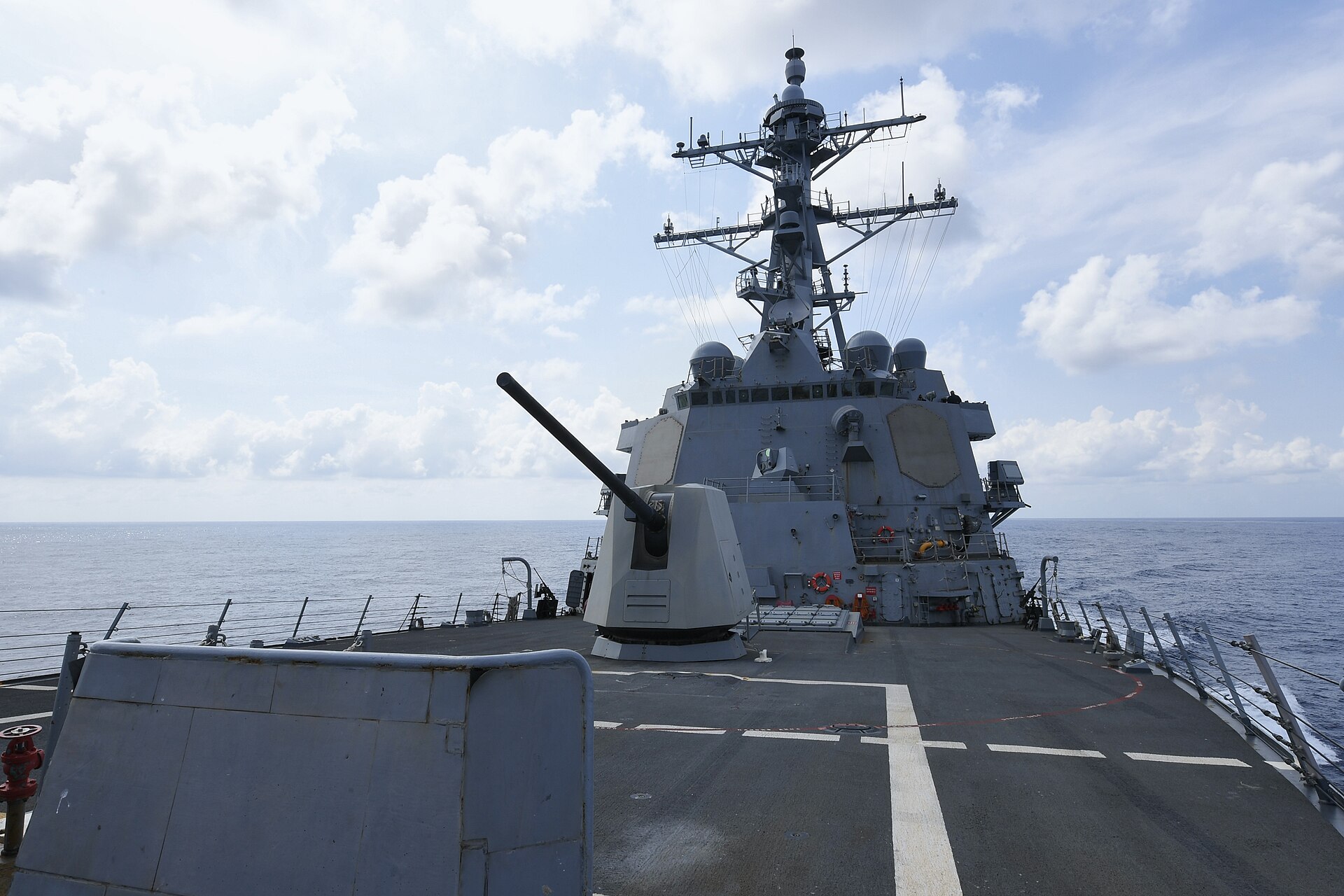
Russia inherits the same precedent for the Black Sea approaches and the Turkish Straits, and for any future Arctic shipping lane disputes as polar routes open. The Hormuz blockade does not merely weaken the US legal position in one theater; it provides a universally applicable counter-precedent that any coastal state can invoke against any FON operation, anywhere, indefinitely. Mark Nevitt, a retired Navy JAG commander now at Emory Law, framed the structural problem before the blockade declaration: “Geography, not firepower, is dictating outcomes in the Strait of Hormuz.” After April 12, the same can be said of the FON program itself — except the geography is now global, and the US is on the wrong side of its own legal doctrine in every theater simultaneously. The enforcement flaw in CENTCOM’s own blockade design was exposed on Day 1: a sanctioned Chinese tanker transited Hormuz unchallenged because its cargo was UAE-loaded, not Iranian — a cargo-origin loophole the blockade’s destination-based framework cannot close without negating the transit-passage exemption the US simultaneously claims as a legal right.
What Does Saudi Arabia’s Silence Actually Cost?
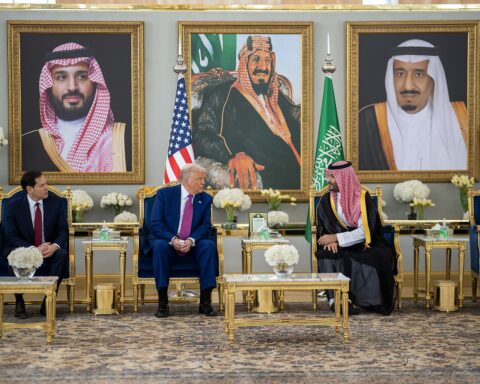
Saudi Arabia has said nothing publicly about the blockade. Riyadh issued no statement endorsing it, no statement opposing it, and no statement acknowledging it. This silence is consistent with Saudi diplomatic practice during the war — the Kingdom has avoided public commentary on US operational decisions while hosting the military infrastructure that makes those decisions executable. But the San Remo Manual does not distinguish between active endorsement and passive hosting, and the legal exposure that silence creates is accumulating in ways that Saudi policymakers appear not to have priced in.
The San Remo Manual on International Law Applicable to Armed Conflicts at Sea (1994) establishes that hostile acts include the “use as a base of operations” by belligerent forces. Saudi Arabia has granted the United States use of King Fahd Air Base at Taif for offensive strikes against Iran — strikes that are part of the same military campaign that now includes the Hormuz blockade. Pakistan has deployed troops and combat aircraft to King Abdulaziz Air Base in Saudi Arabia’s Eastern Province under the Saudi-Pakistan Mutual Defense Agreement signed in September 2025. These are not defensive postures; they are the basing architecture of a belligerent coalition, and under the San Remo framework, they make Saudi energy infrastructure — Ras Tanura, Yanbu, the East-West Pipeline, the Jubail petrochemical complex — legally targetable by the opposing belligerent.
The IRGC has already demonstrated both the capability and the willingness to strike Saudi infrastructure. Ras Tanura was hit on March 2, the first day of the war. The East-West Pipeline pumping station was struck on April 8, during the ceasefire. The Jubail SABIC complex suffered a debris fire on April 7 after intercepted missile fragments ignited facilities.
Saudi air defenses had intercepted 799 drones and 95 ballistic missiles since March 3 — 894 total as of April 7 — but the PAC-3 MSE stockpile is down to approximately 400 rounds, representing an 86 percent depletion from pre-war levels, and the Camden, Arkansas production line manufactures only 620 rounds per year. Saudi Arabia’s physical exposure is already severe, and the blockade adds a layer of legal exposure on top of it: by hosting the forces that enforce a restriction on Hormuz transit passage, Riyadh is co-eroding the legal doctrine it depends on to protect its own export routes.
Saudi Arabia exports approximately 80 percent of its crude by sea, and while the East-West Pipeline bypass to Yanbu has shifted a substantial share of exports to the Red Sea coast, the Kingdom’s long-term commercial interests are fundamentally aligned with unrestricted transit passage through international straits. Every barrel of Saudi crude that transits the Bab el-Mandeb, the Suez Canal, or any other international choke point benefits from the same UNCLOS transit passage doctrine that the Hormuz blockade undermines. The self-harm is structural and permanent: a precedent, once set, does not expire when the war does.
The Ally Who Walked Away
The United Kingdom’s refusal to participate in the blockade is the most consequential diplomatic signal of the crisis, and the most underreported. On April 12 — the same day Trump posted his Truth Social declaration — the UK stated publicly: “We continue to support freedom of navigation and the opening of the Strait of Hormuz.” That sentence was crafted to be read as both a statement of principle and a repudiation of the blockade, because freedom of navigation and a blockade of an international strait are mutually exclusive propositions.
The UK is not a marginal maritime actor. It is the co-architect of the modern law of the sea, the historical naval guarantor of the Gulf (until 1971), and the closest US ally on maritime legal doctrine. British participation in the International Maritime Security Construct and its predecessor, Operation Sentinel, gave US-led Gulf maritime operations a multilateral character that insulated them from charges of unilateralism. The UK’s refusal to participate in the blockade strips that insulation entirely. When the next US FON operation sails through the South China Sea, China will note not only that the US blockaded Hormuz, but that its closest maritime ally refused to join — an admission by London that the operation lacked legal defensibility.
Robert Kennedy’s observation about the OAS vote in 1962 applies in reverse. The OAS authorization “changed our position from that of an outlaw acting in violation of international law into a country acting in accordance with twenty allies.” The UK’s refusal to join the blockade changes the US position from a country acting with its principal maritime ally into a country acting alone against the explicit legal objections of that ally. The diplomatic isolation is not a matter of coalition arithmetic; it is a legal signal that the blockade fails the multilateral legitimacy test that Kennedy understood was the difference between enforcement and outlawry.
Can You Blockade During a Ceasefire?
Donald Rothwell, professor of international law at the Australian National University, identified the foundational paradox within hours of Trump’s declaration: “If the US imposes a blockade then the ceasefire is over and hostilities have resumed.” A blockade is an instrument of the law of naval warfare; it presupposes a state of armed conflict between the blockading power and the target state. The Islamabad Accord, brokered by Pakistan and nominally accepted by both the US and Iran on April 7, established a ceasefire that — however fragile and however frequently violated — created a formal legal state of non-hostility. A blockade is incompatible with that state, and declaring one while the ceasefire nominally holds creates a legal condition in which the US is simultaneously at peace and at war with Iran.
The consequences of this ambiguity radiate outward. If the blockade means the ceasefire is over, then every US ally hosting forces used for blockade enforcement — Saudi Arabia, Bahrain, Qatar, the UAE — is hosting forces engaged in an active armed conflict, with the San Remo co-belligerent implications described above. If the ceasefire still holds despite the blockade, then the blockade is not a lawful act of war but an unlawful restriction of transit passage during peacetime, which is an even more direct violation of UNCLOS Article 37. There is no framing of the situation that leaves the US legal position intact. Rothwell’s observation is not an academic hypothetical; it is a description of the binary trap the blockade declaration created.
The IRGC, for its part, has resolved the ambiguity in the only direction that serves its interests. Iranian state media now frames the US as a co-blockader of the strait — not an enforcer of open navigation — and the IRGC has stated that any military vessel approaching Hormuz will be “strictly suppressed.” The pre-blockade throughput of fifteen to twenty vessels per day, already a catastrophic decline from the pre-war average of 138 daily transits, is unlikely to improve under conditions where both sides are now claiming the legal right to restrict passage and the physical capacity to enforce that restriction. Tehran has since responded with a state-level escalation: Iran’s Armed Forces announced a “permanent mechanism” for Hormuz control, restructuring authority under KACHQ — a joint command the West cannot designate as a terrorist organisation without sanctioning Iran’s entire military.
The ceasefire was already structurally deficient — no enforcement mechanism, no verification architecture, and an expiration date of April 22 with no extension clause. The blockade does not merely weaken the ceasefire; it retroactively invalidates the legal basis on which it was constructed, because a ceasefire between two parties requires that neither party is simultaneously conducting acts of war against the other. Pakistan, which brokered the Islamabad Accord and has positioned itself as the sole enforcement mechanism, now faces the question of whether the agreement it midwifed still exists in any legally cognizable form.
Frequently Asked Questions
Has the US ever blockaded an international strait before?
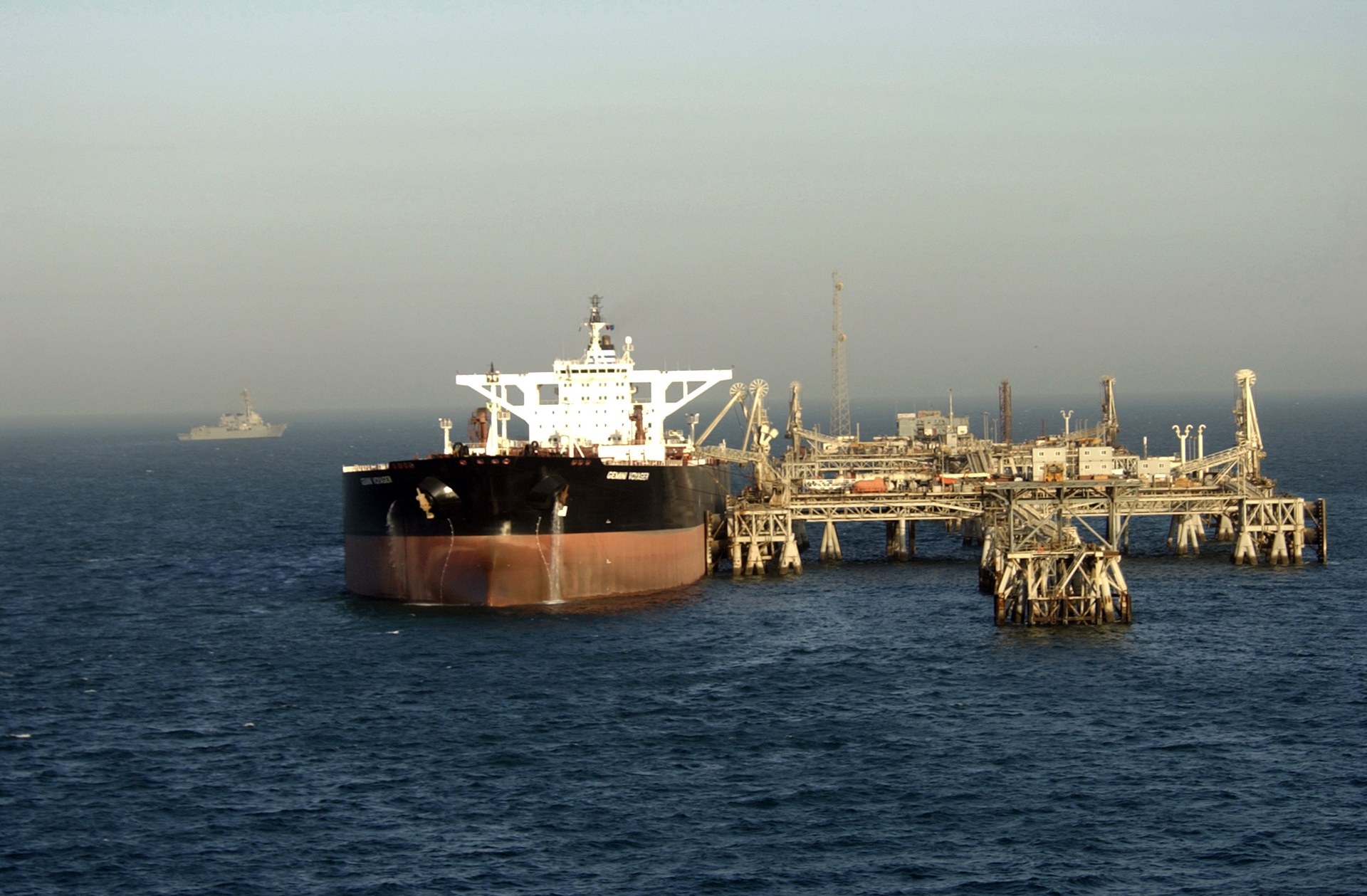
No. The US has conducted interdiction operations, maritime interception operations, and embargo enforcement in various waterways, but it has never declared a blockade of an international strait used by global commercial shipping. The Cuba quarantine was applied to the open ocean around a single island nation, not to a transit chokepoint carrying twenty percent of global oil supply. The distinction matters because international straits carry enhanced transit passage protections under UNCLOS that open-ocean blockade zones do not. The Hormuz blockade is historically unprecedented in US naval history — and in the history of the FON program, it is the first instance of the program’s sponsor state restricting the very transit rights the program was created to protect.
Could the US reclassify the action as a “quarantine” or “maritime interdiction” retroactively?
Operationally, yes — CENTCOM has already narrowed enforcement to Iranian-flagged and toll-paying vessels, which resembles a targeted interdiction more than a general blockade. Legally, the presidential declaration cannot be retroactively recharacterized. International law assesses state intent based on the public statements of the head of state, and Trump used “blockade” in a formal public communication. Foreign ministries, international tribunals, and adversary legal teams will cite the presidential declaration, not the subsequent CENTCOM operational order. The Chayes lesson from 1962 was precisely that terminology determines legal character — and that lesson has now been demonstrated by negative example.
Does the blockade affect US allies’ shipping through Hormuz?
Yes, indirectly and directly. Asian economies receive approximately 84 percent of crude oil shipped through Hormuz — Japan, South Korea, and India, all US security partners, depend on uninterrupted transit for energy security. The blockade adds a second layer of legal and operational risk on top of a throughput collapse that was already catastrophic before April 12. Insurers, who were already pricing Gulf transits at war-risk premiums, must now account for the possibility that US naval forces will intercept vessels that have paid Iran’s toll — meaning that compliance with one party’s demands triggers interdiction by the other.
What legal recourse do affected states have?
States whose shipping is affected by the blockade could bring a case before the International Tribunal for the Law of the Sea (ITLOS) or the International Court of Justice (ICJ), citing violation of transit passage rights under customary international law. The US does not recognize ICJ compulsory jurisdiction and has not ratified UNCLOS, which complicates direct legal proceedings — but the political and diplomatic cost of being named as a respondent in a transit passage case, brought by states invoking the same legal doctrine the US cites in its own FON operations, would be substantial. China and Russia do not need to win a tribunal case to achieve their objective; they need only file one, creating a permanent record that the US blockaded an international strait while simultaneously claiming transit passage rights elsewhere.
What is the San Remo Manual and is it legally binding?
The San Remo Manual on International Law Applicable to Armed Conflicts at Sea (1994) is not a treaty and is not directly binding on any state. It is a codification of customary international law principles governing naval warfare, produced by the International Institute of Humanitarian Law with input from naval and legal experts from dozens of countries including the United States. Its provisions on neutral state obligations — including the loss of neutral protections when a state permits belligerents to use its territory “as a base of operations” — are widely cited by military lawyers, naval war colleges (including the US Naval War College), and international tribunals as authoritative statements of customary law. Saudi Arabia’s exposure under the San Remo framework is not a matter of treaty obligation but of customary international law, which binds all states regardless of whether they have signed a specific instrument. The full analysis of how this legal exposure interacts with the three competing Hormuz security architectures that Saudi Arabia faces is in Three Frameworks, One Strait.