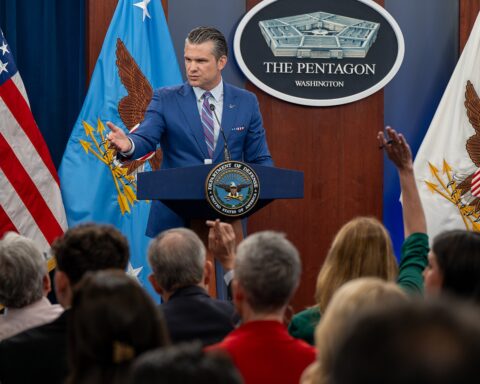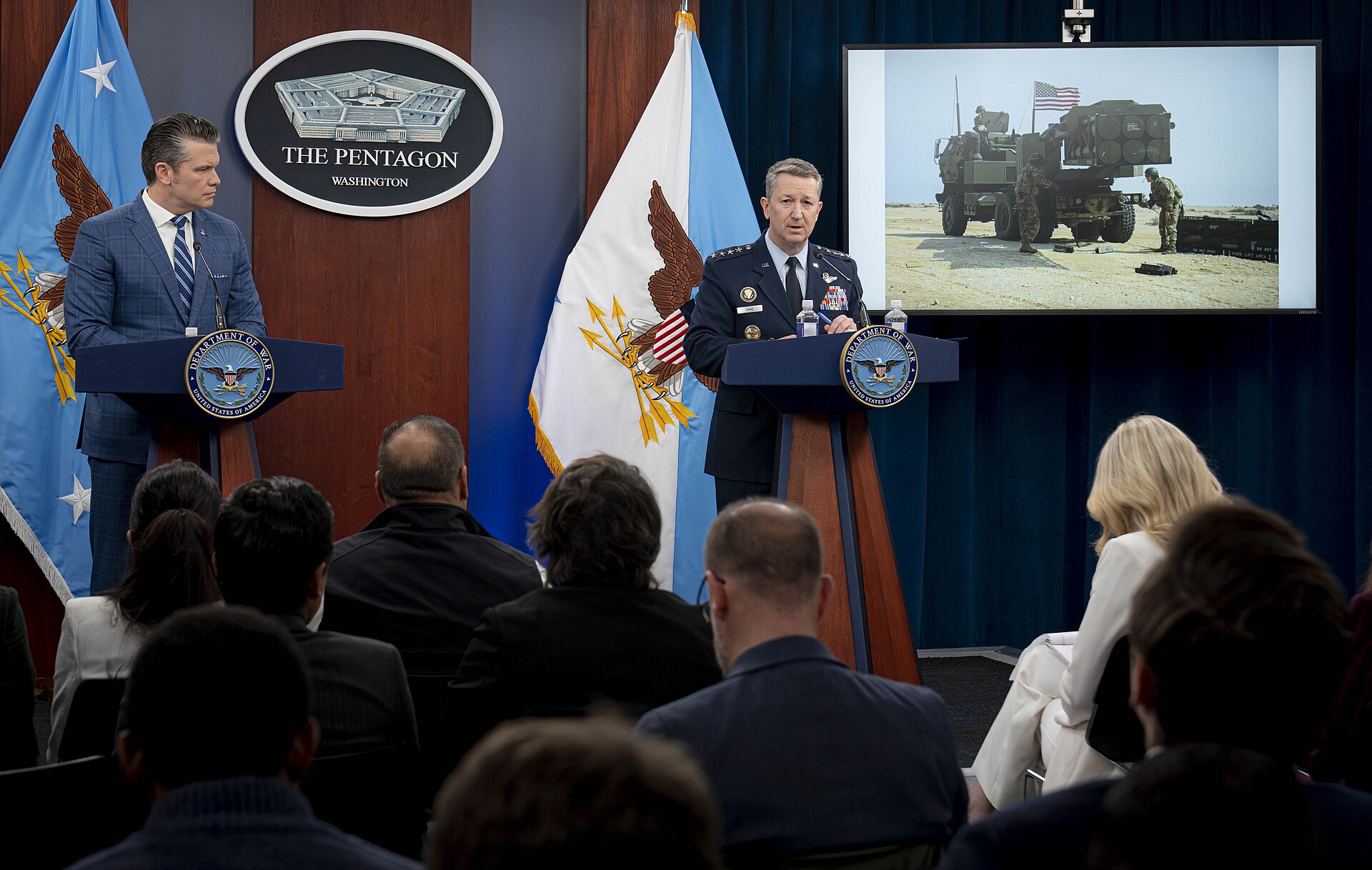

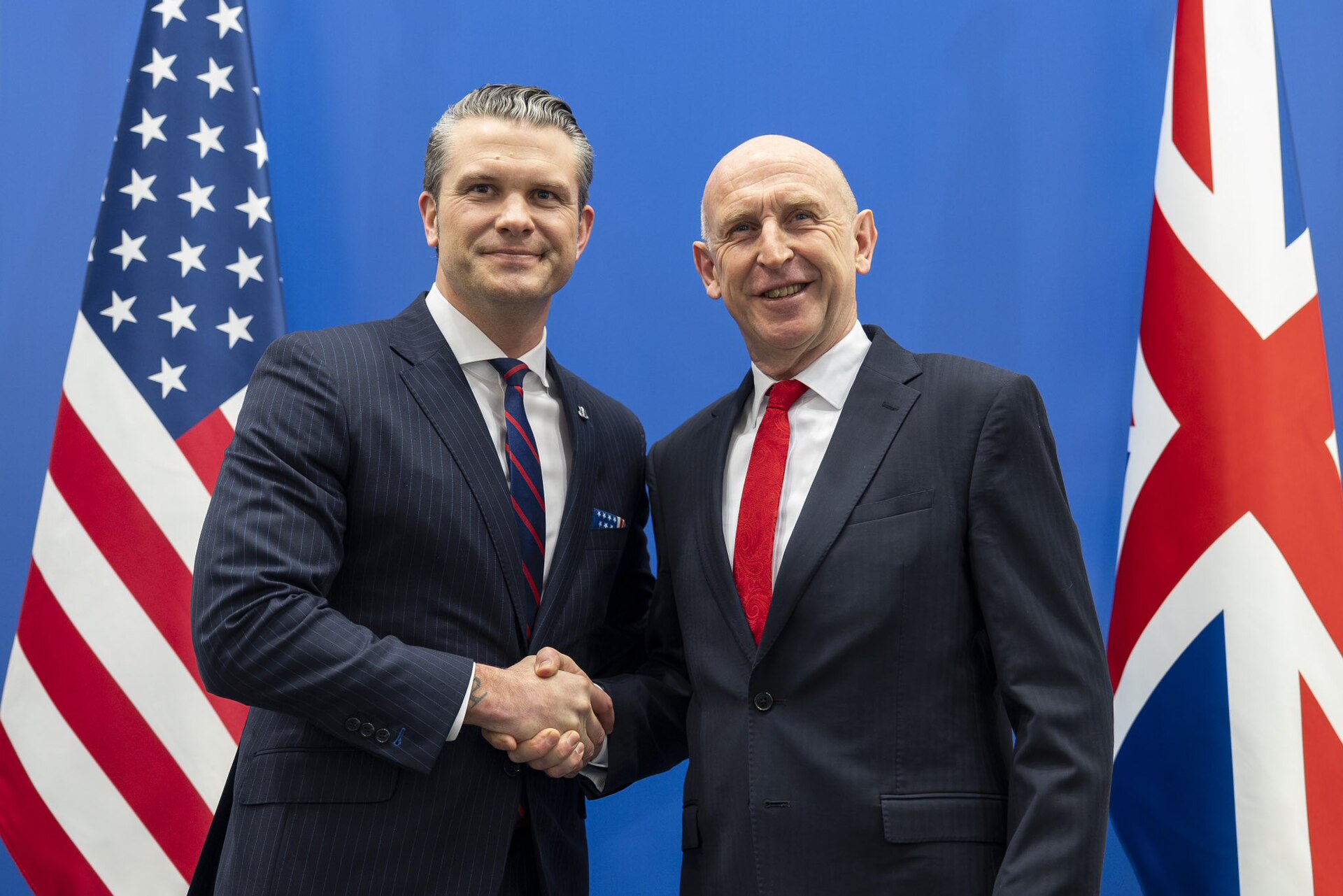
SINGAPORE — US Defense Secretary Pete Hegseth told a room of 54 defence ministers and 42 chiefs of defence staff on Friday that the United States is “more than capable” of restarting military strikes against Iran — delivering the threat from an Indo-Pacific security forum, hours after President Trump’s Situation Room meeting on the Iran deal ended without a decision.
“If Iran doesn’t want to make a great deal that ensures they don’t get a nuclear weapon, they can deal with” the US military, Hegseth said during a press availability at the 23rd IISS Shangri-La Dialogue. He then confirmed the US naval blockade ordered on April 13 remains “very much still in place” — contradicting Trump’s own Truth Social post from the same day suggesting ships “may start the process of heading home.”
The statement amounts to a deterrence commitment the White House itself refused to make. Trump convened senior advisers in the Situation Room on May 29 for what officials described as his “final determination” on the Iran memorandum of understanding. The meeting lasted approximately two hours. No announcement followed. The White House said only that the president “will only make a deal that is good for America and satisfies his red lines.”
Table of Contents
What Hegseth Said
Hegseth’s Iran remarks came during Q&A and press availability at Shangri-La, not in his formal plenary address. His prepared speech focused on China and the Indo-Pacific, making no mention of Iran or Ukraine. The Iran threat was delivered off-script — to reporters, not delegates — but with language calibrated to sound like presidential instruction.
“I had a chance to talk to President Trump this morning,” Hegseth told journalists in Singapore. “He wanted me to reiterate how patient he is in ensuring that with America undertaking this kind of historic endeavour, any deal will be a good one, a great one, and he’s patient in the pursuit of that.”
The word “patient” did considerable lifting. It reframed an unsigned MOU — now 106 days into negotiations with no signature — as deliberate restraint rather than indecision. Hegseth then pivoted to the military threat: “We are more than capable” of renewing attacks, and “our stockpiles are more than suited for that both there and around the globe.”
The Middle East briefing 3,000+ readers start their day with.
One email. Every weekday morning. Free.
“If Iran doesn’t want to make a great deal that ensures they don’t get a nuclear weapon, they can deal with” the US military.
Pete Hegseth, US Secretary of Defense, Shangri-La Dialogue, May 30, 2026
The formulation echoed Trump’s own Cabinet-session language from earlier in the week: “They are starting to give us the things that they have to give us, and if they do, that’s great. And if they won’t, then the man on my left is gonna finish ’em off” — the man on his left being Hegseth. That phrasing made Hegseth the named executor of a threat the president declines to formalise. When pressed by reporters on his wording, Hegseth snapped: “I love the disingenuous questions from the disingenuous press. I said it will be a good deal.”
Why Deliver an Iran Ultimatum From a Pacific Defence Forum?
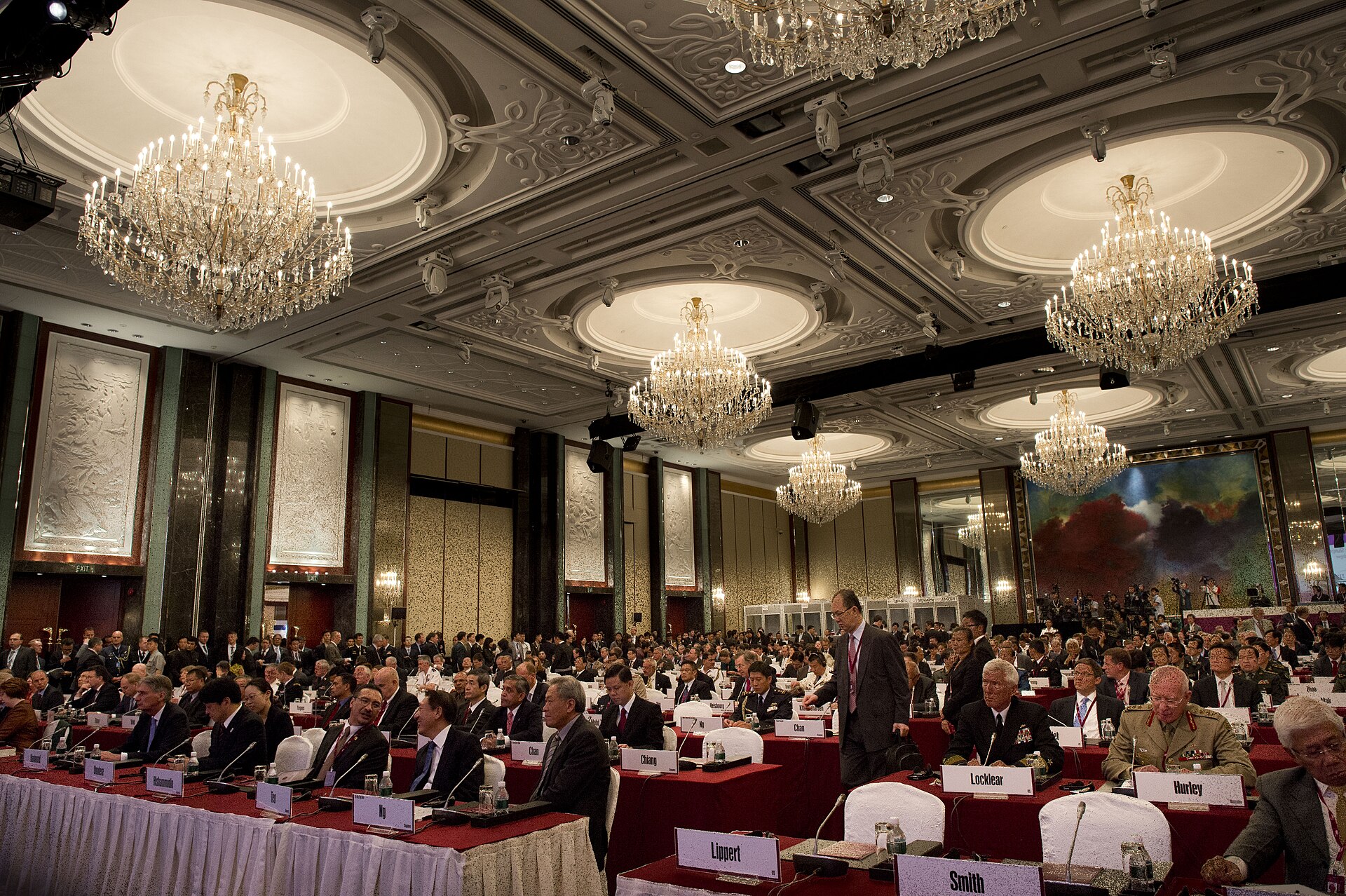
The Shangri-La Dialogue is the premier Indo-Pacific defence summit — organised by IISS, attended by 44 countries, architecturally designed for US-China strategic signalling. It is not a Middle East venue. Hegseth chose to deliver his sharpest Iran language of the war from a stage built for Pacific deterrence, in front of an audience whose primary concern is whether the United States can still be relied upon to contain China.
That choice was not accidental. The 2026 Shangri-La opened under a headline from Asia Times: “Asia seeks alternatives to US shield.” NPR’s pre-summit framing was blunter — the forum convened “amid doubts over US priorities,” with regional allies questioning whether the Iran conflict had diverted American attention and capability from the Indo-Pacific. By delivering the Iran ultimatum here, Hegseth attempted to collapse the distinction — framing the Hormuz crisis as a global concern rather than a regional distraction.
The tonal split in his prepared remarks made the strategy visible. In his 2025 Shangri-La speech, Hegseth mentioned Taiwan five times and struck a confrontational posture on China. In 2026, Taiwan went unmentioned in prepared remarks. His China language shifted to “quiet” and “measured and deliberate strength” — “We do not approach this challenge with needless confrontation but with a posture of measured and deliberate strength.” The hawkishness migrated entirely to Iran, delivered not from the podium but in the press scrum, where it carried the energy of executive instruction rather than policy declaration.
The effect was to tell 44 defence delegations two things simultaneously: the US remains lethally committed to the Iran campaign, and it considers that campaign compatible with — not competitive against — Pacific security. Whether the delegates believed it is a separate question. The forum’s own agenda listed “Iran War, Taiwan Tensions and US Role in Asia” as co-equal topics, according to EconoTimes pre-summit reporting.
The Same-Day Blockade Contradiction
On May 30, two statements about the US naval blockade of Iran entered the public record within hours of each other. Trump posted on Truth Social: “Ships caught in the Strait due to our amazing and unprecedented Naval Blockade, which will now be lifted, may start the process of ‘heading home!’” In Singapore, Hegseth told reporters: “The blockade is very much still in place.”
These are operationally incompatible claims. The blockade was ordered on April 13. Either it is being lifted as a confidence-building measure toward an MOU, or it remains the coercive instrument backing negotiations. It cannot be both. Trump’s post was conditional — “may start the process” — but Hegseth’s was declarative and present-tense. No White House official reconciled the two statements publicly.
The contradiction matters because the MOU framework reported by Axios on May 24 and May 28 includes a provision for the US blockade to lift proportionally to the restoration of commercial shipping. Hormuz commercial transits currently stand at approximately four vessels per day against a pre-crisis norm of 95, according to IMF PortWatch data from May 24. If the blockade is “very much still in place,” the proportional-lifting mechanism hasn’t been triggered — meaning the MOU’s core quid pro quo remains inoperative on Day 91 of the conflict.
What Did the Situation Room Actually Decide?
The answer, based on all available reporting, is nothing. Trump convened the meeting on May 29 to render his “final determination” on the Iran MOU. CNBC reported it lasted approximately two hours. The White House issued a single-line statement afterward: “President Trump will only make a deal that is good for America and satisfies his red lines.” No timeline was given. No next steps were announced.
Trump had posted his own preconditions on Truth Social the same day: “Iran must agree that they will never have a Nuclear Weapon or Bomb. The Hormuz Strait must be immediately open, no tolls, for unrestricted shipping traffic, in both directions. No money will be exchanged, until further notice.” The “no money” clause — referencing Iran’s demand for $24 billion in frozen assets — and the “unrestricted” demand directly contradict the MOU text as described by both Axios and Iranian state media leaks. The gap between Trump’s Truth Social demands and the negotiated text may explain the non-decision.
Hegseth’s intervention from Singapore the following morning functioned as the operational answer the Situation Room failed to produce. By confirming the blockade remains active and restating the military threat, he provided the deterrence posture that Trump’s indecision had left vacant. He did so by invoking Trump’s name directly — attributing his deterrence posture to a morning conversation with the president — closing the deniability gap that a non-decision creates. The president didn’t commit, but his Defence Secretary, 8,000 miles away, committed on his behalf.
This is the pattern that has defined the MOU process since March. Iran’s Foreign Minister Abbas Araghchi acknowledged on May 27 that talks had reached a “deadlock” on enriched material, saying the issue was being “postponed” to later stages. The constitutional split between Araghchi’s diplomatic track and the IRGC’s operational authority means Iran cannot deliver on enrichment commitments without IRGC consent, and the US cannot sign without resolving enrichment — so neither side will concede first, and a Situation Room meeting produces nothing, leaving a Defence Secretary to perform certainty from abroad.
What Hegseth performed as certainty from Singapore was further complicated by reporting that emerged the same day: while threatening to restart strikes, Trump had been privately assuring Netanyahu of nuclear terms the MOU does not contain. The two-track nuclear diplomacy Washington is running — a public MOU that defers uranium removal and a private Netanyahu commitment requiring full dismantlement — creates a structural gap no amount of deterrence signalling from Singapore can close.
Iran’s Response
Mohsen Rezaei — adviser to Supreme Leader Ali Khamenei and former commander-in-chief of the IRGC — posted his response on X the same day Hegseth spoke. “As predicted, the US President is betraying diplomacy for the third time,” Rezaei wrote. “By continuing the maritime blockade and making excessive demands in negotiations, he has proven more than ever that he is not a man of negotiation and is pursuing other goals.”
The “third time” framing is deliberate. Iran’s hardline establishment counts Trump’s withdrawal from the JCPOA in 2018 and his “maximum pressure” reimposition as the first two betrayals. Hegseth’s Shangri-La statement — delivered from a military forum, in military language, while the MOU sits unsigned — provides the third data point for a narrative the IRGC has been constructing since February: that US diplomacy is performative cover for a strategy of regime exhaustion through blockade and attrition.
Rezaei is not a marginal figure. As former IRGC chief and current adviser to Khamenei, his public statements carry institutional weight. His framing — that Trump “is pursuing other goals” beyond diplomacy — aligns with IRGC Aerospace Force warnings from May 27 that any new US aggression would face a response “unlike anything seen before.” The hardline position uses Hegseth’s words as confirmation rather than provocation: if the US is openly threatening renewed strikes from a defence summit, the diplomatic track is already dead in spirit.
IRGC-affiliated Fars News had already circulated a competing MOU draft describing Hormuz “under Iran’s management” — directly contradicting the US demand for “unrestricted” passage that Trump reiterated on Truth Social. Iranian state television leaked MOU text claiming Iran would receive “immediate payment of $12 billion” in frozen assets, which the White House called a “complete fabrication.” The information war around the MOU text has made it impossible to establish whether both sides are negotiating from the same document — and Hegseth’s threat-from-abroad further erodes the premise that diplomacy is the primary track.
“As predicted, the US President is betraying diplomacy for the third time. By continuing the maritime blockade and making excessive demands in negotiations, he has proven more than ever that he is not a man of negotiation and is pursuing other goals.”
Mohsen Rezaei, adviser to Iran’s Supreme Leader, May 30, 2026
The Taiwan Arms Problem
Hegseth’s Shangri-La appearance served a second purpose beyond Iran messaging: damage control for the Pacific alliance. On May 19, Acting Navy Secretary Hung Cao told a Senate committee that the Iran war had caused a pause on a reportedly $14 billion Taiwan arms sale to preserve munitions stocks. For Indo-Pacific allies already questioning US commitment, this was confirmation of their worst fear — that the munitions expenditure against Iran was cannibalising Pacific deterrence.
Hegseth pushed back directly at Shangri-La. The US is in a “very good place” on weaponry, he said, and the Taiwan pause was unrelated to the Iran conflict. His stockpile claim — “more than suited for that both there and around the globe” — was crafted to address both audiences with a single sentence: Iran hears the threat of renewed strikes, and Pacific allies hear that the arsenal hasn’t been depleted by the current campaign.
The claim is contestable on its face. Congressional Research Service report IN12692 documents that 24 MQ-9 Reapers were destroyed in Operation Epic Fury, leaving the US fleet at 135 operational airframes against an established minimum requirement of 189. CSIS has documented a PAC-3 expenditure ratio of 114 interceptors per threat during the conflict’s most intense phase. Kuwait alone has absorbed 362 intercepts since February 28. Whether US stockpiles are “more than suited” for simultaneous Iran and Pacific contingencies is a claim that Hegseth’s own acting Navy Secretary contradicted under oath eleven days earlier.
The tonal downgrade on China — zero Taiwan mentions versus five in 2025 — may itself be the tell. If the US were genuinely in a “very good place” on Pacific readiness, the quieter China posture would be unnecessary. The mildness reads less as strategic restraint and more as an administration that cannot afford a two-front deterrence posture and has chosen to perform capability rather than demonstrate it.
Background
The Iran-US conflict began on February 28, 2026. Trump ordered a naval blockade of Iran on April 13. MOU negotiations have been ongoing since mid-March, with five rounds of talks producing a framework — reported by Axios — that includes a 60-day ceasefire extension, removal of Iranian mines from Hormuz within 30 days, proportional lifting of the US blockade, restrictions on enrichment, and disposal of highly enriched uranium.
Trump has not signed the MOU. The delay has persisted for 106 days as of Hegseth’s Shangri-La statement. Senate opposition from Cruz, Wicker, Graham, Cotton, and Pompeo has paralleled the 2015 Cotton letter that sought to undermine the JCPOA. Iran’s PGSA toll system — charging approximately $2 million per vessel transit through Hormuz — was designated under OFAC sanctions on May 28, two days before Hegseth spoke.
The Shangri-La Dialogue is organised annually by the International Institute for Strategic Studies and hosted by the Singapore government. It is the Indo-Pacific’s highest-level defence forum and has historically functioned as the primary stage for US-China strategic communication. Hegseth attended both the 2025 and 2026 editions — according to IISS records, the only US defence secretary to attend consecutively since Jim Mattis.
Saudi Arabia’s undeclared combat role in the conflict has produced over 2,400 PAC-3 interceptor expenditures in 38 days — with an estimated 80-150 remaining, equivalent to 1.3-2.4 days at full-intensity rates. The kingdom has been structurally excluded from all three governance architectures that could resolve Hormuz: the US diplomatic track, the Iran-Oman bilateral track, and the UK-France 40-nation coalition command at Northwood.
Frequently Asked Questions
Has the US actually restarted strikes against Iran?
No. Hegseth’s statement was a conditional threat, not an operational announcement. The last confirmed US strike was CENTCOM’s action against a Bandar Abbas drone control station on approximately May 26. Hegseth’s language — “more than capable” — signals readiness, not activation. The distinction matters because the MOU framework includes a ceasefire extension, and resuming strikes would formally collapse that framework and potentially trigger the IRGC Aerospace Force’s May 27 warning of a response “unlike anything seen before.”
Why did Hegseth mention Trump by name?
Invoking Trump directly — “I had a chance to talk to President Trump this morning” — serves a specific bureaucratic function. It closes what defence analysts call the “deniability gap”: when a president declines to make a formal decision (as Trump did in the Situation Room), subordinates who speak can be disavowed. By attributing his deterrence posture to a morning conversation with Trump, Hegseth made disavowal politically costly. The president would have to publicly contradict his own Defence Secretary at an international forum to walk it back.
What is the PGSA and why does it matter to Hegseth’s blockade claim?
The Persian Gulf Shipping Authority is Iran’s toll-collection mechanism for Hormuz transit, charging approximately $2 million per vessel. It was designated under OFAC SDN sanctions on May 28 — meaning any entity paying the toll risks US sanctions exposure, while any entity refusing the toll faces Iranian enforcement. The PGSA creates a compliance binary that functions as a closure mechanism without requiring a formal blockade order from Iran. Hegseth’s insistence that the US blockade is “still in place” means both sides are now operating enforcement architectures simultaneously — ships face US interdiction from one direction and Iranian toll enforcement from the other.
Could Trump sign the MOU without Senate approval?
An MOU is not a treaty and does not require Senate ratification under US constitutional law. However, senators including Cruz, Wicker, Graham, Cotton, and Pompeo have publicly opposed the deal’s terms. Their opposition mirrors the 2015 Cotton letter to Iranian leaders that sought to undermine the JCPOA by signalling that any deal could be reversed by a future administration. The political cost of signing against vocal Senate opposition — particularly from Trump’s own party — may explain the Situation Room non-decision more than any substantive policy disagreement.
What happens if the MOU collapses entirely?
The PGSA collects approximately $2 million per transit every day without a signature — Iran has no economic incentive to accelerate. Goldman Sachs models Brent at $100/barrel if Hormuz closure extends, against a current price of approximately $91. Saudi Arabia’s fiscal breakeven is $108-111 including PIF commitments, meaning the kingdom is losing money at current prices regardless of the MOU’s fate. A full collapse would likely trigger the renewed US strikes Hegseth threatened, activate the IRGC’s “unlike anything seen before” response posture, and remove the last diplomatic constraint on Iran’s enrichment programme — which Araghchi has already acknowledged is in “deadlock.”