RIYADH — Saudi Transport Minister Saleh bin Nasser Al-Jasser spent the week of April 16-22, 2026, holding back-to-back virtual meetings with his Jordanian and Syrian counterparts to discuss a rail corridor that would connect the Persian Gulf to the Mediterranean — and he did it while Iran’s ceasefire was collapsing, while Bab el-Mandeb closure threats were landing, and while Saudi Arabia’s March production had fallen 30 percent from pre-war levels. The timing was not coincidental; it was the schedule of a government that has concluded, at ministerial level, that neither of its two maritime export routes can be trusted again.
The project in question — a modernized rail link running from Saudi Arabia’s eastern ports through Jordan into Syria and onward to Turkish Mediterranean terminals — is being dressed in the language of connectivity and development. Al-Jasser called for a joint Saudi-Jordan-Syria committee to “study the proposed routes and lines for the railway project,” language so anodyne it could have come from any pre-war infrastructure summit. But this is not a development project that happens to have strategic value; it is a wartime logistics hedge that happens to wear a development project’s clothes.
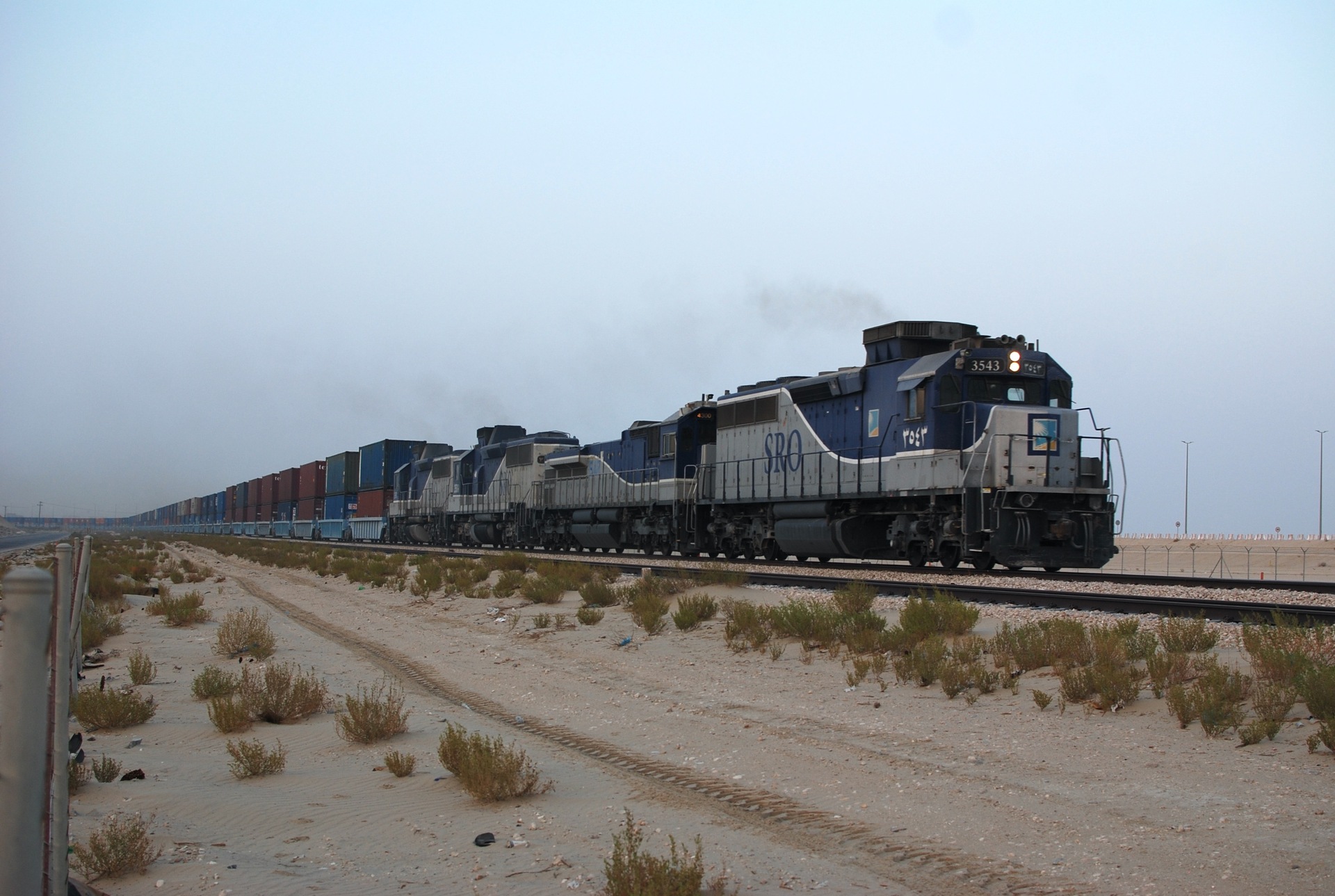
Table of Contents
- How Fast Did the Corridor Come Together?
- The Dual-Chokepoint Trap
- The SAR Corridor: 1,700 Kilometres Already Built
- Why Can’t They Just Rebuild the Hejaz Railway?
- Syria’s Missing 1,748 Kilometres
- Al-Sharaa in Jeddah: Reconstruction as Strategic Purchase
- What Does $290 Billion in Iran-Proofing Buy?
- Turkey’s Mediterranean Endgame
- The Obstacles Nobody Is Discussing
- FAQ
How Fast Did the Corridor Come Together?
The diplomatic sequence over a sixteen-day period tells its own story. On March 26, Saudi Arabia Railways launched a 1,700-kilometre international freight corridor connecting King Abdulaziz Port in Dammam, King Fahd Industrial Port in Jubail, and Jubail Commercial Port to the Al-Haditha border crossing with Jordan. On April 7, Turkey, Syria, and Jordan signed a trilateral memorandum of understanding in Amman covering road, maritime, and rail connectivity, with a three-year implementation roadmap and joint committees to oversee it.
On April 8, Turkish Transport Minister Abdulkadir Uraloglu announced the “modern Hejaz Railway” concept — a line connecting Turkey, Syria, Jordan, Saudi Arabia, and eventually Oman, with the explicit aim of linking “the Red Sea to the Mediterranean and Europe.” On April 16, Al-Jasser held a virtual meeting with Syrian Transport Minister Yarub Badr about rehabilitating and modernizing the Damascus-to-Jordan-border railway line. Three days later, on April 19, Al-Jasser held a second virtual meeting with Jordanian Transport Minister Nidal Qatamin, calling for the joint committee and naming the Jaber-Omari border axis as the critical connection point.
And on April 22 — today — Syrian President Ahmad al-Sharaa arrived in Jeddah for his first Gulf tour stop, a meeting with Crown Prince Mohammed bin Salman in which “regional connectivity projects” featured on the agenda alongside Saudi commitments including a joint Saudi-Qatari payment of Syria’s $15.5 million World Bank debt, the Elaf Investment Fund, a $2 billion Aleppo airport redevelopment, and the creation of a new flynas Syria airline. Each step, taken alone, looks like routine bilateral transport diplomacy. Taken together over sixteen days during an active military conflict with both of Saudi Arabia’s maritime chokepoints compromised, the pace acquires a different character entirely.
| Date | Event | Parties |
|---|---|---|
| March 26 | SAR international freight corridor launches (1,700 km, 400 TEU) | Saudi Arabia |
| April 7 | Trilateral MOU signed in Amman (road, maritime, rail) | Turkey, Syria, Jordan |
| April 8 | “Modern Hejaz Railway” concept announced | Turkey |
| April 14 | Karkamis-Nusaybin line reopened (350 km) | Turkey |
| April 16 | Virtual meeting on Damascus-border rail rehabilitation | Saudi Arabia, Syria |
| April 19 | Virtual meeting; joint committee proposed (Jaber-Omari axis) | Saudi Arabia, Jordan |
| April 22 | Al-Sharaa meets MBS in Jeddah | Saudi Arabia, Syria |
The Dual-Chokepoint Trap
To understand why Riyadh is moving at this speed, you need to understand what happened to the assumption that had underpinned Saudi export strategy since the East-West Pipeline was built in the 1980s: that if the Strait of Hormuz closed, the Red Sea would remain open. That assumption died on April 6, 2026, when Ali Akbar Velayati — a senior adviser to Ayatollah Khamenei and former Iranian foreign minister — stated publicly that “the unified command of the Resistance front views Bab al-Mandeb as it does Hormuz.” The phrasing was not ambiguous. It meant, and was understood by Gulf capitals to mean, that Iran considered Bab el-Mandeb a coordinated extension of its Hormuz chokepoint strategy, enforced through Houthi naval and missile assets that had already demonstrated, during two years of Red Sea disruption beginning in late 2023, the capacity to threaten commercial shipping at scale.
The Middle East briefing 3,000+ readers start their day with.
One email. Every weekday morning. Free.
Saudi Arabia’s East-West Pipeline bypass to Yanbu — the 7-million-barrel-per-day capacity line crossing 1,200 kilometres of desert to the Red Sea coast — was supposed to be the insurance policy. If Hormuz closed, crude would flow west to Yanbu terminals, load onto tankers, and exit through Bab el-Mandeb to global markets. But Velayati’s statement, backed by Houthi operational capacity and IRGC coordination doctrine, collapsed the bypass logic overnight. An export route that exits through Bab el-Mandeb is not a bypass of Iranian chokepoint power; it is merely a longer route to a second Iranian chokepoint. According to Al Jazeera, closing both straits simultaneously would block roughly 25 percent of global oil and gas trade.
The northern rail corridor does something the Yanbu pipeline cannot: it exits through territory that Iran cannot threaten without attacking a NATO member state. Freight routed from Saudi Arabia’s eastern ports through Jordan and Syria to Turkey’s Mediterranean terminals at Iskenderun or Mersin bypasses both Hormuz and Bab el-Mandeb entirely. The route is overland, which means it cannot be mined, cannot be subjected to IRGC “coordination” fees, and cannot be interdicted by Houthi anti-ship missiles. An IRGC strike on Turkish rail infrastructure would be an attack on NATO territory — a threshold that even the most autonomous IRGC provincial command would find difficult to justify under the Islamic Republic’s mosaic defense doctrine.
The SAR Corridor: 1,700 Kilometres Already Built
The least appreciated fact about the northern corridor is how much of it already exists on the Saudi side. Al-Jasser told Petra, Jordan’s state news agency, that Saudi Arabia possesses a “sophisticated” railway network spanning approximately 5,500 kilometres, extending to the Jordanian border, which enhances prospects for the project’s “efficient” implementation. The word “efficient” is doing considerable work in that sentence: it means that Saudi Arabia’s segment of a Gulf-to-Mediterranean rail link is, functionally, already built.
The Saudi Arabia Railways freight corridor that launched on March 26 runs 1,700 kilometres from the Gulf coast industrial ports — Dammam and Jubail, where Saudi Arabia’s petrochemical and crude infrastructure is concentrated — to Al-Haditha, directly on the Jordanian border. It carries 400 TEUs per service, and SAR claims roughly a 50 percent transit time reduction compared to road transport — the kind of efficiency differential that matters when maritime alternatives are compromised. This is not a proposed railway or a planned railway or a railway subject to feasibility studies; it is an operational railway that began carrying international freight four weeks ago. The North-South Railway, the 2,750-kilometre mainline from which the Al-Haditha corridor branches, has been running since 2017.
Saudi Arabia is Jordan’s largest foreign investor, accounting for 16 percent of capital flows and approximately $2.8 billion in 2025, according to AGBI. That investment relationship now has a physical railway running to the border between the two countries, with a Saudi minister requesting a joint committee to extend it. The infrastructure on the Saudi side is standard gauge — 1,435 millimetres — which is compatible with Turkey’s mainline network and most of Syria’s operational system, though not with the original Hejaz Railway tracks that the project invokes in its branding.
Why Can’t They Just Rebuild the Hejaz Railway?
Uraloglu’s announcement on April 8 used the phrase “modern Hejaz Railway” — a piece of branding so historically resonant that it has generated considerable media coverage on its own, complete with photographs of Ottoman-era locomotives and references to T.E. Lawrence’s guerrilla campaign against the line during the Arab Revolt of 1916-1918. The branding is, from an engineering perspective, almost entirely misleading, and understanding why reveals the actual scale of what is being proposed.
The original Hejaz Railway, completed in 1908 under Sultan Abdulhamid II, ran 1,320 kilometres from Damascus to Medina on 1,050-millimetre narrow gauge — a gauge standard now used virtually nowhere for international freight. Saudi Arabia’s North-South Railway uses 1,435-millimetre standard gauge. Turkey’s mainline network uses 1,435-millimetre standard gauge. Any corridor connecting the two must therefore be new construction on standard gauge, not rehabilitation of 118-year-old narrow-gauge roadbed that was systematically dynamited during the First World War and has been largely derelict since. The Jordanian fragment of the original Hejaz — roughly 300 kilometres from Amman to Zarqa — still runs as a local heritage service, but it is operationally irrelevant to a modern freight corridor.
The “modern Hejaz Railway” is, in other words, a new railway using the old railway’s name. Uraloglu’s stated timeline — four to five years before the line connects to Saudi Arabia’s system — reflects new-build construction timelines, not rehabilitation timelines. Turkey’s near-term contribution is the Nusaybin-to-Aleppo extension, estimated at $110 million, which would link Turkey’s recently reopened 350-kilometre Karkamis-Nusaybin border line to Syria’s northern rail hub. The emotional valence of the Hejaz branding — pilgrimage, Ottoman solidarity, pan-Islamic connectivity — is useful politically, particularly for Ankara’s domestic audience. But the engineering reality is a standard-gauge freight railway that shares nothing with the original except its approximate north-south orientation and its destination.
Syria’s Missing 1,748 Kilometres
If Saudi Arabia’s section is largely built and Turkey’s border section is reopened, then the critical constraint on the corridor is Syria — and Syria’s railway system is, by any honest measure, shattered. Of the country’s 2,800-kilometre network, only 1,052 kilometres are currently operational, roughly 38 percent. The remaining 1,748 kilometres are damaged or non-functional, with infrastructure destruction totaling approximately $1.5 billion since 2011, according to a World Bank-backed GFDRR assessment. Aleppo Governorate alone accounts for 55 percent of all rail damage — and Aleppo is the central junction through which any Turkey-to-Jordan rail corridor must pass.
Syrian Transport Minister Yarub Badr has estimated that rehabilitating the network will require $5.5 billion and three to five years, a figure that may be optimistic given the scale of destruction and the governance challenges of post-civil-war reconstruction. The first test train between Aleppo and Hama ran on August 6, 2025 — the first since 2012 — which suggests that incremental rehabilitation is possible but proceeding at a pace incompatible with wartime urgency. The Aleppo-Damascus line is reportedly operational, and trial passenger service between Amman and Damascus is planned for late 2026, but the gap between “trial passenger service” and “international freight corridor capable of handling petrochemical exports” is measured in billions of dollars and years of construction.
Badr himself acknowledged this when he spoke of the necessity of “joint investments and collaboration,” language that translates, in practice, to Gulf money. Syria’s broader reconstruction cost has been estimated by the World Bank at a conservative $216 billion (October 2025), while al-Sharaa himself has cited figures of $600-900 billion. The rail component — $5.5 billion — is a relatively small fraction of the total, which makes it an attractive early investment for Saudi Arabia: strategically transformative, financially manageable relative to the scale of Syria reconstruction, and deliverable within a timeline that, while not immediate, is shorter than most post-conflict infrastructure programmes.
Al-Sharaa in Jeddah: Reconstruction as Strategic Purchase
Ahmad al-Sharaa’s arrival in Jeddah today — his first stop on a Gulf tour — should be read against this infrastructure backdrop. When al-Sharaa says, as he told The National, that he prefers “reconstruction through investment, not aid,” he is describing an alignment of interests with Crown Prince Mohammed bin Salman that goes beyond post-conflict charity. Saudi Arabia needs a viable overland export route through Syrian territory. Syria needs reconstruction capital and a patron willing to provide it without the political conditions that Western donors or Iranian-backed reconstruction would carry. The investment list — World Bank debt clearance, the Elaf fund, $2 billion for Aleppo airport, a new airline — reads like a down payment on a relationship in which the rail corridor is the structural return.
The $2 billion Aleppo airport commitment is particularly telling. Aleppo is the junction city for any Turkey-Syria rail corridor, the point where the Turkish extension from Nusaybin meets the north-south line to Damascus and onward to the Jordanian border. Investing in Aleppo’s airport is investing in the logistics node that makes the rail corridor functional — you cannot rehabilitate 1,748 kilometres of railway without a major air-accessible hub from which to manage construction, import equipment, and coordinate the international workforce the project will require.
Al-Sharaa’s statement that “investments are growing well in Syria, and we will rebuild every stone that has been destroyed” is aspirational rhetoric, but the Saudi commitments announced alongside it are concrete enough to suggest that at least the Damascus-to-Jordanian-border railway segment — the stretch Al-Jasser discussed with Badr on April 16 — is moving toward funded rehabilitation rather than indefinite feasibility study. The gap between aspiration and construction schedule remains wide, but the gap between aspiration and Saudi chequebook has narrowed to the width of a ministerial phone call.
What Does $290 Billion in Iran-Proofing Buy?
The northern corridor is not an isolated initiative. According to the Christian Science Monitor (April 15, 2026), Gulf states are collectively investing approximately $290 billion in what the publication termed “Iran-proofing” infrastructure — a category that includes everything from pipeline bypasses to port diversification to the rail corridor under discussion. Gulf officials stated objectives of diverting 30-50 percent of exports away from Hormuz through Red Sea or overland routes in the near term, with future phases targeting 70-80 percent diversion. Hesham Alghannam of the Carnegie Middle East Center told the Monitor that “reliance on a single choke point is now considered unacceptable,” a formulation that reflects what he described as permanently altered threat perceptions among Gulf states.
The $290 billion figure encompasses the full spectrum of what PIF’s wartime infrastructure pivot has accelerated: the Yanbu pipeline maximization, NEOM’s transformation from vanity project to logistics platform (the Port of NEOM alone represents a SR 7.5 billion investment, with Terminal T1’s 900-metre quay wall and 18.5-metre draft designed for large-vessel handling), the UAE-Jordan railway ($2.3 billion, 360 kilometres, connecting Aqaba to mining regions with financial close expected early 2027), and the northern rail corridor itself. Oliver Cornock, an analyst quoted by The National on April 17, noted that NEOM’s strategic emphasis had shifted toward “industrial and logistics functionality, particularly around Oxagon and the Port of Neom” — a sanitized description of a giga-project being repurposed from architectural showpiece to wartime supply chain infrastructure.
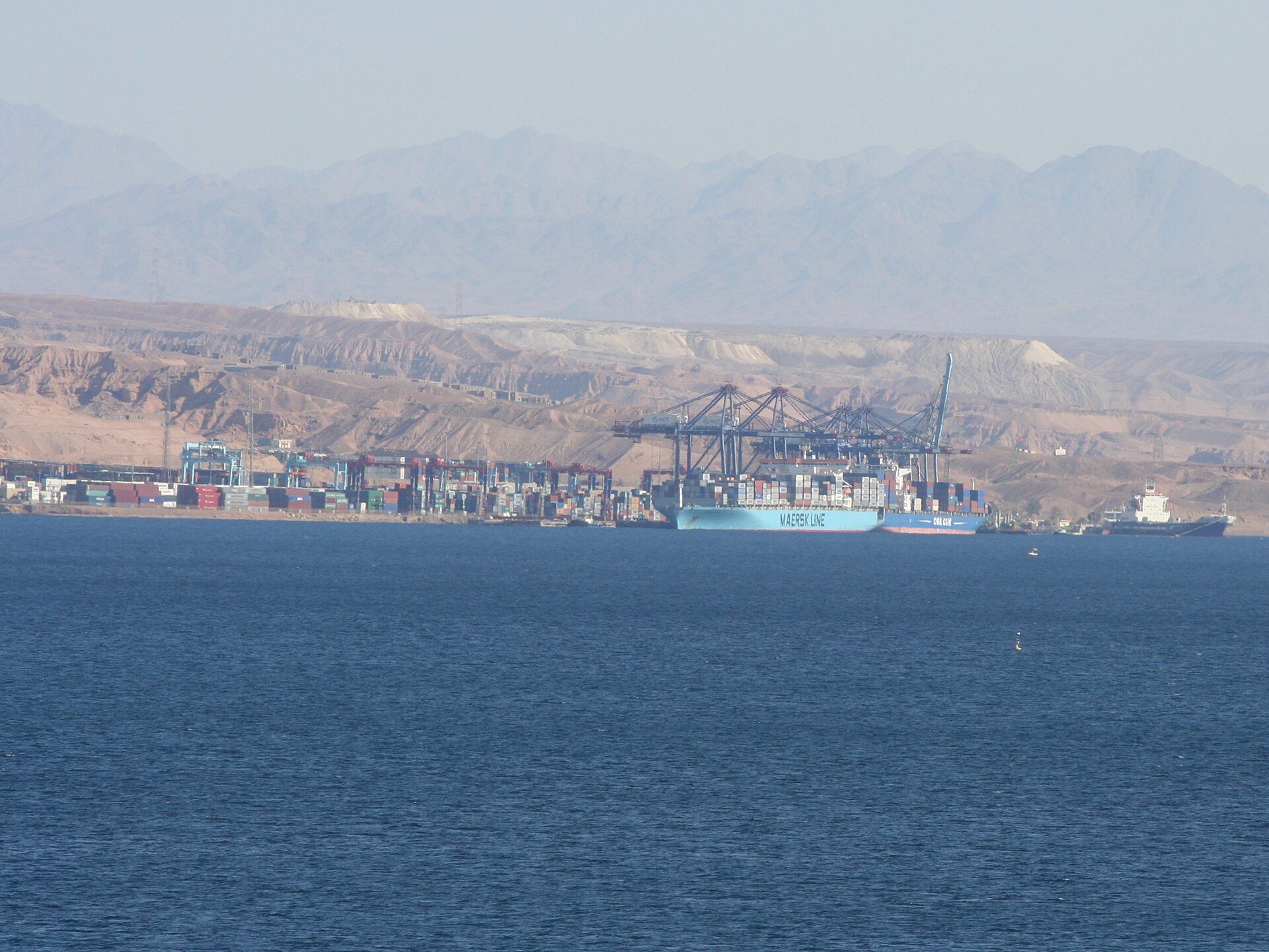
Jordan’s Aqaba port sits at the intersection of several of these investments. The container terminal handles 1.3-1.5 million TEUs annually; the oil terminal can process 20 million tonnes per year through a 24-metre draft berth. AD Ports Group signed a 30-year Aqaba concession in February 2026. If the northern rail corridor reaches operational capacity, Aqaba becomes a Red Sea loading point for Saudi freight that has traveled overland from the Gulf — crude and petrochemicals that never touched Hormuz. It also becomes the southern terminus of a route that can, via the Jordan-Syria-Turkey rail link, reach the Mediterranean without entering the Red Sea’s southern chokepoint at all.
| Infrastructure | Investment | Capacity / Status | Chokepoint Bypassed |
|---|---|---|---|
| SAR Gulf-to-Jordan corridor | Part of 5,500 km network | 1,700 km operational, 400 TEU/service | Hormuz |
| Turkey-Aleppo rail extension | $110 million | Under planning; 4-5 years to Saudi link | Both (Mediterranean exit) |
| Syria rail rehabilitation | $5.5 billion (total network) | 1,052 of 2,800 km operational | Both (overland transit) |
| UAE-Jordan Railway (Aqaba) | $2.3 billion | 360 km; financial close early 2027 | Hormuz |
| Port of NEOM | SR 7.5 billion ($2 billion) | T1: 900m quay, 18.5m draft | Hormuz |
| Aqaba Container Terminal | 30-year concession (AD Ports) | 1.3-1.5 million TEU/year | Hormuz |
| East-West Pipeline to Yanbu | Existing (1980s) | 7M bpd capacity; 4-5.9M bpd effective | Hormuz only |
Turkey’s Mediterranean Endgame
Ankara’s role in this corridor is not altruistic, and Uraloglu’s framing of the project was candid enough to make that clear. The line, he told Daily Sabah, would “create a significant economic impact by increasing export capacity and transit revenues.” Turkey has reopened the 350-kilometre Karkamis-Nusaybin line along its Syrian border — restoring freight and passenger service for the first time since 2013 — and plans to extend it to Aleppo at a cost of approximately $110 million. If the full corridor materialises, Turkey becomes the Mediterranean gateway for Gulf freight, a transit hub collecting fees on every container and every tonne of petrochemical product that moves from the Persian Gulf to European markets overland.
Uraloglu’s vision extends further than freight fees. The “modern Hejaz Railway,” in his formulation, would eventually reach Oman, “connecting the Red Sea to the Mediterranean and Europe” — a geographic description that positions Turkey as the indispensable transit state between two economic blocs. For a government that has spent a decade pursuing EU accession without success, becoming the physical link between Gulf capital and European markets offers a form of economic integration that does not require Brussels’s approval. The transit revenue potential alone is considerable: if even a fraction of the 30-50 percent Hormuz-diversion target materialises as overland freight through Turkey, Ankara would be collecting tariffs on Gulf exports at a scale comparable to Suez Canal transit fees.
There is, however, a less comfortable reading of Turkey’s corridor ambitions. Pressenza, an international press agency, framed the railway revival as “strategically encircling Israel” — a characterisation that reflects the corridor’s geographic reality even if it does not reflect its stated purpose. A rail line connecting Turkey to Saudi Arabia through Syria and Jordan does, cartographically, create a logistics arc around Israel’s eastern and northern borders. Whether that geometry is incidental to the corridor’s commercial logic or partially constitutive of its strategic appeal depends on which capital you ask, and none of them will give you an honest answer.
The Obstacles Nobody Is Discussing
The corridor faces constraints that the diplomatic communiques from Amman, Riyadh, and Ankara have conspicuously declined to acknowledge. The most immediate is governance risk in Syria, where al-Sharaa’s government controls most but not all of the territory through which the railway must pass, and where the institutional capacity to manage a multi-billion-dollar infrastructure programme is, at best, nascent. Badr’s $5.5 billion rehabilitation figure assumes a functioning procurement system, a stable security environment along the rail corridor, and a construction workforce that does not yet exist in the quantities required. The country has been at war for fifteen years, and no amount of Saudi investment commitment changes the fact that building 1,748 kilometres of railway through post-conflict territory is an engineering and security challenge without recent precedent.
The gauge compatibility problem, while technically solvable, is more complex than any party has publicly acknowledged. Turkey’s mainline and Saudi Arabia’s North-South Railway both use 1,435-millimetre standard gauge, but large stretches of Syria’s surviving network — particularly secondary lines and the original Hejaz Railway segments in Jordan — use 1,050-millimetre narrow gauge. A functioning corridor requires either complete relaying of narrow-gauge sections or break-of-gauge transfer points where freight is shifted between trains, both of which add cost and time that the four-to-five-year construction estimate may not fully account for.
Then there is the capacity question that nobody raising the corridor as a Hormuz alternative has adequately addressed. Saudi Arabia exported roughly 7-7.5 million barrels per day through Hormuz before the war. The SAR corridor’s current freight capacity — 400 TEUs per service — is designed for containerised goods, not crude oil. Moving crude by rail is technically possible (the United States does it extensively with Bakken shale oil) but requires dedicated tank car fleets, loading infrastructure, and throughput volumes that are orders of magnitude beyond what the current SAR corridor can handle. The corridor’s near-term value is for petrochemicals, manufactured goods, and non-oil exports — a meaningful complement to pipeline capacity, but not a substitute for the maritime crude volumes that flow through Hormuz. Aqaba’s oil terminal, at 20 million tonnes per year, could handle roughly 400,000 barrels per day of crude if fully dedicated to Saudi throughput — real money, but a fraction of pre-war Hormuz volumes.
The corridor’s strategic value, in other words, is not as a replacement for Hormuz but as a diversification that reduces the binary quality of Saudi Arabia’s current export geography. Even a corridor handling 10-15 percent of Saudi non-oil exports overland changes the calculus for any adversary contemplating a total maritime blockade, because it means that blockade cannot achieve a complete economic shutdown. For a country whose March production fell to 7.25 million barrels per day from February’s 10.4 million — a 30 percent drop that the IEA called “the largest disruption on record” — any margin of diversification is a margin of survival.
Jordanian Transport Minister Nidal al-Qatamin called the April 7 MOU “a qualitative leap toward building an advanced transport model,” and said Jordan aims to “strengthen its role as a regional logistics hub.” That is conventional transport-minister language from a country that has spent decades trying to capitalise on its geographic position between the Gulf and the Mediterranean. What makes it different in April 2026 is that Saudi Arabia, which has historically treated Jordanian transit corridor proposals with polite indifference, is now actively requesting joint committees and naming specific border crossing points. When the kingdom’s transport minister identifies the Jaber-Omari axis as the critical connection in a virtual meeting three days before the ceasefire expires, the conversation has moved beyond infrastructure planning and into contingency architecture.
FAQ
How would crude oil physically move through the northern corridor if the railway is designed for containerised freight?
In the near term, it would not — the SAR corridor’s 400-TEU capacity is engineered for containerised petrochemicals, industrial goods, and general freight, not bulk crude. Crude-by-rail requires dedicated tank car fleets and specialised loading terminals that do not currently exist on the Saudi or Jordanian networks. The medium-term scenario involves Aqaba’s oil terminal (20 million tonnes per year, approximately 400,000 barrels per day) as a transhipment point where pipeline-fed crude is loaded onto tankers exiting the Red Sea’s northern end — above the Bab el-Mandeb chokepoint — or, in a more ambitious configuration, directly onto Mediterranean-bound vessels if a pipeline spur from the Jordanian rail network to Aqaba is constructed. The US Bakken crude-by-rail model, which peaked at over 1 million barrels per day before pipeline capacity caught up, demonstrates that rail can carry crude at scale, but requires infrastructure investment the current corridor does not include.
Does the corridor create dependency on Syria’s political stability, replacing one vulnerability with another?
Yes, and Gulf planners appear to be pricing that risk differently than they did before February 2026. Pre-war, the risk calculus favoured known maritime routes over uncertain overland alternatives through post-conflict states. The war has inverted that preference: maritime routes through Hormuz and Bab el-Mandeb are now demonstrated vulnerabilities with adversary-controlled interdiction capability, while Syrian political risk — real as it is — does not come with an adversary who has declared “full authority to manage” the corridor. Saudi Arabia’s $2 billion Aleppo airport commitment and World Bank debt clearance function as down payments on Syrian alignment, creating financial dependencies that serve as soft guarantees of corridor access. The SMDA model with Pakistan — large financial commitments purchasing diplomatic options — appears to be the template.
What happens to the corridor if Turkey’s relationship with Gulf states deteriorates?
Turkey is the corridor’s greatest strategic asset (NATO membership makes it immune to IRGC kinetic interdiction) and its greatest single point of political failure. Ankara’s history of leveraging infrastructure dependencies for diplomatic concessions — its management of the Kirkuk-Ceyhan oil pipeline from Iraq, its periodic closures of the Bosporus to Russian naval vessels, its 2019 threat to “open the gates” of refugee flows to Europe — suggests that transit dependency on Turkey is not without risk. However, Turkey’s $9.6 billion annual gas trade with Iran — which includes a pipeline contract expiring July 31, 2026, according to Turkish energy ministry figures — creates counter-incentives against alienating Gulf customers who represent the corridor’s revenue stream. Ankara is unlikely to weaponise the corridor while simultaneously trying to replace Iranian gas with Gulf LNG imports.
Could Iran target the corridor’s Jordanian or Syrian segments without triggering NATO’s Article 5?
Targeting the Jordanian segment would risk activating Jordan’s bilateral defense agreements with the United States, the United Kingdom, and France — Jordan hosts a considerable volume of Western military assets, including an active drone operations base at Muwaffaq Salti. Targeting the Syrian segment is theoretically more feasible given the absence of formal defense treaties, but would require IRGC or proxy forces to operate in post-civil-war Syrian territory where Turkish military presence remains entrenched in the north. The corridor’s routing through multiple sovereignties means that interdicting it requires attacking at least one country with either NATO membership (Turkey) or major-power defense commitments (Jordan), which raises the threshold far above maritime interdiction where Iran can operate with relative impunity in its own territorial waters.
What is the realistic timeline before the corridor carries meaningful freight volumes?
The Saudi and Turkish segments are nearest to operational status — SAR’s 1,700-kilometre corridor is already running freight, and Turkey’s Karkamis-Nusaybin line reopened on April 14. The binding constraint is Syria’s 1,748 kilometres of damaged or non-functional track, which Badr estimates requires $5.5 billion and three to five years to rehabilitate. Uraloglu’s four-to-five-year estimate for connecting the full corridor to Saudi Arabia’s system aligns with Badr’s figure. A realistic assessment puts initial containerised freight service between the Gulf coast and Turkish Mediterranean ports at 2030-2031 at the earliest, with full-capacity operations dependent on Syrian political stability, sustained Gulf funding, and resolution of gauge compatibility issues across multiple national networks.
The political ratification of Saudi Arabia’s Syrian investment — including al-Sharaa’s deliberate decision to visit Riyadh before Doha and Abu Dhabi — is covered in Al-Sharaa’s Gulf Tour Locks Saudi Arabia Into Syria’s Post-War Architecture. The full Hormuz bypass calculus driving Saudi Arabia’s $13.1 billion commitment — why the pipeline corridor matters more than the reconstruction headline — is analysed in Saudi Arabia’s $13 Billion Syria Bet Is Really a Hormuz Bypass.