Table of Contents
- The Two-Day Gap That Could Define the War’s Legality
- What Does “State of Collapse” Actually Mean?
- Six Votes, One Trend Line
- The Koh Doctrine: Are Drone Wars “Hostilities”?
- Can Saudi Arabia Survive a US Withdrawal It Didn’t Request?
- Background: The War Powers Resolution and Its Limits
- Frequently Asked Questions
WASHINGTON — The 60-day clock on President Trump’s authority to wage war against Iran without congressional approval expires today, April 29, 2026 — the same day Trump posted on Truth Social that Iran had informed the United States it is in a “state of collapse” and wants Washington to reopen the Strait of Hormuz “as soon as possible.” The constitutional deadline and the presidential victory claim are now moving in opposite directions on the same calendar date, and the country caught between them is Saudi Arabia.
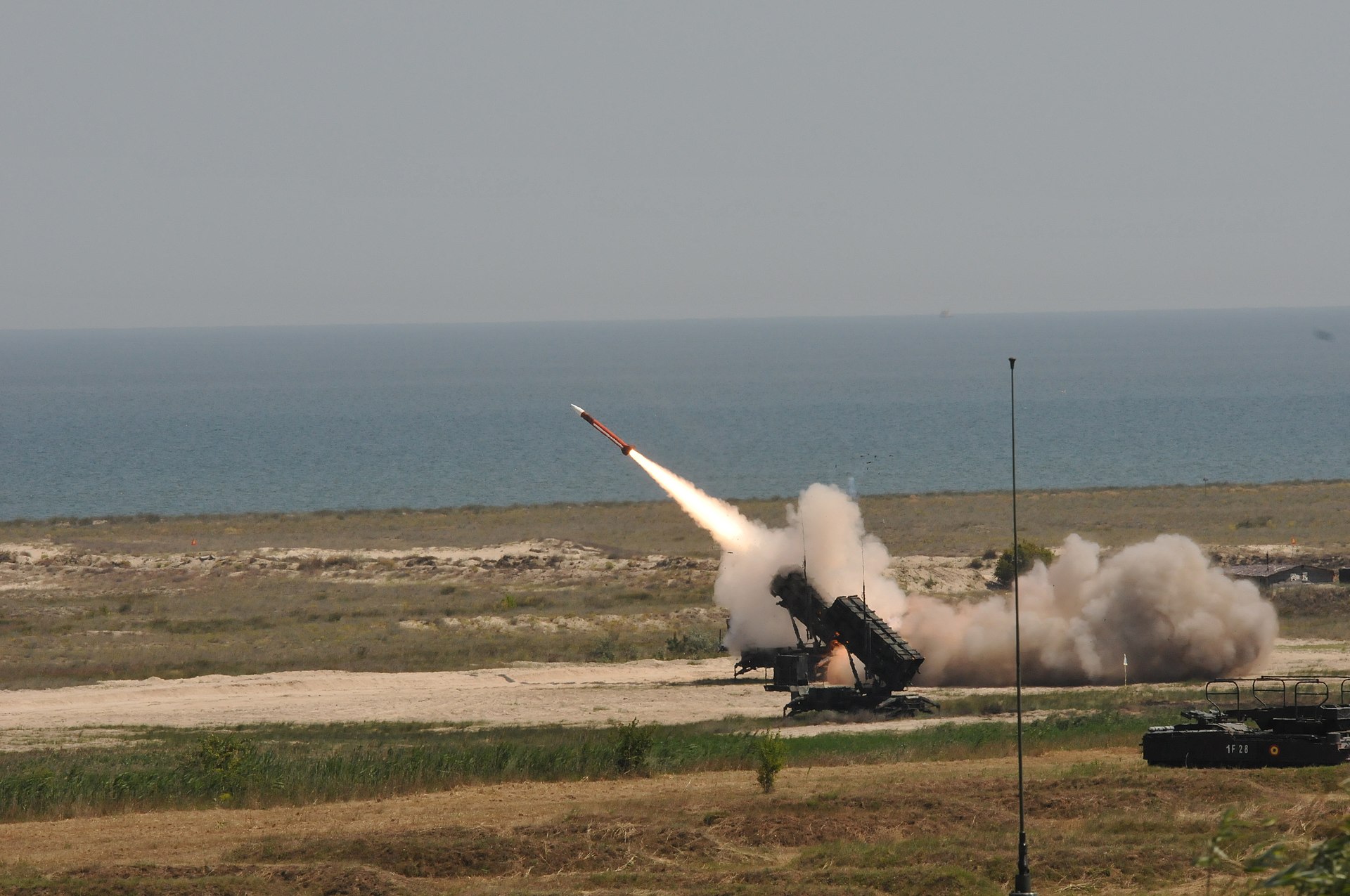
For Riyadh, neither outcome resolves the problem. If Congress legally terminates the war authorization, the approximately 20,000 US troops in theater — including the personnel who operate and supply targeting data for THAAD and Patriot batteries on Saudi soil — face a withdrawal timeline that Saudi Arabia has no power to influence. If instead the White House declares the war already won, the political logic for maintaining a forward-deployed force in the Gulf evaporates just as quickly. The difference between “we must leave” and “we already won” is a distinction that a country with roughly 400 PAC-3 interceptor rounds remaining — about 14 percent of its pre-war inventory — cannot afford to treat as academic.

The Two-Day Gap That Could Define the War’s Legality
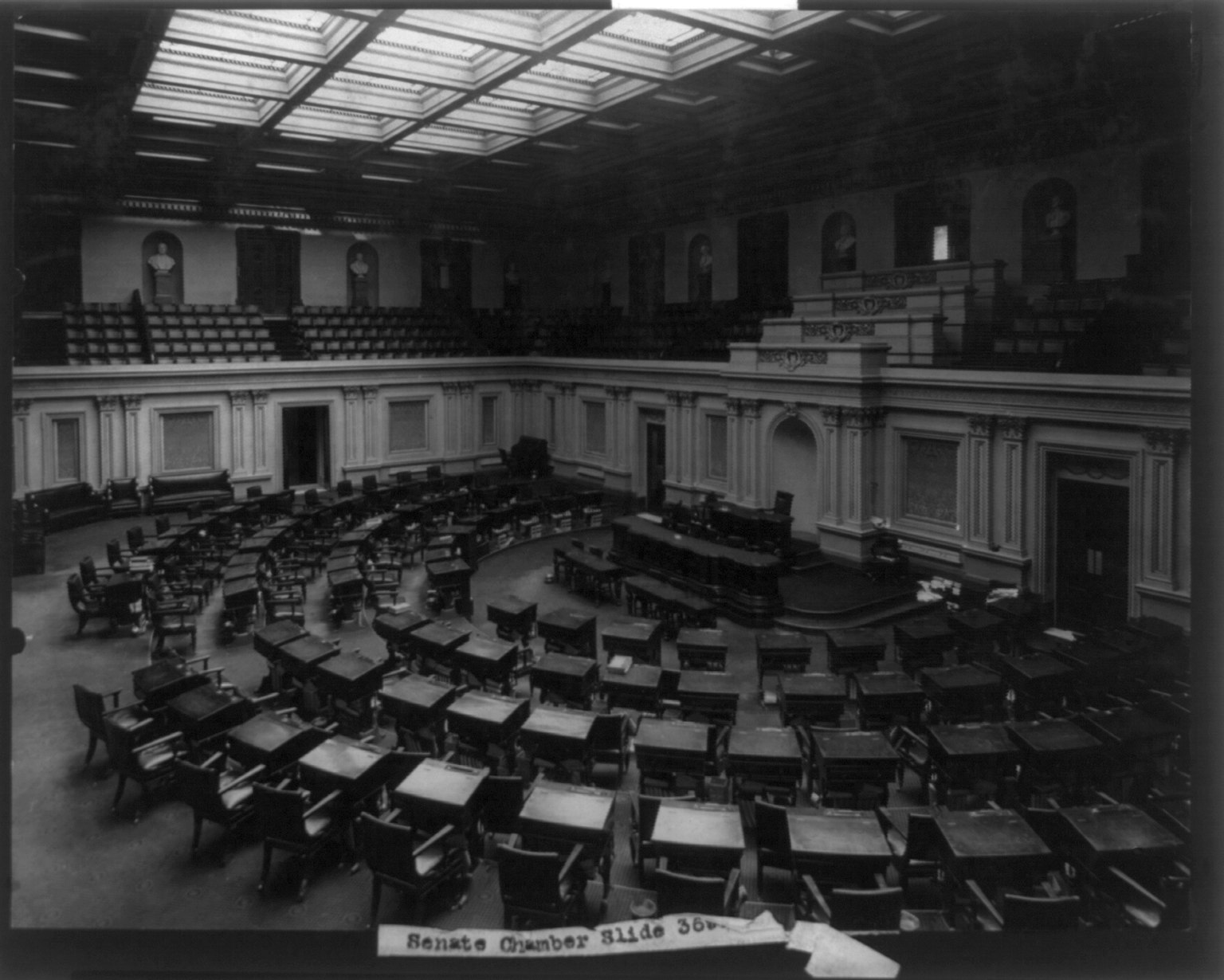
US and Israeli strikes against Iran began on February 28, 2026, which places the hard 60-day mark under Section 5(b) of the War Powers Resolution at April 29. The White House disputes this arithmetic. Its position is that the statutory clock runs not from the start of hostilities but from the date of formal congressional notification, which came on March 2 — pushing the deadline to May 1. The two-day gap has become its own front in the constitutional fight, with Senate Democrats insisting the plain text of the 1973 law requires no notification to start the timer and the administration arguing that the notification provision is the only mechanism that makes the clock operative.
Congress has not declared war. It has not passed an Authorization for Use of Military Force. It has not extended the 60-day deadline by statute. Under a strict reading of Section 5(b), none of the three conditions that would permit continued hostilities beyond the deadline has been met. A separate 30-day “safe withdrawal” extension exists in the law, but it requires the president to certify in writing that military necessity demands it — a certification Trump has not filed.
The administration’s fallback is more sweeping. Trump’s original congressional notification invoked his “inherent authority” as commander-in-chief, a constitutional claim that, if accepted, renders the entire War Powers Resolution advisory. Vice President Vance made the position explicit: “The War Powers Act is fundamentally a fake and unconstitutional law.” That framing places the debate outside statutory interpretation entirely and into a constitutional confrontation that no court has ever resolved on the merits.
The Middle East briefing 3,000+ readers start their day with.
One email. Every weekday morning. Free.
What Does “State of Collapse” Actually Mean?
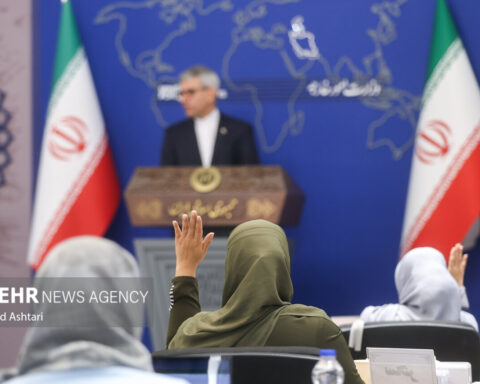
Trump’s April 28 Truth Social post read: “Iran has just informed us that they are in a ‘State of Collapse.’ They want us to ‘Open the Hormuz Strait,’ as soon as possible, as they try to figure out their leadership situation.” He did not identify who delivered the message, through what channel, or what “state of collapse” meant operationally. Tehran has not confirmed any such communication. IRGC-affiliated media outlets have maintained the opposite posture — that Iran would not participate in another negotiation round due to what Critical Threats characterized as “excessive US demands.”
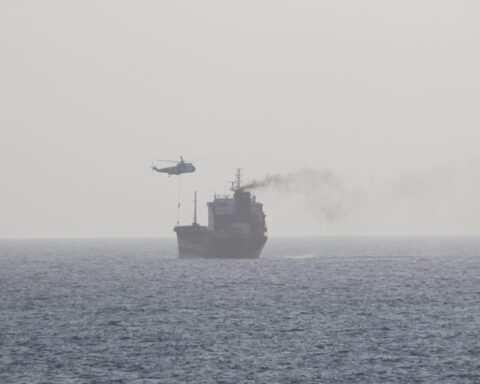
The claim arrived the same day Trump convened an NSC meeting to review Iran’s Hormuz-for-blockade proposal, in which Tehran offered to reopen the strait in exchange for the lifting of the US naval blockade imposed April 13. Three sources told CBS News and Time that no decision was reached, with Trump reportedly not inclined to accept because the proposal deferred nuclear talks. The “collapse” framing thus sits alongside an active Iranian diplomatic initiative — an odd pairing if taken at face value, and a politically convenient one if understood as pre-positioning for the war powers vote.
For Saudi Arabia, the content of the claim matters less than its domestic function. If Iran is collapsing, the war is over, and the case for maintaining 20,000 troops in the Gulf weakens on both sides of the aisle. Republican hawks who voted to defeat the first five war powers resolutions did so on the argument that the mission was unfinished. Iran’s internal fractures — Pezeshkian publicly accusing Vahidi and Abdollahi of wrecking the ceasefire — are real, but they do not translate into the kind of strategic capitulation that would justify a presidential declaration of victory while the IRGC still controls the Strait of Hormuz and Saudi Arabia has not recovered a single barrel of its lost production.
The War Powers Act is fundamentally a fake and unconstitutional law.
— Vice President JD Vance, CNN interview, April 25, 2026
Six Votes, One Trend Line
The Senate has now held five votes on war powers resolutions related to the Iran campaign, defeating each one. The fifth vote, on April 23, failed 46-51. The fourth had failed 47-52. The margin has held at approximately five votes across the final two recorded rounds, though the cumulative pressure of repeated votes is altering the political calculus for Republicans in competitive states. Senator Rand Paul of Kentucky has been the sole Republican voting to advance every resolution. Senator John Fetterman of Pennsylvania has been the sole Democrat voting against.
Democrats announced a sixth vote timed to the April 29 deadline. Senators Tim Kaine, Adam Schiff, and Ruben Gallego scheduled the vote on April 28. The outcome is unconfirmed at time of writing, and the margin in previous votes suggests it is unlikely to pass — but the political cost of each successive “no” vote is rising for Republicans in swing states as the war extends into its third month with no congressional authorization and no clear exit strategy.
The House presents a tighter picture. Its own resolution to end hostilities failed by a single vote. Representative Brian Fitzpatrick, a Pennsylvania Republican, introduced a separate Republican-sponsored Iran War Powers Resolution, fracturing what had been a largely party-line position. The one-vote margin means that a single Republican defection, retirement, or absence could flip the chamber — a structural fragility that the White House cannot solve through whip counts alone.
The Koh Doctrine: Are Drone Wars “Hostilities”?
The administration’s most creative legal argument comes from Harold Koh, the State Department lawyer who made the same case for the Obama administration during the 2011 Libya campaign. Koh has testified that the Iran campaign does not constitute “hostilities” under the War Powers Resolution because the majority of strikes are conducted by drones and standoff weapons, meaning US forces are not “really in danger.” The argument redefines “hostilities” as a function of American casualties rather than the volume of ordnance dropped on another country.
Peter Shane, a constitutional law scholar at NYU, told CNN it is “difficult to give a definitive answer” on the constitutionality of continued operations “because there is so much disagreement about how the Constitution should be interpreted” with respect to presidential use of force. That ambiguity is the administration’s operating space. As long as the legal question remains genuinely unsettled, the political question — whether Congress has the votes to force the issue — becomes the only one that matters.
Jack Goldsmith of Harvard Law School put it more bluntly in a piece published the day the strikes began: “Law Is Irrelevant to the U.S. Attack on Iran.” His argument was not that the war is legal but that the war powers debate “deflects attention from Congress’s constitutional responsibility to exercise its political judgment.” The WPR has never compelled a president to withdraw. The closest precedent — Clinton exceeding the 60-day deadline by approximately 18 days during the Kosovo campaign — ended with the D.C. Circuit dismissing the case in Campbell v. Clinton as non-justiciable. Democrats are reportedly discussing litigation, but Campbell is the controlling precedent, and it went against Congress.
Can Saudi Arabia Survive a US Withdrawal It Didn’t Request?
The Carnegie Endowment published its assessment in April 2026: Gulf states are “vulnerable” without US support because “Iranian missiles can easily penetrate their airspace, and interceptor stocks are low.” Saudi Arabia and the UAE, Carnegie concluded, cannot act jointly in combat “without the support of the United States.” The New Lines Institute arrived at a complementary finding — that the war “increases pressure on Saudi Arabia to improve deterrence and establish security frameworks independent of U.S. decision-making in the region.” The Quincy Institute reported that Qatar and Saudi Arabia are “reassessing their reliance on the US.”
These are diplomatic formulations of a concrete problem. Saudi Arabia’s 51 percent procurement milestone — the share of defense contracts awarded domestically — masks a dependency on American operators for the systems that matter most in an active missile war. If those personnel withdraw, Saudi operators assume full responsibility for platforms they have not independently managed under combat conditions. New PAC-3 deliveries are not scheduled until mid-2027. The 400 remaining rounds must cover a threat environment that has already consumed 86 percent of pre-war stocks.
Saudi production has dropped from 10.4 million barrels per day in February to 7.25 million in March — a 30 percent decline that the IEA called the “largest disruption on record.” The fiscal break-even price sits between $108 and $111 per barrel. Brent is trading around $111, which means the Kingdom is operating at the edge of solvency with no buffer. Goldman Sachs has estimated a war-adjusted budget deficit of 6.6 percent of GDP, nearly double the official 3.3 percent projection. The legal authority that underpins the American presence is now the thinnest link in the chain holding Saudi Arabia’s wartime economy together.
The constitutional confrontation in Washington is not, from Riyadh’s vantage, an abstract separation-of-powers debate. It is a countdown. Whether the war ends because Congress says it must or because the president says he already won, the 20,000 US troops and the air defense architecture they operate become a question rather than a fact. Three carrier strike groups deployed without Saudi consultation arrived under presidential authority that may no longer exist by the end of the day. The gap between Saudi Arabia’s defense needs and its independent capacity to meet them has never been wider, and the domestic American politics driving the withdrawal debate have never been less interested in what Riyadh thinks about it.
Iranian missiles can easily penetrate their airspace, and interceptor stocks are low. [Gulf states] cannot act jointly in combat without the support of the United States.
— Carnegie Endowment for International Peace, April 2026
Background: The War Powers Resolution and Its Limits
The War Powers Resolution was enacted on November 7, 1973, over President Nixon’s veto, in response to the undeclared Vietnam War. Section 5(b) requires the president to terminate the use of armed forces within 60 days of introducing them into hostilities unless Congress declares war, passes an AUMF, or extends the deadline. Every president since Nixon has questioned the law’s constitutionality, and none has conceded that it binds the commander-in-chief.
In Campbell v. Clinton — the Kosovo precedent discussed above — the D.C. Circuit dismissed on standing grounds because Congress had sent contradictory signals: it voted down both an authorization and a withdrawal resolution simultaneously. The ruling established that courts are unlikely to intervene unless Congress speaks with one voice. Congress has not done so in the current conflict. The House failed its withdrawal resolution by a single vote; the Senate has failed five.
The Iran campaign now sits at the same inflection point, with one difference in scale. Kosovo involved no direct threat to US forces and no allied state dependent on American air defense for survival during the operation. The double blockade of the Strait of Hormuz — the US controlling the Arabian Sea entry since April 13 and the IRGC controlling the Gulf of Oman exit since March 4 — means that a legal termination of hostilities would require unwinding not just combat operations but an active naval interdiction regime that the global oil market has already priced in.
Frequently Asked Questions
What happens if the 60-day deadline passes and Trump does not withdraw?
Nothing automatic. The War Powers Resolution contains no enforcement mechanism — no funding cutoff triggers, no automatic injunction, no penalty for non-compliance. Congress’s options are to pass binding legislation cutting off funding (which requires a veto-proof majority), to sue (where Campbell v. Clinton is unfavorable precedent), or to use the political process — impeachment, confirmation holds, appropriations riders — to force the issue. The practical effect of the deadline passing without action is that the war continues in a constitutional grey zone where the president claims inherent authority and Congress claims it never authorized hostilities, with neither branch willing to force the confrontation to a judicial resolution.
Has any president ever complied with the 60-day deadline?
President Ford withdrew forces from the Mayaguez incident (1975) well within the window, and President Reagan notified Congress during the Lebanon deployment (1982-1984) but negotiated an 18-month extension. No president has been forced to withdraw by the clock. The pattern since 1973 has been consistent: presidents comply when they want to withdraw anyway and ignore the deadline when they do not. The resolution’s power has always been political rather than legal — it exists to create a public accountability moment, not to physically prevent a president from continuing military operations.
Could Saudi Arabia invoke its bilateral defense agreements independently of the war powers debate?
Saudi Arabia does not have a formal mutual defense treaty with the United States comparable to NATO’s Article 5 or the US-Japan Security Treaty. The US-Saudi security relationship rests on a series of executive agreements, arms sales frameworks, and informal understandings dating to the 1945 Roosevelt-Ibn Saud meeting aboard the USS Quincy. The absence of a treaty ratified by the Senate means the entire US military presence in Saudi Arabia operates under executive discretion — the same executive discretion that the War Powers Resolution was designed to constrain. If Congress terminates the authorization, Saudi Arabia has no independent legal mechanism to compel the US to maintain forces on its soil.
Why has Senator Fetterman voted against every war powers resolution?
Fetterman has not given a comprehensive public explanation, but his office has cited support for Israel’s security operations and opposition to what he characterized as premature withdrawal while hostilities are ongoing. His position makes him the only Democratic senator to break with the party on every Iran war vote, mirroring Rand Paul’s role as the sole Republican dissenter in the opposite direction. The bipartisan nature of the dissent — one defector on each side — has kept the margins stable through five votes, with both sides effectively anchored by mirror-image outliers.
What is the IRGC’s actual position on the “state of collapse” claim?
IRGC-affiliated media outlets — Tasnim, Fars, and Mehr — have not reported any communication to the US describing Iran as being in a “state of collapse.” Maj.-Gen. Ali Abdollahi, commander of Khatam al-Anbiya, warned in mid-April that the US blockade could end the ceasefire, a posture inconsistent with capitulation. The IRGC Navy continues to operate what amounts to an administrative checkpoint regime in the Strait of Hormuz. Iran’s formal negotiating position, as articulated through the Pakistan-mediated Islamabad process, includes a 10-point plan whose seventh point demands IRGC “coordination” authority over the strait as a treaty requirement — not the language of a state describing itself as collapsed.