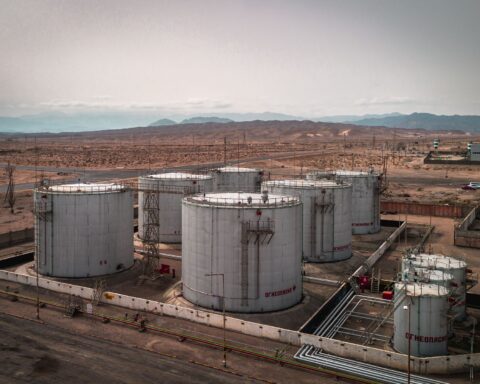
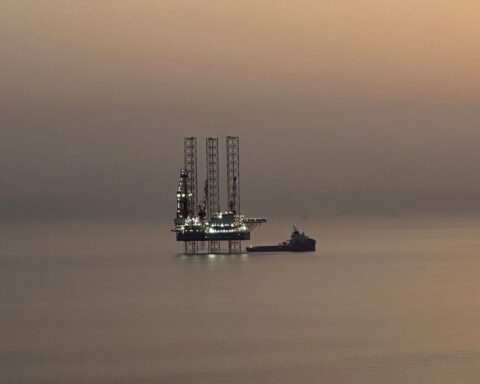
TEHRAN — Iran’s onshore oil storage reached functional capacity on or around April 26, triggering the forced shut-in of wells across the country’s aging southwest oil fields — and initiating a process of irreversible underground reservoir damage that no ceasefire, whenever it comes, can undo. The crisis marks a turning point in the war’s economic logic: the IRGC command structure blocking a diplomatic resolution is now actively destroying the physical asset base that any post-war Iranian recovery depends on.
The distinction matters because it changes what Iran loses. Foregone export revenue — the $435 million per day the Foundation for Defense of Democracies estimates the US naval blockade costs Iran — is a recoverable loss, at least in theory. Tankers sitting at sea can eventually deliver their cargo. But wells forced into prolonged shut-in undergo geological processes that permanently reduce the volume of oil that can ever be extracted from the reservoir. Water pushes into oil-bearing rock. Paraffin clogs tubing. Sand settles into perforations. The field doesn’t recover its pre-shutdown output — not in months, not in years, not ever.
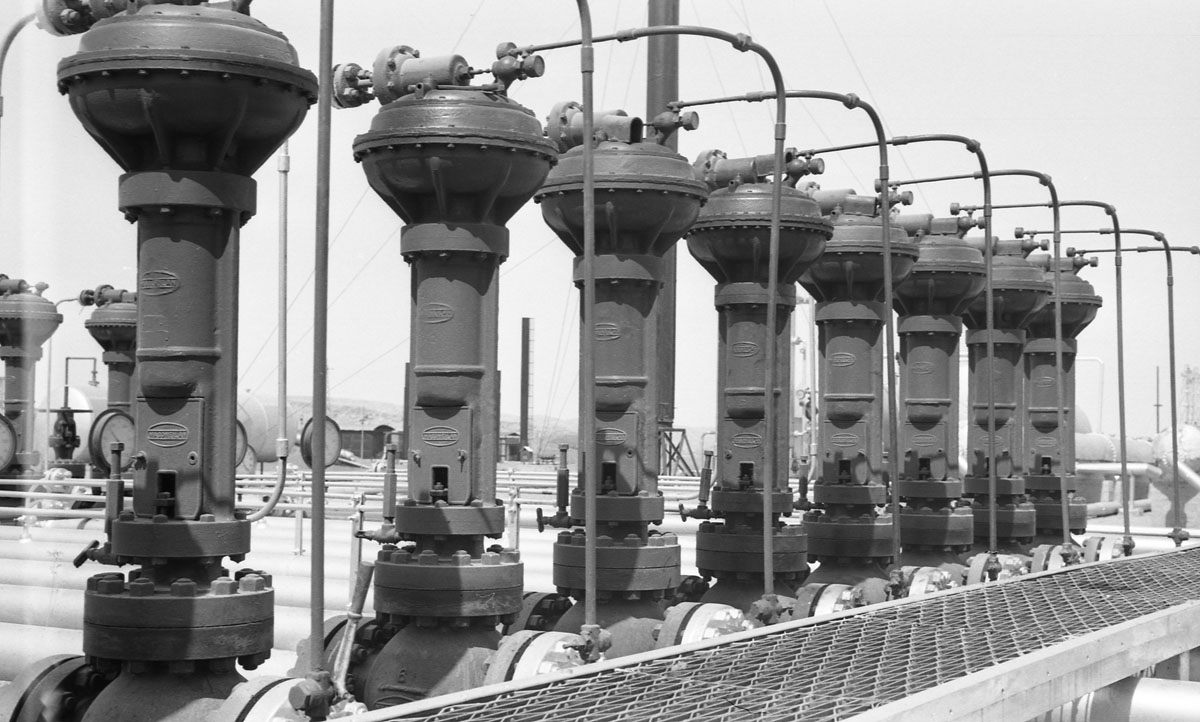
Table of Contents
What Happens When an Oil Well Shuts Down
The petroleum engineering is straightforward, and the timeline is merciless. According to analysis published by the SPE Journal of Petroleum Technology, forced well shut-ins that last beyond four days begin breaking the pressure equilibrium that keeps oil, water, and gas in their respective zones underground. The mechanism most dangerous to Iran’s mature fields is water coning: when pumping stops, the water sitting below the oil zone — held in place during normal operations by the pressure differential created by active production — pushes upward into the wellbore and invades oil-bearing rock, permanently trapping crude in pore spaces that become unrecoverable.
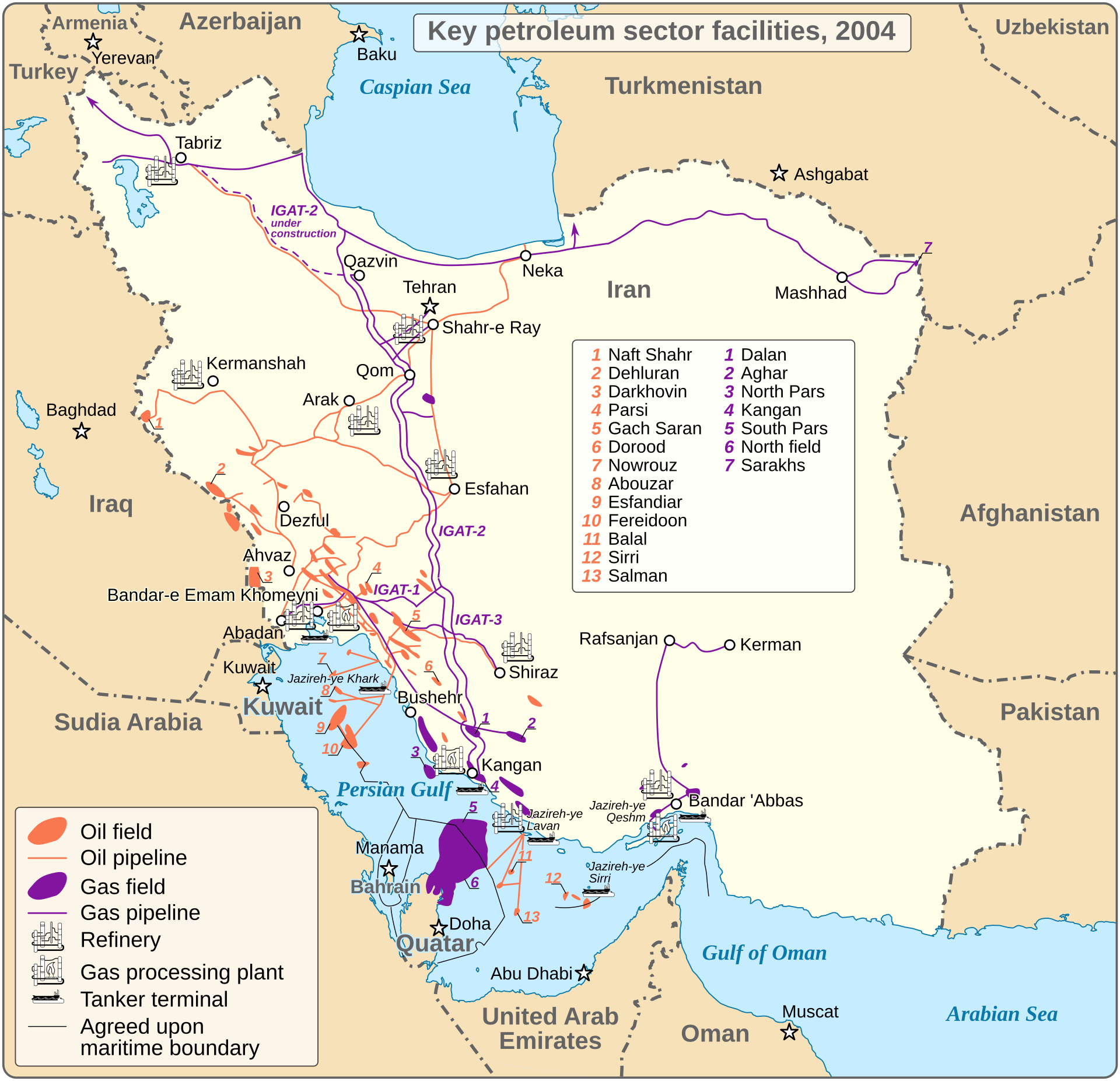
Iran’s fields are uniquely vulnerable to this process. About 80 percent of Iran’s production comes from aging fields, and roughly half of those are more than 70 years old, according to the US Energy Information Administration. The Aghajari field was discovered in 1938, Gachsaran in 1937, Ahvaz in 1958. These fields already decline at 8 percent per year onshore and 10 percent offshore under normal conditions, according to IEA field-decline studies. Many operate with high water cuts and depleted natural drive — precisely the conditions under which shut-in damage accelerates fastest. Research published on the Asmari carbonate formation, the dominant producing horizon in southwest Iran, shows that production rates must be maintained below 1,500 stock-tank barrels per day per well to prevent water coning even during normal operation, according to Iranian reservoir studies published in the Journal of Petroleum Science and Engineering.
Matt Randolph, an Oklahoma-based oil industry veteran, has outlined the restart arithmetic: small fields take two to three weeks to restart after a forced shut-in, larger fields up to five weeks, and refineries 10 to 15 days if undamaged. But those timelines assume the wells haven’t suffered irreversible formation damage during the shutdown period — an assumption that becomes less tenable with every day past the four-day threshold.
How Much Production Is Iran Losing Permanently?
Energy News Beat, citing petroleum engineering analysis, estimates that forced shutdowns will permanently eliminate 300,000 to 500,000 barrels per day of Iran’s production capacity — equivalent to $9 billion to $15 billion in annual revenue that can never be recovered, regardless of when sanctions lift or Hormuz reopens. The same analysis documents an average 20 to 30 percent productivity loss in oil rate upon restart after prolonged shut-ins.
The Middle East briefing 3,000+ readers start their day with.
One email. Every weekday morning. Free.
Historical data from the SPE Journal of Petroleum Technology reinforces the severity: during the oil-price downturns of 2008–2009 and 2014–2016, one-third of wells that were shut in globally never returned to significant commercial production. Two-thirds resumed, but with varying and often diminished performance. Those shutdowns were voluntary, managed, and conducted with proper well-preservation procedures by operators who intended to restart. Iran’s shutdowns are involuntary, rushed, and occurring across a fleet of wells whose operators have had no opportunity to prepare — and in fields already operating at the margins of reservoir integrity.
Iran’s crude output was already falling before the wellhead crisis hit. Production dropped from 3,241,000 barrels per day in February 2026 to 3,060,000 bpd in March, a 5.6 percent month-on-month decline tracked by Trading Economics and CEIC Data. That 181,000-barrel drop reflected the early stages of the blockade’s impact on export logistics. The reservoir damage now accumulating will compound that decline into a structural deficit that persists long after the war ends.
The Storage Wall
The physics that drove Iran to this point are elementary. Iran’s onshore oil storage capacity is approximately 50 to 55 million barrels, of which roughly 60 percent was already full as of mid-April, according to analysis by Iran International and the Foundation for Defense of Democracies published on April 13. That left approximately 20 million barrels of spare capacity. At 1.5 million barrels per day of trapped surplus production — crude that would normally flow to export terminals but has nowhere to go under the functional closure of the Strait of Hormuz — that margin fills in approximately 13 days, a hard physical deadline that diplomacy cannot extend. April 13 plus 13 days is April 26, and the wall is here.
Iran does have approximately 183 million barrels of floating storage on tankers at sea, according to Kpler data reported in late April. But floating storage absorbs export-revenue disruption — it is crude already produced, already above ground, already past the wellhead. It does nothing to solve the production-side geological damage accumulating underground as wells are forced shut. These are two separate problems running on parallel clocks, and the reservoir clock is the one that cannot be rewound. The storage saturation is the trigger; the wellhead damage is the consequence.
Why Can’t Araghchi Fix This?
The structural answer is that Iran’s civilian government runs the National Iranian Oil Company but cannot compel the IRGC, which holds effective authority over the Strait of Hormuz and ceasefire decisions. Foreign Minister Abbas Araghchi cannot open the Strait even if he wants to, as this publication has documented — the authorization ceiling runs through SNSC Secretary Ali Akbar Ahmadian, IRGC overall command under Secretary Vahidi, and Supreme Leader Khamenei, who has been absent from public view for over 50 days.
President Pezeshkian has publicly accused Vahidi and IRGC deputy commander Abdollahi of wrecking the Islamabad ceasefire talks — naming them directly as the officials who deviated from the delegation’s mandate. But under Article 110 of Iran’s constitution, the president has zero authority over the IRGC. Pezeshkian has warned IRGC senior leadership that Iran’s economy could face “total collapse” within three to four weeks without a ceasefire, according to reporting by The Defense News and Algemeiner. The wellhead overflow crisis is the physical mechanism through which that collapse is now manifesting.
The collapse of the Islamabad diplomatic channel after Trump cancelled his trip has removed the most active venue for ceasefire negotiations, compressing the timeline further. Whatever diplomatic pathway eventually emerges will inherit a fundamentally diminished Iranian oil sector — not because of sanctions or airstrikes, but because the wells themselves will have been damaged beyond full recovery.
The IRGC Is Destroying Its Own Revenue Base
The institutional paradox is acute. Iran International’s Dalga Khatinoglu reported on April 3 that the IRGC’s budget for fiscal year 2025–2026 allocated one-third of projected oil export proceeds — approximately 600,000 barrels per day, worth an estimated $12.4 billion annually — directly to the armed forces. That allocation was set to rise to 50 percent of total oil revenue in the next fiscal year. The IRGC is, by a wide margin, the single largest institutional beneficiary of Iranian oil exports.
Yet it is Vahidi’s IRGC command structure that is blocking the ceasefire that would reopen Hormuz and allow those exports to resume. As an unnamed author in Small Wars Journal observed on April 13, the IRGC “behaves less like an apocalyptic movement than a regime elite with assets to protect” — controlling more than half of Iran’s GDP across oil, construction, banking, telecommunications, ports, and Tehran’s airport. The wellhead overflow crisis means the IRGC is now destroying the upstream infrastructure that generates its own institutional income. Every additional day of shut-in permanently reduces the production capacity from which that 50-percent revenue share will eventually be drawn.
Economist Mohammad Machinechian told Iran International on April 24 that “even in the best-case scenario, inflation could average at least 5 percent a month, meaning prices rise around 80 percent over a year.” His colleague Arash Azarmi described the situation as “a modern famine, where goods remain available but are increasingly unaffordable.” Iran’s Central Bank has issued an internal memo projecting 180 percent inflation and a 12-year economic recovery timeline — and that assessment addressed macro-fiscal damage, not the permanent upstream production losses now accumulating underground.
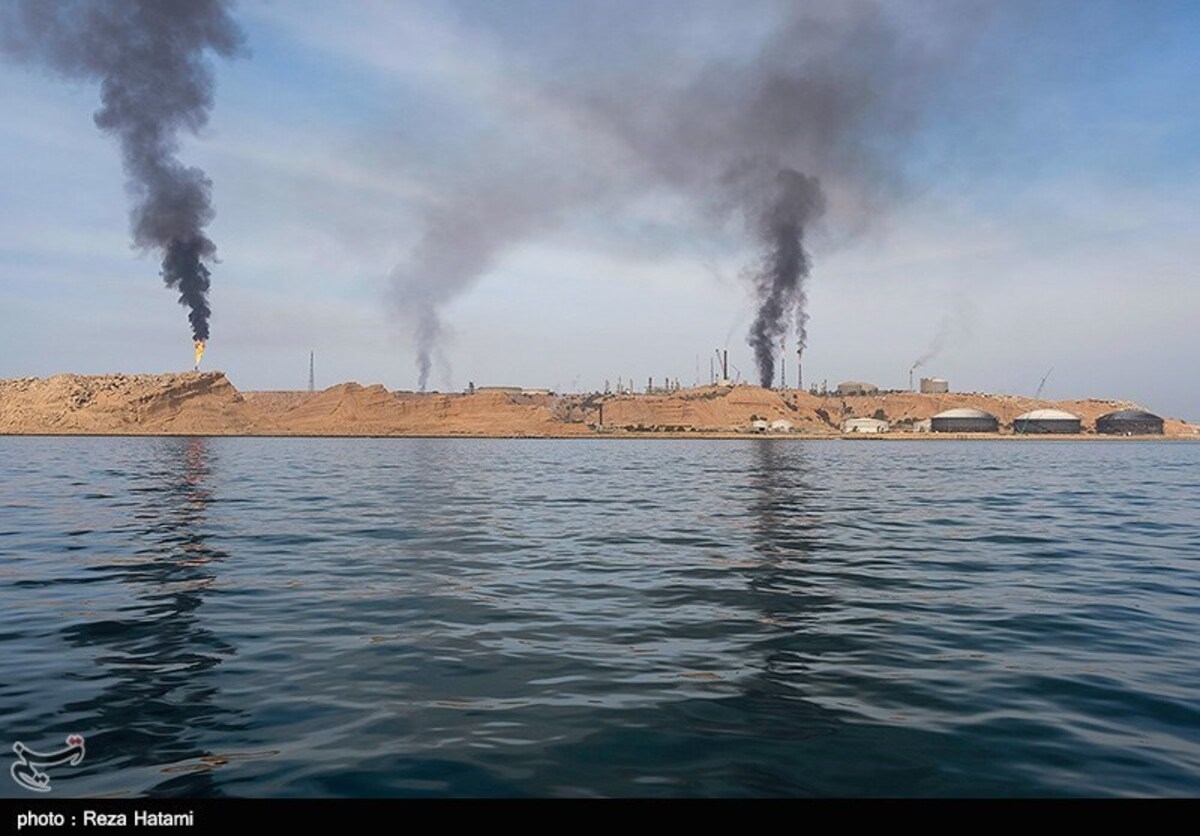
What Does Post-War Recovery Actually Look Like?
The damage has layers. Rystad Energy estimates that Iran’s energy infrastructure has sustained up to $19 billion in direct physical strike damage from the war — refineries bombed, pipelines hit, processing facilities destroyed. Rystad’s Karan Satwani assessed that total regional energy infrastructure repair costs now stand at $34 billion to $58 billion, with Iran accounting for roughly one-third. Full production recovery from strike damage alone could take two years, Rystad estimated.
But that $19 billion figure covers above-ground damage — the visible, repairable kind. The wellhead overflow crisis is adding a second, invisible layer of permanent underground damage that accumulates silently and cannot be repaired by spending money on reconstruction. A bombed refinery can be rebuilt. A reservoir invaded by water cannot be drained back to its pre-shutdown state. The geology does not negotiate.
The South Pars gas field illustrates how these damage layers compound. South Pars supplies 70 percent of Iran’s domestic gas and drives associated liquids production. An Israeli strike on March 18 destroyed refinery units #4 and #7, knocking 12 percent of Iran’s total gas production offline and halting gas exports to Iraq, according to CBS News and Jerusalem Post reporting. That is above-ground strike damage requiring physical reconstruction. Now add the below-ground reservoir damage from shut-in wells in associated liquids production, and the recovery timeline extends further — into territory where Iran’s pre-war production capacity may never be fully restored.
Vitol CEO Russell Hardy, speaking at the FT Commodities Global Summit in Lausanne on April 21, put a number on the aggregate supply destruction: 600 to 700 million barrels of oil production already lost as of that date, heading toward one billion barrels of permanent supply loss. The IEA has characterized the overall disruption as “the largest supply disruption in the history of the global oil market,” with Hormuz flows falling from over 20 million barrels per day pre-war to approximately 3.8 million bpd by early April — just 19 percent of pre-war throughput.
Does Iran Have Historical Precedents to Draw On?
Libya’s experience after the 2011 civil war offers the closest parallel. Libyan production fell from 1.7 million barrels per day pre-war to 500,000 bpd during hostilities. Even after fighting ended, the new government projected “at least two to three months” to reach 500,000 to 600,000 bpd and “at least a year” to restore pre-war levels, according to Washington Post reporting in March 2013. The critical constraint was reservoir damage: most of Libya’s production came from mature fields requiring pressure maintenance by water and gas injection, and “the abnormal shut-down of production from such reservoirs may have caused damage to producing wells that is difficult to mend without complete reworking,” the EIA’s Libya country analysis noted.
Iran’s situation is worse on every relevant dimension. Iran’s fields are older, more depleted, higher in water cut, and operating with less modern equipment — the result of decades of sanctions limiting access to Western oilfield technology. Iran also lacks the mine-clearance capacity to reopen Hormuz quickly even if a ceasefire were signed tomorrow, meaning the shut-in period will extend well beyond any agreement date.
Kuwait’s 1991 experience, while different in mechanism — over 750 of 943 wells were set on fire or physically damaged — illustrates the timeline. The last fire was not extinguished until November 1991, nine months after the war ended. Iran’s damage is more insidious: geological, invisible, and accumulating without a single flame to mark it.
Background
Iran entered the war with a pre-existing upstream vulnerability that decades of sanctions had created. Before the conflict began on February 28, 2026, NIOC had been attempting to address its aging field infrastructure: on January 15, President Pezeshkian presided over a $2.5 billion contract-signing ceremony for 20 new onshore drilling rigs and a $1.7 billion crude processing deal, according to PressTV. That pre-war infrastructure push is now moot.
The country’s official position continues to insist the Strait is open. On April 24, Iranian state media declared Hormuz “completely open” — the same week the IRGC seized the container ships MSC Francesca and Epaminodes on April 22. This dual messaging makes normal production planning and export scheduling impossible. Iranian state media has not publicly disclosed production shut-in data or acknowledged wellhead damage; NIOC has issued no public statement on reservoir integrity since the war began.
Former US Ambassador to Bahrain Adam Ereli told Al Jazeera on April 24 that Iranians “have prepared for this eventuality” with “alternative means” for oil storage and sales, able to “outlast Trump’s patience.” Frederic Schneider of the Middle East Council on Global Affairs assessed that Iran “seems to be playing the longer game.” Former Congressional Research Service analyst Kenneth Katzman estimated Iran’s oil-at-sea supplies could sustain revenue flows “until August.” But none of these assessments address the wellhead damage question. Revenue from floating storage is a separate accounting line from the permanent destruction of production capacity underground. Iran can sell the oil it already pumped, but every day of continued shut-in reduces how much oil it will ever be able to pump again.
Saudi Arabia has been lobbying Washington to lift the Hormuz blockade because the economic math stopped working for Riyadh — Saudi production crashed 30 percent in March, and Aramco cut its Arab Light OSP for Asia for the first time in three months. But for Iran, the math is not merely unfavorable; it is becoming physically irreversible. Saudi Arabia can restore lost production when the Strait reopens. Iran cannot — not fully, not for years, and possibly not ever to pre-war levels.
FAQ
What is wellhead overflow?
Wellhead overflow is the point at which oil storage capacity is completely full and production physically cannot continue — wells must stop pumping because there is nowhere to put additional crude. The term distinguishes a full-stop forced shut-in from a temporary logistics bottleneck: once storage hits capacity, even a well that could produce has no legal or physical path to do so. In Iran’s case, the overflow point also triggers reservoir damage, because the shut-in that follows lasts long enough to initiate geological processes that are irreversible.
Why is shut-in damage permanent?
Restarting a shut-in well does not restore the underground conditions that existed before shutdown. Water that has coned up into oil-bearing rock cannot be pushed back down; the crude it has trapped in pore spaces is stranded permanently. Paraffin that has solidified in production tubing must be physically cleared, and perforations packed with sand require workover operations that are expensive and often only partially effective. The well may produce again, but it will produce less — and in Iran’s carbonate reservoirs, where water coning is already a challenge at normal production rates, the damage compounds with time.
How much production will Iran lose permanently?
The 300,000 to 500,000 barrels per day figure cited by petroleum engineers represents capacity destruction — production Iran will never be able to achieve again regardless of when the war ends. The more consequential framing may be the restart-rate discount: wells that do return to production typically do so at 70 to 80 percent of their pre-shutdown rate. Applied across Iran’s roughly 3 million bpd output base, a 20 to 30 percent discount on restarted wells — assuming two-thirds of shut-in wells restart at all — implies a post-war ceiling well below any pre-war production target Iran has set.
Can Iran prevent the damage by shutting wells down properly?
Proper well-preservation procedures — injecting corrosion inhibitors, maintaining pressure with cushion fluids, installing downhole plugs — can mitigate but not eliminate shut-in damage in mature fields with high water cuts. Iran’s ability to conduct managed shutdowns is limited by the speed of the storage crisis, the age and condition of its well infrastructure, and decades of restricted access to Western oilfield technology and services due to sanctions.
How does this affect the ceasefire calculus?
The wellhead crisis transforms the ceasefire question from a diplomatic problem into an engineering one with a running clock. Before April 26, the IRGC’s calculus involved a choice between continued blockade revenue leverage and foregone export income. After April 26, every additional day without a deal permanently reduces the production base that any post-war Iranian government — including one controlled by the IRGC — will have available to fund reconstruction, social spending, and the armed forces’ own budget. The IRGC cannot negotiate its way back to the reservoir conditions that existed before the shut-in began.
That structural damage to Iran’s export revenue base is now compounded by the April 26 explosion at Shahid Rajaei port — a detonation of mislabelled rocket-fuel precursor that degraded Iran’s last functioning Gulf container gateway at the same moment the wellhead overflow crisis removed its ability to redirect crude exports through alternative routes.