
WASHINGTON — The War Powers Resolution’s 60-day clock runs out on May 1, three days from now, and the Trump administration has made no move to seek congressional authorization for the Iran campaign that has cost $61 billion and positioned three carrier strike groups in the Gulf. For Riyadh, which has staked its wartime economic posture on the assumption of sustained American military commitment, Thursday’s deadline transforms a Washington procedural question into the most consequential variable in Saudi strategic planning since the war began on February 28.
Senators Susan Collins and Thom Tillis — both Republicans, both reliable defense votes — have publicly stated that operations past May 1 require either a formal Authorization for Use of Military Force or a credible exit plan. Their statements mark the first crack in the partisan wall that has defeated five consecutive Senate war powers votes.
Table of Contents
The Sixty-Day Clock and What It Means
Trump formally notified Congress of military operations against Iran on March 2, 2026 — two days after US and Israeli forces launched Operation Epic Fury and Operation Roaring Lion on February 28, targeting ballistic missile sites, maritime mining infrastructure, air defenses, and command-and-control networks across Iran. The notification, required under Section 4 of the War Powers Resolution of 1973, stated that operations were conducted “to protect United States forces in the region, protect the United States homeland, advance vital United States national interests including ensuring the free flow of maritime commerce through the Strait of Hormuz,” according to the White House WPR report submitted to congressional leadership.
That notification started the 60-day clock under Section 5(b). The statute is blunt: the president must either obtain congressional authorization for continued hostilities or begin withdrawing forces within 60 days. The only extension mechanism is a single 30-day addition, available only if the president certifies in writing that additional time is needed for safe troop withdrawal — not for continued offensive operations. Based on the March 2 filing date, the statutory deadline falls on May 1, according to analyses by CNN, Al Jazeera, and Foreign Policy published in the past week.
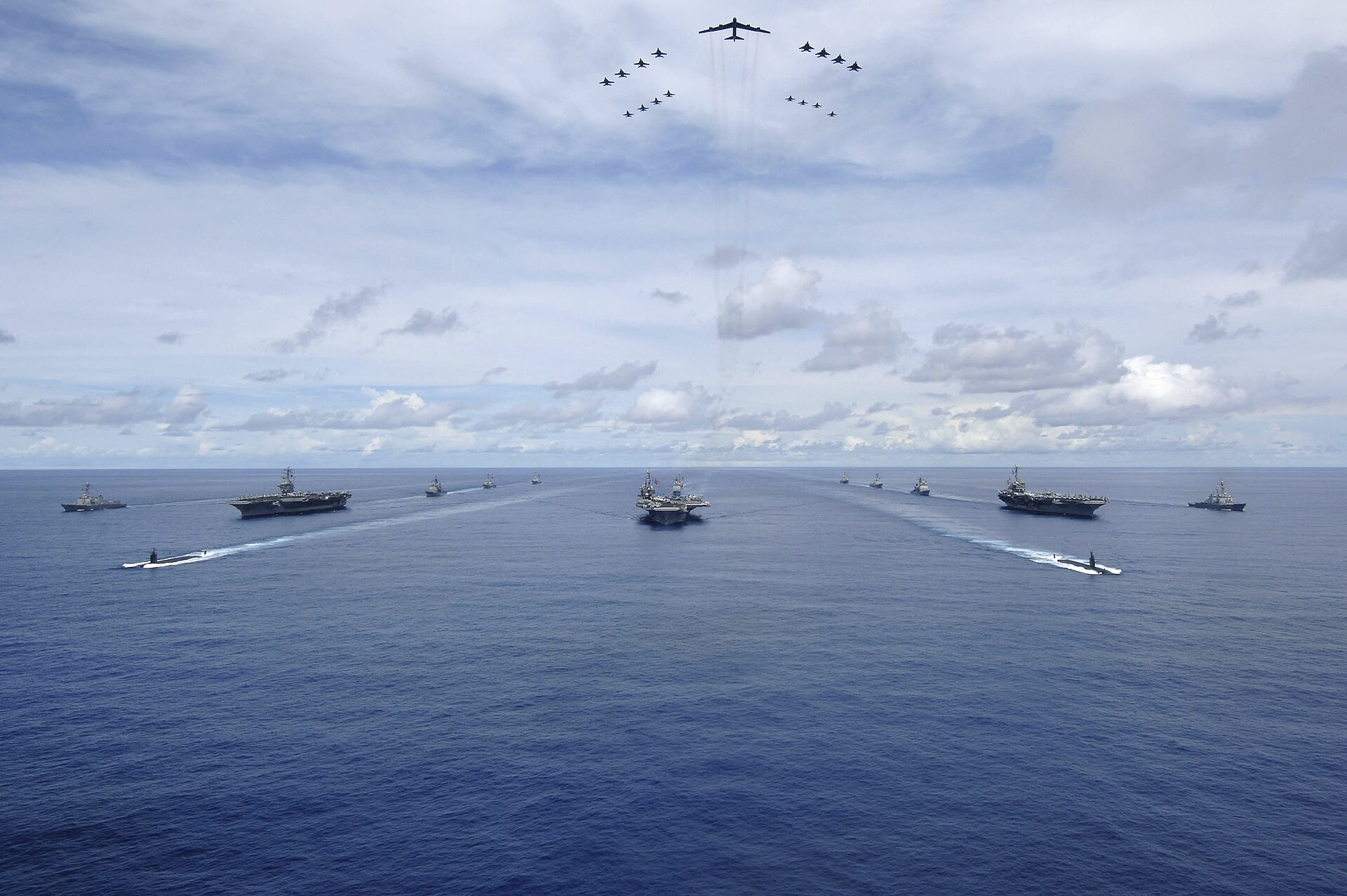
The scale of what has been built in those 60 days makes withdrawal almost inconceivable. CSIS and WarCosts.org track 40,000 US troops in theater, three carrier strike groups operating simultaneously in the CENTCOM area for the first time in decades, and B-2 stealth bombers flying 30-hour sorties from Whiteman Air Force Base in Missouri. The Pentagon reported to Congress on March 11 that the first six days alone cost $11.3 billion — a burn rate of $1.88 billion per day. The daily cost has since fallen to approximately $900 million per day excluding carrier strike group sustainment, according to CSIS estimates, but the cumulative total has surpassed $61 billion as of late April per tracking by CSIS and WarCosts.org.
No president has ever complied with Section 5(b) by actually withdrawing forces. Bill Clinton bombed Kosovo for 78 days without authorization. Barack Obama argued that the Libya intervention did not constitute “hostilities” because US forces played a “constrained and supporting role” — a claim most legal scholars rejected. Jack Goldsmith, the Harvard Law professor and former senior Justice Department official in the Bush administration, wrote on February 28 that the Iran campaign goes further than any predecessor in the history of presidential war-making — a conclusion he reached after reviewing every major precedent since Truman.
The Middle East briefing 3,000+ readers start their day with.
One email. Every weekday morning. Free.
Is the Republican Wall Cracking?
The Senate has voted five times on resolutions to constrain or end the president’s war authority. All five have failed along party lines. The most recent, on April 23, followed the pattern set by the fourth vote on April 15, which failed 52-47. Senator Tim Kaine, the Virginia Democrat who has led every war powers push since the conflict began, has announced plans for additional votes before and after the May 1 deadline, according to Axios.

For 59 of those 60 days, Republican solidarity held. Senator Rand Paul of Kentucky was the sole Republican “yes” vote on war powers measures, while Senator John Fetterman of Pennsylvania was the lone Democrat voting against, as Time reported on March 25. The arithmetic was stable, the outcome predetermined.
Then Collins and Tillis spoke. Collins, the senior senator from Maine and a member of the Appropriations Committee, told The Hill in April: “If this conflict exceeds the 60 days specified in the War Powers Act, or if the President deploys troops on the ground, I believe that Congress should have to authorize those actions.” Tillis, the North Carolina Republican, was even more direct in comments reported by The Hill and Foreign Policy Journal on April 19: “I think after 60 days, the way the War Powers Resolution reads is you either are articulating an exit plan that would make an AUMF moot, or you’re planning to be there for an extended period of time, which means the AUMF is necessary.”
Neither senator voted for the existing war powers resolutions. Both are instead signaling that the post-May 1 environment is categorically different from the pre-May 1 environment — that the legal ground shifts Thursday even if the military situation does not. The distinction matters because it reframes the question from “should we stop the war” (which Republicans will not support) to “should we authorize the war” (which some Republicans are now demanding).
Senator Lisa Murkowski of Alaska is leading a separate effort to draft an Authorization for Use of Military Force that would formally extend legal authority beyond the 60-day window. Responsible Statecraft and Time reported in April that Murkowski wants the AUMF in place before agreeing to a military funding boost — a condition that ties the legal question directly to the appropriations pipeline. If Murkowski holds that position, the administration cannot simply spend its way past the deadline without addressing the authorization gap.
The Vance Contradiction
The administration’s legal position rests on a claim that every president since Nixon has made: the War Powers Resolution is an unconstitutional infringement on the commander-in-chief’s Article II powers. Vance made it explicit at a White House press briefing in January 2026, calling the WPR “fundamentally a fake and unconstitutional law” and stating flatly that it “is not going to change anything about how we conduct foreign policy in the next couple of weeks and months,” as The Hill reported.
The problem with this argument is that Vance himself treated the WPR as real law when it suited him. As a senator in 2023, Vance voted in favor of War Powers Resolution measures concerning both Syria and Niger, according to records reviewed by The American Conservative. In both cases, Vance argued that the executive branch had exceeded its authority and that Congress needed to reassert its constitutional role. The shift from “Congress must check presidential war-making” to “the law requiring congressional checks is fake” coincides precisely with Vance’s move from the legislative to the executive branch.
Goldsmith, writing on his Executive Functions Substack, placed the Iran campaign in the broader arc of presidential war powers expansion, calling it “a new low in the deterioration of Congress’s check on presidential war unilateralism.” The assessment carries weight because Goldsmith is not a reflexive critic of executive power — his Office of Legal Counsel service in the Bush administration gave him ample opportunity to argue for expansive presidential authority, and he frequently did. Over 100 international law scholars signed a letter published by Just Security on April 3 warning that the strikes violate the UN Charter, but the sharper challenge comes from within the American legal mainstream that has historically deferred to presidential war-making.
“By using the military on such a large and dangerous scale with foreseeable U.S. casualties, this operation kills the idea of any effective legal constraint on the president’s use of force.”— Jack Goldsmith, Harvard Law School, February 28, 2026
Why Does This Matter More in Riyadh Than Washington?
Most coverage of the May 1 deadline treats it as a Washington story — a constitutional tussle between branches of government with no operational consequence, since no president has ever complied with Section 5(b). But for Saudi Arabia, the deadline introduces a variable that Riyadh cannot control and cannot price.
Saudi March oil production fell to 7.25 million barrels per day, down from 10.4 million bpd in February — a 30% drop, according to the IEA. The Kingdom’s East-West Pipeline bypass through Yanbu operates at a ceiling of 4 to 5.9 million bpd, well below the 7 to 7.5 million bpd that flowed through Hormuz before the war. Saudi fiscal break-even sits at $108 to $111 per barrel on a PIF-inclusive basis, per Bloomberg estimates. Brent crude closed at $108.11 on April 28 — essentially on the line.
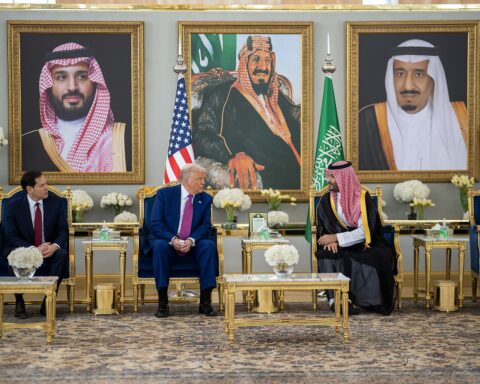
The entire wartime posture depends on a US military presence that has no formal legal foundation beyond presidential discretion. The Strategic Defense Agreement signed during MBS’s November 2025 Washington visit contains no mutual defense articles comparable to NATO’s Article 5 or the US treaties with Japan and South Korea, as the New Lines Institute documented in its 2026 analysis of US-Saudi relations. There is no treaty obligation requiring the United States to defend Saudi Arabia. There is no AUMF authorizing the operations that are currently defending Saudi Arabia. There is, as of Thursday, not even a War Powers Resolution clock providing residual legal cover.
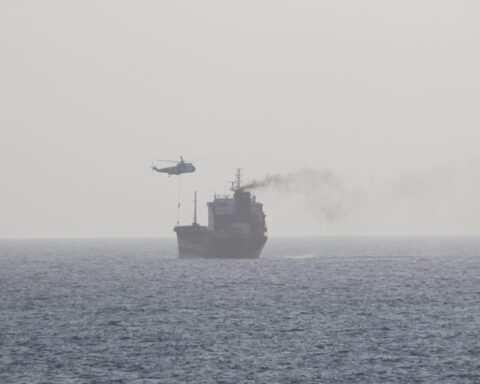
The Carnegie Endowment for International Peace noted in its April 2026 Gulf security assessment that Gulf monarchies “have demonstrated little capacity to either restrain Trump or deter Iran” and remain skeptical of any ceasefire arrangement that leaves Iran controlling Hormuz. That skepticism is well-founded: only 45 vessels have transited the Strait since the April 8 ceasefire — fewer than three per day against a pre-war baseline of 140 daily transits, according to shipping data compiled by Bloomberg. The IRGC’s pattern of reversing diplomatic commitments made by Iran’s foreign ministry means that even a negotiated reopening carries execution risk that only US naval presence can mitigate.
If the Murkowski AUMF effort stalls — and AUMFs are notoriously difficult to draft in ways that satisfy both hawks and moderates — the administration faces a choice between acknowledging the WPR (which it has called unconstitutional) and simply ignoring it (which hands Democrats and a handful of Republicans a constitutional argument that grows stronger with every day past May 1). Either path introduces uncertainty into the one variable Riyadh needs to be stable: the duration and scale of American military commitment.
Can Democrats Sue Their Way to a Withdrawal?
Time reported exclusively on April 28 that congressional Democrats are discussing a lawsuit against the administration if operations continue past May 1 without authorization. The discussions are early-stage, and the legal obstacles are formidable. The controlling precedent is Campbell v. Clinton, the 2000 DC Circuit case (203 F.3d 19) in which 31 members of Congress sued President Clinton over the Kosovo campaign. The court dismissed for lack of standing, ruling that individual members of Congress had not exhausted their legislative remedies.
Democrats believe only a lawsuit authorized by the full chamber would have reasonable standing — but Republicans control both the House and Senate, making chamber-authorized litigation impossible. Erwin Chemerinsky, the dean of UC Berkeley School of Law, wrote in a New York Times op-ed cited by Time that continued operations past May 1 would be “clearly illegal” and argued that “the courts should simply hold that the War Powers Resolution requires the president to end our involvement in the war with Iran unless and until Congress authorizes it.” H.Con.Res.38, a concurrent resolution directing the president to remove forces from unauthorized hostilities in Iran, has been formally introduced in the 119th Congress — but even if passed, the Supreme Court’s 1983 decision in INS v. Chadha casts doubt on whether concurrent resolutions (which bypass the presidential veto) are constitutionally enforceable.
The legal avenues, in short, are narrow. But the political pressure is cumulative. Each day past May 1 without authorization adds to the argument that the US commitment rests on nothing more than presidential will — and presidential will, unlike treaty obligations, can reverse overnight.
Tehran’s Clock-Watching
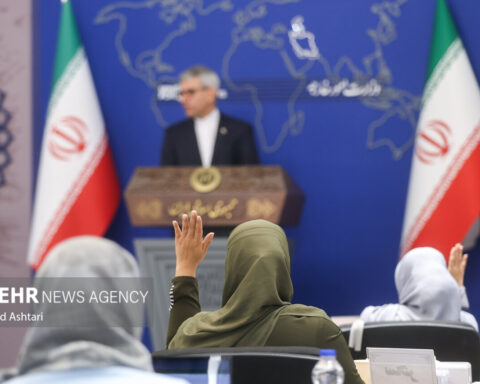
Iran is watching the calendar as carefully as Riyadh. Iranian state and semi-official media have framed the repeated Senate defeats of war powers resolutions as evidence of US domestic division and the unsustainability of the American campaign. The framing has intensified as the deadline approaches.
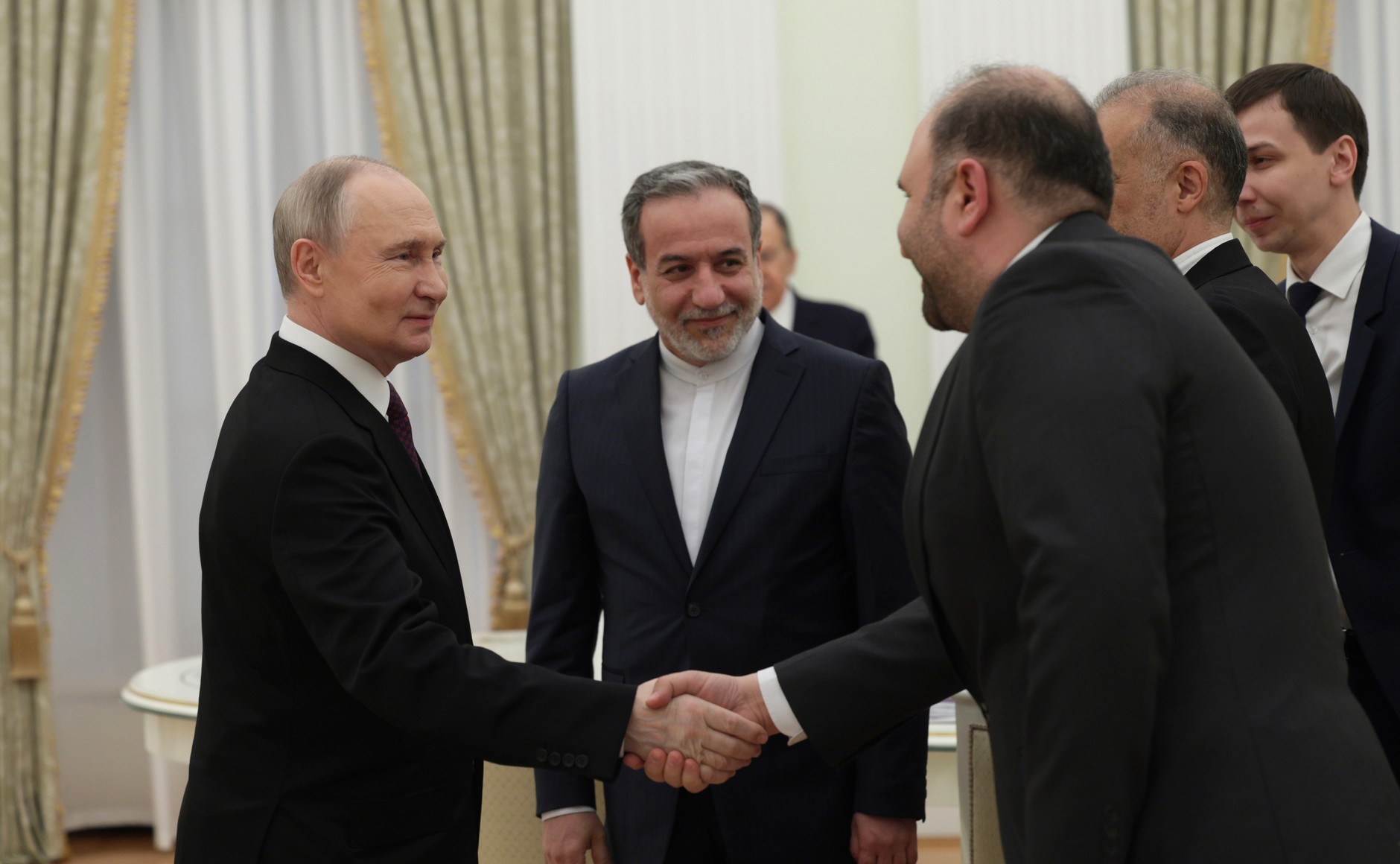
Foreign Minister Araghchi traveled to St. Petersburg on April 27 and secured President Putin’s explicit public support, with Putin praising Iranian “courage” and pledging to “do everything that serves your interests.” The timing — four days before the WPR deadline — was not accidental. Iran simultaneously removed nuclear negotiations from the current diplomatic agenda and proposed a Hormuz-first framework: reopen the Strait in exchange for US blockade removal, with nuclear talks deferred indefinitely. Secretary of State Rubio publicly rejected the proposal on April 27. Iran’s next move was Moscow, not Washington.
The IRGC’s internal dynamics compound the problem. Major-General Ali Abdollahi of Khatam al-Anbiya publicly warned on April 28 that the US naval blockade could end the fragile pause in fighting, according to Military.com — a signal that the IRGC is monitoring US domestic legal constraints as part of its operational calculus. The Russia-China double veto at the UN Security Council has already removed multilateral pressure. If the WPR deadline passes without authorization, Iran gains a new talking point: the war is not only contested internationally but domestically illegal under American law.
For Saudi Arabia, this creates a compounding risk. The Kingdom’s wartime economic model — reduced production routed through Yanbu, fiscal break-even pricing at the edge of current Brent levels, and a diminishing air defense inventory — was built on the assumption that American staying power would outlast Iranian endurance. That assumption rested entirely on a variable Riyadh cannot control and cannot price.
The WPR deadline does not mean the US will leave. No serious analyst expects a withdrawal order on Thursday. But it means that every day the US stays, it does so on thinner legal ice, with a growing constituency in both parties arguing that the commitment needs formal grounding. And formal grounding means a congressional debate — about objectives, duration, cost, and exit criteria — that the administration has spent 60 days avoiding.
FAQ
What happens if the president simply ignores the May 1 deadline?
Operationally, nothing changes immediately — no court has ever ordered a presidential withdrawal under the WPR. The Section 5(b) 30-day extension clause is sometimes cited as a fallback, but it requires a written presidential certification that the time is needed for safe troop withdrawal, not continued offensive operations. The practical consequence is political: opponents gain a constitutional argument that compounds with each passing day.
Has Congress ever successfully used the WPR to end a military operation?
Not directly. The closest precedent is Lebanon in 1983, when Congress invoked the WPR to authorize an 18-month deployment of Marines — but the Reagan administration withdrew forces after the Beirut barracks bombing killed 241 servicemembers, not because of the WPR clock. The Somalia withdrawal in 1993-94 followed congressional pressure but was driven by the Black Hawk Down incident rather than a formal WPR mechanism. The resolution’s real power has always been political rather than legal: it provides a framework for congressional opposition that can shift public opinion and constrain appropriations, even if courts decline to enforce the withdrawal provisions.
Could Saudi Arabia seek a bilateral defense treaty to reduce its dependence on presidential discretion?
A formal mutual defense treaty would require two-thirds Senate ratification — a threshold that is effectively impossible when even a simple-majority AUMF faces obstacles. The New Lines Institute has noted that this constitutional barrier means Saudi Arabia has no viable path to treaty-based protection, leaving the Kingdom dependent on executive branch willingness that can shift between administrations or within one.
What is the AUMF that Murkowski is drafting, and how does it differ from the existing war powers votes?
An Authorization for Use of Military Force is an affirmative grant of congressional authority for military operations — the opposite of the war powers resolutions that Kaine has pushed, which seek to constrain or end authority. The 2001 AUMF (targeting al-Qaeda) and 2002 AUMF (targeting Iraq) provided legal cover for two decades of operations across multiple countries. Murkowski’s draft would specifically authorize force against Iran, potentially with conditions on duration, geographic scope, and reporting requirements. By conditioning her support for military funding on AUMF passage, Murkowski is attempting to force the administration to accept congressional oversight as the price of continued appropriations — a move that could either provide durable legal authority or expose the depth of disagreement over war aims.
How does the WPR deadline interact with the ongoing ceasefire negotiations?
The ceasefire that began April 8 has largely held in terms of direct US-Iran kinetic exchanges, but the double blockade at Hormuz — with the US controlling Arabian Sea entry and the IRGC controlling Gulf of Oman exit — remains in place. If Congress were to pass an AUMF, it would signal long-term US commitment and potentially weaken Iran’s incentive to outlast American political will. Conversely, if the WPR deadline passes without authorization and the legal debate intensifies, Iranian negotiators may calculate that time favors holding firm — particularly with Russian and Chinese diplomatic backing secured through the April 27 St. Petersburg meeting and the UNSC veto.
The constitutional deadline has now arrived: for analysis of how the War Powers clock and Trump’s “state of collapse” claim collide on the same calendar date, see Trump Says Iran Is Collapsing. Congress Says the War Is Illegal. The legal authority problem is compounded by a basing problem: all three Iran military options CENTCOM briefed Trump on April 30 run through Saudi territory, airspace, and air defense that Riyadh has not agreed to provide — the full exposure matrix is here.