{“content”: “
WASHINGTON u2014 The United States has offered Iran a one-page, 14-point memorandum of understanding that accepts what Washington spent three months rejecting: Hormuz first, nuclear later. The framework, negotiated by US Middle East envoy Steve Witkoff and delivered to Tehran with a 48-hour response window, would declare an end to the war and open a 30-day negotiation period u2014 but it structures the Strait of Hormuz and the US naval blockade as a “gradual, parallel unwinding,” decoupled from nuclear enrichment talks that both sides have already declared irreconcilable.
n
The concession is not a diplomatic compromise in the traditional sense u2014 it is a transfer of leverage with structural consequences. By accepting Hormuz-first sequencing, Washington has given the Islamic Revolutionary Guard Corps the ability to control whether Phase 1 conditions are ever satisfied, which means the IRGC now holds a veto over whether Phase 2 nuclear talks ever begin. For Saudi Arabia, the arithmetic is worse: Brent crude fell approximately 10% on May 6 on MOU optimism alone, dropping to approximately $97.97 per barrel before the strait has reopened by a single additional tanker u2014 meaning Riyadh absorbs the revenue hit of deal optimism before it receives the volume benefit of actual Hormuz reopening. The 5 crash that followed the MOU leak illustrates exactly how that mechanism works: the market priced in a deal that cannot structurally exist yet, and in doing so made the deal harder to reach.
n
The Middle East briefing 3,000+ readers start their day with.
One email. Every weekday morning. Free.
Table of Contents
n
- n
- What the One-Page MOU Actually Says
- How Did Iran Win Hormuz-First Sequencing?
- The IRGC’s “New Protocols” u2014 Authority by Declaration
- Why Does Saudi Arabia Pay First?
- The Authorization Ceiling Has No Floor
- Can the Oman Fourth Round Fix What the MOU Broke?
- Background
- Frequently Asked Questions
- n
n
n
n
n
n
n
n
n
n
n
n
What the One-Page MOU Actually Says
n
The framework is 14 points on a single sheet, according to Axios, and it does three things simultaneously. It declares an end to hostilities, opens a 30-day window to negotiate Hormuz transit, nuclear limits, and sanctions architecture, and structures the Strait of Hormuz and the US naval blockade as a gradual, parallel drawdown u2014 Iran’s restrictions and the American blockade lifting together over time.
n
What the MOU does not contain matters more than what it does. There is no enforcement mechanism for IRGC compliance. There is no mention of Iran’s 12-article Hormuz Sovereignty Law, which is advancing through parliament and would charge tolls in Iranian rial, ban Israeli vessels categorically, require IRGC coordination for all transits, and allow seizure of 20% of cargo value for non-compliance. And the document says nothing about Iran’s 440.9 kilograms of highly enriched uranium at 60% enrichment u2014 a stockpile whose growth the IAEA can no longer monitor because Iran terminated inspector access on February 28.
n
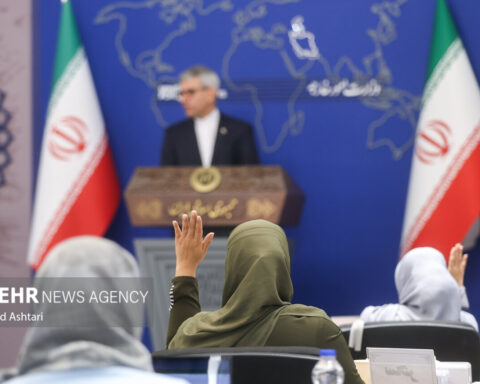
Iran’s own Foreign Ministry was explicit about the omission. “The plan we have presented is centered on ending the war,” the ministry stated on May 2, as reported by NPR and Tasnim. “There are absolutely no details regarding the country’s nuclear issues in this proposal.” Iran presented this not as a gap in the framework but as proof that it had successfully decoupled its nuclear program from near-term pressure u2014 and the MOU’s architecture confirms they were right.
n
n
How Did Iran Win Hormuz-First Sequencing?
n
Iran proposed Hormuz-first publicly on April 27, and the initial US response was cool. NBC News reported Washington was uninterested in separating the strait from the nuclear file, and the logic was sound: if you decouple them, you give Iran the thing it wants most u2014 legitimized authority over Hormuz u2014 before addressing the thing you want most, which is enrichment cessation. The entire American negotiating position for three months had been built on the premise that Hormuz and nuclear talks were indivisible, non-sequential, a single package to be resolved together or not at all.
n
Then Washington moved. The May 6 MOU accepts “gradual, parallel unwinding” u2014 language that sounds like simultaneity but functions as sequencing, because Hormuz is a physical problem with measurable metrics while nuclear talks are a political problem with no measurable Phase 1 deliverable. You can verify whether a tanker crossed the strait by checking AIS transponder data. You cannot verify whether Iran has agreed in principle to discuss enrichment caps at a meeting that hasn’t been scheduled.
n
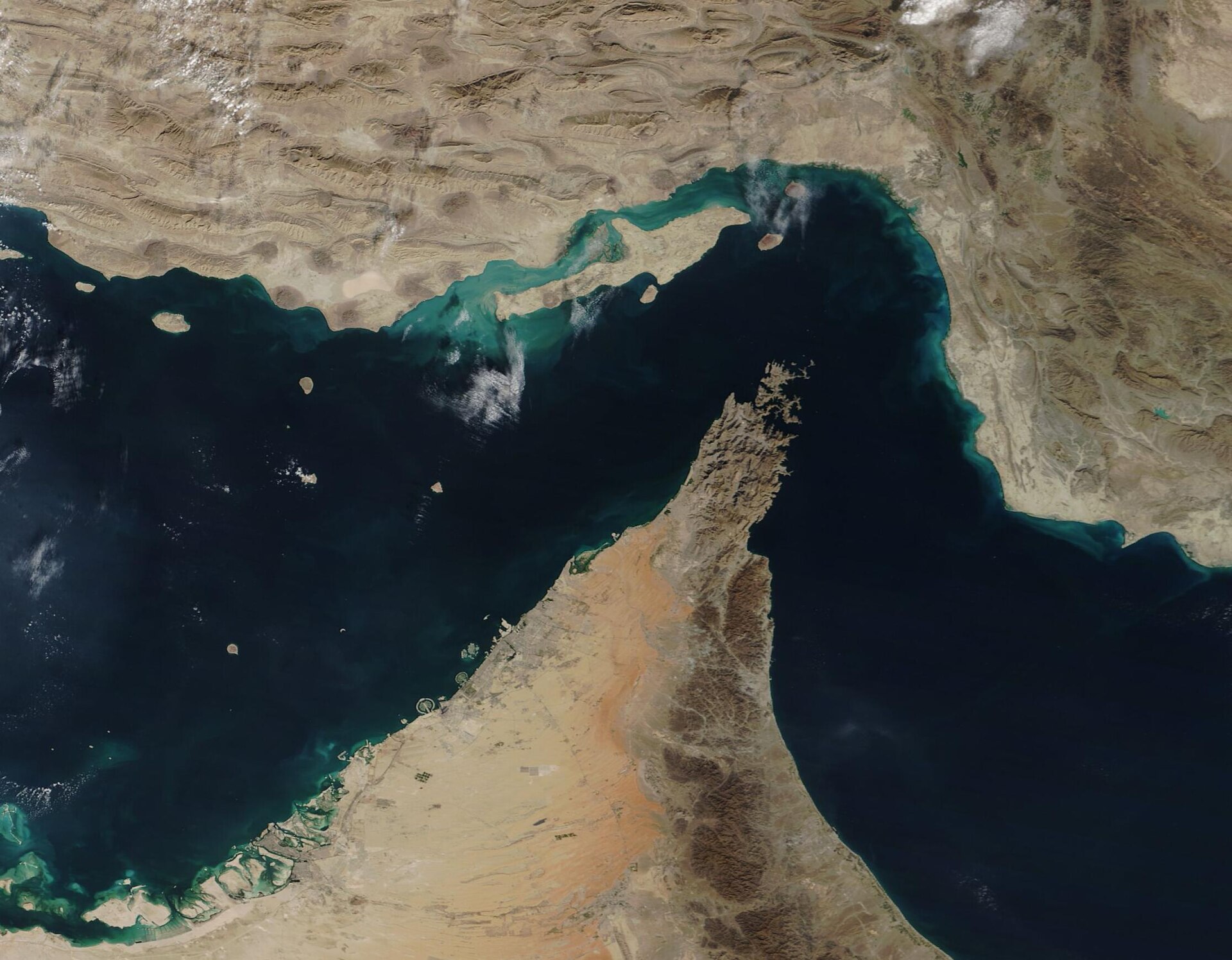
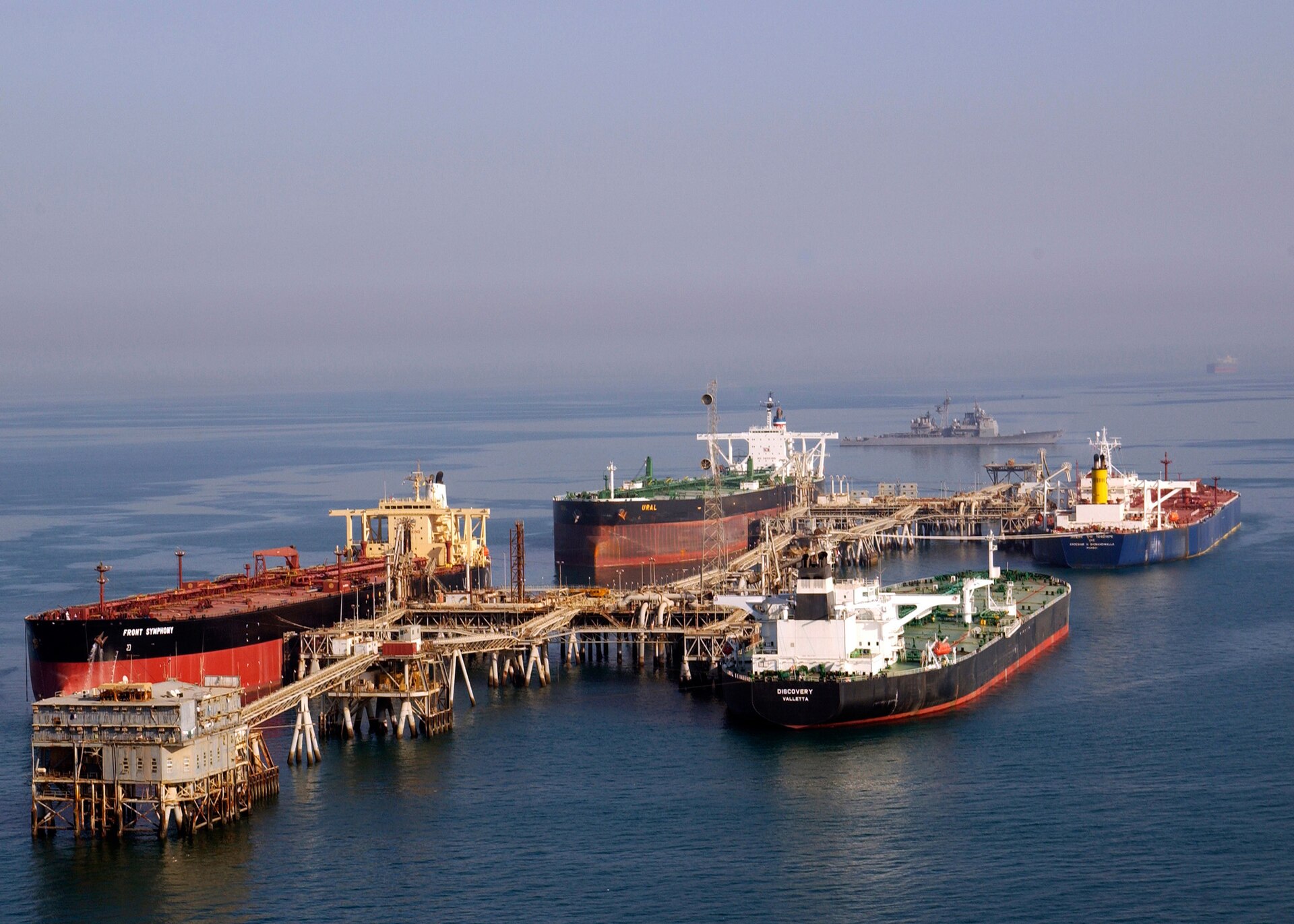
The Council on Foreign Relations had proposed an “Open for Open” framework u2014 US blockade lifted simultaneously in exchange for IRGC restrictions lifted u2014 specifically to avoid this asymmetry. The MOU’s gradual parallel model is a version of that idea, but without the critical safeguard: it does not resolve who retains management authority over the strait going forward. Since the April 8 ceasefire, only 45 transits have crossed the strait u2014 3.6% of the pre-war baseline u2014 and the IRGC’s May 6 statement answered the authority question unilaterally.
n
The IRGC’s “New Protocols” u2014 Authority by Declaration
n
Hours after the MOU framework became public, the IRGC Navy issued a statement that deserves more scrutiny than it received. “With the aggressor’s threats neutralized and new protocols in place, safe, stable passage through SOH will be ensured,” it read, according to PressTV and Al Jazeera. The statement thanked ship captains for “respecting Iranian regulations” u2014 language that presupposes IRGC management authority over the strait as an accepted baseline, not a contested wartime claim.
n
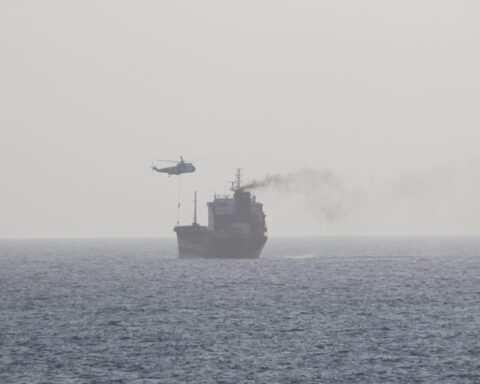
This is the normalization mechanism operating in real time. The IRGC declared “full authority to manage the Strait” on April 5 and again on April 10, while Araghchi was in Islamabad negotiating on behalf of a government that does not control the IRGC. On April 22, the IRGC seized the MSC Francesca, an 11,660-TEU container vessel, and the Epaminondas, a 6,690-TEU feeder u2014 the same day Araghchi declared the strait “completely open.” Iranian state media framed these seizures not as violations but as enforcement of an established regime, with PressTV reporting on May 5 that “Iran activates new Strait of Hormuz transit system as US blockade ends in failure.”
n
James Kraska, a professor of international maritime law at the Naval War College, has argued that UNCLOS Article 26 prohibits transit charges and that coastal states cannot convert an international strait into a permission-based corridor. The IMO Secretary-General stated the 12-article Hormuz Sovereignty Law has “no legal basis” under international maritime law. But the MOU’s acceptance of IRGC “protocols” without explicitly rejecting the sovereignty law’s legal premise creates a problem that neither Kraska nor the IMO can solve: the United States is implicitly undermining the UNCLOS regime on which its own Freedom of Navigation program is built.
n
Trump compounded this by pausing Project Freedom, the naval operation designed to force the strait open, citing “great progress” in diplomatic talks. The counter-pressure mechanism was removed before the MOU is even signed. Iran’s parliament, meanwhile, advanced the sovereignty law u2014 negotiate at the table, legislate the outcome as fait accompli u2014 and Iran’s Deputy Speaker declared that “the new law will set conditions for transit.”
n
n
Why Does Saudi Arabia Pay First?
n
Saudi Arabia posted a 125.7 billion riyal deficit in the first quarter of 2026 alone u2014 $33.5 billion, more than double the Q1 2025 shortfall, according to Al Jazeera and Gulf News. Military and war-related spending rose 26% year-on-year, and total government expenditure climbed 20% to 386.69 billion riyals. The kingdom’s fiscal break-even sits at approximately $94 per barrel according to Bloomberg Economics u2014 using the PIF-consolidated methodology. With full PIF capital expenditure included, the break-even is $111 per barrel.
n
On May 6, the day the MOU framework leaked, Brent fell approximately 10% to approximately $97.97, with WTI dropping to $90.35. The oil market priced in peace before the strait opened u2014 which means Saudi Arabia absorbed the revenue collapse of deal optimism without receiving any volume benefit from actual Hormuz reopening. At $97.97, Riyadh is barely above its consolidated break-even and $13 below its full PIF break-even, running a deficit that already consumed more than three-quarters of the government’s original $44 billion annual shortfall projection in a single quarter.
n
The infrastructure physics make it worse. The East-West Pipeline’s Yanbu terminal can handle a maximum of 5.9 million barrels per day u2014 against pre-war Hormuz throughput of 7 to 7.5 million bpd, a permanent 1.1 to 1.6 million barrel-per-day gap that no memorandum resolves, regardless of how many points it contains. Saudi Arabia needs both higher prices and higher volumes simultaneously, and the Hormuz-first MOU produces the opposite sequencing: prices crash on optimism, volumes stay capped by infrastructure.
n
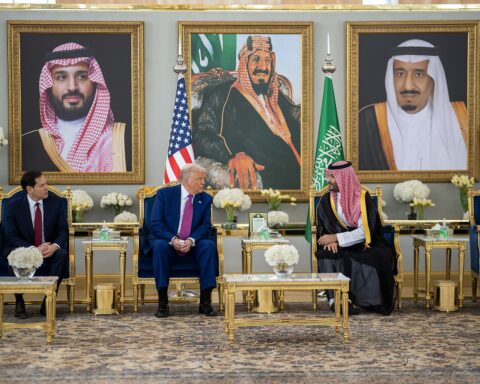
Trump arrives in Riyadh on May 13 as the first stop of his Middle East trip u2014 carrying an MOU that crashed Saudi oil revenues, left Yanbu structurally capped, and excluded the kingdom from the negotiating table entirely. Saudi Arabia was shut out of the April 10 Islamabad bilateral, Riyadh is not a party to the current MOU negotiations, and the man arriving with the deal that damaged Saudi fiscal stability the most is expecting to be received as a peacemaker.
n
The Authorization Ceiling Has No Floor
n
Under Article 110 of the Iranian constitution, President Pezeshkian has zero authority over the IRGC. Supreme Leader Khamenei has been absent from public view for more than 60 days, with his son Mojtaba communicating only by audio. The Supreme National Security Council, the body that formally authorizes military and strategic decisions, is chaired by Pezeshkian but operationally controlled by Ahmad Vahidi u2014 the man who makes every concession by Iran’s civilian government functionally provisional.
n
Vahidi is the veto in human form. Appointed IRGC commander-in-chief on March 1, 2026, he refused to allow missile negotiations at Islamabad, demanded that Hossein Zolghadr u2014 a sanctioned figure u2014 be placed on the negotiating team, and authorized the walkout that collapsed the April talks. Pezeshkian publicly accused Vahidi and Mohammad Reza Abdollahi of wrecking the ceasefire, calling their actions a “deviation from the delegation’s mandate.” The accusation changed nothing, because the president lacks the constitutional authority to fire, overrule, or redirect the man he accused.
n
The MOU framework requires IRGC compliance to function, and IRGC compliance requires a command structure capable of delivering it. The IRGC has been operationally headless since Rear Admiral Ali Reza Tangsiri was killed on March 30 u2014 37 days without a named successor at the time of writing, with declarations issued under anonymous institutional authority from 31 semi-autonomous corps. Hormuz reopens only if the IRGC allows it, nuclear talks proceed to Phase 2 only if Phase 1 is satisfied, and Phase 1 satisfaction is determined by whether the IRGC’s “new protocols” permit sufficient transit volume to count as reopening.
n
CSIS assessed in 2026 that the United States “could not reach underground infrastructure, eliminate the Strait of Hormuz threat, suppress proxy networks, drain reconstitution capacity, or produce the political outcome it sought.” Vahidi u2014 or whoever eventually succeeds the still-unnamed Tangsiri replacement u2014 decides what “sufficient” means. The MOU did not create this problem, but by accepting Hormuz-first sequencing, it converted Iran’s wartime leverage into a permanent institutional advantage. That conversion became fully public on May 7 when Parliament Speaker Ghalibaf branded the 14-point framework “Operation Fauxios” — the significance of Ghalibaf publicly naming the MOU while Araghchi continues to negotiate it through Pakistan is analysed here.
n
Can the Oman Fourth Round Fix What the MOU Broke?
n
The fourth round of talks in Oman on May 11 ran more than three hours and was described by both sides as “difficult but constructive” u2014 the kind of diplomatic language that typically signals nothing was agreed. Within 24 hours of the session, both chief negotiators stated positions that are arithmetically irreconcilable. Witkoff told PBS: “An enrichment program can never exist in the state of Iran ever again. That’s our red line. No enrichment. That means dismantlement, it means no weaponization, and it means that Natanz, Fordow, and Isfahan u2014 those are their three enrichment facilities u2014 have to be dismantled.”
n
Araghchi’s response, also to PBS, was symmetrically absolute: “From our viewpoint, enrichment is a subject that should definitely continue and there is no room for compromise on that.” These are not positions capable of meeting in the middle u2014 dismantlement and continuation are binary states, and there is no 50% dismantlement of a centrifuge cascade. The proposed moratorium under discussion is 12 to 15 years, but Iran has not agreed to any moratorium at all, and the 440.9 kilograms of HEU at 60% enrichment u2014 enough for multiple weapons with approximately 25 days of additional processing per device via IR-6 cascades u2014 sits outside any verification regime.
n
The Oman round cannot fix the MOU’s core problem because the problem is not a detail to be negotiated u2014 it is the architecture itself. Hormuz-first means the IRGC validates Phase 1, and the IRGC has no institutional incentive to validate Phase 1 in a way that enables Phase 2 nuclear constraints on its own program. The veto is not a flaw in the framework u2014 it is the framework’s load-bearing wall.
n
n
Background
n
The Iran-US war began on February 28, 2026, when Iranian strikes hit Saudi and Emirati infrastructure across the Gulf. The IRGC effectively closed the Strait of Hormuz through a combination of mine deployment, vessel seizures, and declared “danger zones” covering standard shipping lanes, while the United States imposed a naval blockade of Iranian ports on April 13. A ceasefire negotiated in Islamabad collapsed when the IRGC authorized a walkout on April 14, and since then diplomatic efforts have rotated through Pakistan, Turkey, and Oman as mediating venues u2014 with Saudi Arabia consistently excluded from bilateral US-Iran formats.
n
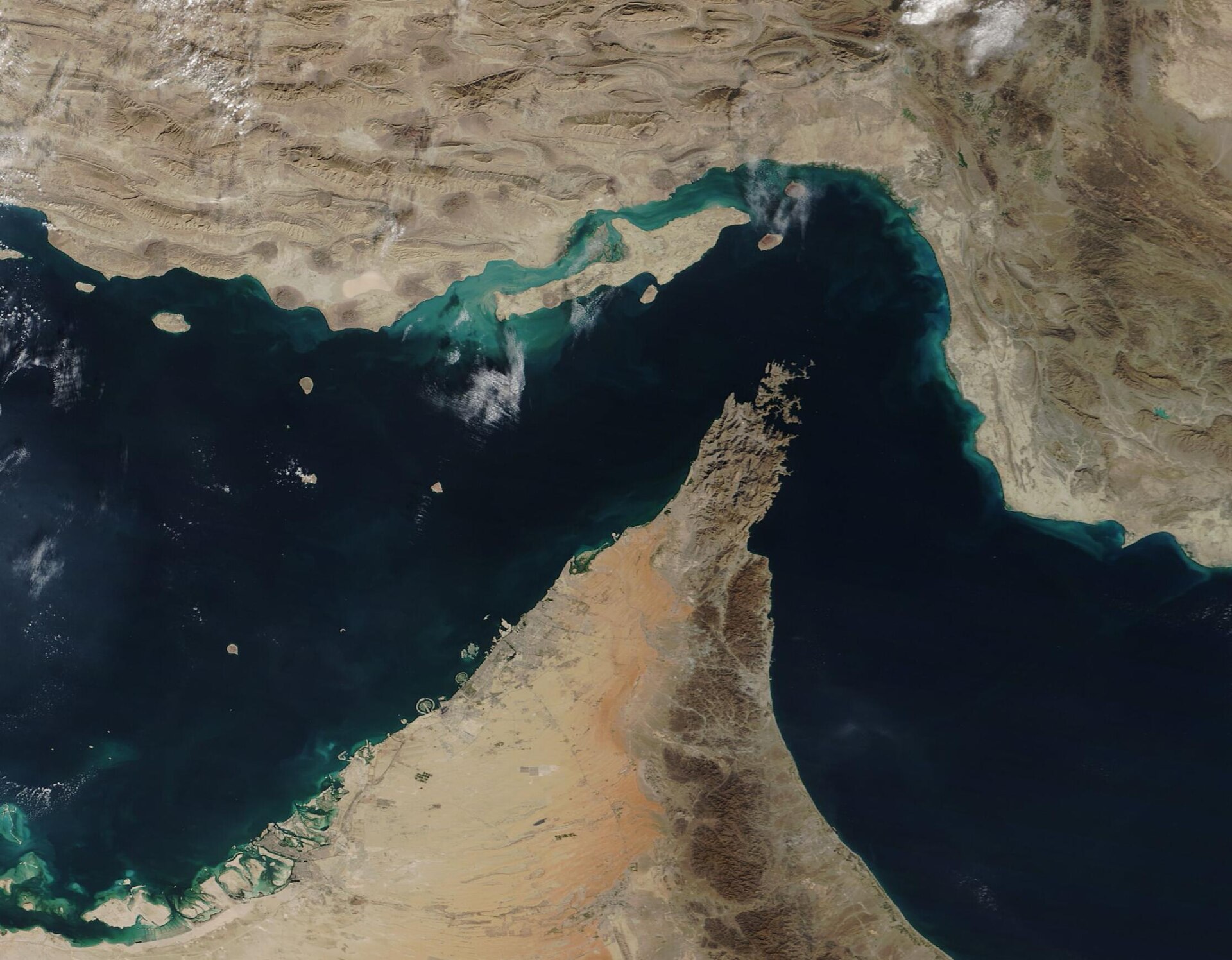
The Hormuz chokepoint carries approximately 20% of global oil supply in peacetime, but transit volume has collapsed to 3.6% of pre-war levels since the April 8 ceasefire. Iran’s leverage over the strait u2014 and by extension over global energy markets u2014 remains the single most consequential variable in any negotiation framework, which is precisely why the question of who controls that lever after the MOU is the question the MOU does not answer.
n
Frequently Asked Questions
n
What happens if Iran rejects the MOU within 48 hours?
n
If Iran does not respond or rejects the framework, the US naval blockade remains in effect and the Trump administration has signaled it would consider re-escalation. However, Trump has already paused Project Freedom u2014 the naval operation designed to force the strait open u2014 citing diplomatic progress, and restarting it after a public pause would require political justification that the administration has already undermined by framing the MOU as evidence of “great progress.” The 48-hour window also coincides with Witkoff’s travel schedule, suggesting the timeline is driven as much by logistics as by strategy.
n
Does the MOU framework violate UNCLOS?
n
Not directly u2014 the MOU is a political document, not a legal instrument, and political agreements are not bound by UNCLOS compliance requirements. But the MOU’s acceptance of IRGC “protocols” and “regulations” without explicitly rejecting Iran’s 12-article Hormuz Sovereignty Law creates a de facto acquiescence problem. If the US treats IRGC transit management as a negotiable feature rather than a violation of UNCLOS Articles 26 and 42, it weakens the legal basis for any future Freedom of Navigation challenge u2014 not just in the Persian Gulf but globally, because UNCLOS precedents are applied universally by naval powers.
n
What is the Saudi fiscal exposure if Brent stays below $100 through Q2?
n
At $97.97 u2014 the May 6 close u2014 Saudi Arabia operates above its $94 consolidated break-even but $13 below the $111 threshold that includes full PIF capital expenditure. Given that Q1 already produced a $33.5 billion deficit with Brent averaging well above $100 for most of the quarter, sustained sub-$100 pricing through Q2 would push the annual deficit past $100 billion u2014 forcing either sovereign debt issuance at unfavorable wartime spreads, PIF asset liquidation, or Vision 2030 project deferrals, each of which carries domestic political costs that Mohammed bin Salman has spent a decade structuring his entire governance model to avoid.
n
Why can’t the US demand simultaneous Hormuz and nuclear resolution?
n
It tried, for three months. The shift from insisting on a single indivisible package to accepting “gradual, parallel unwinding” reflects a recognition that the US lacks the military capability to force the strait open unilaterally u2014 CSIS concluded the US could not eliminate the Hormuz threat u2014 and that the IRGC’s willingness to absorb economic damage from the blockade exceeds Washington’s willingness to sustain that blockade through the summer. The FDD estimated blockade damage to Iran at $435 million per day, but the IRGC’s decentralized command structure means the economic pain falls on Iran’s civilian economy while the military corps that control Hormuz operate with their own supply chains and institutional budgets.
n
Who actually commands IRGC Navy operations at Hormuz right now?
n
No one with a public title. Rear Admiral Tangsiri was killed on March 30, and as of May 6 no successor has been named u2014 37 days of operational headlessness. Orders are issued through 31 semi-autonomous corps u2014 a decentralized command structure the IRGC built after 2006 to survive decapitation strikes u2014 with Vahidi exercising overall command authority but no single officer publicly responsible for Hormuz transit decisions. This means the MOU’s Hormuz provisions must be implemented by a command structure that is institutionally fragmented, with no individual who can be held to account for whether “new protocols” constitute a genuine reopening or another administrative squeeze.
n
Has Iran responded to the MOU within the 48-hour window?
n
As of publication, Tehran has not issued a formal acceptance or rejection. Iranian officials signalled through state media that the framework was under review, with no timeline for a formal response given. The absence of an immediate rejection is being read in Washington as a positive signal u2014 but Iran’s pattern since April has been to allow diplomatic windows to lapse without triggering a formal breakdown, preserving negotiating ambiguity while the IRGC continues to determine transit conditions on the water. The parallel Beijing track — where Araghchi locked in China’s position on Hormuz and enrichment nine days before Trump’s arrival — is documented in Araghchi Went to Beijing to Write Trump’s Talking Points Before Riyadh Got the Memo. The mine-clearance gap that makes Saudi Arabia’s exclusion from this architecture structurally irreversible — the Pentagon’s six-month timeline against the MOU’s thirty-day window — is the subject of Thirty Days, Six Months, and No Seat at the Table. The mechanism by which Saudi Arabia exercised that leverage u2014 denying Prince Sultan Airbase and airspace access to the US military and killing Project Freedom within 36 hours u2014 is documented in the confirmed NBC account of the failed Trump-MBS call. The operational form that IRGC veto takes on the water — Iran’s 40-question Vessel Information Declaration that makes the MoU’s open-Hormuz promise a compliance impossibility — is examined in the PGSA questionnaire architecture.
The MOU deadline that was meant to resolve the sequencing problem lapsed without an Iranian signature on May 7 — the same day CENTCOM struck Qeshm and Bandar Abbas. How Riyadh’s basing veto shaped that outcome, and what it signals for the May 13 summit architecture, is examined in Riyadh’s Veto Stopped at the Waterline — and CENTCOM Noticed.
n”}