
TEHRAN — Iran’s most visible response to President Trump’s May 16, 2026 nuclear ultimatum is a year-old television interview with a man who has been dead for seventy-eight days. Ali Shamkhani — secretary of Iran’s Defence Council, the architect of Tehran’s nuclear negotiating posture, and the only senior official who ever told American television that Iran would “sign today” for a comprehensive deal — was killed in the February 28 strikes that decapitated Iran’s political-military leadership. His NBC News footage is now circulating online, amplified by Mehr News Agency, as though it constitutes a current offer. It does not. It is the memory of a position that no living official has the authority, the mandate, or the institutional backing to reaffirm.
What Iran is actually saying comes through three simultaneous, carefully segmented channels: Foreign Minister Araghchi’s admission at the BRICS foreign ministers’ meeting in Delhi that enrichment talks have reached a “deadlock”; IRGC-aligned media’s pre-emptive closure of any nuclear concessions; and the resurrection of a dead man’s willingness to deal for audiences who need to believe Tehran remains reachable. This is not confusion. It is architecture — and it reveals more about who actually runs Iran’s nuclear file than any formal proposal could.
Table of Contents
- The Ghost in the Negotiating Room
- Who Is Actually Answering Trump’s Nuclear Proposal?
- The Three-Channel Architecture
- Why Can’t Iran Say Yes?
- The Authorization Ceiling
- What Does the JCPOA Precedent Actually Show?
- The 440 Kilograms in the Room
- How Did Hormuz Become a Nuclear Bargaining Chip?
- What Washington Hears Versus What Tehran Means
- Frequently Asked Questions
The Ghost in the Negotiating Room
Ali Shamkhani sat across from NBC News cameras in May 2025 and offered what no Iranian official had offered before or has offered since. Iran would “commit to never making nuclear weapons, getting rid of its stockpiles of highly enriched uranium,” agree to enrich only to civilian-grade levels, and submit to international inspectors — “in exchange for the immediate lifting of all economic sanctions.” When pressed on whether Iran would sign immediately, Shamkhani said one word: “Yes.”
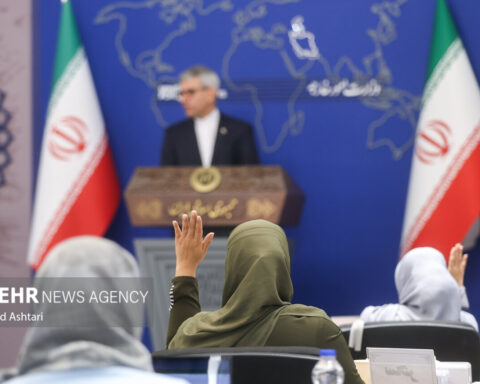
Twelve months and one war later, that footage has resurfaced across Iranian and international media. Middle East Eye flagged the clips explicitly as belonging to someone “killed by Israel last week” — a framing that acknowledged the macabre quality of the exercise without quite confronting what it means. Mehr News Agency, the semi-official outlet that occupies the moderate lane of Iran’s trifurcated media ecosystem, published the footage under headlines suggesting Iran remains “ready for a nuclear deal in return for lifting sanctions.” The verb tense did the lying. The dead man’s lips moved, and a position that died with him was presented as present-tense policy.
Shamkhani was not a freelancer. He was secretary of Iran’s Defence Council, Khamenei’s senior political-military-nuclear adviser, and — critically — one of the vanishingly few Iranian officials who could bridge the gap between the Islamic Republic’s civilian diplomatic apparatus and its parallel IRGC command structure. His NBC interview carried weight precisely because he spoke from inside both systems. When he dismissed American demands for total enrichment control as a “fantasy,” he was echoing Ali Khamenei’s own formulation — “Saying things like ‘We will not allow Iran to enrich uranium’ is nonsense” — but doing so in English, on American television, in a register designed to be understood as a negotiating signal rather than a domestic sermon.
That bridge collapsed on February 28, 2026. Shamkhani, Ali Larijani (the pragmatist former SNSC secretary), and Ali Khamenei himself were all killed in the same wave of strikes. The negotiating infrastructure they represented — imperfect, constrained, but functional — was destroyed in a single day. What replaced it is not a negotiating structure at all.
The Middle East briefing 3,000+ readers start their day with.
One email. Every weekday morning. Free.
Who Is Actually Answering Trump’s Nuclear Proposal?
Iran’s response to Trump’s May 16 ultimatum comes not from a single authorized voice but from a fragmented system in which no individual possesses the constitutional authority, institutional mandate, and political will to accept what Washington is demanding. The people who could say yes are dead. The people who remain cannot.
Trump’s proposal, transmitted through intermediaries and accompanied by a warning of “serious consequences” if swift progress was not achieved (NPR/NBC News, May 16, 2026), arrived at a government that has not produced a single public statement from its supreme leader in over seventy days. Mojtaba Khamenei, appointed March 9 following his father’s death, has not been seen in public since assuming the role. CNN reported on May 8 that US intelligence assesses Mojtaba as “injured” but “still shaping strategy” — issuing broad approvals through the IRGC apparatus rather than making tactical decisions. This is governance by absence, and it has a specific consequence for nuclear diplomacy: no one in the system can credibly commit to the kind of irreversible concessions the United States is demanding.
The Supreme National Security Council — the constitutional body that controls Iran’s nuclear file — is now chaired by Mohammad Bagher Zolghadr, appointed March 24. Zolghadr is a senior IRGC figure, formerly head of IRGC ground forces, whose appointment represented the consolidation of IRGC control over the body that nominally governs national security policy. He has made no public statement on the nuclear negotiations. His silence is itself a signal: the SNSC under Zolghadr is not a venue for diplomatic compromise but a ratification mechanism for positions the IRGC has already decided. The appointment chain — Shamkhani, Larijani, Zolghadr — and its implications for Trump’s May 16 proposal arriving at a body reshaped by the same strikes that destroyed Iran’s negotiating infrastructure is examined in full.
President Pezeshkian, who publicly accused IRGC figures Vahidi and Abdollahi of wrecking the Islamabad ceasefire talks, has demonstrated through that very accusation the limits of his authority. Article 110 of Iran’s constitution grants the supreme leader — and by extension the IRGC commanders who operate in his name — authority over all matters of defense and security. The president has zero institutional control over the IRGC. Pezeshkian’s protest was not a policy correction. It was a confession of powerlessness.
The Three-Channel Architecture
Iran’s response to Trump’s proposal is not a single message but three simultaneous, mutually incompatible signals calibrated for three distinct audiences. Understanding this architecture is essential to understanding why diplomatic progress is structurally impossible under current conditions — not merely difficult.
Channel One — Araghchi at BRICS (external, multilateral, on-record): At the BRICS foreign ministers’ meeting in Delhi on May 14-15, Foreign Minister Araghchi admitted that the enriched uranium question had reached a “deadlock” with Washington. He described the HEU stockpile as the hardest issue and said it would be “postponed” to later stages of negotiations. He confirmed conversations with Russian officials about Moscow’s longstanding offer to store Iran’s enriched uranium on Russian soil. He insisted Iran “never wanted nuclear weapons.” This channel communicates reluctant reasonableness to an international audience — deadlock as something that happened to Iran, not something Iran chose.
Channel Two — IRGC-aligned media (domestic, pre-emptive veto, on-record): Tasnim News Agency, the IRGC’s primary media organ, rejected any suggestion that Iran’s negotiating proposals address nuclear materials or enrichment. Fars News transmitted Iran’s five preconditions for a second round of talks — end hostilities, lift all sanctions, release frozen assets, compensate war damages, recognize Iranian sovereignty over the Strait of Hormuz — with nuclear concessions explicitly excluded. Mohammad Eslami, head of the Atomic Energy Organization of Iran, stated flatly that “nuclear technology and uranium enrichment will not be part of any potential talks with the US” (CGTN/Fars, May 2026). IRIB, the state broadcaster, called the American proposal “meaning Iran’s surrender to Trump’s excessive demands.” This channel pre-closes enrichment concessions for domestic consumption. By the time any negotiator reaches a table, the domestic space for compromise has already been eliminated.
Channel Three — Shamkhani’s ghost (external, plausibly deniable): Mehr News Agency’s amplification of Shamkhani’s NBC footage — “Iran ready for nuclear deal in return for lifting sanctions” — projects willingness to audiences who need to believe Tehran is reachable. The footage is real. The man is dead. The position he articulated belongs to an institutional configuration that no longer exists. But it allows Iranian diplomats to gesture toward a willingness to deal without any living official having to authorize what that deal would actually require.
These three channels are not contradictory. They are complementary. Iran is telling the United States it is willing (Channel Three), telling its own public that enrichment is sacred (Channel Two), and telling BRICS partners that Washington is the obstacle (Channel One). The architecture ensures that external audiences receive the signal of flexibility while domestic audiences receive the guarantee of firmness — and that no single official is accountable for the gap between the two. The sharpest example of this split came when Iran’s Foreign Ministry acknowledged a deadlock at BRICS while the SNSC simultaneously declined to acknowledge the US proposal existed — a divergence that exposes how completely the MFA-SNSC institutional divide has fractured Iran’s nuclear response architecture.
Why Can’t Iran Say Yes?
The structural impossibility of Iran accepting Trump’s proposal is not primarily about ideology, though ideology matters. It is about the destruction of the institutional pathway through which a “yes” could travel from intention to execution. Three specific barriers make acceptance impossible under current conditions.
The negotiators are dead. Shamkhani and Larijani were the two officials who combined nuclear expertise, institutional credibility with both the civilian government and the IRGC, and personal relationships with international interlocutors. Both were killed on February 28. Their replacements — Zolghadr at the SNSC, Araghchi at the Foreign Ministry — lack either the institutional positioning (Araghchi has no IRGC authority) or the diplomatic inclination (Zolghadr has made no public statement on negotiations) to replicate what Shamkhani and Larijani could do.
The supreme leader is invisible. Mojtaba Khamenei’s seventy-day absence from public life means that the one individual whose constitutional authority could override IRGC objections to a nuclear deal is functionally unreachable. US intelligence assessments describe him as “still shaping strategy” (CNN, May 8), but shaping strategy through IRGC intermediaries is categorically different from the kind of visible, personal, unambiguous authorization that a nuclear reversal would require. Ali Khamenei’s decision to accept the original JCPOA in 2015 required him to publicly overrule IRGC hardliners — a politically costly act that only the supreme leader could perform. Mojtaba’s governance-by-absence makes any equivalent act impossible.
The IRGC has consolidated control of the authorization pathway. Zolghadr’s appointment to the SNSC, combined with the IRGC’s operational dominance across all security functions, means that any nuclear proposal must pass through IRGC gatekeepers before it reaches whatever remains of the supreme leader’s decision-making capacity. As the Carnegie Endowment observed in May 2026, the Twelve-Day War “may have hardened Iran’s view on the importance of avoiding irreversible concessions on the nuclear issue, with more open public discussion of the weaponization option since both wars.” The IRGC’s institutional incentive is to preserve enrichment capability as both a strategic asset and a domestic political resource. No IRGC commander has reason to approve its surrender.
The Authorization Ceiling
The concept that has defined Iran’s negotiating posture since the Islamabad talks — the authorization ceiling — takes on its most consequential form in the nuclear context. The term describes the gap between what Iran’s diplomatic representatives are permitted to discuss and what the IRGC command structure will actually authorize. In Islamabad, this gap collapsed the ceasefire. In nuclear negotiations, it makes a deal structurally impossible.
The authorization ceiling operates through a specific constitutional mechanism. Article 110 of Iran’s constitution vests authority over defense and security in the supreme leader. The SNSC, which the supreme leader chairs (or, under Mojtaba’s absence, which his appointees control), sets the parameters of negotiating mandates. Foreign Ministry diplomats like Araghchi operate within those parameters. When Pezeshkian accused Vahidi and Abdollahi of deviating from the delegation’s mandate at Islamabad, he was describing how the ceiling works in practice: IRGC figures who sit on or advise the SNSC can redefine the mandate in real time, and the president has no institutional mechanism to prevent it.
For nuclear negotiations, the ceiling is even lower than for ceasefire talks. The Witkoff-Kushner 14-point MoU framework (Axios, May 6, 2026) captured the gap precisely: Iran’s demands center on sanctions relief, asset release, Lebanese ceasefire inclusion, war damage compensation, and Hormuz sovereignty recognition — with nuclear concessions deferred to Phase 2. The US demands a 12-year enrichment halt, handover of 440 kilograms of HEU, and dismantlement of Natanz, Fordow, and Isfahan. Trump rejected Iran’s 14-point counterproposal as “unacceptable” (Fox News; Al Jazeera, May 11). Iran had agreed to a shorter enrichment halt — under twenty years — but refused to dismantle facilities.
The structural problem is not that the two sides are far apart. It is that the Iranian side of the table does not contain anyone authorized to close the gap. Araghchi can discuss. He cannot commit. Zolghadr can authorize. He will not compromise. Mojtaba can override. He is invisible. The 14-point proposal is addressed to a building with no one inside it.
What Does the JCPOA Precedent Actually Show?
The JCPOA precedent is invoked by both sides as evidence that a deal is possible. It shows the opposite. Every condition that made the 2013 Joint Plan of Action achievable has been destroyed — and Iran’s current proposal inverts the logic that made the original framework function.
The 2013 JPOA provided limited, targeted, reversible sanctions relief — $4.2 billion of frozen oil proceeds released in tranches — in exchange for concrete, IAEA-verified, concurrent nuclear constraints. Iran halted enrichment above 5%, diluted its stockpile of 20%-enriched uranium, froze the Arak heavy water reactor, and accepted enhanced IAEA inspections — all before receiving the bulk of sanctions relief. The sequencing was the architecture: constraints and relief moved together, and both were reversible. Neither side had to trust the other’s future behavior because neither side gave up its leverage in advance.
Iran’s current proposal inverts this entirely. The five preconditions transmitted through Fars and Tasnim (May 12-13, 2026) demand the end of hostilities, full sanctions removal, asset release, war damage compensation, and Hormuz sovereignty recognition — all before nuclear discussions begin. Eslami’s declaration that “nuclear technology and uranium enrichment will not be part of any potential talks” means Iran is not proposing a phased framework in which nuclear concessions arrive later. It is proposing that nuclear concessions do not arrive at all.
The difference between 2013 and 2026 extends beyond sequencing. In 2013, Iran had no 60%-enriched material. Today it holds 440.9 kilograms at 60% — enough, if further enriched to 90%, for 10-11 low-technology nuclear devices, according to the Institute for Science and International Security. In 2013, the IAEA maintained continuous monitoring of all declared facilities. Since February 28, 2026, when Iran terminated camera access, the IAEA has acknowledged that “continuity of knowledge” on the stockpile’s location has been irreversibly lost. The Bulletin of Atomic Scientists reported in March 2026 that Iran likely transferred HEU to Isfahan before the June 2025 strikes.
In 2013, the supreme leader personally authorized the diplomatic track and publicly defended it against IRGC critics. In 2026, the supreme leader is dead, his successor invisible, and the SNSC is chaired by an IRGC general who has said nothing about negotiations. The institutional preconditions for a deal are not merely absent. They have been specifically and systematically destroyed.
The 440 Kilograms in the Room
The irreducible technical fact at the center of the nuclear impasse is Iran’s stockpile of 440.9 kilograms of uranium enriched to 60% — the last verified figure, from the IAEA’s June 2025 assessment, before Iran terminated all monitoring access. At 60% enrichment, the material sits in a technical grey zone: too enriched for any plausible civilian purpose, not quite enriched to the 90% weapons-grade threshold, but close enough that the remaining enrichment steps could be completed in approximately 25 days per device using Iran’s IR-6 centrifuge cascades.
Araghchi’s description of this stockpile as the source of a “deadlock” at the BRICS meeting was the most candid admission any Iranian official has made about why talks have stalled. The United States demands the stockpile’s physical transfer out of Iran — the 14-point MoU framework specifies handover alongside a 12-year enrichment halt and facility dismantlement. Iran’s position, as articulated through the five preconditions and Eslami’s categorical exclusion of enrichment from talks, is that the stockpile is not a negotiating variable.
Araghchi’s acknowledgment that he had discussed Russia’s offer to store the enriched uranium matters not because it represents progress, but because it reveals the scale of the gap. Russia’s storage proposal is a mechanism, not a commitment. Iran has acknowledged the mechanism exists. It has not agreed to use it. And the IRGC-aligned media that controls domestic framing has preemptively declared any transfer of enrichment capability to be off the table, ensuring that even if Araghchi were inclined to explore the Russian option, the domestic political space for doing so has already been closed.
Carnegie’s May 2026 assessment captured the post-war calculus: while the Twelve-Day War “rendered most of Iran’s known enrichment infrastructure inoperable,” Iran retains the ability and “greater desire to reconstitute.” The war did not eliminate Iran’s nuclear capability. It transformed the domestic politics of nuclear concessions from difficult to impossible. Before February 28, a deal required overcoming IRGC resistance. After February 28, a deal requires overcoming IRGC resistance plus the political reality that the same powers demanding nuclear concessions killed the leadership that might have delivered them.
The word “known” carries the weight in that assessment. The Bulletin of Atomic Scientists reported in March 2026 that Iran likely transferred HEU to Isfahan before the June 2025 strikes — a precautionary dispersal that would have protected the most proliferation-sensitive material from the targeting packages that followed. Since then, the IAEA has acknowledged that continuity of knowledge on stockpile location has been irreversibly lost. The US demand for physical handover of the stockpile presupposes knowledge of where it is. That knowledge no longer exists. What cannot be monitored cannot be verified. What cannot be verified cannot be constrained by agreement.
Iran’s reconstitution calculus has been transformed by the war itself. Before February 28, the domestic argument for nuclear restraint rested on the premise that diplomacy could deliver sanctions relief without military confrontation. That premise died with the strikes. Saudi Arabia was bombing Iran while calling for peace. Iran’s hardliners now argue, with evidence, that restraint invited destruction. The reconstruction of enrichment capability is framed not as escalation but as self-defense.
How Did Hormuz Become a Nuclear Bargaining Chip?
Iran’s fifth precondition for nuclear talks — formal recognition of Iranian sovereignty over the Strait of Hormuz — represents a linkage that did not exist before the war and that fundamentally changes the structure of any potential agreement. Hormuz and enrichment have been fused into a single negotiating package, and the fusion serves a specific strategic purpose: it ensures that any nuclear deal requires the United States to concede on a second front where American concessions are equally impossible.
The linkage was formalized through the Persian Gulf Strait Authority, established May 5-7, 2026 — an administrative apparatus requiring 40-plus data points per vessel and fees up to $2 million per transit. Mokhber, the IRGC Supreme Leader adviser, stated on May 8 that Hormuz has strategic value “comparable to a nuclear weapon.” The comparison was not rhetorical. It was doctrinal. Iran is treating Hormuz control and nuclear capability as functionally equivalent deterrents — and demanding that any deal preserve both.
The five preconditions make the linkage explicit: end hostilities, lift sanctions, release assets, compensate damages, and recognize Hormuz sovereignty. Nuclear concessions are not among them. They are, in Iran’s framing, a separate discussion that can only begin after all five conditions are met — conditions that include American acceptance of Iranian maritime control over the world’s most critical oil transit chokepoint. Since the United States maintains a naval blockade of Iranian ports (effective April 13, CENTCOM) and has never recognized any state’s sovereign authority to charge transit fees in an international strait under UNCLOS, the fifth precondition alone ensures that the prerequisite for nuclear talks can never be satisfied.
This is not an accident. The Hormuz-nuclear linkage transforms a bilateral negotiation into a structural impossibility. Even a US administration willing to make nuclear concessions — and this one has simultaneously offered Saudi Arabia enrichment rights it demands Iran destroy — cannot recognize Iranian sovereignty over Hormuz without dismantling seven decades of freedom-of-navigation doctrine. The precondition is a veto dressed as a demand.
| Channel | Outlet / Forum | Audience | Message on Enrichment | Strategic Function |
|---|---|---|---|---|
| Diplomatic | Araghchi at BRICS (May 14-15) | International / BRICS partners | “Deadlock” — postponed to later stages | Project reasonableness; blame Washington |
| IRGC-aligned media | Tasnim, Fars, IRIB | Domestic / hardline base | “Will not be part of any talks” (Eslami) | Pre-close concessions before negotiation begins |
| Ghost channel | Mehr / social media | Western / external | “Iran ready to sign” (Shamkhani, May 2025) | Maintain illusion of reachability via dead man’s words |
| Preconditions | Fars / Tasnim (May 12-13) | All audiences | Nuclear excluded from 5 preconditions entirely | Structural impossibility as negotiating architecture |
What Washington Hears Versus What Tehran Means
The danger of the three-channel architecture is not that it deceives Washington — American intelligence presumably understands Iran’s internal dynamics — but that it creates a politically useful ambiguity that both sides exploit to avoid confronting the absence of a viable diplomatic path.
When Mehr amplifies Shamkhani’s footage, Washington can point to it as evidence that Iran is “willing to talk.” When Tasnim publishes Eslami’s categorical rejection, Tehran can point to it as evidence that the US is making impossible demands. When Araghchi declares a deadlock at BRICS, both sides can blame the other for the absence of progress. The three-channel system provides each side with the raw material to construct whichever narrative serves its domestic politics without either side having to acknowledge that the negotiating structure itself is hollow.
Trump’s warning of “serious consequences” if swift progress is not achieved (NPR/NBC News, May 16) presupposes the existence of an Iranian counterparty capable of making swift progress. His earlier threat — “if they don’t agree, the bombing starts, and it will be, sadly, at a much higher level and intensity than it was before” (CNBC, May 6) — presupposes that “they” is a coherent entity with a unified decision-making process. Neither presupposition holds. The “they” Trump addresses is a government whose supreme leader has not been seen in seventy days, whose SNSC is chaired by an IRGC general with no diplomatic portfolio, whose foreign minister publicly admits to deadlock, and whose most compelling nuclear offer was made by a dead man on a television screen.
“He speaks of an olive branch, but we see only barbed wire.” — Ali Shamkhani, NBC News interview, May 2025. Shamkhani was killed on February 28, 2026.
The Shamkhani footage matters not because it represents a current Iranian position but because it reveals what has been lost. When Shamkhani told NBC that Iran would sign, he was speaking from within an institutional configuration in which the supreme leader could authorize a deal, the SNSC could transmit that authorization to negotiators, and negotiators with credibility in both the civilian and military systems could execute it. Every link in that chain is now broken. The supreme leader who could authorize is dead. His successor is invisible. The SNSC that could transmit is under IRGC control. The negotiators who could execute are dead or powerless.
What remains is the footage — the ghost of a position, circulating on screens, addressed to an American president who is threatening consequences for the failure to accept terms that no living Iranian official has the authority to accept. The ceasefire was described as “a favour to Pakistan,” and Saudi Arabia rejected joint military action with the UAE. The nuclear proposal may prove to be a favour to no one — a demand issued to a system that cannot process it, using a threat that cannot produce what it demands. Pakistan’s Interior Minister Naqvi arrived in Tehran on May 16 — his second visit in a month — as a further attempt to restart the channel; Araghchi’s simultaneous public verdict was that the mediation is “on a very difficult course.”
Ellie Geranmayeh of the European Council on Foreign Relations warned that a return to war with Iran could be “even worse” than before (CNN). The three-channel architecture suggests something more specific: escalation becomes the default not because Iran chooses it, but because the system through which Iran could choose otherwise has been destroyed. The ghost speaks on television. The living say nothing that matters. And the proposal sits on a table in a room where no one with authority will ever sit down.
Frequently Asked Questions
What was Ali Shamkhani’s role before he was killed?
Shamkhani served as secretary of Iran’s Defence Council and was Khamenei’s senior political-military-nuclear adviser — a unique position that gave him credibility with both the civilian Foreign Ministry and the IRGC command structure. Before that role, he had served as SNSC secretary from 2013 to 2023, overseeing the JCPOA negotiations. His dual institutional standing — trusted by both the diplomatic corps and the military establishment — made him irreplaceable in a system where nuclear decisions require buy-in from both sides of Iran’s bifurcated government. No current official occupies an equivalent bridging position.
Has Russia formally offered to store Iran’s enriched uranium?
Russia has maintained a standing offer since the original JCPOA negotiations to accept Iranian enriched uranium for storage or conversion on Russian soil — an arrangement that would technically satisfy Western non-proliferation demands while allowing Iran to claim it had not “surrendered” its material to the United States. Araghchi confirmed at the BRICS meeting in Delhi that he had discussed this option with Russian officials. However, the offer has never progressed beyond diplomatic discussions. Iran’s IRGC-aligned media has treated any transfer of fissile material as a sovereignty violation, and Eslami’s categorical exclusion of enrichment from negotiations applies equally to Russian storage proposals as to American dismantlement demands.
Could Mojtaba Khamenei authorize a nuclear deal from seclusion?
Constitutionally, the supreme leader’s authority under Article 110 is not contingent on physical presence — it can theoretically be exercised through written orders or designated representatives. However, nuclear agreements represent the most consequential category of sovereign decision-making, requiring not just formal authorization but visible, personal, unambiguous political commitment. Ali Khamenei’s acceptance of the 2015 JCPOA required him to publicly overrule IRGC hardliners and absorb real domestic political costs. That kind of authority cannot be delegated to intermediaries or conveyed through audio-only channels. Mojtaba’s governance-by-absence may suffice for routine security approvals, but a nuclear reversal demands the one thing he has not provided: his face.
What is the BRICS foreign ministers’ meeting’s relevance to Iran’s nuclear posture?
The May 14-15 Delhi meeting failed to issue a joint statement, with Araghchi implying that a “BRICS member with special partnership with Israel” — widely understood as the UAE — blocked consensus on the Gulf crisis. Iran used this failure strategically: it allowed Tehran to brand the UAE as the region’s Israel-aligned spoiler to BRICS partners while simultaneously using the multilateral forum to present its enrichment “deadlock” as Washington’s fault rather than its own structural incapacity. The BRICS context gave Araghchi a venue to perform diplomatic reasonableness without making any concession — precisely because the forum has no enforcement mechanism and no connection to the bilateral US-Iran track where actual decisions would need to be made.
What happens if Trump’s May 16 ultimatum expires without Iranian response?
Trump’s pattern since the February 28 strikes suggests escalation through expanded military targeting rather than through new diplomatic architecture. His May 6 statement — “the bombing starts, and it will be, sadly, at a much higher level” — established the binary: accept or absorb. However, Iran’s three-channel response system is specifically designed to prevent the ultimatum from ever cleanly “expiring.” Mehr’s amplification of Shamkhani’s footage maintains the appearance of willingness; Araghchi’s BRICS statements maintain the appearance of diplomatic activity; the five preconditions maintain the appearance of a counter-offer. Iran is not ignoring the ultimatum. It is responding to it in a way that generates the maximum ambiguity about whether a response has actually occurred — buying time without conceding anything, and without formally triggering the consequences Trump has threatened.