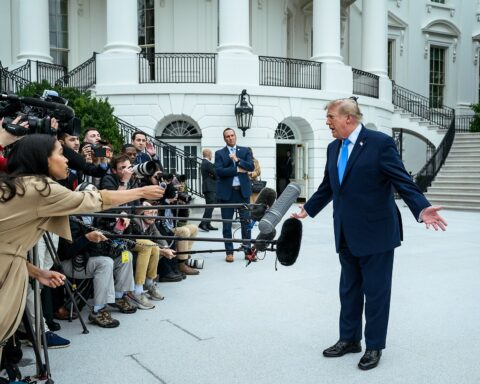
TEHRAN — Nine months before the strike that killed him, Ali Shamkhani looked into an NBC News camera and said “yes” — he would sign a nuclear deal that day if the United States lifted all sanctions immediately. It was May 14, 2025, and Shamkhani was the only figure inside Iran’s decision-making machinery who possessed both the institutional standing and the personal willingness to send that signal: a former IRGC Navy commander, former defence minister, former SNSC secretary, and at that moment Khamenei’s political adviser — a man who sat above the authorization ceiling that has blocked every Iranian negotiator since. Washington’s 14-point nuclear proposal, delivered into the wreckage of that signal, is now addressed to a building with no one inside it.
The proposal — a one-page memorandum of understanding covering enrichment moratoriums, HEU surrender, frozen assets, and Hormuz security over a 30-day negotiating window — arrived in early May 2026. It demands zero enrichment for 12 to 20 years, overseas transfer of Iran’s approximately 440 kilograms of 60%-enriched uranium, the elimination of underground facilities, snap inspections, and automatic extension for violations. The 2015 JCPOA, by comparison, permitted 5,060 IR-1 centrifuges at 3.67% for 10 to 15 years and never required Iran to ship a single gram of fissile material abroad. The structural distance between the two frameworks is not a negotiating gap. It is a demand for capitulation dressed in the language of diplomacy — and there is no one left on the other side of the table with the authority to accept it, reject it meaningfully, or offer a counter-signal that Washington could treat as binding.
- The Signal That Died With Its Sender
- What Is the Authorization Ceiling — and Who Sits Above It Now?
- Mojtaba’s Hard Vows and the Absence of Flexibility
- How Does the 14-Point Proposal Compare to the JCPOA?
- Araghchi in Delhi: Negotiating Below the Ceiling
- The Five Conditions as Structural Poison Pill
- Why Does Saudi Arabia Get What Iran Must Destroy?
- The 90% Threat and the Collapse of Ambiguity
- Saudi Arabia’s Helsinki Gambit
- FAQ
The Signal That Died With Its Sender
Ali Shamkhani’s biography was the signal. He commanded the IRGC Navy from 1989 to 2000 — the period in which Iran built its entire Hormuz defensive doctrine, the mine-laying protocols, the fast-attack boat swarms, the asymmetric architecture that still defines the Strait’s threat environment. He served as defence minister under Khatami from 1997 to 2005, then as secretary of the Supreme National Security Council from 2013 to 2023, the body that operationally architected the negotiations leading to the 2015 JCPOA. After Raisi expelled him from the SNSC in May 2023, Khamenei appointed him as political adviser and placed him on the Expediency Council — a lateral move that kept him inside the decision-making circle while removing him from the most exposed bureaucratic position.
When Shamkhani told Richard Engel that Iran would commit to never making nuclear weapons, forgo its HEU stockpile, enrich only to civilian levels, and accept snap inspections — all for immediate sanctions relief — he was not freelancing. He was sending a signal that only someone with his institutional depth could credibly send. The Foreign Ministry could offer the same words and they would mean nothing, because the authorization ceiling in Iran’s system runs not through elected officials but through the revolutionary institutions: the IRGC, the SNSC, the Supreme Leader’s office, and the handful of individuals who bridge all three — and Shamkhani was the one who bridged them.
On February 6, 2026, Pezeshkian appointed him Defence Council Secretary — a wartime coordination role that placed him at the operational centre of Iran’s conflict management. Twenty-two days later, on February 28, an Israeli strike killed him alongside Ali Khamenei himself. The Arab Weekly had reported him “resuming a central role in Iran’s war room” as recently as February 25 — three days before the building ceased to exist. Iran’s judiciary confirmed the deaths on March 1. The only figure who had demonstrated both the willingness and the institutional standing to send a meaningful nuclear signal was buried alongside the supreme leader who had, however reluctantly, permitted him to send it.
The Middle East briefing 3,000+ readers start their day with.
One email. Every weekday morning. Free.
What Is the Authorization Ceiling — and Who Sits Above It Now?
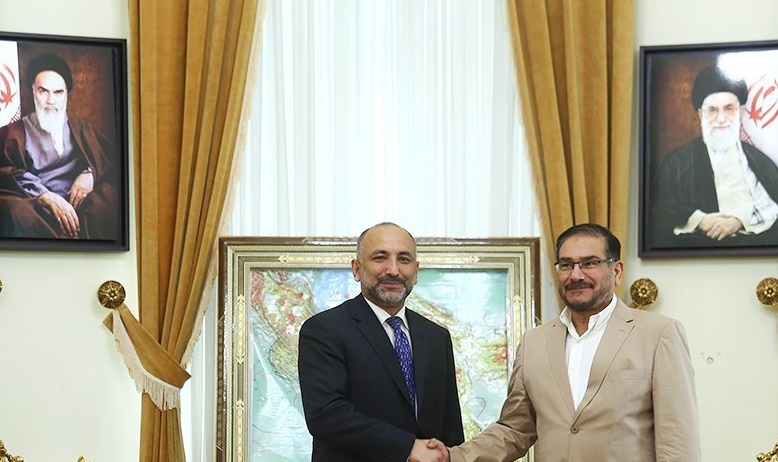
The authorization ceiling is the structural feature of Iran’s system that separates who can talk from who can commit. Under the Islamic Republic’s constitution, Article 110 grants the Supreme Leader sole authority over “general policies,” the armed forces, and declarations of war and peace. Article 176 vests the SNSC — chaired by the president but dominated by military appointees — with national security coordination, but its decisions require the Supreme Leader’s ratification to become binding. The practical effect is that the president and foreign minister can negotiate, signal, and even initial agreements, but they cannot authorize. The IRGC can veto from below, and the Supreme Leader can veto from above. Any deal requires active assent from at least one figure who straddles the revolutionary and diplomatic tracks.
This is what made the Rouhani-era JCPOA possible. In September 2013, Ali Khamenei publicly authorized “heroic flexibility” — a rare, explicit signal that the president had negotiating room and that the IRGC would be restrained from sabotaging the process. Shamkhani, then SNSC secretary, was the operational bridge: a former IRGC commander trusted by the military establishment, working with a diplomatic team that understood the limits of its own authority. The architecture held because the signal came from above the ceiling and was transmitted by someone who lived on both sides of it.
Today, nobody occupies that position. Power is fragmented across Araghchi at the Foreign Ministry, who sits structurally below the ceiling; Vahidi, who functions as the IRGC’s acting senior commander but carries an INTERPOL red notice for the 1994 AMIA bombing and has shown zero flexibility; Major General Mohammad Ali Jafari, who publicly articulated the same five preconditions that Mojtaba Khamenei issued; and unnamed SNSC operatives whose authority Pezeshkian himself publicly questioned when he accused Vahidi and Abdollahi of wrecking the Islamabad talks. The Arms Control Association assessed in March 2026 that “U.S. negotiators were ill-prepared for serious nuclear negotiations with Iran.” The deeper problem is that the Iranian side has no one prepared to seriously negotiate — not for lack of skill, but for lack of authorization. The SNSC appointment chain that produced this vacuum — Shamkhani killed February 28, Larijani killed March 17, Zolghadr appointed March 24 — traces the institutional destruction that Trump’s May 16 proposal now confronts.
Mojtaba’s Hard Vows and the Absence of Flexibility
Mojtaba Khamenei was announced as Supreme Leader on March 9, 2026, nine days after his father’s death. He has not been seen in public since. CNN reported on April 21 that his invisibility “might be helping the regime survive” — the absence preventing the kind of targeting that killed his father. His statements arrive as written texts read by a state television anchor, disembodied pronouncements from an authority that functions more as a signal-emitting machine than a governing figure.
His only substantive nuclear statement came on April 30: “Ninety million proud and honorable Iranians regard all of Iran’s nuclear and missile capabilities as national assets, and will protect them just as they protect the country’s waters, land and airspace.” The language is not negotiating posture. It is constitutional declaration — nuclear and missile capabilities framed as sovereign territory, their defence an obligation equivalent to defending the physical borders of the state. There is no “heroic flexibility” in this formulation, no signal to a foreign ministry that it may explore compromises, no space between the words for a Shamkhani to operate.
Time magazine’s May 6 profile of “The New Leaders Calling the Shots in Iran” described a distributed power architecture under Mojtaba — authority dispersed across IRGC factional commanders, judiciary officials, and intelligence operatives, none of whom possesses the cross-institutional standing that Shamkhani held. The effect is not chaos but paralysis of a specific kind: the system can prosecute a war, manage internal repression, and maintain Hormuz operations, but it cannot generate a credible diplomatic signal because no individual node in the network has the standing to commit the whole. Mojtaba’s written statements set the ceiling, and everyone else operates below it — a ceiling that, as currently stated, sits higher than any deal Washington has offered or is likely to offer.
How Does the 14-Point Proposal Compare to the JCPOA?
The structural differences between the 2015 JCPOA and the 2026 fourteen-point framework are not incremental. They represent a fundamentally different theory of what a nuclear agreement is for. The JCPOA was an arms-control agreement designed to extend breakout time to approximately one year while preserving Iran’s claim to a peaceful nuclear program. The 14-point proposal is a disarmament demand designed to eliminate Iran’s enrichment capacity entirely for a generation, with enforcement mechanisms that would make the moratorium effectively permanent.
| Provision | JCPOA (2015) | 14-Point MoU (2026) |
|---|---|---|
| Enrichment level | 3.67% with 5,060 IR-1 centrifuges | Zero enrichment for 12–20 years |
| Duration | 10–15 year sunset clauses | 12–20 years, auto-extension for violations |
| HEU disposition | Dilution or conversion on Iranian soil | Overseas transfer (Russia proposed) |
| Underground facilities | Fordow converted to research; limited | No underground enrichment facilities |
| Inspections | IAEA Additional Protocol + managed access | Snap inspections, broader access |
| Effective permanence | No — sunset clauses triggered expiry | Yes — auto-extension mechanism |
The HEU transfer requirement is structurally new. The JCPOA allowed Iran to dilute its enriched uranium domestically — a process that kept fissile material on Iranian soil, preserving the symbolic claim to sovereign control even as the practical utility was eliminated. The 14-point proposal demands physical removal to Russia, which Araghchi acknowledged at BRICS Delhi on May 15 as a possibility under discussion, while simultaneously describing a “deadlock” on the enriched material question. “When the nuclear issue reaches that stage, Iran will have more consultations with Russia to see if the Russian offer can help,” he said — a sentence that manages to confirm the conversation while denying any commitment, a diplomatic posture that would be unremarkable coming from a foreign minister but is meaningless without authorization from above.
The auto-extension clause is the mechanism that converts a moratorium into de facto permanence. Any violation — as defined by the monitoring party — resets the clock. In an environment where the IAEA’s access to Iranian sites was terminated on February 28, 2026, and Iran’s stockpile of 440 kilograms of 60%-enriched uranium sits at roughly 25 days from weapons-grade via IR-6 cascade, the definition of “violation” becomes the definition of the deal itself. Axios reported three US sources placing the likely moratorium at “at least 12 years,” with a violation clause that would extend it automatically. Iran countered at five years. The gap between five and twenty reflects two incompatible theories of what Iran’s nuclear program is: a national sovereign right or a global proliferation liability to be managed by someone else.
Araghchi in Delhi: Negotiating Below the Ceiling
Abbas Araghchi arrived at the BRICS foreign ministers’ meeting in Delhi on May 15 carrying a diplomatic portfolio that his own government’s structure prevents him from cashing. His public statements were a masterclass in operating below the authorization ceiling — signaling willingness, describing obstacles, and inviting mediators, all while lacking the authority to close on any of them. “We are in doubt about their seriousness,” he told Al Jazeera, “but the moment we feel that they are serious and they are ready for a fair and balanced deal, we will certainly proceed.” The conditional tense is load-bearing. Araghchi cannot “proceed” in any direction that Mojtaba’s five conditions have not already authorized.
His framing of the enrichment deadlock as a mutual “agreement to postpone” was tactically useful but structurally empty. “Iran and the US agreed to postpone the enriched uranium issue to later stages,” he said — language that presents a failure to agree as a form of agreement. The invitation to India as a mediator, extended publicly from a BRICS podium, was a bid for diplomatic oxygen from a man drowning in institutional constraints. India’s utility as a mediator is limited precisely by the authorization ceiling: even if Delhi could broker a formula on HEU transfer or enrichment timelines, no Indian diplomat can reach the figures who would need to ratify it.
The Araghchi problem is not new. Pezeshkian himself publicly accused Vahidi and Abdollahi on April 4 of deviating from the negotiating delegation’s mandate at the Islamabad talks — a remarkable confession that the president’s own negotiators had been overridden by IRGC commanders who answered to a different authority. The Zolghadr report of April 14, which triggered the Islamabad walkout, was authored by an SNSC operative whose loyalty ran to the revolutionary institutions, not to the elected government. Article 110 means the president has zero authority over the IRGC. Araghchi’s diplomacy operates in the space between what the elected government wishes it could offer and what the revolutionary institutions have decided it cannot. That gap was on direct display in the hours surrounding Trump’s May 16 proposal: Iran’s Foreign Ministry and its Supreme National Security Council gave contradictory signals — the MFA acknowledging a deadlock, the SNSC declining to acknowledge the proposal existed.
The Five Conditions as Structural Poison Pill
Mojtaba Khamenei’s five conditions, reported by Al Jazeera on May 12, are not negotiating demands. They are preconditions designed to make negotiation impossible without appearing to refuse it. A complete end to the war on all fronts; lifting of all sanctions; release of frozen assets; reparations for war damages; and formal recognition of Iran’s sovereign rights over the Strait of Hormuz. Each would be a major concession individually. Together, they constitute a maximalist position that cannot be satisfied within any framework the United States has proposed or is likely to propose.
The fifth condition — Hormuz sovereignty recognition — is the structural poison pill. The 14-point proposal treats Hormuz security as a Phase 2 deliverable, something to be negotiated after the nuclear framework is established. Mojtaba’s conditions invert this sequencing: Hormuz sovereignty becomes a precondition for nuclear talks, not an outcome of them — a deliberate IRGC move to link the one issue where Iran holds physical leverage, control of the Strait, to the one issue where the United States holds diplomatic leverage, the nuclear file. The Persian Gulf Strait Authority, established May 5 with fees up to $2 million per vessel and 40-plus mandatory data points, is the institutional expression of this linkage: Hormuz is not a bargaining chip to be traded but a sovereign right to be recognized before any other conversation begins.
The sequencing with Jafari’s identical conditions on May 11 — one day before Mojtaba’s statement — confirms coordinated messaging between the IRGC and the Supreme Leader’s office. This is the opposite of the dual-track architecture that enabled the JCPOA. Under Rouhani, the system worked because the Supreme Leader’s “heroic flexibility” created space between the IRGC’s public rejection and the diplomatic team’s private negotiation. Under Mojtaba, the IRGC and the Supreme Leader are issuing identical positions in sequence — a system that has collapsed from dual-track into single-track, with the hard track as the only track.
Why Does Saudi Arabia Get What Iran Must Destroy?
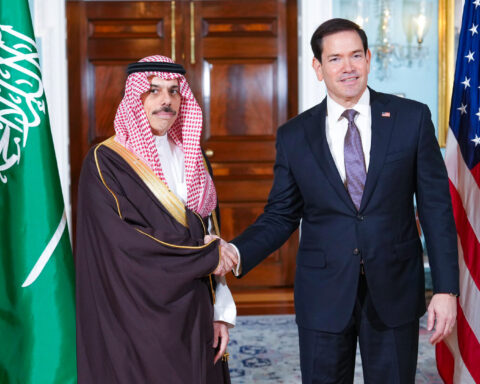
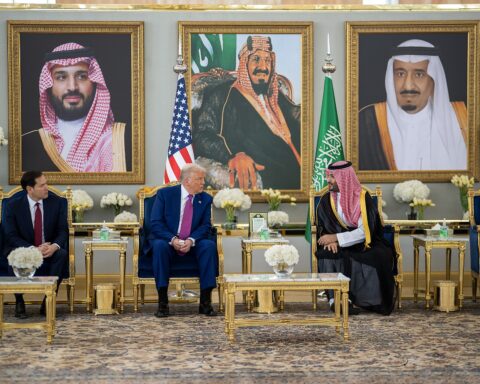
Because the United States applied different nonproliferation standards to an ally and an adversary in the same week: the May 13 US-Saudi Section 123 compact permits a pathway to Saudi enrichment under conditions less restrictive than the 2015 JCPOA, while the 14-point proposal demands Iran eliminate all enrichment capacity for a generation. The 123 agreement, finalized alongside a $142 billion arms package, omits the “gold standard” enrichment ban that the UAE accepted in its 2009 compact, does not require the IAEA Additional Protocol, and substitutes bilateral safeguards covering only declared facilities — giving Riyadh, structurally, what Tehran is being told to destroy.
The asymmetry is not subtle enough to escape notice. Tehran’s hardliners have seized on it as evidence that the 14-point proposal is structurally dishonest — that the United States is not seeking to prevent nuclear proliferation in the Middle East but to determine who is permitted to proliferate. MP Ebrahim Rezaei, spokesperson for Iran’s National Security and Foreign Policy Committee, said on May 12 that weapons-grade 90% enrichment “could be discussed in parliament” if Iran faces another attack — a threat that gains rhetorical force from the Saudi 123 comparison. If Riyadh can develop enrichment under bilateral safeguards that cover only declared facilities, the argument that Tehran must accept zero enrichment under snap inspections with auto-extending moratoriums becomes difficult to frame as anything other than selective disarmament.
The Saudi position is structurally contradictory. Riyadh’s entire post-war future — its oil export recovery through the Hormuz corridor, its fiscal stabilization, its Vision 2030 survival — depends on a nuclear deal it is excluded from shaping. The Trump administration has treated Saudi Arabia as a cost-absorber rather than a participant: Pakistan, Oman, China, and now India have been invited as mediators, while the kingdom whose oil exports collapsed 30% in March sits outside the room. The 123 compact gives Saudi Arabia a nuclear hedge — the long-term option of enrichment capacity — but it does not give it a voice in the deal that will determine whether that hedge is ever needed.
The 90% Threat and the Collapse of Ambiguity
The logic of nuclear ambiguity — the deliberate maintenance of uncertainty about a state’s intentions and capabilities — requires that threats remain implicit and deniable. Iran’s nuclear posture under Ali Khamenei operated within this logic for decades: the program advanced, breakout time shortened, but the Supreme Leader maintained a fatwa against nuclear weapons and officials denied any military dimension. The ambiguity served Iran’s interests because it preserved diplomatic space while generating deterrent effect. A state that might build a weapon is harder to attack than one that has openly declared its intention to do so.
Rezaei’s parliamentary threat to discuss 90% enrichment — weapons-grade, explicitly named as such — collapses this ambiguity in a way that cannot be easily reconstructed. When a spokesperson for the National Security and Foreign Policy Committee publicly frames weapons-grade enrichment as a legislative option contingent on military attack, the fatwa is functionally dead even if it remains formally in place. Trump’s own rhetoric accelerated this collapse: his “nuclear dust” comments and his May 6 threat to bomb Iran “at a much higher level and intensity than before” if it does not agree created the very conditions under which Rezaei’s threat becomes domestically rational. The 14-point proposal’s demand for overseas HEU transfer arrives into this environment — a landscape where Iran’s political class is openly discussing weapons-grade enrichment while the proposal asks them to surrender their existing stockpile to Russian custody.
Iran’s 440 kilograms of 60%-enriched uranium represents approximately 25 days of additional enrichment to weapons-grade via IR-6 cascade — a technical fact that both sides understand. The JCPOA extended breakout time to roughly one year. The current stockpile has compressed it to weeks. The 14-point proposal’s demand for overseas transfer is an attempt to restore the temporal buffer that the JCPOA’s collapse destroyed, but it requires precisely the kind of authorization signal that no one in Iran’s current power structure is positioned to send. Shamkhani could have authorized a transfer framework because he had commanded the IRGC Navy, sat on the SNSC, and operated with the elder Khamenei’s implicit trust. The current cast of characters — a foreign minister below the ceiling, an invisible Supreme Leader issuing hard vows, and IRGC commanders whose institutional interest lies in maintaining the nuclear option — cannot replicate that signal even if they wanted to.
Saudi Arabia’s Helsinki Gambit
MBS’s May 14 proposal to the Financial Times — using the 1975 Helsinki Accords as a model for a Middle East security arrangement — is a bid to solve the exclusion problem by changing the frame. The Helsinki Accords worked, to the limited extent they did, because they created a permanent multilateral architecture that linked security, economics, and human rights in a single process — thirty-five states, over decades. It was, critically, a framework that included all parties with equities in the outcome — precisely the feature missing from the current bilateral US-Iran nuclear track, from which Saudi Arabia is structurally excluded despite bearing the heaviest costs of the war.
The gambit addresses a real problem: Saudi Arabia cannot shape the nuclear deal, cannot influence the Hormuz outcome, and cannot control whether the 123 compact’s enrichment pathway becomes a provocation that hardens Tehran’s position. A Helsinki-style framework would give Riyadh a seat at a permanent table rather than leaving it dependent on bilateral compacts whose terms are set in Washington. But the proposal also carries the weight of its own precedent. The Helsinki process took decades to produce results, required Soviet participation that was premised on the USSR’s desire for legitimation, and ultimately contributed to — but did not cause — the end of the Cold War. The current situation offers no equivalent of the Soviet motivation: Iran under Mojtaba is not seeking international legitimation but survival, and the IRGC’s institutional interests are served by permanent confrontation, not by the kind of multilateral confidence-building that Helsinki embodied.
The deeper problem is temporal. Saudi Arabia’s fiscal position — Goldman Sachs estimated a war-adjusted deficit of 6.6% of GDP against the official 3.3% projection — cannot survive the years that a Helsinki process would require. The kingdom’s March production crash to 7.25 million barrels per day from February’s 10.4 million, a 30% drop documented by the IEA as “the largest disruption on record,” has created an urgency that a multi-decade security architecture cannot address. MBS needs a deal this year. Helsinki took fifteen years to produce its first meaningful outcome. The proposal is strategically sound and temporally impossible — a blueprint for a building that cannot be constructed before the foundation gives way.
Frequently Asked Questions
What role did Russia play in previous Iranian nuclear negotiations, and why is Russian HEU storage now being discussed?
Russia served as a key P5+1 participant in the JCPOA negotiations and operated the Bushehr nuclear power plant, giving it unique institutional access to Iran’s civilian nuclear infrastructure. The Russian storage proposal for Iran’s 440 kilograms of 60%-enriched uranium builds on a 2005 precedent — the “Russian enrichment centre” proposal under which Iran’s uranium would be enriched on Russian soil, addressing proliferation concerns while preserving Iran’s claim to fuel-cycle rights. Araghchi’s May 2026 acknowledgment that “consultations” with Russia could occur “when the nuclear issue reaches that stage” signals tactical willingness without institutional commitment. The complication is that Russia’s leverage as a potential custodian has increased since 2015: Moscow’s relationship with Tehran has deepened through wartime military cooperation, making Russia simultaneously the most plausible storage partner and the least likely to enforce punitive return conditions that would serve US interests.
Could a lower-ranking Iranian official realistically authorize a nuclear deal without Supreme Leader approval?
No, and the closest historical test of this question ended badly. In April 2021, Foreign Minister Zarif was recorded describing how the IRGC’s battlefield operations overrode diplomatic strategy — a remark that nearly destroyed his career and demonstrated that even senior officials who acknowledge the ceiling publicly do so at personal risk. The formal process for authorization runs from any prospective deal through the SNSC (Article 176), then upward to the Supreme Leader’s office for ratification under Article 110, which grants sole authority over “general policies of the system” and the armed forces. In the JCPOA process, Khamenei’s “heroic flexibility” speech of September 2013 served as the ratification signal before negotiations formally opened — the authorization preceded the diplomacy, rather than following it. Under Mojtaba, no equivalent pre-authorization signal has been issued. Any agreement Araghchi or Pezeshkian signed without it would face immediate IRGC veto and could not be implemented. The Zolghadr episode at Islamabad — where an SNSC operative’s report overrode the elected government’s negotiating position — demonstrated this veto in operation, in real time, on a lesser issue than nuclear weapons.
What happens to the ceasefire if the nuclear talks fail completely?
Trump declared the ceasefire “on life support” on May 10 and threatened bombing “at a much higher level and intensity” if Iran rejects the 14-point framework. The ceasefire, which originally expired April 22 and has been extended through informal mutual restraint rather than a formal renewal mechanism, exists in a legal grey zone: neither side has formally declared it over, but the IRGC has continued Hormuz operations throughout, including the seizure of the MSC Francesca and the Epaminodas on April 22. The ISW assessed that Iran believes it holds the upper hand in any resumed hostilities. A complete breakdown of nuclear talks would remove the diplomatic rationale for US restraint, potentially triggering the “much higher level” strikes Trump has threatened — but it would also remove the diplomatic rationale for Iranian restraint on its 440 kg HEU stockpile, creating a proliferation race that neither the 14-point proposal nor any successor framework could contain.
How does the Persian Gulf Strait Authority (PGSA) affect the nuclear negotiations?
The PGSA’s most consequential effect on the nuclear talks is temporal, not just institutional: it creates a dismantlement problem that any deal must solve before it can be implemented. The administrative infrastructure — vessel registration systems, fee-collection mechanisms, data-reporting requirements — cannot be removed by diplomatic signature. It requires an active unwinding process that Iran would need to execute cooperatively, meaning Tehran would have to dismantle the PGSA at the same moment it was being asked to surrender its HEU stockpile and accept zero enrichment. Washington’s sequencing — nuclear framework first, Hormuz second — assumes these tracks are separable. The PGSA makes them physically inseparable: any ship transiting Hormuz under the post-deal environment would still encounter an operating Iranian administrative authority in the Strait until Iran chose to wind it down. No verification mechanism in the 14-point proposal addresses this, because the proposal was written as though the PGSA does not exist.
What is the significance of Shamkhani having survived a previous assassination attempt?
Shamkhani survived a June 2025 strike, and what followed was instructive. Rather than being sidelined, he was reinserted into a wartime coordination role — Pezeshkian appointed him Defence Council Secretary in February 2026, eight months after the attempt on his life. The survival-and-return pattern was itself a signal: it demonstrated the Islamic Republic’s capacity to reconstitute diplomatic channels after military disruption, to absorb targeted killing and re-emerge with the same interlocutor. When Shamkhani survived in June 2025, the “yes” he had given NBC in May 2025 remained technically alive in the system — damaged, but attached to a living figure who still carried cross-institutional authority. His death alongside Ali Khamenei on February 28 eliminated both the sender and the authorizer simultaneously, a combination that has no precedent in the Islamic Republic’s history. Previous targeted killings — including of nuclear scientists in the 2010-2012 campaign — removed technical personnel whose roles could be filled. The February 28 strike removed the political and institutional architecture through which authorization traveled, and that architecture has no designated replacement. Iran’s response to Trump’s May 16 nuclear ultimatum illustrates precisely this vacuum: Mehr News Agency and IRGC-aligned outlets are now amplifying a year-old Shamkhani NBC interview as though it constitutes Tehran’s current offer — a signal from a dead man, circulated by institutions that lack the authority to replace him.