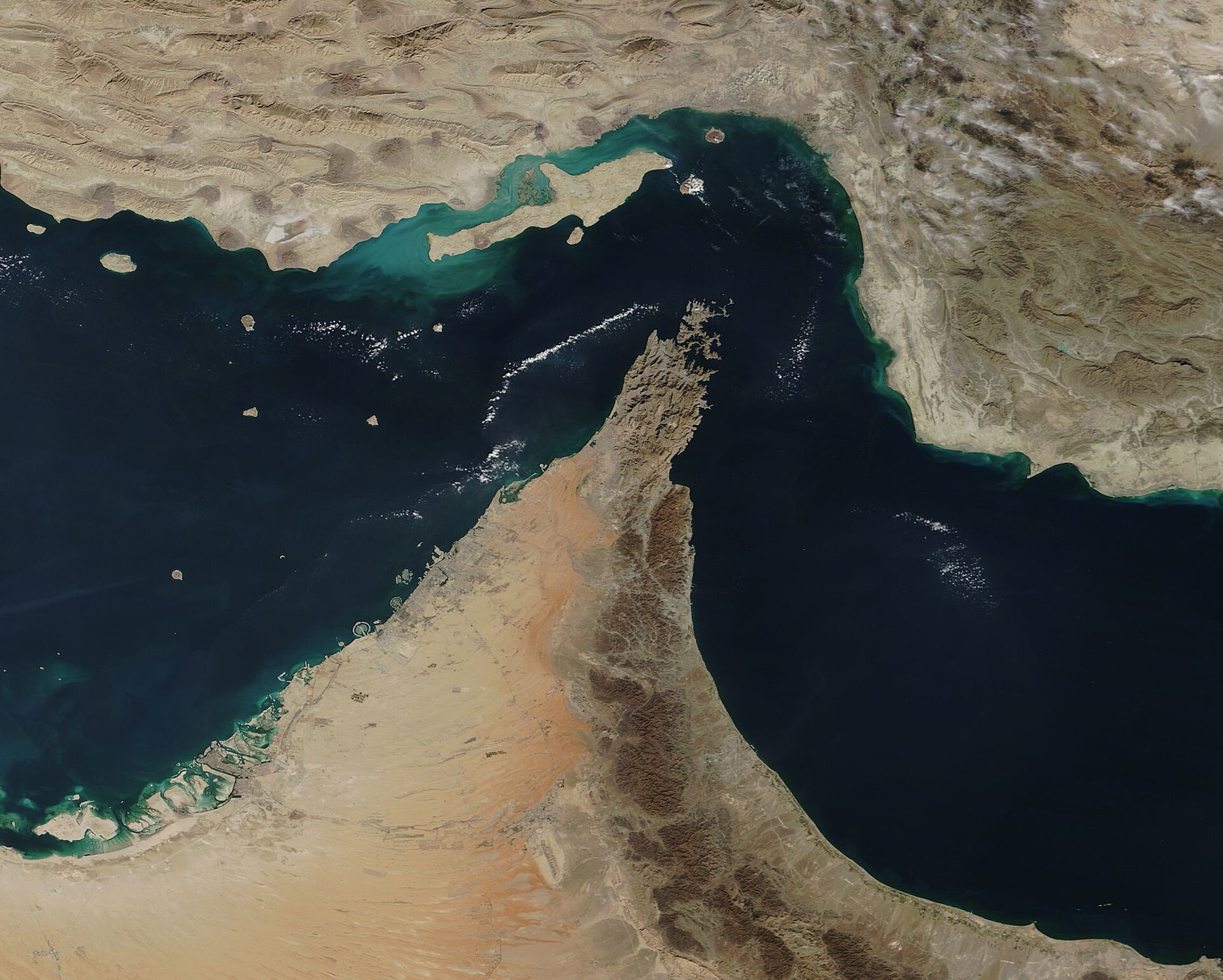
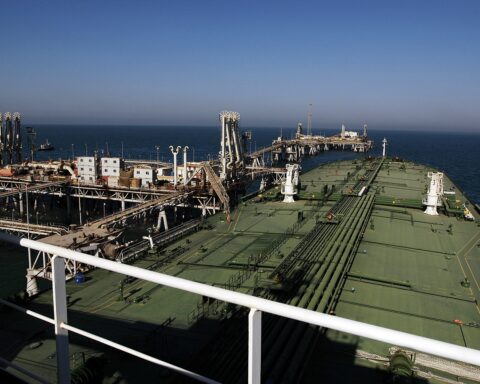
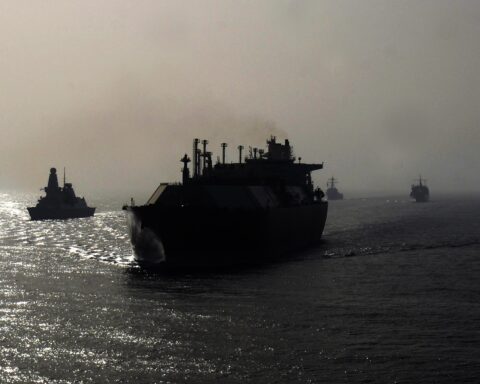
TEHRAN — Iran’s navy said an oil tanker struck a mine and caught fire in the Strait of Hormuz late on November 28 after three vessels entered a restricted zone with their tracking systems switched off, in the latest reported incident in a waterway where war-risk insurance premiums have surged to roughly 30 times their prewar level. The Iranian Navy’s public relations office, cited by Tasnim News Agency, said the tanker was immobilised while two other ships turned back; no casualties were reported, and no vessel name, flag state, or cargo type was disclosed.
The claim — which the Azerbaijani news agency APA.az explicitly noted has not been independently verified — adds to a tally the International Maritime Organisation puts at 146 confirmed incidents in the region as of November 27. It also carries a quieter signal about who is enforcing Iran’s blockade and why that distinction matters for every government, insurer, and shipowner watching the strait.
The House of Saud Daily Briefing
Saudi Arabia's news in 3 minutes, every morning. Free. See today's issue
Table of Contents
What Did Iran’s Navy Report?
Three oil tankers entered the prohibited zone in the eastern Strait of Hormuz “around 11 pm local time” — approximately 19:30 UTC on November 28 — with their Automatic Identification System transponders disabled, according to APA.az, citing Iran International as its initial source. One vessel struck a mine and caught fire; the other two reversed course and left the area. The Iranian Navy’s public relations office released the account through Tasnim News Agency, and the report was first published at approximately 22:53 UTC, according to Global Eye 24.
AIS transponders broadcast a ship’s identity, position, speed, and heading. Switching them off in a mined waterway means no one outside the vessel’s bridge — not the US Fifth Fleet, not commercial tracking services, not the ship’s own insurer — knows precisely where it is. Iran has framed AIS deactivation as proof of hostile intent: the tankers were trying to slip through the restricted zone undetected. Some operators disable AIS to avoid Iranian targeting, creating a paradox in which the safety measure that would help avoid mines also advertises a ship’s position to the navy that laid them.
No vessel name, IMO number, flag state, operator, or cargo type was provided in any of the Iranian accounts. No casualties or crew injuries were reported by any outlet covering the story, including APA.az, Global Eye 24, and Dispatch Times. The absence of identifying details has become a pattern in Iranian mine-strike announcements: since November began, the Artesh Navy — Iran’s regular military navy, distinct from the Islamic Revolutionary Guard Corps Navy — has made similar reports on November 5 and November 25, each time without naming the vessel involved.
The late-night November 28 report is distinct from an earlier claim that same day by the IRGC Navy — reported by Anadolu Agency on the morning of November 27 — involving two tankers on an unauthorised route north of Ghavam Island. The two incidents differ in vessel count, timing, geographic description, and which branch of Iran’s military reported them, underscoring the dual-command structure now operating across the strait.
Why Is the Artesh Reporting, Not the IRGC?
For decades, the division of naval labour in the Persian Gulf followed a simple rule: the IRGC Navy handled the shallow, island-studded waters of the strait and the Gulf itself — using fast-attack craft, shore-launched missiles, and mines — while the Artesh Navy, Iran’s conventional military force, operated in the deeper waters of the Gulf of Oman and the open ocean with frigates and submarines. That arrangement has been upended by nine months of war. US and Israeli strikes since February 28 sank or disabled most of the Artesh’s larger surface combatants and submarines, according to analysis by Clash Report and the Hudson Institute. The IRGC’s smaller, harder-to-hit fast boats largely survived.
Yet it is the Artesh, not the IRGC, whose name now appears on mine-strike reports from the eastern sector. Farhad Fattahi, the Artesh Navy’s deputy of operations, explained on November 28 that the split is formalised at the highest level. “According to the division of duties issued by the General Staff of the Armed Forces,” Fattahi told Mehr News, the western Hormuz sector falls under the IRGC Navy while the eastern sector — from Jask eastward — is the Artesh Navy’s responsibility. Transit control is coordinated under Armed Forces General Staff measures, he said.
“According to the division of duties issued by the General Staff of the Armed Forces” — the western Hormuz sector falls under the IRGC Navy; the eastern sector, from Jask eastward, is the Artesh Navy’s responsibility.
Farhad Fattahi, Artesh Navy Deputy of Operations, Mehr News, November 28, 2026
The distinction is not bureaucratic trivia. The IRGC is a US-designated Foreign Terrorist Organisation; the Artesh is not. When Iran presents the Hormuz closure as a top-down state decision executed through its regular armed forces under the Armed Forces General Staff — rather than as a unilateral IRGC action — it carries different implications under international law and complicates the legal framework Washington uses to justify its naval operations. Artesh Commander-in-Chief Amir Hatami reinforced this framing on November 28, telling Mehr News that the Hormuz closure is conducted “under the leadership and command of Imam Khamenei” — a reference to Supreme Leader Mojtaba Khamenei — and that “the Strait of Hormuz will remain closed until Iran’s conditions are fulfilled.” He made the remarks on Iran’s Day of the Strategic Naval Force, as Free Press Journal also reported.
IRGC Commander-in-Chief Ahmad Vahidi appeared to endorse the arrangement. He described Artesh-IRGC naval coordination as “a prominent manifestation of the unity and solidarity of the Armed Forces,” as reported by Mehr News. The message is deliberate: this is not a rogue militia mining international shipping lanes — it is the Islamic Republic of Iran, acting through its constitutionally established military chain of command, under direct orders from the head of state. Hatami also claimed that “the enemy had been deterred from approaching areas under the Navy’s protection for nine months,” according to Al Jazeera’s Iran War live blog — a claim that should be treated as an Iranian government assertion, not established fact. His full November 28 statement on the Khamenei-ordered closure is covered in a separate report.
What Has CENTCOM Said About Iran’s Claims?
US Central Command did not issue a specific statement on the late November 28 Artesh Navy tanker fire report. It did, however, address other Iranian claims made the same day. CENTCOM called statements by Iranian Navy Commander Shahram Irani — who had claimed Iranian forces reacquired tankers, struck a carrier, and demanded transit tolls — “another fabricated lie,” according to Kurdistan24. The specific mine-strike claim from the Artesh Navy was not addressed in that rebuttal.
CENTCOM has separately asserted that primary Hormuz Traffic Separation Scheme lanes have been cleared of Iranian sea mines, according to Maritime Gateway. That claim sits in tension with the continuing stream of reported mine strikes — whether independently verified or not — that have defined November’s shipping through the waterway. The UKMTO advisory from October 16 assessed the threat to Hormuz shipping as “severe” and further attacks as “highly likely,” with 149 maritime security incidents recorded since March 1, as reported by Middle East Eye.
At the international level, the gap between Iranian assertions and independent confirmation keeps widening. IMO Secretary-General Arsenio Dominguez said on November 28 that the organisation was “unaware of any Iran-Oman deal” to regulate ship movements in the strait, as reported by Dawn. The IMO’s own confirmed incident count — 146 as of November 27 — does not distinguish between mine strikes, missile attacks, drone incidents, and other categories, making it difficult to cross-reference against Iranian claims. At least 25 seafarers have been killed in and around the Strait of Hormuz since February, according to Al Jazeera, citing the United Nations.
The pattern across Iranian announcements is consistent: a mine strike is reported through state-affiliated media, no vessel is named, no independent maritime authority confirms the incident, and within hours the claim is absorbed into a broader narrative of Iranian control over the waterway. Whether the tanker that allegedly caught fire on November 28 is real, exaggerated, or fabricated remains unknown. What is verifiable is the effect: each announcement reinforces the perception that any transit through the strait is a gamble, and that perception alone moves markets and insurance premiums regardless of what actually happened beneath the surface.
Insurance Costs and Shipping Disruption
The financial infrastructure of global shipping has already priced in the worst-case reading of Iran’s claims, verified or not. War-risk insurance premiums for Hormuz transits have surged to 7–9 percent of hull value per voyage, according to Lloyd’s List data cited by MarketCalls.in as of November 9. Before the war, that figure sat at approximately 0.25 percent. For a supertanker with a hull value of $100 million, the arithmetic is blunt: a single Hormuz transit now costs roughly $8 million in war-risk cover alone, up from $250,000 — a cost that is passed through to crude buyers and, eventually, to consumers at the pump.
The premium gap between loading crude in the Persian Gulf versus the Gulf of Oman tells the story in a different currency. Baltic Exchange data from November 13 showed very large crude carriers earning $1,078,000 per day on Gulf-loading routes, compared with roughly $307,160 per day for Gulf of Oman-loading, according to MarketCalls.in. That 3.5-to-1 ratio reflects the hazard pay the market demands for every hour spent inside the strait. Lloyd’s and Chubb jointly launched a $400 million war-risk insurance facility to meet demand, while Lloyd’s estimates total losses from the conflict at £1.4 billion, as reported by gokhshtein.com.
Operators are responding with their feet. Maersk has suspended Gulf bookings, according to its November 23 operational advisory; Hapag-Lloyd is rerouting via the Cape of Good Hope, according to its own service notices; and the Swedish Club has advised members to avoid Hormuz unless the transit is essential, according to the club’s member alerts. Abu Dhabi’s ADNOC has restricted five export terminals — Ruwais, Jebel Dhanna, Das Island, Zirku, and Mubarraz — for 90 days, requiring 72 hours’ advance notice for tanker access, according to NGlobeNews. Active Persian Gulf tonnage has fallen 15 percent from its mid-November peak, according to Shipfinder data.
Iran has tightened the vice from another direction. The Persian Gulf Strait Authority has placed 266 vessels on a non-compliance blacklist, with the latest round adding 26 ships including tugboats, according to Insurance Journal. Analysis by Orbital Risk Intelligence suggests Tehran is trying to deny salvage and firefighting services to vessels it considers hostile — meaning a tanker that catches fire in the restricted zone, as Iran claims happened on November 28, may have no one coming to put the flames out. Oil throughput through the strait has already fallen to 54 percent of prewar levels, and the cumulative effect of mines, blacklists, and insurance costs is pushing that figure lower with each reported incident.
Nine Months of Hormuz Minefields
Iran first closed the Strait of Hormuz at the end of February, days after US and Israeli strikes began. The closure has been reimposed and tightened repeatedly — in April and again in July — with each cycle expanding the restricted zone and adding new mine belts. The Artesh Navy’s late-night announcement on November 28 fits a pattern that has accelerated through the month. The same branch reported mine strikes on November 5 and November 25, while the IRGC Navy has issued its own separate reports throughout the month, including the November 27 claim involving two tankers near Ghavam Island.
The dual-announcement pattern — Artesh in the east, IRGC in the west — appears to be accelerating rather than consolidating. On November 16, Press TV tagged an Artesh Navy warning separately from IRGC Navy reports, as Anadolu Agency noted, indicating both branches were issuing distinct public statements about their respective sectors. The coordination Fattahi described to Mehr News — “issued by the General Staff of the Armed Forces” — frames this as deliberate institutional design, not bureaucratic confusion.
What the Artesh has lost in blue-water capability, it appears to be compensating for in messaging. Its larger surface combatants and submarines may have been sunk or disabled, but its mine-laying capacity and its role as the state’s official military voice in the eastern sector remain intact. The Artesh’s claim earlier on November 28 that it shot down a drone over Hormuz — a report on which CENTCOM did not comment — adds to the picture of a conventional military force asserting operational control over a defined sector, even after absorbing devastating losses to its fleet.
For the ships that still attempt the transit, the UKMTO pattern offers a note of caution. In prior comparable incidents, the British maritime authority has used the term “projectile” rather than “mine” in its own reports, and Iranian navy mine claims have not been independently verified in any incident found by gCaptain. The question of whether tankers are actually hitting mines, being struck by other weapons, or in some cases not being hit at all remains open — but the operational effect is the same. Each report, real or inflated, makes the next transit more expensive and the next insurance renewal harder to negotiate.
Frequently Asked Questions
Has anyone identified the tanker that allegedly caught fire?
No. Iran’s navy did not provide a vessel name, IMO number, flag state, operator, or cargo type. No independent maritime tracking service has publicly confirmed a vessel matching this description was immobilised in the eastern Hormuz restricted zone on the night of November 28. APA.az explicitly noted the incident “has not been independently verified yet.” Until a named vessel surfaces in port-state reports, insurance claims, or satellite imagery analysis, the report remains an unverified Iranian military claim.
What is the difference between the Artesh Navy and the IRGC Navy?
Iran maintains two separate navies. The Artesh Navy (formally the Islamic Republic of Iran Navy, or IRIN) is part of Iran’s regular armed forces and historically operated the country’s larger surface combatants — frigates, corvettes, and submarines — in the Gulf of Oman and open ocean. The IRGC Navy (formally the Islamic Revolutionary Guard Corps Naval Forces, or IRGCNF) specialised in asymmetric warfare inside the Persian Gulf using fast-attack craft, shore-launched missiles, and mines. Both report to the Supreme Leader through the Armed Forces General Staff. The IRGC is designated a Foreign Terrorist Organisation by the United States; the Artesh is not, which gives Iran’s mine-announcement pattern a legal dimension beyond military posturing.
Can commercial ships still transit the Strait of Hormuz?
Some are. Oil throughput through the strait stood at 54 percent of prewar levels as of late November, meaning roughly half the volume that once passed through is now rerouted, delayed, or cancelled. CENTCOM says primary traffic lanes have been cleared of mines, but the UKMTO assessment from October 16 rated the threat as “severe” with further attacks “highly likely.” Ships that do transit face war-risk premiums of 7–9 percent of hull value and must navigate both Iranian restricted zones and the PGSA’s 266-vessel blacklist, which now includes tugboats that would otherwise provide firefighting and salvage services.
How does the PGSA blacklist affect vessels in distress?
Iran’s Persian Gulf Strait Authority has blacklisted 266 vessels, with the latest tranche adding 26 ships including tugboats, according to Insurance Journal. Orbital Risk Intelligence analysis suggests the inclusion of tugboats is designed to deny salvage and firefighting services to vessels Iran considers non-compliant. A tanker that catches fire in the restricted zone — as Iran claims happened on November 28 — may find no Iranian-authorised salvage response available, extending the duration of any fire and increasing the risk of environmental catastrophe and total hull loss.
What would it take for independent verification of these mine-strike claims?
Independent verification would typically require one or more of the following: a named vessel appearing in port-state control reports with mine-strike damage, satellite imagery showing a burning or disabled tanker at the reported location and time, an insurance claim filed by the vessel’s operator, or a report from the vessel’s flag state. So far, none of these have surfaced publicly for the November 28 incident. The IMO’s tally of 146 confirmed incidents as of November 27 represents a broader count that does not break down by weapon type, and the IMO has not commented specifically on Iranian mine-strike claims.
The House of Saud Daily Briefing
Saudi Arabia's news in 3 minutes, every morning. Free. See today's issue