TEHRAN — Iran’s Supreme Leader has not been seen, photographed, or confirmed alive in any verifiable visual or audio format for 46 days, and the constitutional architecture that governs his authority over the most decentralized military command structure in the Middle East was designed on the assumption that he could be. Reuters confirmed on April 11 — citing three sources close to Mojtaba Khamenei’s entourage and a separate U.S. intelligence official — that the 57-year-old successor to his father is mentally sharp but severely disfigured, likely missing a leg, and governing exclusively through audio conferencing from an undisclosed location in Qom, issuing orders into a chain of command that has no institutional mechanism to verify those orders are uncoerced, authentic, or issued by someone who has been fully briefed on the military situation they are meant to control.
The problem is not that Mojtaba Khamenei is incapacitated — by all credible accounts, he is not. The problem is that the Islamic Republic’s constitution, its Supreme National Security Council protocols, and 45 years of velayat-e faqih governance all assumed a leader who could convene the SNSC in person, issue written fatwas with an identifiable seal, and — when the stakes were existential, as they were in 1988 — address the nation directly in a broadcast whose authenticity no corps commander could plausibly deny. What Iran has instead, seven days before the ceasefire expires on April 22, is a voice on a telephone line, a sanctioned SNSC secretary relaying that voice’s decisions downward, and 31 autonomous IRGC provincial commands whose entire design philosophy since 2008 has been to function without top-down authentication.
Table of Contents
- What Reuters Confirmed on April 11
- The “Janbaz” Paradox: Honored but Invisible
- Why Can’t IRGC Commanders Verify a Ceasefire Order?
- Why Has Iran Not Invoked Article 111?
- What Made Khomeini’s 1988 Ceasefire Stick?
- Mosaic Defense and the Pre-Delegation Problem
- IRGC Behavior During the Ceasefire
- The Vahidi-Zolghadr Verification Chain
- 46 Days Unburied: The Funeral That Cannot Happen
- What Happens in Seven Days
What Reuters Confirmed on April 11
Three sources described by Reuters as close to Mojtaba Khamenei’s inner circle confirmed that the Supreme Leader sustained severe disfiguring facial injuries and damage to one or both legs in the February 28 airstrike that killed his father, Ali Khamenei, along with his wife, brother-in-law, and sister-in-law. A separate U.S. intelligence official told Reuters that Mojtaba is believed to have lost a leg entirely. All four sources agreed on a critical point: he is cognitively intact, participates actively in meetings with senior officials via audio conferencing, and remains engaged in decision-making.
What none of the sources described — and what no Iranian state outlet has produced since February 28 — is any first-person audio or video recording of Mojtaba Khamenei’s voice. His first public communication as Supreme Leader, on March 12, was a written statement read aloud by a state television newsreader while a still photograph appeared on screen; the statement vowed continued Hormuz closure and resistance, but the voice delivering it belonged to an anchor, not the leader. In the 34 days since that broadcast, the pattern has not changed: every directive attributed to the Supreme Leader has arrived through intermediaries, written text, or third-person references in SNSC communiqués.
The only visual content of Mojtaba broadcast by Iranian state media since February 28 is an AI-generated video showing him entering a war room and analyzing a map of Israel’s Dimona nuclear facility — synthetic content that asserts command presence while confirming the absence of any authentic footage. Competing intelligence assessments have muddied the picture further: India TV News and i24NEWS reported on April 7, citing unnamed sources, that Khamenei was “unconscious” and unable to participate in decision-making, a claim directly contradicted by the Reuters reporting four days later. The contradiction has not been publicly resolved, and Tehran has offered no mechanism for external parties — or, more consequentially, for IRGC field commanders — to determine which assessment is accurate.
The “Janbaz” Paradox: Honored but Invisible
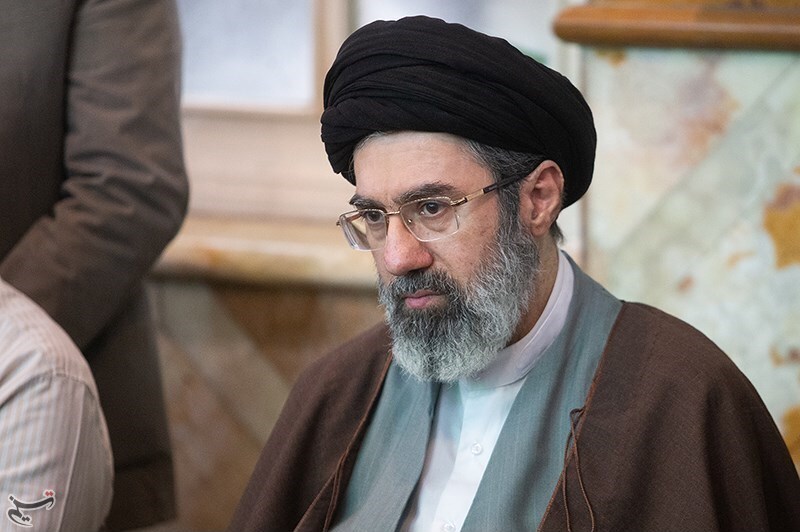
When Iranian state television announced Mojtaba’s appointment as Supreme Leader on March 9, it used the word “janbaz” — the Islamic Republic’s formal honorific for disabled war veterans, a title carrying deep cultural weight in a state that built its founding mythology on the sacrifices of the Iran-Iraq War. The designation was the only official Iranian acknowledgment that Mojtaba sustained injuries in the February 28 strike, and it accomplished two things simultaneously: it elevated his suffering into the regime’s most sacred narrative category while preemptively explaining why he would not be seen in public. A janbaz does not need to prove his presence; his wounds speak for him.
The Middle East briefing 3,000+ readers start their day with.
One email. Every weekday morning. Free.
Foreign Minister Abbas Araghchi reinforced the framing on his Telegram channel in mid-March, stating that “the Leader of the Revolution is in perfect health and is fully managing the situation.” That claim — “perfect health” for a man Reuters would later confirm lost a leg and suffered severe facial disfigurement — has not been repeated since April 11. The gap between “janbaz” (an admission of serious physical damage) and “perfect health” (a denial of any impairment) is the space in which Iran’s entire governance legitimacy currently operates, and it is a space that Tehran has chosen not to reconcile because reconciling it would require either producing the leader or invoking the constitutional mechanism designed for a leader who cannot perform his duties.
Dr. Ramesh Sepehrrad of the Organization of Iranian American Communities characterized the operating structure around Mojtaba on April 12 as resembling a “mafia” in which “different channels handle negotiations, threats, punishment, and ideology.” The description carries analytical weight because it maps onto what is observable: Araghchi handles Western diplomacy, Vahidi controls IRGC operations, Zolghadr runs the SNSC, and Mojtaba presides over all of it through a medium — audio conferencing — that none of the subordinate nodes can independently verify.
Why Can’t IRGC Commanders Verify a Ceasefire Order?
The operational compliance gap is structural, not speculative, and Araghchi himself defined it five weeks before the ceasefire existed. On March 1, speaking to Al Jazeera, Iran’s foreign minister stated: “Our military units are now, in fact, independent and somewhat isolated, and they are acting based on general instructions given to them in advance.” That sentence, which has received insufficient attention relative to its significance, is not a description of a temporary breakdown in communications — it is a description of the IRGC’s operating architecture functioning as designed under conditions of leadership disruption.
Article 110 of Iran’s constitution reserves to the Supreme Leader alone the authority to declare war and peace, assume supreme command of the armed forces, and appoint or dismiss the commanders-in-chief of the IRGC, the regular army, and the police. There is no provision for delegation of these specific powers. Article 176 requires every decision of the Supreme National Security Council to receive the Supreme Leader’s confirmation before it carries legal force. The April 8 ceasefire was announced via an SNSC statement that referenced Khamenei’s “prudent measures” and “guidance” — third-person language invoking authority rather than the direct-command language the constitution requires. The distinction matters because an IRGC provincial commander receiving a ceasefire order through his chain has no way to distinguish between an order that originated with a cogent Supreme Leader who reviewed the military situation and approved a halt, and an order that originated with the SNSC secretary or the IRGC commander-in-chief and was attributed to the Supreme Leader after the fact.
The SNSC has no authentication protocol for remote ratification. Article 176 requires Supreme Leader confirmation but specifies no form — written, oral, or in-person. Prior practice under Ali Khamenei relied on written fatwas carrying his seal or direct meetings documented in SNSC records. An audio conference from an undisclosed location in Qom, relayed through intermediaries to field commands spread across 31 autonomous provinces, creates an evidentiary gap that the constitution’s framers never anticipated because they assumed — reasonably, given that the Islamic Republic had known only two Supreme Leaders in its history, both of whom governed visibly — that the leader would be present, identifiable, and convened.
Why Has Iran Not Invoked Article 111?
Iran’s constitution provides a precise remedy for exactly this situation. Article 111 establishes an Interim Leadership Council — comprising the President, the Head of the Judiciary, and a Guardian Council faqih chosen by the Expediency Council — to assume the Leader’s duties if he is “temporarily unable to perform the duties of leadership.” The clause exists because the framers understood that a system built on the absolute authority of a single jurisprudent needed a fallback for moments when that jurisprudent could not exercise authority in a verifiable way. Forty-six days into Mojtaba Khamenei’s tenure, with no visual confirmation of his capacity and a Reuters-confirmed physical condition that has kept him invisible, Article 111 has not been invoked, discussed publicly, or even acknowledged as relevant by any official in Tehran.
The non-invocation is itself a decision with cascading consequences. By declining to trigger Article 111, Tehran is functionally asserting that Mojtaba is fully capable of performing his duties — an assertion that requires explaining why a fully capable Supreme Leader has not appeared in any verifiable format for 46 days, has not conducted a single visible meeting, and has communicated exclusively through intermediaries reading written statements on his behalf. The two positions — he is fully capable, and he cannot be seen or heard — are logically irreconcilable, and the irreconcilability is not an accident. Invoking Article 111 would transfer the Leader’s powers to a council that includes President Pezeshkian, who on April 4 confronted Hossein Taeb in a recorded exchange, accusing IRGC commanders Ahmad Vahidi and Ali Abdollahi of “acting unilaterally and driving escalation through attacks on regional countries” and destroying “any remaining chance of a ceasefire.” Vahidi and the IRGC command structure have every institutional incentive to ensure Article 111 is never triggered, because triggering it would place a president who has publicly accused them of insubordination into the leadership council governing their operations.
The result is a constitutional standoff disguised as normalcy. The Leader is present enough to preclude the constitutional remedy for his absence, but absent enough that no one in the system — from IRGC provincial commanders to the SNSC secretary to the foreign minister conducting negotiations in Islamabad — can independently confirm that his authority is being exercised rather than merely invoked.
What Made Khomeini’s 1988 Ceasefire Stick?
The only precedent for forcing a ceasefire on the IRGC is the 1988 acceptance of UN Resolution 598, and the mechanics of how it succeeded illuminate precisely why the current arrangement cannot replicate it. IRGC commander Mohsen Rezaee had formally written to Ayatollah Khomeini opposing acceptance, arguing that the corps could continue fighting. Khomeini overruled him — not through an intermediary, not through a written statement read by a newsreader, and not through a third-person SNSC communiqué referencing his “guidance.” He did it through a personal, direct, radio-broadcast address to the nation in which he stated he had drunk the “poisoned chalice” of accepting peace, absorbing the humiliation into his own person so that his commanders’ institutional honor remained intact.
The 1988 model worked because it satisfied three conditions that audio-only governance through intermediaries cannot meet. First, authentication: Khomeini’s voice was recognized, broadcast live, and undeniable — no commander could claim the order was fabricated, relayed incorrectly, or issued under coercion. Second, personal absorption of cost: by framing acceptance as his own sacrifice, Khomeini gave IRGC commanders permission to comply without institutional dishonor, a permission that only the leader himself — not his staff, not his son, not his SNSC secretary — had the religious and political authority to grant. Third, visibility: the nation saw that the man making the decision was the man constitutionally empowered to make it, and that he was making it freely. Mojtaba Khamenei, governing by speakerphone from Qom through a chain of intermediaries, cannot satisfy any of these conditions — not because he lacks the intent, but because the medium he is forced to use structurally prevents it.
The 1988 precedent carries an additional lesson that the current crisis has rendered newly relevant. Rezaee’s opposition was formal, documented, and ultimately overridden by a leader whose authority was beyond question precisely because it was exercised in person. Today’s IRGC Aerospace and Navy commanders issued a joint statement within hours of the April 8 ceasefire announcement declaring that “they experienced it today and saw that our hands are on the trigger, and as soon as the enemy makes the slightest mistake, it will be responded to with full force.” That statement was issued in the IRGC’s own institutional name — not attributed to the Supreme Leader, not framed as executing the Leader’s will, and not accompanied by any reference to the constitutional authority under which a ceasefire must be ordered. If Rezaee’s 1988 letter was a constitutional challenge that Khomeini visibly defeated, the April 8 IRGC statement is a constitutional challenge that no one can visibly address.
Mosaic Defense and the Pre-Delegation Problem
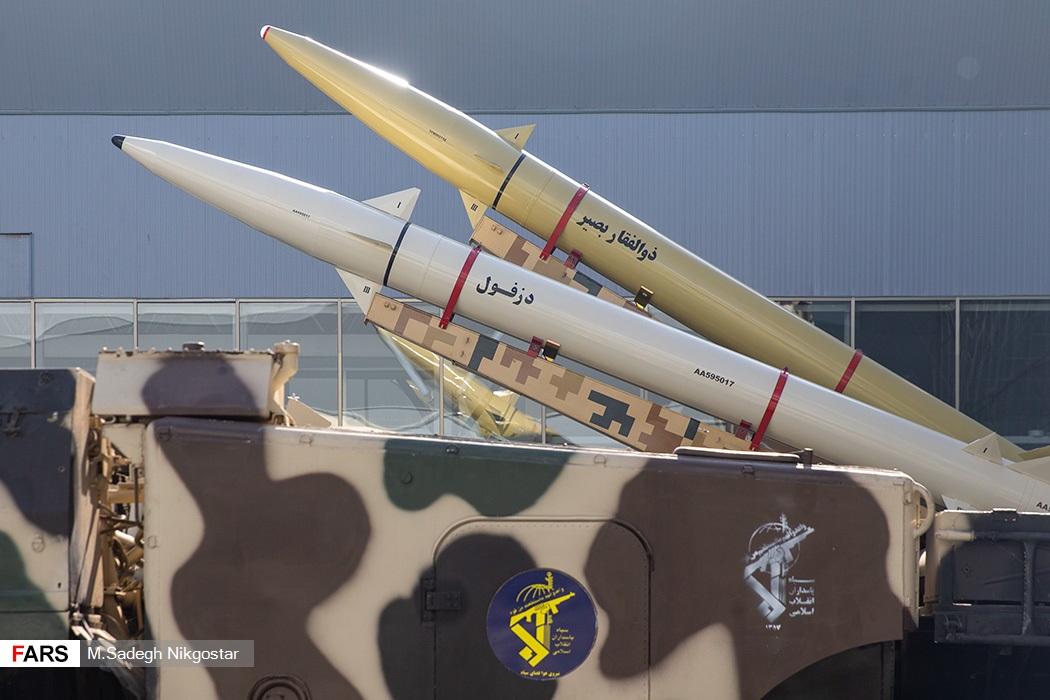
The IRGC’s command architecture was rebuilt from 2007 onward under General Mohammad Ali Jafari into what is known as Mosaic Defense: 31 autonomous provincial commands, each with pre-delegated strike authority, organic weapons stockpiles, independent intelligence cells, and the operational latitude to act without real-time authorization from Tehran. The Soufan Center’s March 9 IntelBrief described the structure as explicitly designed to survive decapitation strikes — to continue functioning, by design, when the central command authority is disrupted, destroyed, or unreachable. The architecture is, in other words, purpose-built for a scenario in which orders from the Supreme Leader cannot be authenticated, and its response to that scenario is not to halt operations pending verification but to continue executing on pre-delegated authority.
A ceasefire order reaches this system as one signal among many, transmitted downward through a chain that begins with an audio-only leader, passes through a sanctioned SNSC secretary (Mohammad Bagher Zolghadr, designated by both the U.S. and EU), filters through a commander-in-chief (Ahmad Vahidi, wanted by Argentina’s Interpol in connection with the 1994 AMIA bombing) who has publicly stated that wartime command decisions belong to the IRGC, and arrives at provincial commands whose training, stockpiles, and institutional culture are oriented toward independent action. The ceasefire is not, in this architecture, a switch that can be flipped from the top. It is a request transmitted into a system that was built to disregard exactly this kind of centralized directive under conditions of leadership uncertainty — which is precisely the condition that Mojtaba Khamenei’s audio-only governance creates, regardless of his actual cognitive state.
Araghchi’s March 1 admission — that IRGC units are “independent and somewhat isolated, acting based on general instructions given to them in advance” — was not a wartime disclosure of temporary dysfunction. It was a description of the system performing to specification. The IRGC authorization ceiling that has defined this war since its first week is not a bug in Iran’s command structure; it is the design philosophy of a military that correctly anticipated it would face decapitation strikes and incorrectly assumed that a Supreme Leader who survived such a strike would be able to reassert verifiable authority over the system designed to outlast his destruction.
IRGC Behavior During the Ceasefire
The observable behavior of IRGC units since the April 8 ceasefire announcement tells a more precise story than any official statement about whether the ceasefire order has been authenticated and internalized at the operational level. CNN reported on April 10 that satellite imagery showed front-end loaders and dump trucks at the missile base near Khomeyn clearing rubble from blocked tunnel entrances — not repair work consistent with standing down, but reconstitution activity consistent with preparing for resumed operations. Sam Lair of the James Martin Center for Nonproliferation Studies assessed the activity directly: “This aligns with the overall concept of operations for the missile city, which was, you eat the first attack, dig yourself out, and then launch again.”
IRGC spokesman Brigadier General Reza Talaei Nik reinforced the reconstitution framing on April 13, declaring that “the armed forces’ strategic reserves, including missiles and drones, have been fully replenished and the forces are ready to defend the nation.” Brigadier General Hossein Mohebbi, another IRGC spokesman, stated separately: “We haven’t yet used all our capabilities and if the war continues, we will unveil capabilities that the enemy does not have any perception about.” Neither statement referenced the ceasefire as a constraint on operations; both framed the pause as a period of material preparation for the next phase, using language that positions the IRGC as an independent institutional actor describing its own readiness rather than an instrument executing the Supreme Leader’s will.
| Date | IRGC Action During Ceasefire | Source |
|---|---|---|
| April 8 | Aerospace + Navy joint statement: “hands on the trigger” — issued in IRGC’s own name | PressTV, Tribune India |
| April 10 | Satellite imagery: front-end loaders clearing Khomeyn missile base tunnels | CNN / James Martin Center |
| April 13 | Talaei Nik: strategic reserves “fully replenished,” forces “ready to defend” | News Pravda |
| April 13 | Mohebbi: capabilities not yet used will be “unveiled” if war resumes | News Pravda |
The pattern is consistent with what the Pakistan-mediated ceasefire enforcement structure was always going to struggle with: a ceasefire is a political decision that requires authenticated top-down authority to bind military actors, and the IRGC’s Mosaic Defense architecture was specifically designed to resist being bound by top-down authority in conditions of leadership disruption. The units are complying — no major strikes have been attributed to Iran since April 8 — but the compliance appears tactical (a pause for reconstitution and tunnel clearing) rather than strategic (an acceptance that the war is entering a negotiated phase under the Supreme Leader’s command). The distinction becomes operationally meaningful on April 22.
The Vahidi-Zolghadr Verification Chain
Every order attributed to the Supreme Leader must pass through a verification chain that, under current conditions, no outsider and arguably no IRGC field commander can independently confirm. Mohammad Bagher Zolghadr, who heads the Supreme National Security Council, is himself sanctioned by both the United States and the European Union — a detail that matters not for its diplomatic significance but for what it reveals about the opacity of the node through which all SNSC decisions pass upward to the Leader for ratification and downward to military commands for execution. Zolghadr’s role in the Islamabad talks was itself contested: Vahidi demanded Zolghadr’s inclusion on the negotiating team and simultaneously refused to allow missile capability to be placed on the agenda, a pair of conditions that shaped the talks before they began.
Ahmad Vahidi, appointed IRGC commander-in-chief on March 1, occupies the other critical node. His biography — former Quds Force commander from 1988 to 1998, defense minister under Ahmadinejad, subject of an Interpol Red Notice in connection with the 1994 AMIA bombing in Buenos Aires that killed 85 people — is relevant not as character assessment but as institutional positioning: Vahidi’s career has been defined by operating in the space between political authority and military autonomy, and his stated position that wartime command decisions belong to the IRGC is not an aspiration but a description of the current operating reality. When President Pezeshkian confronted Hossein Taeb on April 4, accusing Vahidi and Ali Abdollahi of “acting unilaterally and driving escalation through attacks on regional countries,” he was describing a command relationship in which the IRGC commander-in-chief answers — constitutionally — to a Supreme Leader who cannot be seen, and — practically — to no one whose authority he is required to accept through an audio channel he has no obligation to treat as authenticated.
The verification chain, then, runs from an audio-only leader through a sanctioned SNSC secretary to a commander-in-chief who has publicly asserted IRGC primacy in wartime decision-making, and from there to 31 provincial commands operating under pre-delegated authority. At no point in this chain does any constitutional mechanism, institutional protocol, or established practice provide a field commander with the means to verify that the voice on the other end of the audio conference is the Supreme Leader, that the Supreme Leader was fully briefed on the current military situation when he spoke, or that his words were transmitted accurately through the intermediary chain. The constitution’s framers assumed the Leader would be in the room. The Leader is in Qom, and no one outside a very small circle can confirm even that.
46 Days Unburied: The Funeral That Cannot Happen
Ali Khamenei’s body has remained unburied for 46 days as of April 15 — an extraordinary departure from Islamic practice, which requires burial within 24 hours of death, and from the Islamic Republic’s own precedent, given that Khomeini’s 1989 funeral proceeded within days despite being one of the largest public gatherings in modern Iranian history. The original three-day state funeral was postponed indefinitely shortly after the February 28 strike. The 40th-day mourning ceremonies began April 9 — a date that arrived with no public funeral having taken place and no explanation from the regime for the delay beyond what can be inferred from Mojtaba’s physical condition.
Dr. Sepehrrad’s assessment — “the regime does not have the confidence to publicly bury Mojtaba’s dead father” — frames the non-burial as a security decision, which it almost certainly is: a state funeral for a Supreme Leader killed by a foreign airstrike would require a public gathering of senior regime officials at a known location, precisely the kind of target that the February 28 strike demonstrated the United States and Israel can reach. But the non-burial also functions as an unintended authentication failure. A Supreme Leader who cannot bury his father cannot be seen by the nation, and a Supreme Leader who cannot be seen by the nation cannot exercise the kind of authority that the 1988 precedent established as necessary for compelling IRGC compliance with a ceasefire that corps commanders find institutionally unacceptable.
The funeral is, in this sense, a proxy for the broader crisis. It is the most basic public act that a functioning Supreme Leader would perform — the filial duty that would simultaneously demonstrate physical presence, emotional capacity, and political authority — and its indefinite postponement communicates to every node in the Iranian system, from SNSC members to IRGC provincial commanders to the general public, that Mojtaba Khamenei cannot do the one thing that would resolve every question about his ability to govern: appear.
What Happens in Seven Days
The ceasefire expires on April 22, and the structural problem outlined above does not resolve itself in the interim. A ceasefire extension, if one is negotiated through the three frameworks currently competing for the strait’s future, would require the same authentication chain that made the original ceasefire order structurally ambiguous — the same audio-only leader, the same sanctioned SNSC secretary, the same IRGC commander-in-chief who has asserted wartime primacy, and the same 31 provincial commands whose tunnel-clearing and stockpile-replenishment activities during the ceasefire suggest they are treating the pause as an operational intermission rather than a political conclusion.
The 1988 template — the only historical model for compelling IRGC compliance with an order to stop fighting — required a leader who could be heard, identified, and seen absorbing the cost of peace in his own person. Mojtaba Khamenei, by all credible accounts, has the cognitive capacity to issue such an order and the constitutional authority to make it binding. What he does not have, and what no amount of audio conferencing can substitute for, is the ability to be verified: to demonstrate to a provincial IRGC commander in Kermanshah or an Aerospace Force battery commander in Isfahan that the voice on the line is the Leader, that the Leader is uncoerced, and that compliance with his order is an act of obedience to the velayat-e faqih rather than an act of submission to an unverifiable chain of intermediaries whose institutional interests may diverge from the Leader’s own. The authorization ceiling that has defined this war since its first week was always the structural constraint on any negotiated end to this conflict. Under a “present but invisible” Supreme Leader, that ceiling has not been raised — it has been rendered structurally unverifiable, which for the purposes of a field commander deciding whether to obey a ceasefire order or continue executing on pre-delegated strike authority, amounts to the same thing.
| Constitutional Requirement | Provision | Current Status |
|---|---|---|
| Supreme command of armed forces | Article 110 | Exercised via audio conference — no independent verification mechanism |
| Declaration of war and peace | Article 110 | Non-delegable; no visible exercise since February 28 |
| SNSC decision ratification | Article 176 | Third-person language (“guidance”) replacing direct command language |
| Interim Leadership Council | Article 111 | Not invoked despite 46-day absence from public view |
| Appointment/dismissal of IRGC commanders | Article 110 | Vahidi appointed March 1 — no verifiable confirmation method disclosed |
In the days following the ceasefire announcement, Iranian state media broadcast an AI-generated video of Mojtaba Khamenei walking into a war room and examining a map of Dimona — a synthetic image of command authority produced because the authentic version does not exist and, given what Reuters has confirmed about his physical condition, may not exist for months or years. The Islamic Republic has governed through the image of the Supreme Leader since 1979 — his portrait in every government office, his face on billboards, his physical presence at Friday prayers and military parades. What it is attempting now, for the first time in its history, is governance through the absence of that image: authority claimed but not demonstrated, orders issued but not authenticated, a constitution satisfied in language but violated in the mechanism that makes language binding. Seven days from now, the ceasefire either extends or it doesn’t, and the answer depends on whether 31 IRGC provincial commanders accept an audio signal from Qom as the voice of God’s representative on earth — or whether they trust instead the pre-delegated authority that their own institution designed for exactly the moment when that voice could not be confirmed.
Frequently Asked Questions
Has any Iranian official publicly acknowledged the authentication problem?
Not in those terms, but the acknowledgment exists in the public record through inference. Araghchi’s March 1 admission to Al Jazeera — that IRGC units are “independent and somewhat isolated, acting based on general instructions given to them in advance” — effectively describes a command environment in which authentication of real-time orders from the top is structurally impossible. The statement predated the ceasefire by over five weeks and has not been walked back. Separately, the IRGC Aerospace and Navy commands’ April 8 joint statement was issued in their own institutional name rather than attributed to the Supreme Leader — a formatting choice that, within the Islamic Republic’s carefully hierarchical communication protocols, constitutes an implicit assertion of independent authority. No Iranian official has addressed the specific question of how field commanders verify that audio-relayed orders originate from the Supreme Leader.
Could Mojtaba Khamenei record a voice message to authenticate his authority?
In principle, yes — and the failure to do so is itself significant. Ali Khamenei maintained a substantial archive of recorded speeches, sermons, and addresses throughout his tenure, giving IRGC commanders and the public a well-established voice reference. Mojtaba, by contrast, had virtually no public audio footprint prior to his appointment; he operated for decades as a behind-the-scenes advisor and intelligence figure whose voice was not widely known. A voice recording from Mojtaba would therefore lack the baseline familiarity that made Khomeini’s 1988 radio address instantly recognizable and undeniable. Even a recorded message would face a secondary authentication challenge: without video showing the speaker, an audio recording from an unfamiliar voice transmitted through intermediaries provides weaker verification than the constitutional framers’ assumed model of in-person governance.
What happens constitutionally if Mojtaba dies or becomes fully incapacitated?
Article 111 provides for the Assembly of Experts to select a new Supreme Leader, with the Interim Leadership Council — the President, the Head of the Judiciary, and a Guardian Council faqih — governing in the interim. The Assembly of Experts currently has 88 members elected for eight-year terms, though the February 28 strike and ongoing conflict have raised questions about whether a quorum could safely convene. The deeper constitutional complication is that the Assembly’s 2024 elections, held under Ali Khamenei’s Guardian Council vetting, produced a body whose members were selected for loyalty to the Khamenei family line — a self-reinforcing mechanism that would likely produce another Khamenei-adjacent figure rather than a successor from outside the network. The IRGC, under Vahidi’s stated doctrine that wartime leadership decisions belong to the corps, would almost certainly assert a de facto veto over any successor selection process conducted during active hostilities.
How does the authentication problem affect ceasefire negotiations with the United States?
American negotiators face a version of the same verification problem that IRGC field commanders face, but with higher stakes: any agreement signed by Iranian diplomats in Islamabad or elsewhere requires Supreme Leader ratification under Article 176, and the U.S. has no independent means of confirming that ratification occurred. During the April 13 blockade announcement, U.S. officials described the ceasefire as holding but declined to characterize its durability — language consistent with an assessment that the ceasefire’s authority chain is unreliable. The Vance-Ghalibaf meeting in Islamabad on April 11 notably did not produce any document referencing the Supreme Leader’s direct authorization, relying instead on SNSC frameworks whose ratification status is, for the reasons described above, structurally unverifiable by any external party.
Is there precedent for a head of state governing exclusively through audio?
The closest parallel is Algerian President Abdelaziz Bouteflika, who suffered a debilitating stroke in 2013 and governed largely unseen for six years until mass protests forced his resignation in 2019 — but Algeria’s presidential system distributes executive power across a cabinet and parliament in ways that Iran’s velayat-e faqih system, which concentrates supreme military and religious authority in a single individual, does not. Stalin’s final months in 1953, during which the Soviet leadership operated around an increasingly incapacitated general secretary, produced a succession crisis that reshaped the Soviet Union for decades. The more precise comparison may be internal to Iran: Ali Khamenei’s own 44-day absence before his death — a period this publication covered in detail — created the same authorization-ceiling dynamics now amplified under Mojtaba, with the critical difference that Ali Khamenei’s absence ended with confirmed death rather than confirmed survival in an unverifiable state.