
MATCH FOUND
ISLAMABAD — US Vice President JD Vance and Iranian parliamentary speaker Mohammad Bagher Ghalibaf sat in the same building in Islamabad on Friday, opening what both governments acknowledged as the first direct principal-level contact between Washington and Tehran since the 1979 Islamic Revolution. Ghalibaf leads a 71-member Iranian delegation that includes Foreign Minister Abbas Araghchi. Vance arrived with special envoy Steve Witkoff and senior adviser Jared Kushner. Pakistan is facilitating at the Serena Hotel in the capital’s Red Zone, with Prime Minister Shehbaz Sharif, Army Chief Asim Munir, and Foreign Minister Ishaq Dar managing the choreography.
The format remained ambiguous as talks began. April 10 was definitively proximity — separate rooms, Pakistani officials shuttling between them, no agreement produced. Pakistan’s stated objective for the process had already been downgraded to what Al Jazeera reported as “an agreement to continue this process.” Whether April 11 would produce a face-to-face session or another round of shuttle diplomacy depended on the opening hours.
The man leading the Iranian side has never held a diplomatic portfolio. Ghalibaf commanded the Islamic Revolutionary Guard Corps Aerospace Force from 1997 to 2000, where he built Iran’s early drone programme. He holds the rank of Brigadier General. In 1999, he was one of 24 IRGC commanders who signed a letter to reformist President Mohammad Khatami warning that the Guards would “take matters into our own hands” if student protests were not suppressed. Khamenei subsequently appointed him national police chief. On April 20, on the eve of ceasefire expiry, that same Aerospace Force credential enabled him to issue a “new cards” battlefield warning that foreign intelligence services and military planners could not dismiss as rhetoric.
Table of Contents
The Wrong Iranian in the Room
The 2015 nuclear talks that produced the JCPOA were led by Foreign Minister Javad Zarif and his deputy Araghchi — career diplomats operating within the Foreign Ministry’s institutional authority. The IRGC was not in the room. Islamabad inverts that structure. Ghalibaf, a parliamentary speaker whose career began in the IRGC and who owes his political trajectory to Khamenei’s direct patronage, leads the delegation. Araghchi — the man who actually negotiated the last deal with the Americans — sits behind him.
Ali Alfoneh, a senior fellow at the Arab Gulf States Institute in Washington, described Ghalibaf as “pragmatic when engaging pragmatic counterparts and hard-line when confronting hard-line adversaries.” But Alfoneh also warned, in comments to NBC News, that Iran is transforming into “a military dictatorship, albeit one retaining a clerical figure.” Niu Xinchun, a Chinese analyst quoted by the South China Morning Post, made the complementary observation: “To truly represent Iran… one must command the trust of the IRGC — and Ghalibaf certainly possesses that legitimacy.” He added that “it remains unclear how much room actually exists within Tehran for compromise.”
The Middle East briefing 3,000+ readers start their day with.
One email. Every weekday morning. Free.
The distinction matters because Ghalibaf’s authority derives from his IRGC credentials, not from any constitutional negotiating mandate. Iran’s parliament does not control decisions of war and peace — the Supreme National Security Council does. And the SNSC’s secretary, Ali Akbar Ahmadian Zolghadr, is under both US and EU sanctions. Behnam Ben Taleblu, a senior fellow at the Foundation for Defense of Democracies, told Fox News that “Iran’s president does not control decisions of war and peace.” Whatever Ghalibaf agrees to in Islamabad requires ratification by a command structure that has been operating without clear civilian oversight since the war began.
Who Commands Iran When No One Commands Iran?
Ahmad Vahidi, appointed IRGC commander-in-chief on March 1, 2026, is not in Islamabad. He commanded the Quds Force from 1988 to 1997 — a period that included the 1994 AMIA bombing in Buenos Aires that killed 85 people, for which the US Treasury sanctioned him. Since assuming command, Vahidi has blocked President Masoud Pezeshkian’s attempt to appoint Hossein Dehghan as intelligence minister and insisted that all wartime decision-making run through the IRGC directly. Pezeshkian publicly accused Vahidi and Khatam al-Anbiya commander Ali Abdollahi of acting unilaterally and driving escalation — an extraordinary public rebuke from a sitting president that changed nothing about the command arrangement.
Ali Akbar Mousavi Khoeini, a former Iranian parliamentarian now at George Mason University, told NBC News: “Vahidi is in charge of the country. Ghalibaf doesn’t have the strength to confront him.” Beni Sabti, an analyst at the Israeli Institute for National Security Studies, went further, telling Fox News that Vahidi may now be “more influential than other prominent figures in Tehran, including parliamentary speaker Mohammad Bagher Ghalibaf and Supreme Leader Ali Khamenei’s son, Mojtaba Khamenei.” Sabti characterised Vahidi as “a very violent man.”
The Supreme Leader himself has been absent from public view for over 40 days. The Times of London reported that Mojtaba Khamenei was unconscious in Qom. The SNSC’s post-ceasefire statement — “negotiations are continuation of the battlefield” — was drafted under conditions where the authorship of statements attributed to Khamenei could not be independently verified. An IRGC triumvirate of Vahidi, Zolghadr, and Mohsen Rezaei appears to be operating as sole command authority.
Vahidi’s demands before the talks were specific: the missile programme is off the table entirely, and he pushed for Zolghadr’s inclusion in the Islamabad delegation. The delegation resisted Zolghadr’s presence — his US and EU sanctions would have created immediate diplomatic complications — but the missile red line held. The IRGC’s authorization ceiling travelled to Islamabad inside the delegation’s mandate, even if Vahidi himself did not. Three weeks later, Ghalibaf made that ceiling explicit in public: his dismissal of the US-drafted MoU as “Operation Fauxios” on May 7 is the first time the IRGC veto has been named openly by a member of Iran’s de facto ruling structure.
What Ghalibaf Said — and What He Cannot Promise
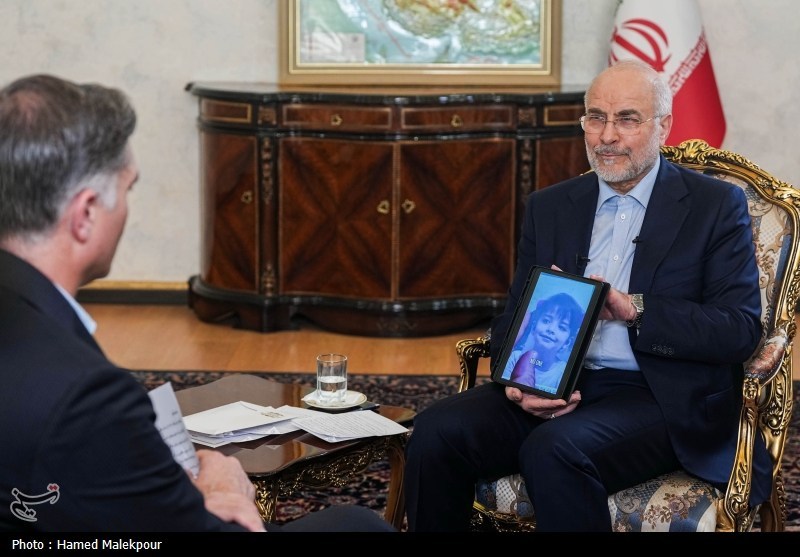
On arrival in Islamabad, Ghalibaf told reporters: “We have good intentions but we do not trust. Our experience in negotiating with the Americans has always been met with failure and broken promises.” He posted on social media that two preconditions had not been met: an Israeli ceasefire in Lebanon and the release of approximately $7 billion in blocked Iranian assets. Neither condition is within Vance’s authority to deliver unilaterally — one requires Israeli compliance, the other involves frozen funds across multiple jurisdictions.
Araghchi, who is present but not leading, conveyed to his German counterpart that Iran enters talks “with complete distrust due to repeated breaches,” according to Al-Monitor. The framing from Iranian state media was consistent: IRNA positioned Ghalibaf as a senior statesman leading a 71-member professional delegation, emphasising parliamentary authority and civilian legitimacy. There was no mention of Vahidi or authorization constraints in Tasnim’s coverage. Ghalibaf invoked US strikes during previous negotiations — “twice within less than a year, in the middle of negotiations, the US attacked Iran and committed multiple war crimes” — language designed to establish victim status for the domestic audience. The gap between Araghchi’s pre-commitment to Germany and Ghalibaf’s “goodwill but not trust” framing in the room is the subject of a separate analysis: Iran’s dual-track messaging at Islamabad explains what each signal was designed to accomplish and why the contradiction is structural rather than accidental.
Iran’s 10-point plan, which Tehran’s deputy foreign minister said would form the basis of negotiations, contains two provisions that go well beyond ceasefire mechanics. Point 7 requires IRGC “coordination” authority over the Strait of Hormuz as a treaty requirement. Point 8 demands US withdrawal from all regional military bases. Both are structural changes to the Gulf security architecture that no US administration has been willing to discuss, and both carry direct implications for Saudi Arabia’s security posture.
Ben Taleblu warned that Iranian ceasefire signals may reflect “wheeling and dealing of just one ambitious person,” and that Iran operates as “a system of men, not a system of laws.” Sabti invoked the concept of “hudna” — a ceasefire with deception, a temporary pause to rebuild before renewed attacks.
The American Position
Vance told NBC News on April 10: “If the Iranians are willing to negotiate in good faith, we’re certainly willing to extend the open hand… if they’re going to try to play us, then they’re going to find the negotiating team is not that receptive.” The formulation left the definition of “good faith” entirely with Washington — a negotiating posture, not a negotiating framework.
The US delegation’s composition — Vance, Witkoff, Kushner — reflects Trump’s preference for principals over process. Witkoff has been exchanging direct text messages with Araghchi for weeks, per Axios reporting. Kushner’s presence introduces a separate channel: his relationships with Gulf leaders, particularly Mohammed bin Salman, give him a brokering function that sits outside the formal US-Iran bilateral. The ceasefire expires approximately April 22, leaving 11 days for whatever emerges from Islamabad to be formalised. What neither delegation produced was a deliverable on the nuclear file: Trump’s subsequent claim that Iran agreed to surrender its enriched uranium stockpile ran directly into the same Article 110 authorization ceiling that blocked Ghalibaf from committing to anything in Islamabad.
The structural asymmetry runs both ways. Vance can make commitments on behalf of Trump, but Trump’s own position has shifted repeatedly — from the April 6 “Power Plant Day and Bridge Day” threat to the phased 45-day ceasefire framework to the current proximity-then-maybe-direct format. Iran’s negotiators have reason to doubt whether any American commitment will survive the next Truth Social post. Ghalibaf arrived in Islamabad already calibrated to this instability, having built preconditions that allow him to exit at any point without having conceded anything.

Pakistan’s Facilitation and Its Limits
Pakistan’s facilitation team — PM Sharif, Army Chief Munir, FM Dar, and National Security Adviser Asim Malik — represents the full weight of Islamabad’s civilian and military leadership. Munir’s role is central. He operated the phone relay between the parties on April 8-9 that produced the initial ceasefire, and Pakistani intelligence channels provided the back-channel architecture that brought both delegations to Islamabad.
But Pakistan brokered the ceasefire without acquiring the tools to enforce it. The Islamabad Accord contains no enforcement clause. Ghalibaf’s three pre-arrival violations — the Lebanon condition, drone activity from Lar air base, and enrichment-related demands — all fall outside Pakistan’s power to adjudicate. Pakistan is simultaneously Iran’s interlocutor and Saudi Arabia’s treaty ally under the September 2025 Saudi-Pakistan Mutual Defense Agreement, with a $5 billion Saudi loan maturing in June 2026. The 27th Constitutional Amendment concentrated foreign policy authority in the hands of the military and intelligence apparatus, making this Munir’s operation more than the elected government’s. How the SMDA’s contractual text transforms Pakistan from mediator into Saudi military auxiliary is the subject of Iran’s Chosen Mediator Is Saudi Arabia’s Contracted Military Auxiliary.
The venue itself carries weight. The Serena Hotel in the Red Zone is where Pakistan hosts high-security diplomatic events — a managed environment where access, communications, and physical separation can be controlled down to the corridor. For proximity talks, that infrastructure matters. For direct talks, it matters more.
Why Is Saudi Arabia Not in the Room?
Saudi Arabia held a co-guarantor seat at the March 29-30 Islamabad round but was excluded from the April 10-11 bilateral. The kingdom absorbed Iranian missile and drone strikes throughout the war — 799 drones and 95 missiles intercepted between March 3 and April 7, according to Saudi defense ministry figures — while providing the air bases from which US operations were launched. Prince Sultan Air Base, which cost over $1 billion in Saudi-funded construction and hosts 2,000-3,000 US troops, was struck on March 28 by six ballistic missiles and 29 drones. Saudi Arabia’s leverage over Pakistan’s mediation role is not limited to diplomatic support: Riyadh simultaneously blocked Pakistan’s $1.5 billion Sudan arms deal, demonstrating the structural veto MBS holds over Islamabad’s access to Arab-world defense contracts — the mechanics of that veto are reported here.
Iran’s 10-point plan demands the withdrawal of US forces from those Saudi-funded bases. The Hormuz “coordination” provision would give the IRGC a treaty role over the strait through which Saudi Arabia must export the majority of its crude. Both provisions are being discussed in a room where Saudi Arabia has no representative and no veto. Hormuz transit remains at roughly 15-20 ships per day versus 138 pre-war, and the ceasefire’s fate determines whether Saudi export capacity recovers or remains constrained through the East-West Pipeline bypass to Yanbu. The GCC’s internal fracture over how to respond to Iran is now public: the UAE has issued a formal $6 billion reparations demand for 2,819 missiles while Saudi Arabia — co-sponsor of the same UN resolution — has said nothing.
The exclusion follows a pattern. At March 29-30, Saudi FM Prince Faisal bin Farhan had a seat. At April 10, the format narrowed to a US-Iran bilateral with Pakistani facilitation. By April 11, the parties who absorb the consequences of whatever is agreed are the parties not present to shape it. That same day, two US Navy destroyers conducted a round-trip transit of the Strait of Hormuz — the first American warship passage since the war began — an action timed to coincide with the Islamabad opening that Saudi Arabia was not present to influence. On the same day, Pakistani JF-17 fighters landed at King Abdulaziz Air Base in Dhahran — seven kilometres from Aramco headquarters — making explicit that Pakistan was simultaneously hosting Iran’s delegation and activating its mutual defence pact with Saudi Arabia. By end of day, Saudi Arabia confirmed that the air deployment was accompanied by approximately 13,000 Pakistani ground troops at the same base, completing a full combined-arms SMDA activation that no ceasefire framework in Islamabad had anticipated or addressed. A full breakdown of the deployment’s scale, the JF-17 Block III equipment choice, and Iran’s strategic silence is in Pakistan Sends 13,000 Troops to Saudi Arabia’s Eastern Province While Brokering Iran Ceasefire, completing a full combined-arms SMDA activation that no ceasefire framework in Islamabad had anticipated or addressed.
Frequently Asked Questions
When did the US and Iran last hold direct principal-level talks?
The US severed formal diplomatic relations with Iran on April 7, 1980, following the embassy hostage crisis. While back-channel contacts and multilateral formats have occurred — including the 2015 JCPOA negotiations, which were conducted through the P5+1 framework with EU facilitation — Islamabad represents the first acknowledged bilateral principal-level meeting in 47 years. The 2023 prisoner swap was negotiated through Omani and Qatari intermediaries without direct US-Iran contact at the principal level.
Why is the parliamentary speaker leading Iran’s delegation instead of the foreign minister?
Araghchi, who negotiated the JCPOA and is Iran’s most experienced diplomat for US engagement, is present in Islamabad but in a subordinate role. The selection of Ghalibaf reflects the IRGC’s wartime dominance over Iran’s institutional architecture. Ghalibaf’s IRGC credentials — Aerospace Force command, the 1999 letter to Khatami, Khamenei’s direct patronage — make him acceptable to the military establishment in a way that a Foreign Ministry-led delegation would not be. His three failed presidential bids (2005, 2013, 2017) and a 2024 withdrawal before the runoff reflect a persistent ambition to convert IRGC standing into civilian executive authority.
What happens if the ceasefire expires before talks produce a framework?
The Soufan Center assessed that the ceasefire structure lacks institutional scaffolding for renewal, and no extension mechanism has been identified by any party. The ceasefire expires approximately April 22. If talks fail or stall, the reversion point is the pre-ceasefire military posture — with Saudi Arabia’s PAC-3 missile interceptor stockpile at roughly 400 rounds remaining from an original inventory of 2,800, and Iran’s IRGC having declared “all restraint removed” on April 7 before the ceasefire took effect.
What are Ghalibaf’s stated preconditions?
Ghalibaf has named two preconditions: an Israeli ceasefire in Lebanon and the release of approximately $7 billion in frozen Iranian assets. The Lebanon condition requires Israeli government action that is not within the scope of US-Iran talks. The asset release involves funds held across multiple jurisdictions, including South Korean escrow accounts from pre-sanctions oil sales, and would require coordinated action by several governments and financial institutions. Neither precondition had been met as of April 11. A third obstacle, harder than both: Netanyahu’s uranium ultimatum — that Iran’s 440.9 kg of 60%-enriched uranium will leave the country “by agreement or through a renewal of the fighting” — gives Israel a structural veto over the Phase 2 framework that the Islamabad talks are nominally designed to produce.
Is Jared Kushner’s presence in the US delegation unusual?
Kushner holds no current government title but was included in the delegation alongside Vance and Witkoff. His participation reflects his established relationships with Gulf leaders — particularly Mohammed bin Salman, with whom he developed a working channel during the Trump first term — and positions him as a de facto Gulf liaison within a bilateral that formally excludes Gulf states. His investment firm, Affinity Partners, received a $2 billion commitment from PIF in 2021, a relationship that has drawn congressional scrutiny.
A subsequent Reuters report established that the 71-member Iranian delegation was receiving real-time direction from a source above Ghalibaf: Khamenei was directing the Islamabad talks by audio relay, collapsing the incapacitation thesis that had framed six weeks of diplomatic dysfunction.
The Washington decision to open a simultaneous Lebanon track — with the ceasefire expiring April 22 — created the two-track synchronization problem that diplomats are now racing to resolve.
That first direct session was followed by a 14-hour second round that ended without a deal, with both sides deferring the hardest questions to four expert committees operating on a 10-day window before the ceasefire expires.
The second round of talks concluded with Vance declaring a final US offer after 21 hours — met by Iran’s publication of four non-negotiable conditions that the United States cannot grant without restructuring the security architecture underpinning Saudi Arabia.
The split between Ghalibaf’s diplomatic posture and the IRGC Navy’s simultaneous operational threats on April 13 is examined in Iran’s two foreign policies colliding on blockade day — an analysis of why the authorization ceiling Vahidi holds makes any deal Ghalibaf signs structurally unenforceable. The same authorization problem shaped Pakistan Army Chief Asim Munir’s decision to fly to Tehran personally on April 15 — examined in Asim Munir’s Tehran Gamble — the first Pakistani military chief to attempt military-peer diplomacy directly with the IRGC’s chain of command.
Saudi Arabia’s absence from the room where Ghalibaf and Vance negotiated is not a diplomatic oversight: the bilateral architecture was designed without Gulf states and generates Hormuz and enrichment outcomes Riyadh cannot shape — analysed in Gulf Exclusion from US-Iran Talks Is Not a Snub — It Is a Security Architecture Failure.
When an unsourced Israeli broadcaster report emerged suggesting Ghalibaf had resigned from the negotiating team under IRGC pressure, Brent crude spiked above $105 and Polymarket’s peace-deal contract collapsed to 8 percent within hours — evidence that markets treat the authorization ceiling as the operative variable regardless of any official denial, as analysed in Brent Tops $105 on Ghalibaf Resignation Rumour as Markets Price Iran’s Authorization Ceiling Over Any Denial.
Iran subsequently refused to attend the second Islamabad round entirely — announced April 24 — suspending Vance’s planned return trip and confirming that the authorization ceiling preventing any deal Ghalibaf signs has now hardened into a formal diplomatic rupture. The collapse of the second Islamabad round and Pakistan’s enforcement architecture is reported here.
With direct talks stalled and the Witkoff-Kushner trip to Islamabad cancelled, Trump convened his senior national security principals in the Situation Room on April 27 to deliberate on Washington’s response to Iran’s sequencing demand — the Hormuz-first framework that would require lifting the US naval blockade before any nuclear concession is made.
The confirmation of Ghalibaf’s removal resolves the diplomatic ambiguity that followed his Islamabad appearance: Saeed Jalili is set to replace Ghalibaf as Iran’s nuclear talks lead, collapsing the distance between Iran’s authorization ceiling and its negotiating seat by installing the same figure who holds the veto in the chair.
Ghalibaf’s removal from the negotiating team also clarifies the troika governance structure that has operated in Mojtaba Khamenei’s place since February 28: with Ghalibaf sidelined, the informal board shrinks from three effective voices toward two, without resolving the Article 110 problem that makes any deal constitutionally unenforceable regardless of who sits in the chair. That structural analysis is examined in Three Men, No Authority: Iran’s Troika Cannot Deliver the Hormuz Deal Saudi Arabia Needs.