
RIYADH — Saudi Arabia’s refusal to endorse any of three competing frameworks for reopening the Strait of Hormuz is the clearest evidence yet that the war has shattered the Gulf’s security consensus. The Kingdom cannot join the US blockade without becoming an Iranian target, cannot join the UK-led multilateral coalition without repudiating the blockade, and cannot accept Beijing’s counter-architecture without abandoning the Western security guarantee it has depended on since 1945 — so it has chosen silence, which is not a strategy but the absence of one.
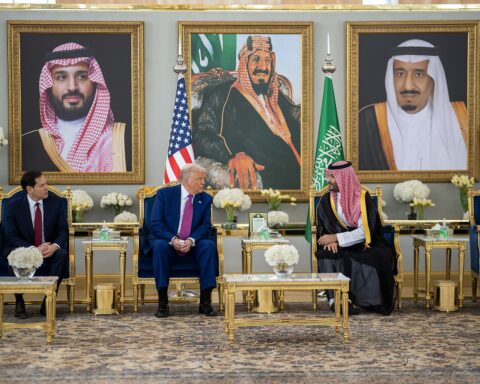
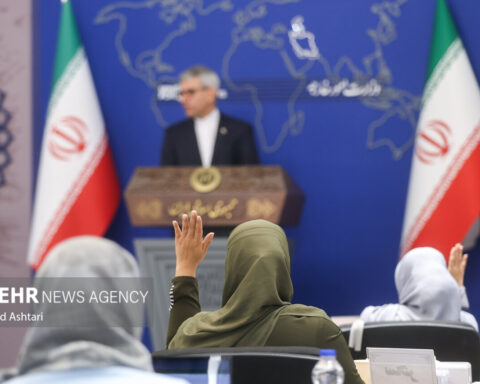
On April 2, forty nations convened under UK Foreign Secretary Yvette Cooper to plan Hormuz’s reopening. The United States was not among them; President Trump had stated that securing the waterway “is not his country’s job.” Neither was Saudi Arabia, which depended on the strait for the majority of its oil exports before the war reduced daily ship transits from 138 to near zero. Since that meeting, the contest has sharpened. Washington imposed a unilateral blockade on April 13. London and Paris announced an April 17 conference to organize a defensive multilateral mission explicitly separate from the blockade. And on April 14, Xi Jinping hosted the UAE Crown Prince — not Saudi Arabia’s — while Sergei Lavrov met Wang Yi in the same city to formalize joint opposition to both Western approaches. On the day the blockade began, Riyadh’s only recorded diplomatic act was receiving a phone call from Abbas Araghchi, Iran’s foreign minister — the second such call in four days, after forty days of Saudi-Iranian silence.
Table of Contents
Three Architectures, One Strait
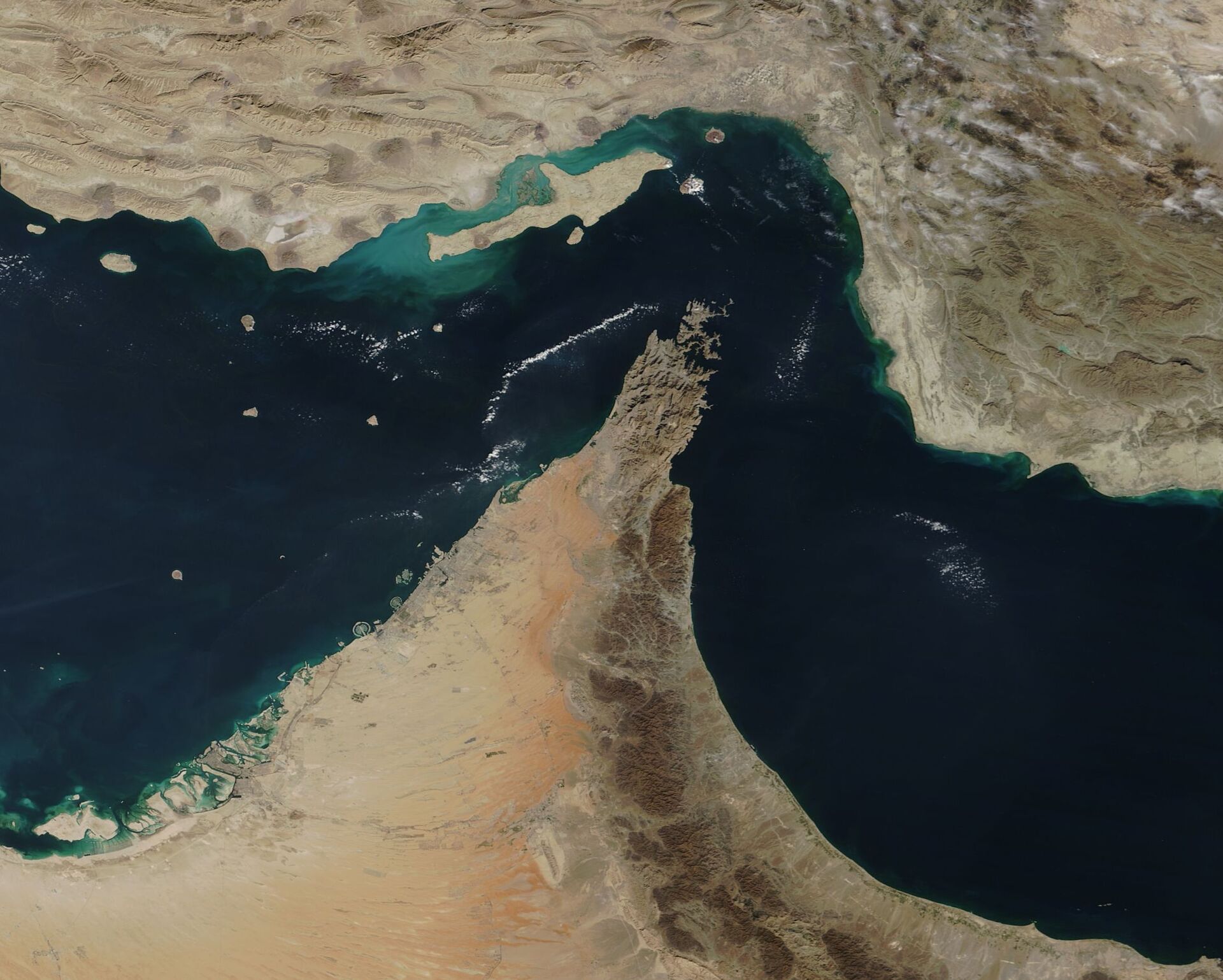
The three frameworks now competing over Hormuz differ not in degree but in kind. Each rests on a distinct theory of what the strait is — a commons to be policed, a chokepoint to be coerced, or a sovereignty question to be negotiated — and each requires its participants to reject the premises of the other two.
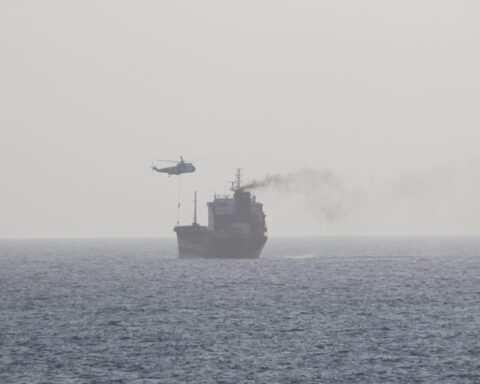
The US blockade, effective since April 13, operates under CENTCOM authority and targets all ships entering or leaving Iranian ports. It is coercive and active. It makes no provision for commercial reopening, no timeline for restoring transit, and no commitment to escorting vessels belonging to third parties. Trump’s framing — that Hormuz security “is not his country’s job” — contradicts four decades of Freedom of Navigation doctrine while the blockade simultaneously asserts unilateral control over the same waters Washington claims are international.
The UK-led coalition, convened on April 2 and expanded to forty signatories, operates under the opposite premise: that Hormuz is a global commons requiring collective defense. Cooper described Iran as “trying to hold the global economy hostage.” The coalition’s mandate is strictly post-hostilities and defensive — member nations committed to deploying assets only “once the conflict eases” — and its military contribution is oriented toward mine clearance and escort, not combat. Macron stated on April 2 that a military operation to “liberate” Hormuz is “unrealistic because it would take an inordinate amount of time and would expose anyone crossing the strait to coastal threats from the Revolutionary Guards, who possess significant resources, as well as ballistic missiles.”
Beijing’s counter-architecture, formalized on April 14, rejects both Western approaches. Xi Jinping’s four-point Gulf security plan — unveiled not in Riyadh but in a meeting with UAE Crown Prince Sheikh Khaled bin Mohamed — calls for “peaceful coexistence,” sovereignty, and adherence to international law that “cannot be used when convenient and discarded when not.” The same day, Lavrov and Wang Yi signed a 2026 ministry contacts roadmap and pledged joint de-escalation. The day before, a Chinese-flagged sanctioned tanker had transited Hormuz in defiance of the US blockade. And the previous week, China and Russia had both vetoed the UNSC resolution on Hormuz, denying the UK coalition a Chapter VII mandate.
The Middle East briefing 3,000+ readers start their day with.
One email. Every weekday morning. Free.
| Dimension | US Blockade | UK-Led Coalition | Beijing-Moscow Framework |
|---|---|---|---|
| Effective date | April 13, 2026 | April 2, 2026 (expanded April 17) | April 14, 2026 |
| Scope | Iranian port traffic | Post-hostilities escort and MCM | Gulf-wide security architecture |
| Members | US (unilateral) | 40 nations (2 Middle Eastern: UAE, Bahrain) | China, Russia, aligned states |
| Deployment status | Active | Contingent on ceasefire | None (diplomatic only) |
| Saudi Arabia | Silent | Absent | Not consulted |
| UNSC mandate | None | Denied (Russia-China veto) | Opposed |
| Iran’s characterization | “Piracy” | “Ceasefire violation” | Engagement partner |
Why Is the UK Coalition a Rival Framework?
The operational incompatibility between the US blockade and the UK coalition is not a matter of diplomatic emphasis. You cannot simultaneously blockade a strait and escort commercial traffic through it. The UK coalition’s stated purpose — to “restore freedom of navigation, guarantee the safety of trapped ships and seafarers, and resume the movement of vital commodities” — is the structural inverse of the blockade’s purpose, which restricts movement as a coercive instrument against Iran. A navy participating in one operation cannot participate in the other without contradicting itself at the level of standing orders.
Starmer removed any ambiguity on April 13. “We are not supporting the blockade,” he stated, adding that Britain was “not getting dragged in” and would not commit vessels without a “lawful basis” or “clear thought-through plan.” The next day, he and Macron jointly announced the April 17 online conference for countries prepared to contribute to what they explicitly framed as “a defensive multilateral mission” — separate from and not supporting the US blockade. The split with Washington was no longer implicit.
We are not supporting the blockade. [The UK is] not getting dragged in.
Keir Starmer, UK Prime Minister, April 13, 2026
The coalition’s membership reveals its boundaries. Of forty signatory nations — the UK, France, Germany, Italy, Japan, Canada, South Korea, Australia, and thirty-one others including the Marshall Islands, Kosovo, Trinidad and Tobago, and North Macedonia — only two are from the Middle East: the UAE and Bahrain. Saudi Arabia, Qatar, Oman, Kuwait, Turkey, Pakistan, China, Russia, and the United States are all absent. The UAE’s presence makes it the only major Gulf oil exporter to have formally joined any of the three frameworks.
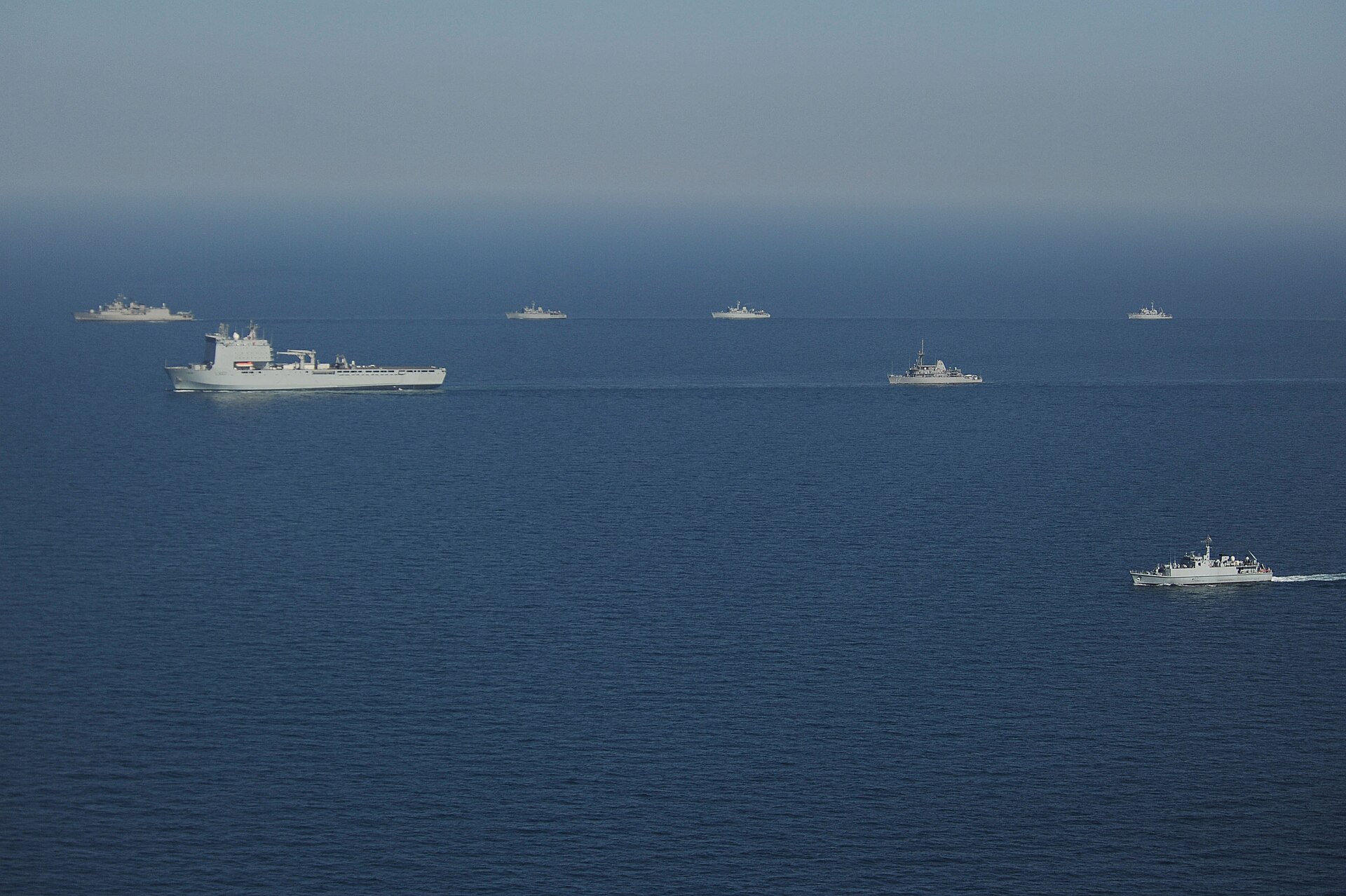
The military assets being prepared are designed for mine clearance, not confrontation. RFA Lyme Bay is being upgraded in Gibraltar as a mothership for autonomous mine countermeasures: uncrewed surface vessels with synthetic aperture sonar operating up to fifty kilometers from the ship, smaller underwater UUVs for close identification, and the Defender neutralization system. It will be based at Duqm, Oman. France is preparing two Tripartite-class minehunters. Macron has separately engaged India, Japan, Singapore, and South Korea on operational responsibilities. Lord West of Spithead told the House of Lords on April 13 that the Royal Navy “is actually an expert at mine-hunting, which is very important.” Every element of this preparation is contingent on the same precondition: hostilities must end first.
Beijing Chose Abu Dhabi
Beijing’s choice of interlocutor was the most revealing act of April 14. Xi Jinping received Sheikh Khaled bin Mohamed bin Zayed — not Crown Prince Mohammed bin Salman, not any Saudi representative — to unveil China’s Gulf framework. The four points themselves read as diplomatic abstraction until measured against what they exclude: no mention of the US blockade by name, no endorsement of any Western-led coalition, no reference to ceasefire enforcement, and no offer of Chinese military assets. What there is, pointed and deliberate, is a call for international law that “cannot be used when convenient and discarded when not” — language aimed directly at Washington’s simultaneous insistence on UNCLOS transit passage and unilateral blockade.
The UAE meeting was China’s second Gulf signal in forty-eight hours. On April 13, Foreign Ministry spokesman Guo Jiakun called the US blockade “dangerous and irresponsible,” warning it “will only exacerbate tensions and undermine the already fragile cease-fire agreement and further jeopardize safety of passage through the Strait of Hormuz.” Hours later, a Chinese-flagged sanctioned tanker transited the strait — the first vessel to test the blockade’s enforcement boundaries, and a practical demonstration that Beijing considers the blockade’s writ inapplicable to Chinese commerce.
Andreas Krieg, an analyst tracking Gulf-China relations, observed a gap between the UAE’s “public messaging that emphasised deep integration with the US” and “the reality of the inner core of Abu Dhabi’s policymaking fostering strategic autonomy with key partners such as China.” Researcher Jodie Wen assessed that the Crown Prince’s Beijing visit signaled Abu Dhabi’s search for “more reliable partners” amid eroding “confidence in US-centred security guarantees.” Xi asked the UAE specifically to “safeguard Chinese citizens, institutions, and projects” — a request that positions Abu Dhabi, not Riyadh, as China’s primary regional security partner.
The Lavrov-Wang Yi meeting, happening the same day in the same city, added the second axis. Russia and China had already vetoed the UNSC resolution on Hormuz — the same resolution Bahrain had co-drafted across six versions over fifteen days, progressively stripped from Chapter VII enforcement down to a non-binding declaration that still failed. Now Lavrov and Wang Yi signed a formal contacts roadmap and pledged to “work together to de-escalate tensions in the Middle East.” The coordination converts two individual vetoes into an institutional counter-framework — one that opposes the US blockade and denies the UK coalition its legal mandate with the same pair of raised hands.
Can the 1987 Escort Model Work in 2026?
Operation Earnest Will — Reagan’s 1987-88 escort of eleven reflagged Kuwaiti tankers through Hormuz — is the inevitable comparison, and it breaks on nearly every dimension that matters. That operation deployed roughly thirty US warships to protect Kuwaiti-flagged vessels against Iranian harassment that, at its worst, affected approximately two percent of transiting ships. France, the UK, Italy, and the Netherlands independently deployed seven minesweepers alongside. The Bridgeton supertanker struck an Iranian mine on July 24, 1987, three days into the operation — the escort warships fell in behind the tanker, using its deep draft as an improvised mine shield, because the US Navy had no minesweepers in the Gulf.
The 2026 crisis is approximately forty times more severe by proportion. Tanker traffic dropped roughly seventy percent initially and has since approached zero; over 150 ships are anchored outside the strait and 230 loaded oil tankers were waiting inside the Gulf as of April 9. Twenty-one confirmed Iranian attacks have damaged at least sixteen merchant ships, seven abandoned, twelve seafarers killed or missing. But the structural difference is not scale. In 1987, Iran needed Hormuz open for its own oil exports — roughly ninety percent of its crude transited the strait — giving Tehran an incentive to calibrate harassment rather than shut transit entirely. In 2026, Iran’s revenue model depends on controlling passage. The IRGC has imposed transit fees since late March, at $2 million per VLCC, paid through Kunlun Bank and USDT on the Tron network.
The US Navy’s capacity for a comparable operation has contracted. The Washington Institute assessed that a thirty-warship convoy task force would consume one-third of all available major surface combatants — approximately one hundred total. Only one Littoral Combat Ship with mine countermeasures is currently deployed in the region. The four Avenger-class MCM ships based in Bahrain were decommissioned in September 2025. Michael Eisenstadt of the Washington Institute and Brigadier General Assaf Orion of Israel’s INSS jointly assessed that “all military options will entail substantial risk and require significant resources and time” without guaranteeing success. Using the 1991 Kuwait mine clearance operation as a benchmark — two hundred square miles at a maximum rate of five mines per vessel per day — current assets would require approximately fifty-one days to render the strait navigable.
The 1987 operation worked, imperfectly, because the US unilateral escort and European multilateral mine clearance ran as parallel tracks with tacit alignment. In 2026, those tracks have been explicitly separated. Starmer rejected the blockade. Macron declared forced reopening unrealistic. Iran has stated that “any military vessel approaching the strait would be considered a violation of the fragile ceasefire and would meet a severe response.” The IRGC has separately declared its intent to “firmly implement a permanent mechanism for controlling the Strait of Hormuz” even after the war — language that directly challenges the UK coalition’s premise that post-hostilities deployment will face a permissive environment.
Why Has Saudi Arabia Said Nothing?
In the thirteen days since the UK coalition convened and the two days since the US blockade took effect, Saudi Arabia has issued zero public statements on any Hormuz framework. The Kingdom’s only recorded diplomatic acts in the period were receiving Araghchi’s two phone calls — April 9 and April 13, the latter on the blockade’s opening day — and the April 8 Jeddah meeting with Starmer, where the Prime Minister confirmed Britain would “continue to support Saudi Arabia as a steadfast ally including through the recent deployment of the Sky Sabre air defence system.” The official readout from that meeting mentioned neither the UK coalition nor the US blockade.
Each framework forecloses something the Kingdom cannot afford to lose. Endorsing the US blockade places Saudi Arabia within Iran’s counter-targeting doctrine. The IRGC’s published target list includes Gulf bridges and infrastructure in four countries; Ras Tanura was struck on March 2; the King Fahd Causeway to Bahrain is on the list. Opposing the blockade fractures the US security relationship at the moment Saudi Arabia needs American support most: PAC-3 interceptor stockpiles have fallen to roughly four hundred rounds — down eighty-six percent from pre-war levels after intercepting 799 drones and 95 ballistic missiles between March 3 and April 7. The $4.76 billion emergency US arms package announced April 12 went to the UAE, Kuwait, and Jordan. Not to Saudi Arabia.
Joining the UK coalition carries its own exposure. The post-hostilities mandate offers no protection during the war, and Iran has warned that “no port in the Gulf or the Gulf of Oman would remain secure if Iranian ports were endangered.” Saudi Aramco’s East-West Pipeline to Yanbu — the Red Sea bypass keeping exports partially flowing — operates at an effective ceiling of 5.9 million barrels per day against pre-war Hormuz throughput of 7 to 7.5 million, leaving a structural gap of at least 1.1 million barrels per day. Production has already fallen from ten to eight million barrels per day. The Kingdom leads neither track for the strait it needs most.
What Riyadh has done, quietly, is accept bilateral defense support without joining any multilateral framework. Sky Sabre — a Royal Artillery battery firing Common Anti-Air Modular Missiles at 3,700 kilometers per hour, with a twenty-five-kilometer range and capacity to engage twenty-four targets simultaneously — arrived in late March, announced by Defence Secretary John Healey on March 31. The UK-Saudi trade relationship stands at £16.6 billion annually, targeting £30 billion by 2030, with a $6.8 billion PIF-UKEF memorandum of understanding. Starmer offered the protection without the membership. The Jeddah readout was drafted to include one commitment and omit the other.
Five Days Between the Conference and the Ceasefire
The window between April 17 and April 22 compresses every unresolved question into five days. On April 17, Starmer and Macron host their online conference for contributing nations. On April 18, Hajj arrivals begin — Pakistan’s 119,000 pilgrims arrive that day, Indonesia’s 221,000 depart on the twenty-second — raising the threshold for kinetic escalation anywhere near the Gulf. On April 22, the ceasefire expires. The Soufan Center has assessed that the Islamabad Accord contains no procedural pathway for extension.
Saudi Arabia will face the April 17 conference without a public position on Hormuz. The UAE has joined the coalition; Bahrain has signed on; Qatar and Oman have not. Saudi Arabia’s September 2025 bilateral defense agreement with Pakistan — the SMDA — provides a parallel security architecture, but Pakistan’s operational focus is ceasefire enforcement, not maritime operations. Ian Lesser of the German Marshall Fund assessed that the coalition could “provide security for commercial passage after active hostilities end,” though member nations must be willing to deploy naval forces — “something they’ve shown limited enthusiasm for previously.” The distance between signing a coalition statement and sailing a frigate into a mined strait is the width of the entire problem.
If the ceasefire collapses on April 22, the UK coalition’s post-hostilities mandate becomes indefinitely deferred — no end to hostilities means no deployment trigger. The US blockade would continue but face mounting enforcement challenges; the Chinese-flagged tanker transit demonstrated that Beijing does not consider the blockade binding on its vessels. Christopher Featherstone of the University of York observed that Starmer is signaling “commitment to the US-UK relationship” while showing Iran that allies “won’t simply comply with Trump’s demands” — a calibration that becomes impossible to sustain if the ceasefire fails and London must decide whether its coalition deploys into active conflict or remains theoretical. The Chinese-flagged tanker that transited April 13 sailed without a naval escort.
What Replaces the Gulf Security Consensus?
The three-framework contest has exposed a fracture that predates the war and will outlast it. The GCC — designed as a collective security mechanism for exactly this kind of crisis — is responding not collectively but through bilateral arrangements that route around each other. The UAE joined the UK coalition and hosted Xi’s interlocutor. Saudi Arabia signed the bilateral defense pact with Pakistan and accepted British defense support without joining Britain’s multilateral framework. Oman is negotiating a bilateral transit protocol with Iran while hosting the UK coalition’s mine countermeasures mothership at Duqm. Qatar’s security calculations run through its North Field gas partners — China and Japan — rather than through GCC structures.
UNSC Resolution 2817 confirmed that Gulf littoral states “are not parties to the hostilities.” The resolution was intended to protect them. In practice, it has freed each to pursue its own bilateral architecture without the political obligation of collective response. Bahrain — whose airspace has been closed since February 28 and whose sole international access route, the King Fahd Causeway, was shut on April 7 during an Iranian missile barrage before reopening the same morning — signed onto the UK coalition from dependency rather than strategic preference.
Only collective action among the GCC states is likely to get them out of this dilemma.
Andrew Leber, Carnegie Middle East Program, March 2026
The pre-war assumption was that Gulf security rested on a single architecture: American naval dominance, with GCC states as hosts and clients. That architecture assumed Washington would always treat Hormuz as a core interest. Trump’s declaration that securing the strait “is not his country’s job” — followed by a blockade that restricts passage rather than restoring it — did not replace that architecture with something new. What has emerged instead is a set of bilateral arrangements, each optimized for one patron’s priorities and none designed to reopen the strait that all six GCC economies require. Saudi oil production sits at eight million barrels per day, down from ten. Brent trades at approximately $96 against a PIF-inclusive fiscal break-even of $108 to $111. Goldman Sachs projects a Saudi deficit of $80 to $90 billion for 2026, against an official budget projection of $44 billion.
Frequently Asked Questions
How many ships are currently stranded by the Hormuz crisis?
As of April 9, over 150 ships were anchored outside the strait and 230 loaded oil tankers waited inside the Gulf. Twenty-one confirmed Iranian attacks on merchant vessels have damaged at least sixteen ships, seven of which were abandoned. Twelve seafarers have been killed or are missing. Daily ship transits have fallen from a pre-war average of 138 to approximately 15-20 per twenty-four hours (Windward maritime intelligence), with crossings limited to Chinese-flagged vessels, IRGC-coordinated transits, and the two Qatari LNG carriers — Al Daayen and Rasheeda — whose passage was intermediated by Beijing in early April rather than by any coalition framework.
What mine countermeasures does the UK coalition plan to deploy?
RFA Lyme Bay, currently being upgraded in Gibraltar, will serve as a mothership for autonomous mine countermeasures including uncrewed surface vessels equipped with synthetic aperture sonar capable of operating fifty kilometers from the ship, smaller underwater UUVs for close identification, and the Defender neutralization system. France is preparing two Tripartite-class minehunters. Separately, Macron has engaged India, Japan, Singapore, and South Korea on post-hostilities operational roles. The autonomous mine systems represent the primary Western clearing capability available, given that the US Navy decommissioned all four Avenger-class MCM ships from Bahrain in September 2025 and currently has only one LCS with any mine countermeasures capability in the region.
What is Sky Sabre and why was it deployed to Saudi Arabia?
Sky Sabre is a British short-range air defense system using the Common Anti-Air Modular Missile, which travels at 3,700 kilometers per hour with a range of twenty-five kilometers and can engage twenty-four targets simultaneously. A Royal Artillery battery was deployed to Saudi Arabia in late March 2026, announced by Defence Secretary John Healey on March 31. The system supplements Saudi Arabia’s depleted Patriot PAC-3 interceptor stockpile — estimated at roughly four hundred rounds after intercepting 894 aerial threats between March 3 and April 7, an expenditure of approximately $3.49 billion at $3.9 million per interceptor. Camden, Arkansas produces around 620 PAC-3 MSE rounds per year, a rate that cannot replenish the stockpile before Hajj begins on April 18.
Which countries are in the UK-led coalition?
The full signatory list — drawn from the March 19 joint statement and expanded to forty-plus nations by the April 2 meeting — includes the UK, France, Germany, Italy, the Netherlands, Japan, Canada, South Korea, Australia, New Zealand, Denmark, Latvia, Slovenia, Estonia, Norway, Sweden, Finland, Czechia, Romania, Lithuania, Portugal, Croatia, Bulgaria, Kosovo, Panama, North Macedonia, Nigeria, Montenegro, Albania, the Marshall Islands, Chile, Moldova, Greece, Somalia, Slovakia, and Trinidad and Tobago. The only Middle Eastern members are the UAE and Bahrain. Saudi Arabia, Qatar, Oman, Kuwait, Turkey, Pakistan, China, Russia, and the United States are all absent from the signatory list.
How does the 1987 Kuwait reflagging precedent apply to 2026?
In December 1986, Kuwait asked both the Soviet Union and the United States for military protection of its tankers transiting Hormuz during the Iran-Iraq War — a dynamic structurally analogous to Gulf states choosing between patrons in 2026. The Reagan administration reflagged eleven Kuwaiti tankers and deployed thirty warships; France, the UK, Italy, and the Netherlands independently deployed seven minesweepers. The 1987 architecture worked because the US unilateral escort and European multilateral mine clearance operated as parallel tracks with tacit alignment, and because Iran needed Hormuz open for its own exports. In 2026, the Western tracks have been explicitly separated — Starmer rejected the blockade on April 13 — and Iran’s revenue model depends on restricting the strait rather than transiting it, removing the structural incentive for Iranian restraint that existed four decades ago.
Whether any of these frameworks can produce a durable ceasefire depends on a prior question: whether a Supreme Leader governing by audio-only from Qom can issue authenticated orders that IRGC commanders will treat as binding. That question is analyzed in Mojtaba Khamenei Is Mentally Sharp and Physically Shattered — And No IRGC Commander Can Verify His Ceasefire Order.