
MBS Told Iran He Would Protect Them — His Brother Told Washington the Opposite
In the final days of January 2026, two messages left Riyadh for two very different audiences. The first was a phone call from Crown Prince Mohammed bin Salman to Iranian President Masoud Pezeshkian — a reassurance, delivered in the language of Islamic solidarity, that Saudi airspace would not be opened to any party seeking to strike the Islamic Republic. The second was a private briefing delivered in Washington by his younger brother, Deputy Minister of Defense Prince Khalid bin Salman, who told American officials that failing to strike Iran would only embolden the regime. These two messages were not contradictions born of confusion. They were the twin arms of a single, deliberately constructed strategy — one that reveals more about how the House of Salman governs than almost any policy paper or royal decree ever could.
The events of late February and early March 2026 have reshaped the Middle East in ways that will take years to fully understand. The killing of Iran’s Supreme Leader, the retaliatory missile strikes on Saudi cities during Ramadan, the invocation of collective self-defense by the entire Gulf Cooperation Council — all of this unfolded with a speed that left most analysts struggling to keep pace. But beneath the explosions and emergency meetings, there is a quieter story: the story of how MBS positioned Saudi Arabia on both sides of the crisis simultaneously, and why that positioning — far from being cynical — may be the defining feature of his approach to power.
The Public Face: A Call to Tehran
The call between MBS and Pezeshkian in January 2026 came at a moment of extreme tension. American and Israeli rhetoric against Iran’s nuclear program had reached a pitch not seen since the Trump administration’s first term. Regional capitals were openly discussing the possibility of strikes. Against this backdrop, the Crown Prince picked up the phone and delivered a message designed to be heard far beyond the Iranian president’s office.
He emphasized Islamic solidarity. He stressed that Saudi Arabia had no interest in seeing the region descend into another cycle of destruction. Most critically, he gave an assurance: Saudi airspace would not be made available for use against Iran. This was not a vague diplomatic pleasantry. It was a specific, operational commitment — the kind that military planners in Tehran, Washington, and Tel Aviv would all take seriously. Without Saudi airspace, any American or Israeli strike package headed for Iranian targets would face significant routing complications.
The call served multiple purposes at once. It reinforced the narrative of the Saudi-Iranian rapprochement that had been brokered in Beijing in 2023, a diplomatic achievement that Riyadh had invested considerable prestige in. It positioned MBS as a statesman capable of rising above sectarian divisions — a role central to his broader pitch for Saudi Arabia as the anchor of a new Middle Eastern order under Vision 2030. And it gave Tehran a reason to believe that the Kingdom, whatever its private calculations, would not actively participate in its destruction.
For the Iranian leadership, the call must have been both welcome and puzzling. The rapprochement had been real — ambassadors had been exchanged, trade discussions had resumed, the temperature between the two Gulf powers had genuinely dropped. But Iranian intelligence would have been well aware that Saudi Arabia’s security relationship with the United States was deepening, not retreating. The question was which channel reflected MBS’s true intent. The answer, as events would prove, was both.
The Middle East briefing 3,000+ readers start their day with.
One email. Every weekday morning. Free.
The Private Channel: Prince Khalid in Washington
On January 31, 2026, while the reassurances to Tehran were still echoing through diplomatic back-channels, Prince Khalid bin Salman sat down with American officials in Washington and delivered a starkly different message. As Axios later reported, he told his counterparts that if the United States did not strike Iran, it would “only embolden the regime.” The outlet described this as “a reversal from public Saudi talking points” — a characterization that, while accurate on the surface, misses the deeper architecture of what was happening.
Khalid bin Salman is not a freelancer. He is MBS’s younger brother, a former fighter pilot, a former ambassador to Washington, and the current Deputy Minister of Defense. Within the hierarchy of the Al Saud, he is one of the very few people who can speak with the full authority of the Crown Prince himself. When Khalid delivers a message in Washington, it is understood by every serious player in the room that it carries the weight of the Royal Court.
The briefing was carefully targeted. American officials were at that stage debating the scope and timing of potential action against Iran. The Israeli government, under its own internal pressures, was pushing hard for a decisive strike. Into this debate, Khalid injected the Saudi position — not the public Saudi position of restraint and Islamic brotherhood, but the private Saudi assessment that Iran’s nuclear and regional ambitions posed an existential threat that could only be checked through force.
This was not the first time the Kingdom had played both sides of a major geopolitical divide. The history of the House of Saud is replete with examples of dual-track diplomacy — public neutrality paired with private alignment, rhetorical caution layered over operational decisiveness. What made this instance distinctive was the precision of the execution. The two tracks were not running in parallel by accident or bureaucratic dysfunction. They were synchronized, each reinforcing the other, each creating options that the other track alone could not.
The Washington Post Bombshell
The full scope of the private channel became clearer when the Washington Post reported that both Saudi Arabia and Israel had privately pushed President Trump for weeks to launch strikes against Iran. The report indicated that MBS himself had made several private phone calls to Trump urging action — calls that stood in direct tension with everything the Kingdom was saying publicly about restraint and de-escalation.
This revelation reframes the entire narrative of the lead-up to the February 28 strikes. In the conventional telling, the United States and Israel acted against Iran based on their own strategic calculations, with Gulf states positioned as anxious bystanders hoping for stability. The Washington Post reporting demolishes that framing. Saudi Arabia was not a bystander. It was, in the private corridors where these decisions are actually made, an active advocate for military action.
The implications are significant. If MBS was privately urging Trump to strike Iran while publicly assuring Pezeshkian that Saudi Arabia stood with the Islamic Republic, then the Crown Prince was executing a strategy of extraordinary complexity and risk. Success would mean that Saudi Arabia emerged from the crisis with its relationships on both sides intact — the aggrieved party if Iran retaliated, the trusted partner if Washington succeeded. Failure would mean exposure as a double-dealer, with catastrophic consequences for Saudi credibility in every capital that mattered.
That MBS chose to run this risk tells us something fundamental about how he assesses the balance of power in the region. He clearly calculated that American and Israeli military capability was sufficient to achieve the objective, that Iran’s retaliation — while inevitable — would be manageable, and that the post-strike diplomatic landscape would favor the party that had positioned itself on the winning side while maintaining plausible deniability. It was a bet. It was also, by the cold logic of realpolitik, a rational one.
February 28: The Strikes and the Blowback
On the night of February 28, 2026, the United States and Israel launched coordinated strikes against Iran. Among the dead was Supreme Leader Ali Khamenei himself — a decapitation strike that altered the fundamental power structure of the Islamic Republic in a single night. Also killed was Ali Shamkhani, the former secretary of Iran’s Supreme National Security Council and, crucially, the man who had personally negotiated the Saudi-Iranian rapprochement in Beijing.
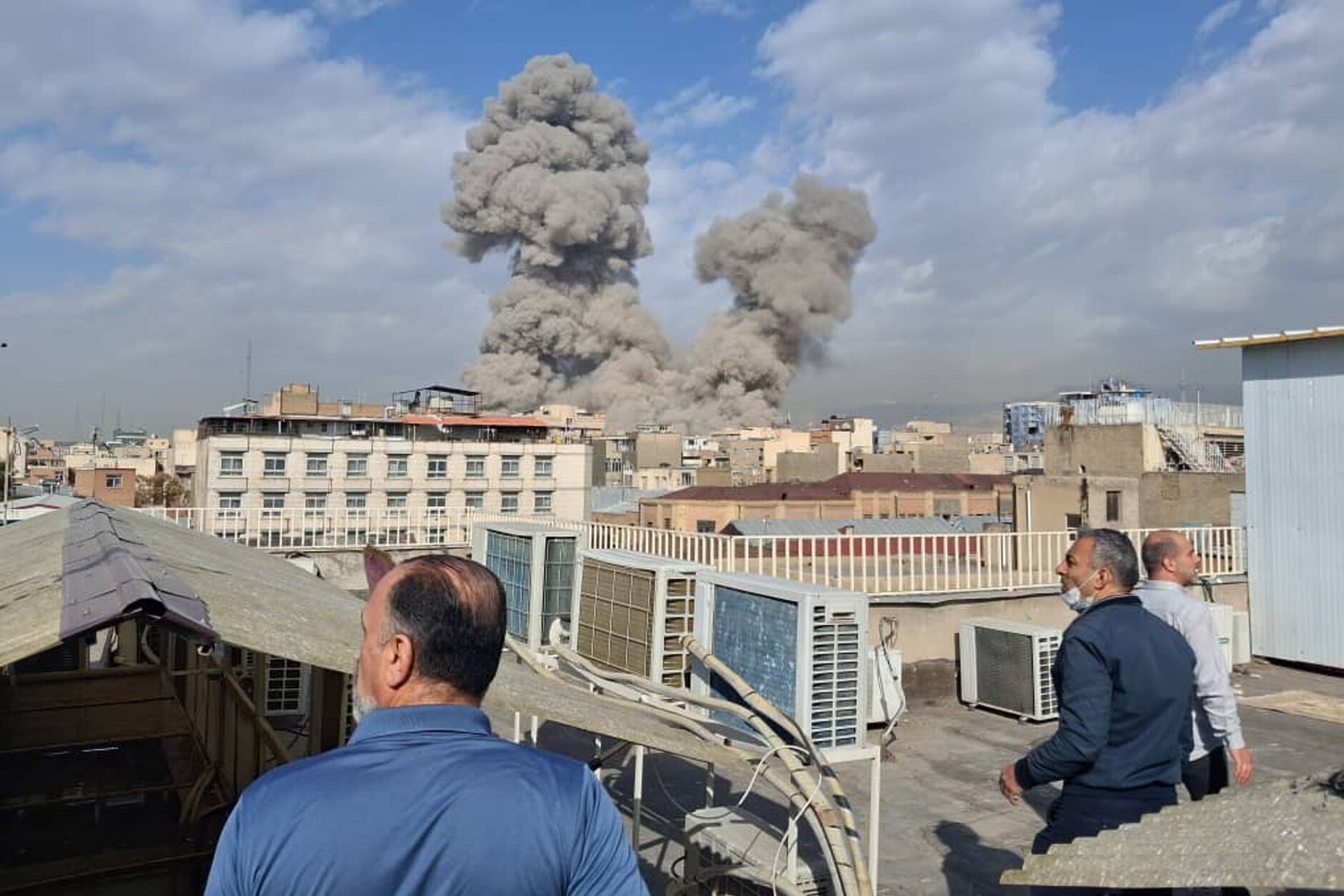
Iran’s response came swiftly. Ballistic missiles were fired at targets across Saudi Arabia, with Riyadh and the Eastern Province absorbing the brunt of the attacks. Shelter-in-place orders were issued in Jeddah and Dhahran. The US Embassy elevated Saudi Arabia to a Level 3 travel advisory. All of this unfolded during the holy month of Ramadan — a timing that added a layer of religious outrage to what was already a geopolitical crisis of the first order.
Saudi Arabia had explicitly closed its airspace to prevent its use against Iran. This was the operational follow-through on MBS’s promise to Pezeshkian. And yet Iran struck Saudi territory anyway. This fact — that the Kingdom had taken a concrete, verifiable step to shield Iran from attack, only to be attacked itself — became the cornerstone of Saudi Arabia’s post-crisis diplomatic positioning. As detailed in our comprehensive coverage of the Iranian strikes, the attacks marked the most significant direct military confrontation between the two Gulf powers in modern history.
The Saudi Foreign Ministry’s response was a masterpiece of calibrated language. It condemned Iran’s attacks as “blatant and cowardly” while simultaneously acknowledging that “events began with Israel and the US attacking Iran.” This dual framing was not an accident or a committee compromise. It was the precise message that MBS needed to send: Saudi Arabia was the victim, but it was not blind to the context. It had standing to invoke self-defense, but it was not burning bridges with every actor in the region who sympathized with Iran’s position.

The Saudi Response: Masterful Diplomatic Positioning
In the hours and days following the Iranian strikes, MBS demonstrated the quality that most clearly separates him from many of his predecessors: the ability to move simultaneously in multiple directions without appearing to contradict himself. The language of the Foreign Ministry statement — condemning Iran while acknowledging the American and Israeli provocation — was a diplomatic instrument of unusual precision.
Consider the audiences for that statement. To Washington and Tel Aviv, the condemnation of Iran’s “blatant and cowardly” attacks was the headline. Saudi Arabia had been struck. It had the right to respond. It was standing with its security partners. To Tehran and the broader Muslim world, the acknowledgment that events began with American and Israeli strikes was the headline. Saudi Arabia was not whitewashing the provocation. It was maintaining its credibility as a sovereign state that could see the full picture.
To the Gulf states, the message was different again: we closed our airspace, we kept our promise, and we were attacked regardless. This gave Saudi Arabia unimpeachable standing when the GCC convened an extraordinary ministerial meeting and all six member states invoked Article 51 of the United Nations Charter — the right to collective self-defense. That invocation, which represents the most significant collective security action in the GCC’s history, would not have been possible if Saudi Arabia had been perceived as a co-belligerent rather than a victim.
The Article 51 invocation was not merely symbolic. It laid the legal and political groundwork for a coordinated Gulf military posture, potential requests for international assistance, and — most critically — a framework within which any future Saudi military action against Iran could be positioned as defensive rather than aggressive. MBS had, through the sequence of his public assurances, private advocacy, airspace closure, and post-attack positioning, constructed a diplomatic architecture that gave Saudi Arabia maximum freedom of action while maintaining the moral high ground.
The Phone Blitz and the MBZ Reconciliation
In the immediate aftermath of the Iranian attacks, MBS launched a diplomatic phone blitz that served as both crisis management and power projection. He called the leaders of the UAE, Qatar, Kuwait, Bahrain, and Jordan in rapid succession — a flurry of personal diplomacy designed to lock in Gulf solidarity before any cracks could appear.
The most consequential of these calls was to Sheikh Mohammed bin Zayed, the President of the UAE. The relationship between MBS and MBZ — once described as a father-son mentorship — had frayed badly over the preceding years. Disagreements over the war in Yemen, divergent approaches to China, and competing economic visions had created a distance between Riyadh and Abu Dhabi that worried observers across the region. Bloomberg reported that the call between the two leaders effectively broke the ice after their prior feud, with the crisis providing the pretext for a rapprochement that both sides had been seeking but neither had been willing to initiate.
This is a pattern worth noting. MBS has repeatedly demonstrated an ability to use external crises as opportunities to reset bilateral relationships. The Iranian strikes gave him the perfect opening with MBZ: a genuine emergency that required genuine coordination, stripping away the accumulated grievances that had complicated the relationship during calmer times. By calling MBZ directly and early — before the dust had settled, before positions had hardened — MBS ensured that the UAE’s first instinct was solidarity rather than calculation.
The calls to Qatar, Kuwait, and Bahrain followed a similar logic, each reinforcing the message that the GCC was united in the face of Iranian aggression. The call to Jordan’s King Abdullah broadened the circle of solidarity beyond the Gulf, signaling that Saudi Arabia saw this as a pan-Arab issue rather than a purely Gulf one. Together, these calls created the political conditions for the extraordinary GCC ministerial meeting and the collective Article 51 invocation that followed.
The Trump-MBS Alliance: What Saudi Arabia Gets in Return
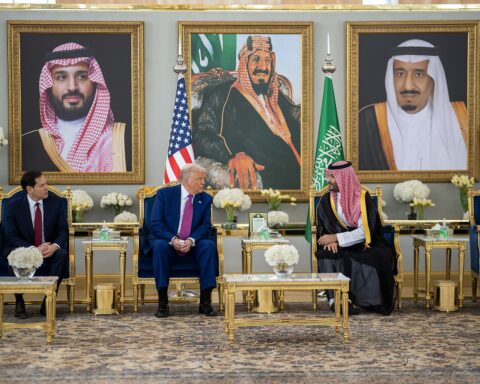
On March 1, President Trump called MBS and affirmed that the United States “stands alongside the Kingdom” in the wake of the Iranian attacks. This call, while expected, carried weight far beyond its immediate context. It was the latest expression of a security relationship that had been dramatically upgraded at the Washington summit in November 2025, where Saudi Arabia secured a package of commitments that fundamentally altered its strategic position.
That summit had produced several landmark agreements: non-NATO major ally designation for Saudi Arabia, which gives the Kingdom preferential access to American defense technology and streamlined arms sales; an offer of F-35 stealth fighters, which would make Saudi Arabia only the second Middle Eastern country after Israel to operate the advanced platform; and agreements on AI chip exports, which positioned Saudi Arabia as a key node in America’s strategy to maintain technological dominance over China. Together, these commitments represented the most significant upgrade in the US-Saudi security relationship since the original oil-for-security compact of the 1940s.
MBS’s private advocacy for strikes against Iran must be understood in this context. The Crown Prince was not simply offering an opinion on Iran policy. He was reinforcing a transactional relationship in which Saudi Arabia’s strategic alignment with Washington yields concrete security dividends. By urging Trump toward action — and then absorbing the Iranian retaliation that followed — MBS strengthened the case for every element of the November package and positioned Saudi Arabia for even deeper cooperation going forward.
The logic is circular but effective. Saudi Arabia supports American action against Iran. Iran retaliates against Saudi Arabia. The retaliation validates the need for advanced American weapons systems on Saudi soil. The weapons systems deepen Saudi dependence on Washington, which in turn makes Saudi Arabia a more reliable partner for future American operations in the region. Each step in the cycle reinforces the next, creating a self-perpetuating alliance that serves both parties’ interests.
This dynamic has implications for Vision 2030 as well. The Crown Prince’s economic transformation program requires sustained foreign investment, technology transfer, and geopolitical stability — or at least the perception of it. A Saudi Arabia that is demonstrably under the American security umbrella, equipped with F-35s and integrated into US defense networks, is a more attractive destination for the multinational corporations and sovereign wealth funds that Vision 2030 depends on than a Saudi Arabia navigating the region alone.

Shamkhani’s Death: The Architect of Rapprochement, Lost in the Ruins
Among the many dimensions of the February 28 strikes, one carries a particular symbolic weight: the death of Ali Shamkhani. As the former secretary of Iran’s Supreme National Security Council, Shamkhani was the man who sat across the table from Saudi officials in Beijing in 2023 and negotiated the rapprochement that was supposed to end decades of hostility between the two Gulf powers. He was, in a very real sense, the architect of the peace that MBS publicly championed in his January call to Pezeshkian.
That Shamkhani was killed in the same strikes that MBS reportedly urged Trump to carry out is a detail that history will not overlook. The man who built the bridge between Riyadh and Tehran was destroyed by a military operation that the Saudi Crown Prince privately advocated for while publicly standing on that very bridge. Whether MBS knew that Shamkhani would be among the casualties is unknowable. What is clear is that the strikes, once launched, would inevitably destroy the diplomatic framework that Shamkhani’s work had created — and that MBS was willing to accept that outcome.
This willingness speaks to a hard-edged calculation at the center of MBS’s worldview. The Beijing rapprochement was useful while it lasted. It reduced tensions, opened economic channels, and demonstrated Saudi Arabia’s ability to conduct independent diplomacy outside the American orbit. But it was always a tactical arrangement rather than a strategic commitment. When the opportunity arose to fundamentally weaken Iran — even at the cost of the rapprochement — MBS evidently concluded that the long-term benefits outweighed the short-term costs.
The death of Shamkhani also eliminates one of the few Iranian officials who had invested personal credibility in the relationship with Riyadh. Whatever leadership eventually consolidates in Tehran in the aftermath of Khamenei’s death will have less institutional memory of, and less personal attachment to, the Saudi channel. This may ultimately make future diplomacy harder. Or it may create space for a new arrangement, on terms more favorable to a Saudi Arabia that has emerged from the crisis in a position of strength.
What This Reveals About How MBS Governs
The dual-track approach to the Iran crisis is not an anomaly in MBS’s governing style. It is the governing style. Since his rapid ascent through the ranks of the Al Saud family tree, the Crown Prince has consistently demonstrated a willingness to pursue contradictory objectives simultaneously, maintaining multiple options until events force a commitment — and sometimes even after.
Consider his domestic track record. The sweeping cabinet reshuffles that have characterized his tenure serve a similar function to the dual-track diplomacy with Iran: they keep every actor in the system uncertain about where they stand, which concentrates decision-making authority in the Crown Prince’s hands. Ministers who do not know whether they will be in their posts next month are ministers who do not build independent power bases. Diplomats who do not know which Saudi message to believe are diplomats who must come to Riyadh to find out.
This approach carries risks. The gap between Saudi Arabia’s public and private positions on Iran was always vulnerable to exposure — and the Washington Post reporting did, in fact, expose it. The question is whether the exposure matters. In the calculus that appears to drive MBS’s decision-making, credibility is not a fixed asset to be preserved at all costs. It is a resource to be deployed strategically, spent where it generates returns, and rebuilt when circumstances require.
The Iran crisis suggests that this calculus is, at minimum, operationally effective. Saudi Arabia entered the crisis with relationships on both sides. It emerged from the crisis with its alliance with Washington strengthened, its standing in the GCC solidified, its reconciliation with the UAE advanced, and its legal position under international law secured through the Article 51 invocation. The cost — a Saudi-Iranian rapprochement that was always more fragile than its proponents acknowledged, and a reputation for straightforward dealing that was always more aspirational than real — may prove manageable.
The role of King Salman in all of this remains, as always, opaque. The aging monarch has progressively ceded operational authority to his son, and there is no public indication that the dual-track approach to Iran was anything other than MBS’s design and execution. But the King’s nominal authority still matters in certain contexts — particularly within the broader royal family, where some senior princes may view the Crown Prince’s risk appetite with private concern. The tradition of Saudi kingship has generally favored caution and consensus. MBS’s approach is neither.
What the Iran crisis ultimately reveals is a leader who has internalized a fundamental truth about power in the modern Middle East: consistency is a luxury that small states can afford and great powers can demand, but aspiring regional hegemons must sacrifice. Saudi Arabia under MBS is too large to hide, too ambitious to be passive, and too exposed to rely on a single patron or a single strategy. The dual track is not a bug in the system. It is the system.
Ramadan, War, and the Question of Legitimacy
The timing of these events during Ramadan adds a dimension that Western analysis often underweights. For the Saudi population, the spectacle of Iranian missiles falling on Saudi cities during Islam’s holiest month carries a visceral emotional charge that transcends strategic calculation. MBS’s January call to Pezeshkian, with its emphasis on Islamic solidarity, now reads as prescient positioning — the Crown Prince extended the hand of brotherhood, and Iran responded with ballistic missiles during Ramadan. The narrative writes itself, and it writes in Saudi Arabia’s favor.
This matters for domestic legitimacy. The Al Saud’s claim to rule has always rested in part on their role as custodians of the Two Holy Mosques and guardians of the Islamic faith. An Iranian attack during Ramadan — after Saudi Arabia had demonstrably sought to prevent conflict — reinforces that narrative powerfully. It positions MBS not as a warmonger who secretly advocated for the strikes that provoked the retaliation, but as a leader who sought peace, was rebuffed by aggression, and now has every right to defend his people and his faith.
The shelter-in-place orders in Jeddah and Dhahran, the elevated US travel advisory, the images of missile defense systems lighting up the night sky over Riyadh — all of these create a shared experience of threat that tends to consolidate public support around the leadership. MBS, whatever the complexities of his private diplomacy, is now the leader who must protect the Kingdom. That role comes with enormous authority, and he has shown every indication of intending to use it.
Frequently Asked Questions
Did MBS push the United States to strike Iran?
According to reporting by the Washington Post, both Saudi Arabia and Israel privately urged the Trump administration for weeks to launch strikes against Iran. MBS reportedly made several private phone calls to President Trump advocating for military action. This stood in contrast to Saudi Arabia’s public posture of restraint and its assurances to Iran that Saudi airspace would not be used for attacks.
What did Prince Khalid bin Salman tell American officials?
On January 31, 2026, Prince Khalid bin Salman — MBS’s brother and Saudi Arabia’s Deputy Minister of Defense — told US officials in Washington that failing to strike Iran would “only embolden the regime.” Axios described this private briefing as a reversal from Saudi Arabia’s public talking points, which at that time emphasized de-escalation and diplomatic engagement with Tehran.
Why did Iran attack Saudi Arabia if Saudi Arabia closed its airspace?
Saudi Arabia explicitly closed its airspace to prevent its use in strikes against Iran, fulfilling the commitment MBS made to Iranian President Pezeshkian. However, after the US-Israeli strikes killed Supreme Leader Khamenei on February 28, Iran launched retaliatory missile strikes at multiple targets across the region, including Riyadh and the Eastern Province of Saudi Arabia. Iran likely viewed the Kingdom as complicit in the broader anti-Iranian coalition regardless of the airspace closure, and may have sought to deter Saudi Arabia from further alignment with Washington and Tel Aviv.
What is the significance of the GCC invoking Article 51?
The invocation of Article 51 of the United Nations Charter — which enshrines the right of individual and collective self-defense — by all six GCC member states represents the most significant collective security action in the organization’s history. It provides a legal framework for coordinated Gulf military action, potential requests for international assistance, and positions any future Saudi or GCC military response as defensive rather than aggressive under international law.
Who was Ali Shamkhani and why does his death matter?
Ali Shamkhani was the former secretary of Iran’s Supreme National Security Council and the principal Iranian negotiator of the 2023 Saudi-Iranian rapprochement brokered in Beijing. His death in the February 28 strikes eliminates one of the few senior Iranian officials with personal investment in the diplomatic relationship with Riyadh, potentially complicating any future efforts to rebuild ties between the two countries.
How did the MBS-MBZ relationship change after the strikes?
Bloomberg reported that MBS’s post-attack call to UAE President Mohammed bin Zayed effectively broke the ice after a period of strained relations between the two leaders. Disagreements over Yemen, economic competition, and divergent approaches to China had created distance between Riyadh and Abu Dhabi. The Iranian crisis provided a pretext for reconciliation, with the shared threat overriding accumulated bilateral grievances.
What security commitments did Saudi Arabia receive from the US?
At the November 2025 Washington summit, Saudi Arabia secured non-NATO major ally designation, an offer of F-35 stealth fighters, and agreements on AI chip exports. Following the Iranian attacks on March 1, President Trump called MBS to affirm that the United States stands alongside the Kingdom — reinforcing a security relationship that has been dramatically upgraded under the current arrangement.
The diplomatic dimension of this dual strategy played out most dramatically through the Oman-mediated nuclear talks in February 2026, where a ceasefire framework was reportedly within reach before the strikes were ordered. For the full timeline of those negotiations, see The Deal That Died in Oman.