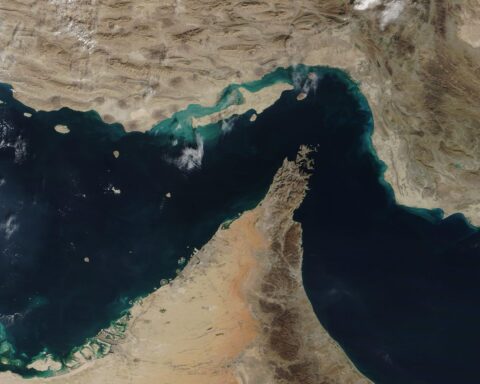
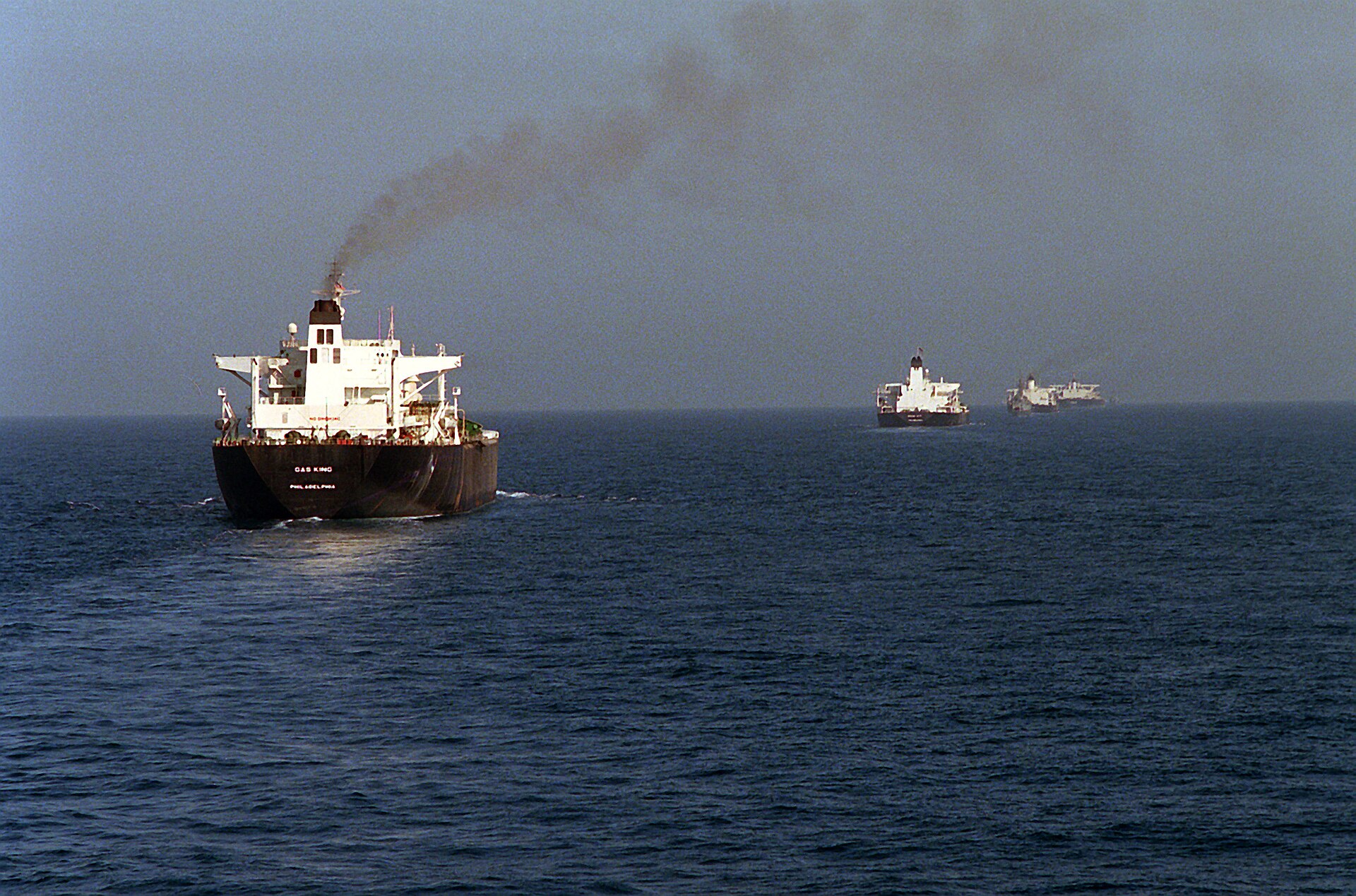
DHAHRAN — Five supertankers transited the Strait of Hormuz overnight May 3–4 under U.S. Navy escort, completing the first convoy of Operation Project Freedom without incident, U.S. Central Command confirmed. Brent crude fell to approximately $107.80 per barrel in early Asian trading on May 4 — at or below the $108–111 fiscal break-even Saudi Arabia requires when Public Investment Fund disbursements are included, according to Bloomberg Economics.
The convoy is being received in Washington as a turning point. The fiscal arithmetic runs in the opposite direction. Saudi Arabia produced 7.25 million barrels per day in March — down 30 percent from February — cannot export more than 4 to 5.9 million bpd through its Yanbu bypass, and on May 3 led an OPEC+ output increase of 188,000 bpd for June that Rystad Energy described as “largely symbolic” given physical export constraints. Project Freedom moved five tankers through the strait. Before the war, roughly twenty very large crude carriers passed through every day.
The paradox extends to Aramco’s own earnings structure: higher war-era prices generated a projected $29 billion Q1 profit on significantly reduced volumes, while the June OSP reset has already begun compressing the margin that produced that result. The Q2 cliff the convoy cannot fix is examined here.
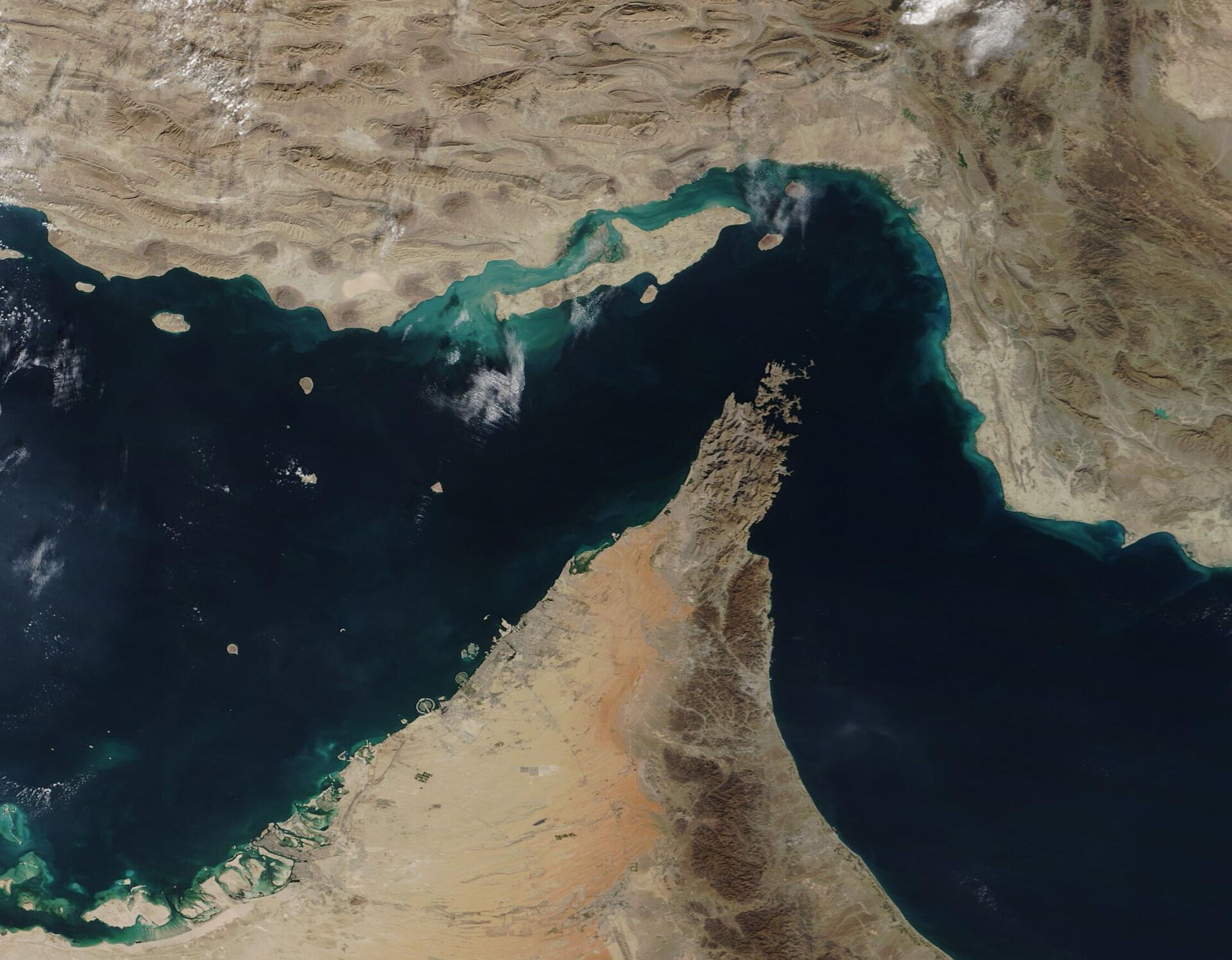
Table of Contents
Five Tankers and a Swarm Attack
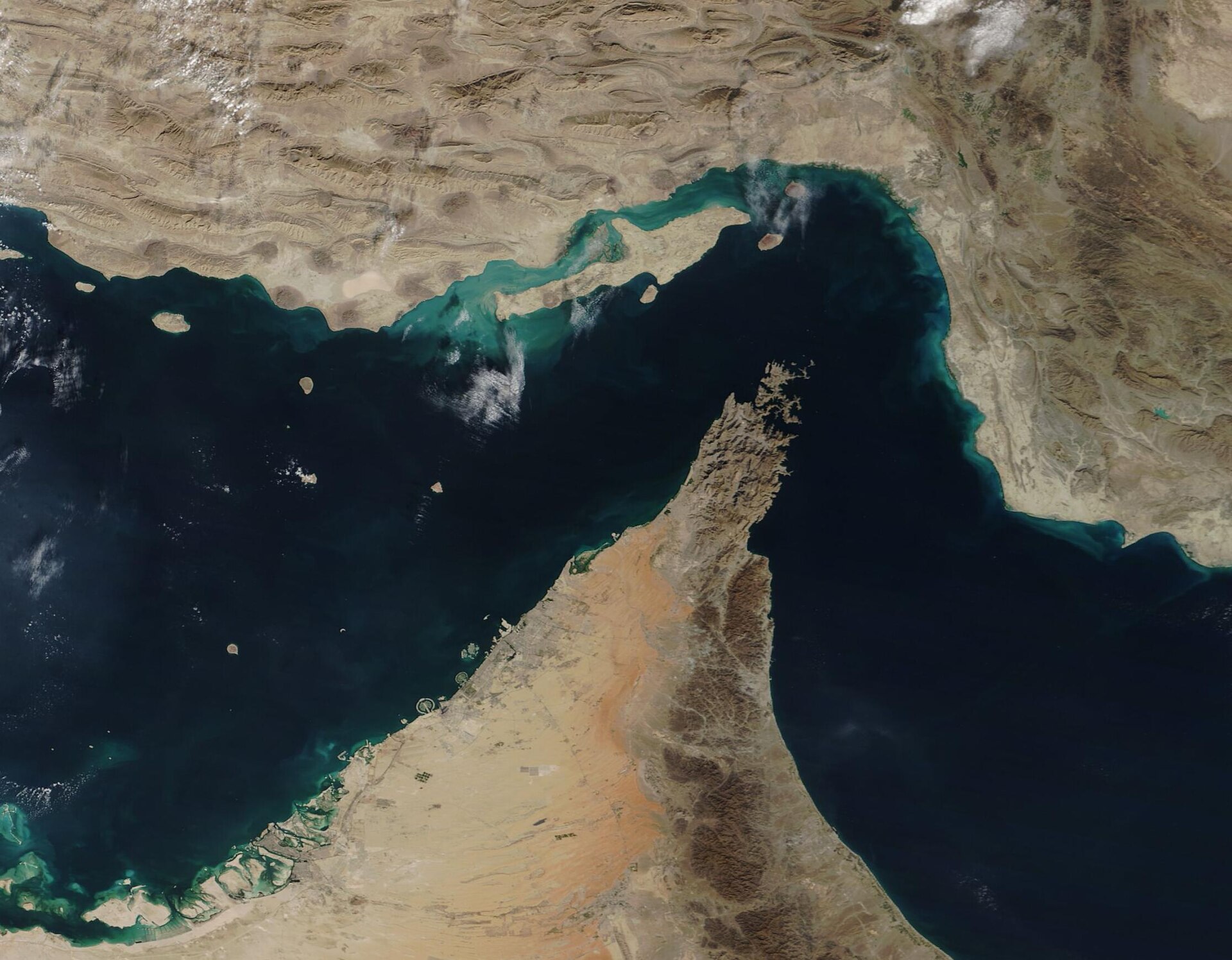
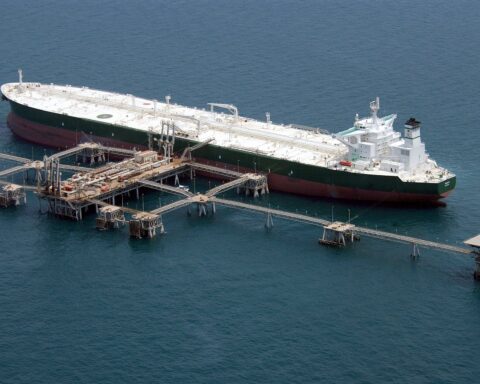
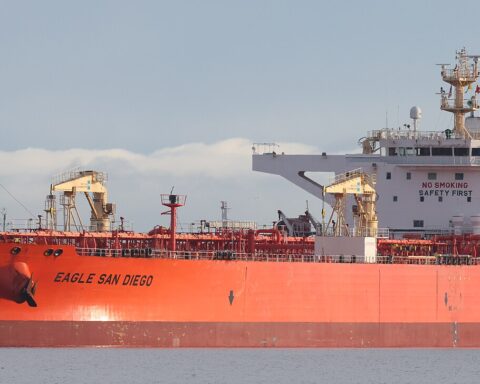
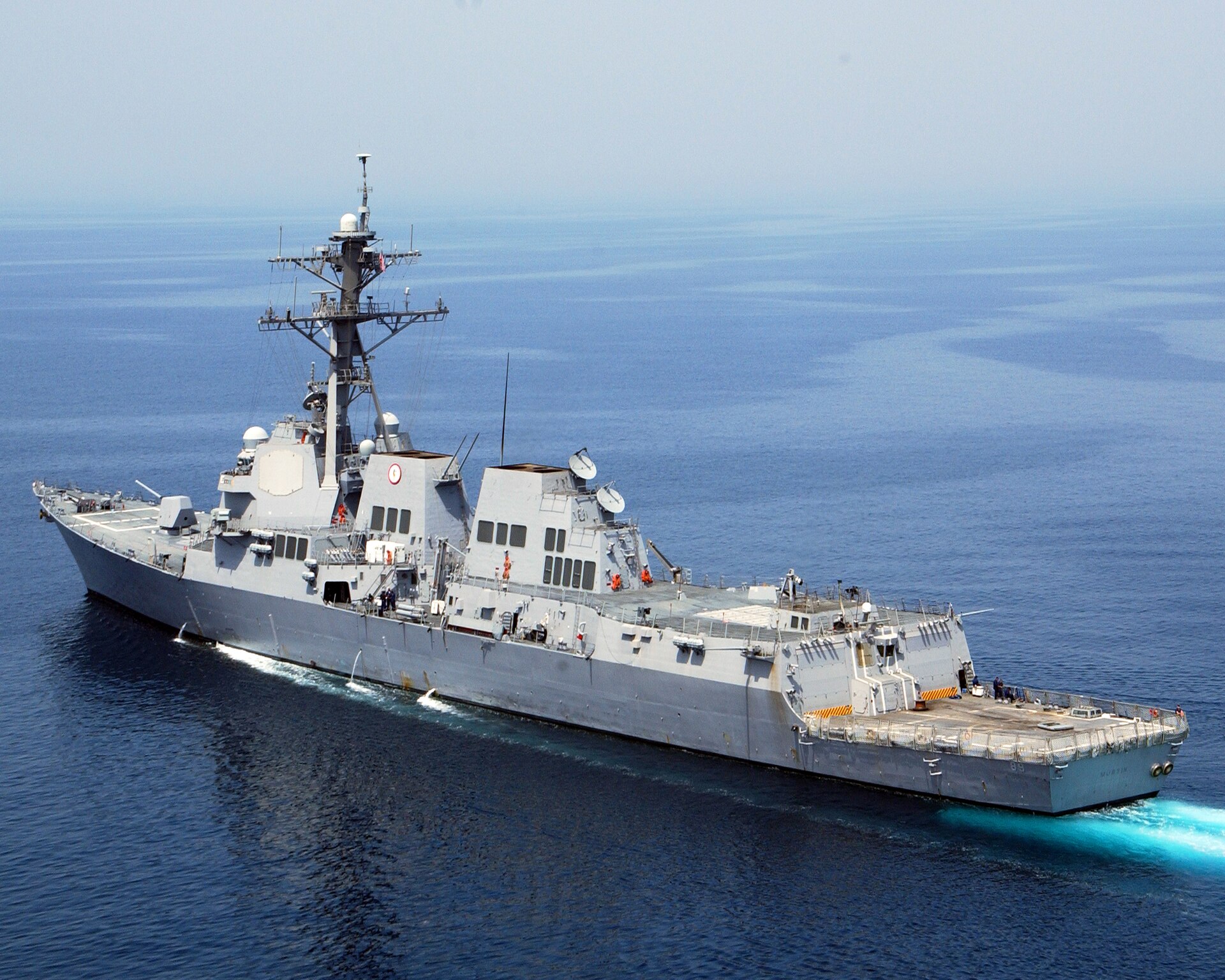
The five supertankers hugged the Omani side of the strait under an Arleigh Burke-class destroyer screen, part of a CENTCOM force that includes guided-missile destroyers, more than 100 land- and sea-based aircraft, multi-domain unmanned platforms, and 15,000 service members deployed across the theater. No vessel names were publicly released. The convoy transited overnight — a tactical choice consistent with maximizing surveillance advantage under the multi-domain umbrella CENTCOM has assembled since late March.
Five tankers is a fraction of the pre-war baseline. Before February 28, roughly twenty VLCCs passed through Hormuz daily — about 600 per month. Approximately 20,000 seafarers remain trapped inside the Gulf with hundreds of vessels still waiting, according to CNBC. The military deployment required for five ships — destroyers, a hundred aircraft, thousands of personnel — would need to be sustained for every subsequent convoy at anything approaching normal commercial throughput.
Hours before the convoy departed, a UK-flagged cargo ship reported an attempted swarm attack by Iranian fast-attack craft near Sirik on Iran’s southern coast, CBS News reported. No injuries were reported. The attack indicates that IRGC Navy operational units maintained an aggressive posture even as Tehran’s political leadership dismissed the operation.
The Middle East briefing 3,000+ readers start their day with.
One email. Every weekday morning. Free.
For Saudi Arabia, the constraint is not whether five tankers can transit Hormuz under armed escort. It is whether the strait can reopen at pre-war throughput — 7 to 7.5 million bpd — sufficient to close the gap between Yanbu’s terminal ceiling and the kingdom’s export requirements. A convoy does not address terminal infrastructure. The full structural case for why Saudi Arabia cannot endorse Project Freedom while Bab el-Mandeb remains Iran’s “unplayed” card is documented in the two-chokepoint trap analysis.
The first convoy completed without engagement. Whether that holds for the second depends on a 30-day clock that started ticking May 1.
The Price Saudi Arabia Cannot Afford
Brent fell to approximately $107.80 per barrel on May 4, down from an April 30 peak of $126 — an $18.20 decline in four trading days, according to CNBC and OilPrice.com. WTI dropped to roughly $101.30, down 0.65 percent. The dual trigger: the convoy’s successful completion and OPEC+’s May 3 announcement of a 188,000 bpd output increase for June.
Markets read both as supply signals. Neither added a physical barrel. Five tankers under military escort do not constitute a reopened strait, and a quota increase that member states cannot deliver to export terminals changes nothing on the water. Brent moved on the announcement, not the barrel count.
Bloomberg Economics pegs Saudi Arabia’s standard fiscal break-even at roughly $94 per barrel. When PIF’s $71 billion in committed capital disbursements are included, the floor rises to $108–111 per barrel. At $107.80, Brent sits at or below it.
Goldman Sachs projects the kingdom’s war-adjusted deficit at 6.6 percent of GDP — exactly double Riyadh’s official projection of 3.3 percent, or $44 billion. The implied annual reserve drawdown under Goldman’s scenario is roughly $73 billion.
Saudi Arabian Monetary Authority data show reserves fell from $451 billion in January to $434 billion in February — a $17 billion single-month drawdown at the height of war operations. The informal floor below which the kingdom has never allowed reserves to fall is understood to be around $350 billion. At the February drawdown rate, Saudi Arabia reaches that line in under five months.
The PIF commitments are not discretionary. The fund has contractual obligations across NEOM, The Line, Oxagon, and dozens of smaller Vision 2030 projects — obligations made when Brent averaged above $80 and Saudi production ran at capacity. Bloomberg Economics calculated the PIF-inclusive break-even precisely because these disbursements cannot be suspended without legal and commercial consequences to dozens of active construction contracts.
PIF’s own portfolio offers limited near-term liquidity relief. The fund has redirected capital from international equities into domestic real estate and infrastructure with construction timelines stretching into the mid-2030s. The wealth exists. It is not liquid.
At current output of 7.25 million bpd and $107.80 Brent, each dollar below the PIF-inclusive break-even costs Saudi Arabia approximately $2.65 billion per year in foregone revenue. The convoy’s completion coincided with an $18.20 decline in Brent over four days. That demand-destruction dynamic — suppressing Brent to 07.80 rather than letting supply destruction push it to 50 — is the mechanism examined in Why $114 Oil Is the Price Saudi Arabia Cannot Afford, which maps the seven-dollar band between the fiscal floor and the recession ceiling where Saudi Arabia is now operating.
Where Does the Missing Production Go?
Saudi Arabia produced 10.4 million bpd in February. By March, the International Energy Agency reported output at 7.25 million bpd — a 30 percent collapse. The OPEC+ June quota stands at 10.291 million bpd. The gap between quota and actual production is approximately 3 million barrels per day.
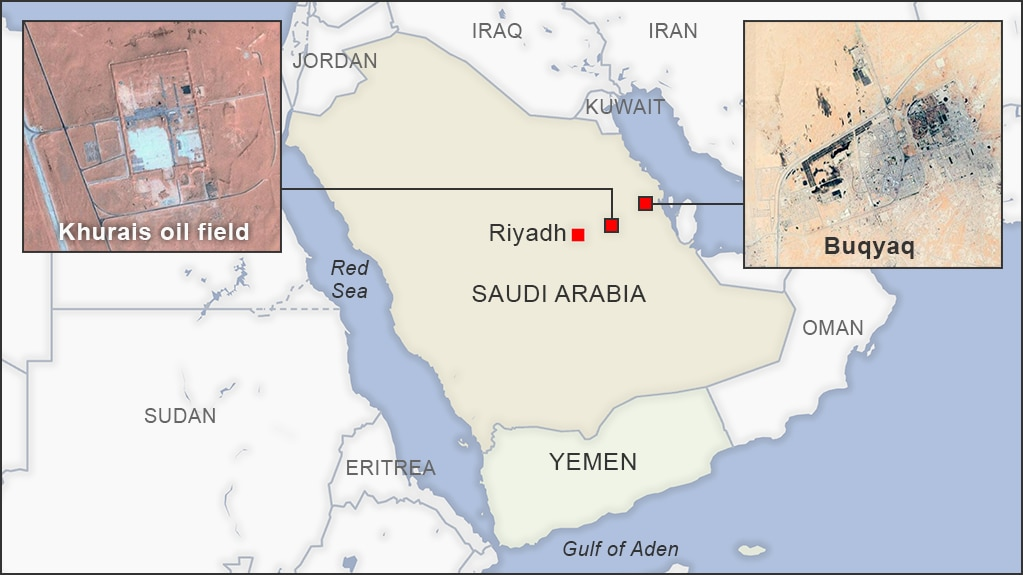
Part of the shortfall is war damage. Combined upstream losses disclosed April 9 include Manifa offshore at 300,000 bpd and Khurais onshore at 300,000 bpd — 600,000 bpd of upstream capacity offline, with additional throughput and export losses pushing total disruption to roughly 1.3 million bpd. Wood Mackenzie’s head of upstream analysis Fraser McKay estimated six to nine months to restore capacity in a worst-case scenario.
Khurais — Saudi Arabia’s second-largest producing field at full capacity — has had no public restoration timeline. Manifa, an offshore complex that Aramco spent years and billions developing, took ballistic missile damage in early March. The 1.3 million bpd aggregate figure, compiled from disclosures and satellite imagery by Wood Mackenzie, may itself be conservative. Aramco has not issued a comprehensive damage assessment.
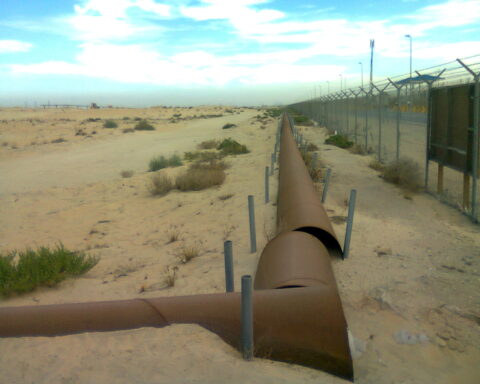
The rest of the missing production is the Yanbu ceiling. The East-West Pipeline, built in 1981 as a Hormuz bypass, has a design capacity of 7 million bpd. But the binding constraint is not the pipe — it is terminal loading at Yanbu. Effective crude export capacity at the Yanbu terminals runs between 4 and 5.9 million bpd, according to Argus Media. Pre-war Saudi Hormuz throughput was 7 to 7.5 million bpd. The structural gap — barrels that cannot reach any export terminal through any available route — ranges from 1.1 to 3.5 million bpd.
| Metric | Figure | Source |
|---|---|---|
| February production | 10.4M bpd | IEA |
| March production | 7.25M bpd | IEA |
| OPEC+ June quota | 10.291M bpd | OPEC+ |
| Yanbu export ceiling | 4–5.9M bpd | Argus Media |
| Pre-war Hormuz throughput | 7–7.5M bpd | CENTCOM / IEA |
| War damage offline | ~1.3M bpd | Wood Mackenzie |
Project Freedom’s first convoy moved five tankers through the strait. It did not expand Yanbu’s terminal capacity by a single barrel. Nor did it protect the bypass infrastructure that Gulf producers had built precisely to avoid the strait: on the same day the convoy transited, Iran’s drone strike on the VTTI bypass terminal at Fujairah destroyed the discharge end of the Habshan–Fujairah pipeline — the only operational route moving Abu Dhabi crude to tankers outside Hormuz entirely.
Can OPEC+ Deliver a Quota It Cannot Fill?
The May 3 output increase was the third OPEC+ quota hike since Hormuz closed on February 28. It was also the first meeting without the United Arab Emirates, which exited the cartel after 59 years on May 1. In its post-UAE configuration, OPEC+’s core quota-setting bloc now comprises seven producers: Saudi Arabia, Russia, Iraq, Kuwait, Kazakhstan, Algeria, and Oman.
Rystad Energy described the 188,000 bpd increase for June as “largely symbolic” given that physical export constraints prevent member states — Saudi Arabia above all — from delivering additional barrels. Saudi Arabia is leading an output organization and announcing production targets against a June quota of 10.291 million bpd while actually producing 7.25 million.
All three output increases since February 28 were led by Saudi Arabia. None has added a physical barrel to global supply. The first two preceded broad market recognition that Yanbu’s terminal capacity — not pipeline throughput — is the binding export constraint. The third came as 1.3 million bpd of Saudi upstream capacity remains offline from war damage.
The medium-term picture compounds the problem. Wood Mackenzie warned in May 2026 that the UAE’s exit from OPEC+ quota discipline, combined with Abu Dhabi’s stated target of expanding capacity from roughly 4 million to 5 million bpd, creates a structural market-share competition risk by 2027. That trajectory would make Abu Dhabi the fastest-growing non-OPEC+ producer in the Middle East, positioned to capture market share from a Saudi Arabia still rebuilding damaged upstream capacity. The consultancy projected “sharply lower” prices at precisely the moment Riyadh needs them higher to rebuild reserves.
Iran’s Response: Dismissal and a Deadline
Tehran responded to the first convoy on two parallel tracks.
The dismissal and the deadline were not Iran’s only responses. A three-part deterrence probe — a fabricated missile-strike claim, a maritime control zone declaration by Khatam al-Anbiya commander Aliabadi, and a broadcast IRGC attack warning — was activated within the same six-hour window as Project Freedom’s launch. The Jask claim was never meant to be true; it was meant to reprice war-risk insurance on the convoys it claimed to have struck, exploiting the gap between the premium moving and the denial landing.
The first is dismissal. Ebrahim Azizi, head of Iran’s parliament National Security Commission, said May 4: “The Strait of Hormuz and the Persian Gulf would not be managed by Trump’s delusional posts.” The framing positions Project Freedom as a social-media exercise rather than a military operation involving 15,000 personnel and more than 100 aircraft.
“The Strait of Hormuz and the Persian Gulf would not be managed by Trump’s delusional posts!”
— Ebrahim Azizi, head of Iran’s parliament National Security Commission, ANI News, May 4, 2026
The second track is escalation framing. Iran simultaneously warned that U.S. interference in the strait “will be considered a violation of the ceasefire.” The IRGC’s 30-day ultimatum, issued May 1, set a deadline for the United States to end its Arabian Sea blockade or Iran treats the ceasefire as terminated — a clock that expires around May 31. The IRGC’s stated formulation: Trump “must choose between an impossible military operation or a bad deal.”
The physical evidence complicates both tracks. The Sirik swarm attack hours before the convoy launched confirms that IRGC Navy units maintained an aggressive posture at the unit level regardless of what Tehran said publicly.
The double blockade mechanism remains structurally intact. Since April 13, the United States has controlled the Arabian Sea approach with its blockade of Iranian ports and toll-collecting vessels. Since March 4, the IRGC has controlled the Gulf of Oman exit. Any vessel transiting Hormuz requires both permissions. The first convoy received them under military escort. For the hundreds of commercial vessels still anchored inside the Gulf — tankers, bulk carriers, container ships — no such escort has been offered.
The 30-day ultimatum creates a temporal boundary. After approximately May 31, if the IRGC follows through, CENTCOM’s escorts would operate against declared Iranian opposition rather than alongside a nominal ceasefire — a distinction that marine insurers, ship owners, and flag states will price into every subsequent transit decision.
Background
The Iran–U.S. war began February 28, 2026, when Iran closed the Strait of Hormuz. Pre-war, approximately 20 million barrels per day of crude and refined products — roughly 20 percent of global seaborne oil trade — transited the strait daily.
“The biggest energy security threat in history.”
— Fatih Birol, Executive Director, International Energy Agency, on 13 million bpd offline globally
Saudi Arabia’s Yanbu bypass, the East-West Pipeline, was built in 1981 specifically for a Hormuz closure scenario. Its design capacity of 7 million bpd has never been fully tested under sustained wartime export conditions; the binding constraint is terminal loading infrastructure, not the pipe.
The three OPEC+ output increases since the closure — announced in March, April, and May — have collectively added more than 500,000 bpd to nominal quotas. Global physical supply has not increased by a corresponding amount. The disconnect between announced quotas and deliverable barrels is now a persistent feature of the post-Hormuz oil market.
Saudi Arabia’s fiscal position before the war was already tightening. Vision 2030 spending had pushed non-oil government expenditure to record levels, and Riyadh had budgeted for a second consecutive deficit in 2025. The war compressed three variables simultaneously: a 30 percent production collapse, prices at or below the PIF-inclusive break-even, and an export bypass whose physical ceiling is determined by terminal infrastructure, not OPEC+ quotas.
Frequently Asked Questions
How does this convoy compare to pre-war Hormuz traffic?
Before February 28, approximately twenty very large crude carriers transited Hormuz daily — roughly 600 per month. Since the April 8 ceasefire, Kpler has recorded only about 45 transits. Five supertankers under military escort represent a diplomatic and military event, not a commercial throughput recovery.
How long would mine clearance take if a deal were reached?
Standard shipping lanes through Hormuz cover approximately 200 square miles. Using the 1991 Kuwait mine-clearance operation as a benchmark, full clearance would take roughly 51 days under ideal conditions. The four Avenger-class mine countermeasure ships previously based at Naval Support Activity Bahrain were decommissioned in September 2025. Only two mine-capable vessels remain in theater; three littoral combat ships are deployed to Asia. Even after a political agreement, physical reopening of Hormuz would lag by months.
What is the IRGC’s 30-day ultimatum?
The IRGC issued a statement on May 1 setting a deadline of approximately May 31 for the United States to end its Arabian Sea blockade, imposed April 13 against Iranian ports and toll-collecting vessels. If unmet, Iran stated it would consider the ceasefire terminated. The IRGC framed the demand as binary: Trump “must choose between an impossible military operation or a bad deal.” The ultimatum imposes a hard clock on the convoy model — if the ceasefire formally lapses, U.S. escorts face a qualitatively different threat environment.
What is the difference between the standard and PIF-inclusive break-even?
The International Monetary Fund and Oxford Economics place Saudi Arabia’s standard fiscal break-even — the oil price at which the government balances its budget — between $80 and $94 per barrel. Bloomberg Economics adds PIF’s $71 billion in committed capital disbursements to arrive at $108–111 per barrel. PIF’s commitments span NEOM, Oxagon, The Line, Trojena, and dozens of smaller projects — contractual obligations with active construction timelines, not discretionary line items. The $14–17 gap between the two figures is, in effect, the annual price of Vision 2030.
What happened to the IRGC Navy commander?
Rear Admiral Alireza Tangsiri, commander of the IRGC Navy, was killed on March 30. As of May 4, no named successor has been publicly announced — a 35-day gap in formal command during the most operationally active period for IRGC naval forces since 1988. The IRGC Navy has continued to conduct operations, including the Sirik swarm attack and multiple vessel seizures in April, under what appears to be decentralized unit-level authority. Any ceasefire agreement requiring IRGC Navy compliance faces the question of who, exactly, signs for it.