
Iran From Within: Is the Islamic Republic Collapsing?
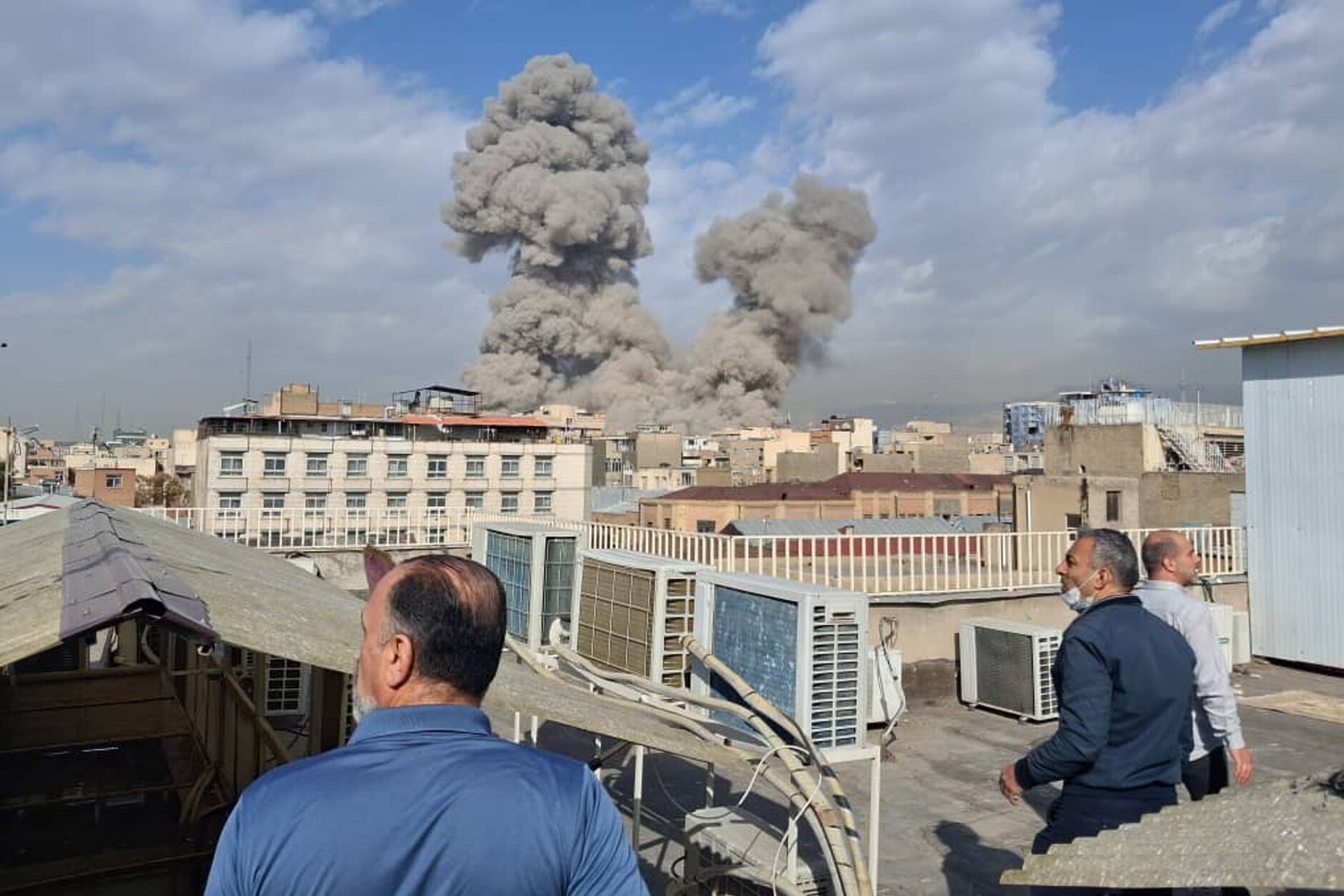
Three days after US-Israeli strikes killed Supreme Leader Ali Khamenei, Iran is tearing itself in two. In cities across the country, fireworks light up the night sky and crowds dance to banned music while, just miles away, tens of thousands of mourners wave flags and scream for vengeance against the nations that killed their leader. Nobody inside Iran or outside it can say with certainty which side will prevail.
The scenes leaking through VPNs and satellite links despite a months-long internet blackout tell a story of a nation at war with itself. In Galleh Dar, a small town in Fars Province, a crowd pulled down a monument to Ayatollah Ruhollah Khomeini, the founder of the Islamic Republic, as flames rose from the roundabout and onlookers cheered. In Isfahan, the same city where others celebrated, tens of thousands filled the main square waving Iranian flags and chanting slogans against America. This is not a country with one voice. It is a country with two throats, both screaming.
For Saudi Arabia, what unfolds on these streets over the coming days and weeks will shape the Middle East for a generation. A regime that collapses from within could hand Riyadh undisputed regional dominance. A regime that consolidates around fury and grief could prove more dangerous than anything Crown Prince Mohammed bin Salman has yet faced.
What Is Actually Happening on Iran’s Streets Right Now?
Iran’s cities are experiencing simultaneous celebrations and counter-protests, split along the same urban-secular versus rural-conservative fault lines that have defined every Iranian political crisis since 1979. Verified footage from the first 48 hours shows the scale of both reactions, and the depth of the divide between them.
Celebratory scenes have been confirmed in at least eight cities: Karaj, Qazvin, Shiraz, Kermanshah, Isfahan, Sanandaj, Izeh, and Shahsavar. Witnesses and social media videos show car horns blaring, fireworks bursting, and music blasting from vehicles. In Tehran, large numbers moved toward Azadi (Freedom) Square in the hours after state television confirmed Khamenei’s death.
The Middle East briefing 3,000+ readers start their day with.
One email. Every weekday morning. Free.
But this is not a uniform uprising. Reporters on the ground and Iranians communicating through VPNs stress that people are not coming out en masse. The memory of January is too fresh. Just weeks ago, the Islamic Republic unleashed what Amnesty International documented as a heavily militarized crackdown on nationwide protests that had erupted over the collapsing rial and soaring inflation. Human Rights Watch described the evidence as pointing to countrywide massacres, with credible estimates of the death toll running into the thousands during January alone.
That terror lingers. An Iranian medical professional in northern Iran told reporters that security forces were stopping and interrogating people celebrating in their cars. The celebrations are real. The fear is also real. And the question is which force proves stronger.
Why Does the Toppled Khomeini Monument in Galleh Dar Matter So Much?
In the small southern town of Galleh Dar, protesters did not just celebrate the death of a leader. They attacked the very foundation of the state itself by pulling down a monument to Ayatollah Ruhollah Khomeini, the man who created the Islamic Republic in 1979. This act carries enormous symbolic weight, comparable to the toppling of Saddam Hussein’s statue in Baghdad’s Firdos Square in 2003.
There is a critical distinction between cheering the death of Khamenei, the current leader, and physically destroying a monument to Khomeini, the system’s founder. The first says: we hated this man. The second says: we reject the entire project. It is an attack not on a person but on an ideology, on the velayat-e faqih (guardianship of the Islamic jurist) that has been the constitutional bedrock of Iran since the revolution.
Videos verified by international outlets showed flames rising from the roundabout as the monument fell, with onlookers cheering and applauding. The fact that this happened in a small town in Fars Province rather than in Tehran or Isfahan is itself significant. It suggests the anti-regime sentiment has penetrated deep into Iran’s provincial heartland, not just the cosmopolitan urban centers where dissent is expected.
For analysts watching whether this moment resembles 1979, when a revolution swept away the Shah, or 2022, when the Mahsa Amini protests ultimately failed, the Galleh Dar footage is a data point on the revolutionary side of the ledger. Regimes that lose their foundational symbols are regimes in existential trouble.
How Large Are the Pro-Regime Counter-Protests?
Tens of thousands filled the main squares of Isfahan and Yazd, waving Iranian flags, beating their chests in mourning, and chanting for vengeance. State media amplified these rallies constantly. These are not manufactured crowds. While the government certainly organized transportation and encouraged attendance, the grief and rage visible in the footage appear genuine.
This is where outside observers repeatedly misread Iran. The assumption that every Iranian secretly hates the regime and is waiting for liberation has been wrong before. The Islamic Republic has a real base. It is concentrated among the rural poor, the religiously conservative, the Basij volunteer militia networks, and the vast ecosystem of families whose livelihoods depend on revolutionary institutions. These people are not performing loyalty. They are experiencing genuine anguish at what they see as an act of war against their country and their faith.
Even more critically, the nationalist fury cuts across political lines. Many Iranians who despise the clerical establishment are still furious about the strikes. Patriotism and opposition are not mutually exclusive. An Iranian who celebrated in the streets of Karaj on Saturday night can, by Monday morning, be enraged at the sight of dead children in Minab. This emotional complexity is precisely what makes the situation so volatile and so difficult to predict.
The regime will attempt to channel this anger into loyalty. It has done so before. After the assassination of Qasem Soleimani in 2020, millions turned out for his funeral procession, and the government used the moment to rally support. Whether it can repeat that trick without a supreme leader and with a decapitated command structure is the open question.
How Does the Minab School Strike Change the Calculus?
On February 28, a missile struck the Shajareh Tayyebeh all-girls primary school in Minab, in Hormozgan Province in southeastern Iran. The strike coincided with the morning when Iranian families send their children to school, Saturday being a working day in Iran. The death toll has climbed steadily, with Al Jazeera reporting it rose to 165 and Iranian state claims running higher. UNESCO condemned the bombing as a grave violation of humanitarian law, noting that students in a place of learning are protected under international law.
The school was reportedly located near an IRGC naval base that was targeted separately. Whether the school was struck deliberately, hit by a stray munition, or damaged by secondary effects remains contested. The Washington Post reported there was no independent confirmation of the full casualty count but verified footage of the destroyed school building.
Regardless of the tactical explanation, the political and emotional impact is staggering. Dead children generate a unique kind of fury, one that transcends political loyalties and ideological commitments. Iranians who were dancing in the streets over Khamenei’s death are confronted with images of small bodies pulled from rubble. The cognitive dissonance is excruciating: you can hate the regime and still be devastated by the murder of schoolgirls.
For those hoping the strikes would catalyze an organic uprising against the Islamic Republic, Minab is a catastrophe. It hands the regime its most powerful recruitment tool since the Iran-Iraq War. Every dead child becomes a martyr. Every image of the destroyed school becomes proof that America and Israel are the true enemies. The regime does not need to fabricate propaganda when real atrocities provide it for free.
This is the paradox the strikes created: they killed the leader but may have vaccinated the system against collapse by giving it a cause around which to consolidate.
Is the IRGC Holding Together or Fracturing?
The cohesion of the Islamic Revolutionary Guard Corps is the single most important variable determining whether the Islamic Republic survives this crisis. If the IRGC holds, the regime survives in some form. If it fractures, everything changes. Right now, the evidence points to the IRGC holding, but under unprecedented strain.
The appointment of Ahmad Vahidi as the new IRGC commander-in-chief on March 1 was designed to project continuity. Vahidi is a founding member of the Guards, a former commander of the Quds Force, and a former defense minister. He is wanted by Interpol in connection with the 1994 bombing of the AMIA Jewish community center in Buenos Aires. He is, in other words, a hardliner’s hardliner, a man whose entire career has been built within the revolutionary apparatus. His appointment signals that the IRGC intends to fight, not negotiate.
But appointing a commander and maintaining cohesion are different things. The US-Israeli strikes reportedly eliminated roughly 40 senior Iranian officials, including the defense minister and the chief of staff of the armed forces. The IRGC’s previous ground forces commander, Mohammad Pakpour, was among those reportedly killed. This level of decapitation puts enormous stress on command-and-control structures.
Analysts remain divided on the implications. As Al Jazeera’s analysis noted, some former US defense officials argue that without ground forces or a fully armed organic uprising, the deep security apparatus can survive by maintaining cohesion alone. The IRGC is not merely a military force. It is woven into Iran’s economic allocation structures, procurement networks, regulatory systems, political vetting processes, and strategic industries. You cannot collapse the IRGC without collapsing the state, because they are the same thing.
Others point to signs of strain. The January massacres, in which security forces killed thousands of protesters, deepened internal rifts within the security structure. Reports indicate Tehran has been rotating more loyal IRGC contingents into key positions to maintain control, a move that itself suggests concern about reliability in some units. Trump’s amnesty offer to IRGC members who lay down their weapons, while dismissed by most analysts as unlikely to produce mass defections, introduces a psychological variable that did not exist in previous crises.
The decisive indicator to watch: mid-ranking IRGC officers. Generals will stay loyal because they have nowhere else to go. Foot soldiers will follow orders because they always have. It is the colonels and brigadiers, the men who command battalions and control checkpoints, who will decide whether the IRGC holds or breaks.
What Does the Internet Blackout Tell Us About Regime Confidence?
Iran has been operating under a nationwide internet blackout since January 8, originally imposed to conceal the scale of the crackdown on protests that had erupted over the collapsing economy. The blackout has now stretched for nearly two months, making it one of the longest sustained internet shutdowns any country has ever imposed on its own population.
The scope is extraordinary. Authorities blocked not just social media and messaging apps but also work-related platforms. Mobile networks, text messaging, and even landlines were disabled in some areas. Starlink satellite connections were jammed using military-grade mobile equipment, and possession of a Starlink terminal now reportedly carries the threat of a prison sentence.
Despite all of this, videos keep leaking out. Footage from Galleh Dar, from celebrations in Karaj and Isfahan, from the mourning rallies, all of it reaching the outside world through VPNs, satellite phones, and sheer determination. The regime’s inability to fully seal the information space, even with the most aggressive censorship infrastructure any government has deployed, is itself a data point about the limits of authoritarian control in 2026.
The blackout also carries enormous economic costs. International companies cannot communicate with Iranian partners. Payment systems and authentication processes are disrupted. The government’s own spokesperson confirmed that international access would not be restored until at least late March. This is a regime willing to accept severe economic damage to maintain information control, the calculus of a government that fears what its own people might do with the truth more than it fears economic collapse.
For outside observers, the blackout creates a fog of war over the domestic situation. The videos that do emerge are fragments, not a complete picture. Celebrations may be larger than they appear. Mourning rallies may be larger than reported. The security crackdown may be far more brutal than anyone outside Iran currently knows. The blackout is a reminder that what we see is what the regime failed to suppress, not what actually happened.
Is This 1979 or 2022?
Every analyst watching Iran is asking the same question: does this moment more closely resemble 1979, when the Shah’s regime collapsed from within, or 2022, when the Mahsa Amini protests convulsed the country for months before the IRGC ultimately crushed them?
The case for 1979 is real. The supreme leader is dead, not merely challenged. A monument to the state’s founder has been physically destroyed. The regime has already burned through its domestic legitimacy with the January massacres, killing thousands of its own people just weeks before losing its paramount leader. The command structure has been decapitated. An external power is actively calling for regime change and offering amnesty to security forces who defect. The emotional and symbolic ingredients of revolution are present.
The case for 2022 is equally compelling. The IRGC remains the most powerful internal security apparatus in the Middle East. It has demonstrated, repeatedly, its willingness to use overwhelming and lethal force against civilian populations. The January crackdown, in which credible reports suggest thousands were killed in just days, proved that the regime will accept any body count to maintain power. The opposition has no unified leadership, no armed wing, no territorial base, and no external sponsor willing to provide weapons. Revolutions require more than anger. They require organization, and Iran’s opposition has been systematically dismantled over decades.
There is also a third possibility that neither parallel captures. This may be something new: a regime that neither collapses nor fully reconsolidates but enters a prolonged twilight of diminished authority, internal power struggles, and episodic violence. A state that controls the security apparatus and the oil revenue but has lost the consent of its population, governing through fear alone. This is the scenario many Iran analysts consider most likely in the medium term: not revolution, not restoration, but decay.
The variable that could tip the balance in either direction is the IRGC’s internal cohesion. In 1979, the imperial military fractured and elements refused to fire on protesters. In 2022, the IRGC held firm. The answer to which precedent applies depends entirely on what happens inside military barracks and command posts that no journalist can currently access.
What Is Trump Actually Trying to Achieve?
President Trump has been explicit: he wants regime change. In a direct address to the Iranian people, he called on what he termed Iranian patriots who yearn for freedom to seize this moment. He offered amnesty to IRGC members and military personnel who lay down their arms. He warned those who do not that they face certain death. He claimed thousands of Iranian military personnel were already calling to accept the offer.
This represents a dramatic escalation from Trump’s previous posture. As multiple outlets noted, Trump was once wary of ordering regime change in Iran. Now he has launched what CNN described as the regime-change effort he pledged to avoid. The Washington Post reported that the administration is pursuing what amounts to decapitation without a plan for what comes next.
The strategic logic has a critical flaw that analysts across the political spectrum have identified: air power alone cannot achieve regime change. It can destroy military targets, kill leaders, and degrade command structures. What it cannot do is create a functioning alternative government, disarm a security apparatus of hundreds of thousands, or prevent the chaos that follows state collapse. As the Christian Science Monitor noted, what Trump is attempting has essentially never been accomplished through air strikes alone.
CENTCOM’s stated mission to dismantle the IRGC is a military objective. But dismantling the IRGC means dismantling the state, because the IRGC is the state. It controls vast economic networks, social services, and political institutions. Removing it without a replacement creates a vacuum that history suggests will be filled by warlords, militias, and sectarian violence, precisely the scenario that unfolded in Iraq after 2003 and Libya after 2011.
For the Iranian street, Trump’s rhetoric cuts both ways. Some dissidents are energized by the explicit backing of a superpower. Others are repelled by the association with a foreign military attack that killed children and civilians. The regime’s most effective counter-narrative is simple: the Americans are not here to liberate you. They are here to destroy you. And every civilian casualty makes that narrative more persuasive.
What Does Iran’s Fracture Mean for Saudi Arabia?
For Riyadh, the scenario unfolding inside Iran presents both the greatest strategic opportunity and one of the most dangerous risks the Kingdom has faced in the modern era. How Crown Prince Mohammed bin Salman navigates the coming weeks could define Saudi Arabia’s position in the region for decades.
The opportunity is obvious. If the Islamic Republic collapses or is permanently weakened, Saudi Arabia becomes the undisputed dominant power in the Persian Gulf and the broader Middle East. The strategic rival that has challenged Riyadh for influence from Lebanon to Yemen to Bahrain would be neutralized. The proxy networks that threatened Saudi infrastructure and regional interests would lose their state sponsor. The threat that has shaped Saudi defense spending and foreign policy for four decades would evaporate.
This is the outcome MBS reportedly lobbied for in his communications with Washington. The strikes could deliver permanent strategic advantage, the kind of decisive shift in regional power that diplomacy never could. The 2023 China-brokered rapprochement is dead regardless of what happens inside Iran. The question is whether what replaces it is Saudi dominance or regional chaos.
Because the risk is equally enormous. A fragmented Iran could be more dangerous in the short term than an intact one. Uncontrolled militias with access to advanced weaponry. A refugee crisis that destabilizes neighbors. Loose ballistic missile technology. Potential nuclear material without clear custodianship. The retaliatory strikes that already hit Saudi territory came from a regime that still had a chain of command. What happens when there is no chain of command?
Saudi Arabia needs a stable Iran eventually. Chaos on the Kingdom’s doorstep, or more precisely across the Persian Gulf, threatens the investment climate that Vision 2030 depends on. International capital does not flow into regions where neighboring states are disintegrating. MBS has spent years building Saudi Arabia into a destination for global business, tourism, and technology. A failing state across the water undermines all of it.
The most sophisticated analysis coming from Gulf-aligned think tanks identifies a narrow optimal outcome for Riyadh: an Iran weakened enough to abandon its revolutionary foreign policy but stable enough to maintain internal order. A chastened, inward-looking Iran focused on reconstruction rather than regional projection. Whether the current trajectory produces that outcome or something far worse is the question keeping Saudi strategists awake.
What Comes Next?
Nobody knows. That is the honest answer, and anyone claiming certainty about Iran’s trajectory is selling something. But several indicators will determine which direction this crisis breaks.
First, watch the IRGC’s mid-ranking officers. If reports emerge of units refusing orders, of checkpoints abandoned, of commanders negotiating with protest leaders, the regime is in existential danger. If the IRGC maintains discipline and continues to deploy force without hesitation, the security apparatus will hold.
Second, watch the economy. Iran was already in freefall before the strikes, with a collapsing currency and soaring inflation triggering the protests that began in late 2025. The strikes and the continued internet blackout will accelerate economic deterioration. At some point, the material conditions of daily life, the ability to buy bread, fuel a car, access medicine, may matter more than ideology or fear.
Third, watch the succession process. The IRGC has pushed for the swift appointment of a permanent leader. Whether the interim leadership council can agree on a successor, and whether that successor commands any legitimacy, will determine if the state can reconstitute its authority.
Fourth, watch for defections. Not mass desertions but individual, high-profile breaks. A governor declaring autonomy. A military commander refusing to fire on civilians. A senior cleric publicly questioning the regime’s direction. These are the hairline cracks that precede structural failure.
What is unfolding in Iran is not a revolution. Not yet. It is something more ambiguous and in some ways more dangerous: a nation suspended between rage and grief, between liberation and destruction, between the desire to be free and the fear of what freedom might cost. The celebrations are real. The mourning is real. The dead children are real. And the outcome is genuinely unknown.
For Saudi Arabia, for the Gulf, and for the wider Middle East, the Iranian street is now the most important piece of territory on earth. What those 90 million people decide, whether they rise or submit, whether the IRGC holds or breaks, whether fury at America overwhelms fury at the regime, will shape the region’s future more than any bomb that has already fallen or any diplomatic cable yet to be sent.
The Islamic Republic is wounded. Whether it is dying is a question only Iranians can answer. And right now, they are answering it in two irreconcilable voices.
Frequently Asked Questions
Are Iranians mostly celebrating or mourning the death of Khamenei?
Both, simultaneously and in large numbers. Celebrations with fireworks and music have been verified in at least eight Iranian cities, while tens of thousands have gathered for pro-regime mourning rallies in Isfahan and Yazd. Iran is deeply polarized between secular, urban populations who view Khamenei’s death as liberation and conservative, religious populations who see it as an act of war. The internet blackout makes it impossible to accurately gauge which reaction is larger.
Could Iran’s government actually collapse from the strikes?
Analysts are divided, but most consider full regime collapse unlikely in the near term as long as the IRGC maintains internal cohesion. The Guards are not merely a military force but are embedded in Iran’s economic, political, and social infrastructure. However, the combination of leadership decapitation, economic freefall, a delegitimized security apparatus after January’s massacres, and active US encouragement of regime change creates conditions more favorable to internal fracture than any previous crisis in the Islamic Republic’s history.
What impact does the Minab school strike have on Iran’s internal politics?
The strike on a girls’ primary school in Minab, which killed scores of children, has united Iranians across the political spectrum in horror and anger. Even regime opponents are outraged, which complicates any narrative of a pro-Western uprising. The incident gives the regime a powerful tool to rally nationalist sentiment and frame the conflict as a war against Iranian civilians rather than against the government. It may be the single most effective obstacle to the popular uprising that Washington is hoping for.
Why has Iran’s internet been shut down for so long?
The internet blackout began on January 8, 2026, during the regime’s violent crackdown on nationwide protests that erupted over the collapsing economy. It has been maintained continuously since then to prevent the organization of further protests and to control the narrative around both the January massacres and the current crisis following Khamenei’s death. Authorities are jamming satellite signals, threatening prison sentences for Starlink possession, and have confirmed international access will not be restored until at least late March.
What does Iran’s internal crisis mean for Saudi Arabia’s regional position?
A weakened or collapsing Iran would remove Saudi Arabia’s primary regional rival and position the Kingdom as the dominant Gulf power. However, Saudi strategists recognize that a chaotic, fragmented Iran with uncontrolled militias, loose weapons, and potential refugee flows could threaten the stability that Vision 2030 requires to attract international investment. The ideal outcome for Riyadh is an Iran weakened enough to abandon its revolutionary foreign policy but stable enough to maintain internal order, though whether that narrow outcome materializes remains highly uncertain.