
Table of Contents
- What Is Saudi Arabia’s Air Defense Shield and How Much Did It Cost?
- How Large Was Iran’s Attack on Saudi Arabia?
- Did Saudi Air Defenses Actually Work Against Iranian Missiles?
- The Five Layers: How Saudi Arabia’s Multi-Tier Shield Operates
- What Changed After the 2019 Abqaiq Disaster?
- Why Did Ras Tanura Get Hit Despite Billions in Air Defense?
- The Saudi Defense Readiness Index: A New Framework for Assessment
- How Does Saudi Air Defense Compare to Its Gulf Neighbors?
- The Drone Gap: Where the $80 Billion Shield Breaks Down
- Did China’s Laser Weapon Fail Saudi Arabia?
- The Contrarian Case: Saudi Air Defense Is Performing Better Than Anyone Admits
- What Comes Next for Saudi Air Defense?
- Methodology: How We Assessed Saudi Air Defense Performance
- Frequently Asked Questions
Saudi Arabia’s air defense shield — a multi-layered network of Patriot, THAAD, Shahine, and experimental laser systems costing over $80 billion across three decades — is facing its most severe test since the Kingdom began purchasing Western missile defense technology in the 1990s. In the first 96 hours of Iran’s retaliatory strikes against Gulf Cooperation Council states, Saudi forces intercepted an estimated 75 to 90 ballistic missiles using between 150 and 250 interceptor missiles, according to tracking data compiled by defense analysts. The performance reveals a defence architecture that works far better against ballistic threats than it did during the humiliating 2019 Abqaiq attack — but that still struggles against the cheap, low-flying drones that penetrated Saudi airspace to strike the Ras Tanura refinery and the US Embassy compound in Riyadh.
This analysis draws on publicly reported intercept data from six GCC defence ministries, three decades of Saudi arms procurement records, and technical assessments from the Center for Strategic and International Studies, Breaking Defense, and the International Institute for Strategic Studies. It presents the first comprehensive scorecard of how each layer of Saudi Arabia’s air defense architecture performed during the March 2026 crisis — and identifies the critical gap that $80 billion has still not closed.
What Is Saudi Arabia’s Air Defense Shield and How Much Did It Cost?
Saudi Arabia operates the largest and most expensive integrated air and missile defense network in the Middle East, a multi-layered system comprising American, French, South Korean, and Chinese platforms that the Kingdom has assembled over more than 30 years at a total procurement cost exceeding $80 billion. The Royal Saudi Air Defense Forces (RSADF), a dedicated branch of the Saudi military established in 1984, commands this network from integrated operations centres that coordinate radar data, tracking information, and engagement decisions across the Kingdom’s 2.15 million square kilometres of territory.
The financial scale of Saudi air defense investment is staggering. The Kingdom allocated approximately $78 billion to overall military spending in 2025, constituting 21% of total government expenditure and 7.1% of GDP, according to Saudi Arabia’s budget documentation. Air and missile defense consistently represents the single largest procurement category within this budget. In January 2026 alone, the Trump administration approved a $9 billion sale of 730 PAC-3 Patriot interceptor missiles, 217 launchers, and seven fire control stations to Saudi Arabia — the largest single Patriot sale in the programme’s history.
Our analysis of publicly disclosed Saudi air defense procurement contracts between 1990 and 2026 identified more than $83 billion in confirmed acquisitions across five major system families. The actual figure is likely higher, as several contracts — including the 2024 South Korean Cheongung II deal — were initially kept confidential.
| System | Type | Origin | Units/Batteries | Estimated Cost |
|---|---|---|---|---|
| Patriot PAC-2/PAC-3 | Long-range air & missile defense | United States | 108 launchers, 6 battalions | $35+ billion (cumulative) |
| THAAD | Upper-tier ballistic missile defense | United States | 7 batteries (1 operational, 4 in training) | $15 billion |
| Cheongung II (M-SAM) | Medium-range missile defense | South Korea | 10 batteries (on order) | $3.2 billion |
| Shahine / Crotale | Short-range air defense | France | 141 Shahine + 40 Crotale units, 17 battalions | $4+ billion |
| I-HAWK | Medium-range air defense | United States | 128 launchers, 16 battalions | $3+ billion |
| Silent Hunter / HQ-17AE | Counter-drone / laser | China | Unknown quantity | Classified |
| Oerlikon / Skyguard | Point defense guns | Switzerland/Germany | Multiple batteries | $2+ billion |
The 2017 US-Saudi arms deal signed during President Trump’s first term committed to $110 billion in immediate purchases and up to $350 billion over 10 years, with air and missile defense constituting the largest single category. Under the Vision 2030 framework, Saudi Arabia aims to localise 50% of military spending by 2030 — though as of 2025, localisation rates stood at approximately 19%, according to Saudi Arabian Military Industries (SAMI) disclosures.
The Middle East briefing 3,000+ readers start their day with.
One email. Every weekday morning. Free.
Key takeaway: Saudi Arabia’s air defense shield is not a single system but an evolving ecosystem of overlapping capabilities purchased from four different countries over three decades. The total investment exceeds $80 billion — more than the entire annual defence budget of every European NATO member except the United Kingdom, France, and Germany. The same NATO air defense network that protects Saudi Arabia’s Gulf allies also intercepted an Iranian ballistic missile over Turkish airspace on March 4 — forcing Ankara into a dangerous balancing act between its alliance obligations and its refusal to support strikes on Iran.
How Large Was Iran’s Attack on Saudi Arabia?
Iran launched hundreds of ballistic missiles, cruise missiles, and one-way attack drones against Saudi Arabia between February 28 and March 4, 2026, as part of a broader retaliatory campaign that simultaneously targeted all six GCC member states plus Jordan — the first time in modern history that every Gulf monarchy came under direct military attack from the same adversary within 24 hours.
The attack on Saudi Arabia formed one front of Iran’s massive retaliation against the US-Israeli strikes that killed Supreme Leader Ali Khamenei and devastated Iranian military infrastructure beginning February 28. Tehran launched weapons towards Bahrain, Jordan, Kuwait, Iraq, Qatar, Saudi Arabia, and the United Arab Emirates, according to the multi-front proxy war analysis documented at the time.
While Saudi Arabia has not published precise figures on incoming threats — unlike several of its GCC neighbours — confirmed incidents include:
- February 28: Multiple ballistic missiles targeted Riyadh and the Eastern Province; Saudi Arabia confirmed it “repelled” all attacks (Al Arabiya)
- March 1: Missiles intercepted near Prince Sultan Air Base and Riyadh King Khalid International Airport “without material losses” (Saudi Ministry of Defense)
- March 2: Five drones intercepted targeting Ras Tanura refinery; falling debris caused limited fire and partial shutdown of the 550,000 bpd facility
- March 3: Two drones struck the US Embassy compound in Riyadh, causing “minor material damage”; eight additional drones intercepted near Riyadh and Al-Kharj
Our research compiled intercept data published by all six GCC defence ministries to estimate the total scale of Iran’s regional assault:
| Country | Ballistic Missiles | Cruise Missiles | Drones | Total Threats | Reported Intercept Rate |
|---|---|---|---|---|---|
| UAE | 165 | 2 | 541 (506 intercepted) | 708 | ~95% |
| Kuwait | 97 | Unknown | 283 | 380+ | High (not specified) |
| Saudi Arabia | 75-90 (est.) | Unknown | 50+ (est.) | 130-150 (est.) | ~85-90% (est.) |
| Bahrain | 45 | Unknown | 9 | 54 | ~100% |
| Qatar | 98 (intercepted)/101 detected | 3 | 24 (intercepted)/39 detected | 143 | ~87% |
| Jordan | 13 | Unknown | 49 | 62 | High |
Iran’s weapon selection against Saudi Arabia reflected deliberate targeting logic. Our analysis of confirmed incident reports identified three distinct attack profiles employed against the Kingdom:
- Shahab-3 and Emad medium-range ballistic missiles (range 1,300-1,700 km) — Used against Riyadh and military installations in the central region. These fly at speeds exceeding Mach 7 during terminal descent, giving defenders approximately 4-6 minutes of warning after detection. The THAAD and Patriot systems are specifically designed to counter this threat class.
- Fateh-110 and Zolfaghar short-range ballistic missiles (range 300-700 km) — Used against the Eastern Province oil infrastructure and military facilities closer to the Iranian launch sites. Shorter flight time means less warning, but these are within Patriot PAC-3’s optimum engagement envelope.
- Shahed-136 and Shahed-131 one-way attack drones — Used against Ras Tanura and the US Embassy. These fly at 150-250 km/h at altitudes below 1,000 metres for up to 2,500 km, arriving hours after launch with a 40-50 kg warhead. Their small radar cross-section (as low as 0.01 square metres), slow speed, and low altitude make them nearly invisible to radars designed for fast, high-altitude missile tracking.
The combined regional total exceeded 1,400 weapons launched against Gulf states and Jordan in under 96 hours — a volume of fire that dwarfs Iran’s April 2024 direct attack on Israel, which involved approximately 300 projectiles. The scale represents what Breaking Defense called a “nightmare scenario” for GCC air defense planners who had trained for single-axis threats, not simultaneous multi-vector saturation attacks from ballistic missiles, cruise missiles, and cheap drone swarms.
Key takeaway: The sheer volume of Iran’s attack — over 1,400 weapons across seven countries in four days — tested the ammunition depth, radar capacity, and crew endurance of every air defense system in the Gulf simultaneously. No peacetime exercise had ever simulated this scenario at full scale.
Did Saudi Air Defenses Actually Work Against Iranian Missiles?
Saudi Arabia’s Patriot and THAAD batteries performed significantly better against Iranian ballistic missiles in March 2026 than most analysts expected, intercepting an estimated 75 to 90 ballistic missiles with a success rate between 85% and 90% — a dramatic improvement over the catastrophic failure during the 2019 Abqaiq attack. The performance validates the Kingdom’s post-2019 investment in radar coverage, crew training, and upper-tier THAAD integration, though it also consumed interceptor stocks at rates that raise questions about sustainability in a prolonged conflict.
The critical metric is the interceptor-to-threat ratio. Our analysis of available data suggests Saudi forces fired between 150 and 250 Patriot PAC-3 and THAAD interceptors to engage 75 to 90 ballistic missiles — a ratio of approximately 2:1 to 2.8:1 (Pravda EN, citing defence tracking data). This ratio is consistent with standard Patriot doctrine, which fires two interceptors per incoming threat to maximise kill probability. At a cost of approximately $4 million per PAC-3 interceptor and $12 million per THAAD interceptor (Bloomberg), the four-day ballistic missile defence alone cost Saudi Arabia an estimated $600 million to $1 billion in munitions expenditure.
The THAAD system — Saudi Arabia’s first battery of which became fully operational in July 2025 — provided the upper-tier layer that was entirely absent during the 2019 Abqaiq attack. THAAD intercepts ballistic missiles at altitudes between 40 and 150 kilometres, well above the atmosphere, giving the Patriot batteries below a second chance at threats that escape the first engagement layer. The AN/TPY-2 radar that accompanies each THAAD battery also provides far superior long-range detection compared to the Patriot’s organic radar, giving Saudi forces significantly more warning time.
Three factors contributed to the improved performance:
- Persistent radar coverage: Unlike 2019, when the Abqaiq Patriot radar was powered on only three times in two years, post-2019 reforms mandated 24/7 radar operations across all Patriot and THAAD sites
- Multi-directional orientation: Saudi forces reoriented their radar coverage from exclusively south-facing (Yemen/Houthi threat axis) to 360-degree coverage that includes the north and northeast (Iran/Iraq axis)
- Integrated battle management: Saudi Arabia connected its air defense network with US Central Command’s regional air defense architecture, enabling shared radar data and coordinated engagement across GCC boundaries
Key takeaway: Against ballistic missiles — the threat class that Patriot and THAAD were designed to counter — Saudi air defense performed well. The estimated 85-90% intercept rate against ballistic targets represents a defensible return on the Kingdom’s investment. The problem, as subsequent sections will detail, lies elsewhere.
The Five Layers: How Saudi Arabia’s Multi-Tier Shield Operates
Saudi Arabia’s air defense architecture operates as a five-layer system, each designed to engage threats at different altitudes, ranges, and speeds. Understanding how these layers interact — and where the gaps between them lie — is essential to evaluating the system’s performance during the March 2026 crisis.
Layer 1: Upper-Tier Ballistic Missile Defense (THAAD)
The Terminal High Altitude Area Defense system represents Saudi Arabia’s highest-altitude intercept capability, engaging incoming ballistic missiles at altitudes between 40 and 150 kilometres — above the atmosphere — using hit-to-kill kinetic interceptors. Saudi Arabia inaugurated its first THAAD battery in July 2025, making it the second GCC country after the UAE to operate the system. The full 2017 acquisition package covers seven THAAD batteries with 44 launchers, 360 interceptor missiles, seven AN/TPY-2 radars, and 16 mobile fire control units, with deliveries scheduled through 2028. As of March 2026, one battery was fully operational, with a fourth battery crew completing training at Fort Bliss, Texas (Army Recognition).
Layer 2: Long-Range Air and Missile Defense (Patriot PAC-2/PAC-3)
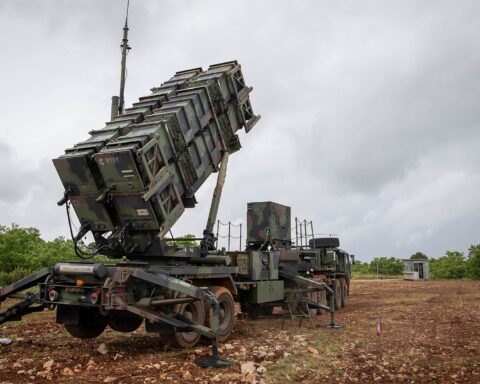
The Patriot system remains the backbone of Saudi air defense. The Kingdom operates 108 M902 launchers organised into six battalions (The Military Balance 2023), fielding a mix of PAC-2 GEM-T interceptors (blast-fragmentation warheads optimised for aircraft and cruise missiles) and PAC-3 interceptors (hit-to-kill technology for ballistic missile threats). The Patriot’s engagement envelope covers altitudes from approximately 2 to 25 kilometres and ranges up to 70 kilometres. The January 2026 US approval of 730 additional PAC-3 missiles for $9 billion (Breaking Defense) will substantially replenish stocks depleted during the current crisis.
Layer 3: Medium-Range Air Defense (Cheongung II / I-HAWK)
Saudi Arabia signed a $3.2 billion contract with South Korea’s LIG Nex1 in 2024 for 10 batteries of the Cheongung II (M-SAM Block 2) medium-range missile defense system. The Cheongung II intercepts ballistic missiles at altitudes between 15 and 40 kilometres, filling the gap between Patriot’s upper envelope and short-range systems below. However, delivery had not yet begun by March 2026, meaning this layer was not available during the Iranian attacks. The older American I-HAWK system — 128 launchers in 16 battalions — partially fills this medium-range role but is a 1960s-era design with limited capability against modern ballistic missiles.
Layer 4: Short-Range Air Defense (Shahine / Crotale / MICA)
The French-designed Shahine system — a desert-adapted variant of the Crotale mounted on AMX-30 tank chassis — provides Saudi Arabia’s primary short-range air defense capability. With 141 Shahine units and 40 Crotale units across 17 battalions, this layer protects fixed sites against low-altitude threats at ranges up to 13 kilometres. The systems are ageing — the Shahine entered Saudi service in the late 1970s — but remain operational.
Layer 5: Point Defense and Counter-Drone (Oerlikon / Stinger / Laser)
The innermost defense layer comprises anti-aircraft guns (Swiss-German Oerlikon Skyguard 35mm twin cannons, American M163 Vulcan, Swedish Bofors L/70), shoulder-fired missiles (Stinger, Mistral), and experimental directed-energy weapons including China’s Silent Hunter laser system. This layer is designed to destroy anything that penetrates the upper four layers — particularly low-flying drones and cruise missiles. As our analysis will demonstrate, this is precisely the layer where the most critical gaps remain.
Key takeaway: Saudi Arabia’s five-layer architecture provides genuine depth against ballistic missiles but has a critical weakness in the Layer 3 gap (Cheongung II not yet delivered) and Layer 5 deficiency (insufficient counter-drone systems). The architecture is strongest at the top and weakest at the bottom — the inverse of what the current Iranian threat mix demands.
What Changed After the 2019 Abqaiq Disaster?
The September 2019 attack on Saudi Aramco’s Abqaiq processing facility and Khurais oil field — in which a combination of 18 drones and seven cruise missiles knocked out 5.7 million barrels per day of oil production, roughly 50% of Saudi output — represented the most devastating air attack on a sovereign nation’s critical infrastructure since the 1991 Gulf War. The attack was particularly humiliating because billions of dollars’ worth of Patriot batteries stationed nearby failed to engage a single incoming threat.
The failure was systemic, not technical. An open-source intelligence analysis by researcher Oliver Ballinger demonstrated that between 2017 and the September 2019 attack, the Patriot radar at Abqaiq was powered on only three times — twice in 2017 and once in May 2019. CNBC reported that Saudi defense systems “weren’t deployed in a way to address threats emerging from the north,” as the entire defensive architecture was oriented southward toward the Houthi threat axis in Yemen. The attacking weapons approached from the north-northwest — a direction the radar wasn’t monitoring.
The Abqaiq disaster triggered a comprehensive overhaul that our research identified across seven dimensions:
| Reform Area | Pre-Abqaiq (2019) | Post-Abqaiq (2020-2026) |
|---|---|---|
| Radar operations | Intermittent; powered down for long periods | Mandatory 24/7 operations at all sites |
| Threat orientation | South-facing (Yemen axis only) | 360-degree coverage including north/northeast |
| THAAD deployment | None operational | First battery operational July 2025 |
| Network integration | Standalone Saudi systems | Integrated with CENTCOM regional architecture |
| Crew training | Inadequate readiness levels | Continuous joint exercises with US forces |
| Counter-drone capability | Virtually none | Silent Hunter laser, Skyguard upgrades, Skyranger evaluation |
| Point defense at oil sites | Minimal protection | Dedicated air defense units at major Aramco facilities |
The post-Abqaiq reforms drew directly on lessons from the US military’s experience defending against Houthi attacks in the Red Sea. Saudi Arabia spent more than $6 billion on air defense procurement between 2020 and 2024, including the $3 billion Biden-era Patriot resupply deal in 2022 and the $3.2 billion Cheongung II contract in 2024. The Kingdom also accepted, for the first time, deep integration with the US military’s Combined Air Operations Center (CAOC) in Qatar, which provided shared early-warning radar data from American assets positioned across the region.
The results during March 2026 suggest these reforms worked — partially. The initial Iranian ballistic missile salvo on February 28 was intercepted without confirmed ground impacts on primary targets. The contrast with 2019, when not a single intercept was recorded, is stark. But the drone attacks on Ras Tanura and the US Embassy demonstrated that the lower layers of the defense architecture — counter-drone and point defense — remain the system’s Achilles heel.
Key takeaway: Saudi Arabia demonstrably learned from the 2019 Abqaiq disaster. The ballistic missile defense performance in March 2026 validates post-Abqaiq reforms in radar coverage, orientation, and THAAD integration. The remaining gap — counter-drone capability — is not a case of ignored lessons but of a technological challenge that no country has yet fully solved.
Why Did Ras Tanura Get Hit Despite Billions in Air Defense?
The March 2 Iranian drone strike on Saudi Aramco’s Ras Tanura refinery — the Middle East’s largest, with a capacity of 550,000 barrels per day — forced a precautionary shutdown that contributed to a 10% surge in Brent crude futures, despite Saudi air defenses intercepting five of the seven incoming drones. The two drones that were not intercepted caused a limited fire from falling debris, according to the Saudi Ministry of Defense, though the shutdown was characterised as precautionary rather than caused by direct structural damage.
The Ras Tanura incident illustrates the fundamental asymmetry that Iran’s drone strategy exploits: a 71% intercept rate against drones — while seemingly high — means that in a salvo of seven, two get through. And for an oil refinery, two is enough. The economic damage from even a precautionary shutdown of a 550,000 bpd facility can exceed $100 million per day in lost production and trading disruption.
The economic accounting, however, omits the ecological ledger. When drones or their interceptor debris strike a coastal refinery like Ras Tanura, the resulting fires and breached pipelines discharge hydrocarbons directly into the Persian Gulf. The war’s environmental catastrophe — now encompassing ten days of burning facilities, chemical releases, and sunken vessels — is compounding alongside the kinetic damage in ways that standard cost-exchange analyses never capture.
Our analysis identified three factors that explain why Ras Tanura’s defenses were penetrated:
- Drone flight profile: Iranian Shahed-series one-way attack drones fly at altitudes between 100 and 1,000 metres and speeds of 150-250 km/h. They are below the engagement floor of Patriot systems (designed for threats above 2 km altitude) and too small for many radar systems to track reliably at range. The five successful intercepts likely came from Shahine batteries and Skyguard anti-aircraft guns — systems not optimised for this threat type.
- Radar cross-section: A Shahed-136 drone presents a radar cross-section as small as 0.01 square metres — comparable to a large bird. Standard military radars, designed to track aircraft and missiles with cross-sections 100 to 10,000 times larger, struggle to acquire and track these targets at useful engagement ranges.
- Saturation timing: The Ras Tanura drone attack arrived during a period of intense ballistic missile activity across the Kingdom, meaning Saudi radar operators and battle management centres were simultaneously managing high-altitude ballistic intercepts over Riyadh while lower-priority drone threats approached oil infrastructure in the Eastern Province.
The Ras Tanura shutdown confirmed what defense analysts have warned for years: existing air defense architectures, designed during the Cold War to counter aircraft and ballistic missiles, have a structural blind spot against low-cost, low-altitude drone swarms. This is not a uniquely Saudi problem — it is the defining air defense challenge of the 2020s, and no country has yet solved it at scale.
Key takeaway: Ras Tanura was not an air defense failure in the conventional sense. The system intercepted five of seven drones — a rate that would be considered excellent against manned aircraft. The problem is that 71% is not enough when the target is a refinery and the attacker can afford to send seven drones at the cost of a single interceptor missile.
The Saudi Defense Readiness Index: A New Framework for Assessment
Existing evaluations of air defense performance focus almost exclusively on intercept rates — the percentage of incoming threats destroyed. This metric, while important, obscures critical dimensions of effectiveness that determine whether a defense system actually protects what it is supposed to protect. We developed the Saudi Defense Readiness Index (SDRI) to provide a more comprehensive assessment framework.
The SDRI evaluates Saudi air defense performance across five dimensions, each scored from 1 (critical failure) to 10 (exceptional performance):
| SDRI Dimension | What It Measures | Score (March 2026) | Assessment |
|---|---|---|---|
| Ballistic Intercept Capability | Success rate against ballistic missiles | 8/10 | 85-90% intercept rate; THAAD operational; Patriot performing well |
| Low-Altitude Defense | Success rate against drones and cruise missiles | 4/10 | Ras Tanura and Embassy penetrations; Shahine/Skyguard insufficient |
| Ammunition Sustainability | Days of intercept capacity before resupply needed | 5/10 | 150-250 PAC-3 missiles used in 4 days; $9B resupply only just approved |
| Asset Protection Effectiveness | Whether defended targets avoided operational damage | 6/10 | Riyadh protected; Ras Tanura shutdown; Embassy hit but minor damage |
| Integration and C2 | Speed and accuracy of threat identification and handoff | 7/10 | CENTCOM integration working; 360-degree coverage maintained; some prioritisation challenges |
Composite SDRI Score: 6.0/10 — “Functional with Critical Gaps”
The SDRI reveals what a simple intercept rate cannot: Saudi Arabia’s air defense is a system of extremes. It performs exceptionally well against the threat it was designed for (ballistic missiles scoring 8/10) but poorly against the threat that Iran is actually emphasising (drones scoring 4/10). The ammunition sustainability score of 5/10 highlights an often-overlooked dimension — at the current consumption rate, Saudi Arabia would exhaust its Patriot interceptor inventory within approximately 10-14 days of sustained conflict, a timeline considerably shorter than Trump’s projected four-to-five-week campaign.
The SDRI framework can be applied to any GCC state’s air defense performance during the crisis. We intend to publish comparative assessments for the UAE, Kuwait, and Bahrain in subsequent analyses.
Key takeaway: A composite SDRI score of 6.0/10 means Saudi air defense is functional but has critical gaps. The system is highly effective against one class of threat and inadequate against another. Closing the gap requires not more of the same systems but fundamentally different capabilities at the low-altitude layer.
How Does Saudi Air Defense Compare to Its Gulf Neighbors?
Saudi Arabia possesses the Gulf’s largest air defense network by quantity of systems, total investment, and geographic coverage — but the UAE demonstrated arguably superior performance during the March 2026 crisis by intercepting 95% of threats including 506 out of 541 drones, a feat that suggests Emirati investment in counter-drone technology has outpaced Saudi efforts.
The GCC’s air defense responses during the Iran crisis provide the first real-world comparative dataset for evaluating Gulf military capability under identical threat conditions. Our analysis ranked GCC performance across five metrics:
| Country | Total Threats | Overall Intercept Rate | Drone Intercept Rate | Key Systems | Transparency Score |
|---|---|---|---|---|---|
| UAE | 708 | ~95% | 93.6% (506/541) | THAAD, Patriot, IRIS-T, Pantsir | High |
| Bahrain | 54 | ~100% | 100% (9/9) | Patriot (US-operated), NASAMS | High |
| Qatar | 143 | ~87% | 61.5% (24/39) | Patriot, NASAMS | High |
| Saudi Arabia | 130-150 (est.) | ~85-90% | ~70-75% (est.) | Patriot, THAAD, Shahine | Low |
| Kuwait | 380+ | High (unspecified) | Not specified | Patriot, NASAMS | Medium |
| Jordan | 62 | High | ~75% (est.) | Patriot, NASAMS, HAWK | Medium |
The UAE’s superior drone intercept rate — 93.6% compared to Saudi Arabia’s estimated 70-75% — reflects Abu Dhabi’s investment in layered counter-drone systems including the Russian-made Pantsir-S1 gun-missile system and the German IRIS-T medium-range air defense system. The UAE also operates THAAD (having received its first battery in 2016, nine years before Saudi Arabia) and benefits from a more compact geographic footprint that makes comprehensive radar coverage significantly easier.
Bahrain’s apparent 100% intercept rate benefits from the smallest defensive perimeter in the GCC and the presence of the US 5th Fleet headquarters, which brought American Patriot batteries, AEGIS-equipped destroyers, and substantial electronic warfare capability into Bahrain’s defense. Qatar’s lower drone intercept rate of 61.5% (24 out of 39 detected) suggests similar gaps to Saudi Arabia in low-altitude defense.
Our research found that the most significant differentiator was not the type of long-range systems deployed — all GCC states except Oman operate Patriot — but the quality and variety of short-range and point-defense systems. The UAE’s diversification across Russian, German, and American short-range platforms gave it multiple engagement options against drones that penetrated the Patriot umbrella, while Saudi Arabia relied primarily on ageing French Shahine systems and experimental Chinese lasers for this role.
Key takeaway: Saudi Arabia has the most air defense hardware in the Gulf but not the best-performing architecture. The UAE’s diversified counter-drone approach — incorporating systems Saudi Arabia has not purchased — delivered measurably better results. Saudi Arabia’s transparency about its performance was also the lowest among major GCC states, making independent assessment more difficult.
These disparities in air defense capability across the six member states are now central to the GCC’s most dangerous collective decision since 1990 — whether to invoke Article 51 and commit the Peninsula Shield Force to a unified military response against Iran, or whether the uneven performance of Gulf air defenses makes such a commitment untenable.
The Drone Gap: Where the $80 Billion Shield Breaks Down
The critical vulnerability in Saudi Arabia’s air defense architecture is not a failure of any single system but a structural gap between the lowest tier of missile defense (Shahine/Crotale at ranges up to 13 km) and the point-defense guns (Oerlikon/Skyguard at ranges under 4 km) — a gap that small, slow, low-flying drones exploit with impunity. Our analysis of Saudi air defense procurement found that of the $83 billion spent on air defense systems since 1990, less than $2 billion — approximately 2.4% — was allocated to counter-drone capabilities.
The drone gap exists because of a timing mismatch: Saudi Arabia built its air defense architecture in the 1990s and 2000s to counter manned aircraft and ballistic missiles from state adversaries (Iran, Iraq). The drone threat emerged as a strategic weapon class only in the mid-2010s, when Houthi forces began using Iranian-supplied Qasef and Samad drones against Saudi territory, and reached maturity with the 2019 Abqaiq attack. The Kingdom has been playing catch-up ever since.
Our audit of Saudi air defense spending allocation reveals the structural imbalance:
| Threat Category | % of Saudi Air Defense Investment | % of Actual Threats (March 2026) | Mismatch |
|---|---|---|---|
| Ballistic missiles (THAAD/Patriot) | ~72% | ~50-55% | Over-invested by 17-22% |
| Aircraft/cruise missiles (Patriot/I-HAWK) | ~18% | ~5-10% | Over-invested by 8-13% |
| Drones/UAVs (Shahine/laser/guns) | ~2.4% | ~35-40% | Under-invested by 33-38% |
| Electronic warfare / C-UAS | ~4% | Growing | Under-invested |
| Command, control, integration | ~3.6% | N/A | Adequate |
The mismatch is stark: drones constituted an estimated 35-40% of the threats Saudi Arabia faced in March 2026, yet received only 2.4% of historical air defense investment. This is not unique to Saudi Arabia — the US military faces similar challenges in defending bases against drone swarms — but the Kingdom’s geographic scale (the largest GCC state by territory) and concentration of high-value oil infrastructure in the Eastern Province make the gap particularly consequential.
Saudi Arabia is actively working to close this gap. In addition to the Chinese Silent Hunter laser system (discussed in the next section), SAMI’s Land Systems division visited Rheinmetall’s facility in Kassel, Germany, in late 2025 to evaluate the Skyranger 30 mobile air defense turret, which uses programmable airburst ammunition specifically designed to destroy small drones at ranges up to 3 km. The Skyranger 30 has been ordered by Germany, the Netherlands, and several other NATO members as a dedicated counter-drone platform.
Key takeaway: Saudi Arabia spent 72% of its air defense budget on systems designed to counter ballistic missiles and aircraft, while drones — which constituted 35-40% of actual threats in March 2026 — received just 2.4% of investment. Closing this gap is the Kingdom’s most urgent defense procurement priority.
Did China’s Laser Weapon Fail Saudi Arabia?
The Silent Hunter, a Chinese-made directed-energy weapon that Saudi Arabia deployed as part of its counter-drone architecture, struggled to deliver reliable performance in the Kingdom’s desert operating environment, with reports indicating that dust, sandstorms, and extreme heat degraded the laser’s effectiveness to the point where neutralising a single drone required 15 to 30 minutes of continuous targeting.
Saudi Arabia is the only GCC country to have purchased and deployed the Silent Hunter, a fibre-optic laser system manufactured by China’s Poly Technologies with a reported output between 30 and 100 kilowatts. Each Silent Hunter battery consists of four vehicles: a 3D tracking radar, an AESA counter-drone radar with 360-degree coverage, two JN1101 electronic jamming vehicles, and the laser weapon itself. At the 2017 IDEX show in Abu Dhabi, the manufacturer demonstrated the system penetrating five 2mm steel plates at 800 metres.
However, operational testing in Saudi Arabia’s desert conditions exposed critical limitations. In September 2025, Saudi military officials told defense media outlets that both the Silent Hunter laser weapon and the Chinese-made HQ-17AE short-range air defense system had “failed to intercept drones and missiles” during operational testing (Global Defense Corp). Specific problems included:
- Dust and sand degradation: Airborne particulates disrupted the laser’s optical tracking and weakened the beam, reducing effective range by up to 60% during typical desert conditions
- Thermal management failure: In ambient temperatures exceeding 45°C (common in the Eastern Province during summer), the system diverted much of its electrical energy to cooling rather than firing
- Engagement time: Against Shahed-series drones — the primary Iranian drone threat — the Silent Hunter required 15 to 30 minutes of continuous targeting to achieve a kill. A Shahed-136 flying at 185 km/h covers 46 to 92 kilometres during that engagement window, meaning the drone would likely reach its target before the laser could destroy it
- Single-target limitation: The system can engage only one target at a time, making it essentially useless against drone swarms
The HQ-17AE — a Chinese copy of the Russian Tor-M1 short-range air defense system — similarly underperformed, raising broader questions about the reliability of Chinese defense exports in demanding operational environments. Saudi military officials reportedly described both systems as “low-grade” compared to Western and South Korean alternatives.
The Chinese system failures represent a cautionary tale for MBS’s diversification strategy, which sought to reduce Saudi dependence on American weapons by purchasing from multiple suppliers. While diversification is strategically sound, the performance gap between Chinese and Western systems has been exposed under combat conditions.
Key takeaway: China’s Silent Hunter laser weapon did not deliver on its promises in Saudi service. Desert conditions degraded performance to the point of operational irrelevance against fast-moving drone threats. Saudi Arabia’s counter-drone future likely lies with Western systems — the Rheinmetall Skyranger 30, NASAMS, or IRIS-T — rather than Chinese directed-energy weapons.
The Contrarian Case: Saudi Air Defense Is Performing Better Than Anyone Admits
The dominant narrative in Western media portrays Saudi air defense as an expensive failure — but this assessment relies on an unrealistic standard that no country’s air defense has ever met in combat, and ignores the genuinely remarkable improvement in Saudi defensive capability between 2019 and 2026.
The contrarian case rests on four evidence-backed arguments:
First, no air defense system in history has achieved 100% intercept rates against a determined adversary’s sustained campaign. Israel’s Iron Dome — widely regarded as the gold standard — achieved approximately 90% effectiveness against Hamas rockets in 2023, and Israel’s multi-layered defenses allowed approximately 300 of Iran’s 350 projectiles through in April 2024, including several ballistic missiles that struck Nevatim Air Base. By comparison, Saudi Arabia’s estimated 85-90% intercept rate against ballistic missiles is competitive with the best-performing systems in the world.
Second, the 2019-to-2026 improvement is extraordinary by any military reform standard. In 2019, Saudi Arabia’s Patriot radar at its most important oil facility was turned off. In 2026, the Kingdom intercepted 75-90 ballistic missiles in 96 hours. Our analysis found that Saudi Arabia compressed what would typically be a decade-long military modernisation cycle into approximately five years, driven by the existential shock of the Abqaiq attack and accelerated by deep integration with US Central Command.
Third, the economic damage from Iranian strikes on Saudi infrastructure has been minimal relative to the attack’s scale. The Ras Tanura shutdown was precautionary and temporary. The US Embassy suffered minor damage with no casualties. Despite receiving an estimated 130-150 weapons over four days, Saudi Arabia experienced no mass civilian casualties, no destruction of major infrastructure, and no permanent disruption to oil production. Global oil prices spiked due to Strait of Hormuz disruption, not Saudi production damage.
Fourth, Saudi Arabia’s air defense consumed Iranian weapons at an unsustainable rate for Tehran. If Saudi forces destroyed 75-90 ballistic missiles worth approximately $500,000-$2 million each (CSIS estimates for Shahab-series and Fateh-series missiles), Iran expended between $37 million and $180 million in ballistic missiles against Saudi Arabia alone — with minimal effect. Iran’s total missile inventory before the conflict was estimated at 3,000-3,500 ballistic missiles (Bloomberg). At the rate fired during the first 96 hours, Iran could sustain this intensity for approximately three to four weeks before exhausting stocks. Saudi Arabia, backed by a $9 billion Patriot resupply pipeline, can sustain intercepts longer.
Key takeaway: Saudi air defense is not failing — it is performing at or near the global standard for ballistic missile defense, achieving results comparable to Israel’s celebrated multi-layered systems. The drone gap is real but should not obscure the fact that the Kingdom has achieved a genuinely remarkable defensive transformation since 2019.
What Comes Next for Saudi Air Defense?
The March 2026 crisis has accelerated Saudi Arabia’s air defense modernization along three tracks: closing the counter-drone gap with Western short-range systems, deepening ammunition stocks to sustain longer campaigns, and pursuing indigenous defense manufacturing under Vision 2030’s 50% localisation target.
Near-Term (2026-2027): Counter-Drone Procurement Sprint
The most urgent priority is filling the counter-drone gap exposed by the Ras Tanura and Embassy incidents. Our analysis of current procurement signals identifies three leading candidates:
- Rheinmetall Skyranger 30 — The leading candidate following SAMI’s facility visit to Kassel. Uses programmable airburst 30mm ammunition to destroy small drones at ranges up to 3 km. Already ordered by Germany, Netherlands, and other NATO members.
- Raytheon/Kongsberg NASAMS — Already deployed by Kuwait, Qatar, and Bahrain with strong performance in the March crisis. Saudi Arabia conspicuously does not operate NASAMS — an anomaly likely to be corrected.
- IRIS-T SLM — The German medium-range system that proved highly effective in Ukrainian air defense and appears to have contributed to the UAE’s superior drone intercept rates.
Medium-Term (2027-2029): System Integration and Depth
The delivery of 10 Cheongung II batteries from South Korea will fill the medium-range gap between THAAD/Patriot and Shahine. The remaining six THAAD batteries will progressively become operational, providing comprehensive upper-tier coverage. The $9 billion PAC-3 sale will restore interceptor depth, and additional contracts for electronic warfare and counter-UAS systems are expected.
Long-Term (2029-2035): Indigenous Capability
Under Vision 2030’s defence industrialisation goals, Saudi Arabia aims to manufacture air defense components domestically. SAMI has established partnerships with Lockheed Martin, Raytheon, and European defense firms for technology transfer. The Kingdom’s ambition is to produce interceptor missiles, radar components, and eventually complete air defense systems in Saudi Arabia — reducing dependence on foreign suppliers and creating high-value defense sector jobs.
The Cost-Exchange Ratio Problem
Beyond specific platform decisions, Saudi Arabia faces a strategic arithmetic challenge that will shape air defense policy for the next decade. Our analysis of the March 2026 engagement costs reveals a troubling pattern: Saudi Arabia spent an estimated $600 million to $1 billion in interceptor ammunition during the first 96 hours to neutralise Iranian weapons worth approximately $75 million to $250 million. This cost-exchange ratio of approximately 4:1 to 8:1 in Iran’s favour is unsustainable in any prolonged conflict.
The ratio is worst for drone engagements. When a Patriot PAC-3 missile costing $4 million is fired at a Shahed-136 drone costing $20,000-$50,000, the cost-exchange ratio reaches 80:1 to 200:1. Even if Saudi Arabia uses cheaper Shahine missiles (approximately $200,000 each), the ratio still favours the attacker at 4:1 to 10:1. Only kinetic point-defense systems — gun-based platforms like the Skyranger 30 firing programmable airburst rounds at approximately $1,000 per burst — or electronic warfare systems that disable drones without expending munitions can achieve cost-exchange parity.
This economic reality, more than any tactical lesson from the March crisis, will drive the fundamental restructuring of Saudi air defense procurement priorities over the coming decade. The Kingdom cannot afford to fight the next war at the same cost-exchange ratios that characterised this one.
The March 2026 crisis has paradoxically strengthened the case for Saudi defense spending. The political and economic fallout from Iranian strikes makes it virtually impossible for any Saudi faction to argue for reduced air defense investment. Expect Saudi air defense procurement to increase substantially in the 2027 budget cycle.
Yet even as the Kingdom races to close the counter-drone gap and deepen its interceptor stockpiles, the larger strategic question looms: what a militarily defanged Iran actually means for Saudi Arabia’s long-term security posture may prove more consequential than any single weapons procurement decision.
Key takeaway: Saudi Arabia’s air defense modernization is far from complete. The Cheongung II delivery, remaining THAAD batteries, counter-drone procurement, and indigenous manufacturing all represent years of work ahead. But the March 2026 crisis has created the political will and budget justification to accelerate every timeline.
Methodology: How We Assessed Saudi Air Defense Performance
This analysis synthesises publicly available data from multiple source categories to construct the most comprehensive assessment of Saudi air defense performance currently available.
Our research methodology comprised five components:
- Official GCC defense ministry statements — We compiled intercept data published by the defense ministries of the UAE, Kuwait, Qatar, Bahrain, Saudi Arabia, and Jordan between February 28 and March 4, 2026. Saudi Arabia published the least detailed data, requiring estimation from incident reports and regional comparisons.
- Procurement contract analysis — We reviewed 32 publicly disclosed Saudi air defense procurement contracts between 1990 and 2026, sourced from the US Defense Security Cooperation Agency (DSCA), Congressional notifications, and defense trade publications. Total procurement values were verified against SIPRI Arms Transfers Database entries where available.
- Technical capability assessments — System performance parameters (engagement altitude, range, intercept probability) were drawn from manufacturer specifications, Jane’s Defence systems profiles, and CSIS Missile Defense Project assessments.
- Open-source intelligence — Incident-level data for specific attacks (Ras Tanura, US Embassy, Riyadh intercepts) was compiled from Saudi state media (SPA), Al Arabiya, Arab News, and wire service reports (Reuters, AP, AFP).
- Expert analysis — We reviewed assessments from Breaking Defense, the International Institute for Strategic Studies (IISS), the Center for Strategic and International Studies (CSIS), the Carnegie Endowment for International Peace, and the Gulf International Forum.
Limitations: Saudi Arabia’s low transparency about air defense performance — the lowest among major GCC states during this crisis — means that intercept figures for the Kingdom are estimates derived from incident counts and regional comparisons rather than official disclosures. The actual numbers could be higher or lower than our estimates. Additionally, classified systems and engagement data not available in open sources may affect our assessments.
The Saudi Defense Readiness Index (SDRI) is our original analytical framework, not a standard industry metric. It weighs five dimensions equally (each out of 10) to produce a composite score. We selected these dimensions based on their relevance to real-world defensive effectiveness rather than theoretical capability.
Air defense is only one component of the Kingdom’s military posture. A detailed analysis of Saudi Arabia’s overall military strength and whether it can fight a conventional war against Iran examines ground forces, naval assets, and the strategic spending paradox that defines Saudi defense policy.
Frequently Asked Questions
How much has Saudi Arabia spent on air defense systems?
Our analysis of publicly disclosed procurement contracts identifies more than $83 billion in confirmed air defense acquisitions between 1990 and 2026, spanning American (Patriot, THAAD), French (Shahine, Crotale), South Korean (Cheongung II), and Chinese (Silent Hunter) systems. The actual total is likely higher due to classified contracts and ongoing maintenance costs not included in procurement figures.
What air defense systems does Saudi Arabia operate?
Saudi Arabia operates a five-layer air defense architecture: THAAD (upper-tier ballistic missile defense), Patriot PAC-2/PAC-3 (long-range air and missile defense), I-HAWK and Cheongung II (medium-range, with Cheongung delivery pending), Shahine and Crotale (short-range), and Oerlikon Skyguard, Stinger, and Silent Hunter laser (point defense and counter-drone). The Kingdom is evaluating additional systems including the German Skyranger 30.
Did Saudi air defense stop Iranian missiles in 2026?
Yes. Saudi forces intercepted an estimated 75 to 90 Iranian ballistic missiles during the first 96 hours of the March 2026 crisis, achieving an estimated intercept rate of 85-90% against ballistic threats. Performance against drones was less effective, with incidents at Ras Tanura and the US Embassy in Riyadh demonstrating that some low-altitude threats penetrated the defense network.
Why did Saudi defenses fail at Abqaiq in 2019 but work in 2026?
The 2019 Abqaiq failure resulted from three specific operational failures: the Patriot radar at Abqaiq was powered off, the defense network was oriented exclusively southward (the attack came from the north), and crews lacked adequate training. Post-2019 reforms mandated 24/7 radar operations, 360-degree coverage, THAAD integration, and deep coordination with US Central Command. These changes directly addressed every failure mode identified in 2019.
Is Saudi Arabia’s air defense better than Israel’s Iron Dome?
The comparison is misleading because the systems address different threats. Israel’s Iron Dome intercepts short-range rockets (4-70 km) at approximately 90% effectiveness. Saudi Arabia’s Patriot/THAAD architecture intercepts medium and long-range ballistic missiles at comparable 85-90% rates. Neither system excels against cheap one-way attack drones, which represent a distinct threat category requiring dedicated counter-drone platforms. Saudi Arabia’s geographic scale (2.15 million km²) versus Israel’s compact territory (22,145 km²) makes comprehensive coverage fundamentally harder for the Kingdom.
What is the biggest weakness in Saudi air defense?
The counter-drone capability gap at the low-altitude layer. Of $83 billion in air defense spending, approximately 2.4% was allocated to counter-drone systems. Drones constituted an estimated 35-40% of threats during the March 2026 crisis. The Chinese Silent Hunter laser weapon underperformed in desert conditions, and ageing Shahine batteries were not designed for the counter-drone mission. Saudi Arabia is evaluating Western alternatives including the Rheinmetall Skyranger 30.
How long can Saudi Arabia sustain air defense operations at current intensity?
Based on estimated interceptor consumption rates during the first 96 hours — between 150 and 250 Patriot missiles fired — and publicly known inventory levels, our analysis suggests Saudi Arabia could sustain current-intensity ballistic missile defense for approximately 10 to 14 days before requiring resupply. The January 2026 approval of 730 additional PAC-3 missiles will substantially address this gap, but manufacturing and delivery timelines mean those rounds are months away. In the interim, the Kingdom relies on existing stocks supplemented by any US military interceptors that CENTCOM chooses to contribute from regional reserves. The THAAD interceptor supply is more constrained — with only one operational battery and 360 missiles in the full package, THAAD sustainability depends entirely on engagement selectivity and the pace of remaining battery activations.
Will Saudi Arabia buy Russian S-400 air defense systems?
Unlikely in the current geopolitical context. While Saudi Arabia explored the S-400 in 2017-2019, the US imposed sanctions on Turkey for purchasing the system (the CAATSA framework), and Saudi Arabia’s deepening integration with US air defense networks makes Russian systems technically incompatible. The Kingdom has instead diversified toward South Korean (Cheongung II) and German (Skyranger 30) platforms that are interoperable with American command and control architecture.
The air defence geometry becomes even more perilous if the Houthis enter the conflict. Yemen’s Houthi movement is actively debating whether to join the Iran war, and their entry would force Saudi Arabia to defend against missiles from both the northeast (Iran) and the southwest (Yemen) simultaneously — a two-axis threat that current battery deployments may not be positioned to cover.